



Abstract
Consistent with memory studies’ emphasis on the tight relationship between memory and identity, this article regards nation-building as an ongoing social process of nation-remembering. Taking the official Chinese nationalism in Taiwan from 1949 through 1987 as the case, this study aims to demonstrate the significant role that commemorative narratives play in nation-remembering. Facing extraordinary difficulties, the master commemorative narrative of official Chinese nationalism led its intended national members to remember their Chinese-hood (thereby maintaining its legitimacy) by telling a shared past, present, and future. That is, collective memory facilitates the imagination of people’s commonalities in a community. Moreover, the abstractness of commemorative narratives allows room for employing mnemonic techniques to narrate a preferred shared past, present, and thus future for people to memorize their national identification. In addition to detailing the employed mnemonic techniques observed in the official Chinese nationalism, how the narrated shared past, present, and future are introduced as a package in the commemorative narrative to construct an organic whole and how the commemorative narrative undergoes ongoing modifications are discussed as well.
Keywords
The 1949 retreat, legitimacy crisis, and nation-remembering
After being defeated in the Chinese Civil War, Chiang Kai-Shek 1 and his Kuomintang (KMT) government retreated to Taiwan in 1949. 2 This social transformation created a serious legitimacy crisis: Among others issues, there were two governments—the People’s Republic of China (PRC), which was led by the Chinese communists, and the Republic of China (ROC), which was led by Chiang Kai-Shek and his KMT government—and both claimed to be the legitimate government of the Chinese nation. Inventing a Chinese nationality that treated the ROC government as the authentic regime was, therefore, a critical issue for Chiang Kai-Shek and his KMT government after 1949. Although all national identity is artificially constructed (Hobsbawm, 2009 [1990]: 9–13; Anderson, 2006 [1983]: 141–154), the KMT government nevertheless confronted an extraordinarily tricky situation. On one hand, while occupying only a tiny portion (Taiwan and its surrounding small islands) of the whole claimed territory, 3 the KMT government maintained itself as the legitimate government of the Chinese nation and the authentic descendant of the 5000-year Chinese history. On the other hand, despite the fact that its intended members—which included 2 million mainlanders in retreat who had come to Taiwan with the KMT government in 1949, 6 million Taiwanese who had just experienced 50 years of Japanese colonization (1895–1945), most of whom had never set foot in mainland China, overseas Chinese, 4 and people who still lived in mainland China—had very different historical experiences, the KMT government had to convince all the factions that they were members of the Chinese nation.
Instead of being only a political doctrine, national identity is a collective cultural phenomenon (Smith, 1991: vii; Spillman, 1997: 6–11) that heavily influences how people talk, think, and act (Calhoun, 2004 [1997]: 11). Nationality by no means is a natural way to classify people and having a state machine is insufficient to imbue people with a national consciousness. To evoke common people’s resonance with their nationality, extra effort in nation-building is needed. Scholars of memory studies have pointed out that people who hold the same identity are people who share the same collective memory (Gillis, 1994: 3–24; Halbwachs, 1992 [1925]: 38; Olick, 1999: 333–335). Memory and identity are tightly linked (Olick and Robbins, 1998: 123–124), and the sharing of memories greatly facilitates the conceiving of social bonding (Irwin-Zarecka, 1994: 55). Following this logic, it is hardly surprising that people indeed remember their national identity (Zerubavel, 2003: 7–8).
Treating nation-building as an ongoing social process of nation-remembering, this article unravels how official Chinese nationalism from 1949 through 1987 in Taiwan led people to remember their Chinese-ness via mnemonic work. More specifically, while admitting that other aspects of mnemonic work have their influence, 5 as in constructing people’s national identification, the current project focuses on the elements that composed the master commemorative narrative of the official Chinese nationalism. 6
Shaping a nationhood through commemorative narrative
Narrative is the core of mnemonic work (Middleton and Edwards, 1990; Ricoeur, 2004). Without exception, using various editing techniques, official nationalism provides an easy-to-remember narrative format for national stories for people to memorize (Mink, 1978: 129–149). According to Zerubavel (1995), a master commemorative narrative indicates a narration that provides the overall structure of the shared past. In addition to the master commemorative narrative, there are many subordinate commemorative narratives on individual historical events. In this study, I focus on the master commemorative narrative of official Chinese nationalism without delving into the sub-narratives for stories of specific events. Moreover, I highlight that the master commemorative narrative indeed defines not only the shared past but also the shared present and, therefore, the shared future (Halbwachs, 1992 [1925]).
To evoke intended national members’ patriotic emotions, a memory organizer needs to tell national stories. Storytelling yields narratives, and events are thereby encoded through story-lization. An inevitable process of “encodation of events” is involved when stories are told to “familiarize the unfamiliar” (White, 1985 [1978]: 81–100). That is, from a specific mnemonic vision of the storyteller, the essentially unstructured and therefore to some extent chaotic historical happenings are selected, ordered, and structured into meaningful events in stories and narratives. The process of encodation often involves scripting stories. For example, the relationship between events is bridged or unbridged, the importance of events is ranked, and differential meanings are assigned to various events in the stories through encodation. It is narratives that bring meaning—positive, negative, central, marginal, sacred, or profane—to the historical events. After all, as Hayden White (1985 [1978]) claimed, “historical situations are not inherently tragic, comic, or romantic” (p. 84).
Telling stories indicates the organizing of events and the harnessing of plot structures and various techniques. Certain events are marked as historical scenarios, such as beginnings, watersheds, turning points, and endings in narratives; as a result, national stories usually are easy to tell and retell since “we habitually reduce highly complex event sequences to inevitably simplistic, one-dimensional visions …” (Zerubavel, 2003: 13). As a consequence, the nationality that mnemonic work intends to invent is remembered with the familiarized commemorative narratives (Berger, 2006; Lowenthal, 1994: 41–57).
Case, data, and method
An analysis of the observance of National Day (observed on 10 October and therefore also called Double Tenth Day) facilitates our understanding of how the commemorative narrative in official Chinese nationalism from 1949 through 1987 convinced people that the sameness between themselves and other members of their specific nation is rooted in a shared past and, therefore, a shared present and even a shared future. 7 National holidays play a significant role in leading people to perceive themselves as members of a nation, thereby resulting in patriotic sentiments (Bodnar, 1992: 15–20; Spillman, 1997: 17–56). National Day commemorates the birth of the nation, which is a critical point in any national story (Cressy, 2004 [1989]: 34–66; Schwartz, 1982: 374–402). For Chinese nationalists, the celebration of Double Tenth Day provided a chance to define and/or redefine the history and fate of the nation. Double Tenth Day is an official national holiday observed since 1912 in mainland China to celebrate the birth of the Republic Era and the great transformation from a traditional China to a modern China. After retreating to Taiwan in 1949, instead of canceling the observation of Double Tenth Day due to the “abnormal” situation (i.e. the whole mainland being “stolen” by the PRC government), Chiang Kai-Shek and his KMT government decided to celebrate the day on a larger scale than ever before. Thus, Double Tenth Day was imported to Taiwan with the 1949 Retreat so as to invent a Chinese nationality. To some extent, supposed national members who had observed it since 1912 and who had never celebrated (in an official sense) Double Tenth Day then experienced it as a newly invented National Day.
My analysis begins in 1949 as the 1949 Retreat created the mentioned legitimacy crisis. My analysis stops in 1987 because Chiang Jing-Kuo (Chiang Kai-Shek’s son) died in January 1988 without formally assigning a “successor,” which left the KMT government in internal contention and symbolized the end of a “pure” official Chinese nationalism. 8 Although I acknowledge the emergence and development of alternative nationalisms during the analyzed period, this article focuses on the story of the invention of a Chinese nationality and the employed mnemonic techniques found in the master commemorative narrative. Nevertheless, alternative narratives are mentioned to emphasize the inevitable selectiveness of the commemorative narrative. 9
From 1949 to 1987, Taiwan was under martial law, and the controlled media were treated as an avenue for releasing an official narrative. Only in the 1980s did more alternative voices appear in the media. Hence, the mainstream newspapers provide valid information for reconstructing the mnemonic engineering of the official Chinese nationalism. The UDNdata, an electronic database that has systematically collected reports from several mainstream newspapers in Taiwan since 1951, is the main data source used for this article. In addition, to obtain data on the topic published prior to 1951, two additional electronic databases (the Central Daily News and TTS Web) were searched. To get an idea of how the PRC government narrated a distinct “Chinese national history” and defined the status of the ROC government and Taiwan, I gathered related newspaper articles in People’s Daily (Renmin Ribao)—a mainstream newspaper in mainland China—from 1949 to 1987. To represent how Taiwanese nationalists promoted their version of national history and how they challenged the official Chinese nationalism, I referred to oral histories and newspaper articles (especially topics published after 1987). 10 Secondary research on Taiwanese history (Brown, 2004; Chou, 2009; Heylen and Sommers, 2010; Hsiau, 2000; Roy, 2003; Rubinstein, 2006; Wang, 2006 [2003]) served as critical material guiding the efforts to represent the complicated social process. Materials were coded into three main categories to foster the representation of the master commemorative narrative of a Chinese nationhood regarding the shared past, present, and future. The first category is presidents’ speeches. 11 The second is constituted by commemorative narratives found in newspaper articles. 12 Texts related to alternative commemorative narratives promoted by alternative nationalisms were coded as the third category.
The commemorative narrative of official Chinese nationalism
An analysis of my data reveals that the days before Double Tenth Day, the day of 10 October, and even days after it were considered opportunities to employ narrations to guide people to remember their nationality. In addition to emphasizing the significant meaning of Double Tenth Day for the Chinese nation, narratives that appeared around this period provided standardized national stories to align and refresh national members’ memory. In brief, the commemorative narrative of official Chinese nationalism from 1949 through 1987 led all its national members to remember their Chinese-ness by telling a shared past (the 5000-year Chinese history), a shared present (defeated by the Chinese communists and temporary residence in Taiwan), and a shared future (recovering mainland China). In the following analysis, I cite excerpts from certain years’ presidential speeches and newspaper articles to support my arguments, but I found similar elements in many presidential speeches and newspaper articles. Those I cite are simply typical examples.
Narrating a shared past
Commemorative narrative of official Chinese nationalism worked to lead national members to remember their shared past. On 10 October 1911, the “successful” Wu-Chang Uprising evoked a series of social protests and the Xin-Hai Revolution eventually overthrew the “corrupted” Qing dynasty. The year 1911 was regarded as the “beginning” of national history, and it was enriched by symbolic meanings. On one hand, according to Chinese nationalism, it symbolized the end of absolute monarchy—the disconnect from a long, dark past. On the other hand, it symbolized the birth of the Republic Era and the arrival of modern China. Chinese nationalists maintained that the establishment of the Republic Era also served as a desirable model for other Asian countries (Presidential speech, UDN, 10 October 1960). All presidential speeches during Double Tenth Day ceremonies contained an articulation similar to the following: Today is Double Tenth Day and it symbolizes the beginning of our Republic of China. On this very day, we commemorate our founding father [Sun Yat-sen] and national heroes who sacrificed their own lives to overthrow the three-thousand-year autocratic monarchy of forty-four years ago. Their efforts established the first democratic nation in Asia which follows the spirit of “Three Principles of the People.” This is the most honorable history of Republic of China, and today is also the most glorious day for all national members to commemorate. (Presidential speech in 1955, UDN, 10 October 1955)
“Founding moments” (or “beginning”) compel candidates to bridge proposed national members to the “shared” past (Spillman, 2003: 161–192), and therefore, such moments play a significant role in all national stories. Consider the unique role of 1776 for Americans, 1788 for Australians, 1802 for Cubans, and World War I for Canadians. As a result, it is not surprising to realize that in all presidential speeches during Double Tenth Day ceremonies, the years after 1911 were mentioned to commence the speech.
Following the 1911 “beginning” was the eventful and thus “hot” history of the KMT.
13
In the narrative, we saw detailed descriptions and plotted stories about the founding and development of the KMT, the inherited spirit of the Xin-Hai Revolution, various battles in which the KMT participated, the national heroes (who were almost exclusively political elites in the KMT), and so on: … Fifty-one years ago, on this very day, our founding father organized the Wu-Chang army, fired the first gun shot, immediately obtained resonance nationwide, and everybody wanted to follow his guidance. Within three months, the giant and corrupted Qing autocracy, which had ruled mainland China for 260 years, was overthrown, and the first democratic republic was established! During the past half century, we have been fighting not only for equality among ethnicities, but also for the independence of our nation. We raised revolutions based on “Three Principles of the People” to bring freedom to all people. We experienced Asks for Yuan, Discusses the law, Eastern Expedition, Northern Expedition, Cleaning out communists, Asks for counter, the Unification, Suppressing communists, and the eight-year Sino-Japanese War. We had never taken success and/or failure into consideration, we continuously fought even when we were defeated … In the past 51 years, our ethos remains intact … (Presidential speech in 1962, UDN, 10 October 1962)
The remark on the “hot” history of the KMT in the speeches worked to define the mention-worthy events after 1911. 14 In addition, it gave the intended national members the impression that all the members of the ROC nation had been through a lot together, including a busy period after the “beginning.” A very distinct quality was bestowed upon this time period (Hubert, 1999), and the decades after 1911 and before the 1949 Retreat were made to stand out in the national history. A further reason that a “hot” history of the KMT was included in the official narrative is that the history of a Chinese nation after 1911 was thereby replaced by a history of KMT development (Fenby, 2004). A national story that was inseparable from KMT history was intended to guide national members to remember that the KMT was and is the legitimate government of the Chinese nation.
Aiming to “bridge” the historical continuity of the Republic Era, in addition to using the “year” of the Republic Era continuously without interruption after 1949, 15 official Chinese nationalism made efforts to highlight that Chiang Kai-shek and his KMT government were the “genuine” inheritors of Sun Yat-sen (the “founding father” of the ROC) and therefore the Republic Era. 16 In brief, the symbolic bridge between Sun Yat-sen and Chiang Kai-shek and therefore his KMT government had to be connected instead of being assumed. For instance, the detailed story maintained that in 1912 it was Sun Yat-sen who decided that the people should observe the establishment of the ROC every 10 October (Lou-Shi, UDN, 1961). Moreover, the speech that Sun Yat-sen gave to celebrate the first Double Tenth Day was published from time to time (Shuo-Shan, UDN, 1970), and the “fact” that the KMT government followed Sun Yat-sen’s “Three Principles of the People” was reiterated (Presidential speech, UDN, 10 October 1953). Stories about the tight relationship between Sun Yat-sen and Chiang Kai-Shek were spread as well.
Whereas in the first decade official narration highlighted the disconnect between an “advanced” Republic Era and the previous “dark” Chinese eras, in the 1960s the official Chinese nationalism began to foreground the “fact” that it was the only inheritor of the 5000-year Chinese history. Although the year 1911 was still a “beginning” year for the nation, it was embedded in the succession of Chinese eras. All national members were led to remember a knitted unilinear dynastic succession with the Republic Era as the latest dynasty.
17
The year 1911 turned out to be a “beginning” of another Chinese era instead of a “Beginning.” As a result, the 5000-year Chinese history was accentuated. In addition, it was claimed that, through tracing 5000 years back, the Yan Emperor and the Yellow Emperor were the two common ancestors of all national members of the Chinese nation. Thus, all national members were more or less “blood relatives” and (presumably) covered by a gigantic family tree, and the Chinese nation thereby is an extended family. The projection of a familial image onto a nation works to naturalize its unmistakable invented-ness (Delaney, 1995: 177). Following this logic, preventing the legitimate inheritance of the glorious 5000-year Chinese culture from being destroyed by the PRC government was turned into “indispensable” responsibilities for the ROC government and its national members: … Our prior missions have been saving seven hundred million people’s lives in mainland China and preserving the 5,000-year Chinese history and culture … The existence of our nation heavily depends on the continuity of our outstanding 5,000-year Chinese culture … but the “Red Guard” which follows the orders of Mao Zedong intends to destroy the 5,000-year tradition and culture of our nation. (Presidential speech in 1966, UDN, 10 October 1966)
The official Chinese nationalism bridged not only the ROC government and its national members to the 5000-year Chinese history but also the PRC government and Chinese communists to the history of Soviet communism: … the Chinese Communists that followed the orders of Mao indeed love their communist motherland: the Soviet. Mao Zedong does not love the Republic of China which all our national members tried hard to establish: He loves the history and culture of Soviet communism instead of the glorious history and culture of the Chinese nation. Mao Zedong admires Marxism-Leninism that Soviet communists follow instead of the “Three Principles of the People” that represent the spirit of the Chinese nation … To put it simply, what Chinese communists do and think is all about making our national members slaves of the Soviet Russian Empire, and ruining the history, culture, language, written materials, ethnic ethos, and institutions of Chinese … (Presidential speech, UDN, 10 October 1956)
Furthermore, the National Celebration Day celebrated by Chinese communists (observed on 1 October) was regarded as an “unmistakably” fake celebration. In addition to the many reports and articles focused on people in mainland China who were reluctant to celebrate 1 1 October (Zhong, UDN, 1975), official Chinese nationalism claimed that the reason Chinese communists chose 1 October as their national celebration day was to inherit the traditions of the Soviet “October Revolution” (UDN, 1961a).
In the narrative, the KMT government in Taiwan focused on ways to preserve the Chinese culture and traditions that make its national members the authentic Chinese. According to official Chinese nationalism, the ROC government was enthusiastically supported and Double Tenth Day was broadly celebrated by its national members, and the PRC government and Chinese communists could never represent the Chinese nation (Presidential speech, UDN, 11 October 1984). A clear-cut contrast was created by the narratives: “We” (the ROC government and its national members) are the authentic heir of Chinese history and the majority; “they” (the PRC government and a “few” Chinese communists) are the fake heir of Chinese history and the minority: The 700 million national members of the Republic of China regard Mao Zedong and Chinese communists as their enemies. The truth is the 700 million people who live on the mainland are not national members of the PRC government … The contest that we see today … indeed is a battle between the majority—our national members—and the minority—a few Chinese communists who follow the lead of Mao … (Presidential speech, UDN, 10 October 1967)
That is, in the commemorative narrative of the official Chinese nationalism, the PRC government was delegitimized as merely a “bad branch” (which “unavoidably” will be pruned) in the national history (see Figure 1).
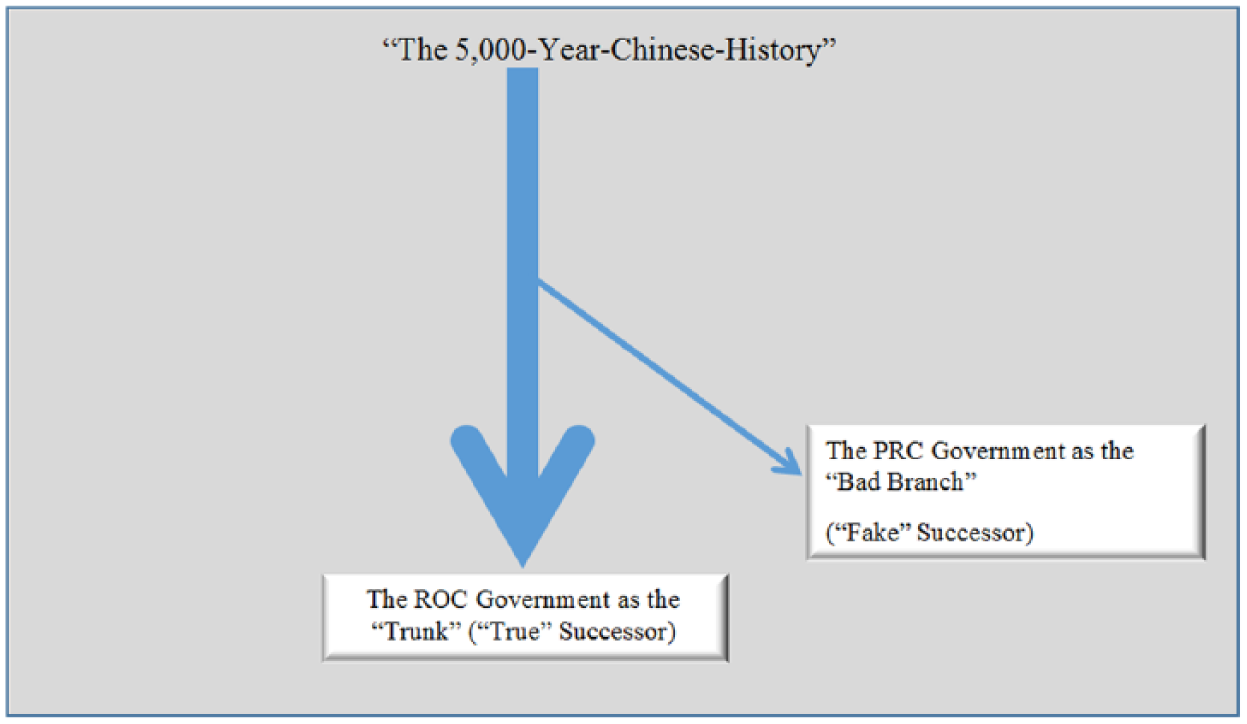
Delegitimizing the PRC government as a “Bad Branch.”
The “beginning,” the eventful KMT history, the “inevitable” connection between Sun and Chiang (and his KMT government), the accentuated “5000-year Chinese history,” the bridged historical continuity (of the KMT government) and the narrated historical discontinuity (of the PRC government), and the delegitimized counter-narratives all contributed to leading the intended national members of the Chinese nation to remember their shared past. The remembered nostalgia among national members of the Chinese nation was the consequence of an aligned and remembered glorious history. Nevertheless, the key components that constituted the “shared past” were subject to a selective mnemonic process (Irwin-Zarecka, 1994: 115–131; Zerubavel, 1994: 72–100). Collective remembrance goes hand in hand with collective forgetting (Zerubavel, 2003: 82–100). For instance, although the Wu-Chang Uprising was the oppositional activists’ 11th attempt to overturn the Qing dynasty, rather than choosing the first attempt or any other following attempt, the uprising was selected as the key event that launched a whole new era. The fact that Chinese communists also claimed to be the “authentic” heir of the spirit of the Xin-Hai Revolution and that Mao Zedong inherited the unfulfilled will of Sun Yat-sen was marginalized and regarded as ridiculous (UDN, 1961b). 18 Moreover, contrasting with the hot history of the KMT in mainland China before 1949, events that occurred in Taiwan and overseas during this period were “edited out.” 19
Narrating a shared present and thus a shared future
In addition to the shared past, narratives served to lead national members to remember that they are experiencing a shared present and therefore should project a shared future. In presidential speeches, the national leaders not only reiterated the current status—being forced to stay in Taiwan and another government’s claim of legitimacy for the Chinese nation—as “abnormal” and “temporary” but also expressed a wish to encourage proposed national members’ cooperation to recover mainland China in the near future: We are here today to celebrate the birthday of our nation. We are here not only to commemorate this glorious day, but also to inform the whole world that we are getting closer to our sacred mission: defeating Chinese communism and recovering mainland China! (Presidential speech in 1983, UDN, 10 October 1983)
Several components in the narratives of official Chinese nationalism that guided people to remember their shared present and therefore their shared future will be introduced in the following paragraphs: the year 1949 as a turning point, the “abnormal” and “temporary” current circumstances, the sacred mission of recovering the mainland, and the muted and marginalized alternative narratives of the present and the future.
The year 1949 was seen as a turning point in the national story: After 1949, the ROC government had to stay “temporarily” in Taiwan and treat this long-term marginalized place as a bastion (Wang, 2007 [1999]). In brief, 1949 created a shared present for national members.
20
Whereas in the 1980s the narratives of official Chinese nationalism started to redefine the shared present of national members as honorable due to the prolonged “abnormal” condition, in the early decades after the 1949 retreat, national members were led to memorize a shameful present that needed to be corrected: … our founding father, our national heroes, and the Republic Era were all shamed by the rising of Chinese communists and the loss of mainland China … (Presidential speech, UDN, 10 October 1956)
Combining the shared glorious past and the shared shameful present, the official narratives assisted people in envisioning their bright shared future: the reunion with mainland China and saving the miserable people there. Double Tenth Day, thus, was observed as the day that reminded national members of their obligation to recover the mainland as well. By suggesting that people in mainland China were also national members who endured the merciless oppression of the PRC government, other national members (people in Taiwan and overseas) were reminded to prioritize the national mission rather than enjoy their own life. The following excerpt exemplifies this dimension in the narrative: On National Celebration Day, the first thing that our people should remember is that, during the past year, our national members in mainland China—including your parents, sons, daughters, brothers, sisters, relatives, and friends—must suffer even more because of the cruel and bloody governing of Chinese communists. This fact brings a deep and indescribable sorrow and sadness to all of us … (Presidential speech in 1954, UDN, 10 October 1954)
The following paragraph from the 1957 presidential speech reveals the typical discourse on the shared present and therefore the shared future: Our splendid national foundation and glorious past was tarnished by the evil Chinese communism that is led by Mao. The mainland has been stolen by Chinese communists for eight years … The only way to recover mainland China and save our national members from their ruthless governing is cooperation! (Presidential speech in 1957, UDN, 10 October 1957)
Being remembered as a turning point that resulted in a shared present and, therefore, an envisioned shared future made the role of 1949 as crucial as that of 1911. Hence, presidential speeches and surrounding narratives calculated and reported not only the number of years that the Republic Era had been established but also the number of years since the KMT government had to retreat to Taiwan and seek to recover the mainland. Intriguingly, every Double Tenth Day was an opportunity to “reset” the countdown clock for the nation’s envisioned victory: … this year will be a key year that we see the collapse of Chinese communism. That is to say, this year is the year that we will taste the victory of recovering mainland China … during the last year, we have prepared for it … (Presidential speech in 1959, UDN, 10 October 1959)
Historical analogies were broadly employed in the narrative to connect people to the “shared” Chinese history and an expected bright future. For instance, the tough conditions for the KMT government after 1949 were compared to the difficult situation of the oppositional activists before the Wu-Chang Uprising and Xin-Hai Revolution (Presidential speech, UDN, 10 October 1980). It was said that, just like oppositional activists eventually overthrew the Qing dynasty after 10 failed attempts, the people of the Chinese nation must be able to defeat the Chinese communists despite prolonged fruitless attempts. Also, the leaders of Chinese communism were analogized with many evil persons in Chinese history (Presidential speech, UDN, 10 October 1962) to indicate that they were doomed to fail.
In addition to narratives that were subject to collective remembrance, there were narratives subject to collective oblivion from the Chinese nationalists’ perspective as well. That is, forgetting also plays a role in collective memory and identification (Gross, 2000: 140–152). Mnemonic work always needs to be accomplished by selecting out certain events as well as by downplaying or even muting alternative narratives (Ricoeur, 2004: 412–452; Trouillot, 1995: 1–30). On one hand, certain events are selected out from the narrative because they may distract the focus and create “noise” mnemonically; on the other hand, the alternative narratives need to be “dealt with” since they could breed unwanted alternative memories and therefore alternative identifications. The alternative narratives that were edited out from the official Chinese nationalism were told and disseminated by the ROC government’s mnemonic rivals, mainly the PRC government and the Taiwanese nationalists.
A comparison of the differences between narratives preferred by the ROC government and the alternative commemorative narrative related to the “present” and the “future” may deepen our understanding of the selectiveness of mnemonic work. For example, while the official narratives of official Chinese nationalism degraded the PRC government as a “rebellious force” and defined the Republic Era after 1949 as a “temporarily” rebellious period that would be over soon, the alternative narratives from the PRC government suggested that 1949 was the “end” of the Republic Era and the PRC was the latest Chinese dynasty; the “fact” that Chiang Kai-Shek and his followers occupied Taiwan simply made Taiwan a “renegade” province of China (People’s Daily News (hereafter PDN), 1949a, 1949b). Moreover, when the ROC government told stories about how national members who lived on the mainland were suffering, the PRC government said quite the contrary: In the alternative narratives of the PRC government, it was the national members living in Taiwan and its surrounding small islands who were tasting the bitterness of KMT rule (PDN, 1954, 1955). In terms of the envisioned future, whereas narratives from both the ROC government and the PRC government projected a reunification between the mainland and Taiwan, each projected itself as seizing the ruling power of the Chinese nation, thus dooming the counterpart to destruction. Following are excerpts to exemplify the PRC government’s alternative narratives: … our history had experienced an unprecedented change. Chinese people … overthrew the reactionary KMT regime, which was strongly supported by American imperialism, and the remnants of Chiang Kai-shek’s gang had been defeated completely. The surviving forces of Chiang’s gang can only hide like cowards in Taiwan and its surrounding small islands … Yet … nothing can prevent them from the destiny of eventual destruction … The emancipation of Taiwan and the reunification of the whole China are this year’s most significant national missions, which 4.7 hundred million Chinese people determine to fulfill … (PDN, 1950)
The contradictions in narratives of Taiwanese nationalism and official Chinese nationalism regarding the remembered present and the future are no less obvious. 21 In addition to narrating a mere 400-year chronology as the “shared past” (instead of a “5000-year” national history) to disconnect Taiwan from Chinese history (Hughes and Stone, 1999: 986; Tu, 2007) and despite the official Chinese nationalism downplaying occurrences in Taiwan that went beyond “Taiwan as a bastion to recover the mainland,” 22 Taiwanese nationalists generally brought up events that occurred in Taiwan (Corcuff, 2002; Rigger, 1999). While mostly transmitted via informal and underground outlets, Taiwanese nationalists suggested that Chiang Kai-shek and his KMT government were nothing but a brutal foreign regime and that islanders in Taiwan were experiencing yet another colonization (Gong, 1999). Negating Taiwan as an indispensable part of China and the recovery of the mainland as the ultimate collective mission, Taiwanese nationalism told stories of the suppression and exploitation that Taiwanese islanders suffered after the 1949 Retreat and maintained that Taiwan was a “nation for itself” (Chiu, 2007; Dittmer, 2004; Lynch, 2004; Stockton, 2008). Hence, rather than reunifying with the mainland, Taiwanese nationalism projected an alternative future of Taiwan independence and the termination of foreign colonization (Fell, 2012).
Table 1 summarizes the master narratives from different mnemonic viewpoints. 23 With the huge contrasts between the preferred narratives and the alternative narratives demonstrated, it is hardly surprising to know that the mnemonic engineering of official Chinese nationalism would want to “deal” with the alternatives via marginalization, downplaying, scoffing, and, more importantly, leaving them to collective oblivion. Moreover, since the alternative narratives were almost completely selected out from the narratives, national members were assumed to be ignorant of these alternatives mnemonically: Remembering too much of these alternative interpretations thereby became an indicator of “mnemonic traitors.”
Narratives on the past, present, and future from different mnemonic visions.
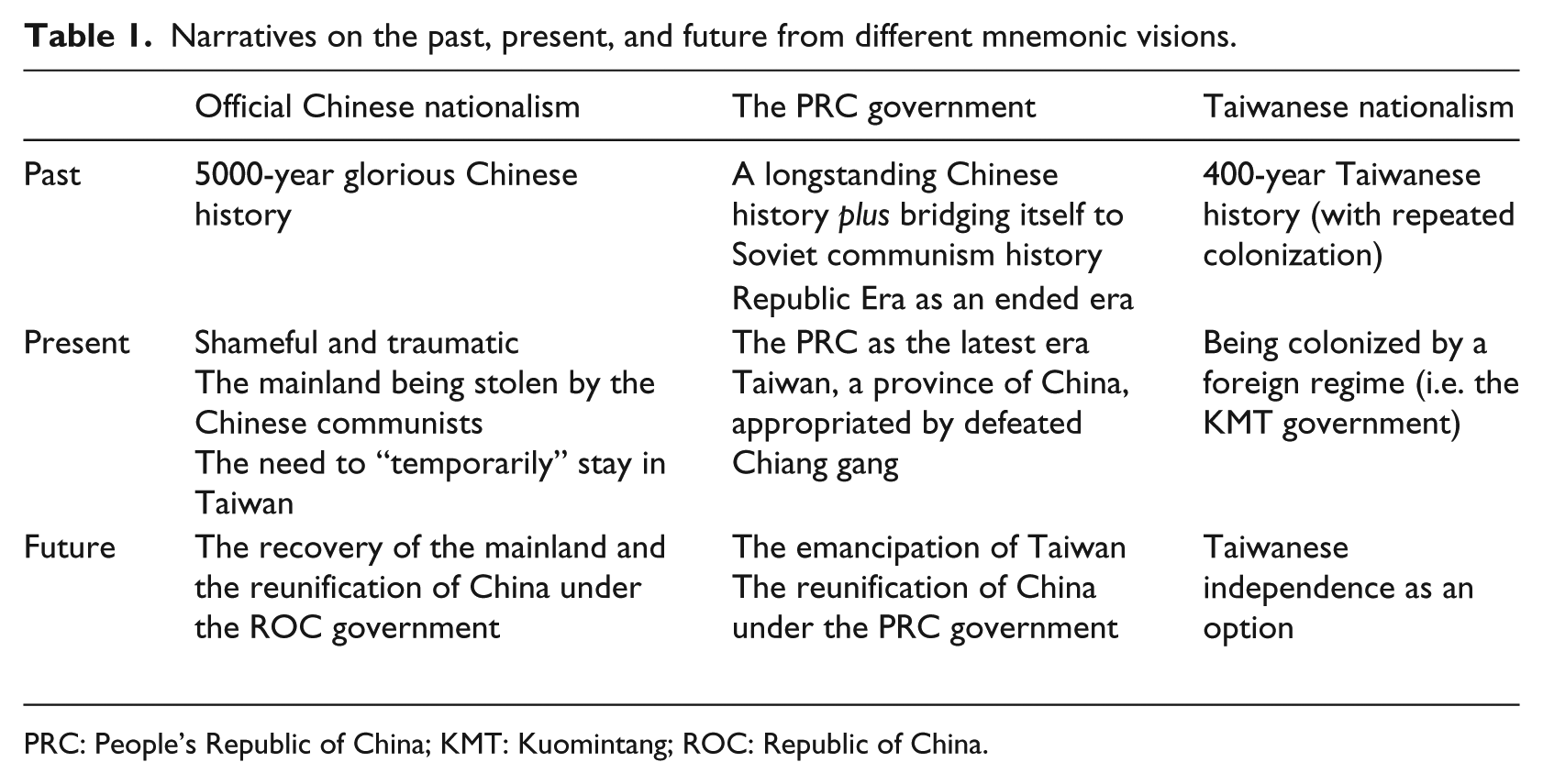
PRC: People’s Republic of China; KMT: Kuomintang; ROC: Republic of China.
Whereas only a small percentage of the national members could receive these messages directly, the aforementioned elements in the commemorative narrative which aimed to tell a shared past, present, and future were directed toward all intended national members: All our national members! Today is the 41st National Celebration Day of our nation. We celebrate this special day in our bastion—Taiwan province … we first should consider that our national members who live on the mainland are suffering: they live under the terrors, killings, starving, and slavery of the Chinese communists. They are not allowed to see our national flag or hear our anthem, and they are expecting us to save them … I also would like to encourage overseas Chinese. I can understand your sorrow due to your motherland being stolen by Chinese communists and your family members being killed and imprisoned by Chinese communists … I also would like to urge our national members who live in freedom areas [people who stay in Taiwan and its surrounding small islands]: Only because of your cooperation and striving can we establish Taiwan province as our national bastion … (Presidential speech, UDN, 10 October 1952; Italics added by author)
In fact, the ROC government attempted to reach all national members. For instance, the air force disseminated brochures and fliers printed with the master commemorative narrative and radio stations broadcast the official narratives nearby the territorial borders (between the ROC and the PRC regimes; UDN, 1975, 1979). To sum up, although the ROC government had to stay “temporarily” in Taiwan and could directly govern only a small percentage of its national members, to invent an organic whole, the mnemonic work of official Chinese nationalism was directed beyond the island to include all national members residing in all locations.
The told (and thus remembered) nationality 24
In the case of official Chinese nationalism from 1949 through 1987, we see the harnessing of historical analogies to assign similar symbolic meanings to distinct historical time periods, the highlighting of pedigree to establish a sense of historical continuity, the manipulating of the distinct quality of the time periods to create dissimilar perceptions of their roles in national history, the fabricating of dummy ancestors to provide a sense of nation as a gigantic family, the degrading of alternative commemorative narratives, the sidelining of political competitors in the historical development, and the neglect of certain historical events to result in collective amnesia, among other conditions. The abstractness of the commemorative narrative allows room for employing various mnemonic techniques to tell a preferred national story from mnemonic organizers’ perspective. On one hand, the mnemonic organizers (in this case, the power elites of the KMT government) could solve the legitimacy crisis and maintain their ruling power; on the other hand, the intended national members derived a sense of ontological security by finding the answer to “who we are” and “what we have to do” through the specific mnemonic vision of official Chinese nationalism.
While many may assume that commemorative narrative can only lead the intended audience to remember a shared past, it indeed guides people to remember that they have a shared present and will have a shared future as well (Mische, 2009; Tavory and Eliasoph, 2014). For example, although not all people have similar experiences or encounter exactly the same conditions, people in a specific time period may describe their “current” situation in similar terms. However, it is far from a coincidence that contemporary people claim they are experiencing a resembling present. People in fact are influenced by the narratives in mnemonic work and thereby are mnemonically aligned to have similar considerations. The “defined present” sometimes is further highlighted by comparison with the constructed shared past: It is not uncommon for people to delineate their present unanimously as a “repetition” of the past, another unavoidable “stage” of history, or the “unprecedented.” Following the same logic, people are also guided to remember their shared future through mnemonic work. Hence, although events have not yet occurred, people can talk about their prospects and work toward their goals; in addition, people in a specific group usually have similar anticipations of what will occur in their future. According to the analysis of the master commemorative narrative of official Chinese nationalism, the past, present, and future are highly correlated and inseparable components in mnemonic work: The way in which each of them is introduced and thus remembered is usually well “packaged.” In short, in the construction of a collective memory, the past is invented in a way to legitimate the present, the present is invented in a way to evoke identification, and the future is created in a way to consolidate cooperation (Frye, 2012; Koselleck, 2004: 9–74).
The analysis also reveals that official Chinese nationalism continued to process adjustments to respond to challenges and crises. Among other factors, the prolonged “abnormal” and “temporary” condition allowed room for the alternative nationalisms (Brown, 2004; Dawley, 2009; Hsiau, 2010). In the early decades after 1949, the main mnemonic rival (which narrated a distinct national story and therefore national memory and identity) of official Chinese nationalism was the PRC government. However, since the 1970s and 1980s, the increasingly vocal Taiwanese nationalisms have emerged as another set of significant mnemonic rivals (Hsiau, 2000).
25
Several discursive adjustments were made in official Chinese nationalism. For example, as mentioned, 1911 was transformed into a small beginning in the 1960s so as to highlight and legitimize the ROC as the latest Chinese dynasty. Moreover, since the chances of recovering mainland China diminished with the prolonged “abnormal” condition, official Chinese nationalism had to redefine the current status of the nation. Taiwan came to be regarded as a “model province” for all other provinces in mainland China to mimic, rather than only as a practical tool and the so-called sacred bastion for recovery. The basic logic behind this was that the “authentic” Chinese government (the KMT) outplayed the “fake” Chinese government (the PRC) in terms of governance with its superior “Three Principles of the People” and democratic values. Thus, the claimed “shameful” present was redefined as an “honorable” present. Following are two excerpts from the presidential speeches that exemplify this redefinition: … Hence, we’ve followed our ideal “Three Principles of the People” and are dedicated to the construction of our bastion of recovery [Taiwan]. Our ultimate goal is to unite with the mainland with freedom and democracy and to establish a firm base for peace in Asia and the whole wide world. Because of the sincere cooperation and hard work of our national members in different areas, we have rebuilt Chinese people’s confidence and self-esteem, and we have also proved our own value. We always expect more from ourselves, and we always put all our expectations into practice. We should lead other people to have a correct understanding of the Republic of China … (emphasis added; Presidential speech in 1986, Economic Daily News, 10 October 1986) Today … we have reached a consensus among national members that we all want a modern society that not only embraces freedom, democracy, and legal regulation politically, but also cherishes equality and prosperity economically … we deeply believe that the faster the development in our recovery bastion, the worse the PRC government seems to be. (Presidential speech in 1987, UDN, 10 October 1987)
In addition, starting in the early 1980s, official Chinese nationalism gradually incorporated more Taiwanese events that occurred after 1949 into its narration due to the prolonged “abnormal” conditions and the prevalence of alternative national imaginings. For example, in both presidential speeches and surrounding narratives, descriptions detailing how Taiwan—as a sacred bastion and as a province—had been “well” constructed by the ROC government began to appear. For a typical example, see the presidential speech in UDN 10 October 1977: A1. In fact, with the redefinition of the current condition and the emphasis on the successful development of the recovery bastion, a sophisticated and implicit modification also occurred: In the late phase of official Chinese nationalism, the reiterated national goal of recovering the mainland transformed into a rather passive national mission instead of an active mission. That the military forces and other societal fields were better prepared to “fight back” against the mainland received less emphasis; the focus shifted to how the “free China” areas (especially Taiwan) were well developed under the ROC government and would become great models for other provinces in the mainland when the reunification occurred. Nevertheless, the exact method of how “recovery [of] the mainland” would occur was left ambiguous in the later stages of the official narrative. Some excerpts from presidential speeches and surrounding narratives may facilitate our understanding of this modification: After thirty years’ cruel suppression by the communists, national members in the mainland now admire the free bastion of Taiwan and request to live as national members in Taiwan. Let’s raise our arms and gather together under the flag of the “Three Principles of the People” to move against the tyranny of communism … (Presidential speech in 1979, Economic Daily News, 10 October 1979) “Recover the mainland politically” was usually deemed merely a slogan. However, till today, the facts have already proved that right from the very day our former president Chiang [Kai-shek] took his position again in Taiwan [1949], our action to recover the mainland with politics had begun. During the past thirty years, the construction we made regarding the political arena, economic development, the educational system, and the cultural field in our Taiwan bastion all provided great models for mainland China. China must be reunified; by simply following our path to reunify China, Chinese society will take steps toward democracy, freedom, and happiness … (UDN, 1980)
The newly added elements were skillfully represented in the narrative through ambiguity, coexistence, and order changing. Instead of replacing the previous narrative with a new discourse, piggybacking and superimposition were more commonly employed. That is, the constructing of commemorative narrative is not totally fluid. Therefore, 1911 as a big beginning and a small beginning were juxtaposed in the official narrative, the perception of Taiwan as a sacred bastion and as a model province coexisted, the “shameful” present and the “honorable” present were mixed, and the added Taiwanese elements were superimposed on the strong emphasis on Chinese history. As a result, ironically, efforts to maintain the internal consistencies created the internal inconsistencies. More intriguingly, the intended national members usually can remember the contradictive elements in the commemorative narrative simultaneously without any dissonance.
Whereas we can see the KMT government—as an authoritarian regime—employing coercion as a method to mute alternative memories (Hsiau, 2010; Roy, 2003; Rubinstein, 2006; Wang, 2006 [2003]), I argue that it was the mnemonic work that delayed and even canceled the challenges from alternative national imaginings for decades. 26 More specifically, while the coercive governance of the Chinese nationalists became a salient “weak point” that alternative nationalists wanted to foreground and attack, the mnemonic works were hard to challenge and eradicate. For instance, whereas Taiwanese nationalism narrated a different national story for common people, Double Tenth Day is still broadly celebrated and has never been abolished even when Taiwanese nationalists acquired ruling power in 2000: They had to tolerate the wrong “beginning” of national history that Double Tenth Day symbolized and continuously use the “year” of the Republic Era without interruption. 27 It was a tough (if not impossible) mission for Taiwanese nationalists to “brush away” the sediments of official Chinese nationalism’s mnemonic work.
Conclusion
Whereas every community should be regarded as a mnemonic group that eagerly wants its members to remember their shared past, present, and future, the invention of a Chinese identity nevertheless offers an intriguing case of nation-remembering. Analysis of the commemorative narrative from 1949 through 1987 indicates that official Chinese nationalism employed various mnemonic techniques to lead people to remember their Chinese identity. In addition, an emerging perspective which addresses the dynamic and ongoing adjustments of mnemonic work is adopted to observe the case.
Although most existing studies merely emphasize the role of “telling a shared past” in the mnemonic work, this article asserts that the past, the present, and the future all play an inevitable role in it. That is, in my case, it is telling a shared past, present, and future which makes the commonalities in a Chinese nation more imaginable for its intended national members. Furthermore, these three aspects are well-packaged in the mnemonic work and modifications which occur in one part all too often cause adjustments in the other two. More importantly, I would like to point out that the seemingly nation-specific idiosyncrasies that the invention of a Chinese nationality demonstrates indeed are transnational and can be generalized to reveal the logics beneath the social construction of memorability and enrich our understandings of mnemonic work.
Footnotes
Acknowledgements
I am grateful to Eviatar Zerubavel, Paul McLean, Ann Mische, Yael Zerubavel, Yu-Sheng Lin, and Jacqueline Ramey for their comments on drafts of this article and to the anonymous reviewers for their very helpful feedback. The article is entirely the responsibility of the author.