



Abstract
Threat perception is a key issue defining intergroup conflict dynamics. To date, it has been linked with power asymmetries and value similarities between groups. This article examines the role of victimization memory in threat construction. The results of an experiment converge to suggest that personal and institutional victimization memories are robust predictors of the levels of threat perception. They act as primary references in the assessment of threat and suppress framing effects. The findings have significant implications for the theory of threat perception.
In international relations, perceptions of threat are mediated by the perceptions of a target country (Stein, 2013: 364). As demonstrated by Rousseau (2006), the perceived similarity of values vis-a-vis a target country can significantly reduce concerns about the asymmetries in the material balance of power, arguably the most cognizant source of elevated threat perception. We build upon these insights and, extending the original study design, explore how historical memory influences the perceptions of threat and its two constitutive factors: identity and power. Do these two factors maintain their effect on threat perception when there is a recent and still sensitive memory of negative encounters with the source of threat? More generally, what is the role of historical memory in threat perception?
We hypothesize that threat perceptions about other states are first and foremost influenced by previous encounters with them. When salient personal and collective victimization memories are present, they become references in the assessment of threat, suppressing the influence of perceptions of similarity and the balance of power. In other words, we argue that self-designated victims are not sensitive to the experimental manipulation of the powerfulness and/or similarity of a target country and instead form their perception of threat based on their victimization memory.
At the same time, there are theoretical reasons to believe that personal and collective layers of memory have similar but distinct linkages to threat perception because of the different levels of their emotional intensity—with the former being more intense than the latter (Smith et al., 2003). To the best of our knowledge, these linkages have not been explored in the literature despite their potential relevance in threat perception. Our study seeks to fill this gap. The findings also have implications for theoretical debates about the social construction of historical memory. In contrast to the constructivist narratives of the infinite malleability of collective memory, we suggest that the process of memory construction at least sometimes faces “objective” constraints. They are grounded in prior but currently salient experiences that function as information-laded precursors to the process of memory construction. This means that prior experiences can be constitutive of identities because they contain information such as valence, which favors particular scenarios of social construction.
We take the case of Lithuanian threat perceptions of Russia in order to test our hypotheses. An experimental survey with different framing conditions is used to determine the nature of interaction between explanatory variables and the levels of threat perception. The data are compared to similar surveys conducted in Germany and Spain, from which we adopt a number of hypotheses. We begin with a literature review on social memory and its salience in threat perception. We then argue for the conceptual distinction between historical memory, traumatic memory, and victimization memory. Focusing on the latter, this article presents research hypotheses and provides some relevant contextual details related to the Lithuania–Russia case study. Thereafter, we discuss the methodology and present the results of the survey. The general discussion section considers the broader implications of the findings, focusing on how memory can condition the perceptions of threat, on the one hand, and be constrained by previous experiences, on the other.
Defining memory
In this section, we purport to establish conditions under which social memory has the most substantive effects on threat perception. Specifically, we single out the measures of congruence between individual and collective levels of memory, the scope of memory’s appeal, and the nature of political regime it is a part of. At the same time, we argue for the conceptual distinction of victimization memory.
Social memory and threat perception
Although research on historical memory has gained considerable momentum with the rise of constructivism, the issue is as old as social sciences. In Economy and Society, Weber et al. (1968) argued that communities based on common memories lies at the heart of nationalism. He further argued that common memories “often have had a deeper impact than the ties of merely cultural, linguistic, or ethnic community” (p. 903). Durkheim dealt with collective memory through the analysis of religious rituals, which codified past traditions and myths and strengthened a sense of community (Misztal, 2003: 125). Durkheim’s disciple Halbwachs (1992)—the founding father of social memory research—also emphasized the social framework of memory, which recall, localize, and shape individual memories (p. 38). Building on these initial insights, the constructivist (sociological) paradigm focuses on the process of construction and contestation of social memory. As noted by Karlsson (2010: 47),
Since all collective memories, even the most private, are social constructs, marked by the cognitive and emotional framework of the social group to which we relate, they can easily be retrieved, manipulated and mobilised on a collective level by those individuals, often educated and communicative, who are able to give utterance to the values and ideals of the social group in question.
However, one of the key challenges of these collectivist approaches, which treat social memory as separate from individual, is to empirically and systemically measure the extent and effects of such a collective phenomenon. There is always the potential for slippage “into a metaphysics of group mind” (Olick, 1999: 338). Still, once defined as institutionalized memory rather than just collective memory, this paradigm acquires analytical and conceptual tools to analyze these social constructs present in institutionalized settings: museum exhibitions, textbooks, public commemorations, and so on.
On the other side of the continuum are individualistic (psychological) approaches to memory research, which view individuals as the primary carrier of both private and social memories. From this positivist ontological perspective, collective memory first and foremost represents aggregated individual memories. Following Olick (1999), we define it as collected memory and distinguish two related types: collected institutional memory and collected personal memory. Both of them are the primary objects of this study. The former designates individual’s appropriation of a national (collective) memory or what Gries et al. (2011) call “nationalist historical beliefs.” In the case of a traumatic historical event, this memory takes the form of “we suffered.” The latter adds a personalized layer of memory, which, if present, designates personal (direct) linkage to a particular event—“I suffered.” Most holders of personal event memory are also likely to identify with the related institutional memory, while the reverse linkage, from institutional to personal memory, cannot be readily assumed because there are very few large-scale events that have a direct impact on the majority of society members. For example, most Japanese were not victims of the 2011 Tōhoku earthquake and tsunami and do not have any immediate personal connections to the victims, but they may strongly associate themselves with the institutional memory of the events. So it translates into “I personally did not suffer, but we as Japanese did.”
The transformation of personal memories to institutional memories vis-a-vis of the same event represents the processes of social construction, contestation, and instrumentalization on a collective level. This manufacturing of institutional memory can be viewed as more or less “artificial” depending on the extent and congruence of collected personal memories. The distinction between the two layers of memory has its basis in experimental psychology literature, which often differentiates between event and autobiographical memory (Pezdek, 2003). The latter tends to have stronger emotional arousal, more frequent subsequent rehearsal of the event and longer persistence over time (Smith et al., 2003). Thus, memories involving large-scale direct (mass) experiences, like genocide, should have a stronger and more persistent effect on threat perception once they are institutionalized.
Another useful distinction in the literature on politics of historical memory relates to the nature of regimes. While the uninhibited manipulation of historical memory may be an appropriate assumption in the analysis of authoritarian regimes, where hegemonic political elites can strive for the Orwellian world of 1984, the construction of social memory in democratic societies tends to be more diversified because of limited state control over the process (Davis, 2005: 4). In this case, dominant historical narratives and memories can be born out of prevalent past experiences rather than interpretative impositions from the state. Smelser (2004) designates such experiences as “a mass phenomenon because it involved many people having the same reactions and assigning the same meaning” (p. 48). This past can still be contested, but usually the contestation is less about what actually took place, but more about “who or what is entitled to speak for that past in the present” (Hodgkin and Radstone, 2003: 1). Another reason for reduced contestation may relate to the fact that memories tend to stabilize in the long run due to repetition and story schematization (Pasupathi, 2001). The ability to recall specific events or their nuanced interpretations is secondary for the purposes of this study. What matters is the general understanding of past events as traumatic with a rather clear victim–perpetrator divide. In line with propositions advanced by Lodge et al. (2006), such memories are approached as affective tags to particular events and actors. Like Halbwachs’ (1992) “imagos,” they can be fuzzy representations of the past in terms of historical details, but they carry distinct dispositional information vis-a-vis other actors establishing a causal link from the memory to the assessments of threat perception. As discussed above, this link should get stronger as institutionalized memories involve a greater mass of people with similar (congruent) experiences.
Types of negative social memory
In sociology and political science, the issue of memory is closely linked with its construction and manipulation by ruling elites and opinion leaders (Forest and Johnson, 2011; Hobsbawm, 1983; Lebel, 2013; Müller, 2004), but the concept is too broad for systemic analysis of its role in threat perception. In order to provide some conceptual rigor, we focus on negative events and differentiate between historical memory, traumatic memory, and victimization memory. This theoretically novel gradation is based on the nature of past experience, moral intentionality, and the specificity of its effects. If historical memory can relate to almost anything with negative valence worth remembering, the next two categories focus on past events involving physical and psychological harm (including loss of lives), which has lasting behavioral/attitudinal effects.
Traumatic memory is still a broad concept of the recollection of negative historical experiences, which does not necessarily involve premeditated breaking of fundamental moral codes. Conversely, victimization memory always contains an element of intentionality to harm on behalf of other actors. Thus, intentionality becomes the central factor in assigning the level of responsibility and guilt (Heider, 1958). To illustrate, intentionality would not play a role in a typical plane accident but would be essential for interpreting the events of September 11. The latter involves premeditated breaking of moral codes, which generates moral outrage and anger against the perpetrator group. Such tragic experiences are still mediated by memory and do not escape the issue of the subjectivity of recollection or political instrumentalization, but the causal effects can often be more clearly formulated and tested. In most cases, they involve heightened negative attitudes toward perceived perpetrators or out-group (Skitka et al., 2004), support for retaliatory policies (Herrmann et al., 1999; Maoz and McCauley, 2008), and willingness to curb liberties at home in order to protect the in-group (Huddy et al., 2002; Shamir and Sagiv-Schifter, 2006). For the purposes of this study, heightened negative attitudes should translate into a heightened sense of threat perception. The case of Lithuanian–Russian relations explored below engages victimization memories related to large-scale and relatively congruent experiences, providing a likely case for the establishment of linkage between the memory of victimization and threat perception.
Research context and hypotheses
In relations between Lithuania and Russia, the institutional and personal victimization memory is related to the loss of Lithuanian independence in 1940 and the return of Soviet troops in 1944. Both events were marked by massive deportations of Lithuanian population to Siberia, collectivization of private property, and aggressive eradication of any forms of resistance against the Soviet rule. Polian (2004: 167) estimates that from 1940 to 1953, the Soviet government deported about 120,000 Lithuanians to special camps. As a result of the war and the Soviet repression, Lithuania not only lost roughly a third of its population (Anušauskas et al., 2005: 395), but also most of its elite (Snyder, 2010: 329). 1
This victimization memory was largely suppressed during the Soviet era and surfaced in public discourse only with Gorbachev’s perestroika. The issue eventually became a rallying cry for Lithuanian independence and the symbol of its suffering under the Soviet regime. Following independence, the topic did not lose its relevance as Russia—the legal heir to the Soviet Union—approached the period from a syncretic and ambivalent point of view (Munro, 2006: 307–308). Russian political elites tended to downplay or sometimes even to negate the fact of the occupation of the Baltic States and any harm done against the population, fueling a sense of insecurity in the former Soviet republics and strengthening the perceptive link between the Soviet Union and post-Soviet Russia (Berg and Ehin, 2008). The ultimate expression of this fusion is legally unprecedented Lithuanian and Latvian demands to Russia to recompense Soviet occupation damages (Grigas, 2013: 155).
Given these victimization memories and their present-day salience (Imhoff et al., 2013), we assume that citizens in Lithuania will exhibit distinct dynamics of threat perceptions toward Russia in comparison to citizens from other countries with less or no traumatic experiences. Recently, some of the authors (Garcia-Retamero et al., 2012) conducted a series of studies, investigating threat perceptions toward Russia in citizens of the United States, Germany, and Spain. They also investigated whether threat perceptions were influenced by a framing manipulation of the power of Russia and the similarity of values of Russia and participants’ own country. In the current study, we extended this research by investigating threat perceptions toward Russia among Lithuanians and whether these perceptions are affected by a framing manipulation of power and value similarity (see Appendix 1 for the exact wording of framing conditions). We measured threat perceptions, perceptions of similarity, feelings of warmth toward Russia, and willingness to cooperate with that country. We anticipated the following effects and correlations.
Hypothesis 1. Victimization: Perceptions of victimization should generate a dominant negative narrative about Russia. Consequently, most Lithuanians would accept and own the narrative of Lithuania’s victimization by Russia. Thus acting as an affective-informational tag, perceived country-level grievances will (1) elevate a sense of military and economic threat perception posed by the alleged perpetrator, (2) diminish perceived similarity between the countries, (3) diminish feelings of warmth toward the perpetrator, and (4) diminish support for economic or military cooperation with the perpetrator. These same relationships will be even more pronounced among respondents with personalized victimization memories because of the additional emotional arousal and subsequent rehearsal of the events within the circles of family or close friends.
Hypothesis 2. Framing: Victimization memories would have such a strong statistical linkage with perceptions of threat, perceptions of similarity, feelings of warmth, and willingness to cooperate with the out-group that framing would not affect these judgments above and beyond the effect of these memories.
Hypothesis 3. Knowledge: Higher levels of general knowledge about Russia will reduce perceptions of threat. This expectation is inspired by the concept of knowledge as an attenuating mechanism in intergroup conflict (Allport, 1954).
Hypothesis 4. Familiarity: The intergroup contact theory (Pettigrew and Tropp, 2006) predicts that in-group members who are in contact with out-group members have more positive attitudes toward out-group members than those who are not in contact with them. Following this theory, we hypothesize that Lithuanians who have Russian acquaintances or visited Russia will exhibit lower levels of threat perception.
Methods
Participants
Participants were 240 students from Kaunas Technological University and Vytautas Magnus University, Lithuania (34% males). 2 Participants had a median age of 20 years (range 18–27) and were all Caucasian. Course credit was provided for their participation.
Timing
The study was conducted in February and March 2013. At the time, Lithuanian–Russian relations were not tense, but marred by the fact that the previous Lithuanian government launched a lawsuit against Russian energy giant Gazprom for alleged price-fixing at the Stockholm Arbitration Tribunal. A new left-leaning coalition led by social democrats, which came to power following the October 2012 parliamentary elections, favored a constructive dialogue with Russia and found mutually acceptable solutions in the dispute with Gazprom (Linas Kmieliauskas, 2012). During this period, Lithuania was also in the phase of intense preparations for its upcoming European Union (EU) presidency, including the now famous Eastern Partnership Summit in Vilnius, the outcomes of which sparked major protests in Ukraine and eventually led to the Russian invasion of Ukraine. However, in early 2013, the situation in the Baltic–Black Sea region was quite stable and showed few signs of distress. Thus, the timing of the survey should favor a more moderate assessment of Russian threat in comparison to later developments.
Procedure and design
Participants completed a 20-minute questionnaire including a short paragraph (approximately 85 words) about the power (strong vs weak) and the degree of manipulated value similarity (similar vs dissimilar) between Russia and the EU (see Appendix 1, a strong military power of the EU countries was framed in terms of “Lithuania and its NATO allies”; a weak military power of the EU countries referred just to the growing military power of “Russia”). The order of the statements was counterbalanced across participants. Participants were randomly assigned to one of eight groups based on the balance of military power, the degree of value similarity between the countries, and the order of the information.
We measured four groups of dependent variables:
Threat perceptions were measured using two questions. First, we asked participants how much of a military threat Russia is to the countries of the EU on a 10-point scale (0 = not at all, 10 = extremely threatening). Then we asked how much of an economic threat Russia was on an identical scale.
Perceptions of similarity were estimated by the extent participants perceive Russia as similar or dissimilar to the countries of the EU on a 5-point scale (2 = similar, −2 = dissimilar).
Feelings of warmth toward Russia were measured on a scale ranging from 0 to 100 (51–100 = favorable/warm feelings, 0–49 = unfavorable/cold feelings, 50 = neither warm nor cold).
Policy cooperation assessments evaluated whether participants would support or oppose (−2 = oppose, 2 = support): (1) an international trade agreement that results in small economic gains by the countries of the EU but major economic gains by Russia, (2) an increase in trade with Russia, (3) the sale of personal computers to Russia that could be used for both civilian and military purposes, and (4) an increase in business investment by the countries of the EU in Russia. Answers to these questions were combined into a single index (Cronbach’s α = .76).
In addition, the questionnaire contained two yes/no questions related to the memory of Lithuania’s victimhood vis-a-vis Russia. One of the questions asked to evaluate whether Lithuania has suffered from Russia, which taps into institutional victimization memory. The other question asked participants whether they or their families had suffered from Russia, which designates a degree of perceived personal victimization. The questionnaire also measured levels of knowledge about Russia. Participants answered six multiple-choice questions testing their ability to identify Russia’s prime minister, population size, gross domestic product (GDP) per capita, neighboring states, membership in international organizations, and communist party leadership. We computed participants’ levels of knowledge about Russia by adding the number of correct responses in these questions. Finally, the questionnaire included two yes/no questions measuring familiarity with Russia. One of the questions asked about whether participants had Russian acquaintances. The other question asked whether participants had ever been to Russia. Appendix 1 provides the precise phrasing of all questions.
Analyses
To test our hypotheses, we compared results in the current study to those of our previous research in Germany and Spain (Garcia-Retamero et al., 2012). As in the case of Lithuania, German and Spanish participants were university students of comparable age and constituting sample sizes of 160 and 112, respectively. In particular, we conducted t test with country (Lithuania vs Germany vs Spain) as an independent factor and perceptions of military and economical threat, perceptions of similarity, feelings of warmth, and policy cooperation assessments as dependent variables. To test our hypotheses, we also conducted multiple regression analyses with frame condition (similar and strong vs similar and weak vs dissimilar and strong vs dissimilar and weak), knowledge about Russia, perceived personal and institutional victimization (yes vs no), acquaintances (yes vs no), and visit (yes vs no) as predictors, and perceptions of military and economical threat, perceptions of similarity, feelings of warmth, and policy cooperation assessments as outcome variables. We used an alpha level of 0.05 in all analyses.
Results
Victimization and framing
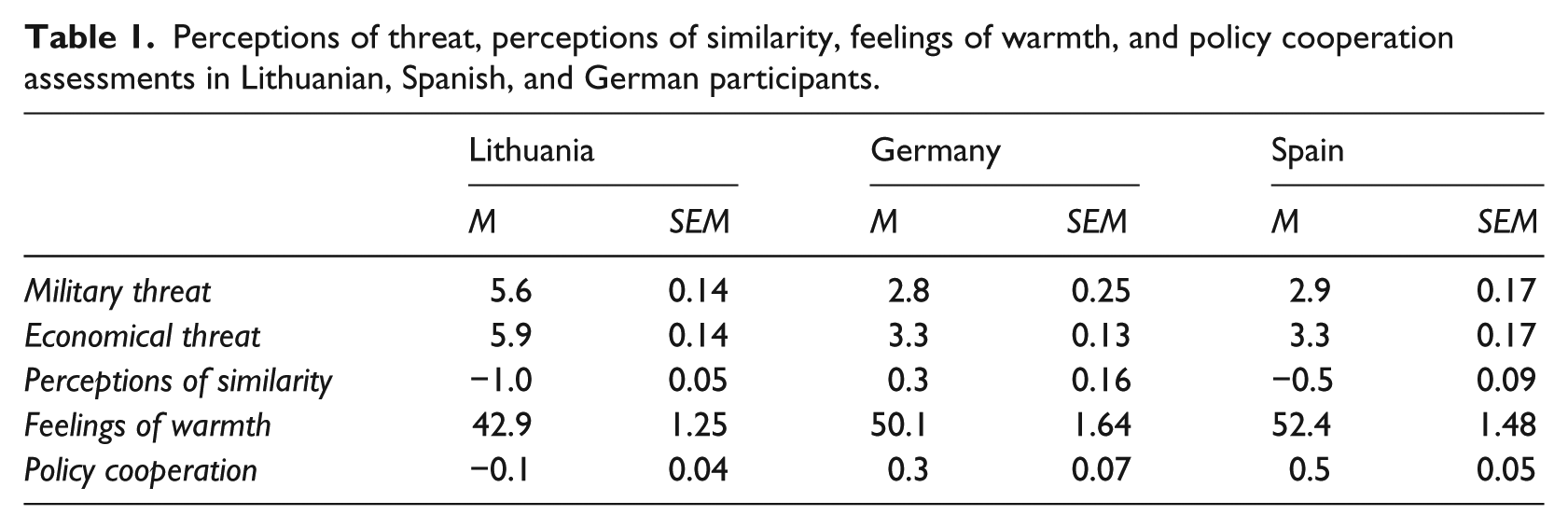
In line with Hypothesis 1, participants showed relatively high perceptions of military and economical threat (M = 5.6, standard error of mean (SEM) = 0.14 and M = 5.9, SEM = 0.14, respectively). These results are in contrast with those in research by some of the authors (Garcia-Retamero et al., 2012) who showed lower levels of threat perception in Germany and Spain using the same procedure (see Table 1). Participants also perceived Russia as a very different country compared with EU countries (M = −1.0, SEM = 0.05), showed relatively low feelings of warmth toward Russia (M = 42.9, SEM = 1.25), and were not willing to cooperate with this country (M = −0.1, SEM = 0.04). These results are also in contrast with those in Germany and Spain. Differences between results in Lithuania and in Germany/Spain are significant for all variables (p < .05).
Perceptions of threat, perceptions of similarity, feelings of warmth, and policy cooperation assessments in Lithuanian, Spanish, and German participants.
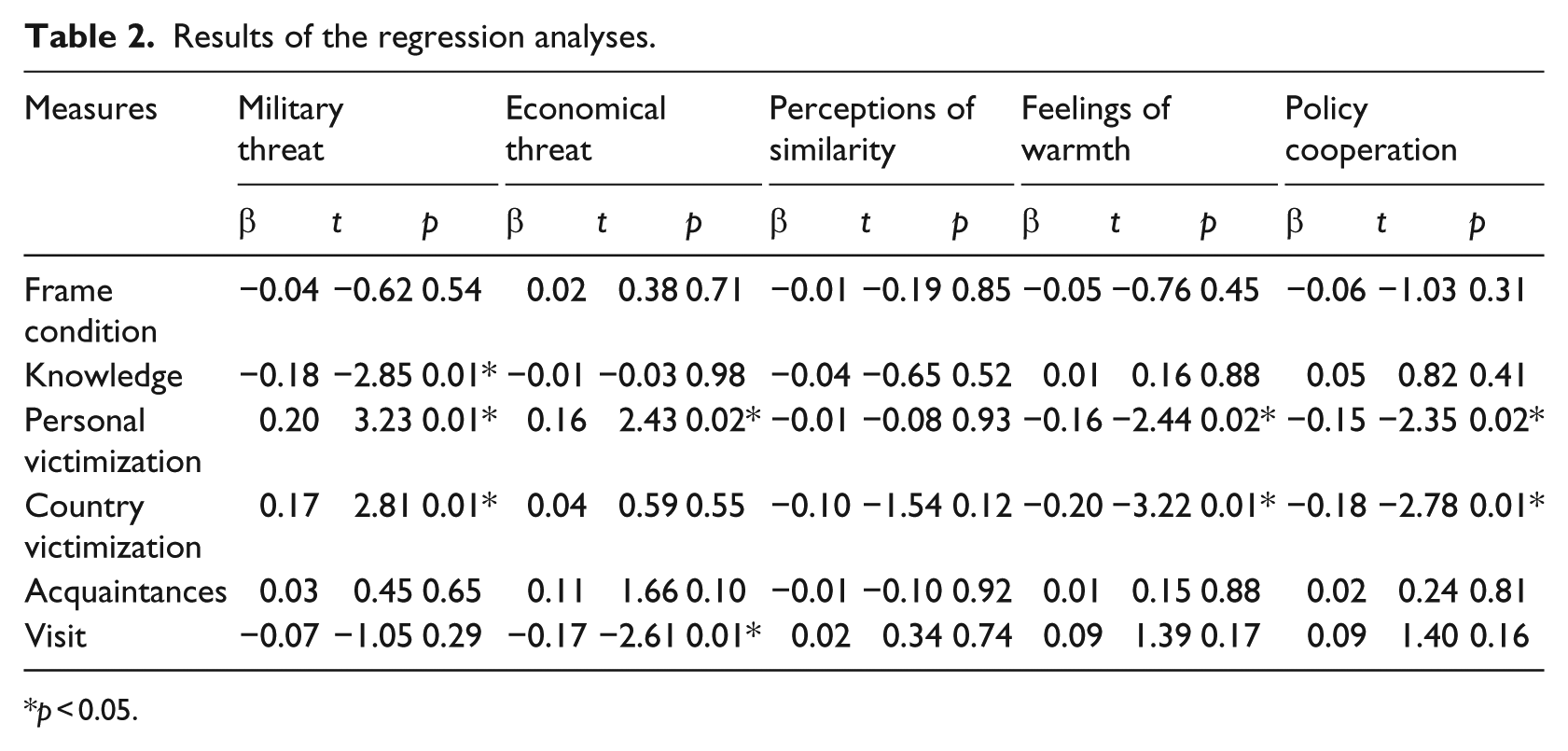
With evidence supporting Hypothesis 1, results in the regression analyses showed that perceived personal victimization was statistically related to the perceptions of military and economical threat (see Table 2). Participants who considered their family members or themselves as having suffered from Russia treated Russia as a more severe military and economical threat than participants who had no personal grievances (M = 6.4, SEM = 0.20 vs M = 5.2, SEM = 0.18, and M = 6.5, SEM = 0.27 vs M = 5.6, SEM = 0.16, for military and economical threat perceptions, respectively). Perceived country victimization also correlated with perceptions of military threat. Participants who believed their country as having suffered from Russia perceived Russia as more severe military threat than participants who believed that their country did not suffer from Russia (M = 5.7, SEM = 0.14 vs M = 3.7, SEM = 0.70). In contrast, country victimization did not influence perceptions of economical threat (M = 5.9, SEM = 0.14 vs M = 5.4, SEM = 0.86).
Results of the regression analyses.
p < 0.05.
Also in line with Hypothesis 1, perceived personal and country victimization was statistically linked with the feelings of warmth and policy cooperation assessments. Participants who considered their family members or themselves as having suffered from Russia had less warm feelings toward that country and were less willing to cooperate with it than participants who had no personal grievances (M = 37.4, SEM = 1.84 vs M = 45.6, SEM = 1.59, and M = −0.31, SEM = 0.09 vs M = 0.05, SEM = 0.07, for feelings of warmth and policy cooperation assessments, respectively). Similarly, participants who perceived their country as having suffered from Russia had less warm feelings toward that country and were less willing to cooperate with it than participants who perceived that their country did not suffer from Russia (M = 41.9, SEM = 1.25 vs M = 61.2, SEM = 5.97, and M = −0.11, SEM = 0.06 vs M = 0.66, SEM = 0.21, for feelings of warmth and policy cooperation assessments, respectively). Finally, with evidence supporting Hypothesis 2, results in the regression analyses showed that framing did not influence threat perceptions, perceptions of similarity, feelings of warmth, or willingness to cooperate (p > 0.05 in all analyses, see Table 2). This finding was in contrast to the results obtained in Germany and Spain, where respondents exhibited statistically significant sensitivity to different framing conditions.
Knowledge and familiarity
In line with Hypothesis 3, levels of knowledge were statistically correlated with perceptions of military threat, whereby more knowledgeable participants perceived Russia as a less severe military threat than participants with lower levels of knowledge (M = 5.1, SEM = 0.29 vs. M = 5.8, SEM = 0.16, for participants whose level of knowledge is above and below the median, respectively). In contrast, levels of knowledge had no statistically meaningful relationship with perceptions of economical threat (M = 5.9, SEM = 0.29 vs M = 5.9, SEM = 0.16, for participants whose level of knowledge is above and below the median, respectively). Finally, in contrast to Hypothesis 4, familiarity was not statistically linked with threat perceptions. Participants who had Russian acquaintances showed similar perceptions of military and economical threat (M = 5.6, SEM = 0.16 and M = 6.0, SEM = 0.15) to those who did not have Russian acquaintances (M = 5.7, SEM = 0.30 and M = 5.5, SEM = 0.40). Similarly, participants who had been to Russia showed equal perceptions of military and economical threat (M = 5.0, SEM = 0.36 and M = 5.12, SEM = 0.31) to those who had not been to that country (M = 5.7, SEM = 0.15 and M = 6.1, SEM = 0.16). 3
General discussion
The narrative about Russia as a key perpetrator and Lithuania as its victim features prominently in our study. Over 90% of participants agreed with the statement that Lithuania suffered from Russia in the past. Nearly a third of the respondents had the memory of personal or family grievances against Russia. Both levels of grievances were distinct (phi coefficient = 0.13), but behaved similarly correlating with the elevated perception of threat and the reduced levels of warmth and support for cooperation, a result that provides evidence supporting Hypothesis 1. This finding is consistent with existent literature pointing to a strong positive correlation between nationalist historical beliefs and the perceptions of threat (Gries et al., 2009b, 2011). The importance of distinct personal memory dimension to threat perception corroborates the findings of intergroup emotions theory, which differentiates between the collective and individual levels of emotions (Smith et al., 2007), and points to the relevance of this distinction in future research. After all, threat perception can be conceptualized as an emotional belief (Mercer, 2010), the strength and persistence of which depends on the level (personal or collective) of emotional experience.
The most theoretically curious implication of this experimental survey has to do with the psychological microfoundations of social memory structures. Referring to the results of the survey, we suggest that the greater the percentage of both personal and country-level grievances, the less this memory appears to be a “chosen” or just politically manufactured phenomenon (Janoff-Bulman, 1992; Volkan, 2001). Its elevation from a personal to a social–institutional dimension is less “artificial,” which in turn implies less sensitivity to manipulation and framing. This is exactly what we observe in the study and when comparing the results to German and Spanish samples. Lithuanian respondents seem to have relatively robust predispositions about Russia, which strongly link to victimization memory, and they exhibit significantly higher levels of “stickiness” in terms of their assessments of Russia and its threat. Thus, historical experiences matter when considering the manipulation and framing of social memories by political and intellectual elite.
The lack of positive framing effect presents an intriguing theoretical supposition. In his famous take on the anarchic nature of international relations, Alexander Wendt (1992) argued that “anarchy is what states make of it.” For constructivists, meaning is tied to ideas and beliefs, which act as raw material for constructing and reconstructing social structures and actor preferences. Barkin (2010) notes that neoclassical constructivism approaches international politics as “intersubjectively constructed rather than objectively given, in that the social structure of international politics does not exist prior to or outside of the mutable norms and discourses that define the identities and interests of actors” (p. 28). The momentum for this construction process is generated by policy or norm entrepreneurs, who seek to persuade (Finnemore and Sikkink, 1998) or rhetorically entrap (Schimmelfennig, 2001) other actors.
However, it appears that this discursive universe at least in some cases is built upon prior experiences that act as information-laded precursors to the process of social construction. In other words, some experiences are not neutral or fuzzy, but favor particular scenarios of social construction, which subsequently impact the levels and persistence of threat perception. They can be viewed as affective–cognitive critical junctures that leave a specific mark in individual and later in institutional memory (Lodge et al., 2006). As Katzenstein (1996) notes, “history is a process of change that leaves an imprint on state identity” (p. 23). Then, what is codified in such social constructs (including social memory) are not just ideas and beliefs, but also ideas and beliefs constituted by shared experiences. Experiences can be constitutive because they contain information such as valence, which leads to differentiated behavioral effects (Kensinger, 2009). In the case of Lithuania, the negative valence associated with the Soviet occupation and subsequent repressions of the population favor the narratives of Russian threat, which in turn stabilize the victim–victimizer paradigm, reduce sensitivity to framing, and elevate the levels of threat perception. Thus, the classical constructivist critique of rationalist approaches for ignoring the process of preference formation can be leveraged against constructivists themselves for underestimating the causal role of information-laden experiences, which act as precursors to the process of social construction. This is akin to Kowert and Legro’s (1996) arguments about the role of dramatic shocks in producing changes in social structures (p. 473). Furthermore, when experiences exhibit high present-day salience and are similar among many individuals within a particular social group, the process of social construction becomes less demanding. There is no need to persuade or to rhetorically entrap but underlying common experiences need to be vocalized in order to transfer them from an individual to a collective level of memory. For example, the Srebrenica massacre hardly needs any acts of construction for the remaining inhabitants of the town. The tragedy in itself is not neutral vis-a-vis Serbia in terms of valence but provides clear precursors for a very specific route of memory construction and, if sensitized through denials by a former adversary, increased levels of threat perception based on that memory (Lind, 2008: 3).
In this particular case, the individual and institutional memories come from the experience of the Soviet occupation of Lithuania and subsequent repressions against its citizens. It carries overwhelmingly negative valence vis-a-vis the Soviet Union because of the very nature of what happened—massive and systematic destruction of people and nationalization of their property. Writing prior to the collapse of the Soviet Union, Smith and Oleszczuk (1992) argued that the Baltic States and Moldova had the highest risk of ethnic unrest qualifying them as “internally colonised nations.”
The core of such a memory can be suppressed, but it is more difficult to reconstruct it as a positive experience. The Soviet authorities tried this strategy for 45 years and it failed even before the collapse of the regime. Once Gorbachev declared the policy of glastnost (increased openness), the issue of the forced incorporation of the Baltic States into the Soviet Union undermined the legitimacy of the state and contributed to its eventual collapse (Strayer, 1998: 153–156). The scope and singularity of this historical experience and its memory is probably most visible in the Baltic Way protests of August 1989 (more than 2 years before the collapse of the Soviet Union) marking the 50th anniversary of the Molotov–Ribbentrop Pact. As noted by Beissinger (2009), this was the moment when “the number of people participating in protest acts approximated the size of the able-bodied adult population of the Baltic nations, so that the crowd as simulated nation approached the actual dimensions of its claimed community” (p. 243). Presently, there is only one political party in Lithuania, Socialist People’s Front, which tends to question the memories of collective victimization and attempts to provide a positive spin on the Soviet experience. In the 2012 parliamentary elections, the party received 1.21% of total votes cast, which clearly indicates how narrow the appeal of such an interpretation is among the Lithuanian public (CEC, 2012).
The effects of victimization memory on intergroup relations can also be compared to the counterfactual (i.e. the absence of such negative memories). In the case of Lithuania, these are relations with Latvia or Belarus. In both cases, there is practically no ground to manufacture a narrative of victimization on either side as these countries (and their titular groups) have a “history of peaceful coexistence” (Plaschinsky, 2012). The intergroup relations might be more or less complicated due to current conflict of interests or personalities, but they are clearly more flexible and easy going than the relations with Russia, which are burdened by negative historical experiences and subsequently constructed institutional memories. This primordialist argument, to draw on terminology from nationalism literature, points to the relevance of preexisting conditions. It does not negate the social construction of historical memory, but it demonstrates that this process is not without its objective constraints and precursors. The universe of available choices is often limited by the nature of historical events. For example, as noted by Gries et al. (2009a), it is much easier to manipulate the historical memories of the Korean War than of the Holocaust:
Because the Korean War ended where it began in a stalemate, and both sides can plausibly claim victory, it is possible to construct positive and negative Chinese and US accounts of the Korean War that respondents should find credible. The Holocaust, by contrast, would be much more difficult to manipulate. (p. 440)
The issue of credibility points to the fact that the alleged infinite regress of social reconstruction is not always as infinite as sometimes argued. In this particular case, the Soviet occupation of the Baltic States and the subsequent repression of their population cannot be credibly reversed into, for example, the Baltic occupation of the Soviet Union and the subsequent repression of its population. However, the debate about the levels of collaboration between the local population and the Soviet government is a much more fluid and open-ended topic, which provides fertile ground for even diametrically different constructions of this historical memory. Returning to the findings of the study, the elevated sense of Russian threat might also relate to the size differences between the two countries, but those respondents, who exaggerated the size of the Russian population when answering knowledge-related questions, showed no perceptive differences from the rest.
The results of the study also provide insight into what building blocks are used in the process of threat assessment. To date, the theory of threat construction has argued that the level of value similarity acts as the first step in determining the levels of threat posed by the other. If the levels of similarity are low, then power asymmetry becomes the key factor in threat determination. However, if the levels of value similarity are high, power asymmetries become largely irrelevant (Garcia-Retamero et al., 2012). This study complements the theory of threat construction by demonstrating that the record of presently salient historical experiences between the two countries codified in personal and institutional memories is the key pre-cursor in determining the levels of identity similarity and threat assessment (see Figure 1). If perceived historical grievances are high and have not been adequately resolved, identity similarity becomes low and insensitive to positive framing about shared beliefs and values. Then a target country is treated as threatening, but the level of threat perception might depend on a number of other factors, including the differences in military capabilities or regime types. These variables have not been investigated in this study, but need to be considered in future research. Similarly, future research should replicate our study using a longer and validated instrument measuring victimization as current operationalization has clear limitations. Still the reliance of the heuristic of threat assessment on the perceived historical record to date seems to make logical sense because such assessments of a target country, like politics in general, are fundamentally uncertain (Cioffi-Revilla, 1998). Thus, past historical record offers a more definite basis on which other factors can be grounded and made sense of.

The role of historical experiences in threat perception.
Historical experiences codified in personal and institutional memories can be treated as a specific type of depository of knowledge—knowledge not only about particular events as such but also about the willingness and openness of actors involved to deal with their consequences. As implied in Figure 1, the resolution of negative experiences through the acknowledgment of grievances and continuing dialogue both at the mass and elite levels (Gardner Feldman, 2012: 12–15) may lower the levels of threat perception by adding positive dimensions to this historical depository of knowledge. It is of course different from the general knowledge about the other country or personal knowledge gained by visiting the country. Based on the intergroup contact theory, we expected to see the attenuating effect of visiting Russia or having Russian friends on threat perception (Hypothesis 4), but the results did not support our expectations. It might have to do with the actual nature of visits that may widely vary in terms of longevity and purpose. However, the high levels of general knowledge about Russia in combination with personal victimization memory turned out to be a significant predictor of heightened economic threat perception in comparison to those who had high knowledge and no personal victimization memory or low levels of knowledge. Thus, partly in line with Hypothesis 3, general knowledge may have a reinforcing effect on threat perception when personal historical grievances are present. Do such grievances motivate to acquire more general knowledge about the out-group? The t-test results show no significant differences in general knowledge about Russia between participants with and without personal victimization memory.
In sum, although some of our initial hypotheses have not been confirmed by the experiment, personal and institutional victimization memories appear to be robust predictors of the levels of threat perception. The memory of previous encounters plays a key role in defining current perceptions of the source of threat. Most notably, the results of this study also suggest that some experiences are less sensitive to social manipulation and framing than others. And this occurs because the experiences are laden with information that favors specific scenarios of memory construction, which in turn may impact the levels and persistence of threat perception. These credibility constraints do not negate the social construction of memory as such, but they demonstrate that this process is not as infinite in its regress as sometimes argued. Thus, the constructivist paradigm may need to be more explicit about the incorporation of preexisting conditions, which influence the dynamics of social construction in general and social memory specifically.
Footnotes
Appendix 1
Funding
The author(s) disclosed receipt of the following financial support for the research, authorship, and/or publication of this article: This study was a part of the project PRO-12061 entitled “Memory and knowledge in threat perception: the case study of Lithuanian–Russian relations” and funded by the Research Council of Lithuania. It was also partially funded by the Ministerio de Economía y Competitividad (Spain) (PSI2011-22954 and PSI2014-51842-R). The authors declare independence from these funding agencies and do not have conflicts of interest including financial interests, activities, relationships, and affiliations.