




Abstract
Reporting from the events of the so-called ‘Euro-revolution’ in Ukraine 2013–2014, the Western media were prompt to point out the excessive use of national symbols, including those connected with the memory of the Ukrainian nationalist organizations ‘OUN’ and ‘UPA’, which for some periods of time had cooperated with Nazi Germany and were involved in the killing of civilians. By using a postcolonial perspective, the article aims to explain this phenomenon, as well as a number of other elements of the politics of memory in contemporary Ukraine, such as the so-called ‘Decommunization Laws’ adopted in 2015. Special attention is paid to Frantz Fanon’s idea of ‘anticolonial nationalism’ and Homi Bhabha’s idea of hybridity and their realization in Ukraine.
After a protracted negotiation process, Ukraine was, in 2013, on its way to sign an association agreement with the European Union (EU). However, on 21 November, shortly before the document was signed, the Ukrainian government, under pressure from Russia, declared that the association agreement with the EU would be suspended. 1
Offended by Russian attempts to dictate Ukrainian politics and frustrated with the notoriously corrupt government led by President Yanukovych, hundreds of people gathered in the main square in Kyiv – Maidan Nezalezhnosti – Independence Square – to voice their protest against the government’s decision to choose a Russian model of development for Ukraine instead of the European one. It started as a spontaneous protest of social media users (Portnov, 2014: 8), but the government’s violent repression of the young protesters changed the dynamics of the demonstrations and caused an anger that made thousands of Ukrainians take to the streets. The protest then went into its second phase and became a revolution against a government that not only was corrupt and subjected to Moscow but also showed contempt towards citizens’ rights and human rights. The ‘Euromaidan’ became a mass movement that encompassed different political forces. However, almost from the beginning, a significant number of the external observers analysing the protests focused on signs of nationalism. Some of them highlighted the demonstrative, frequent singing of the Ukrainian anthem, organized on a few occasions as a mass event with about a million participants. 2 In some Western media, 3 accusations were raised that the movement gave expression to right-wing extremism, and Russian propaganda went as far as calling it a neo-Nazi or fascist movement. 4 These accusations were based on the fact that one of the three leaders who represented the opposition on Maidan was Oleh Tiahnybok, the chairman of the right-wing ‘Svoboda’ Party. Moreover, among the national symbols used to mobilize the protesters, the symbols of the Organization of Ukrainian Nationalists (OUN) and its military arm, the Ukrainian Insurgent Army (UPA), were very visible. The uses of the memory of these organizations were seen as very disturbing due to the so-called ‘dark chapters’ in their history dealing with their collaboration with Nazi Germany, involvement in the killing of Jews, attacks on Polish populations in Volhynia (1943–1944), ‘purging’ campaigns against Ukrainians who did not support them, as well as an authoritarian, nationalist character of their ideology. Those most difficult aspects of the OUN and UPA history are the subject of ongoing controversy among the public and among scholars. Due to the limited space of this article, we cannot summarize, here, the heated debates other than pointing to the existence of the three main positions: first, those who deny the crimes, second, those who state that the crimes (or at least some of them) took place, explain their context, and try to come to terms with them, and, third, those who reproduce the schematic image of the OUN and UPA as ‘fascist and German collaborators’, fostered in Soviet culture and persisting in much of the post-Soviet space. 5 In any case, because of all the difficult and controversial aspects in the history of the OUN and UPA, it was perceived as provoking when the protesters during the Maidan revolution waved OUN’s black and red flags next to flags of the EU and of Ukraine and when they sung the UPA songs. The OUN and UPA greeting – ‘Slava Ukraiini!’ (‘Glory to Ukraine!’), with the anticipated answer ‘Heroiam slava!’ (‘Glory to Heroes!’) – was heard from the speakers on the stage on Maidan and from the crowds of protestors.
Observing this kind of use of the past, many external observers interpreted the whole protest as an outburst of radical ‘nationalism’, 6 while the majority of ‘insiders’, that is, Ukrainians participating in the demonstrations, did not share this view. 7 They saw the protest rather as a liberation movement and named the events on Maidan ‘Revolution of Dignity’ or Euro-revolution. Some of the leading Ukrainian writers, for example, Oksana Zabuzhko (2014) and Yuri Andrukhovych (2015), wrote that the Euromaidan had put an end to the post-Soviet age in Ukraine. The Euro-revolution implied the true end of the Soviet system and the beginning of genuine Ukrainian sovereignty. Similarly, the Ukrainian historian Yaroslav Hrytsak (2015a) contended that Ukraine finally had the chance to actually get rid of its Sovietness. This strong contradiction in interpretation of the events in the Euromaidan from the side of ‘insiders’ (people in Ukraine who share the views of the intellectuals quoted above) and a significant number of ‘outsiders’ demonstrates a serious difficulty to understand the Ukrainian revolution. The aim of the following text is therefore to offer at least a partial explanation of this phenomenon by looking at Ukrainian memory politics in the Euromaidan and shortly afterwards through the lens of postcolonial studies. We postulate that the postcolonial theory can help us comprehend the complexities of memory politics in Ukraine. We want to argue in favour of the hypothesis that the politics of memory, observable in today’s Ukraine, expresses ambivalence, which, according to the postcolonial scholar Leela Gandhi (1998: 5), is typical of the colonial aftermath. On one hand, we can see anticolonial and nationalist models of remembering, and on the other, the expressions of new subjectivity, transculturality and ‘hybridity’, as conceptualized by Homi Bhabha (2004).
Among many important topics of memory politics in contemporary Ukraine that could be studied with the help of a postcolonial approach, we have chosen to focus primarily on the memory of the Second World War and war-time nationalist organizations. This is because it is precisely this memory that, as we will demonstrate, has been undergoing major transformations since the Euromaidan, and it was most frequently referred to in the Laws of Decommunization from 2014, one of the focal points in the analysis that follows. We should, however, stress that there are other important memory veins that, together with the memory of the Second World War, have formed the nucleus of memory work since the Ukrainian independence. These are, for example, the struggle for Ukrainian statehood in 1917–1921 8 and, first and foremost, the memory of Holodomor, the manmade famine in Ukraine in 1932–1933. 9
Ukraine from a postcolonial perspective
Although postcolonial studies tend to focus on the relations between overseas empires and the conditions in the Third World countries that they had previously subjugated, the postcolonial theories lend themselves to a broader application, which was demonstrated, among others, by Declan Kiberd (1995) in his book Inventing Ireland, focusing on the relation between the British Empire and Ireland. There have also been some attempts to apply a postcolonial perspective to the countries of Central and Eastern Europe, including Ukraine. 10 However, it should be mentioned that these ideas meet with opposition. As noticed by Korek (2015: 4), postcolonial studies emerged at the time of the Cold War mainly within Marxist circles, and these ideological roots made it difficult for scholars in the field to view the ideological and economic oppression as well as the national discrimination exercised by the Soviet Union as deserving condemnation on the same terms as the colonial politics of the ‘West’. This was not least due to the double game conducted by the Soviet Union, simultaneously supporting anticolonial struggles against former Western empires and persevering in its oppression of nations and minorities in the USSR and the Eastern Block. In the case of Ukraine, the opponents also point to the fact that the category of race cannot be applied to the relations between Russia and Ukraine, as if racial chauvinism was not comparable to national chauvinism (see Korek, 2009: 3). These kinds of arguments originate in a generally reluctant attitude to postcolonial studies on the part of a number of Ukrainian scholars, who, according to Shkandrij (2009), perceive the concept of ‘postcolonial’ as demeaning and associated with the ‘Third World’ and underdevelopment. This is seen as humiliating in the process of regaining national self-confidence and is one of the reasons why no strong school of postcolonial criticism has developed within the country.
However, there have been some very fruitful studies that apply the theories of postcolonialism to the Ukrainian literature and Ukrainian culture (Grabowicz, 1995; Pavlyshyn, Chernetsky, 2003; 1992; Riabchuk, 2009, 2012; Shkandrij, 2001, 2009, 2015). Their authors have clearly demonstrated the colonial and postcolonial experiences of the Ukrainian people and their existence as the subaltern in the Russian and Soviet empires. It has been pointed out that ‘Ukrainian society shows a remarkable similarity to other colonized societies, in terms of the patterns and syndromes already described and elaborated at length by Frantz Fanon’ (Riabchuk, 2009: 8). If we accept that one of the fundamental premises of colonization is that the imperialist tries to instill in the territory of the colonized culture a conviction of the superiority of its own culture and ideology (world view), Ukraine fits this description very well. For centuries, Moscow viewed Ukrainian culture as peripheral and inferior, while the Russian culture and language were treated as superior and universal. This view became largely internalized by the Ukrainians themselves and led the Ukrainian elites to adopting the Russian language and seeking education and careers in such imperial centres as Moscow or St. Petersburg. Russia has maintained a vast cultural influence in Ukraine, even after the country’s formal independence and despite the granting of official status to the indigenous, that is, Ukrainian language. This is the reason why Ukrainian emancipation from the grip of the Russian empire is as much about politics and economy as about culture, including first and foremost the language and narratives of the past, seen as crucial for the formation of Ukraine’s own identity.
If we recognize the Ukrainian condition as postcolonial, it is possible to look at Ukrainian politics of memory using the concepts of ‘anticolonial nationalism’ and ‘hybridity’.
As stated by the postcolonial scholar Leela Gandhi, nationalism has long been acknowledged as an important feature of decolonization struggles, and it constitutes ‘the political vector through which disparate anticolonial movements acquire a cohesive revolutionary shape and form’ (Gandhi, 1998: 111). Nationalism supplies the revolutionary vocabulary and has the ability to integrate various popular movements. According to Frantz Fanon, anticolonial nationalism should be seen as a ‘therapeutic necessity’ and as ‘a process of reterritorialization and repossession, which replaces the “two-fold citizenship” of colonial culture with a radically unified counter-culture’ (Gandhi, 1998: 112). Anticolonial nationalism challenges and effectively subverts the ruling ideologies. The danger is, however, that in its ‘will-to difference’, it easily becomes a copy of that by which it felt itself to be oppressed. A number of postcolonial critics noticed the mimetic nature of anticolonial nationalisms (e.g. Cohn, 1983; Gandhi, 1998: 118). In the field of politics of memory, it is expressed through the uses and production of narratives about the past that reject everything connected with the imperial culture. This results in the inversion of the colonial discourse and, in fact, in an unconscious reiteration of the binary oppositions of colonial discourse. Thus, the anticolonial politics of memory tend to be locked in the colonial ones. Another feature of anticolonial politics is a desire to forget the colonial past and an urge for historical self-invention and self-assertion. Accordingly, there is a search for national heroes and roots leading to the invention or grave distortions of historical figures and events. Thus, postcoloniality can be described as a condition ‘vulnerable to the infectious residue of its own unconsidered and unresolved past’ and ‘troubled by the consequences of a self-willed historical amnesia’ (Gandhi, 1998: 7).
Although many anticolonial critics (e.g. Fanon, 1990; Lloyd, 1995; Parry, 1994) recognize the positive role of anticolonial nationalism in mobilizing the colonized people, they also tend to believe that it constitutes a transitory stage in the decolonizing process. In their view, this stage should be followed by the emergence of new social consciousness that exceeds reified identities and rigid boundaries involved in nationalistic thinking. According to Homi Bhabha, these polarities should be bridged by a ‘third space’ of communication, negotiation and translation. In this zone, or, in his words, ‘place of hybridity’, a qualitatively new identity can be constructed, that is new, neither the one nor the other (Bhabha, 1994: 25). ‘Such negotiation is neither assimilation nor collaboration, it presumes that the subject can “choose” the way he is going to take in the process of his identification through the active formation of cultural transformations’ (Ha, 2000: 383).
Hybridity is in opposition to essentialism. It refers to the creation of new transcultural forms within the contact zone produced by colonization. Hybridization can have several forms, among others cultural, political or linguistic. According to Bhabha, hybridity and ‘linguistic multivocality’ have the potential to intervene and dislocate the process of colonization through the reinterpretation of political discourse. Hybrid agencies refuse the binary representation, they ‘deploy the partial culture from which they emerge to construct visions of community and versions of historic memory that give narrative form to the minority position they occupy’ (Ha, 2000).
Considering both the anticolonial patterns of nationalist politics of memory and ideas of hybridity as its potentially next stage, we will now proceed to scrutinize the Ukrainian case and ask about the features of the Ukrainian politics of memory.
Some general trends in politics of memory in Ukraine from 1991 to the Euromaidan
Following the dissolution of the Soviet Union in 1991, Ukraine declared its independence. However, as noticed by several researchers (see, for example, Kuzio, 1998; Wilson, 2005, 2014) there had, until the Orange revolution in 2004, been no radical demands, not to speak of policies, of de-Sovietization or decommunization on the state level, which in the Ukrainian context would be equivalent to the process of ‘decolonization’. The ruling post-Soviet nomenclature-cum-oligarchy had been largely non-ideological and a-national and did not pursue any comprehensive politics, except for promoting its own interests. As remarked by Riabchuk (2009: 16), they behaved like a typical Third World ‘comprador’ elite. They flirted with Moscow, and they muddled through between Ukrainian anticolonial nationalists and the Russian minority, afraid of the nationalism expressed in these two groups. They wanted to keep the status quo of a Soviet-cum-independent Ukraine. In this context, the past was addressed by many political actors with purposes changing depending on the context.
Right after the collapse of the Soviet Union under the presidency of Leonid Kravchuk (1991–1994), the slow process of ‘nationalization’ of history started. According to the Ukrainian scholar Georgiy Kasianov, it was the second stage of the nationalization of Ukrainian history. The first had taken place in the mid-nineteenth century and reached its height in Mykhailo Hrushevskyi’s ‘History of Ukraine-Rus’’ but was interrupted and destroyed as a tradition by Soviet authorities after the Second World War. The second stage began in the late 1980s and is not yet complete (Kasianov, 2009: 7). 11 Within this scheme, the main aim of Ukrainian history is national independence and state sovereignty. Thus, according to the historical narratives officially presented since 1991, the emergence of the Ukrainian state in 1991 is a culmination point in Ukrainian history. History, told this way, contributed to legitimize the ruling power since it presented the current Ukrainian state as something for which all previous generations had fought. In this context, the approach to the history of the Second World War also changed. The mere wording ‘Great Patriotic War’, used to describe the war in Soviet terms, was questioned. The dating of the ‘Great Patriotic War’, that is, 1941–1945, was also criticized. In Soviet (and Russian) history writing, the war did not begin in 1939 but was dated to 1941–1945, starting with Hitler’s aggression against the Soviet Union. A more appropriate wording, ‘Second World War’, was introduced into textbooks and into public use. The Molotov–Ribbentrop Pact that had laid the ground for the division of Eastern Europe between Stalin and Hitler at last became known to the broader public.
It should be emphasized that it was not commemorative practices on the state official level that came into focus under Kravchuk’s presidency; it was rather education that became the main arena of anticolonial transformations. The Swedish historian Johan Dietsch has argued that in independent Ukraine, ‘“nationalization” became a lens through which all education was to be filtered and with which it was possible to rid the educational apparatus of Soviet remnants’ (Dietsch, 2006: 80). 12
In 1994, Kuchma was the elected president and remained in power up till the end of 2004. As the politics of 1994–2004 as a whole were marked by incongruity and a multi-vector character of international politics, the same is true of the memory politics. The nationalization continued within the field of educational policy, while Kuchma, similarly to Kravchuk before him, avoided dealing with a past that could awake controversies with Russia or deepen the differences of memory between different regions in Ukraine. To ensure his popularity, he held different speeches in different regions of Ukraine (Portnov, 2013). Thus, anticolonial stance was used instrumentally, only when it could support his power.
The first tangible and more genuine anticolonial protest against this status quo was the Orange Revolution in 2004. Although the hopes connected with it were not fulfilled in the sphere of political and economic reforms, the rule of President Viktor Yushchenko (2005–2010) marked a new era in the politics of memory that acquired anti-Soviet (i.e. anticolonial) features. He supported the new version of Ukrainian history writing that was aimed to be more national in its core, that is, representing the experiences of Ukrainians. First and foremost, the re-evaluation was concentrated around the topic of the Second World War. The above-mentioned underground nationalist movement represented by the OUN and UPA came to the forefront of the new version of history.
Viktor Yushchenko also tried to institutionalize the normative approach to history with the main directive of decommunization when he sanctioned the opening of the Institute of National Memory in 2006. Between 2007 and 2014, the main topics of interest outlined on the website of the Institute of National Memory were Holodomor, qualified as genocide against the Ukrainian nation, 13 the national liberation struggle (1917–1920) and the Second World War, with the main emphasis on the history of the OUN and UPA as fighters for Ukrainian independence. 14 Before leaving his presidential post in January 2010, Yushchenko awarded the posthumous title of ‘Hero of Ukraine’ to Stepan Bandera, the leader of OUN. This decision was broadly discussed and vehemently disputed in Ukraine and abroad. 15 Those who approached the presidential decision with understanding argued mainly for the anti-Soviet meaning of Bandera’s figure. 16
With the election of the pro-Russian Viktor Yanukovych as the president of Ukraine in 2010, the politics of memory started to take on some new features. It is possible to speak about re-orientation from anticolonial politics of memory to ‘restorational’ memory politics characterized by the return to Soviet symbols. The first illustrative step in this direction was a common Ukrainian–Russian–Belorussian celebration of the victory in the Second World War and the return to the name of the ‘Great Patriotic War’ in the public statements of high-ranking politicians. In May 2011, the Ukrainian Parliament took a decision on the ‘Flag of Victory’, which essentially allowed the use of the Soviet red flag as a symbol on Victory Day. Yanukovych also appointed a new director of the Institute of National Memory, Valeriy Soldatenko, the historian of the Ukrainian revolution of 1917–1921, born in Donets’k region and a member of the Communist Party of Ukraine. In the opinion of many commentators, the newly appointed director presented an overtly pro-Russian version of history. 17 His views on the famine of 1932–1933, which he hesitated to term ‘Holodomor’, and his ‘negative attitude’ towards the UPA leaders – Shukhevych and Bandera (expressed in voiding Yushchenko’s proclamation honouring them), became the most discussed issues among intellectuals, journalists and some politicians. 18
Such discussions demonstrated that to most critics, the topics of Holodomor and the OUN and UPA obviously served as a litmus test of his degree of patriotism. Yanukovych’s party, called the Party of the Regions, made some anti-UPA and pro-Soviet/Russian moves in memory politics. In the spring of 2010, Vadym Kolisnichenko, a deputy of the Party of the Regions, organized, in the name of ‘Russian-speaking Ukrainians’, an exhibition in Kyiv devoted ‘to Polish and Jewish victims of UPA with the clear aim to use this tragic memory in the political struggle’ (Portnov, 2013: 131). At the same time in Zaporizhzhia, the local division of the Communist Party built a monument to Stalin, which was later vandalized by Svoboda Party supporters. This clearly signalled the clash between the anticolonial nationalists and the regime that intended to defend the legacy of Soviet imperialism.
As stated above, the dissatisfaction with Yanukovych’s government culminated when Yanukovych declared that he would suspend signing the association agreement with the EU, which had the support of the majority of the Ukrainian people. The refusal was interpreted as throwing Ukraine into the arms of Russia, since it meant choosing the Eurasian Custom Union proposed by Russia instead of a closer connection with the EU. The protests on Maidan Square reached a climax on 22 February, when the Parliament voted for the impeachment of the president. Yanukovych fled the country and escaped to Russia. However, there was no euphoria on Maidan. The victory of the protestors was overshadowed by the fact that more than 100 people died during the protests. Moreover, in the weeks that followed, Ukraine faced a new danger – the Russian invasion of Ukrainian territory and the annexation of Crimea in March 2014. 19
Anticolonial or hybrid?
The Euromaidan itself became the space where old memories were used for mobilization, and it also produced new memories of glory, struggle and sacrifice. By and large, all main national symbols were placed there by the protestors, including, as stated before, the contested symbols of the OUN and UPA. The units of self-organized groups of protestors were, for example, called ‘sotni’ (squadrons), referring both to Cossackdom and to the UPA, as they too were organized in ‘squadrons’.
What was happening on Maidan included taking revenge on and trampling over old symbols of Soviet domination. In the evening of 8 December, the Lenin monument was taken down. Some of the protesters connected with the ‘Svoboda’ Party took responsibility for the action and announced it as an act based on the will to eliminate the legacy of Soviet totalitarianism (Marchenko and Kurbatov, 2014). Soon after the Lenin monument in Kyiv had been toppled, the demolition of other Lenin monuments started throughout Ukraine. 20 These acts can clearly be interpreted as manifestations of spontaneous, anticolonial mass protests. The demands for decommunization and de-Sovietization became central to memory politics during and immediately after the Euromaidan.
Directly after the Maidan events, when Yanukovych had fled and Russia had annexed Crimea, the interim government appointed a new director of the Institute of National Memory – Volodymyr Viatrovych. He was the former director of the Centre of Research of the Liberation Movement, the main organization that was studying the OUN and UPA history. This institution became the main authority for producing, managing and steering commemorative practices on all national levels.
The memory of the Second World War came into focus for the new politics of memory. In response to the accusations made by the Russian media and Russian officials of Ukrainians being involved in ‘fascism’, Ukrainians ‘recalled’ their contribution to the victory over Nazi Germany. Historians estimated that there were more than 3 million Ukrainians in the Red Army. Some put the number at 4.5 million Ukrainians, 21 but this contribution to the victory over Nazi Germany had not been visible since they had merely been labelled ‘Soviet soldiers’. Now it was time for Ukraine to reclaim their rightful place among the fighters for the liberation of Europe from the Nazis. In 2014, with 9 May approaching, the Institute of National Memory published informational charts where they pointed out that 6 million Ukrainians had fought within the ‘Soviet military forces’ and around 100,000 had been in the UPA. Remarkably, the estimation of the number of Ukrainians in the Soviet Army done by historians differed significantly from those presented by the Institute of National Memory. Moreover, the number of those who were fighting in the UPA is lower in the chart than that estimated by historians. Numerical estimations are always difficult, especially in the case of such underground movements as the UPA, but what is characteristic of the work of the Institute is how it tries to emphasize the Ukrainian contribution in the Second World War, counting all the units of which ethnic Ukrainians were part. Additionally, it is worth mentioning that in 2016, the Institute created a special chapter on its website called ‘Ukrainian Second World War’ (Picture 1).
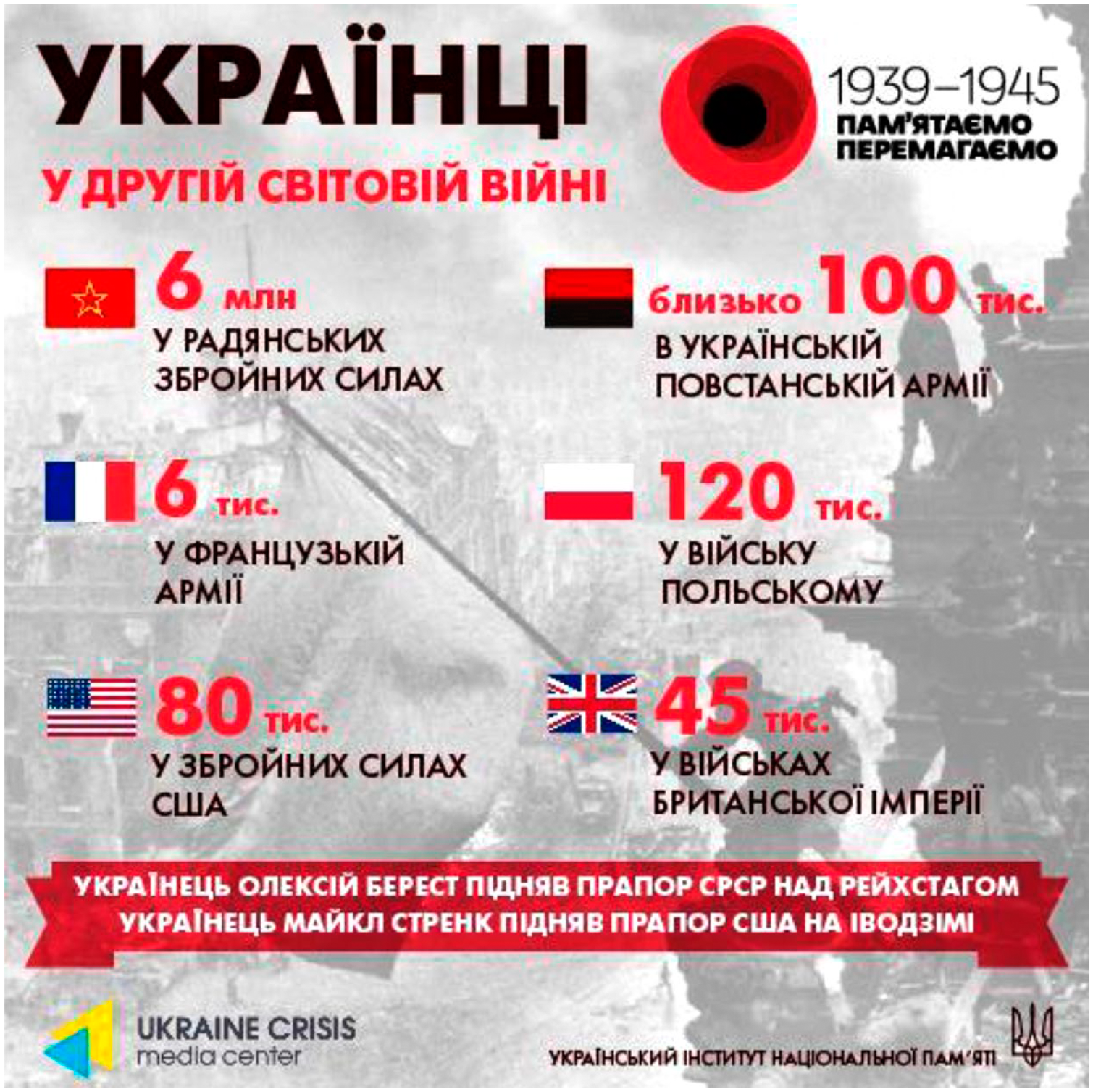
Ukrainians in the Second World War. Picture of the Institute of National Memory. It counts ‘6 million Ukrainians in Soviet Military Forces, 6000 in the French Army, 80,000 in the US army, 100,000 in the UPA, 120,000 in the Polish Army, 45,000 in the military forces of the British Empire’.
One of the first most important changes was the introduction, in 2014, of a new symbol of Victory Day – the poppy flower and the slogan ‘Never again’. According to Viatrovych (2014), the new symbol of victory shows the ethnic (Ukrainian) dimension of victory, while emphasizing the Ukrainian place in European memory culture. The poppy with the inscription ‘1939–1945 Never Again’ undoubtedly referred to the common European framework of remembrance of victims of war. The interactive map ‘poppy field’ launched by the Institute of Memory certainly referred to the poem ‘In Flander’s Fields’ by John Macrae, written in 1915 in commemoration of the fallen soldiers in the First World War. Yet, in this interactive map, the space was limited only to the Ukrainian territory and to Ukrainian citizens who fell in the Second World War, both in the Red Army and in the units of the UPA. In this way, the memory of war from different perspectives was attempted to be united within a common interactive space. This ‘common-izing’ feature became the characteristic feature of memory politics in Ukraine after the Euromaidan.
It should be pointed out that this way of remembering the Second World War was shaped in direct opposition to the Soviet tradition. The Soviet Union (and subsequently post-Soviet Ukraine too) also used a flower as the symbol of victory, but it was a carnation. The wording known to every European: ‘never again’ (‘nunca mas’ or ‘nie wieder’, etc.), had not been used in memory culture in Ukraine on any occasion before (Picture 2).
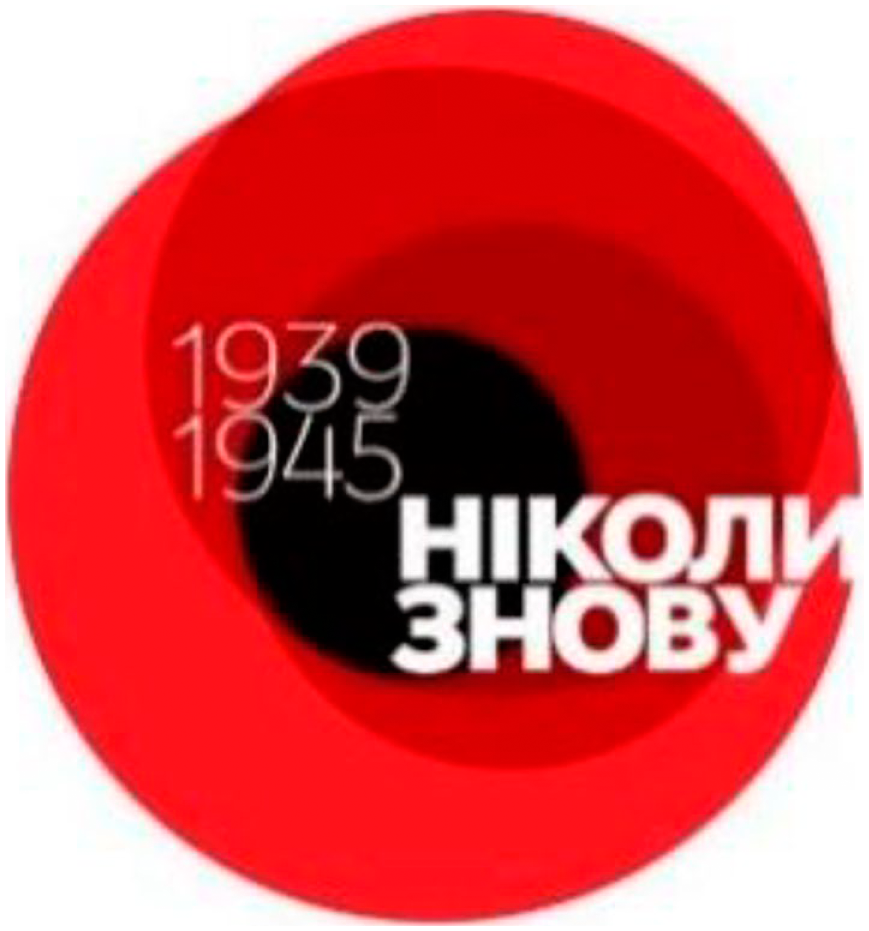
Symbol used for the Victory Day commemoration in 2014. ‘1939–1945 nikoly znovu’ (never again).
It should be added that later on, in 2015, in the context of the Ukrainian – Russian war, which already has lasted for more than a year, the slogan ‘Never Again’ was changed. It became ‘
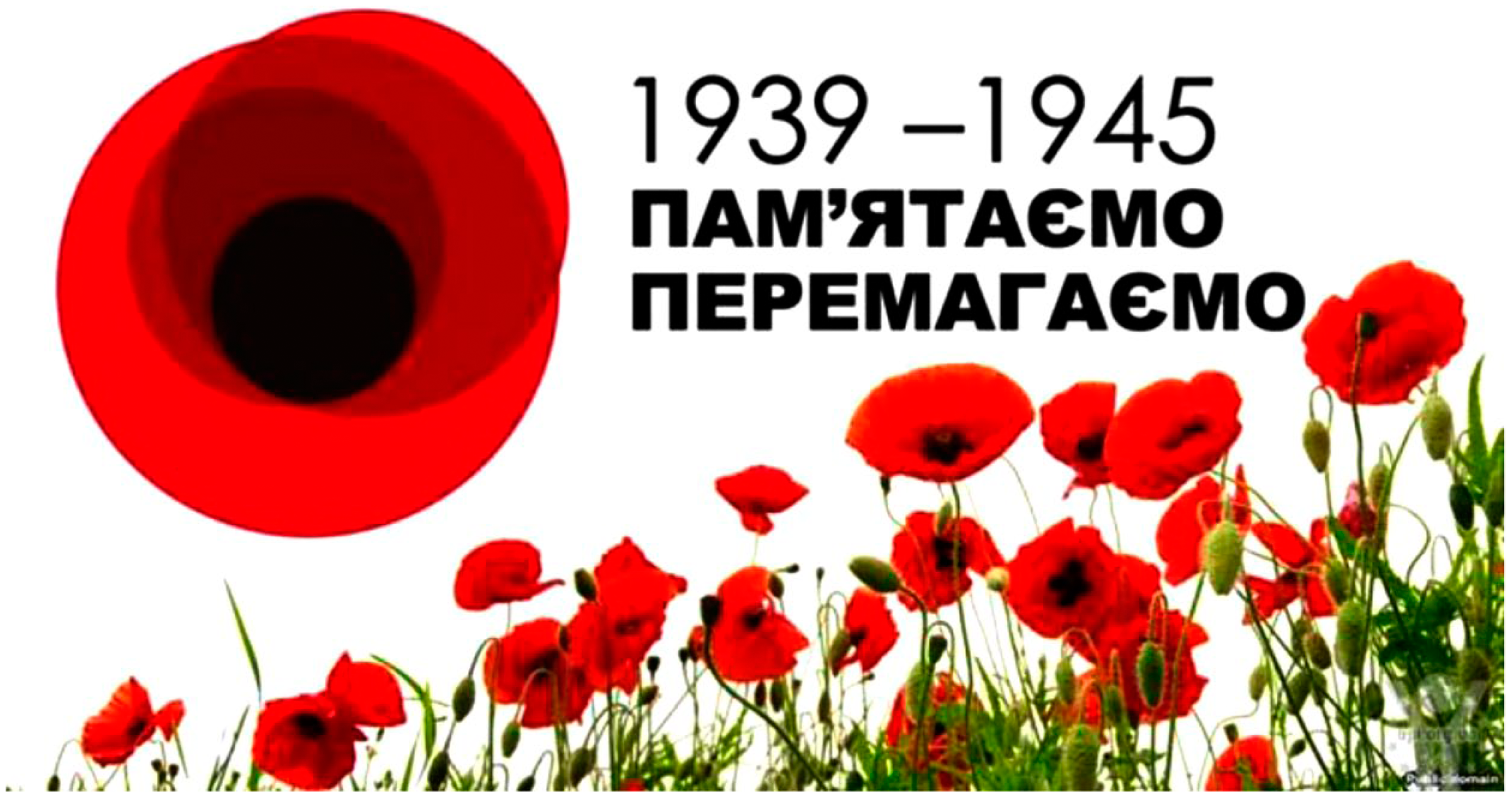
We Remember. We win. Symbol introduced in the 2015 celebration of the victory over Nazism.
The laws of decommunization
Perhaps, the most demonstrative acts of anticolonial nationalist politics of memory after the Euromaidan became the new laws on decommunization adopted in May 2015 (Verkhovna Rada Ukraiiny 2015 a, b, c, d). They were presented by the authorities as necessary in a society where the Soviet past was seen, not only as the past but also as a threat to the present and to the future existence of the nation, as sympathies with the Soviet Union were seen as sympathies to Russia and to the pro-Russian rebels in the east of the country. 22
These ‘Laws on Decommunization’ include four separate ‘laws’, quite different in the themes, motivations and subjects with which they deal. However, in Parliament they were presented as one package, which made a discussion of their relevance very complicated. The laws include the law on the commemoration of the victory over Nazism in the Second World War 1939–1945, 23 the law on the condemnation of the Communist and National-Socialist (Nazi) totalitarian regimes in Ukraine and a ban on the propaganda of their symbols, 24 the law on the status and commemoration of the fighters for the independence of Ukraine in the twentieth century 25 and, last but not least, the law on granting access to the archives of the repressive institutions of the Communist totalitarian regime 1918–1991. 26 As we can see from the titles alone, the laws refer to very different issues in the politics of memory.
The new ‘Law on the Access to the Archives of repressive organizations of the Communist totalitarian regime 1917–1991’ states that it stems from the conviction that ‘promoting better understanding of recent history can help avoiding conflicts and hostility’. Furthermore, it declares that it aims to
promote the establishment of dialogue in society … not to let the crimes of the totalitarian regimes happen again, not to allow any discrimination on the ground of national, social, class, ethnic, racial or any other characteristics in the future, to promote the renewal of historical and social justice, eliminating the threat to the sovereignty, territorial integrity and national security of Ukraine.
27
It is noteworthy that the same law states that ‘inaccessibility to the archives became one of the circumstances that led to the annexation of Crimea and the conflict on the territory of the Donetsk and Lugansk regions’. 28
While these laws are presented as the cure for a society saturated with conflicts, in reality they can serve as strong catalysts for conflicts and tensions. It needs to be said that directly before the annexation of Crimea, Kremlin’s special commission on classified information prolonged the ban on the disclosure of the KGB archives from 1918 onwards, arguing that there might still be information relevant to the present (Grani.ru 2016). 29 This fact shows how much the past matters in de-stabilized countries and how the actions are mirrored in both countries. While Russia closes its archives, Ukraine opens theirs. However, Ukraine is, in a mimetic gesture, trying to monopolize the archives under one institutional structure of the Institute of National Memory.
Before they were signed, the laws mentioned above were criticized by many historians in Ukraine and abroad as they were seen as limiting the freedom of speech. A group of international and Ukrainian scholars published an open letter to President Petro Poroshenko and to the Chairman of Ukraine’s Verkhovna Rada, Volodymyr B. Hroysman, with a request not to make the drafts law, since they violated the freedom of speech. 30
After the letter had been published on the website of the well-known intellectual magazine ‘Krytyka’, it was followed by a series of articles by prominent scholars of Ukrainian studies. This way a vivid discussion was launched between scholars who expressed their opinions about the laws and about the process of decommunization, in general. 31 Some scholars argued that such laws had been required for a long time, but that perhaps they should be slightly edited (Lunin, 2015); some supported the view that the process of decommunization was needed, not only in the form of legislation but rather in practice, challenging the Soviet ‘path dependency’ (Kulyk, 2015); some emphasized the distinction between decommunization and de-Sovietization, arguing that what was going on in Ukraine was closer related to the latter: a distancing from the Soviet legacy (Haukhman, 2015). Yet, other scholars suggested that it is erroneous to see historians as ‘doctors’ who can prescribe a specific view of the past (Portnov (2015). Volodymyr Viatrovych, the director of the Institute of National Memory, also used the Krytyka platform to reply to the letter signed by international and Ukrainian scholars and addressed to President Poroshenko. He argued that these laws were directly connected with the security issues of the country, and if they would have been adopted earlier, there would probably not have been any conflicts in the eastern part of the country (Viatrovych Volodymyr, 2015).
Furthermore, the Venice Commission 32 issued their recommendations to edit ‘The Law on the condemnation of the Communist and National-Socialist (Nazi) totalitarian regimes in Ukraine and a ban on the propaganda of their symbols’, as it goes against the right of freedom of expression and association (Coynash, 2015b).
The director of the Institute of National Memory Volodymyr Viatrovych said that the respective commission in Ukraine could make the required alterations; 33 yet at the time of writing this article, no alteration had been made.
Some critics went so far as calling the adoption of these laws the ‘fascist-ization’ of Ukraine that played into the hands of the Russian propaganda, trumpeting that Ukraine was ruled by a ‘fascist junta’. 34 All these disputes demonstrated not only the lack of professionalism of the people who crafted the laws and the lack of strategic thinking on the part of those who adopted such laws but also the rigid limits of interpretation within the scholarly community that applied universalist theoretical frameworks, ignoring the Ukrainian historical context, including the condition of postcoloniality.
Interestingly, the law on the ‘fighters for independence’ defines ‘participants of the fight for the independence of Ukraine in the twentieth century’ as the fighters who not merely gained but also regained independence, thus, emphasizing that the authors of the law and the President who signed it believed in an independence that was established already before the twentieth century. This can be seen as an example of ‘self-invention’, which is typical of anticolonial historical discourse.
Moreover, the ‘decommunization’ laws are presented as connected with security issues. The need for them is explained in the local context as ‘securing the country’s sovereignty’ and reinstating historical justice for crimes such as Holodomor. It is clear that these laws operate within the ‘Soviet’ framework of history writing, where there is a strong belief in the existence of only one ‘correct’ interpretation of history, and that the state can punish any deviation from this interpretation. Thus, these laws, while aiming at a de-ideologization so badly needed in Ukraine, instead produce another ‘ideologization’ of history and memory. In this way, they reflect a classical anticolonial dilemma about ‘will-to-difference’ that becomes ‘a copy of that by which it felt itself to be oppressed’ (Deane, 1990: 8).
The examples described above point to the presence of a strong anticolonial discourse that results in politics of memory that are depended on the colonial (Soviet and Russian) idiom as they constantly react to it. 35 However, this diagnosis does not do justice to the complexity of the situation in Ukraine. To give a comprehensive picture, it is also necessary to highlight many proofs of the existence of politics of memory that can be seen in line with the concept of ‘hybridity’. It is about attempts to transgress binary anticolonial national consciousness, bridge polarities and create new forms of identity. Indeed, such attempts have already been noticed in the reaction to the ‘Laws on Decommunization’. These laws became perhaps the most discussed and criticized steps in memory politics since Ukrainian independence. The massive criticism on the part of intellectuals led the government to appoint a parliamentary commission that scrutinized the laws. Experts from the commission did not support the adoption of these laws. In their ‘Conclusions’, there are numerous comments against this legislation, as some parts of it directly contradict other laws and, most importantly, the Constitution of Ukraine. For instance, the Constitution directly protects and promotes the principle of pluralism where no one can be persecuted for adherence to any ideology and the state is, in itself, proclaimed as detached from any ideology. However, the law on the propaganda of totalitarian regimes goes against such constitutional statements by prescribing up to 10 years of detention, together with the confiscation of all property, for disseminating Communist or Nazi propaganda.
The expert commission explicitly recommended the president not to sign the laws, as they needed re-working to be more precise. The laws were, nevertheless, signed by the president with a peculiar comment presented to the press that although these laws were signed, work remained on making these laws ‘implementable’ and ensuring that they were not in conflict with human rights. 36 This signalled that the president himself saw the laws rather as an important symbolic gesture than as a legislative policy that was important and feasible to follow. In this way, he opened for a continuing dialogue about memory politics and the possibility for future compromises. 37
The symbolic character of the laws finds expression in the rhetorical, almost poetical language in which they are written. The legal texts are proposed as steps for ‘establishing historical and social justice’. The ‘hybridal’ elements of these laws can be noticed in their references to three distinct traditions and practices: first, they refer to international norms such as UN declarations and EU legislation; second, the need for these ‘decommunization’ laws is explained by the local context as ‘securing the country’s sovereignty’, reinstating historical justice for crimes like Holodomor; third, these laws operate within the ‘Soviet’ framework of history writing, where there is a strong belief in the existence of only one ‘correct’ interpretation of history, and that the state can punish the deviation from this interpretation. In such a way, they combine modern Western liberal tradition with the Soviet legacy and the national interests (understood exclusively in anticolonial defensive terms). In our view, they contain elements of Ukrainian postcolonial hybridity in the sphere of memory politics. However, in the ‘Laws on Decommunization’, this ‘hybridity’ is reduced or ‘tamed’, since they express the state authorities’ belief in some given essentialized qualities of ‘correct’ history.
The day of memory and reconciliation
A more genuine example of a negotiation between Soviet (imperial) and Ukrainian (national) memory, and thus, the creation of ‘the third space’ in the Ukrainian politics of memory, is the new celebration of the day of victory in the Second World War over Nazism. This day, connected with the central Soviet myth of the Great Patriotic War (see Tumarkin, 1995; Weiner, 2002), has been the most celebrated holiday in Ukraine, even after the fall of the Soviet Union. After the Euromaidan revolution, the authorities decided to extend the celebrations to 2 days – 8 May was declared to be the day of memory and reconciliation and 9 May to be the day of victory in the Second World War over Nazism. The Ukrainian historian Oleksandr Zinchenko (2015), a consultant of the head of the Ukrainian Institute of National Memory, explained these new amendments to memory politics in the following way:
Last year the Russian media, mostly propagandist, started to spread the information that the 9 May would be cancelled in Ukraine. But we wanted to demonstrate that we do not only commemorate this day but also show more respect to memory and reconciliation. The day of memory and reconciliation is needed for the reconciliation between different versions of the past.
The prominent historian (and government advisor) Yaroslav Hrytsak (2015b) also emphasized the dialogical and reconciliatory character of the government’s decision:
The 9 May acts in Ukraine and in Russia as a strong historical myth that has considerable impact on many people in Ukraine. That is why we need the 8 May. Ukraine needs reconciliation due to one simple fact – it had a different war experience from Russia. Ukraine was divided both before and during the war. Ukrainians were fighting on different sides and very often it was not their voluntary choice. Under such circumstances there should be a day that reconciles history. The 8 May is such a day. It is an important European symbol because post-war Europe is built on the system of reconciliation.
Such reconciliation rhetoric was pursued in the videos produced for the commemoration of the 70th anniversary of the victory as well. In these videos, the younger generation symbolizes present-day Ukraine that is at war with Russia, and the older generation represents the Soviet past and the victory of the Ukrainian people. The older generation is explicitly supporting Ukraine and Ukrainian victory in the present Russian–Ukrainian war. The agglomeration of Soviet and Ukrainian independence symbols in these videos is an illustration of how memory politics in contemporary Ukraine try to unite Soviet historical narratives with Ukrainian national narratives and use them to mobilize people behind the idea of one, indivisible, sovereign Ukraine. 38 The emphasis on the subjectivity of Ukraine (as a truly sovereign country) and the clear references to European politics of memory in the statements mentioned above give this discourse a new, postcolonial quality, compared to the sheer ambivalence that characterized the politics of memory of the first Ukrainian presidents in the 1990s. This memory discourse is not just about letting two competing narratives (Soviet and Ukrainian) be expressed in public but also about trying to unite them in one narrative and open an arena (during the celebration of Victory Day) for dialogue and reconciliation.
On the other hand, it is important to point out that the instances of ‘hybridity’ are to be found not only in the official politics of memory but even more so at grass root level in people’s spontaneous behaviour. For example, on the Day of Reconciliation, a Ukrainian roofer, who is a well-known Facebook profile in Ukraine, placed a poppy-flower wreath on the head of the statue of the Motherland in Kyiv from Soviet times. He was greeted by President Poroshenko who was visiting this monumental complex, which is a symbol of Soviet Victory. In this spontaneous act of appropriation, the Soviet symbol became the contemporary vivid memory of the war with new, both Ukrainian and European, interpretations and meanings (Picture 4).
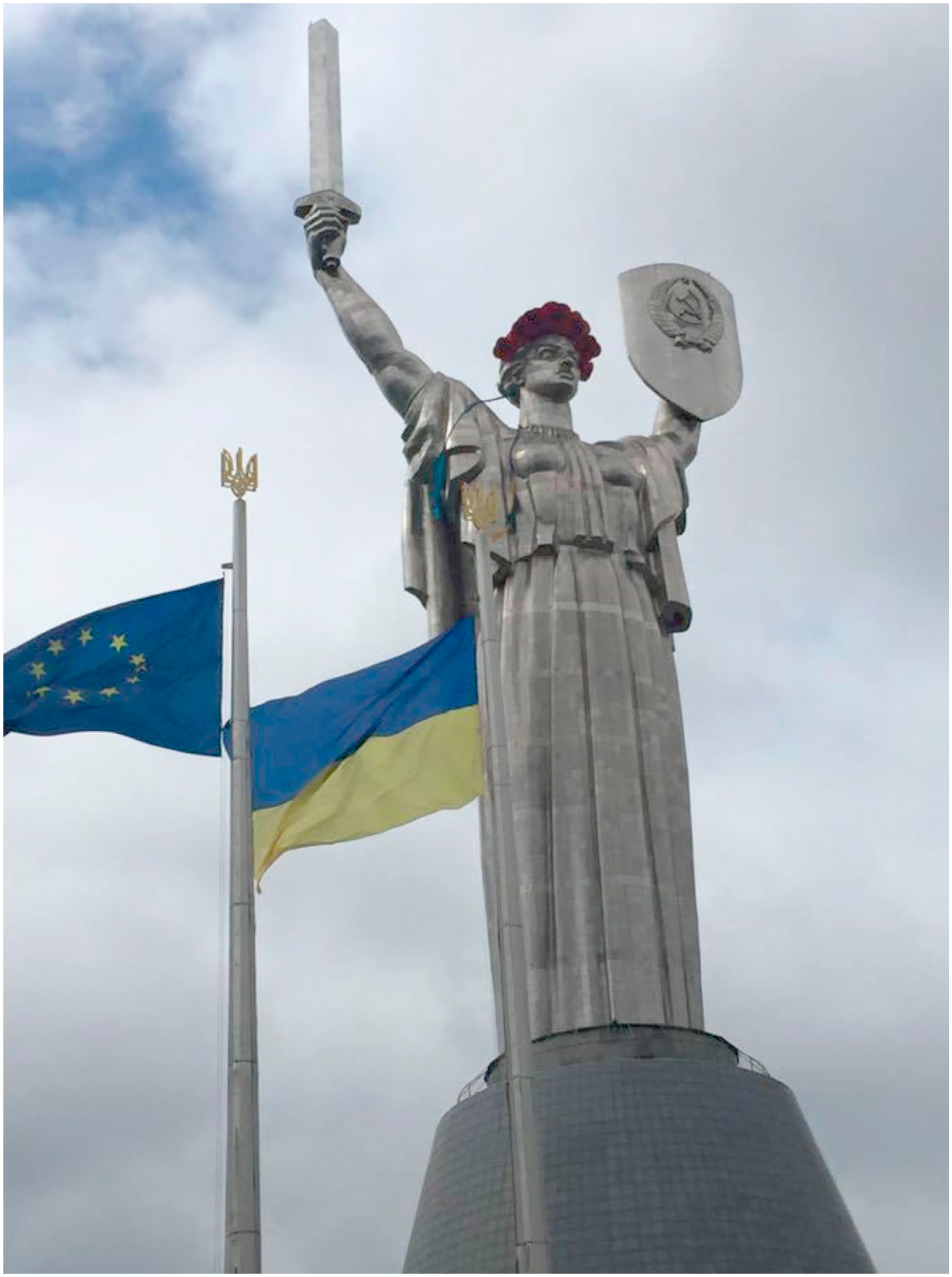
Spontaneous remembrance at the statue of Motherland in Kyiv. 8 May 2015.
In our view, this illustrates well the process of hybridity where old and new symbols are appropriated by the people in creative and unexpected ways, whereby a ‘third space’ is created.
Ilya Gerasimov (2015), who has analysed the events in the country from 2014 until today, has pointed to the rising significance of hybridity. 39 The refusal to accept the binary oppositions of ‘Soviet’ versus ‘Ukrainian’ or ‘Russian’ versus ‘Ukrainian’ has not been unusual in the Ukrainian context. One could argue that since Ukrainians are mostly bilingual and often bi- or multicultural, a kind of hybridity is a part of everyday life for many. However, as argued by Gerasimov (2015), after the Euromaidan, this ‘familiar phenomenon has changed its modality – from a sign of marginality and parochialism to a trendy and mainstream personal quality’ (p. 32). The hybrid identities are celebrated. According to Gerasimov (2015: 33), the representatives and advocates of hybridity are especially visible in social media, and some of them have turned out to be extremely popular, for example, Dmitry Tymchuk, a champion of Russian Ukrainian patriotism. On Facebook, he has launched a project called ‘Information Resistance’, 40 a news medium in the Russian language that was able to comment on the events in the Russian–Ukrainian conflict in an independent way, instead of following the Russian news by either broadcasting them or refuting them. Other examples of people enjoying great popular support that openly embrace ‘hybridal’ attitudes are Semen Semenchenko, a Russian Ukrainian who is the commander of the volunteer battalion "Donbas", or Igor Kolomoisky, the governor of Dnipropetrovsk who is very dedicated to the Ukrainian cause and simultaneously keen to emphasize his Russian–Ukrainian and Jewish background. Gerasimov points to the fact that Ukrainian Russophone Jews are especially prominent among those who proudly display their hybrid identities as a new form of solidarity that gains more and more support. When Russian propaganda labelled Ukrainian revolutionaries ‘Banderites’ (the term derived from the name of Stepan Bandera, the leader of the nationalist UPA), Ukrainian Jews supporting the Euromaidan started to call themselves ‘Jid-Banderites’ (wearing t-shirts with such inscriptions). Thus, they used the special kind of irony, called "stiob" and associated with the Soviet era and Russia, to demonstrate their refusal to identify the Ukrainian protesters with extreme rightist nationalism. As participants in the Euromaidan, they understood that the fact that Euromaidan protesters willingly used some of the outward attributes of Ukrainian nationalism (such as the famous UPA greeting ‘Glory to Ukraine’ – ‘Glory to the heroes’) did not mean that they adhered to the whole UPA legacy and subscribed to its view on the Ukrainian nation (Gerasimov, 2015: 30). Ukrainian nationalism of anticolonial art demonstrated its mobilizing power during the Euromaidan, but the extreme nationalist right had few adherents. Sociological research done on Maidan showed that just about 6% of the participants were supporters of the extreme right, the so-called Right Sector, and about 18% belonged to the nationalist party ‘Svoboda’ (‘Freedom’). 41 Thus, even in the heat of the battle, the radical, essentialist, identity-fixed Ukrainian nationalism never got the upper hand.
Discussion and conclusion
While scrutinizing the memory politics in Ukraine after the Euromaidan, we have seen two different approaches prevailing: on one hand, the anticolonial, nationalist one, caught in a rigid binary oppositions to the Soviet past, and on the other, hybrid forms that open up a third space for negotiations between new historical narratives and Soviet historical narratives in search of new meanings. In our opinion, these two approaches reflect general features of the development in Ukraine during and after the Euromaidan. In our view, it is possible to identify the appearance of two simultaneous movements in Ukraine: both anticolonial revolution and postcolonial revolution. The evidence for the latter is the emerging of ‘postcolonial’, hybrid identities. The simultaneous existence of these movements confirms the ideas of such scholars of postcolonial studies as Bhabha (2004), Said (1993) and Pratt (1992), who envisage a possibility of the entanglement of ‘the anticolonial’ and the ‘postcolonial’ stages. From this point of view, Ukraine can be seen as an example of the possible existence of multiple temporalities in the societal development. It is also noteworthy that they do not exist completely separated from each other, but can manifest themselves in the same cultural expression (such as the laws analysed above) or in the views of the same person.
The visionary blueprint for a postcolonial future, proposed by postcolonial thinkers such as Bhabha and Said, is the overcoming of nationalism and the triumph of postnational solidarity based on transcultural dynamics and hybridity. Is this kind of development feasible in Ukraine today? Do the instances of hybridity enumerated in this text speak in favour of the possibility of such a process? In our view, such a development in the Ukraine of today seems to be far away. The emerging ‘hybrid identities’ in Ukraine are non-essentialist, individualistic and inclusive, but they are not postnational. They rather stand for a civil type of nationalism, loyal to the Ukrainian state. Moreover, in the situation of the existential and cultural insecurity in which Ukrainians live today, it is hard to imagine that they will soon transform into the postnational stage. Progress in such a direction would require the mutual transformation of both the colonized and the colonizer (the point made by Gandhi, 1998: 140). Both sides should be open for negotiations about the past. At the time of writing, we cannot see such signs on the part of Russia, the inheritor of the Soviet empire. On the contrary, the Russian side displays aggression, disrespect of the Ukrainian party and the wish to keep control over Ukraine’s future. This means that the anticolonial struggle is not over for the Ukrainians, which makes the creation of a ‘third space’ a very difficult and at the same time necessary endeavour.
The double temporality of the Ukrainian revolution makes its interpretation challenging. As demonstrated above, some label it as ‘nationalist’, focusing on the visibility of nationalist symbols and figures representing nationalist organizations. They are also pointing to the fear that this visibility (skilfully used by the Russian propaganda) has caused among parts of the Russian and Russophone population in Eastern Ukraine. Others would like to see the Euromaidan as a postcolonial revolution, focusing on its democratic potential, the promotion of European values and new ways of being Ukrainian by affirmation of the hybrid identities. Notwithstanding thelabels, in our view, the most important thing to notice is that the Ukrainian revolution of 2014 was a manifestation of the subjectivity of the Ukrainian people. People who participated felt that they had finally made their own voice heard. That is why they called the events the ‘Revolution of Dignity’. According to the polls, about 20% of Ukrainians participated in the protest in one way or another. 42 Moreover, the revolution had a broad social base and released forces of societal self-organization that are still visible in the country. In general, it was an act of national self-assertion.
However, from the postcolonial perspective, it is interesting to highlight that this act of self-assertion seems to be largely ignored. Ukraine still seems to occupy a subservient position in the international community, that is, a position of the ‘subaltern’. Russia does not recognize Ukraine’s right to ‘difference’ and to make decisions about its own politics. This is quite a typical reaction on the part of a former colonizer, but the surprising thing is that Western European societies seem to accept the premise that Ukraine belongs to the Russian sphere of interest. Ukraine is ‘orientalized’ as a country unknown and always existing in the shadow of Russia. Western media show considerable ignorance concerning Ukraine, which makes them prone to accept the Russian propaganda image of Ukrainians as essentialist nationalist. In fact, this image is easy to adopt due to the existing Western stereotypes of Eastern Europeans as stubborn nationalists. 43 Thus, Western media seem to constantly watch the Ukrainian political scene, looking for a confirmation of their prejudice and disregarding any evidence to the contrary. Moreover, many approach Ukraine with the anti-American view promoted by Russia in the debate. According to this perspective, Ukraine is not a subject on the political scene but merely an object of American manipulation. The Ukrainian revolution was supposedly the work of the United States which merely used some Ukrainians to enlarge its power in the East at the expense of Russia. 44 Tragically for the Ukrainians, the country is objectified not only by those who are friendly to Russia and/or hostile to the United States but also by many experts, journalists and scholars who try to be objective but still are incapable of seeing Ukraine as a subject, an agent on the international scene with its own will and choices. Thus, Ukraine’s future is always discussed from the perspective of the power game between North Atlantic Treaty Organization (NATO) and Russia. In this power game, Ukraine is ascribed the role of a pawn. To sum it up, it was not enough for the Ukrainian subaltern to carry through the anticolonial revolution and attempt postcolonial transformation. Ukraine seems to have a long way to go in order to become a widely recognized political subject and leave the condition of postcoloniality behind.
Footnotes
Declaration of Conflicting Interests
The author(s) declared no potential conflicts of interest with respect to the research, authorship, and/or publication of this article.
Funding
The author(s) received no financial support for the research, authorship, and/or publication of this article.