



Abstract
In Tehran, murals depicting men who died in the Islamic Revolution of 1979 and the Iran–Iraq war of 1980–1988 are ubiquitous. The murals represent an exercise in state propaganda, serving to remind citizens that these men died not simply for the nation but for Islam; they are martyrs. This message resonates with deeply held religious views in Iran. There is constant reference to the Battle of Karbala and the martyrdom of Imam Hossein, the grandson of the Prophet Mohammed. This is seen to prefigure the revolt of the people against the Shah in 1979, the defence of the Revolution against Saddam Hussein in the 1980s and, furthermore, the claim of the Iranian opposition that the ideals of the Islamic Revolution have been distorted by politicised clerics. In propagating the myth of Karbala, the murals function to control the masses, bolster elite power and marginalise opposition to that power.
Introduction: why study the murals of Iran?
Although Iranian propaganda murals have become a subject of Western academic inquiry, for most Iranians these murals have become ‘invisible backgrounds’. It is no wonder that those who notice them are largely foreigners visiting Iran for the first time. (Karimi, 2008: 55)
Karimi’s insight is that the propaganda murals of Tehran go more or less unnoticed in the everyday life of citizens; they have become habitual and mundane, no more significant than the other street furniture of a bustling city. Her point is reminiscent of that made by Billig (1994) about ‘banal nationalism’, that often the symbols of nationalism are commonplace and quotidian rather than loud and spectacular: ‘The metonymic image of banal nationalism is not a flag which is being consciously waved with fervent passion; it is the flag hanging unnoticed on the public building’ (Billig, 1994: 8). In a literal sense, the quantity and scale of the murals of Tehran is unmissable; they are an omnipresent aspect of the urban landscape. Karimi’s point is more subtle, however, focusing as it does on the reception of these murals by the citizens of the city.
The murals came to have an important attraction to one set of foreigners, namely, the Western media. During the last three and a half decades in the West, whatever has been the latest crisis in relation to Iran has led to numerous media reports illustrated with photographs of murals. But these were always a backdrop to the story, never the story in their own right. The result was that there was little insight into the purpose and themes of the murals.
In attempting to go beyond the media gloss to analyse the murals of Iran, I faced a number of obstacles. I am a foreigner who does not read or speak Farsi. The breakthrough I needed was contact with an Iranian postgraduate at the university where I worked. With her help and that of a number of her friends, I embarked on an extensive bout of ‘mural hunting’ in Tehran, Shiraz and Yazd. This is where the next obstacle arose. The murals of Tehran in particular are painted on high buildings alongside the many highways which run through the city. The difficulty is in taking good pictures of the murals; there is extensive traffic, often moving at speed. The split second opportunity one needs for the photograph can disappear as a passing car blocks the view. Leaving the highway does not necessarily solve the problem. One may find the mural’s location but high barriers block any access to the road from where the best view is available (see Figure 1). It took all the ingenuity of my Tehran guides to enable me to photograph as many murals as I eventually did.
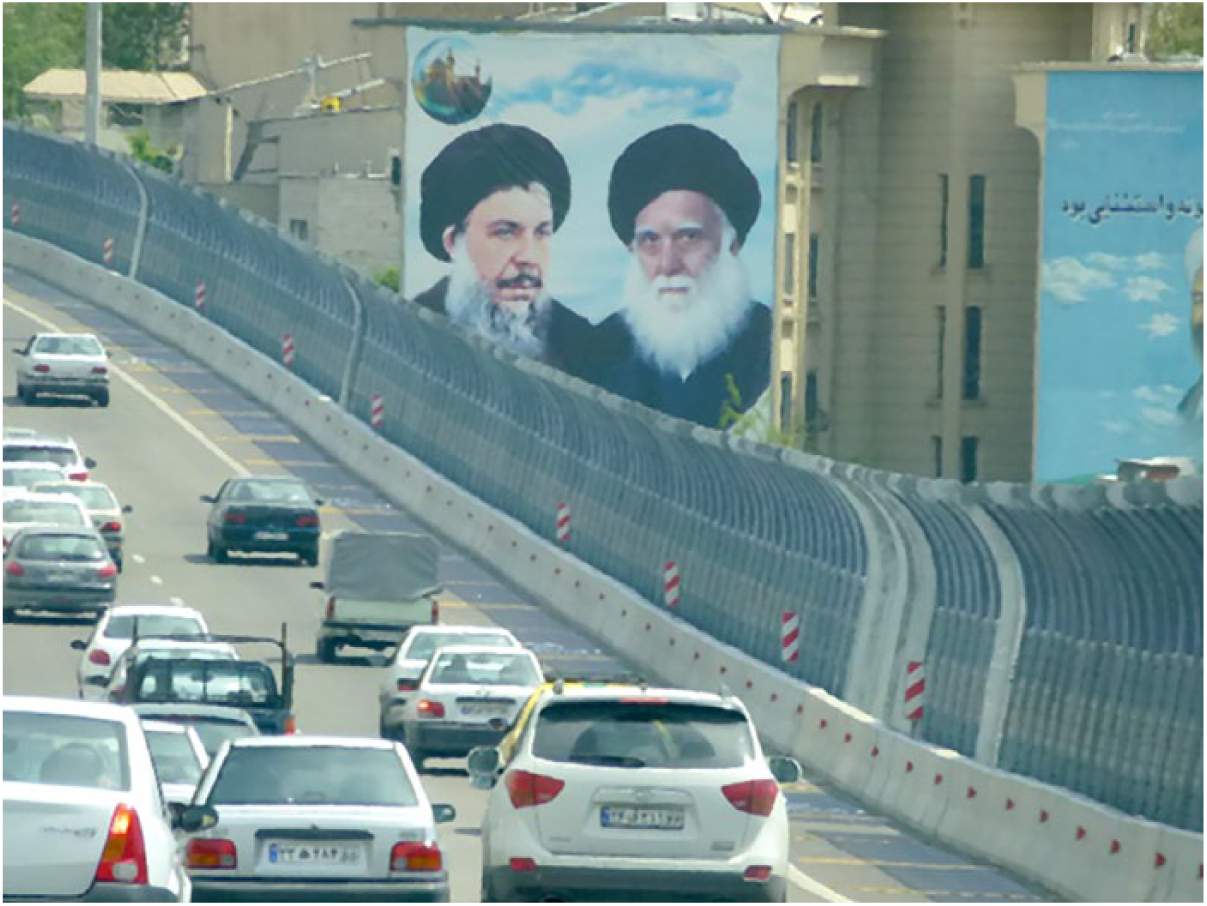
On the right is Iraqi Shia leader Mohammad Sadeq al-Sadr, who was killed on the orders of Saddam Hussein in 1999. He was the father of Iranian-born cleric Musa al-Sadr, founder of the Lebanese political group Movement of the Disinherited (whose armed wing was Amal). He disappeared in 1974 on a visit to Libya, possibly killed on Gadaffi’s orders. On the left is Muhammad Bagher Sadr, Imam Musa’s cousin. (© Bill Rolston)
In 1999, it was claimed that there were over 600 murals in Tehran (Marzolph, 2003: 90). By the time I visited in late 2013, there may have been more but no figures were available. I managed to photograph about 200 murals, a quantitatively significant amount. My method was in effect a form of ‘convenience sampling’. The advantage of this method is clear; it allows one to collect data in the absence of the necessary information on the full data set which would make more purposeful methods possible. The downside of the method is its inability to reach precise conclusions about the representativeness of the sample; there is, for example, no way to assess the distorting effect of possible ‘outliers’ (Farrokhi and Mahmoudi-Hamidabad, 2012).
The most significant feature of the murals is that almost every one depicts men who died in the Islamic Revolution of 1979 or the Iran–Iraq war of 1980–1988. Coming from the West, it is easy to dismiss these displays as heavy-handed propaganda. The murals are easily interpreted within a number of well-rehearsed Western tropes: fanatical ayatollahs, a cult of martyrdom, the imposition of religious fanaticism. But to judge them thus is to miss a number of important points. Undoubtedly, their sheer size and omnipresence indicate a massive propaganda intervention by the authoritarian state into the everyday lives of citizens. But, as will be made clear, it would be a mistake to dismiss them as a mere imposition. The themes of the murals speak to deep beliefs in Iranian society, both old religious beliefs – in particular the centrality of the notion of martyrdom in Shia Islam, going back to the quintessential martyr, Imam Hossein, killed at the Battle of Karbala – and more recent political beliefs – notably the martyrdom of hundreds of thousands of Iranians in the Islamic Revolution and the subsequent Iran–Iraq war. In fact, it is the merging of these two sets of belief that is at the core of the murals’ message. As such, the overwhelming focus on martyrdom cannot avoid striking chords in the wider society at the level of religious belief. Equally important is the fact that the murals portray real people who died within the living memory of many who view them. It is the interplay between religion and politics, memory and propaganda that will be the central focus of this article.
Consequently, the article will first consider the question of memory and power to examine the way in which formal memory is created in societies and in particular the role played by powerful elites in that creation. The consolidation of state power in Iran is the subject of the next section, followed by an account of how the use of martyrdom and the story of the death of Imam Hossein have been central to state power for the current political leaders in Iran. A detailed survey of the martyr murals of Tehran is then presented, followed by consideration of some silences on the walls of the city. The final section returns to Karimi’s initial insight to put forward some conclusions on how the murals are received by the public.
Memory and power
Iran offers a valuable case study in understanding the role of memory and memorialisation in transitional states. At the same time, the specificity of the Iranian case, where the role of the state in public space is so dominant and virtually unchallenged, provides insights not immediately available from Latin America, the Balkans and other fruitful sites for memory studies. That said, it is valuable to start with some of the insights from this wider research.
Jelin (2003) sets the stage for the debate on memory when she concludes,
The past is gone, it is already de-termin(at)ed; it cannot be changed … What can change about the past is its meaning … That meaning of the past is dynamic and is conveyed by social agents engaged in confrontations with opposite interpretations … (p. 26)
Such confrontations are pronounced in times of transition:
Political openings, thaws, liberalizations, and transitions give a boost to activities in the public sphere, so that previously censored narratives and stories can be incorporated and new ones can be generated. Such openings create a setting for new struggles over the meaning of the past, with a plurality of actors and agents who express a multiplicity of demands and claims. (Jelin, 2003: 29)
Struggles over memory can become particularly contentious in relation to memorialisation. Drawing on examples from Argentina, Jelin (2007) concludes,
The creation of public markers of the past, such as sites, museums or memorials, is usually the result of struggles and confrontations. The confrontation is between the voices of those who call for commemoration, for remembrance of repression, disappearances and torment, for denunciation of the repressors, and those who make it their business to act as if nothing has happened or even to claim the recognition of the heroism and patriotism displayed in repression and state terrorism. (p. 142)
Globally, struggles over ‘public memorials are increasingly being used by nonpowerful groups to wrestle their way into the national memory’ (Bickford, 2014: 499). At the same time, powerful state elites also have a stake in these memory struggles. Vinitzky-Seroussi (2002) argues that commemorative narratives consist of three analytical elements: the person or persons being commemorated, the event being commemorated and the wider context of the event. Focusing on the first two produces a ‘thin’ narrative, while bringing in the third leads to a ‘thick’ narrative. Power elites in the state prefer ‘thin’ over ‘thick’ memorialisation. Or, as Marschall (2010: 140) puts it, ‘Official memory invariably synthesises and simplifies diverse and potentially contradictory narratives’.
In addition, the state usually has a preference for monumentalism and may not easily incorporate more vernacular forms of memory:
The state primarily sponsors the preservation of memory in tangible objects and structures – museums, commemorative monuments, memorials and public statues – not in intangible, traditionally rooted, popular, community-based expressions such as festivals, songs, performances, rituals and ephemeral markers. (Marschall, 2010: 142)
It is for this reason that the continued existence or revival of grassroots memory through folklore, poetry and stories can represent a serious challenge to the official narrative (Ahmida, 2006; Goldstein, 2015).
Given the confrontational nature of memorialisation, Barsalou and Baxter (2007) issue a caution:
Memorials planned and built through a top-down process without significant participation from key stakeholders run the risk of becoming irrelevant. If memorials are to help reunite a society, they must be the outgrowth of a consultative process dominated by survivors. (p. 15)
Insightful as such a conclusion is in understanding memory struggles, it does not fit universally. In Iran, there was little space for consultation or survivors’ agency. The overthrow of an authoritarian regime led to the emergence of another authoritarian regime. Conservative clerics came to virtually monopolise state power; in doing so, they became the sole ‘memory entrepreneurs’ (Jelin, 2003) in the fashioning of official memory.
The role of the memory entrepreneur is to articulate an interpretation of the past which enables a society to pull together and build a common identity. On occasions, that task can be highly instrumental, involving a manipulation, even a distortion of the past. Either way, memory entrepreneurs are well placed to create collective or national myths, in the Barthian sense:
Myth does not deny things, on the contrary, its function is to talk about them; simply, it purifies them, it makes them innocent, it gives them a natural and eternal justification, it gives them a clarity which is not that of an explanation but that of a statement of fact … myth acts economically: it abolishes the complexity of human acts, it gives them the simplicity of essences, it does away with all dialectics … it organizes a world which is without contradictions … (Barthes, 1987: 101)
The case of Iran seems to confirm the instrumentalist approach to memory rather than seeing memory as the compromise between bottom-up and top-down claims about the past. The development of the transitional Iranian state was built on the relentless marginalisation and elimination of opponents of the new state power elite. The clerics came to monopolise memorialisation in public space through the commissioning of monumental murals. The public space for alternative or subaltern memory declined rapidly as the martyr murals came to dominate the cityscape. In such a situation, Budryte’s (2013) advice is apt when considering why to study the murals of Iran; the public claims made by memory entrepreneurs
should be scrutinized and criticized, to avoid the creation of white-washed, self-congratulatory, uncritical national histories and exclusionary memory regimes based on the rhetoric of victimization. This is especially true during political transitions, when societies are trying to create new political orders. (p. 10)
Revolution and the consolidation of state power
Mohammad Reza Shah Pahlavi was the authoritarian ruler of Iran from 1941. At the centre of his plan for Iran was a policy begun during his father’s rule of the ‘modernisation’ of society which saw increased access to consumer goods and some rights, but also increased inequality. He also oversaw the build-up of repressive state institutions (Adib-Moghaddam, 2012: 287) and the control of oppositional groups. Control was also apparent in public space, with a proliferation of state-sponsored representation which related directly to the Shah and his family. Streets were named after him and his wife and numerous portraits and statues were on display.
Those opposing the Shah’s regime covered a wide spectrum: politically aware citizens calling for greater democracy, workers organising for better rights and pay, students and intellectuals pursuing political ideals of human rights and socialism, women encouraged by some advances towards equality pushing for even greater equality (Moruzzi and Sadeghi, 2006; Shaditalab, 2005) and Islamic clerics urging the ‘re-Islamisation’ of Persian society (Adib-Moghaddam, 2012: 285). These separate elements coalesced in a movement to overthrow the Shah. That merger took place around a number of secular and religious tropes. The opposition, including the clergy, was united in opposing the Shah’s subordination to Western capitalist and strategic interests, his squandering of national resources such as oil and the repression of internal opposition. They couched their opposition in a common discourse of nationalism and anti-imperialism built around a relatively ‘soft’, third-world liberationism (Sheikholeslami, 2000: 106–7) which owed more to Fanon than to Marx (Chelkowski and Dabashi, 2000: 91). At the same time, even secular and left opponents of the Shah also employed the metaphor of martyrdom: ‘In the absence of free political parties and other channels of political participation … they perceived themselves as new apostles of change whose self-negation would give life to the mass movement’ (Dorraj, 1997: 510).
The movement against the Shah led to an explosion of visual representation in public space, in particular posters. Rather than being ‘just a secondary reflection of the revolutionary movement, these posters played a vital role in the struggle for change and in the articulation of collective ideology. In this sense, the Revolution and its art were mutually constitutive’ (Ram, 2002: 90).
The separate forces tended not to see themselves in rigidly binary terms. For example, to be a student socialist did not necessarily mean rejecting Islam. Sections of the clergy also adopted a hybrid view, with some critical of any moves towards fundamentalism. At the same time, there was a powerful group of clerics, gathered round Ayatollah Khomeini, who did think in binary terms. Although subscribing to a generalised anti-imperialism, the ideology of these clerics focused on religion, with little if any space for socialism, feminism and democratic opposition. The Islamist clerics won the day in line with Ayatollah Khomeini’s goal of redefining ‘what had been a pluralistically-oriented revolution as a decidedly “Islamic” one’ (Marzolph, 2003: 88). The Left became increasingly isolated (Sheikholeslami, 2000). The workers’ independent organisation was replaced by a system of state-endorsed workers’ councils (Fischer, 2010: 515–6). The students went back to their studies, taking to the streets periodically, most obviously in 1999. Within limits, the feminists continued to be active, not least through their million signature campaign for women’s rights launched in 2006 (Fischer, 2010: 514).
The Right-wing clerical vision of society became the dominant one. The clerics held on to some of the anti-imperialist rhetoric, reinvigorated a reading of Shiism which focused almost exclusively on the celebration of martyrdom, and drew on pre-Islamic sources of national pride and identity. And they set about establishing that society not simply through intellectual argument but also through rigid control of the state and its repressive arm. The opposition was imprisoned, killed or marginalised. Political and civil society groups lost out in the face of the powerful theocratic state.
Repression was not the only mechanism of control. The Revolution had given rise to a mural painting tradition. Artists such as Safarzadeh Dabiri and Al Has painted murals which combined the precision of Persian miniature painting, the narrative style of Iranian coffee house paintings and the grandeur of Mexican muralism (Cockroft, 1991). Eventually, a fully fledged popular mural painting tradition emerged. The leaders of the revolutionary state quickly came to understand the power of visual propaganda in the consolidation of state power. Khomeini argued that visual propaganda was ‘as powerful as any firearm’ (Shirazi, 2012: 103). The full power of the state was martialled behind a strategy to mobilise the masses through displays in public space. Streets were renamed; in Tehran between 1979 and 1987, 302 avenues, 41 squares, 13 freeways and 17 parks had their names changed (Chelkowski and Dabashi, 2000: 121).
In Khomeini’s view, murals had an identical purpose to ritual ceremonies or pilgrimages in that they were intended to ‘cement brotherhood among Muslims’ (Gruber, 2008b: 193). Consequently, during the Iran–Iraq war in the 1980s, the Artistic and Cultural Bureau of the powerful Qom Seminary’s Office of Propaganda issued guidelines for the correct production of murals:
Under all circumstances the effectiveness of the revolutionary mural must be kept clearly in mind. Vague, indirect and superfluous paintings should be avoided at all costs … The artist must study religious texts as seriously as he examines the techniques of other artists … (quoted in Chehabi and Christia, 2008: 4)
The murals were sponsored and paid for by a range of state and parastatal organisations: the Iranian Revolutionary Guard Corps, the Ministry of Islamic Guidance, the Foundation of the Oppressed and Disabled People, and the Martyrs’ Foundation or Bunyad-i Shaid. The last of these was the most significant. It was begun with money confiscated from the Shah’s wealth and was directly answerable to Ayatollah Khomeini himself.
The clerics’ hold on ideology and state power was given a massive boost by the Iran–Iraq war, ‘the War of Holy Defence’ (1980–1988), which cost the lives of between 750,000 and one million Iranians. There was an especially high rate of casualties among 18- to 20-year-old males (Gruber, 2008a: 25). The call was now to rally around the leadership of Ayatollah Khomeini to defend the nation and the revolution. Central to the mobilisation of the masses and the consolidation of state power and legitimacy was the representation of martyrs from the war. Society now had ‘a new kind of hero: the war martyr (shahid)’ and Iran ‘became marked by an omnipresent culture of martyrdom, which manifested and sustained itself largely through visual production’ (Gruber, 2008a: 37).
The iconography drove home a powerful and repeated message: ‘those who perished live on, if not bodily then in spiritualized form’ (Gruber, 2013: 172). The first martyr representations in public space resulted from private initiative, but that soon changed: ‘Bit by bit these representations became instruments of the state’ (Fromanger, 2012: 55). If a central task of the revolution was ‘to implant the seeds of an Islamic lifestyle in the minds of the new generation’ (Kazemipur and Goodarzi, 2009: 163), then the success was evident: ‘By the early 1980s, the Islamic Republic of Iran was in full semiotic control of the representation of itself … collectively held symbols … were used to mobilize a people’ (Chelkowski, 2002: 128).
Later, as the dust of the revolution settled and war passed, the influence of more liberal clerical elements re-emerged to influence policy to some extent. Relaxations in relation to economics and culture came to fruition during the two terms of President Khatami between 1997 and 2005. As a pragmatist, Khatami voiced ‘society’s yearning for a synthesis between Islam and democracy’ (Sheikholeslami, 2000: 122). For many Iranians, including clergy, reform became preferable to permanent revolution (Sheikholeslami, 2000: 125). During the more relaxed period of Khatami’s leadership, there was a decline in mural production (Fromanger, 2012: 48) and indeed some predicted the disappearance of the phenomenon altogether (Chelkowski, 2002: 139).
That changed under Ahmadinejad’s presidency. Ahmadinejad had in effect stolen the 2009 election from the more secular Green opposition. Unlike his immediate predecessors, the President did not face the authoritarian rule of the Shah nor the external threat of Iraq. He needed new villains to target in his consolidation of power. America and Israel offered obvious choices. There was also an internal target. The opposition was portrayed as in cahoots with Western imperialism and Israel (Yarbakhsh, 2014: 81). Protesters were forced off the streets and opposition political activists jailed. The state’s propaganda machine worked at full throttle to disparage political opposition using proven tropes and messages. Martyr mural painting was revived. Martyrs’ graves were placed in the grounds of mosques and shrines and, even more unusually, on university campuses. Those university students who objected astutely summed up the state’s purpose when they responded with the slogan: ‘Ban the instrumental utilization of war martyrs’ (Talebi, 2012: 121).
From 2004, Tehran had witnessed the emergence of ‘beautification murals’, apolitical or obliquely political in content (Karimi, 2008) and paid for by an organisation known as the Beautification Bureau (Speed, 2015). Ahmadinejad and his supporters tried to marginalise these murals, not by forbidding them but by creating more propaganda and ideological murals. The beautification murals continued to appear after Ahmadinejad’s time; however, this should not be taken as proof that the state’s control of the production of murals has been lessened. The ability of political and civil society groups to challenge the virtual monopoly of memorialisation in public space is as slight as before.
State consolidation and recent nation building in Iran have been authoritarian with a strong emphasis on visual propaganda. Central to that propaganda has been the valorisation of martyrs. The power of the martyr image is that it signifies not simply religious belief but also political affiliation; the martyr has sacrificed life for both Iran and Islam. A key to understanding the power of the martyr myth is to consider the frequent referencing of the most important martyr for Shia Islam, Imam Hossein, who was killed at the Battle of Karbala.
Martyrdom and mobilisation
The Battle of Karbala occurred on the day known as Ashura, the 10th day of the month of Muharram, in the year 61 of the Muslim calendar, 680 of the Christian calendar, in present-day Iraq. Hossein, the grandson of the Prophet Mohammed, and 72 of his followers were slaughtered in a battle with the Umayyad Caliph Yazid. Hossein, like his brother Hassan and father Ali before him, had tried to prevent bloodshed by not directly challenging the caliphate leadership. Despite that, Yazid considered Hossein a threat to his position as Caliph. Hossein and his infant son were among the dead. The female relatives of Hossein mourned the dead before being brought, along with the severed heads of the dead, to Yazid in Damascus (Chelkowski and Dabashi, 2000: 77; see Figure 2).

Reproduction of Mahmoud Farshchian’s painting ‘the Evening of Ashura’. (© Bill Rolston)
While all Muslims recognise the significance of Karbala, it is of particular importance to Shia believers. For them, Hossein is ‘the paradigmatic martyr’ (Yarbakhsh, 2014: 78). As Shariati (n.d.) points out, in European countries, the word martyr refers to the manner of a person’s death. ‘One of the basic principles in Islam and in particular in Shiite culture, however is “sacrifice and bear witness.” So instead of martyrdom, i.e. death, it essentially means “life,” “evidence,” “testify,” “certify”’. In taking a stand against Yazid, Hossein was upholding the ideals of his grandfather and father in the face of the distortion of those ideals by the Caliphate. He faced down authoritarianism and injustice through the sacrifice of his own life. His act of altruism was in order to save Islam.
Ashura is celebrated across the world of Shia Islam, to the point that the ‘the vast majority of distinctly Shiite rituals are derived from the events that took place in the Battle of Karbala’ (Aghaile, 2005: 8; for a fuller account, see Aghaile, 2004). There are, however, nuances to the reading of this myth in the case of the Islamic Republic of Iran. There, the focus is on the martyr as agent rather than victim. The latter trope figures more centrally in representations of martyrdom in Lebanon (where the Karbala myth is arguably even more assertive than in Iran – see Norton, 2005) and Palestine (Buckner and Khatib, 2014). In the Iranian case, the martyr is in charge of his or her destiny.
The Karbala myth came to have contemporary political significance in Iran in the 1970s, with the Shah portrayed as the tyrant (Yazid) and the revolutionary opposition as the tyrannised (Hossein). Karbala became ‘primarily a political message, anchored deeply in religious sentiment that yelled and clamoured and shrieked for salvation from tyranny …’ (Gruber, 2008a: 30). This political reinvigoration of the Karbala myth was espoused not simply by Islamist clerics opposing the Shah but also inspired secularists because of its call to social justice and national sovereignty. To stand up to the Shah might mean having to choose the path of martyrdom in the name of justice, just as Imam Hossein did. Karbala was not in the past but in the present. ‘During the revolutionary upheaval of 1978–9, as far as its participants were concerned, every month was Muharram; every procession became a demonstration; everywhere in Iran was Karbala’ (Chelkowski and Dabashi, 2000: 71).
At the same time, the Karbala paradigm handed a trump card to the clerics. They seized the opportunity to mark what emerged from the revolution as not just a republic, but an Islamic republic. While others might protest that they too shared the Shia ideals of justice, the clerics were ideally placed to monopolise the interpretation and propagation of the Karbala myth.
The war with Iraq (1980–1988) exacerbated the politicisation of Karbala. As hundreds of thousands of men went to their death, the message of the clerics was that they were defending not just the revolution, not just the nation, but the Shia faith itself. Karbala had come again; Saddam was the modern incarnation of Yazid. All were called upon to be martyrs. Furthermore, ‘Martyrdom was no longer a predominantly discursive phenomenon; rather, it was now incarnated in the flesh and blood of hundreds of thousands of Iranians’ (Talebi, 2012: 125). Again, as in the revolutionary heyday, ‘all battlefields were Karbala, all months were Muharram, and all days were Ashura’ (Gruber, 2008a: 30).
Thus, in the years leading up to the revolution and in the decade which followed, the Karbala myth proved a powerful mobilising tool in the hands of astute and powerful memory entrepreneurs. The leadership could demand great sacrifices from the people, even to the point of volunteer soldiers walking across Iraqi minefields in order to clear them for the regular army by stepping unprotected on the mines.
It is easy to dismiss the phenomenon as religious fanaticism. It is also possible to be highly cynical about the way in which the leadership has used the ‘systematic martyrdom that occurred during its eight year war with Iraq to maintain a permanent state of mass mobilization and to ward off criticism by presenting itself as the guardian of the honor and blood of martyrs’ (Dorraj, 1997: 519). Overall, the ‘cult of martyrdom’ could be dismissed as mass hysteria or religious indoctrination. At the same time, the message meshed with the recent popular experiences of the overthrow of the Shah, the threat to the revolution from Iraq and the death of hundreds of thousands of fellow citizens. The prevalence of death was interpreted as martyrdom, that is, a ‘reward’ (Shirazi, 2012: 101), and as such was embraced, valorised, commemorated in speeches, songs, films, posters and monumental murals.
Murals and memories of martyrdom
‘Nowhere in the Islamic world … has there been a more deliberate and long-lasting effort at creating propaganda in visual form than in post-revolutionary Iran’ (Gruber, 2008a: 16). That memory work has focused on the official memory of the struggle to establish the Islamic Republic, through overthrowing the Shah and then the war with Iraq. Despite a conclusion in relation to other societies that ‘the way that public memorials seek to educate about the past is through the transfer of basic – often gruesome – information about victims’ (Bickford, 2014: 509), there are no graphic representations of war and death in the murals of Iran. Instead, the focus is almost exclusively on portraits of individual males who lost their lives in the Iran–Iraq War (Marzolph, 2003: 89). In point of fact, only a small proportion of the hundreds of thousands who died in that war have been immortalised on the walls; for example, although a significant number in itself, only 1400 martyrs have streets in Tehran renamed after them (Chelkowski and Dabashi, 2000: 121). Out of 33,000 Tehrani martyrs, only 140 are portrayed on the city’s walls (Karimi, 2008: 61). Often the murals consist of a simple portrait, not over-idealised, with often no more accompanying text than the martyr’s name. The representation would not be out of place in a family album (see Figure 3).
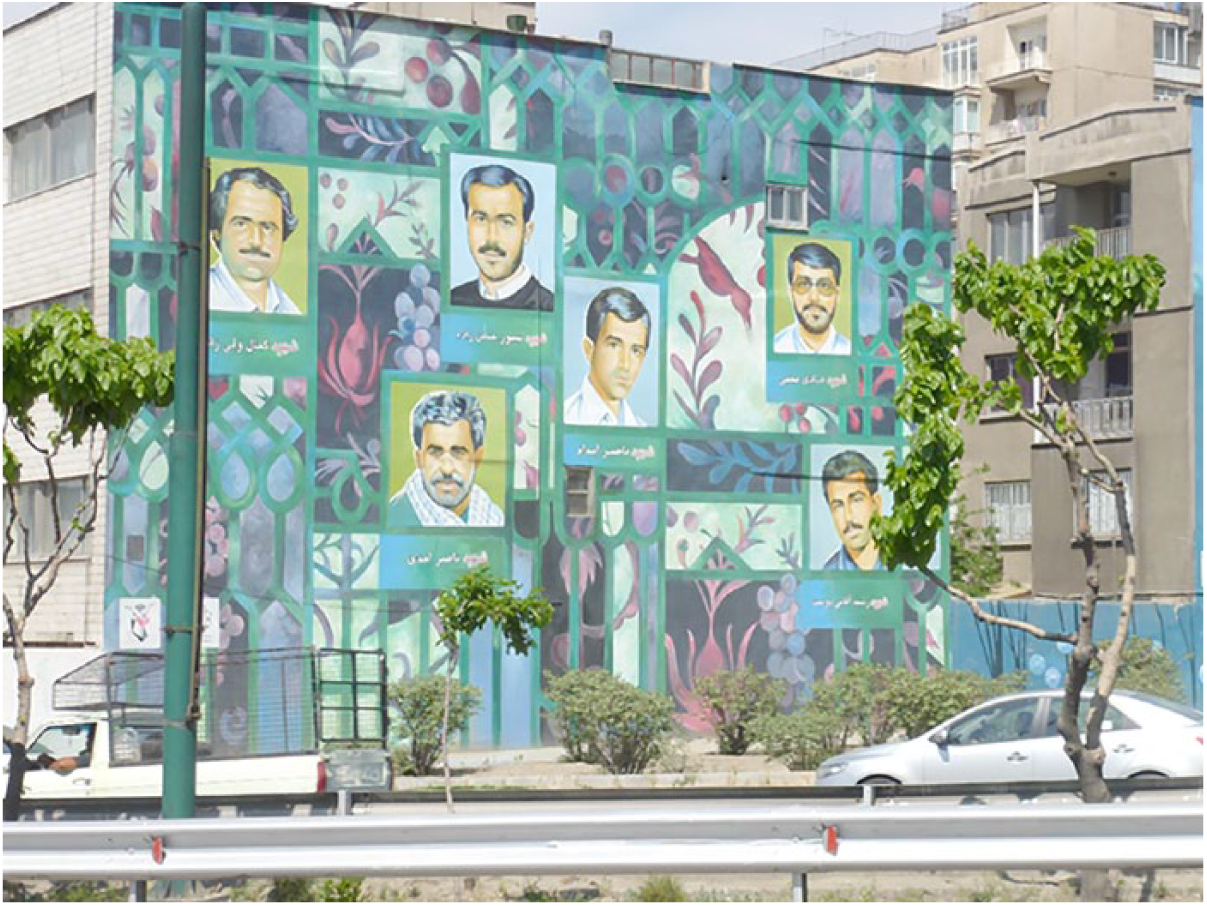
Portraits of martyrs with accompanying names. (© Bill Rolston)
At times, there are clues given as to the martyr’s function – a pilot, a naval officer – without any details of the operations in which they were involved.
On rare occasions, the details of the martyr’s death are well known. For example, Muhammad Husayn Fahmida, a 13-year-old schoolboy, in 1981 strapped grenades to his body and crawled under an Iraqi tank to blow it up. He has been immortalised in posters (Gruber, 2009: 686–7), school books for primary school children (Chelkowski and Dabashi, 2000: 132) and murals (Gruber, 2008a: 31; see Figure 4).
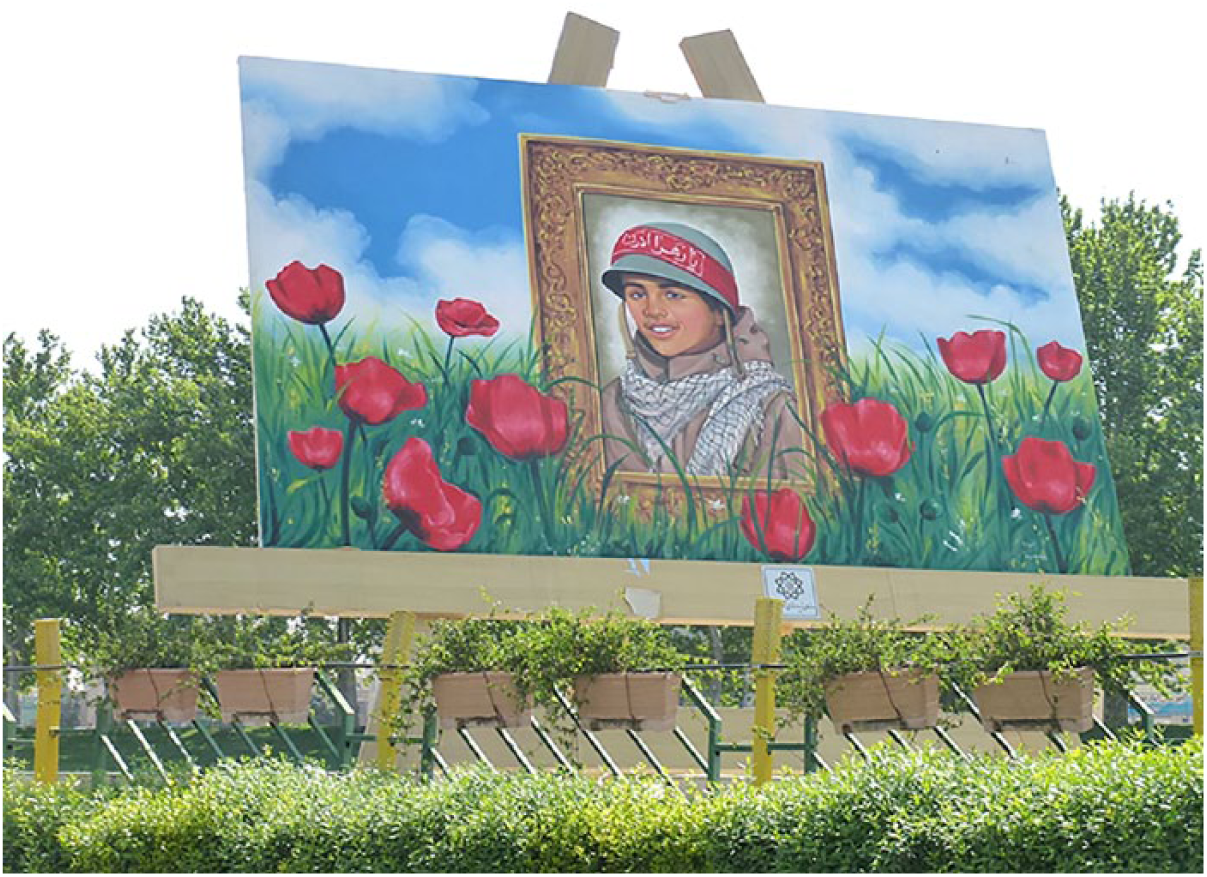
Muhammad Husayn Fahmida, the 13-year-old martyr of the Battle of Khorramshahr, 1981. (© Bill Rolston)
The martyr is not just an individual, but rather an individual instance of a collective phenomenon, linked on the one hand to a long tradition of martyrdom stretching back to Imam Hossein and on the other to more recent politics (see Deeb, 2008). Thus, it is not unusual for direct reference to be made to the Karbala story, for example, by juxtaposing the martyr’s portrait with a representation of the image of the veiled Imam Hossein (see Figure 5).

The martyr Seyyed Mujitaba Hashemi, a commander during the irregular wars in Kurdistan in 1985, and, top right, Imam Hossein on horseback. The accompanying caption states, ‘Our God, we send greetings to the Prophet and his family’. (© Bill Rolston)
On occasions, the seal of approval is given by the juxtaposition of one of the Supreme Leaders to date, Ayatollah Khomeini and Ayatollah Khamenei. The gaze of the Leader, either sombre or benign, thus confers a blessing not just on the mural but on the act of martyrdom itself.
Not all martyrs were military personnel: government ministers and functionaries were killed, either at the front or in attacks by oppositional forces within Iran. Various nuclear scientists have been assassinated in a campaign which the Iranian government blames on the Israeli secret service Mossad. Senior clerics such as Abbas Shirazi have died (see Figure 6), either at the front or in bomb attacks and also media personnel such as Seyyed Morteza Avini. All have been commemorated in murals.
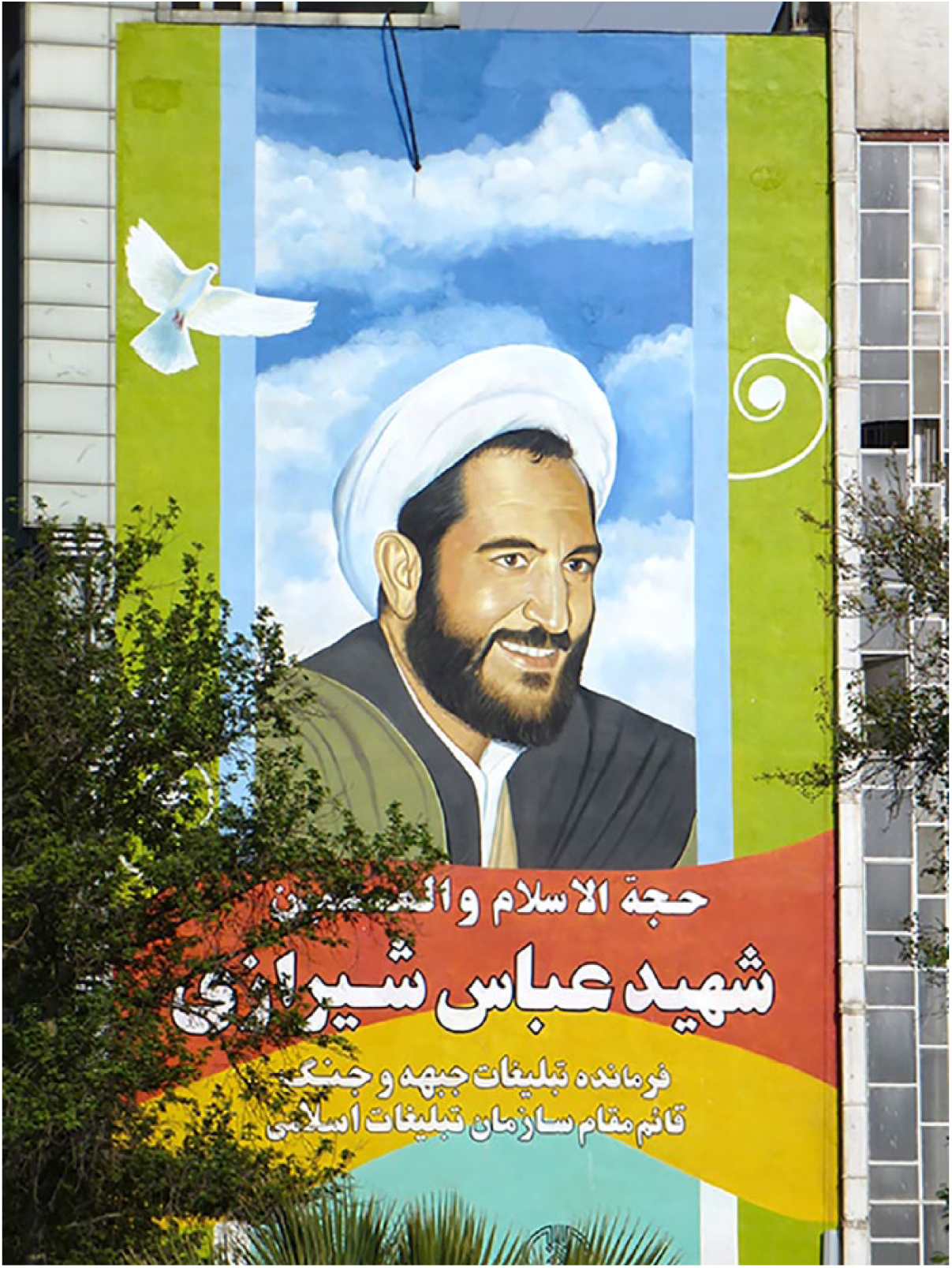
Abbas Shirazi, Vice-President of the Islamic Propaganda Organisation, Commander of War Propaganda, cleric and martyr in the Iran–Iraq War, 1984. (© Bill Rolston)
Some died as the result of attacks by groups such as the Mojahedin-e Khalq. In June 1981, the Mojahedin killed 74 people in a bomb at the Islamic Republican Party headquarters. Among the dead was Ayatollah Beheshti, the head of the judiciary who is depicted in one mural. During 1981, the Mojahedin killed more than 1000 government officials (Iran Human Rights Documentation Center (IHRDC), 2009). The conflict was far from one-sided. Many Mojahedin leaders were assassinated or exiled, and in 1988, an estimated 4500 to 5000 political prisoners were executed, many of them accused of being associated with the Mojahedin (Parvaresh, 1994).
Despite the intimate connection made between contemporary martyrdom and the battle of Karbala, direct representation of Karbala is rare in murals. One exception is a reproduction of Mahmoud Farshchian’s 1976 painting, ‘The Evening of Ashura’ (see Figure 2 above). This depicts the female relatives of Hossein along with children mourning his death and that of the others before themselves being taken captive and brought to Damascus. At the centre of the painting is Hossein’s riderless horse (Za’feranlou, 2012). There are however various oblique references to Karbala in murals, not least the use of the panjah symbol, a symbolic hand, the five digits of which represent the Prophet Mohammed, his daughter Fatima, his son-in-law Ali and his grandsons Hassan and Hossein (Gruber, 2012: 88; Rauh, 2013: 1323). Numerous other symbols appear in the murals which refer to martyrdom: the tulip (Ram, 2002: 96), the rose (Marzolph, 2003: 90) and birds (Chehabi and Christia, 2008: 13), especially doves (Fromanger, 2012: 54). Water is depicted, not simply because it is fundamental to life but because Imam Hossein’s contingent was refused access to water by the enemy (Marzolph, 2003: 91). There are also butterflies and moths (Gruber, 2013: 172), as well as candles (Gruber, 2013: 173). A number of these symbols derive from Persian poetry and Sufi mysticism.
There is one major exception to the rule that murals depict martyrs, that is, when they portray the Supreme Leaders, Ayatollahs Khomeini and Khamenei. Representations of Ayatollah Khomeini outnumber those of Khamenei as befits his role as the architect and leader of the 1979 revolution. In one mural, based on a photograph of the Ayatollah when he was in exile in Neauphle-le-Chateau in France in 1978, Khomeini is shown walking, with eyes downcast, while the background displays the flag of the Islamic Republic of Iran. In the centre of the flag is the word ‘Allah’, and above and below it, the phrase ‘Allahu akbar – God is great’ occurs 22 times (see Figure 7). The number is significant. The anniversary of the 1979 revolution is celebrated on the 22nd day of the Iranian month of Bahman.
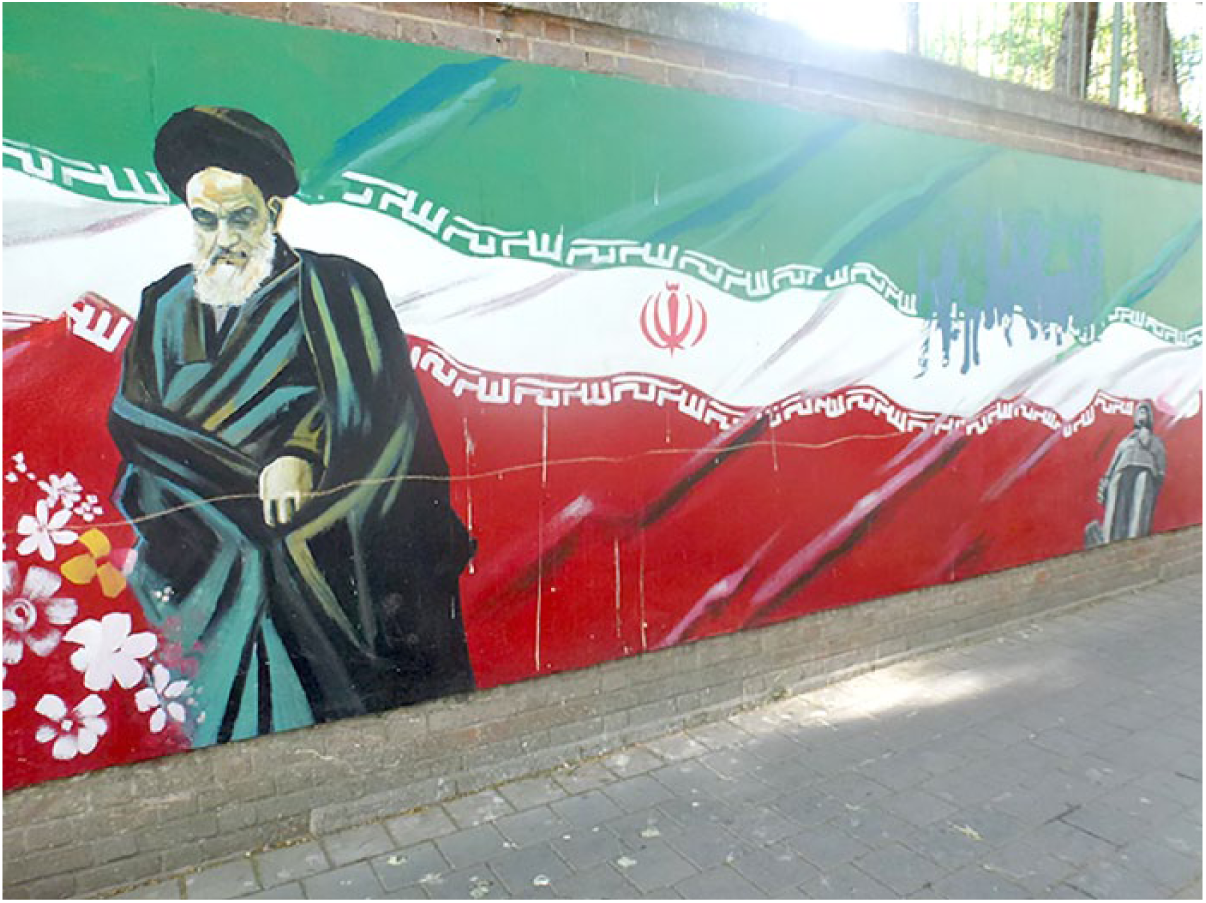
Ayatollah Khomeini with Iranian flag in background. (© Bill Rolston)
Despite the self-identification of many leaders of the 1979 Revolution, clerics included, with third-world liberation, there are remarkably few murals in Iran relating to other societies striving against colonialism, imperialism and repression (Chehabi and Christia, 2008: 7). The main exception is Palestine, but the prism through which it is viewed is that of Iran itself. Thus, while there is clearly an identification in the murals with the plight of fellow Muslims, at least as important have been the foreign policy needs of the Islamic Republic. Support for Palestine was ‘part of a larger bid to establish regional legitimacy and supremacy after the US-led invasions of its two neighbouring countries’ (Gruber, 2008a: 36), Iraq and Afghanistan. In addition, ‘the liberation of Jerusalem was a mainstay of official rhetoric concerned with exporting the Islamic Revolution abroad’ (Gruber, 2008b: 177). This was captured in rhetoric concerning the Iran–Iraq war, where the liberation of the holy shrines of Najaf and Karbala in Iraq was represented as a step on the path to the liberation of Jerusalem. As Khomeini put it on one occasion, ‘the road to Jerusalem goes through Karbala’ (Gruber, 2008b: 171). References of solidarity with Palestine continue to appear in murals. One (see Figure 8) displays the Dome on the Rock in Jerusalem and the Supreme Leader Ayatollah Khamenei. The accompanying text states, ‘Palestine is a piece of the heart of Islam’. One square in Tehran has been renamed Palestine Square and boasts a sculpture which includes a map of Palestine and a number of militant pro-Palestinian murals.
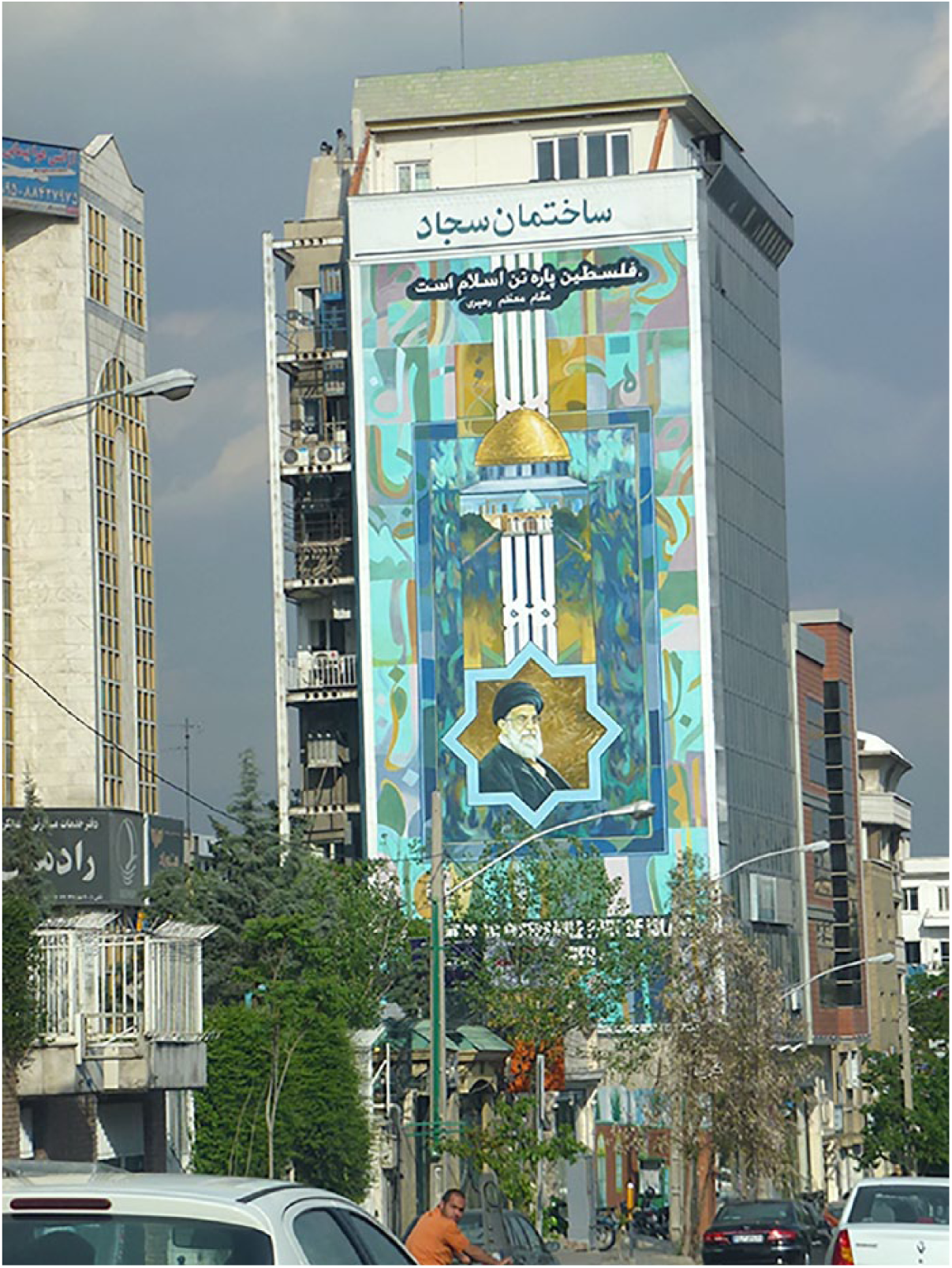
The Dome on the Rock in Jerusalem and statement from Ayatollah Khamenei (portrayed): ‘Palestine is a piece of the heart of Islam’. (© Bill Rolston)
While anti-Israeli murals were apparent at an earlier stage, this is not so currently. Even the quantity of anti-US murals has declined since the heyday, although the preponderance of such murals around the former US embassy in Tehran (the so-called ‘nest of spies’) remains. One of these murals juxtaposes anti-Americanism with another nest, that of doves being attacked by US rockets (see Figure 9).

Iranian soldier, and doves’ nest under attack from rockets fired from a US jet. (© Bill Rolston)
There is no reference in murals to struggles elsewhere in the Muslim world – Lebanon, Syria, Iraq, despite the support of the Iranian state for Shia militants in a number of these places. However, one mural honours Khaled Eslamboli, the Egyptian army officer who assassinated President Anwar Sadat of Egypt in 1981 and was executed in 1982 (see Figure 10). Regarded in Iran as a martyr, his image also appears at the entrance to Behesht-e Zahra Cemetery to the south of Tehran which contains the graves of thousands of martyrs from the Iran–Iraq war.
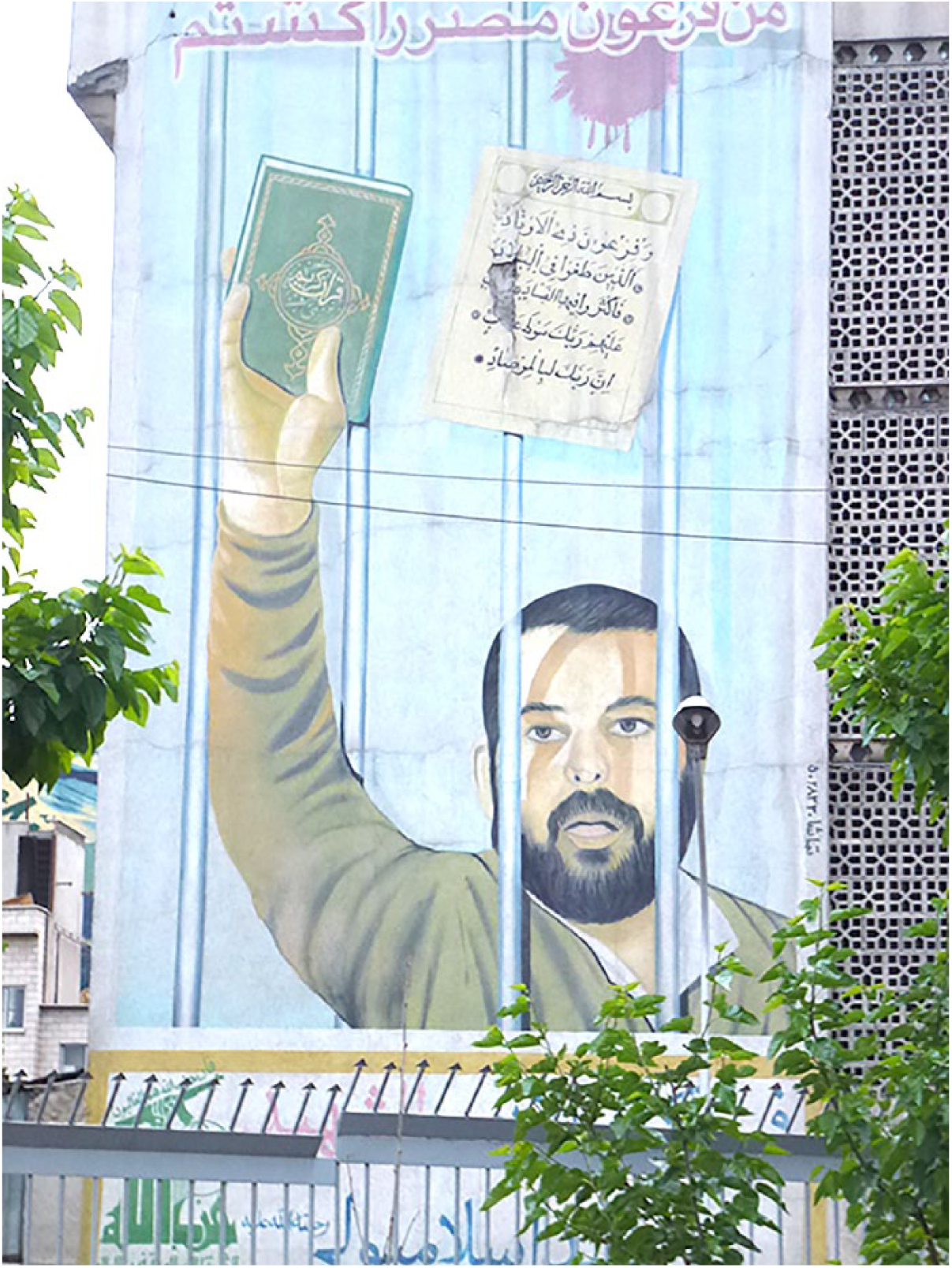
Khaled Eslamboli, Egyptian army officer who assassinated President Anwar Sadat in 1981 and was later executed. (© Bill Rolston)
Silences
There are some significant silences on the walls of Tehran. Representations of women are rare. In this light, the creation in 2006 of a section of the Shohada (Martyrs) Museum dedicated to women was significant if initially mystifying. Women did not share in military combat during the Iran–Iraq war, their only roles being those of nurses and other auxiliaries distant from the front line (Shirazi, 2012: 108). The women represented in the Museum are political activists who opposed the Shah, women who died in Iraqi bomb attacks and Palestinian suicide bombers (Shirazi, 2012: 111). For some commentators, this is viewed as ‘a clever, calculated strategy to demonstrate “equal and honourable” status for Iranian women in accordance with Islamic tradition … throwing a bone, so to speak, to equal rights for women …’ (Shirazi, 2012: 109).
There is only one female martyr displayed in Tehran, Fouzieh Shirdel, whose picture appears on a number of billboards. She is depicted with two men, all three being chosen as ‘martyrs of the year’. Shirdel was a nurse in a hospital in Paveh, a town in Iran’s Kurdistan province. In August 1980, the hospital was attacked by a militant group who were combating the newly formed Islamic government in Kurdistan. She refused to leave the patients under her care and was killed. 1
The other major silence relates to the Green opposition. Many of the battles for political legitimacy waged in 2009 between the Green opposition and the state were fought out at the visual level. The Greens sought to reclaim symbolism which had been monopolised by the state. Their colour was green, the colour associated with the Prophet and with Islam, 2 and they took every opportunity to display it through flags, banners, head scarves, arm bands, eye shadow, nail paint and so on (Fischer, 2010: 520). They repeated the slogans and practices of 1979, and often with identical repercussions. Protesters chanted ‘Allahu Akbar’ from rooftops in the evenings as was also done during the revolution against the Shah, and as then, the state sought to ban the practice (Rauh, 2013: 1328). The Shah had banned Ashura ceremonies in 1979, and the Islamic Republic repeated this move by banning Ashura ceremonies at Khomeini’s tomb in 2009 (Yarbakhsh, 2014: 82).
‘[W]ords and gestures that for 30 years had sustained the political imagination of revolutionary Iran were redeployed in order to challenge the state by means of its own vocabulary’ (Yarbakhsh, 2014: 81). Thus, the Greens chanted ‘Down with the dictator’ instead of ‘Down with the Shah’; and instead of ‘Independence, Freedom, Islamic Republic’, they shouted ‘Independence, Freedom, Iranian Republic’ (Rauh, 2013: 1333). They called for Ahmadinejad’s death and targeted the Supreme Leader: ‘Khamenei is a murderer, his leadership is invalid’. 3
The ability of the Greens to paint murals was severely restricted; however, they utilised walls in other ways, leaving bloody handprints or the letter V (denoting peace and freedom), painted in green. Sometimes they simply threw plastic bags filled with green paint against walls. Most of their painted slogans were short and unsophisticated, painted hastily for fear of discovery. This did not prevent the Basiji and other state functionaries expending a great deal of effort in erasing or amending the messages. ‘V = WC’ became a common scatological distortion; on other occasions, the V was converted into a Star of David. 4
The Greens’ strategy was to declare that they were not simply Iranian but Muslim too (Khatib, 2013: 107). More radically, they reclaimed the mantle of the 1979 revolution, arguing that it was they rather than the regime which was true to its ideals, echoing Hossein’s message that it was he, rather than Yazid, who remained true to the ideals of Islam. For the Greens, the parallels with Karbala were many. Thus, the regime’s killing of their supporters during Ashura ceremonies in 2009 was easily interpreted within the Karbala paradigm. As the regime killed and injured protesters on the streets, people left bloodstained handprints on the walls. In doing so, they recalled one of the important symbols of Shia Islam, the panjah.
To first appearances, it might seem strange that an opposition movement objecting to the capture of the revolution and state power by clerics should itself employ religious symbolism. Once again, this points to the deep significance of the Karbala myth for Shia faithful in general and Iranians in particular. Once more Karbala was everywhere; the protesters were victims facing the tyranny of the tyrant. In referencing Karbala and martyrdom, the Greens were making a claim to political legitimacy by denying the state the monopoly of religious symbolism (Rauh, 2013: 1339).
There has been a struggle in Iran over meaning, public memory and public representation before and after the Islamic Revolution of 1979 which can be seen in areas such as cinema (Naficy, 2012) and public architecture (Grigor, 2009). The focus of this article, however, has been on how these issues have been expressed in public murals since the Revolution. There have been some shifts in relation to the number and form of murals and other public symbolism, but overall, there has been a rigid focus on the representation of martyrdom in the recent past, albeit tied into the martyrdom of Imam Hossein many centuries earlier. The state has been the source of this unidirectional public memory which allows almost no space for counter-memory. As a result, for all the visual ‘loudness’ of the murals of Tehran, there are also some powerful silences.
Conclusion: banality and reception
Visiting Tehran five years after Karimi’s (2008) remarks, I got a sense of the banality of the murals from the young adults I met; many seemed genuinely astonished when their attention was drawn by my interest that there were so many murals in Tehran. It was clear that when encouraged to comment on the murals, their position was a complex one; many seemed to reject the form but not the totality of the message of the murals. In terms of how the murals are received by the public, this is an insight which matches the findings of other researchers such as Gruber (2008a).
The propaganda work of the Iranian state has involved a sophisticated merging of a specific interpretation of Islam with an appropriation of political martyrdom. Memories of war have been utilised in the consolidation of elite power. The official memory represented in public memorialisation has not emerged from consultation or the partial incorporation of opposition interpretations, but from the victory of one narrative. Memory entrepreneurs have created a powerful state-friendly myth which simplifies the past and removes any sense of a dialectics of memory.
At the same time, it has to be stressed that the official narrative of the Iranian state has not been created out of nothing. It resonates with elements of popular culture, not least the memory of the dead of the Iran–Iraq war. From the beginning, the clerical leaders of the revolution in 1979 were concerned ‘to implant the seeds of an Islamic lifestyle in the minds of the new generation’ (Kazemipur and Goodarzi, 2009: 163). They were aided in that task by the sheer number of martyrs during the Iran–Iraq war. Keeping alive the memory of martyrs became ‘a continual mission of the state’ (Talebi, 2012: 123) during the 1980s. However, as the direct memory of those upheavals has declined, there has emerged evidence a ‘fading reverence’ (Talebi, 2012: 136) for murals, even martyr murals. That decline was most pronounced in relation to young people. Although still personally religious (Kazemipur and Goodarzi, 2009), many youths reject a state-sponsored approach which sees religion as political expedience (Kazemipur and Goodarzi, 2009: 172). Gruber (2008a: 45) found that ‘the majority of Iranians believe that it should remain a personal, rather than politicized act’ and that young people questioned consider ‘martyrial scenes particularly vulgar and distasteful, and also judge the theme of martyrdom as necrophilic, dépassé, and obstructive to the therapeutic act of moving onward to less sinister goals in life than seeking death’ Gruber (2013: 17).
In a situation where the revolution has been well and truly established, there is no ongoing war with a neighbouring state, the internal opposition has been neutralised and even relationships with the old enemy, the United States, seemed to be mellowing under President Obama, it became more difficult to play the Karbala card. And yet that is precisely what the martyr murals continued to do. In the face of rejection of or unease with the murals, the state response was not to seek an alternative form of hegemony, but rather to, as it were, ‘turn up the volume’ of the old message of martyrs. The martyr murals ‘are specifically targeting a younger generation that experienced neither revolution nor war’ (Gruber, 2008a: 33). In this sense, the purpose of the murals remains what it has always been. But there is a wider and more urgent need, the need for state legitimacy in the face of an element of popular rejection or indifference. For the state, now, more than ever, ‘keeping its martyrs in the eye of the public is tied up with its need to maintain its own legitimacy …’ (Talebi, 2012: 138).
Recent years have witnessed a slight relaxation with the sponsorship of beautification murals by the Tehran municipality. The themes of these murals frequently do not touch on politics, and even those which do so are softer than before. For example, the martyr, if portrayed at all, ‘is not depicted as a brave young man in battle but rather as a mystical bird’ (Karimi, 2008: 13; see Figure 11). At the same time, the beautification murals cannot stray too far from the orthodoxies of the state in public space. More significantly, public space reveals nothing of the subaltern memories which may be preserved in more private spaces through oral accounts and other means. Beautification murals notwithstanding, opening up the walls of Tehran to a multiplicity of voices is a project which awaits wider political developments.
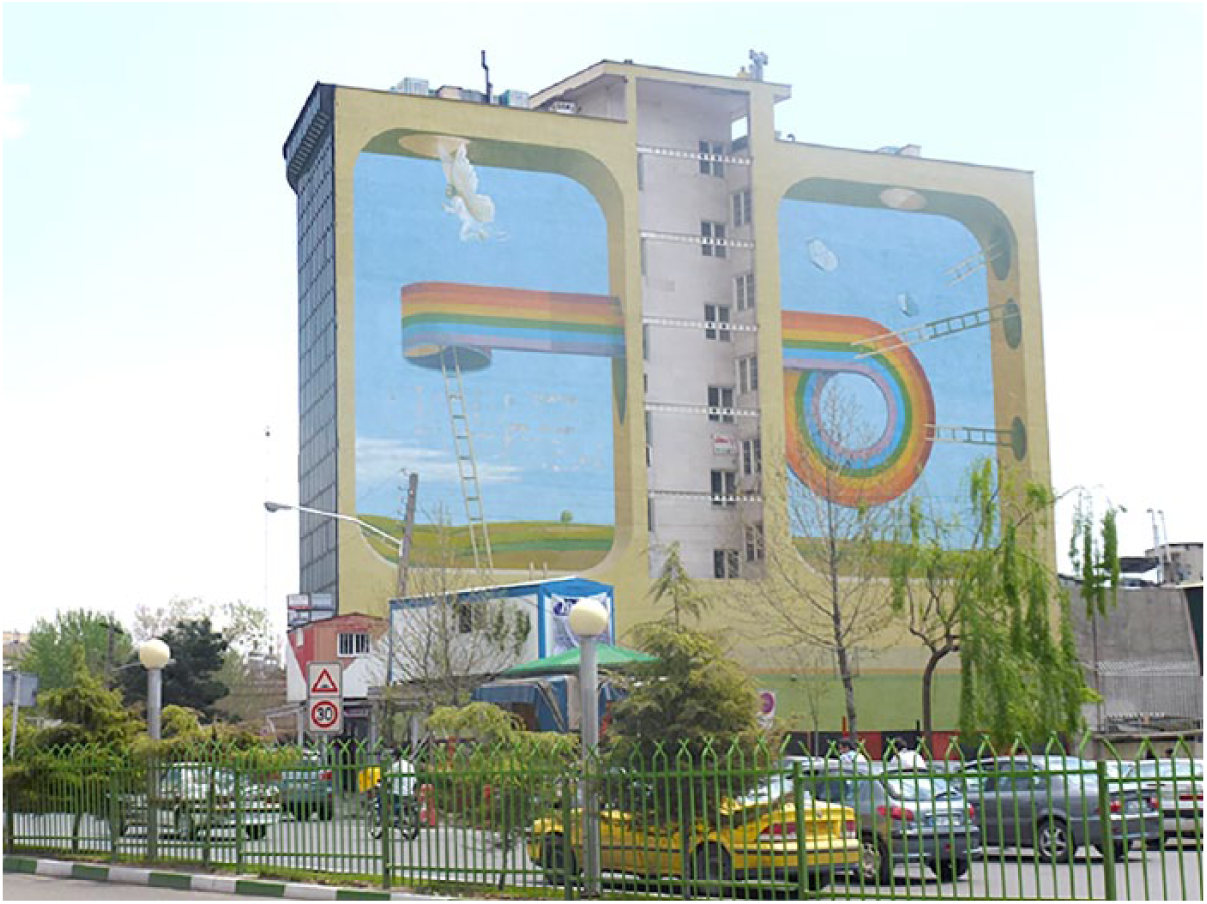
Beautification mural, with the martyr represented as an angel. (© Bill Rolston)
Footnotes
Acknowledgements
I could not have undertaken this research without the help of Hosein Pessaran, Hamid Reza Baqtiari, Sara Salimi, Ayoub Davoodi and especially Azadeh Sobout.
Declaration of Conflicting Interests
The author(s) declared no potential conflicts of interest with respect to the research, authorship, and/or publication of this article.
Funding
The author(s) received no financial support for the research, authorship, and/or publication of this article.