



Abstract
This article explores the multilayered struggles within the memory field in post-dictatorship Chilean society by investigating the Day of the Young Combatant, a commemoration of the murder of two young brothers perpetrated by police officers in 1985. Every 29 March, people born after the end of the dictatorship—members of the post-dictatorship generation—commemorate through cultural activities and violent riots. Since the murder, the commemoration has evolved from local and unofficially recognized to a large-scale, violent event that takes place every year in working-class neighborhoods of Santiago. This article analyzes the contested ways of recalling the murder of these brothers and the multilevel struggle that the post-dictatorship generation engages in to expand the field of memory at three levels: narratives, territories, and practices. It illustrates the multilayered process for negotiating the meanings and time frames to narrate not only the dictatorial past but also the political transition.
Keywords
Introduction
“Don’t forgive or forget; new combatants are born every day” and “everyone to the streets, the struggle continues” are the statements inscribed in two of the posters calling to participate in the 2015 commemoration of the Day of the Young Combatant. This commemoration, held every 29 March, involves events and demonstrations that pay homage to the 1985 murder of the Vergara Toledo brothers. The murder of these brothers occurred 4 years before the end of Augusto Pinochet’s military dictatorship (1973–1990), which resulted in the execution and disappearance of more than 3000 people 1 and in the radical socioeconomic transformation of Chilean society toward neoliberalism. As the message on the Day of the Young Combatant posters reflects, the commemoration of this crime is a relevant and ongoing event held annually by young people, in which cultural activities coexist with violent riots in working-class neighborhoods of different Chilean cities. 2
The murder of the Vergara brothers is an emblematic case of human rights violations. However, for the post-dictatorship generation, it constitutes more than that. The brothers were not random victims of the military dictatorship; they were militants of the Leftist Revolutionary Movement (MIR) and were active in resisting the dictatorship. Neither the significance of this leftist organization or the role of the resistance movement has been addressed by the official discourse of the past. Instead, the official discourse, built by political authorities and elites during the transition to democracy, condemned the military’s human rights violations and emphasized political stability (Hite and Cesarini, 2004; Lechner and Guell, 1998; Moulián, 1998). The political elites privileged political and social order over recognition of the repressive past, putting forward a version of the past that focused on the idea of national reconciliation, as well as on the material and symbolic reparations of the human rights crimes perpetrated during Pinochet’s regime. 3
Today, those who participate in the Day of the Young Combatant seek acknowledgment of the political involvement and militancy of the Vergara Toledo brothers, the legacy and continuity of their struggle in the present, and the socioeconomic consequences of the neoliberal system installed during the dictatorship and expanded during the political transition. By posing these demands every year in their commemoration of the Young Combatant, the young participants claim a place in the memory field.
Following Pierre Bourdieu’s (1991) notion of a field as a “privileged site for the exercise of the power of representation or manifestation that contributes to making that which exists in practical sense, tacitly or implicitly, exist fully” (p. 235), I propose the notion of the memory field as an analytical tool to describe the multilayered symbolic disputes within Chilean society to remembering the dictatorial past. The memory field in Chile has been dominated by official, emblematic, and highly polarized ways of remembering the past embraced and disseminated by older generations (Tocornal, 2008). Emblematic memories are those common and acceptable cultural frames to narrate the violence of the past (Stern, 2006) including, for example, the traumatic memories of the victims and their relatives or the memory held by the military. As per James Wertsch’s Schematic Narrative Templates, emblematic memories work at a deep cultural level guiding the different ways in which people think, imagine, and interpret the past (Wertsch, 2009)
The participants of the Day of the Young Combatant, as this article shows, are trying to access the memory field by questioning the historically acceptable frames of interpreting the past while expanding the available repertories or the forms with which to talk and think about the dictatorial past. The memory field constitutes a space of struggles in which different memories will be constantly disputed (Jelin, 2002).
The goal of this article is to explore The Day of the Young Combatant and the different disputes in which the participants of this commemoration engage to enter the memory field. It explores the social locations in which these disputes take place. As the results illustrate, the members of the post-dictatorship generation struggle on three different levels. First, they challenge the official narrative of the past by posing distinct interpretations and periodicities to talk about this period. Second, they focus the conflict on the territories in which events should be remembered, where local categories go up against national ones. Finally, they contest the practices of remembering used by the authorities and older members of the previous generation.
This qualitative project draws on data from 10 in-depth interviews with members of the post-dictatorship generation (between 15 and 24 years old) who participated in the commemoration conducted between December and February 2013 in Santiago, Chile, and archival research of the news about this commemoration from four nationwide newspapers in Chile 4 between 1985 (the year in which the brothers were murdered) and 2013. The archival research also considers official documents regarding the official ways of dealing with the past, such as the two truth commission reports 5 (Rettig, 1991; Valech, 2004) and the narrative of the official Museum of Memory and Human Rights. It also includes an analysis of secondary sources recently published regarding the Chilean politics of memory. The interviews and material were analyzed using content analysis with the assistance of ATLA.ti, software for qualitative analysis. The content analysis of official documents and secondary sources aims to explore the trajectory of the official narrative of the past, by tracking the main narrative strands and their changes along the transition.
The analysis of this commemoration offers insights into the connections between the political process of transition and the post-dictatorship generation’s actions and discourses when interpreting and talking about the dictatorial past in Chile. It provides these results by triangulating categories that emerged from my interviews and observations with the results of the archival research and the secondary sources that trace the trajectory and changes of the Chilean politics of memory. The triangulation of all these sources contributed to elucidate diverse but complementary perspectives of the same phenomenon—the role of the post-dictatorship generation in the commemoration studied—and to enhance the analysis of the Day of the Young Combatant within the trajectory of the Chilean memory field.
The results highlight the multilayered process through which members of this generation forge their own representations of the past while expanding the available ways of remembering. Studying the Day of the Young Combatant sheds light on a specific generational struggle within this commemoration, yet it is not intended to be representative of all the post-dictatorship generations’ ways of remembering.
Transitional narratives of the past and the role of new generations
This project draws from and contributes to the literature on transitions to democracy and debates about the politics of memory in contemporary Latin America (Hite and Cesarini, 2004; Jelin, 2002; Roniger and Sznajder, 1998). This literature has explored the role of constructing an official narrative of the past after periods of violence and repression. These processes are characterized by a deliberate selection of symbols that are put together to facilitate identification with the new order (Anderson, 2006; Hobsbawm, 2012; Offe, 1996).
The literature on transitions states that the construction of an official narrative about the past is crucial to legitimate the new system in which collective memory plays a fundamental role (Desfor Edles, 1998; Hite and Cesarini, 2004) as an important aspect in the consolidation of the new regime (Art, 2006; Gillis, 1996). New authorities consolidate new official narratives to reinforce the ties of the political community (Bernhard and Kubik, 2014; Zerubavel, 1995). Yet the legitimization of these rhetorical strategies depends on power struggles, and consequently, it is always an unfixed process in which social actors have the potential to transform its direction (Cruz, 2000; Davis, 2005; Jelin, 2002; Misztal, 2010; Olick, 1999; Wagner-Pacifici and Schwartz, 1991).
The literature on transitions has highlighted the role of political stability in political processes of transformation (Linz and Stephan, 1978; O’Donnell and Schmitter, 1986; Offe, 1996) and the importance of using mechanisms of transitional justice such as truth commissions, amnesties, and economic and symbolic reparation to prevent the emergence of social conflict and the reemergence of violence (Hayner, 2001; Teitel, 2000). Transitional justice mechanisms have been central to developing the institutional and symbolic arrangements of several transitions to democracy, promoting in some cases oblivion as a form to maintain political stability (Roniger and Sznajder, 1998). This literature has recognized only recently some of the debates about silencing aspects of the past, such as the socioeconomic transformation generated during the analyzed period (Mani, 2008; Sharp, 2015). However, this perspective has not fully considered the contested features of constructing an official discourse or the role of new generations in questioning the narratives of transition. I propose to examine this struggle through the concept of memory field.
The literature on memory and generations has focused on the problem of transmitting traumatic events from one generation to the next and has stressed the role of psychosocial mechanisms that either prevent or facilitate this transmission (Hirsch, 2012; Laub, 1992; Schwab, 2010; Welzer, 2010). This literature, mostly based on Holocaust studies, describes younger generations as the direct or indirect receptors of family and social trauma. This approach has influenced most of the research on generations and memory in post-dictatorship societies in Latin America. Thus, Latin American countries, such as Chile, Argentina, and Uruguay, have focused their politics of memory on concrete and symbolic forms to overcome the traumatic experiences of the past.
Recent studies shift from the traditional literature by analyzing the political significance of new generations’ memories besides the transmission of traumatic events (Achugar, 2016; Hirsch, 2014; Hite, 2012; Jara, 2016; Levey, 2014; Reyes et al., 2016; Ros, 2012). These authors highlight the mobilizing effects of remembering the dictatorial past, especially in everyday interactions and through cultural production like theater, literature, documentaries, and movies. An example analyzed by Ana Ros (2012) is the documentary Actores Secundarios. It depicts the story of the student movement during the 1980s, emphasizing the strategies of resistance used by high school students instead of the repression suffered by them. This study contributes to this debate by stressing the role of new generations in disputing a place within the memory field by offering a different understanding of what commemorating the dictatorial past means to the construction of public memory.
Bourdieu (1991) conceptualized “fields” as arenas of struggle in which individuals and organizations compete for valorizing the positions and forms of capital that they possess. A field constitutes a site of power struggle in which participants fight for a better position to legitimate their practices and meanings. Within each field, the resources are limited, and thus, struggle is necessary to enter or improve one’s social location within the field.
The dispute for accessing a field and, in the case analyzed in this article, a memory field strives for recognition, acknowledgement, and legitimacy of a different form of thinking and talking about the dictatorial past in Chile. Within the memory field, older actors normally have defined the rules of access (Bourdieu, 1984; Eyerman and Turner, 1998). Exerting power within the field takes place simultaneously in different locations and not only between a hegemonic versus subaltern positions. I argue that members of the post-dictatorship generation are active subjects who will have to dispute other powerful positions within the memory field to be recognized.
Unfolding the memory field in Chile and its dominant narrative of the past
The Chilean dictatorship started on 11 September 1973 with the coup d’état that overthrew the democratic government of Salvador Allende. Augusto Pinochet’s regime stayed in government for 17 years through the use of violence, repression, and unconstitutional means. During this period, more than 3000 Chileans were murdered or disappeared, and more than 40,000 were tortured or exiled by the intelligence service, the police, or the military. 6 During the same period, the military regime undertook many structural changes in the economic and social realms. The dictatorial regime reversed all the economic reforms passed by Allende’s socialist government and introduced a neoliberal economic model in Chile that included the privatization of the main social services, such as health, education, and pensions. The role of the state was widely reduced, while the market gained significant influence over social and political decisions.
The dictatorship ended in 1990, and a transition toward democracy, discussed among political elites during last years of the military regime, started. The new government had to negotiate the conditions with the outgoing authorities to ensure the country’s political stability, an approach to transition that has been fostered and disseminated by the Transitional Justice paradigm (Hayner, 2001; Teitel, 2000). This scenario meant that the new authorities could not make significant advances on matters of truth and justice to achieve political stability. This choice put forward a version of the past that focused on the idea of reconciliation and material reparation but excluded different and conflicting versions of the past, which promoted the forgetting and excluding of many political actors from real participation (Stern, 2006; Wilde, 1999).
During the transition’s first years, this political context had repercussions on the processes of making amends and constructing collective memory. These actions concentrated on the relatives of the people disappeared, executed, and exiled and not on the creation of a memory process for society as a whole, such as the design of policies of public recognition of the social trauma.
The politics of memory began to change in 1998 with the unexpected arrest of Pinochet in London on an extradition charge to face trial for crimes against humanity led by the Spanish judge Baltasar Garzón. The extradition request was denied and after more than 1 year under arrest, Pinochet returned to Chile. The fact that the figure of the ex-dictator had been internationally brought into question marked a very significant change in the Chilean political scene and changed the power balance within the memory field (Roht-Arriaza, 2005). As a result, some memories and experiences of the past previously excluded gained recognition and visibility, and there was an upsurge of memory projects supported mostly by civil society (Aguilera, 2015; Klep, 2012). In general, these projects sought recognition of the human rights violations perpetrated by the military regime. There were also intensified efforts to prosecute perpetrators and provide reparations to victims as well as some initiatives that looked for the recognition of the victims and their political struggles. For example, the Colectivo Londres 38, one of the Chilean human rights organizations, highlighted the relevance of making visible the memories of the victims political struggles by recovering a former center of detention and torture and installing a memorial that shows the political affiliation of those who were murdered or disappeared. In 2004, a second truth commission 7 was established to address the situation of victims left out of the first one: former prisoners who were tortured and survived these abuses. State actions framed under the transitional justice paradigm were developed such as construction of memorials and the construction of the Memory and Human Rights Museum.
While all of these actions represented a fundamental change in post-dictatorship Chile (Collins et al., 2013), this form of coming to terms with the past has excluded different conflicts and narratives. For example, the economic and social consequences of the dictatorship have been barely addressed, despite the situation of structural violence that have been perpetuated in Chile (Rovira, 2007).
Reemergence of nonofficial and local memories
The recent 40-year commemoration of the coup d’etat on 11 September 2013 and the Student Movement (2011–2013) started an impressive public debate about the economic and social consequences and the problem of reconciliation. Some of the socioeconomic transformations carried out during Pinochet’s regime, such as the privatization of the public education system, were the main claims of this movement. The Student Movement was a crucial phenomenon that initiated an alternative way to remember the dictatorial past as it “represented at some level the rejection of persistent inequalities now seen not as unfinished business for the neoliberal model but rather as a direct consequence of it” (Collins et al., 2013: 5). As the student movement was massive and gained broad support from Chilean society, it operated as a turning point in the ways Chilean society has been talking and thinking about the past, bringing back the possibility to remember silenced narratives of the past.
Social actors and in particular new generations have started to look for independent and nonofficial forms to narrate the past that have remerged especially since the emergence of the student movement. The Day of the Young Combatant constitutes a remarkable event to study the transformation of the memory field as it takes place every year since the murder of the Vergara brothers in 1985 exposing the expansion and emergence of suppressed memories.
The Day of the Young Combatant: expanding the memory field
In the evening of 29 March 1985, Rafael and Eduardo Vergara Toledo, who were 18 and 20 years old, respectively, were taking part in a demonstration in Villa Francia, a neighborhood located in central Santiago. That day, the Vergara brothers were followed by the police and brutally assassinated. Both Rafael and Eduardo were members of the MIR and participated actively in the resistance to the dictatorship (Torres, 2012). They had been involved in politics from a young age, not only through their participation in the MIR but also as residents of Villa Francia, whose inhabitants were deeply involved in fighting Pinochet’s regime (Cabrera, 2007).
During the dictatorship, Villa Francia, a working-class neighborhood with a history of collective organization and local participation, was at the forefront of the struggle against Pinochet’s regime. Demonstrations and riots used to take place in its streets, and police harassment, repression, and human rights violations were common. From 1974 to 1988, at least 14 of its inhabitants disappeared or were murdered by the police. 8
The murder of Eduardo and Rafael was reported in the national newspapers as a confusing but regular criminal event. Newspapers presented highly contradictory facts: some of them reported the event as an attempted robbery and mentioned the Vergara brothers as run-of-the-mill delinquents. For example, the headline of La Tercera, one of the most-read national newspapers, read, “Two delinquents die in a spectacular shooting with police forces.” 9 Brief reports in the official newspapers presented events as facts without questioning the reasons for the confrontation, providing false information and evidence that the police allegedly found. 10 Nevertheless, witnesses who observed the violent events were able to reconstruct the facts from that day: The brothers were followed 11 and shot to death by the police. The news of the murder spread among the community and the funeral of the brothers turned into an impressive demonstration against repression and state terrorism. The following year, people living in Villa Francia as well as MIR militants and members of other left-wing organizations arranged to commemorate this event for the first time. 12
Despite the civil response to these killings, up until 2003, their murder was considered a criminal event by the judicial system. In 2003, their family took the case from the military judicial system to the civil court and the Supreme Court designated a special judge, Sergio Muñoz, to preside over the case. Muñoz called more than 55 witnesses to testify and ordered the bodies of the two brothers to be exhumed. 13 In 2010, 25 years after their murders, the judicial system passed its final sentence and declared the police officers guilty. 14
Militants and organizers named the commemoration the Day of the Young Combatant to acknowledge both the deaths of Rafael and Eduardo and those of many other young people who were murdered or who disappeared at that time. This day aimed to honor the motivations of their struggle, and since then, the commemoration has turned into an annual event of remembrance and recognition of Eduardo’s and Rafael’s deaths, the resistance movement, and the revolutionary organizations involved.
In the first few years of this commemoration, those who participated were mainly militants belonging to political organizations, people living in Villa Francia, and the relatives and friends of the Vergara Toledo brothers. Most of the activities and memorials took place in Villa Francia and close to Eduardo’s university. Since the first commemoration more than 30 years ago, its participants have significantly changed. Although they are mostly young people aged between 15 and 25 years, it is not necessary nowadays to belong to a specific political organization, reside in Villa Francia, or even be familiar with the story of the Vergara brothers. As one of my interviewees describes,
We went to Villa Francia and I heard the Vergara brothers mom’s speech … to see the sadness in her face … What she said was beautiful, and we all felt that energy. We were encouraged, like lets go to make that barricade and block some streets … (Camila, 17)
As if the Day of the Young Combatant had been a call for action, a generation born after the end of the dictatorship (1990) is today claiming a space in the memory field. As the following section illustrates, The Day of the Young Combatant sheds light on the multilayered struggle in the memory field in at least three different levels: narratives, territories, and practices.
Disputing the official narrative of the past: expanding contents and timeline
The diverse representations of the past displayed every 29th March challenge the official narrative of the period by both expanding the timeline to be remembered and demanding the inclusion of new contents to those offered by official and public narratives of the dictatorial past (1973–1990) that stress the human rights crimes and atrocities committed by the military. Participants of the Day of the Young Combatant claim the necessity to remember not only the human rights violations committed by the military regime but also the role of the resistance movement against the dictatorship. They also bring forward the socioeconomic consequences of the neoliberal system consolidated by Pinochet’s regime and expanded during the transition.
To remember the Vergara brothers, the new generation expresses the necessity to remember beyond the dictatorship’s time frame. They incorporate the process of political transitions and the continuity of a process of resistance that did not conclude at the end of the dictatorship. As Rosa, a young woman who has been taking part in the commemoration, points out, “I’d celebrate the Day of the Young Combatant as if I’d been there … to show that the fight continues, that we’re still at it … that the twenty years the coalition was in power only reinforced this” (Rosa, 20). For all of my interviewees, the economic reforms instigated during the dictatorship are also seen as a violation of social and economic rights that should be remembered. As one of the participants mentions, “… there are other violations of human rights that are fundamental … Like being deprived of education, being deprived of culture, being deprived of a real democracy” (Juan, 19). Members of the new generation demand the inclusion of structural forms of violence experienced in Chile within the narrative of the past.
The fight of the local communities before and during the dictatorship is emphasized as one of the features of the resistance against the dictatorship that have inspired the new generation until today. One example is the Slum Dwellers Movement (Movimiento de Pobladores) that represented the working-class people and was extremely important in the resistance against the dictatorship (Schneider, 1995), yet later was excluded from the democratization process (Cabrera, 2007; Monsalve, 2007). As one of the participants notes, “we’re the continuation of the fight our people participated in during the dictatorship” (Antonio, 19). In fact, they are inspired today by some of the repertories of action of the Slum Dwellers Movement, such as street blockades or barricades.
The ideas that the post-dictatorship generation highlights every year through their active participation have been overlooked in the mass media coverage of this commemoration. 15 During the first years of transition, the coverage of 29th March was associated with the presence of subversive groups that were active in the resistance against the dictatorship. Since the arrest of Pinochet in London in 1998, this discourse has changed, and in general, the press has reported the event as criminal actions not connected to political goals. Instead of describing the participants as subversives, terrorists, or extremists as the official right-wing press did until 1998, the media started describing the participants as delinquent, demonstrators, or hooded protestors, 16 dismissing the political contents of their actions.
The content analysis of the media contrasts with the interviews I conducted in which participants reported political motivation in their participation every 29th March. “There’s been no passivity on any March 29. I think that’s okay, because I think the acts of political violence that occur on that date are really relevant, against the police, against capitalism” (Juan, 19). What many of my interviewees illustrate is a logic of political participation in which the affiliation to a political organization is not essential, and anarchic and more individualistic perspectives are viewed positively. In sum, participants of this commemoration have extended the contents and timeline to remember the difficult past disputing the official discourses about the past constructed by political authorities and endorsed by mass media coverage.
A conflict of territories: toward local memories
Another layer of the struggle over the access to the memory field takes place at the territorial level, where participants of the Young Combatant demand the need to remember local experiences, events, and social actors, in opposition to the national and unifying memories promoted by the official discourse. Local stories, victims, and their experience of political involvement during the dictatorship do not form part of the national memory of this period, a narrative that stresses a unified version of the past.
The official narrative highlights that those who were murdered were victims beyond the political and territorial struggles in which they were taking part. As the decree that created the National Commission on Political Imprisonment and Torture affirms,
any attempt to solve the problem of human rights in Chile obliges one to take a global look at the essential rights of human beings that were violated and to recognize the victims of those violations […] this is the only way that future generations can inherit a nation whose soul is united and at peace.
17
This narrative attempts to disseminate a unified perspective in which the recognition of human rights violations is “the only way” to work through the dictatorial past. In Aleida Assmann’s (2011) words, this official narrative could be interpreted as a model that seeks “remembering in order to forget” (p. 54). By facilitating reconciliation, this model pushes away those fragments of the past that can promote conflict.
Since the origin of the Day of the Young Combatant, participants of this commemoration have highlighted the memory of Villa Francia and, later, the memory of other peripheral neighborhoods. The first years of the events took place only in Villa Francia and close to the university where Eduardo was studying. 18 Yet during these more than 30 years, every year there are new territories involved. The media describes the expansion only in terms of violent incidents, without mentioning other forms of organization, political motivation, or manifestation that may be taking place in the neighborhoods where people commemorate.
The expansion of the Day of the Young Combatant to other peripheral areas of the city as well as many universities in Santiago and in other Chilean cities illustrates for my interviewees a demand for recognition of local experiences, victims, and heroes. In this sense, the parents of the Vergara brothers have become a legitimate referent for the participants of this commemoration in setting the memorialization and protest agenda of this event. As a young male participant notes, “The very parents of the Vergara Toledo always say the struggle must continue, and this motivates a lot of people” (Santiago, 24). This expansion echoes a history of resistance during the years of dictatorship in which peripheral areas became emblematic places of political formation and collective action. This emphasis implies recognition of the social history of these areas of Santiago as working-class neighborhoods with a legacy of political participation and organization (Cabrera, 2007; Monsalve, 2007; Raposo, 2012).
In Villa Francia, one of the most important ceremonies during the day is the romería. The romería is a march originated as a religious procession led by members of the post-dictatorship generation and open to all the neighbors who walk together carrying pictures and banners to remember the brothers and their fight. At night, the commemoration also takes place in the streets: “It’s important to commemorate events but you have to find the right way. It has to be done on the street, maybe violently” (Santiago, 24). Yet at night, only young people participate by organizing barricades and riots in different peripheral neighborhoods of Santiago, stressing the role of the post-dictatorship generation in the territorial dimension of this commemoration.
The relevance of the struggle for local memories is also revealed in the creation of murals and graffiti with contents that remember the dead and disappeared from the local areas and their political projects. For example, they represent the figure of the Vergara Toledo brothers and the idea of the “young combatant.” These works have been made by young local artists and can be seen in different peripheral areas of the Santiago, illustrating the expansion of the commemorative actions toward new territories.
Another aspect of the struggle at territorial level is seen in the difference between the official memorial to those murdered or disappeared during the dictatorship and the handcraft memorial built where the two brothers were killed (Figures 1 and 2). The official memorial is an impressive sculpture located in a central area of Villa Francia, inaugurated in August 2008 and funded by the government, the municipality, and members of the community. According to the Cultural Center for Recovering Our History, the local organization that coordinated the construction of this memorial, it seeks to promote peaceful coexistence and a culture of tolerance, 19 a goal that is in line with the national politics of memory. 20
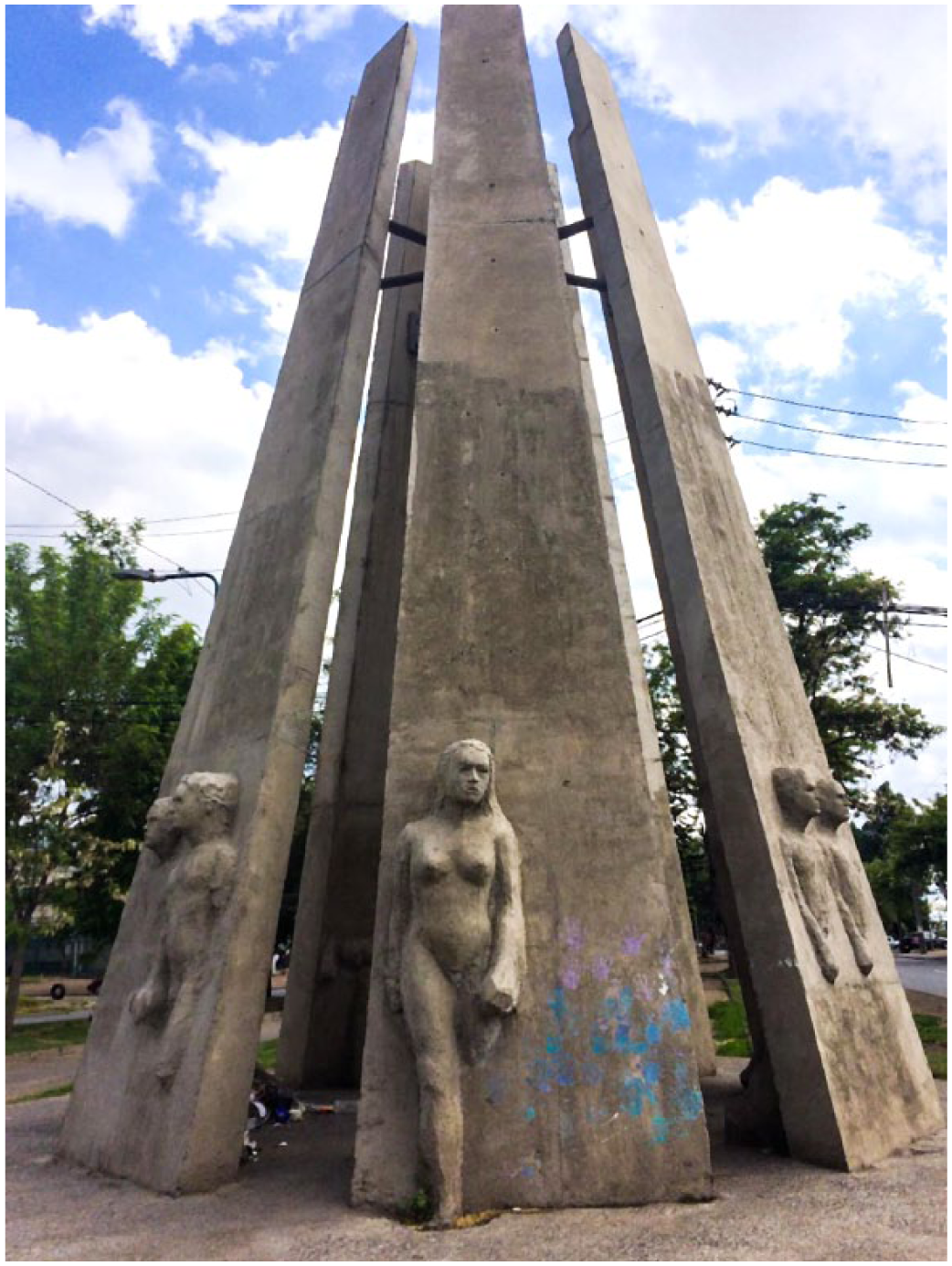
Villa Francia’s memorial.
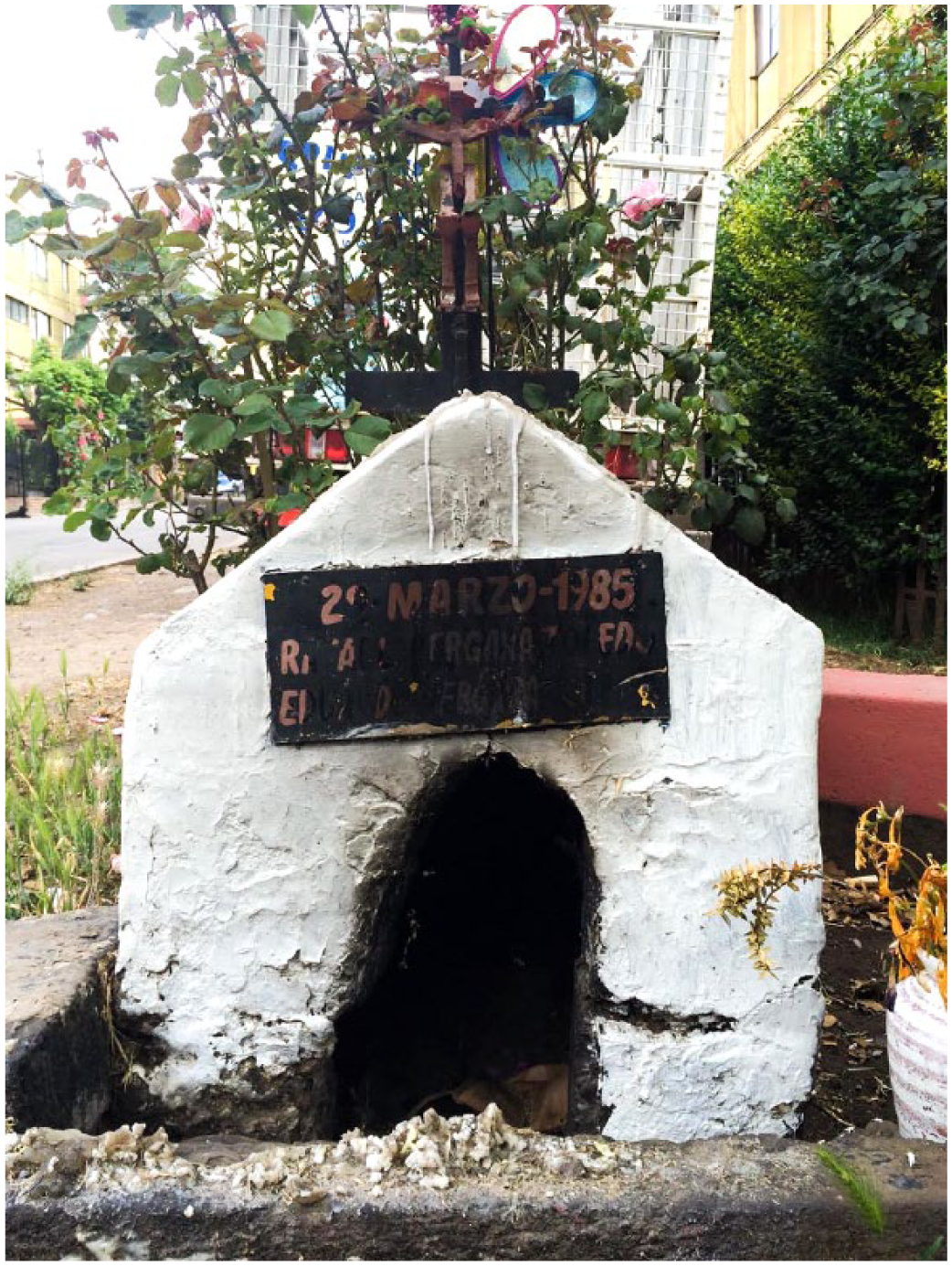
Vergara brothers’ roadside shrine.
The discourse and the resources involved in this project contrast with the small and handcraft memorial (roadside shrine) that was constructed where the two brothers were killed, that clearly has not received financial support. The contrast between these two memorials shows an example of local process of memorialization in which the tension between national and local ways of remembering is materialized.
The coverage of every 29 March has reported the events that take place in marginalized territories as criminal actions of vandalism, recounting these areas as dangerous neighborhoods that common citizens should avoid during this day, as we can see in the headline of one of the national newspapers: “On the Day of the Young Combatant: high security to avoid outrages.” 21 The press has reported it with an emphasis on violence and on the riots organized by young people. The territorial struggle has been deepened by the way in which the press has depicted the commemoration during all these years.
In 29 March 2014, a map was published in two newspapers showing the neighborhoods where the commemoration took place with violent incidents (Figure 3). The map marks those areas, depicted in red, as places to be avoided during that day, perpetuating the sense of exclusion and marginalization that motivate some of the demonstrations every year.

Map of risky areas during the Day of the Young Combatant.
This coverage “affects the external images of this local process of memorialization, where every action is seeing as illegitimate and threatening for the institutional order” (Raposo, 2012: 6). 22 This public discourse disseminates an image of this local commemoration and the areas in which these events take place as deviant forms of remembering.
Disputing the practices
The last layer of the struggle over access to the memory field is the one of practices of remembering, through which new generations fight to find a place to be recognized as new political actors in contrast to what they report as the old generation’s attempts to preserve their (old) forms of remembering. Those who participate in the Day of the Young Combatant emphasize the role of political action and violence as valid strategies to get recognition and to preserve the legacy of the Vergara brothers and their struggle. Simultaneously, they have incorporated cultural expressions that before were not part of the possible repertoires to remember such as dance parades and rock concerts. These practices represent a significant difference between the new generations and the older generation that commemorate violent events from the dictatorial past.
Every year, there are incidents such as riots and looting and several people are arrested; neighbors (vecinos), protestors, and policemen have been injured, and in 2008 and 2015, two people were killed. 23 Newspapers have systematically reported the event as a time of delinquency, where common citizens should return to their homes earlier, avoid driving in some areas of the city, or just stay at home. The violence, ranging from barricades, street blockades, as well as cutting off electricity, throwing stones and Molotov bombs, and, more recently, shootings, generally begins at night, after cultural events have ended. It is this violence that receives press attention every year and one of the explanations for the national coverage of these events.
The general rule is that participants cover their faces with hoods and scarves to avoid being recognized. Local and small organizations led by young people in different neighborhoods of Santiago, and more recently in other cities, coordinate specific actions, yet independent participants often also join these activities. Indeed, some of my interviewees described the presence of nonpolitical and more opportunistic types of participants who use this commemoration to take advantage of the clashes with police and engage in criminal acts. As one of my key informants expresses, “[The Young Combatant] became a date on which all marginalized youth could express their discontent, including delinquents who take advantage and use the date to commit vandalism” (Rafael, 29). An interesting interpretation of these actions is that they have historically been considered legitimate in specific neighborhoods as strategies that are available for resisting the dominant forces of the state and the police or, similarly, as a response to the marginalization and stigmatization of these areas of the city (Raposo, 2012).
Violent practices are used to commemorate, and all the interviewees justify these actions as a strategy to protest against the “other effects” of the dictatorship, meaning the socioeconomic transformation and the impressive increment of inequality. These violent practices are perceived by the older generation who still lives in Villa Francia as one of the main differences between the demonstrations organized during the dictatorship and those organized today by young people. As one of Villa Francia’s neighbors claims, “The demonstrations have turned into a sort of youth action against the entire system.” 24 These violent practices challenge the means of remembering of official authorities and institutions that have fostered a logic of negotiation and political agreements, excluding any organization or political actor who considers or believes in the necessity of conflict and political violence.
This dispute is also located within the family domain, where family members are seen as the main actors of the “old” ways of representing the past that is necessary to overcome. For the post-dictatorship generation, the memory of those who lived through the dictatorship is paralyzing and sad and associated with funerals and vigils:
My mother was always one of those who lit candles, cried, suffered a bit and put up a photo of the person being detained; believe me, we are sorry, but I also told her off and said what was the point. (Camila, 17)
For the youngsters, memory is a mobilizing and creative exercise or, at least, a motivation to carry on being involved.
The interviewees describe the events of 29 March as politically active demonstrations that require strong mobilization from them. Their participation entails organization to go to the street, to show forcefully their demands, to coordinate themselves and the neighbors beforehand, and to be prepared to confront police repression. The participants of the Day of the Young Combatant show the urgency of changing the funeral-like character of this memory. “I’ve never liked seeing how my people are remembered, making them victims. I’d rather remember their struggles” (Ana, 15).
The interviewees claim that their actions are very political in their strategies, and goals, but they do not follow the logic of older generations to commemorate the dictatorial past, which, in general, have been connected to political parties or nationwide organizations. Instead, the interviewees’ actions are less connected to political organizations but are organized by small groups in each neighborhood answering to different political logics and alternative ways of participation where cultural expressions are organized, such as concerts, painting murals, theater, and movie screenings in which the youngsters relate to the memory field. These are activities organized by young people in many universities and neighborhoods through which they consolidate a network of initiatives to express and transmit their forms to narrate the past. Yet these activities are barely mentioned in the press. Every 29 March, members of the post-dictatorship generation through the use and display of actions that question traditional ways of remembering claim their own space in the memory field.
Conclusion
The commemoration of the “Day of the Young Combatant” organized and shaped by members of the post-dictatorship generation constitutes an insightful case for studying the contentious process of interpreting and representing the past in societies that have experienced periods of violence and repression. This case shows that the negotiations and struggles to enter into the memory field take place simultaneously on different levels or social locations, stressing the always-dynamic character of memory processes where different hegemonic categories are—and will be—disputed simultaneously at least at the level of narratives, territories, and practices. This is an exceptional case to illustrate how the field of memory might be transformed as new actors appropriate and re-signify past events (Wagner-Pacifici, 2017).
The post-dictatorship generation is, first, disputing the official narrative of the past promoted by the State. They claim the necessity to remember not only human rights violations but the role and actions of the resistance movement against the dictatorship as well as the socioeconomic consequences of the neoliberal system installed during the dictatorship. Second, this struggle involves a conflict of territories. The territories involved in the Day of the Young Combatant are peripheral and marginalized neighborhoods that during that day claim recognition of their local memories. Local memories then are in tension with national memories. Finally, this struggle takes place at the level of the practices of remembering. Members of the post-dictatorship generation who participate in this commemoration emphasize the role of political action and violence as a valid strategy to get recognition and to preserve the memory of the Vergara Toledo brothers and their militancy. These three levels of struggle allow us to observe a generational dimension operating within each of them, stressing the active role that new generations can have in the construction and transformation of transitional and post-transitional narratives and the importance of this dimension within the memory field after periods of violence. This is particularly important when new generations bring violence as a validated political strategy and when they, as some authors have observed (Piper, 2015; Reyes et al., 2016), seem to have lost the fear to act and talk about the past.
The Day of the Young Combatant is a commemoration that brings some aspects of the past that have remained marginalized in the Chilean memory field. This multilayered struggle is important because it makes visible new political actors, brings peripheral and local memories to the front, and shows the relevance of multiple ideas and practices that the Vergara brothers represent to members of the post-dictatorship generation. This commemoration shows that there are some events that although silenced remain present and can be enacted by new generations that did not experience directly these events. 29 March is an outstanding example of how the memory field is an ongoing process or, in other words, memory in movement.
Footnotes
Acknowledgements
I would like to thank Robin Wagner-Pacifici, Virág Molnár, Federico Finchelstein, and Katherine Hite for their thoughtful comments on earlier drafts of this paper. I would also like to thank my colleagues at the Janey Annual Workshop, the NSSR Sociology PhD Workshop, and the anonymous reviewers at Memory Studies for their insightful feedback on this manuscript. Special thanks go to my interviewees without whom this article would not be possible and to my colleagues and friends, Guillermina Altomonte and Valentina Abufhele, who read and commented on each draft of this manuscript.
Declaration of Conflicting Interests
The author(s) declared no potential conflicts of interest with respect to the research, authorship, and/or publication of this article.
Funding
The author(s) disclosed receipt of the following financial support for the research, authorship, and/or publication of this article: The Janey Program in Latin American Studies at the New School supported this research.