




Abstract
Political discourse in contemporary Scotland increasingly revolves around the vision of a ‘New Scotland’, more prosperous and meritocratic than the rest of the United Kingdom. This has a convoluted relationship with Scotland’s industrial past, and specifically the social dislocation experienced through deindustrialisation. This article analyses the deployment of this narrative within regeneration efforts in former industrial communities in Lanarkshire and Inverclyde, West Central Scotland, before counterpoising it with the reflections of former industrial workers and their families. It does so through an analysis of monuments to the industrial past, comparing those erected as part of regeneration schemes by local authorities with community efforts to commemorate past struggles and industrial disasters. This examination is accompanied by the use of oral history narratives to argue that there are two distinct understandings of the nature of place, space, struggles over social justice and communal identities within these localities, which lean heavily on the memory of the industrial past in contrasting ways.
Introduction
The development of Scottish politics following the election of a majority Scottish National Party (SNP) government in 2011, and the 2014 referendum on independence, has brought ideas of Scottish nationhood and identity to the forefront of political discussion. The SNP has successfully outmanoeuvred the Labour Party in capitalising on the idea of a socially just and economically prosperous ‘New Scotland’ (Law and Mooney, 2006). Opposition to Conservatism, austerity and UK foreign policy is counterpoised with a Scottish ‘social democratic’ consensus which has obscured traditional divisions based on class. This article analyses the contestations within this broad narrative through an engagement with the transnational literature on deindustrialisation, which highlights substantial complexity in experiences of industrial decline that the narrative of a New Scotland conceals. Focus is given to areas impacted by capital migration and mass deindustrialisation. A critical examination of the ideals which underpin the New Scotland standpoint is then constructed through an analysis of historic monuments erected as part of regeneration efforts over the past decade by two local authorities in West Central Scotland – Inverclyde and North Lanarkshire.
The first section outlines the debates present in the international literature on deindustrialisation and labour geography. Following this, the research design is outlined, with an emphasis on explaining and justifying the specific localities being investigated. Then, the idea of the New Scotland is explored further, before a range of monuments erected as part of regeneration efforts that engage with this narrative are analysed. The article then introduces the contested narratives that emerged through the oral history testimonies from former industrial workers and their families. It analyses community memorials to the industrial past, arguing that these highlight the continued desire within industrial communities to ascribe distinct value and significance to their histories and experiences.
Transnational labour geography and deindustrialisation
The predominant labour geography concerns in analysing deindustrialisation have been the dynamics of capital mobility which characterise restructuring and elements of resistance and power imbalances within areas experiencing the departure and influx of investment. Silver’s (2005) influential work has integrated this into a consideration of how shifts within the ‘spatial fix’ of fixed capital, labour markets and economic sectors create different possibilities for mobilisation which make and unmake forms of working-class identification and struggle. Recent scholarship has seen an increasing focus on elements of geographical relationships and consciousness. Herod (2001) has highlighted the need to analyse ‘how workers’ lives are structured and embedded spatially’ (p. 4). Mitchell (2005) built on these sentiments to argue that ‘the landscape is a significant site of social struggle’, combining elements of ideological symbolism with sites of production and reproduction. Reflecting this article’s focus on differing deployments of the past, Smith et al. (2011) observed that competing historical interpretations share an ‘uneasy co-existence on the landscape and in the public memory’. Analysis of power and resistance necessitates an understanding of the intersectional correlation of social relations and forms of domination. Dicks (2000) considered the pervasive relationship between the idea of community as a ‘product’ of spatial relations and the constructions of identity through top-down processes, asserting that such formulations ‘may be profoundly contested’ by a range of stakeholders (Dicks, 2000: 57). Stanton (2006: 226) developed this notion further in her analysis of Lowell, Massachusetts, arguing that any heritage project that attempts to combine local celebration and post-industrial development is inherently characterised by tension and conflict. Thus, it is evident that the relationships between communities, identities and power in deindustrialised landscapes are widely contested and not easily packaged for public consumption.
This article combines a labour geography perspective with insights from the international historical literature on deindustrialisation, which has greatly expanded over the past decade. Its focus has shifted ‘beyond the ruins’ from the immediate economic impact of divestment and the ‘body count’ of job loss (Cowie and Heathcott, 2003: 5). This has been shaped by the privileging of grassroots perspectives on questions of ‘what it means and how it feels to live in a deindustrializing society’, with a range of authors considering issues of identity and depravation caused by the dramatic reconfiguration of space and place in the late twentieth century (Strangleman et al., 2013: 10). Steven High (2013) argues that deindustrialisation is a ‘continuing process, as is the struggle over meaning and collective memory’ (p. 152). Similarly, Stanton (2006: 168) highlights that post-industrial ‘success stories’ often mask the reality of increased inequalities within towns and cities due to gentrification, leading to ongoing conflict over space and place in deindustrialised economies. This article develops perspectives over such contested meanings of the industrial past within ongoing economic change and redevelopment. It considers the interaction of the ‘political economy’, transformation of localities which experienced deindustrialisation, and the ‘cultural economy’, discursive (re)construction of a sense of place through uses of the industrial past (Hudson, 2004). Within the interaction between a hegemonic New Scotland narrative and subaltern voices from working-class communities, ‘the spatial is integral to the production of history, and thus to the possibility of politics’ (Massey, 1992: 84). The crucial role of ‘territorial attachments’ to the historical imagination is apparent through the integration of industrial activities with locales and Scottish national identity (Samuel, 2012).
Different uses of history, and symbolism of the industrial era, feature prominently in the literature on deindustrialisation. As capital relocates, landscapes have been transformed through the abandoned site being either neglected or redeveloped and used for alternative economic purposes. In the American Midwest, the symbolic value attributed to such sites and the ritualistic way they have been demolished demonstrate the significance of the different meanings that social and political groupings have attached to industrial change (High and Lewis, 2007). Tim Strangleman (2013) has argued that the increased demand for post-industrial photography demonstrates a contemporary desire to ‘reflect back and find value in the industrial past’, representative of a ‘mourning process’ (p. 19). In the case of Youngstown, Ohio, Russo (2013) and Linkon (2013) have considered the ways in which deindustrialised areas and sites have been used by local and national political leaders, business and left-wing critics. These concerns were evident in the redevelopment agendas, and contested uses of the industrial past are analysed in this article. Areas which underwent accelerated contraction towards the end of the twentieth century in the United Kingdom remain some of the most deprived areas in the country, with high levels of unemployment, substance addiction and poverty. As Strangleman et al. (1999) have argued, in the United Kingdom, civic narratives of former mining areas have promoted them as possessing a valuable work ethic and culture while simultaneously labelling them as old-fashioned and backward-looking. Notably, in a UK context, former coalfield communities have also maintained traditions such as the large annual Durham Miners’ Gala. Activities associated with this have included local groups recreating trade union banners which have become ‘a physical representation of a unique way of life that had been destroyed’ (Wray, 2011: 112). Contested representations of industrial communities are a transnational phenomenon (Strangleman, Rhodes and Linkon, 2013), and this article looks at similar deployments of these narratives in Scotland through regeneration efforts within Inverclyde and North Lanarkshire.
Research design
This article analyses these tensions within the arenas of history and ideology through focusing on contrasting uses of the memories ascribed to industrial employment. It case studies the former shipbuilding area of Inverclyde, to the west of Glasgow, and North Lanarkshire, the county bordering Glasgow to the east, which was formerly a coal mining and steelmaking centre (Image 1).
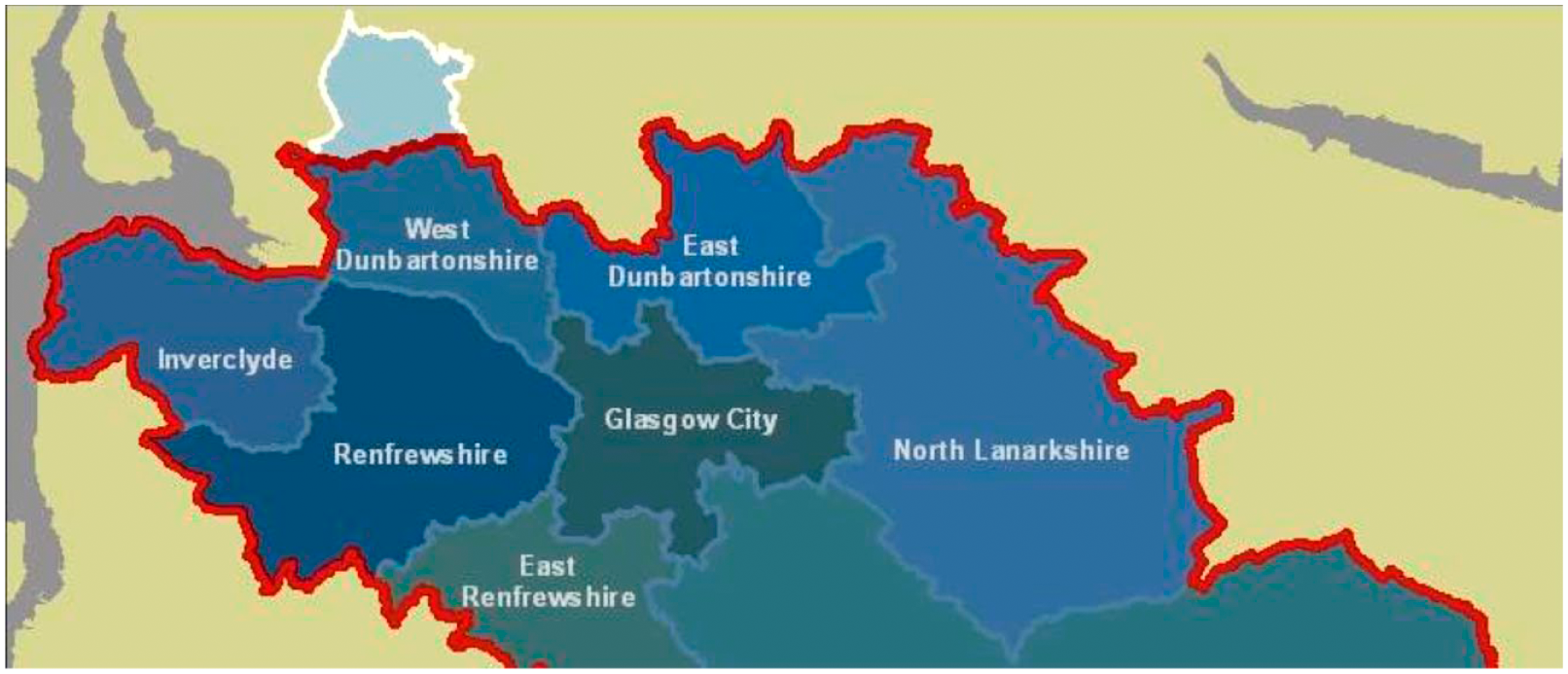
Map of Clydeside with Inverclyde and North Lanarkshire (Ordinance Survey, 2011).
The analysis of monuments to the industrial past in Inverclyde and Lanarkshire conceptualises conflicting interpretations over the meaning of history in contemporary public art, counterpoising the hegemonic representations influenced by a regeneration agenda, with counter-hegemonic community and labour movement–inspired efforts. Both areas were formerly key centres of male-employing ‘staple’ heavy industries whose population resided in towns and villages that developed around production. In the post–Second World War period, as these industries contracted, industrial diversification was attained through regional policy which secured inward investment in assembly engineering factories. As Table 1 demonstrates, since the 1970s, both North Lanarkshire and Inverclyde have experienced a sustained decline in industrial employment. Intensified deindustrialisation was met by labour movement resistance and community mobilisation during the 1980s. Lanarkshire experienced both the 1984–1985 miners’ strike and the Caterpillar factory occupation in Uddingston during 1987, while in 1981 the Lee Jeans occupation took place in Inverclyde, along with a number of smaller disputes in the shrinking Lower Clyde shipbuilding industry (Clark, 2013; Woolfson and Foster, 1988).
Industrial employment a (%).
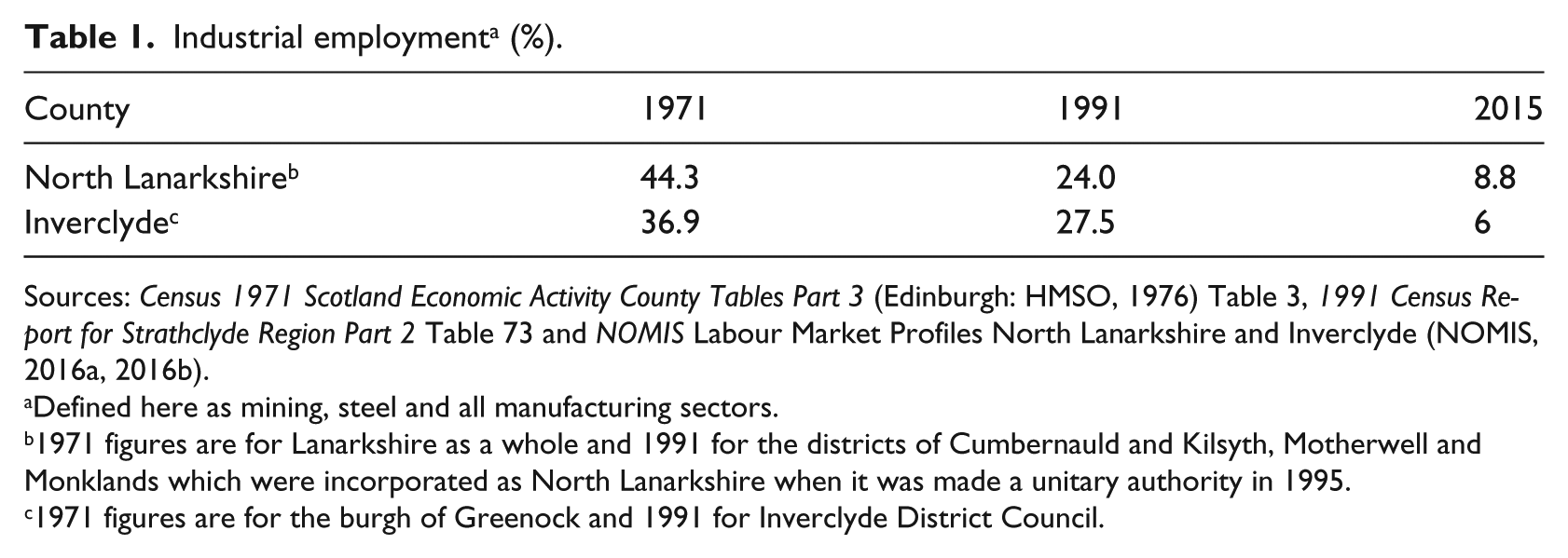
Sources: Census 1971 Scotland Economic Activity County Tables Part 3 (Edinburgh: HMSO, 1976) Table 3, 1991 Census Report for Strathclyde Region Part 2 Table 73 and NOMIS Labour Market Profiles North Lanarkshire and Inverclyde (NOMIS, 2016a, 2016b).
Defined here as mining, steel and all manufacturing sectors.
1971 figures are for Lanarkshire as a whole and 1991 for the districts of Cumbernauld and Kilsyth, Motherwell and Monklands which were incorporated as North Lanarkshire when it was made a unitary authority in 1995.
1971 figures are for the burgh of Greenock and 1991 for Inverclyde District Council.
Later contraction, since the 1990s, has been less visible in the context of falling trade union membership and power. The economy of Inverclyde has become overwhelmingly concentrated in the service sector, particularly low-paid and insecure contact centres, where 10 percent of the area’s workforce was employed in 2008 (Taylor and Anderson, 2012). The analysis in this article further contends that while Inverclyde and North Lanarkshire became economically marginalised, industrial employment has also been historicised within dominant Scottish political narratives. These tend to praise the development of a New Scotland with a prosperous service sector and high-tech employment centred on cities. A major part of this economic transition has been the rise of commuting. Recently, the towns of Greenock and Motherwell, in Inverclyde and North Lanarkshire, respectively, were named among Scotland’s most affordable ‘commuter towns’, indicating a significantly different relationship between residence and employment (BBC News 2016a). By 2015, almost 60,000 workers left North Lanarkshire daily, with the area in reach of the more prosperous labour markets of Glasgow and Edinburgh (Campsie, 2015). Looking at the Inverclyde experience, a conservative estimate suggests that 7000 people leave the county to travel to work each day, predominately to Glasgow and Renfrewshire, representing approximately 15% of those of working age (Strathclyde Passenger Transport, 2016).
The collaboration behind this article is the product of two doctoral research projects: Ewan Gibbs’ work on deindustrialisation in the Lanarkshire coalfield and Andy Clark’s investigation of female factory occupations in the early 1980s. Oral history projects conducted by the authors between 2011 and 2014 in each case revealed distinctions in the narratives of industrial work associated with the memories of former industrial workers and official accounts of the industrial past. It was in preparation to submit conference papers that the authors recognised the common themes within their distinct interview narratives and chose to focus on memorialisation and the contestation of industrial memory that resulted in this collaboration. The interviewees were recruited through a variety of methods, with most participants being found through ‘snowballing’ via existing contacts, but some also found through advertisements in the local press (Knight, 2008). Recruitment was biased towards former trade union activists, a product of both the contact networks that snowballing was conducted through, and the tendency of those most vocal and intimately involved in mobilisation to have confidence in making their narrative heard. This reflects the tendency of activists to have the strongest narratives and retain social and emotional connections with movements they took part in (Fielding and Thomas, 2008; Stiza, 1999). Many of the interviewees had taken part in factory occupations during the period of accelerated manufacturing decline in the early 1980s or the 1984–1985 miners’ strike. These individuals most readily articulated an alternative reading of the experience of industiral employment and deindustrialisation which stands contrary to narratives that emphasise Scotland’s progressive ‘post-industrial’ development. These have recently been embedded in the landscape through community efforts to memorialise industrial development that represent both a reckoning with the industrial past and an attempt to reclaim identities in asserting a sense of place (Bailey and Popple, 2011).
Within Inverclyde and North Lanarkshire, memorials to the past have become incorporated in regeneration. This represents a transition from a strategy broadly themed around publicly ‘forgetting’ (Hoelscher and Alderman, 2004) the industrial past to one that makes use of the past to provide a sense of belonging and to boost economic activity (Strangleman et al., 1999). As both Inverclyde and Lanarkshire have increasingly been converted towards dormitory settlements for professionals working in larger cities, development has focused on making their towns attractive places to live and socialise. The monuments discussed below have come from regeneration efforts that have centred on redeveloping former industrial areas into more pleasant residential localities and to stimulate local economic development in retail and services. Interest in monuments to industry was initially spurred when Ewan Gibbs was shown the monument to the 1959 Auchengeich Colliery disaster in Moodiesburn, North Lanarkshire, by Willie Doolan, a former miner who was involved in raising money for the initiative, discussed below. To access these, the authors visited the monuments and observed their symbolism, geographical location in relation to industrial decline and the rationale behind their commission. Evidently, within these monuments, the industrial past has been presented as surpassed, but it has also played a role in the narratives of redevelopment, physically embodied in the monuments analysed below (Dicks, 2000).
The New Scotland narrative
The transformation of the Scottish economy through deindustrialisation and the rise of service activities has been a potent source of social disorientation and political contention. Perchard’s (2013) reflection on Scottish coalfield oral histories recognises the importance of the ‘cultural scars’ which accompanied coalfield restructuring. The long-term impact of displacement through mass unemployment along with the highly politicised and externally imposed nature of pit closures in the 1980s combined to cement a nationally framed narrative. This perspective rejected the political and social values of Thatcherism as outwith Scottish communitarian traditions. It was enunciated by a coalition of dominant political parties and civil society institutions that came to be known as ‘Civic Scotland’. Civic Scotland gained prominence as traditional labour movement strategies failed, and the Conservatives became increasingly isolated in Scottish politics during the 1980s (Gibbs, 2014).
Civic Scotland originally emerged out of broad opposition to industrial closures and social policies which targeted the unemployed while undermining the public sector. Incorporating all the major political parties aside from the Conservatives alongside the major institutions of local government, the Scottish Trades Union Congress and the churches, this coalition melded opposition to deindustrialisation to the demand for Scottish devolution, which was eventually achieved in 1999 (Aitken, 1997). Historical memory has been shaped by this perspective. Recent scholarship has noted that in relation to the 1984–1985 miners’ strike and the struggle against the ‘poll tax’, both popular and academic accounts gloss over the reality of class conflict within Scotland (Gibbs, 2014; Phillips, 2015). Recently, proponents of the New Scotland thesis have extended their analysis to profile a post-deindustrialisation success story. The narrative has developed from resistance to Thatcherism and national awakening towards the triumph of a ‘New Scotland’ that is culturally tolerant and economically prosperous. Sir Tom Devine (2014), Scotland’s foremost historian, has been prominent in this effort. His statement declaring support for a ‘Yes’ vote in the 2014 referendum on Scottish independence was underpinned by ‘the emergence of a more powerful and more mature Scottish democracy and economy’. These conclusions stemmed from the widespread backing across Scottish politics for a ‘social democratic agenda’ based around a more extensive welfare state than is supported at UK level and an assumed lack of support for the far right. The success of the ‘diversified economy’ which has prospered in Scotland following the decline of ‘dinosaur heavy industries’ that dominated its economy into the early 1980s makes this realisable. Devine argued the transition towards a service and high-tech ‘brain-intensive industry’ economy had enabled Scotland to prosper following deindustrialisation which was ‘almost an historic inevitability’. This further develops Devine’s earlier assertions in his bestselling The Scottish Nation, which recognised the dislocation associated with deindustrialisation but argued a meritocratic, more ‘middle class’ Scotland had emerged (Devine, 2007).
Countering Devine, a more critical analysis of ‘social neoliberalism’ in Scotland has posited that it demonstrates the limits of a political economy based on promoting welfare policies while accepting the predominance of business interests (Davidson, 2010). Law and Mooney (2006) have criticised the predominant outlook within Scottish political science which has been formed by academics who largely agree that Scotland is developing towards a more inclusive and egalitarian society. Devolution has contributed towards maturity along with the establishment of an open, European, service sector economy. This concurs with the broad outlook of both previous Labour and now SNP Scottish Governments who followed strategies aimed at further encouraging and deepening the transition towards a liberalised labour market. The development of ‘social exclusion’ agendas has centred on providing individuals with means to take these opportunities through education and training, rather than a recognition of structural impediments. Law and Mooney (2006) argue that on the contrary Scotland remains a society primarily divided by class where ‘social exclusion’ is not a result of dysfunction but a necessary outcome of economic restructuring. Analysis from the Centre for Research on Socio-Cultural Change confirms Scotland is disproportionately polarised within a UK context. A greater proportion of the Scottish population live in ‘failed economies’, where gross value added per capita is in the bottom 10% of the United Kingdom and, conversely, in areas where it is in the top 10%. The latter are concentrated in cities which have benefited from access to employment in the globally competitive service and oil sectors, while the former are disproportionately within deindustrialised areas where replacement activities have tended to be menial and low paid (Johal et al., 2014). The rise of commuter towns demonstrates the potential for localities outwith the major cities to lay claim to some of the benefits of the modernised Scottish economy. However, they also lay bare the increasingly marginalised nature of what were formerly relatively self-sustaining industrial communities.
The next section considers how recent monuments to the industrial past, erected as part of regeneration strategies, have involved local authorities deploying narratives of the transition to a New Scotland. Sections after reflect how these are conflicted by elements of community memory and experiences of deindustrialisation.
The memorialisation of industry in the New Scotland
Public monuments offer insights into the demonstration of the historicised narratives behind the New Scotland and allow us to explore the tensions within the communities in which they are erected. In this section, several recently unveiled sculptures from North Lanarkshire and Inverclyde will be discussed, framed within an analysis of the uses and meanings of industrial ‘heritage’ and the tensions between post-industrial place imagery and working-class communities. These areas share a similar economic pattern, marked by rapid deindustrialisation towards the end of the twentieth and start of the twenty-first century. Both Inverclyde and North Lanarkshire are now presented as ideal locales for the location of service-based industries, which are actively encouraged through local authority regeneration efforts.
Recent efforts by North Lanarkshire Council (NLC) to regenerate town centres have incorporated a physical memorialising of the area’s industrial past, with a focus on the coal and steel industries. These male-employing staple industries dominated the county between the industrial revolution and mid-twentieth century. The end of deep mining came in 1983, when Cardowan Colliery closed in the face of workforce opposition which contributed to the outbreak of the miners’ strike the following year (Phillips, 2009). Ravenscraig strip mill, a major symbol of government commitment to Scottish industry, closed 9 years later, following privatisation (Payne, 1995). Notably, NLC’s recent monuments have clearly avoided engagement with the trauma and political controversies regarding deindustrialisation in favour of a more benign representation of the longer industrial history of North Lanarkshire. Three examples of these are provided in Images 2 to 4.

‘Harthill miner’ (Author, 29 November 2014).

‘The Shotts Giant’ (Author, 29 November 2014).
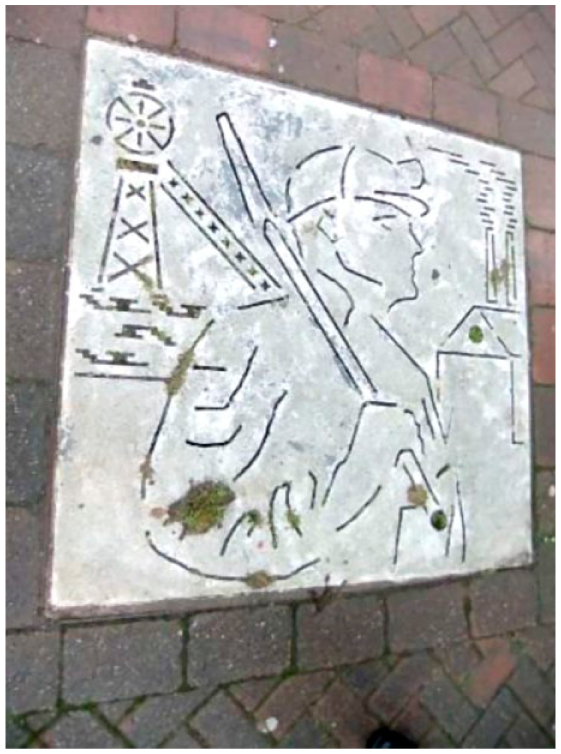
‘Miners’ Plaque’, Shotts (Author, 29 November 2014).
Both the sculptures and plaque from Harthill and Shotts were funded through NLC’s Local Development Programme and involved the well-known Glasgow-based metal sculptor James Paterson. Community input was apparent through the ‘Shape Up Shotts’ group. Shape Up Shotts lists ‘heritage’ initiatives among its objectives for improving the town. This group provides an interface between the local authority and community. Shape Up Shotts is a body which incorporates local volunteers interested in the area’s welfare in dialogue with other stakeholders, and it has worked with organisations set up to improve the welfare of former industrial areas such as the Coalfield Regeneration Trust (Coalfield Community Futures, 2013). It was apparent that regeneration in Shotts was influenced by the New Scotland narrative in consigning industrial activities to the past. This reflected an emphasis in commemorating two industries, coal mining and steelmaking, which had long departed the area but were key in forming the town’s identity. In welcoming the unveiling of the ‘Shotts Giant’ statue of a steel mixer and a plaque commemorating the area’s mining history, NLC Regeneration Manager Matt Costello claimed, ‘It is a true reflection of the industrial heritage of the area and I am sure it will be much appreciated by the local community and visitors to the area’ (Mitchell, 2013). Costello’s comments indicate the dual role of community and identity affirmation and also practical economic purpose in facilitating regeneration focused on services and retail that these monuments have.
The focus on commemorating a foregone era is even more evident in the Harthill example. As in Shotts, Community Council involvement indicates elements of local support for the effort. The statue contains the statement ‘Harthill we remember the past’ at its front, while at the sides it states that ‘all things change and we change with them’. Community engagement was also visible in the local primary school children in choosing the wording, which is emphasised on a plaque next to the monument. Like with the framing of the Shotts statue, this raises questions about the story of industrial transition that predominates and is perhaps also taught in schools. The choice of words indicates the influence of the New Scotland narrative in implicating a progressive change of eras, with little reflection on the strife, conflict or hardship this entailed. This narrative conflicts with those put forward within former industrial communities, particularly by former workers, family members and labour movement activists.
Recent regeneration investment in Inverclyde has been led by the publicly funded regeneration company Riverside Inverclyde (RI) in association with Inverclyde Council. RI was incorporated in 2006 and allocated £96 million from the Scottish Government, the aim being to help regenerate economically depressed areas through creating new jobs, constructing new housing and attracting private investment. A further aim of RI has been to positively change ‘place image’ through a range of initiatives to enhance the image of the town centres of Port Glasgow, Greenock and Gourock, to encourage inward investment and make the area more attractive to potential visitors (Riverside Inverclyde Online). This has included improvements to shop signage, streetscape landscapes and a number of monuments erected in 2011 and 2012.
There were four sculptures erected across Inverclyde at this time: a Roman Nymph (Oak Tree Nymph) and an iron horse (Ginger the Horse) were unveiled in Greenock, the self-descript ‘Girl on a Suitcase’ in Gourock, and Endeavour, a ship’s bow emerging from the water, in Port Glasgow (Images 5 to 8).
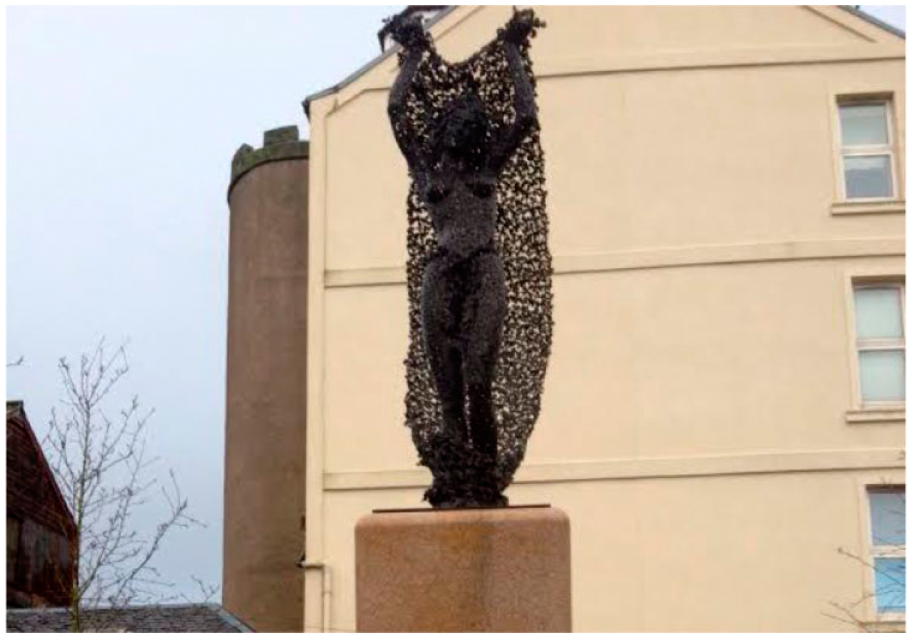
‘Oak Tree Nymph’. (Author, 2 March 2015).

‘Ginger the Horse’ (Author, 2 March 2015).
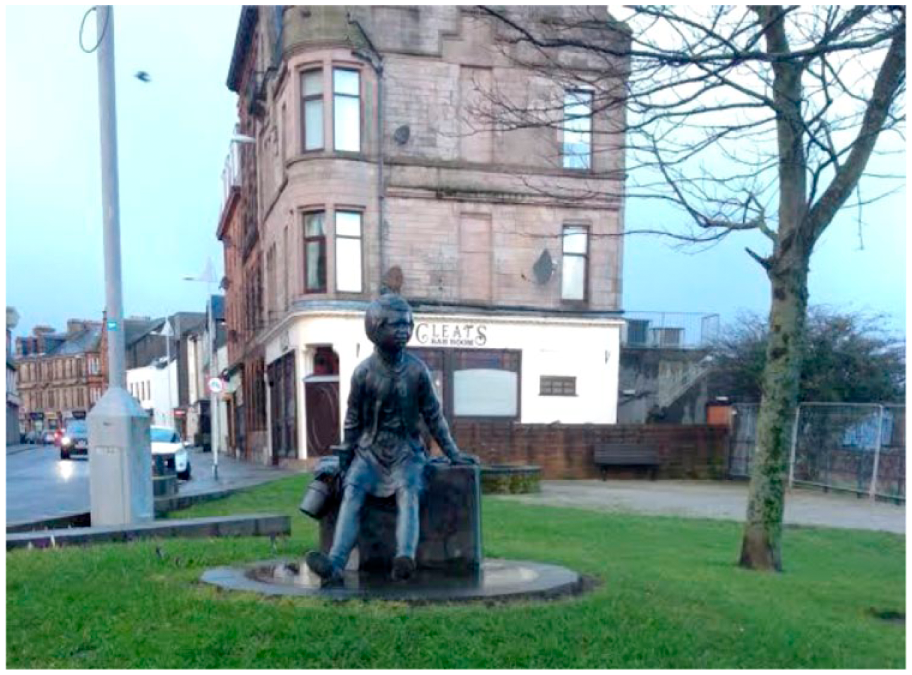
‘Girl on a Suitcase’ (Author, 2 March 2015).
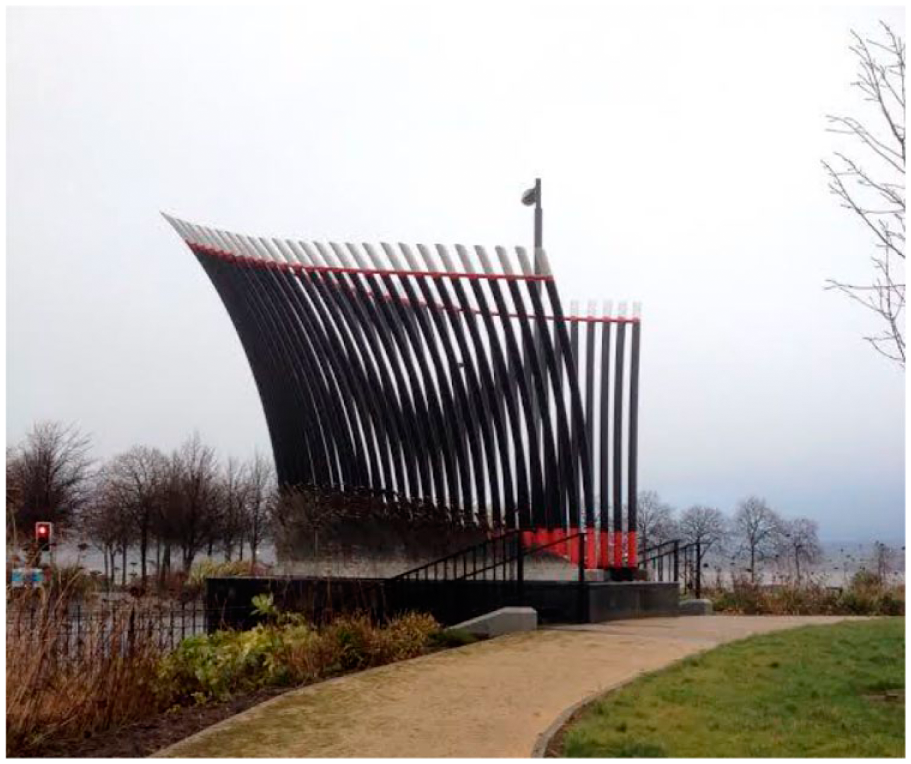
‘Endeavour’ (Author, 2 March 2015).
Two of the sculptures unveiled by RI have evident links to the area’s past, with Girl on a Suitcase reflecting Gourock’s history as a seaside resort mostly for Glasgow visitors and Endeavour which, much like the North Lanarkshire monuments above, attempts to reflect the historic significance of shipbuilding to the town. At its unveiling, Geoff Gregory of RI stated that Endeavour ‘represented the spirit of the river in relation to Port Glasgow and celebrated the pioneering spirit, achievements and resilience of the people of the town’ (Riverside Inverclyde Online). The aim of Endeavour for RI, however, was not to celebrate shipbuilding, with Gregory stating that it was hoped that ‘the new sculpture will convey, in no uncertain manner, the perception that this is the main entrance to a modern, lively town centre’. Thus, Endeavour serves as a symbol of Inverclyde’s economic transition and plays a practical role in efforts to regenerate business activity.
These monuments are indicative of Russo and Linkon’s (2003) argument that the images of industrial areas are used by different groups for different purposes. As with the arguments outlined above in relation to North Lanarkshire, Endeavour presents a simplified, nostalgic image of the industrial past. In the words of Gregory once more, Endeavour looks ‘back to an era when the town was internationally renowned for the quality and quantity of shipping tonnage built’ (Riverside Inverclyde Online). At the unveiling, there were no representatives of the labour movement or former workers, with Henry Birkmyre Semple, whose family formerly owned the nearby Ropeworks, being invited to speak on behalf of the town’s ‘industrial heritage’.
Such sentiments concur with Kirk et al.’s (2012) view that ‘heritage spectacles and exercises in nostalgia’ tend towards depicting industrial cultures as ‘extinct or as increasingly obsolete’ (p. 9). In this sense, the underlining of a clear break with an industrial past is in confluence with the dominant New Scotland vision of ‘post-industrial’ economic development. As Clarke (2011: 449) has noted in relation to the experience of French deindustrialisation, the ‘process of memorialisation of lost industry’, especially through ‘heritage objects’ commemorating heavy industries, has buttressed an ‘unproblematic assumption that the industrial world is dead and gone’. This has furthered a perspective centred on the end of ‘a social and economic order and the working-class world that went with it’ (Images 9 and 10). The example of ‘Endeavour’ is further complicated as, despite its stated intention being to celebrate the area’s shipbuilding past, it is situated less than 1 mile from a working shipyard which has recently underwent significant expansion, demonstrating the difficulty in historicising industries and people who are not necessarily ‘part of a bygone era’ (Clarke, 2011: 449).
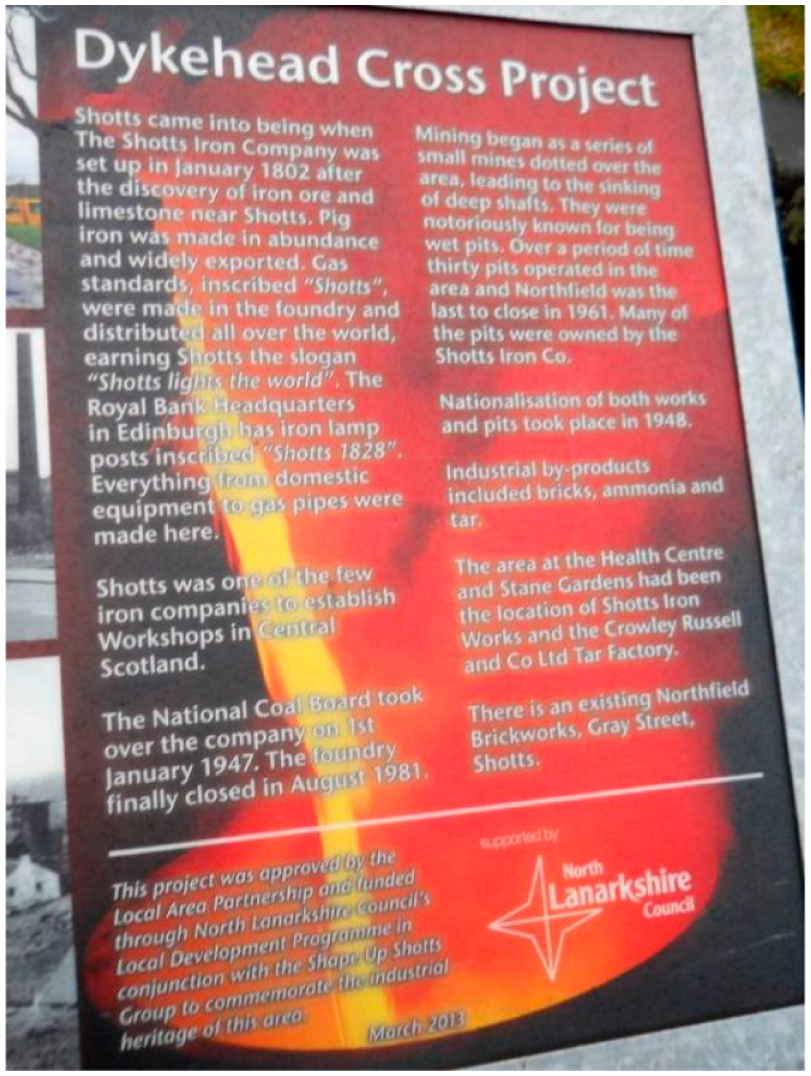
‘Dykehead Cross Project Plaque’ (Author, 29 November 2014).
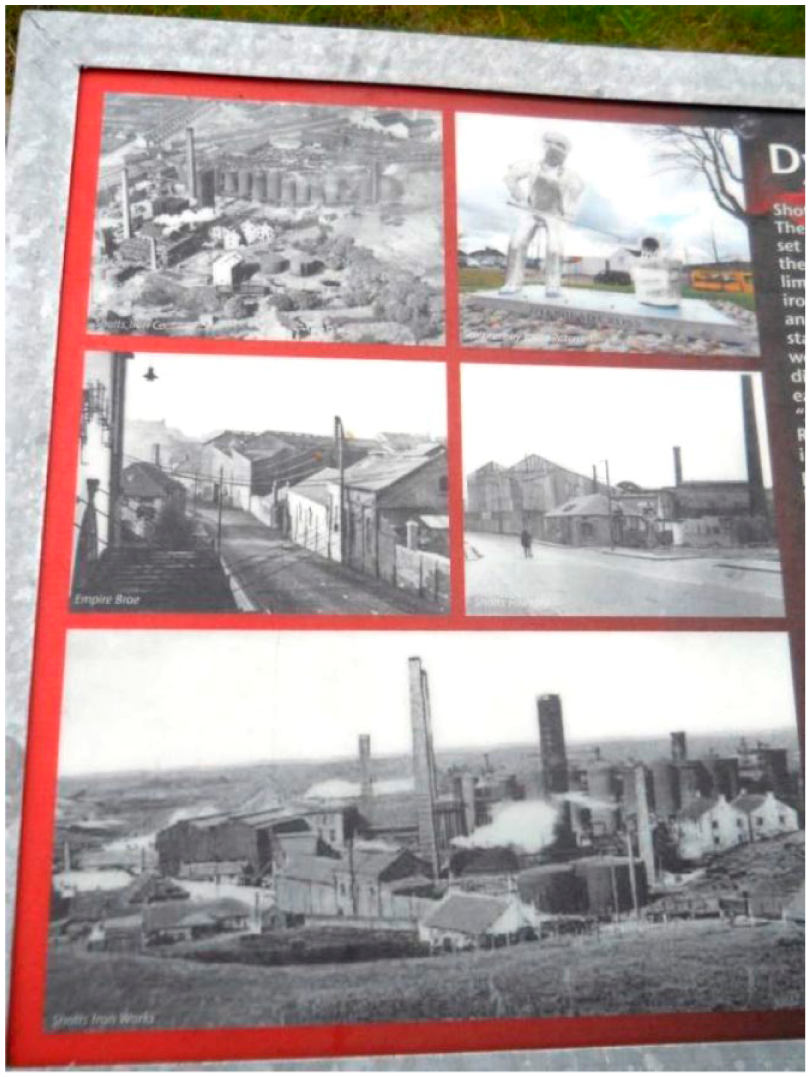
‘Dyhekead Cross Project images’ (Author, 29 November 2014).
The information plaque for the ‘Shotts Giant’ (Image 9) demonstrates that Clarke’s conclusions in relation to deindustrialisation in France also hold validity in Scotland. A potted history of the area’s industrial development is given, detailing both steelmaking and coal mining’s rise and subsequent decline. Images of the Shotts ironworks and foundry, as well as that of the now demolished housing owned by the Shotts Iron Company and rented to workers at Empire Brae, depict a bygone world. Their juxtaposition as black and white images (Image 10) next to the colour image of the new monument confirms this and supports Stanton’s (2006: xii) assertion that the role of heritage monuments is ‘to praise and to bury’ (original emphasis). The inclusion of the fact that Shotts still has an operating brickwork at the very end of a text which lists the loss of all its other industrial sites depicts it as a survivor from another period and functions to ‘relegate these people and places to a time and space outside the contemporary social world’ (Clarke, 2011: 446).
Thus, narratives of economic progress have strongly affected political conceptions of Lanarkshire and Inverclyde and are visible in public art. The collection of monuments unveiled by RI in 2011 and 2012 further reflect this, with minimal note of working-class agency or resistance during the industrial period and in response to deindustrialisation or to the damage and dislocation which resulted from these processes. While Endeavour is the only sculpture to give note to the area’s industrial past, it does so in a simplistic manner. These monuments attempt to present an attractive image of the modern, ‘post-industrial’ Scottish town. Oak Tree Nymph and Ginger the Horse contain no apparent local significance, Girl on a Suitcase looks to Gourock’s past as a holiday resort and Endeavour presents an image of shipbuilding as once important to Port Glasgow and the River Clyde, with little perspective of those who lived and worked in the town or those who still do. These monuments serve a dual function. Alongside beautification aims, they provide a version of the past which accords with localities’ identities, but in a manner which avoids reflection on the negative aspects of deindustrialisation and dislocation. This connects with the New Scotland narrative in the form of presentation of benign development and shared prosperity based on developing vibrant commercial sectors.
Community memorials
The qualitative nature of deindustrialisation associated with the decline of heavy industries and the social routines and institutions that they maintained has created dissonance and distance between a past within living memory and contemporary circumstances. Both the articulation of oral history narratives and community efforts to create public monuments to industry reflect the fact that the era of mass industrial work now stands ‘between history and memory’ in Scotland (Nora, 1989). Under the impact of the ‘acceleration of history’, through the relatively sudden disappearance of a way of life centred on industrial work, there is ‘no longer a retrospective continuity but the illumination of discontinuity’ (Nora, 1989: 16). Those who lived and worked in industrial communities thus experience ‘a separation experienced as radical difference’ between the recent past and present. Raphael Samuel (2012) identified deindustrialisation as pivotal to the driving forward of industrial heritage, which became a significant phenomenon in Britain during the 1980s. Before discussing examples of community memorial efforts, this section will first consider the deployment of ‘broad brushed contrasts’ which Samuel underlined as characteristic of comparisons drawn from memory of major social changes.
Marked anger towards the impacts of capital migration shapes Scottish narratives of deindustrialisation (Perchard, 2013). Maggie Wallace, who worked at the Lee Jeans factory in Greenock, asked the question, ‘Why are we naw makin them [Lee Jeans]? Why is oor kids, or grandweans or witever, naw? … they’ll never have that feelin that we had. Workin in the big unit, under the same roof’ (Interview with Author, 2011). Daily interactions with capital and a similarity of experience were central in shaping consciousness among workers. This is evident in the testimony of Mary McGachie, another former sewing machinist at Lee Jeans. In recalling her own reasons for being a member of a trade union once beginning work, she recollected that
ah think most people’s families in Greenock, most of them worked in the shipyards at the time. So most people who went to work in factories, their father or somebody worked in a shipyard, so they were always in a union.
This belief is shared by Marie Gallagher, also of Greenock, who stated in terms evoking the transmission of communal identity that ‘ah wis always brought up that if ye were workin class ye should be in a union … maybe it wis ma granda’ (Interview with Author, 2011).
Distance from a lost history has been furthered by subsequent economic development which has destroyed reminders of the past. This has been associated with the transition towards the rise of commuter towns and new private housebuilding. Scott McCallum, whose brother, father and grandfather worked at Cardowan colliery, portrayed a sense of loss, emphasising the abandonment experienced in the community following the pit’s closure. He underlined the emblematic importance of the subsequent demolition of the colliery chimney, an event that was attended by members of the local community including Scott’s high school class who were taken to watch the event:
They’ve just shut this place it lay empty for years after it. They demolished all of the grounds, the building, built 600 hooses which gives you an idea of the size of the area. Ehmm it wis a shame to see it go.
Was the removal of that symbolic?
Yeh it meant there used to be a chimney it was quite a view you could see from a few miles away the Campsie hills and that you always seen the chimney it stuck out. There were quite a few tears shed the day that came doon, there was a crowd watching it, it was getting brought down to the ground. (Interview with Author, 2014)
Scott’s perspective concurs with High’s (2013) view that the closure of industrial workplaces amounts to ‘wilful acts of violence committed against working people’ (p. 148). The destruction of sites in a ‘ritualistic’ manner serves both to underline the finality of closure and to contribute towards the subsequent invisibility of the industrial past. Yet these reflections also display continuity, sharing aspects of Trigg’s (2006) conception of a ‘landscape of memory’ which ‘point towards a place which is no longer present’. Scott’s memories also confirm Edensor’s (2005) emphasis on the ‘haunting’ of former sites of industrial production by memories of the past. This was further confirmed in the tendency of locals from mining families to still refer to the site of the old pit decades after its demolition (Interview with author, 2014).
The removal of physical reminders and the decline of ‘spontaneous history’ passed on through oral traditions or the labour movement in recent years have stimulated community-led initiatives to establish permanent memorials (Nora, 1989). These have centred on the legacy of mining disasters, as communities seek to use memorials to educate future generations, in contrast to civic attempts to promote place image and increase tourism (Dicks, 2000).
Image 11 shows the memorial wall in Condorrat, North Lanarkshire, which was unveiled in 2011 following a fundraising campaign led by the village’s Tenants and Residents’ Association and the input of local building workers. The memorial remembers local weavers involved in the strike and insurrection of the 1820 ‘Radical War’, fallen members of the armed forces, as well as six local miners who died in the 1959 Auchengeich pit disaster. This was the worst mining disaster in twentieth-century Scotland, killing 47 men in an underground fire (McIvor, 2010). Connecting these strands, the local newspaper Cumbernauld News reported Condorrat ‘has at last honoured its working-class heroes’ through the monument. The chair of the Tenants and Resident Association Kate McLean, referring to the Auchengeich disaster, stated that ‘we have waited 52 years for this memorial’, following the opening of the memorial by Margaret Muir whose father died at the colliery.
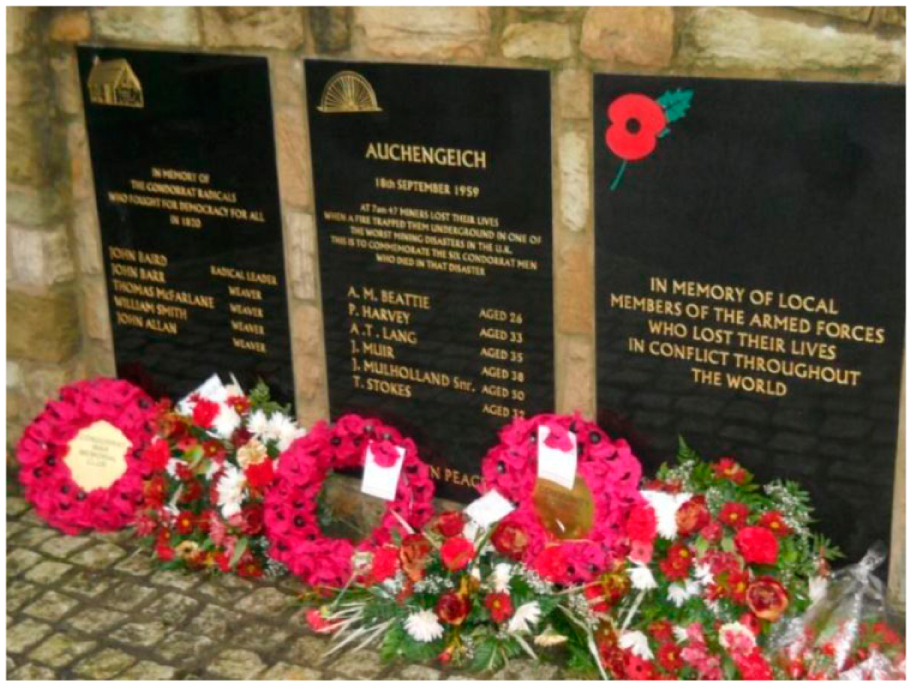
‘Condorrat Memorial Wall’ (Author, 29 November 2014).
This event was mentioned in many testimonies. Billy Ferns who worked at the neighbouring Western Auchengeich recalled not only the horror of the incident over 50 years later but also its importance in local memory which was displayed through the large-scale attendance at the 50th anniversary events in 2009 (Figure 12):
Terrible disaster should never have happened either. They were all working Monday then they were idle Tuesday Wednesday Thursday with a strike then some of them went back to work on Friday they went intae these bogeys and never came out they bogeys they were trapped wi the heat they had to take the clothes when they were taking the clothes off the bodies the skin was coming wi them they were that warm terrible, terrible, so it is. Last September there I was really pleased there were big turnouts so there was that was an anniversary I think it was the 50th anniversary. Tragedy. (Interview with Author, 2014)

‘Auchengeich Memorial’, Moodiesburn (Author, 29 November 2014).
Thus, the Auchengeich disaster represents not only the worst example of the danger and loss of life associated with the mining industry but also the resilience and solidarity which characterised coal communities. The unveiling of a new memorial for the disaster at Auchengeich Miners Welfare in 2009, for which £35,000 was publicly fundraised, underlined an example of continuity between the industrial past and the present. Willie Doolan is a former trade union representative at Cardowan colliery who grew up in a mining family in Moodiesburn, adjacent to Auchengeich and where many of the families of those who died in the disaster lived. He has been highly involved in commemoration activities:
Every year we have an annual memorial service to commemorate the miners that lost their lives in the Auchengeich pit disaster. They, I mean the 50th anniversary was in 2009, and we could command 3 thousand people at that memorial service. But it wasn’t only the families of ex-miners from this community. We had people from as far as the Lothians coming through we had people from down south coming up tae share with this community once again the sorrow that we and the sadness that we had undergot due to that disaster that happened in oor pit. (Interview with Author, 2014)
In contrast to the NLC monuments, the Auchengeich memorial is not to a generic appraisal of the industrial era; rather, it is a memorial to a particular event and the lives lost in the trauma of a major disaster. This is further demonstrated in distinctions between the monuments: The Auchengeich statue depicts a specific, detailed, 1950s British miner rather than a more general, imagined industrial worker. However, the events associated with the 50th anniversary of the disaster contained a meeting point of community memories and the New Scotland narrative. The Scottish First Minister Alex Salmond opened the memorial, stating that
Scotland is fortunate enough to have been blessed with rich natural resources, from the abundant coal seams of the central belt to the oil and gas reserves off our shores and the emerging renewable energy sources we are just beginning to feel the benefits of. But we should never forget the human cost which has come with that. (STV News, 2009)
A more class-conscious perspective grounded in a Lanarkshire labour movement background was presented by Elaine Smith, who at the time was the Labour Member of the Scottish Parliament (MSP) for Coatbridge and Chryston constituency, which contains Moodiesburn. In a Scottish Parliamentary motion Smith stated
Commemorating the disaster also allows us to reflect on the hard work and sacrifice of the working class in this area over hundreds of years. We can remember the difficult circumstances in which those people worked and lived. Scotland’s prosperity was built on their blood, sweat and tears and that should never be forgotten. (Bunting, 2009)
Thus, different perspectives coincided and met while commemorating the same event. Heritage commemorations of West Central Scotland’s industrial history pose the question, ‘Whose history should be remembered and memorialized, by whom, and to what ends?’ (Frisch, 1998: 241). This was exemplified in Inverclyde by the attempts of Greenock historian, Shaun Kavanagh, to secure support for a tribute to eight local men killed in the town during the ‘Radical War’ of 1820. Kavanagh made this appeal in the same period as RI was commissioning and unveiling the sculptures discussed above, yet he was unable to gain civic backing as they sought to improve place image (Greenock Telegraph, 23 Feburary 2012). A grassroots appeal to local people was eventually successful, with the sculpture approved by Inverclyde Council and erected in September 2015 (Greenock Telegraph, 22 April 2016). As in Condorrat, such a commemoration was dependent on community efforts rather than delivered by regeneration schemes, demonstrating the argument of Hoelscher and Alderman (2004) that there are constantly ‘multiple agendas, conflicts and negotiations that characterize the process of remembering the past’ (p. 351).
Conclusion
Within West Central Scotland, communities have been divided over their approach to heritage and remembering the industrial era. This has been most apparent in the contrast of public monuments which embody differing interpretations of the experience of industrial employment as well as distinct narratives surrounding deindustrialisation and ‘post-industrial’ economic reconstruction. In both Inverclyde and North Lanarkshire, such processes have been particularly apparent, with relatively self-contained industrial communities transitioning to commuter towns. Economic strategies for regeneration posit future development upon attracting incoming residents and an appeal for inward investment based on positive place image. These changes have been framed within the narrative of an emergent ‘New Scotland’ which predominates within Scottish public discourse. Per this hegemonic perspective, the major social, political and economic changes over the previous four decades have allowed for a national reawakening and the establishment of a more prosperous, meritocratic and socially just society. Localities which have lost their primary employment bases mobilise these motifs, and civic organisations place their own efforts within a story of overall progress. However, these continue to be contested and rejected by many ex-industrial workers, particularly former labour movement activists and their families. Their narratives focus upon the loss of employment and community cohesion associated with the dissonance of the long-term effects of labour market restructuring. These sentiments extend to a differing interpretation of the industrial era itself, underlining collective experiences of struggle and mobilisation, as well as danger and tragedy.
Monuments to the industrial past are a significant example of public representations where these differing perspectives meet. The prime impetus of the drive to memorialise the contribution of industry to the villages and towns of North Lanarkshire and Inverclyde has been within regeneration efforts that aim to stimulate service and retail activity as well as establishing a sense of community belonging and narrative. These function to further attract commuter residents and visitors. However, alongside encouraging place image, these monuments also deploy a specific interpretation of the industrial past and the experience of deindustrialisation. They tend towards a relatively benign historical representation and a broad sweep of the industrial era. In contrast to the imagery of a ship’s hull, Endeavour, in Inverclyde, the NLC memorials do emphasise the masculine exertion of the coal mining and steelmaking industries. Yet, they also depict a broad contrast with the present and a comfortably departed point in the area’s past. This was redoubled by the discourses associated with the emphasis on the monument’s purpose in encouraging new service sector activities – modern employment as opposed to these memorials to a bygone era. The involvement of community organisations in North Lanarkshire demonstrates that these narratives, while shaped by elites at academic and Scottish Government level, are shared by some at a grassroots level too.
In recent years, there has been a notable addition to Scottish politics in the form of commitments to ‘reindustrialisation’ which emphasises government support for preserving manufacturing jobs (Scottish Government, 2014). This shift has been visible in both Inverclyde and North Lanarkshire. In August 2015, First Minister Nicola Sturgeon made a ‘hastily arranged’ visit to Fergusons shipyard in Port Glasgow, Inverclyde, to be part of celebrations after the firm received a large ferry contract which safeguarded its future (Swindon, 2015). Just over a year later, Sturgeon formally reopened Dalzell steelworks in Motherwell, North Lanarkshire, following the Scottish Government playing a prominent role in finding a buyer for the steelworks after previous owners Tata announced closure (Coyle, 2016). The profiling of Fergusons and Dalzell demonstrate the limits to the New Scotland narrative; political capital is seen to be gained from supporting employment in traditional industrial sectors which is connected to a historical sense of economic identity. This was communicated by Paul Kelly, the Labour Deputy Leader of NLC, when upon the reopening of Dalzell he reflected on the significance of steelmaking in the county: ‘It’s been at the heart of our community for over 140 years, it’s dominated the skyline and it’s an integral part of what we’re about as a local community’ (BBC News, 2016b).
The very public government support offered to Fergusons shipyard and Dalzell steelworks indicates the continued importance of support for sectors that the New Scotland narrative predominantly consigns to the nation’s past. The testimonies from former industrial workers and family members are indicative of the contested nature of the history of deindustrialisation. These emphasise the painful dislocation associated with divestment and closure and the difficulty of re-establishing a sense of place within localities which developed around, and were defined by, industrial activities. The rise of commuting and suburbanisation created a further sense of dissonance for those who had long established roots in Inverclyde and North Lanarkshire. The recent memorialisation of the Auchengeich mining disaster in North Lanarkshire underlines a contrast in understanding of the industrial era to those predominant in monuments raised through regeneration efforts. This emphasises a specific episode, as opposed to a generality, and it depicts a concrete worker relatable to workers and family members themselves, rather than a generic vision of a miner or steelworker. This counter-hegemonic interpretation demonstrates that the reckoning of the industrial past and the experience of deindustrialisation remains unfinished business. The construction of narrative and placement within a cohesive historical story remains not only an important task for communities, and policy-makers, but also a latent source of division between them.
Footnotes
Acknowledgements
Both authors would like to express their thanks to the Economic and Social Research Council who funded their PhD work which contributed to the research presented in this article. Thanks to Dr Andrew Perchard who provided feedback on earlier drafts of this article and to the two anonymous reviewers whose comments and suggestions strengthened the analysis in this final article.
Declaration of Conflicting Interests
The author(s) declared no potential conflicts of interest with respect to the research, authorship, and/or publication of this article.
Funding
The author(s) received no financial support for the research, authorship, and/or publication of this article