



Abstract
This study examines the process of remembering and unremembering around the physical monumentality associated with historic military control over the city of Barcelona and its surrounding region. In particular, it looks at the Parc de Ciutadella, Barcelona’s primary public park and green space, where a major fortification was built in the eighteenth century to pacify and control the city, following the siege of Barcelona in 1714 and the subsequent oppression of the Catalan region by the Bourbons. Deliberately destroyed in the nineteenth century, it was perceived at that time as a hated symbol of repression, a perception that has continued in the literature and through various interpretative schemes in the city’s heritage centres and museums. Memory around the site is contested and selective and has been deployed in the officially constructed narratives of separatism.
Introduction
Within the Catalan separatist movement, cultural heritage sites and objects have been appropriated to play an intrinsic role in supporting political perspectives. A variety of cultural institutions and state-sponsored monumentality play an active part in the formation and dissemination of particular identity-based narratives. These are centred on the themes of a separate and culturally distinct Catalan nation, which has been subject to extended periods of oppression by the varying manifestations of the central Spanish State. This study examines the process of remembering and disremembering around the physical monumentality associated with historical military control over the city of Barcelona and its surrounding region. In particular, it examines memory surrounding the Parc de Ciutadella, Barcelona’s primary public park and green space, where a major fortification was built in the eighteenth century to pacify and control the city, and the part this has played in the reimagined narratives of contemporary separatism in Catalonia. Deliberately destroyed in the nineteenth century, it was perceived at that time as a hated symbol of repression, a perception that has again appeared in literature and through various interpretative schemes in the city’s heritage centres and museums (Hughes, 2004). For much of the twentieth century, its military role was largely forgotten within the unitary framework of Franco’s Spain, but more recently its oppressive role has been recalled. As such, it is deployed in a negative light repeatedly through the officially constructed narratives of separatism. However, the city’s residents and visitors have only a limited, and often disjointed, understanding and tangled memory of this central place in the city’s past.
From the middle of the nineteenth century, Catalan nationalist sentiment has been fostered across northeast Spain (Laitin, 1989). This movement paralleled the emergence of similar nationalist movements across Europe, driven for the most part by a middle-class cultural elite. A cultural movement led by academics and the literary class, known as the Renaixença, and the later early twentieth-century Noucentisme, was interested in the promotion of Catalan culture and heritage, in an attempt to promote Catalonia as being distinctive and culturally separate to the rest of Spain (Gracia Alonso, 2013). Barcelona was at the centre of these movements and both its nationalist politicians and town planners engaged in a series of projects to develop it as one of the great world cities, and reimagine it as the new ‘Paris of the South’ (Monclús, 2000). Their ambitions lay in recreating the city as the capital of western Mediterranean region, recapturing its pre-eminence as the central port associated with medieval maritime empire of the Catalano-Aragonese Crown. During the Spanish Civil War, and subsequent period of centralised Spanish rule under Franco, Catalan culture was actively suppressed, with the Catalan language being banned from schools, and from many other facets of society including public and civil administration bodies. Much of this was related to the resistance role the region played during the Civil War and the support base it provided for its fiercely leftist politics. Consequently, Franco’s regime viewed the region with deep distrust, and active dislike. Following the emergence of a democratic Spain at the close of the 1970s, after the death of Franco in 1975, Catalan separatism again began to re-emerge, resulting in the region obtaining a high degree of autonomy from 1977 onwards. Unlike the Basque region, the Catalan pro-independence movements had little association with violence, although the unilaterally declared independence referendums of 2017, deemed illegal by the Spanish state, resulted in widespread street violence and protests associated with Spanish police disruption of the voting process.
A central feature of the separatist movement has been an active process of the reassertion of Catalan heritage and the deliberate positioning of cultural centrally within the process of nation building (Breen et al., 2016). The use of heritage and culture is a common facet of many other nation building projects over the past two centuries. In Catalonia, this has been a multi-faceted process involving built heritage, cultural and linguistic traditions as well as the natural environment. A range of museums, cultural centres and monuments have been supported to convey and propagate Catalan cultural differences from the rest of Spain, and illustrate the supposed uniqueness of their people and landscape. While this process emerged in the middle of the nineteenth century, recent decades have seen culture become more overtly a core vehicle conveying the increasingly politicised message of separation. Crameri (2006) has argued that the Museum of the History of Catalonia (MHC), opened in 1996, was conceived politically by the ruling Catalanist coalition Convergéncia i Unió (CiU) with a nation-building function. Its exhibits re-orientate a cultural narrative away from the central Spanish state towards a Catalan nationalist ideology shaped by the CiU. Fuses (1985) has highlighted the rejuvenation of the medieval core of the region’s historic cities as places that are regarded as central to Catalan heritage and identity. The 20-year restoration and urban rejuvenation programme from 1982 of the medieval sections of Girona led by the city’s mayor Joaquim Nadal were, for example, intrinsically linked to local identity politics and the promotion of the Catalan past (Nadel, 2016: 4). Nadal was particularly passionate about the interlinkages between historic conservation and local place identity to counter the Franco narrative of national social cohesion. This rooting of contemporary separatism to an independent and successful medieval Catalonia is a key message within this process. Messenger (2016: 49) has further argued that memories across Catalonia, associated with perceived historic social injustices, have been used to articulate and support elements of civic nationalism in the region. In particular, the themes of Spanish oppression and subjugation appear repeatedly in the official narratives in a number of museums and heritage centres supported by the Catalan regional government (Breen et al., 2016).
Memory and Catalan separatism
Catalan separatism is a highly contested process. Its political supporters, as exemplified through the writings of Artur Mas, the region’s former president, will argue that the Catalan people are a nation, one that is separate and culturally distinct from the other peoples of the Iberian Peninsula (Crameri, 2016; Davis, 2004). This is a distinctiveness built on interpretations of past histories, cultural traditions and language. In the transitional post-Franco period, this promotion of a national Catalan identity through the politicisation of cultural issues and the targeted use of cultural policy was led by the Catalan Autonomous Government under the direction of Jordi Pujol and his party, Convergència i Unió during its time in power from 1980 to 2003 (Crameri, 2008). Dowling (2013) has argued that ‘Pujolism’ focussed on building Catalonia and increasing its autonomy within Spain. The primary political aspiration of these policies was to preserve, enhance and promote a Catalan national identity. These policies were further aimed at identity construction through the recovery of both tangible and intangible aspects that shape culture (Villarroya, 2012). In particular, Kathryn Crameri (2000: 50) has argued that this politicisation has been linked to ‘the assumed equation of culture with national identity’, through the three pillars of language, literature and Catalanism. While these official visions of Catalan culture have been directly challenged by a number of the region’s writers such as Montserrat Roig and Biel Mesquida who offered a more nuanced and pluralistic perception of what it is to be Catalan, the institutionalised narratives remain prevalent in public interpretative displays (Crameri, 2000).
However, most social science theorists will argue that such narratives of distinctiveness and cultural difference are often socially constructed notions, built around the political aspirations of particular interest groups or individuals. This ‘constructionist’ approach has been emphasised by Hobsbawm and Ranger (1983) who argue that such approaches are frequently invented and fabricated, promoted by a ‘nationalising elite’ that manipulates the state to promote the culture and interests of a core ethnocultural nation (Brubaker, 1996). Anderson’s (1983) concept of imagined communities further suggests that these groups build an artificial construct of self and identity, used to promote their place and aspirations within regional societies. One central tenant of this process is the adoption, or interpretation of a particular view of the past. Memories around particular pasts are then negotiated or mediated to justify contemporary narratives of people and place. Developing accurate or truthful memories during this process becomes problematic. While memory can position insights into the historical process (Chedgzoy et al., 2018), how and where those insights are articulated from can become contested.
Memory is an important component of identity construction. In Catalonia, Messenger (2016) has highlighted the complex way with which memories of Catalan experiences of the Spanish Civil War play in the negotiation of contemporary identity. In particular, he discusses how narratives surrounding sites associated with the war have been configured to parallel Catalan struggles against Franco and the Nationalist forces, alongside a European-wide struggle against Nazism in World War II. This can be seen as a deliberate attempt to orientate growing Catalan separatist sentiment towards pan-European democratic nationalism and away from the Spanish centre in Madrid. It has built on earlier pro-European sentiment during the Franco period when the Catalan Council of the European Movement integrated into the Consejo Federal Espanol del Movimiento Europep (CFEME), an exiled group in Paris promoting European integration post Franco. Later, the Democratic Union of Catalonia (UDC), part of the governing coalition party CiU, joined the European centrist bloc, the European Christian Democratic Union in 1965 (López Gómez, 2014).
A number of other important events and places play a key part in the negotiation of Catalan cultural and historical identity. In particular, the events surrounding the Bourbon takeover of Catalonia following the siege and subsequent fall of Barcelona in September 1714 has come to represent a pivotal moment in Catalan nationalist histories. The fall of the city, and the assumption of Bourbon power, is now remembered as the collapse of an independent Catalan state and the emergence of a region that has been suppressed ever since by a dominant and oppressive Spanish state ruled from Madrid. The Ajuntament de Barcelona, or Barcelona City Council, has been to the forefront of the reimagining of these events and reframing them within the context of the contemporary separatist movement. As an interpretative panel on the city council sponsored El Born Centre states The defeat of 1714 opened the doors to the repression of all those who had defended the Austrian cause and Catalan constitutionalism. The Catalan’s worldview suffered a radical mutation, subjugated by a regime classified by many historians as military terrorism
From some perspectives, this event might be categorised as a rupture, an episode that subsequently altered the collective consciousness of the Catalan peoples. As a consequence, it has become a central facet in the narratives surrounding Spanish subjugation. The event is now remembered on, and has become the central focus of, Catalonia’s La Diada, or national day on 11 September every year. Official remembrance events are held at locations pertinent to the siege and fall of Barcelona and in recent years massive pro-independence marches have been held through the city. Memory theorists have proposed that the need to remember, embedded within many contemporary separatist movements, is deliberately positioned within a corrective framework, structured around the need to seek justice for past wrongs (Klein, 2000). Various mechanisms are then deployed to convey these messages and to garnish support or further promote structured messages. Roudometof (2007: 1) has argued that the term memory itself points to the actual process of recreating or constructing the past. The highly politicised nature of the La Diada marches implicitly vocalises these messages of separatism and independence.
Monuments and historical sites can often be highly visible elements of the public landscape, places associated with memory and commemoration. These are places imbued with social and political meanings and are often presented in ways that support or propagate elements of these promoted narratives. They have been referred to as ‘frameworks of collective memory’ or places that help shape official memory and agreed societal narratives (Halbwachs, 1992). However, the meanings assigned to these places or structures are rarely constant, are often contested and can be subject to transgressive acts (Gough, 2008). They can be subject to continual reinterpretation or have different interpretations attached to them by different communities. These are tangible structures or features that are still present in the landscape. However, Nora (1989: 7) has discussed the points at which memory can become ‘torn’ from the past, or lieux de mémoire, sites of memory, as there are no longer real environments of memory, milieu de mémoire. He has highlighted the dichotomies that lie in the examination of real memory as against historical memory, or the process by which modern society organises its past. To Nora, memory and history now appear to be in ‘fundamental opposition’. What then of places that have been deliberately destroyed or erased, as a political act of forgetting or an attempt at historical elimination? This process of deliberate forgetting is often considered as the decisions which underpin the selection of monument erection. Bach (2016) has written about the process with which the Berlin Wall was destroyed or mostly erased from the physical landscape as a border but re-emerged as a place of memory. Through re-temporalization, the wall was reimagined as a space that served as a reminder of past trauma and political commemoration. In this process, it was both de-coded and then re-coded to temporally reframe it. Similarly, in Barcelona the Citadel has been largely erased from the urban landscape, and its area has been reimagined as a space of leisure. However, its physical and remembered space continues to carry resonance and reflects the complex politicised narratives surrounding Catalan separatism.
Building and forgetting the Citadel
By the close of the seventeenth century Europe was once more lurching through a period of crises surrounding competing ambitions and the shifting allegiances of its Royal families. Throughout the Middle Ages the Principality of Catalonia had enjoyed varying degrees of autonomy within the broader Crown of Aragon. However, during the opening years of the eighteenth century, the Catalan region had created an alliance with England, prompted by trepidation surrounding Philip V’s perceived attempt to create a centralised state centred on Castile (Elliott, 1963). To counter this, the Catalonian authorities proclaimed the Austrian Archduke Charles VI as Charles III of Spain, one of many factors that led to the outbreak of the Spanish War of succession in 1702 (McGuigan, 1966). There are competing contemporary historical perspectives on this war. Catalan nationalists view it as a war of conquest with Spain as the victor, while an alternative historical perspective views it as competing interests fighting for the succession to the Spanish Crown, allowing for the further development of a unified Spain (see Kamen, 1969). The subsequent government of Archduke Charles in Barcelona proved to be ineffective and both Aragon and Valencia fell to the Bourbons and Philip V in 1707 (Elliott, 1963: 376). To compound Catalonia’s difficulties, the English signed a peace accord with France in 1713, which effectively left the region isolated. Following an extended period of conflict, and bloody siege, Barcelona fell to the Bourbon forces on 11 September 1714, followed by the ‘wholescale destruction’ of Catalan institutions (Elliott, 1963). The subsequent Decree of Nueva Planta 1716 by Philip V led to the abolition of Catalan laws and institutions, and language (Laitin, 1989, 1997). The further abolition of internal borders and customs tariffs marked a deliberate move towards a centralised Spanish state. Elliott (1963: 377) has suggested that the subsequent dismantling of the administrative and traditional Catalan structures was an attempt by the Bourbons to ‘put an end to the Catalan nation’. The Viceroys of Catalonia were replaced by Spanish Captain-Generals and the principality was divided into new administrative divisions mimicking those of Castile. The Diputació and Barcelona city council were dismantled and the six regional universities were abolished and replaced by the Royal University at Cervera. Apryshchenko (2018) has argued that public consciousness across Catalonia views the Nueva Planta decree as essentially still having an effect on present-day politics. In the words of the region’s former premier Artur Mas, its abolition would lead to the return of Catalan sovereignty.
Once Barcelona fell, the Bourbons moved to defend their interests in the city against future aggression. One of the interpretative panels in the Montjuïc Castle record that in 1715 the Flemish engineer Joris van Prosper Verboom wrote to Philip V stating that if dismantling the walls and other fortifications of Barcelona were only to serve as punishment for its inhabitants, who not only deserve to have their walls destroyed, but also all their houses … unless HRH maintains a considerable corps of troops in Barcelona or else erects a citadel that will keep them in check and duly obedient at all time.
A year later in 1716 Philip V ordered the construction of the Ciuatadella, what was then to be the largest fortification in Europe (Castinera, 2011). Subsequently designed by Verboom, the military complex emerged as a ‘hated symbol of Castilian rule’ over the following decades (Aibar and Bijker, 1997). In March, construction began which necessitated the destruction of a large part of the La Ribera and Quarter de Mar neighbourhoods, involving the demolition of over 1000 structures and the displacement of 5000 people, to make room for the fortification’s erection. The event is remembered on an interpretative panel in the city’s El Born heritage centre where some residents considering the project so absurd as to be unthinkable, continued to repair the damage caused by the impact of the bombs on their roofs, ceilings, walls and floors … but on the 27th April 1717 they were forced to pull down their own houses and leave.
For over 100 years, the fort’s garrison oversaw the city’s security with the eminent Iberian historian JH Elliott (2018) noting that successive generations saw the fortress as a symbol of ‘absolutism and oppression’.
In 1842, a local Junta attempted to initiate the demolition of the Citadel without permission of the Spanish State but the military commander of Barcelona Antonio Van Halen, rebuilt the demolished section (Olivar, 2010). A popular uprising, associated with taxation and food availability grievances, against General Baldomero Espartero began in December 1842, which was quickly suppressed, while a second uprising was met by an artillery bombardment in October 1843 from the Castle of Montjuïc. During both of these events, the citadel was subject to attack and partial demolition (Epps, 2011). The subsequent Catalan Carlist war of the Matiners (1846–1849) heralded a decade-long state of emergency across Catalonia (1844–1854). By the early 1850s, a series of commissions had been established to examine the demolition of the city walls to allow for the commercial expansion of the city and alleviate the social conditions of its inhabitants. The walls now physically constrained the city in every sense of the word, and its inhabitants were desperate to remove this restrictive barrier. This was reflected in the work of contemporary writers such as Antoni de Bofarull who described the citadel, in his 1855 Guía de Cicerone de Barcelona, as haunting the city like a ghost (Olivar, 2010: 93). Over the following years, the city walls were gradually removed and a new phase of urban planning emerged, led by Ildefons Cerdà’s utopian reimaging of urban space. While his plan of 1859 does show the removal of the citadel, it is replaced largely by his uniform blocks of housing, or manzanas, with only a small green public space outside of the blocks shown (Ref. 2947. Arxiu Històric de la Ciutat de Barcelona). Following the revolution of September 1868, and the subsequent deposition of Queen Isabella II, the rebellious General Juan Prim was named regent a year later. He subsequently gave the citadel site back to city of Barcelona and it reverted to civilian use. Over the following years between 1869 and 1888 it was gradually destroyed with only a few buildings surviving, including the chapel, Governor’s residence and the arsenal. The interpretive panels at the El Born heritage centre, funded and developed by Barcelona City Council, record that Prim ‘was well aware of the profound desire of the Barcelona people to do away with that [citadel] symbol of terror’ as it had always been viewed them as a ‘symbol of military occupation’.
Monumentality was to be a key feature of the process of redeveloping Barcelona over the following decades. The Catalan author Narcís Oller wrote in 1878 that there was a need to develop a series of monuments across the city, so that they would embellish it through the ‘potential to commemorate and glorify local historical events, and their instrumental character in the aesthetic education of the masses’ (Olivar, 2010: 260). The need for more expansive leisure space was also recognised. In 1881, Àngel Baixeras published a new plan for the urban reform of the city, illustrated in his 1884 Plan de reforma interior de Barcelona. An intrinsic feature of this was the creation of an expanded public park in the citadel area. This expansion was formally adopted and the park’s opening received worldwide attention. In Australia, for example, the New South Wales newspaper Maitland Mercury and Hunter River General Advertise reported on its front page the creation of a new park on Thursday 23 March 1882, stating that it was formerly occupied by the decaying walls and ruined ramparts of the old citadel. Here also was the old state prison. These ancient works, relics and mementoes of barbarous times, have all given place to the new park of the citadel, filled with marble fountains, beautiful walks.
A plaque was placed at the entrance carrying the inscription ‘These parks and gardens, being the property of all the citizens, they are all interested in their preservation; and they are accordingly placed under their especial care and vigilance’. The city’s resurgent literary community responded to the park in similar terms. Remembering what had been there before, the poet Jacint Verdaguer wrote in the 1880s that ‘The happiest quarter of Barcelona is erased … they built a fortress, the ill-fated and hateful Citadel, born in Barcelona like erysipelas, in the middle of a lovely face’ (quoted in Hughes, 2004: 50). In Coroleu’s (1888) Memorias de un menestral, the citadel was still remembered as a place of repression, but it is clear that the structure was now also being consigned to memory by the workers of the city. These negative images and memories of the citadel remain with an English writer, resident in Barcelona, recording that the park was created ‘as a symbol of renascent Catalonia, a garden extended over the bones of the Citadel, the corpse of imperial Bourbonism’ (Hughes, 1992: 356). By the close of the decade, the park site had come to represent Barcelona as a modern, revitalised, cosmopolitan city that had lost the shackles of the physicality of its early-modern past. Following a brief financial crisis and an outbreak of cholera in the early 1880s, a proposal was forwarded in 1885 to hold a Universal Exhibition in the city. The area of the park provided the most suitable location for such an event and it was decided that it was to be located in the grounds of the new park (Espuche et al., 1991). Rather than being associated with oppression and military dominance, the park now became a central space associated with the beautification and modernisation of the city.
Since that time, there has been no attempt to commemorate the former presence of the citadel. None of the interpretative plaques around the park remember the site in any way. There is considerable interpretation about its natural heritage, but nothing about its cultural significance. One exception was evident during the construction work for the Parc de la Ciutadella sports centre by Batlle i Roig Arquitectes between 2006 and 2009. Located at the entrance to the park, by the zoo, the sports centre contains a swimming pool and other courts for various sporting events. During the course of the construction groundworks, a section of citadel walling was uncovered 5 metres below the ground surface. The architects subsequently adopted the wall section into their plans and persevered them in situ due to their ‘architectural quality and archaeological value’. The remains can now be seen below the seating gallery in the pool area, although this is not an area frequented by the general public.
Surveying memory and heritage
This study is particularly interested in the processes by which heritage and the historic environment have been integrated into the discourses surrounding separatism in Catalonia. Over the course of a series of study visits to both Barcelona and Girona, project teams have undertaken a series of critical analysis studies of museum and heritage collections and displays. A central component of this has been the use of a mixed methods approach towards understanding the dynamics of these processes, involving qualitative surveys conducted across the cities around the questions of heritage and separatism. Many of the city’s monuments and historic spaces have been integrated into these separatist narratives, such as the Fossar de les Moreres or the statue of Rafael Casanova. Memories surrounding the citadel as a place of perceived oppression seemed typical of a broader regional-wide pattern. A specific focus on the citadel was then undertaken, and qualitative surveys, involving informal semi-structured street interviews, were undertaken to try and assess memory and the layers of meanings associated with this site. This particular survey formed part of a much larger sample of over 755 interviews conducted across the city over the past 3 years associated with conflict and separatism. In addition, surveys were also conducted at Montjuic castle, as both it and the citadel were seen as dual controlling entities, dominating the city’s urban space. Over the course of a qualitative survey undertaken during March 2018, a series of short interviews were conducted in the immediate vicinity of the park. Sixty-seven interviews were completed in total, divided equally between visitors to the city from outside Spain and with those who identified as being from mainland Spain. Of the latter group, half identified as Catalan, or 15% of the overall total. Questions were structured around the awareness of the prior existence of the citadel and its functions. If respondents had no knowledge of the fortification, an image of the fort, overlain on a modern satellite image of the city, was shown to the respondent to illustrate its form and extent (Figure 1). Respondents were then asked if, and how, the site should be remembered. A shorter set of interviews were conducted in the vicinity of the Montjuic site around function and remembrance.
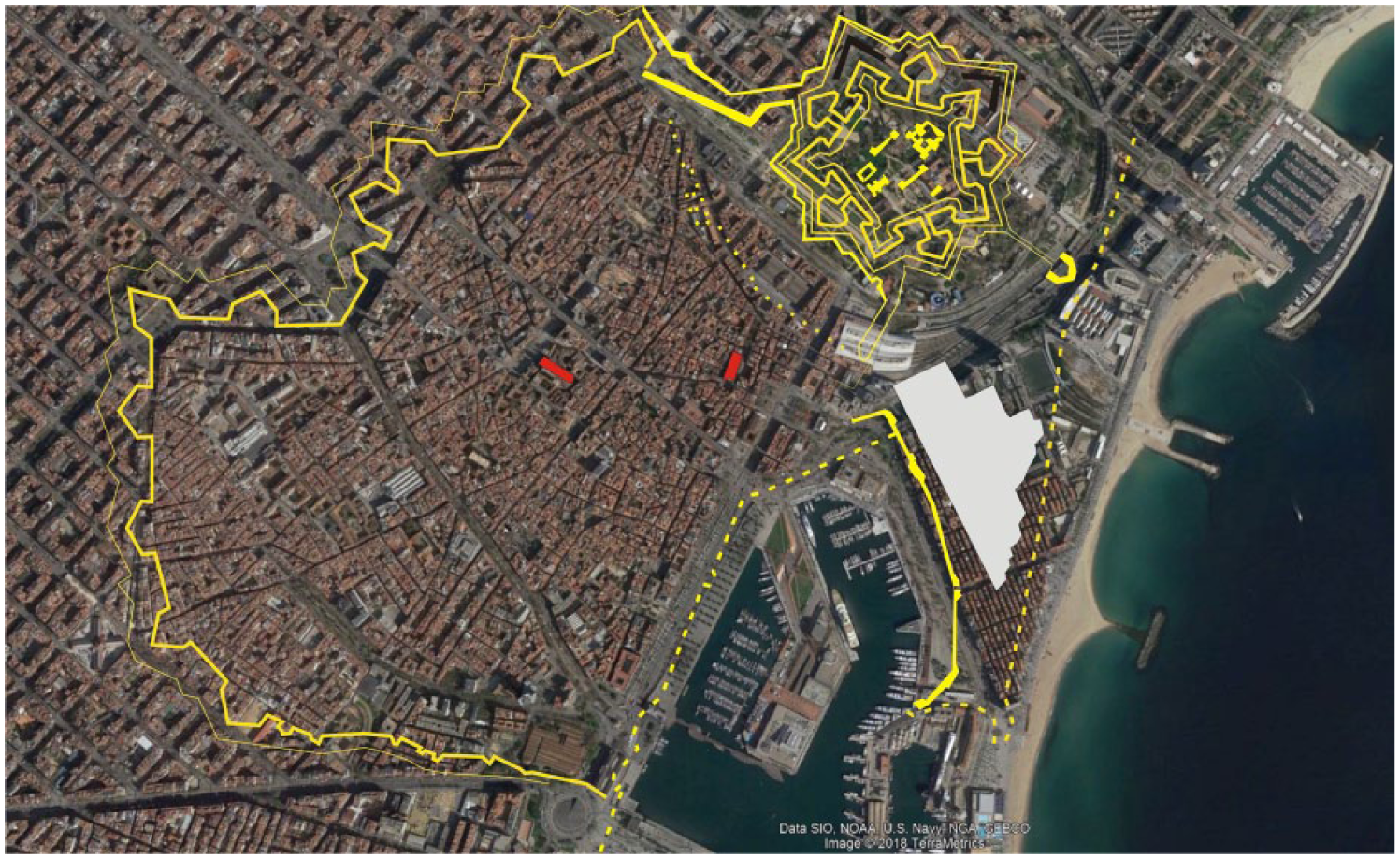
Plan of the citadel, and associated medieval town walls, superimposed on a satellite image of Barcelona.
A number of general categories of responses became apparent. First, in terms of knowledge and understanding of the site, two general categories emerged, those with no knowledge of the site and a larger sample size who knew of the site but had very little understanding of it. Of the visiting tourists to the city, three respondents knew about the existence of the citadel but had little knowledge about it. None of those who identified as Spanish were aware of the Citadel, indicative of the differing historical narratives that exist from a Spanish perspective. One woman from Andalusia who was now living in the city did not want to talk about it. She suggested that in the context of the contemporary political climate she was not prepared to discuss a potentially contentious place. There was a greater level of awareness amongst those who identified as Catalan, but the accuracy of these inherited memories varied greatly. One male tour guide had a relatively detailed knowledge of the site’s history but the remaining 16 Catalan respondents had little or no knowledge of the site. Most had a vague understanding of the site functioning as a prison, but even then chronologies and historical associations were confused. While the site had functioned as a prison briefly during the middle part of the nineteenth century, a number of respondents stated that it was a prison used during the Franco period to house Catalan prisoners, a period when the park had already been built for many decades. Here, there is clear conflation with the Montjuic site which did serve as a prison during the twentieth century. Another respondent stated that the ‘prison’ had been used for ‘torturing Spanish people that disagreed with the king, and years later to imprison Catalans for speaking Catalan. It was like a little Bastille’. The association of the building with Franco and the Spanish Civil War came up repeatedly and is illustrative of the centrality of Franco-period oppression that still dominates Catalan historical narratives. The identification of sites of Spanish oppression and of the Franco period has generally become fused. Inaccurate distorted memory has taken a general concept and assigned meaning and purpose to a place that was unconnected to the mid-twentieth-century dictatorship.
A second general category of responses were associated with how best to remember and potentially interpret the site. Again, two general categories of responses were received, those who thought the citadel should be forgotten and a second larger sample of respondents who argued for its remembrance, but in a number of different ways. In the first category, just under 20% of respondents stated that the site should not be remembered in any way. One young female Catalan suggested that the Catalans had destroyed it for a reason and that it should be forgotten. Another Catalan suggested that in the context of the political developments, this was not a good time to engage in any form of interpretative remembrance. This was further supported by an American visitor who stated that ‘it was a bad time to integrate Spanish influenced things with the issues and conflict happening’. These were, however, minority opinions and most suggested that the site should be interpreted in a more detailed way. Suggestions ranged from the use of display panels around the park to the exposure of sections of walling. Many suggested that the display of ruins associated with the citadel would serve both as an additional visitor attraction and also be used to discuss the contested nature of the city’s past. A young Catalan recognised the ‘layers of history’ the site has and the need to remember and discuss these. One visitor also suggested that it ‘is good to keep history alive, whether it is good or bad’.
In contrast to the Citadel site, all of the further 22 interviews obtained at the Montjuic site were exclusively with English-speaking international tourists, representative of the site’s role as a major city tourist attraction. Each of these visitors had very limited knowledge of history and the short interviews contributed little to this study. None of them were aware of the citadel site, and all of them appeared more interested in Montjuic serving as a viewing place over the city’s urban vista, rather than its historical context.
Oppression and resistance
One of the dominant narratives underpinning Catalan nationalist sentiment is that of oppression by the Spanish state of Catalonia. This associated concept of Catalan resistance, linked to repeated historic oppression, is a central recurring theme in many of the museums and heritage centres, and features on many of the city’s monuments. Montjuic Castle has come to represent the strongest physical manifestation of this oppression. Originally built in the seventeenth century, the fortification was extensively refurbished in eighteenth century as a military garrison and strategic artillery location. The fortification, visible from most areas of Barcelona, was built on top of hill Montjuic, a place used for quarrying during Roman times and later the burial place of the city’s Jewish population. Current interpretations of the site focus on its role as a controlling garrison over the city’s residents after 1714. According to the brochure given to visitors upon entry to the site as a short introduction and guide, published by Barcelona City Council, during industrialization in the nineteenth century it became the symbol of ‘an absolutist and militarised state’ and during a number of protests against state taxation policy the city was bombed from the site. During the early twentieth century, the castle was used for ‘imprisonment, torture, trials and executions’ as part of the state’s repression of anarchist terrorism, social uprising and political opposition. Today the fortification is a major tourist attraction and is maintained as a monument primarily to the repeated historic injustices perceived to have been committed on Catalonia by Spain. Exhibits largely focus on the castle’s role in oppression while emotive multi-media exhibits show the bombing of Barcelona from the site. One section of an exhibition gallery within the inner courtyard of the castle is entitled ‘Defence and Repression of Barcelona’. The introductory panel states that the ‘Repression of Barcelona began after the War of Spanish Succession when the defence of the Bourbon authority … prioritised military control and the subjugation of the population … The repression was indiscriminate and public freedoms were violated from the castle’.
Elsewhere a new public visitor centre was officially opened in September 2013 amid heightened calls for Catalan independence from Spain. The El Born Cultural Centre, established on a former market site, has as its central attraction an exposed archaeological excavation. The interpretative framework around the site has been reimagined and presented to communicate the horrors of war inflicted on the citizens of Barcelona following the War of Succession in 1714. Narratives that emphasise the historical degradation of Catalan political or cultural identity that reaffirm the distinct and separate nature of Catalan nationalism are present on a series of interpretative boards placed on a raised walkway around the area of the excavation (Breen et al., 2016). El Born’s mission statement welcomes visitors at the main entrances: Història, Patrimoni, Meemòria and Llibertats. A summary of the exhibition explicitly outlines the narrative of oppression: Catalans backed the Austrian claim for the throne when ‘faced with the despotic policies of the Bourbons’ and ‘opened the doors to the repression’ ‘the Catalans world view suffered a radical mutation, subjugated by a regime classified by many historians as “military terrorism”’. The extent to which the city was ‘mutilated’ is illustrated by focusing on the life of the suburb prior to the demolitions. The narrative is very similar to that offered at the Museum of Catalan History; the Catalans are shown to be multi-cultured, diverse, progressive and cultured. The ruins’ interpretation help accentuate the vibrancy of colour of Catalan life prior to the disaster: they contained public games halls, businesses, ornamental and vegetable gardens, water wheels, fountains, fruit trees, and a diversity of flowers. These were ‘neighbourhoods of personal, professional and social activity’; ‘a society connected with half the world … the city folk were well fed and passionate about sweet things’. Other displays reinforce the message that the area was full of colour, ornament, celebration, dancing, music, theatre and gambling. The visitor is invited to contrast this with its loss, demolition and replacement with stark military necessity and oppression. Much of this text refers directly to the area that was levelled to allow for the construction of the citadel. This former mixed used area within the walled city is reimagined in the constructed memory of the interpretative text as almost being utopianesque, a vibrant area brimming with cultural diversity and colour. The reality would have been somewhat different, given the nature of disease associated with the living and working conditions of the inhabitants in the seventeenth and eighteenth centuries.
This thematic approach to the citadel as a place of Spanish subjugation was highlighted in a 1995 guide to the city’s parks and gardens published by Barcelona City Council. The authors state that the Parc de la Ciutadella was the prize in a struggle against the symbol of oppression. The military fortress was knocked down by groups of volunteers, and that tells us everything. The aim was to undo, not to build (Gabancho and Freixa, 1995: 22). In 2014, the Contemporary Municipal Archive in Barcelona launched a major exhibit of maps, documents and photographs that examined the city authorities’ efforts from 1868 ‘to recover and establish spaces and symbols lost at different times in history. These included the Ciutadella Park, the Fossar de les Moreres and the monument to Rafael Casanova associated with the celebration of the Diada, Catalonia’s National Day’. The exhibit was launched to mark the tercentenary of the events of 1714. One of the primary documents on display in the Municipal Archives is a 1781 document that lists the streets and residents of the La Ribera area that had been ‘forced to demolish their own homes to build the fort’ after 1714. The Ciutadella was referred to in this exhibit as ‘the fortress built to suppress and keep Barcelona under Bourbon control’. In April 2016, the Barcelona blog, managed by Barcelona City Council, posted an article about La Ciutadella and stated that the site ‘has had an ambivalent and contradictory relationship with Barcelona’. It refers to the demolition of the La Ribera neighbourhood to build the citadel and refers to one of the ‘blackest periods’ in the site’s history between 1827 and 1832 when individuals were imprisoned there and ‘shot without the slightest guarantee of fair treatment’ (Barcelona blog, 2016).
Discussion
Nation-building is a complex and highly contested process, within which national identity is being constantly redefined (Schlesinger, 1991). Within Catalonia, culture and heritage have become central elements in the process of identity formation and negotiation. This has brought it into direct opposition to the two dominant all-Spanish discourses within Spain. These include the unitarian and conservative Spain that has adopted a centralised vision of the country as well as that of the more liberal Spain, which accepts the devolved power of its regions and is more Europeanised, as exemplified by the Partido Socialista Obrero Espaol (POSE) (León Solís, 2003). While previously the CiU was broadly content to remain as a recognised cultural nation with this wider, albeit problematic, Spain, politics have shifted in Catalonia where the Esquerra Republicana de Catalunya (ERC) now advocates for full independence. Under the CiU, who were the primary advocates for a separatist agenda, many of these heritage spaces were used to promote the cultural elements of the Catalan ‘nation’. As the pro-independence movement has strengthened over the past decade, with a notable shift amongst Catalan conservatives towards this position, these cultural narratives have shifted to lay further emphasis of Catalan grievances against the Spanish state and the historical ‘injustices’ that have been committed against the region. The citadel then plays a significant part in framing memory around Spanish oppression and the loss of Catalan independence. It is one of the many devices used in the othering process within the contemporary separatist movement. In remembering the site as a place of subjugation and military horror, it is added to the many grievances felt by the Catalans in their broader opposition to Madrid. This is not a new phenomenon but is one that has its roots in the emergence of the regionalist and nascent nationalist movement in the nineteenth century.
With the development of the initial nineteenth-century Catalan renaissance and the prioritisation of regional Catalan identity over a centralised and unified Spanish identity, the city fathers deliberately chose to eradicate the citadel and recreate a green, open and public space. In doing so, they were rejecting the repressive eighteenth-century centralist regime of the Spanish state as well as removing the enclosing, claustrophobic city walls and citadel. They were, in effect, letting the city expand and breathe. This flattening of the wall and citadel was symbolically repeated during the 2018 annual pro-independence march held on 11 September, Catalonia’s National Day. A huge rally, attended by over 1 million people stretched down Meridiana Avenue to the entrance to the Parc de la Ciutadella. A series of wall panels erected at the entrance to the park, symbolising Spanish barriers to independence and representative of the old city and citadel walls, were toppled, paving the way symbolically to an independent Catalonia.
As with the nineteenth-century rebuilding, Barcelona is again going through a period of major change and is on its way to becoming a global city and a major European capital, rivalling Madrid. Similarly, the nineteenth-century expansion was an ambitious venture, aimed at recreating a new Catalan capital and redeveloping the city as the major urban centre in the western Mediterranean region. This is also reflective of the more recent attempts to redevelop the city following the catharsis of the Franco period and the imaginative approach taken to revitalising the city associated with its hosting of the Olympic Games. The nineteenth-century developments paralleled aspects of contemporary urban planning in a concept termed by Boyer (1994) as ‘the city as panorama’. Under this process, the city would be redeveloped to express ambition and aspiration through architecture and urban space. This was a politicised process that conveys multiple meanings to its audiences. It also marks a transition from cities controlled by monarchies, and where architecture and monumentality was used to legitimise sovereignty, through to the democratisation of city space, reflective of changing political environments. Cities and place now became ‘expressions of themselves as a nation’ (Mellon, 2008: 77).
Barcelona as a ‘panorama’ has played a significant role in conveying this notion of Catalan nationhood at multiple levels. Of particular interest here is the way Catalans have used cultural heritage to engage an external international audience with their aspirations for independence (Vargas, 2015: 37). The citadel site is one of many places across the city that has been remembered as a monument of Spanish oppression, originally in the nineteenth century, and now again through the narratives of separatism. This theme features repeatedly in interpretative signage in the city’s museums and heritage centres and through social media platforms. Online promotional blogs for the 2017 and 2018 11 September refer to the location at the Parc de la Ciutadella as the place where ‘Bourbon troops built the largest military citadel within a city in the whole of Europe, with most of its canyons pointing towards the city and its inhabitants’. The Park became a further focus of attention when yellow ribbons, the symbol showing support for Catalan political prisoners and exiled leaders, were attached in large numbers to its railings, sparking a number of controversial incidents in early 2018 when some of them were removed.
By contrast, there is no interpretation at the site itself, aside from the largely inaccessible swimming pool section of walling. Interestingly, this study suggests that there is a greater awareness amongst the city’s visitors and tourists about the existence and function of the former citadel than there is amongst the city’s local residents. This information is obtained from guidebooks and from the variety of visitor experience centres across the city. The study was, of course, a small-scale sample but is indicative of the efforts being made to promote the central narratives of the Catalan cause to external audiences. In contrast, the limited knowledge of the city’s residents about the presence and role of the citadel is indicative of a more general process of unremembering amongst Catalans.
Jeffrey Olick (2005: 8) has argued that this form of structuring collective memory is an inclusive concept that encompasses multiple traditions and practices, while recognising that past societies were complex. Multiple narratives can exist associated with the variety of groupings that make up society or a population. Assigning authenticity with memory is then highly problematic in the context of memory being mediated and negotiated. In the case of the citadel, it is not the building itself which is problematic, but it is instead the meanings assigned to it that have been formed by collective or historic memory. The selective propagation of often historically incorrect functions of the site is particularly problematic. Furthermore, Stone and Hirst (2014) have written about the important of collective memory in shaping identity, but have also stressed the role of not remembering in shaping identity, using the analogy of the Spaniards not remembering their country’s role in the decimation of indigenous populations in Latin America.
Zerubavel (2004) has argued that public silence is experienced by a mnemonic community. In Catalonia, it is a shared community silence on the Citadel and its oppressive presence in the city, where the place is remembered as a site of terror and subjugation. The citadel is not then remembered physically, but only in an abstract and selective manner. Lowenthal (2005) wrote that heritage is ‘everything we suppose has been handed down to us from the past. Although not all heritage is uniformly desirable, it is widely viewed as a precious and irreplaceable resource, essential to personal and collective identity and necessary for self-respect’ (p. 81). However, Catalans have largely chosen to deheritagise this site and have engaged in a deliberate process to erase and refunction this space. Societies chose what to preserve and are selective in the set of heritages they present to represent their past. In doing so, they are constructing their view of an appropriated and selective past that is used to justify and promote present politicised perspectives. To use Nora’s (1989) terminology, memory associated with the citadel has been torn from the past, mirroring its deliberate physical destruction. There is little real memory surviving, with the site instead being reimagined within the framework of particularised political perspectives. Whatever of the whole of its historical realities, a selective and myopic vision of its function is replacing the complexity of its actualised past.
Footnotes
Acknowledgements
The author would like to acknowledge the work of this article’s initial reviewers, whose detailed comments have greatly improved this article.
