



Abstract
Memory in journalism has largely been investigated in relation to the commemoration of historical key events. This article sheds light on everyday, less obvious forms of memory in journalism with a focus on non-commemorative memory. We carried out a large-scale content analysis of contemporary newspaper articles (n = 2799) about two historic storm surge disasters in the Netherlands (1953) and Germany (1962) and a subsequent qualitative study based on 10 interviews with Dutch and German journalists. Combining content-based results with actor views enabled us to look below the surface of memory in news reporting and lay bare potential triggers, justifications, and underlying motivations for memory use. We found that journalists frequently use memory to connect past, present, and future, driven by a range of professional, economic, ideological, and cultural motivations that go beyond commemoration. We propose the term “strategic motivations” to better understand the dynamics of memory in journalism.
Introduction
By profession, journalists occupy a unique and contradictory temporal position in which they operate within the subliminal space between past and future, and are assigned multiple roles to bring news, chronicle the past, and forecast developments. Even though it may not seem like it on the surface, dealing with the past is an essential part of the journalist profession. But journalists’ responsibility entails more than recounting strings of past events: their work creates and reshapes cultural memories, thereby influencing our perspectives on the past, present, and future. In an effort to shed light on the various and sometimes inconspicuous ways in which memory finds its way into news, this article focuses on journalists’ everyday use of memory, beyond the well-studied form of commemorative memory.
To maximize our insight into non-commemorative memory, which has so far received limited scholarly attention, we strived to create a framework that allowed us to study memory and its underlying mechanisms through both memory content and actor perspectives. For this, we used two traumatic storm surge disasters in the Netherlands (1953) and Germany (1962) as case studies, and identified several memory types to explain the apparent purpose of the two events being mentioned in contemporary national and regional news reports. To validate and further investigate these findings, we interviewed journalistic actors in both countries, focusing on their motivations for using memory in news reporting. By looking at both memory content in newspaper articles and the perspectives of journalistic actors, we have gained valuable insight into the dynamics of non-commemorative memory and the complexity of journalists’ memory work.
Over the next paragraphs, we lay out the conceptual framework at the basis of this article. After defining our research questions, we set out our mixed-methods design that combines a comparative quantitative content analysis of newspaper articles and an interview study with journalists. In an overview of the findings, we first look at the content analysis and see a wide variety of memory types in contemporary references to the past events, of which commemoration is not the most prevalent one. Next, we examine these findings in light of the interviews and reveal a range of underlying motivations for journalistic memory work, including the use of memory as commemoration, context, reliable knowledge, and as a story angle. Finally, we discuss our findings and conclude that journalistic memory is more complex than it would appear on the surface: although commemoration might seem an obvious motivator, journalists in fact use memory for a wide variety of reasons. This complexity, we argue, can best be understood by integrating content- and actor-based insights.
Conceptual framework
Before setting out our methodological approach, we will first explain our key research interests in non-commemorative memory, the integration of past, present, and future, and the role of journalists in memory construction.
Non-commemorative memory
For more than a decade, communication scholars have been dealing with the relationship between journalism and memory. There seems to be no doubt that memory plays a central role within journalists’ daily activities, and that journalists play a key role within societal memory processes (Olick, 2014; Zelizer, 2008; Zelizer and Tenenboim-Weinblatt, 2014). The list of historical events carved into journalists “memory agendas” is long and varied, depending on the size of the past events, their perceived cultural and geographical proximity, and the distance in time between an event and its memory. Furthermore, scholars have examined correlations between what makes an event newsworthy and what will make it memorable in the long term (Hoskins, 2010: 463 ff; Kligler-Vilenchik et al., 2014). In consequence, numerous memory studies focus on historical key events, and how they are commemorated by various news media. To a certain extent, it is understandable that so much attention has been devoted to commemorative coverage. The expected increase in publications in light of anniversaries delivers a robust basis for content analyses. Or, as Barbie Zelizer (2014: 26) puts it: “[. . .] coverage of commemorative events is a particularly potent demonstration of the involvement of journalism with social memory and its politics.”
Less empirical research has been done on implicit and intuitive, non-commemorative forms of memory that journalists apply. This is surprising, because we know that journalists often refer to the past for other reasons, for example, to provide contextual information or to draw analogies between present and past (Edy, 1999), or to create relevance for current topics or grievances and demand for action (Tenenboim-Weinblatt, 2011: 218). Michael Schudson (2014: 85) has even argued that commemorative coverage is not the most important journalistic contribution to cultural memory, noting that individuals and societies usually do not remember past events and experiences to commemorate, but rather to orientate and reassure themselves over the course of time.
Integrating past, present, and future
The human ability to draw from past experiences in an effort to shape the future has received extensive scholarly attention, particularly by sociologists. Works of note include Norbert Elias’ (1992) Time: An Essay, Alfred Schütz’s (1976) research on intergenerational knowledge transfer, and more recent studies by Barbara Adam (2004) and Helga Nowotny (2008) on the ways that past events are interpreted and employed to act preemptively on potential future risks and threats. In all of this, journalists play a central role. As chroniclers of our time, journalists need to fit their stories into the context of previous events to present the audience with information that is accurate, balanced, and complete. Doing so, journalists rely on memory to connect the past with the present and the future, not least because they tend to focus on secure terrains of knowledge: facts that can be proven and explained to the audience rather than uncertain projections (Schoenbach, 2007).
The meaning of “news,” therefore, goes beyond the reporting of current issues, as several recent studies on the temporal characteristics of news narratives have argued (Neiger and Tenenboim-Weiblatt, 2016; Tenenboim-Weinblatt and Neiger, 2015, 2018). Instead, we ought to concentrate more on its relational temporal dimensions beyond the paradigm of news, and be aware of the effects of digitalization and acceleration that journalists seem to respond to by increasingly integrating past, present, and future. To reflect the necessary integration of different temporal layers within news stories, we base our research on memory concepts that integrate retrospective and prospective elements (Tenenboim-Weinblatt, 2013; Trümper and Neverla, 2013).
Journalists as memory agents
The mediation of memory is a long and contentious process, and it may take decades before societal consensus is reached on versions of the past that are acceptable to the majority (Assman, 2006). However, in today’s digitalized media environment, there is increasingly more scope for “multitudes of memory” beyond collective memory (Hoskins, 2018: 8 ff.). Journalists obviously do not carry out their profession in a cultural vacuum (Hall, 1975: 11; Hoggart, 1976: x; Preston, 2009: 110; Schudson, 2005: 186). In fact, several studies have argued that memory is an essential part of journalists’ professional identity construction (Mannik, 2015; Meyers, 2007). Journalists need to constantly negotiate how to include narratives of the past in their news reports to create plausible parallels between past and present, and frame potential future developments. Here, we can see an interesting discrepancy: on the one hand, journalists tend to regard past events as fixed, factual, and self-explanatory (Edy, 1999: 77, 2006: 149), while on the other hand, journalists seem cautious to use historical analogies in light of contemporary contestations and reevaluations of the past itself (Lee et al., 2019).
Despite the important role of journalists as memory agents, only few empirical studies focus on journalistic actors. Notable exceptions are Zelizer’s (1992) study on journalists’ role in the creation of collective memory of the assassination of J. F. Kennedy, studies on the relationship between individual and collective memory (Mannik, 2015; Meyers, 2007; Zandberg, 2010), and studies on journalists with historical specialisms (Arnold, 2010; Pfaff-Rüdiger and Arnold, 2010). In effect, several scholars have justifiably noted that the subject of journalists as memory agents is relatively unexplored (Arnold, 2010: 89; Meyers, 2007: 722; Neiger et al., 2011: 16) and have argued for more research on how journalism remembers and why it remembers in the ways that it does (Zelizer, 2008: 85). All in all, it seems particularly worthwhile to explore journalists’ everyday connections with memory from their own viewpoints, and to gain more insight into the complex mix of cultural and professional influences on journalists’ memory work.
Research questions
Regarding the aforementioned research gaps, this article aims to further knowledge on (1) non-commemorative memory in journalism and (2) the construction of memory as an interplay of past and future by (3) using a research framework that integrates content-based results with actor-based views—an approach that has rarely been used in journalism and memory studies. By highlighting how the past infuses itself into news reports, this study aims to contribute to a broader perspective on journalism that looks beyond its usual rhetoric of the present. To achieve these objectives, we have defined two sets of research questions. The first focuses on memory on the content level and investigates the variety of memory types in contemporary news coverage:
RQ1: Which memory types can be identified in the coverage of past events in contemporary news?
Which occasions can be identified for the memory references in the coverage?
What are the apparent purposes of the memory references in the coverage?
How can we explain the variety of memory types among the coverage?
The second set explores journalistic memory from the actor-perspective and focuses on journalists’ motivations for using memory in contemporary news coverage:
RQ2: How do newspaper journalists and editors explain the use of memory in their work?
When do journalists feel triggered to use memory in their news reports?
Which justifications do journalists mention for using memory in their work?
What strategies do journalists describe for using memory in news stories?
Research design
To investigate the variation of memory content in news reports and to explain journalists’ motivations for doing memory work, we used a case study approach and developed an explanatory sequential mixed-methods research design. Following Creswell and Plano Clark (2007), collection and analysis of quantitative and qualitative data were carried out in two consecutive phases within one study. While the quantitative data and the results provide a general image of the research, the qualitative data collection refines, extends, and explains this further.
In the first phase of our study, a quantitative content analysis was set up to discover the occasions and apparent purposes of references to the historical disasters in current news reports. Our cases were two storm surge disasters that took place more than 50 years ago: the Watersnoodramp in the Netherlands in 1953 and the Hamburger Sturmflut in Germany in 1962. While the Netherlands and Germany have similar journalistic cultures and media systems, several differences between both countries should be noted. The Netherlands is a low-lying country that has historically been under threat from water, whereas in Germany, this is only the case in the North. Another important difference is that the Dutch flood mainly hit Zeeland, a relatively poor, provincial region, whereas the flood in Germany hit the densely populated port city of Hamburg. And finally, concerning the scope of the disasters, the death toll in Germany was close to 300, whereas the Dutch storm surge took nearly 2000 lives.
The comparative nature of this case study helped us to examine journalistic memory construction through a multilayered perspective that provides room for the national and local memory contexts in both countries. By investigating both national “elite” newspapers and local newspapers, we aim to contribute a differentiated approach to better understand the interplay of national and local memory (for a similar argument, see, for example, Kitch, 2008; Neiger et al., 2014).
The content analysis included all articles of eight Dutch and German newspapers that mentioned either of the storm surges, published over a period of 12 years (January 2000 to March 2012 complete inventory count). The newspaper sample contained the four biggest broadsheets, the two biggest tabloids and two regional newspapers that were chosen according to geographical proximity to the areas where the disasters happened. As represented in Table 1, the total number of Dutch articles used for coding and analysis differs from the number used for measuring the average media attention for the past flood disasters. For pragmatic reasons, we worked with a random sample (50% out of the total number of articles) in the case of the regional Dutch newspaper Provinciale Zeeuwse Courant (PZC). The total sample size for measuring the average issue-attention, therefore, contains 2799 articles (complete inventory count) and for the analysis 2117.
Newspaper sample.
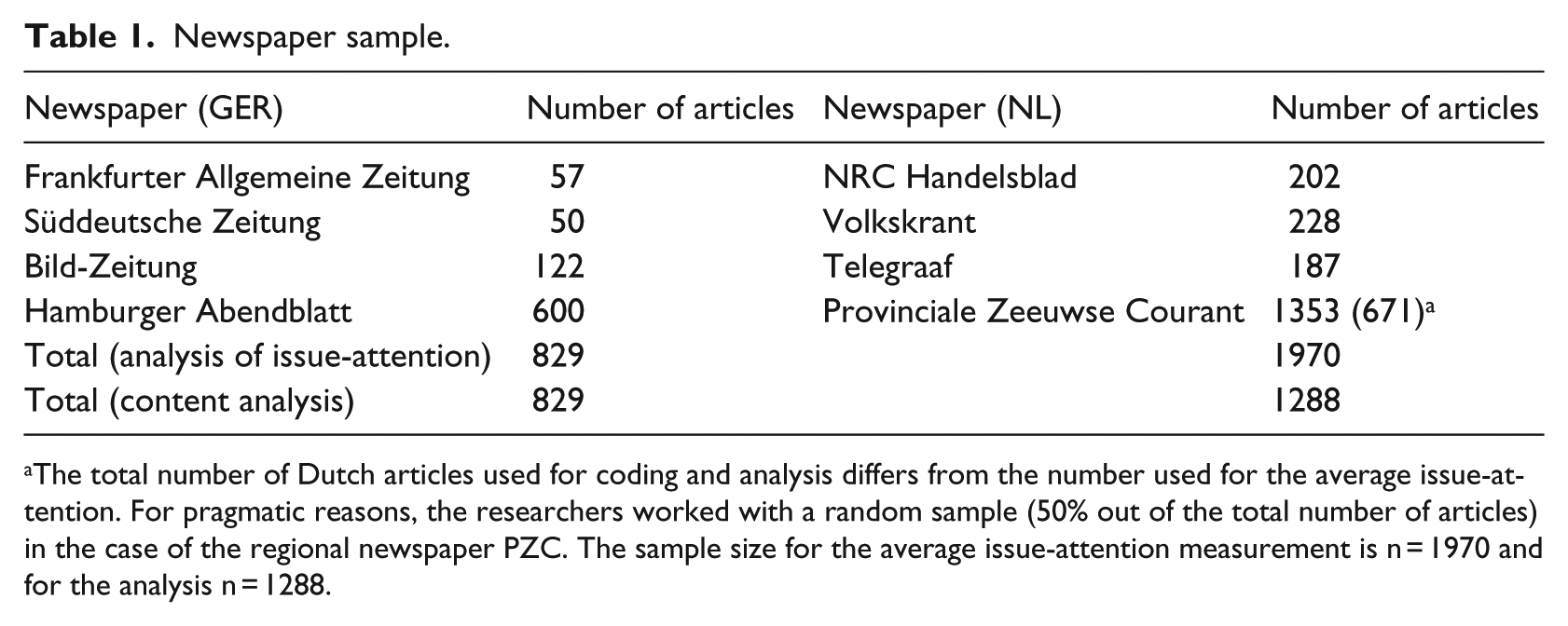
The total number of Dutch articles used for coding and analysis differs from the number used for the average issue-attention. For pragmatic reasons, the researchers worked with a random sample (50% out of the total number of articles) in the case of the regional newspaper PZC. The sample size for the average issue-attention measurement is n = 1970 and for the analysis n = 1288.
Subsequently, we based the qualitative phase of our study directly on the quantitative content analysis. Following a purposive sampling technique, we approached those journalists who had authored comparatively many articles mentioning the storm surge disasters, arguing that these facts would help pique their interest and would provide a useful entry point for the interviews. Regarding one German journalist we needed to adjust our initial selection due to limited access to the field. The approached journalists were affiliated with the German national newspaper Süddeutsche Zeitung (SZ), its Dutch equivalent Volkskrant, the local German newspaper Hamburger Abendblatt (HA), and the local Dutch newspaper PZC (see Table 1).
Of these newspapers, we contacted the chief editors and similar leading editors, hoping to learn more about organizational topics, agenda setting processes, and the newspapers’ broader mission and identity. Finally, our participants included three Dutch and two German journalists, and two Dutch and two German leading editors. Each participant was interviewed separately and two participants joined an additional double interview.
The 10 semi-structured interviews were held in 2015 and 2016 and had an average duration of 60 minutes. The two storm surges proved good starting points and resurfaced several times during the interviews. However, because both our research interests and the professional realities of the participants extend beyond these particular cases, the interviews had a stronger focus on general viewpoints on memory work in journalism, including daily working routines, possible motivations, and restrictions. Because “memory work” is not widely understood outside a memory studies context, we operationalized this as “referencing the past,” “going back into the past,” “using the past,” or simply “writing about past events.”
The interview guide encompassed six sections: the first dealt with daily working routines and decision-making processes. In the second section, our participants described the perceived character of their newspaper and its readership. Based on our cases, third section had a special focus on reporting methods for calamities, disasters, and unexpected events. Fourth and fifth sections explicitly focused on memory in the newspaper and included questions like “When is it important to refer to the past in the newspaper?” “Which past events do you consider important enough to write about?” and “What are the biggest difficulties when referring to the past?” We specifically asked journalists for exemplary situations, their approaches to doing memory work and encountered limitations. Furthermore, we inquired about commemoration routines, scheduled memory events and role perception regarding journalists’ contribution to societal memory. Here, we, for instance, asked, “What does the past mean to you as a journalist?” and “How do you define past?” and “What does the past mean to you in relation to news?” Finally, sixth section focused on how journalists relate to the future, and their approaches to covering ongoing developments.
The data analysis followed the procedures of open, axial, and selective coding to derive meaningful categories. The final set of codes helped us to identify the categories of justifications and motivations for journalistic memory work that we set out further on in the findings.
Findings
Following our research design, we first present what the quantitative content analysis revealed concerning the variation of memory types, defined in relation to the occasion and apparent purpose of the memory references in the contemporary news coverage. Then we move on to interpret these findings with the qualitative data.
Variation of memory in contemporary news stories
In an answer to RQ1, we analyzed the media attention that the two past disasters received over the course of 12 years. We could identify six occasions on which the past events received above average attention (Figure 1). In both cases, milestone anniversaries (here: 40th and 50th anniversaries) were pivotal occasions for media reports about the past disasters. Considering our focus on non-commemorative memory in journalism, it is noteworthy that the analysis revealed further memory occasions. In both cases, similar disasters like the Elbe River Flood (2002) in the German case and the tsunami in Thailand (2005) in the Dutch case, as well as movie releases about the historical disasters themselves, triggered the attention for the floods of 1953 and 1962.
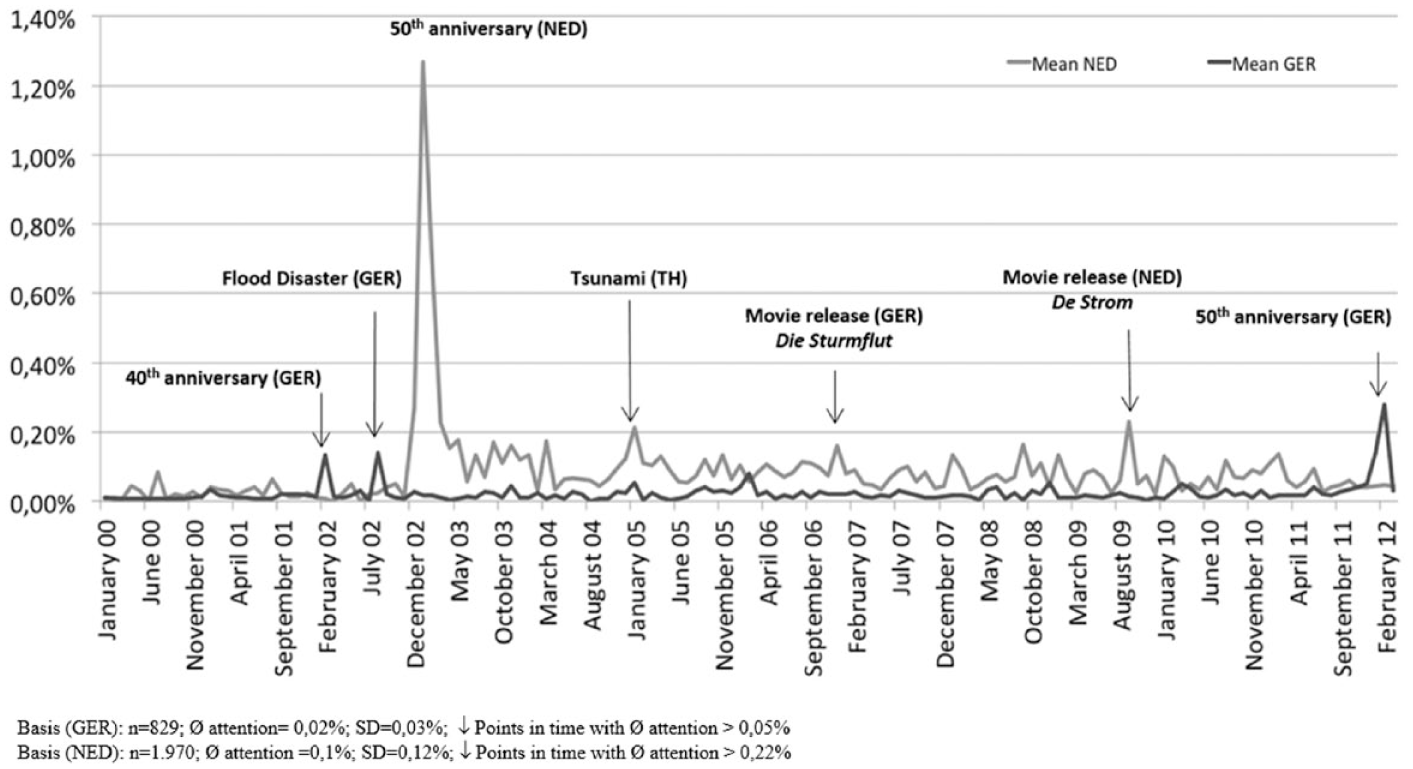
Degree of media attention and memory triggers.
Because the memory occasion, for example, external triggers like anniversaries, may not necessarily match the actual purpose of the memory reference in the articles, we defined seven potential memory types to help explain the underlying reasons for the past events appearing in contemporary news reports. We slightly adapted the three memory types, commemorations, analogies, and historical contexts, as coined and further elaborated by Edy (1999, 2006). The other four types were deduced from cultural memory studies (cultural production), news values (personalization), journalists’ preference for verifiable information (fact-centered memory), and their ability to provide more in-depth news coverage (reflection of relevance).
Commemoration
The past event is mentioned in connection with current ritualized and/or ceremonial acts of remembering.
Analogy
The past event is mentioned in connection with a current event and similarities between the past and current event are highlighted.
Historical context
The past event is mentioned as the event as such and is being used as a reference point to enrich the reporting about an issue in the immediate present.
Cultural production
The past event is mentioned in connection with cultural products like films, plays, musicals, monuments, or exhibitions that represent or stage it (e. g. in a review or critique).
Personalization
The past event is mentioned in connection with private or public persons who were either involved with the past event in former times or are obliged to refer to the past event because of their current role.
Fact-centered memory
The past event is mentioned and portrayed by means of key data, such as facts and figures that define the memory.
Reflection of relevance
The past event is mentioned and its relevance for present and future issues is explicitly mentioned (e.g. in relation a perceived risk, such as climate change).
Some types provide obvious reasons for referring to past events and can be regarded as reactive memory types. This applies especially to commemoration and cultural production, which point to self-referential triggers like milestone anniversaries or culturally objectified forms of memory (e.g. films; see Figure 1). Types such as reflection of relevance, analogies, historical context, and personalization all point to active decision-making and interpretive performance by the journalists themselves. Because we regard memory as an interplay between past and future, each of these types ties together the underlying thematic purpose and time relation of the reference to the past disasters.
All types apply to the immediate memory context within the article and were coded three sentences before and after the reference to the past flood disasters. Anticipating that journalists may highlight a variety of aspects while referencing past events, multiple answers were permitted during the coding process. The inter-coder agreements for these categories were tested within and across countries and resulted in substantial reliability scores. 1
As the results show, the two past flood disasters are remembered in manifold ways. Interestingly, commemoration is equally present in both the Dutch and German memory contents (about 14%), but it is not the most dominant memory type (Figure 2). This finding would support the assumption that commemoration is only one of various forms of journalistic memory. Beside this, it is interesting to see that the German coverage offers a greater variety of memory types than the Dutch case. In the latter, the two types cultural production (41.5%) and historical context (36%) appear most often. In the German articles, we can find four dominant memory types: fact-centered memory (38.5%), personalization (38%), reflection of relevance (35%), and analogies (16%).

Memory types in the overall coverage in Dutch (NED) and German (GER) newspapers (in percentage).
We additionally compared the distribution of all types within the local and the national coverage to examine the differences between our cases (Table 2). First of all, we can see that the high presence of cultural production and historical context in the Dutch case as well as the reflection of relevance in the German case is due to the local coverage (Table 2, right column). Second, the types analogy, personalization, and fact-centered memory are more present throughout the whole German coverage (Table 2, right column). Finally, commemoration is more present in the Dutch than in the German national coverage (Table 2, middle column).
Memory types in the national and local coverage in Dutch (NED) and German (GER) newspapers (in percentage).
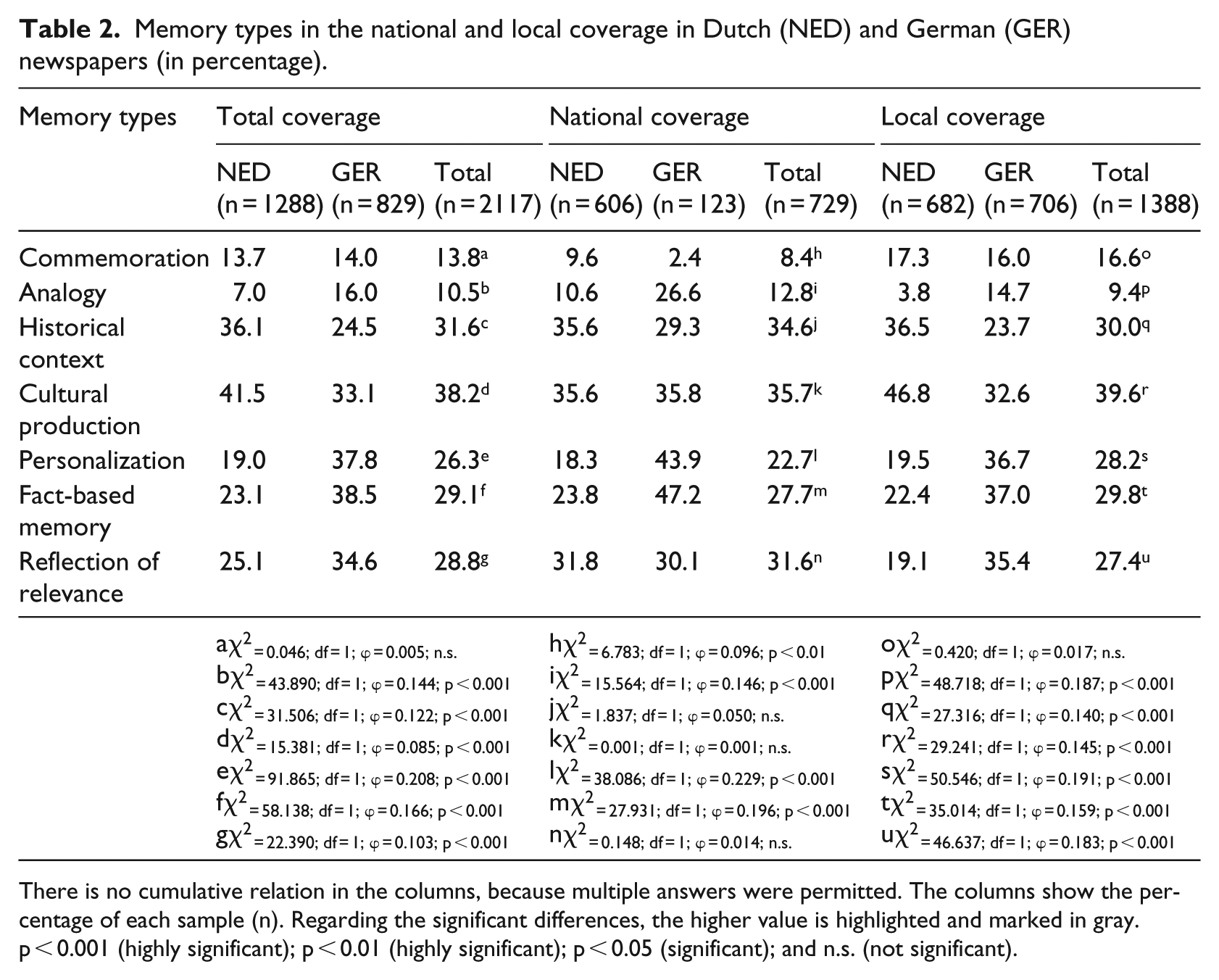
There is no cumulative relation in the columns, because multiple answers were permitted. The columns show the percentage of each sample (n). Regarding the significant differences, the higher value is highlighted and marked in gray.
p < 0.001 (highly significant); p < 0.01 (highly significant); p < 0.05 (significant); and n.s. (not significant).
Looking back at the similarities and differences in the context of the two storm surges, we can draw tentative conclusions for some of these findings. One possible interpretation of the heterogeneous memory of the 1962 flood disaster in the German coverage could be that the event is regarded as one of many other memorable events within the fast-moving metropole of Hamburg. Moreover, urban characteristics like velocity, complexity, and redevelopment might explain why the current relevance of the event is not self-explanatory but has to be explicated whenever referred to in the media coverage.
In contrast, the Dutch flood disaster of 1953 seems to be a key event not only for the region of Zeeland but also for the whole country, which reflects the country’s cultural identity as a nation below sea level (de Boer, 2013: 123; Mauelshagen, 2007: 55). Simultaneously, due to its high local impact, we can assume that the event is historically contextualized with multiple issues and artifacts (e.g. buildings, streets), especially on the local level.
Motivations behind journalistic memory work
Now that the content analysis has illustrated the variety of memory types found in contemporary news coverage, we move on to explore the role of journalists as memory agents from the perspective of journalists themselves (RQ2). The interviews revealed that memory plays a role throughout the conception of news stories. The journalists and editors we interviewed generally considered “the past” a part of their jobs, because, like the editor of a Hamburg newspaper said, “You can’t understand the current situation if you don’t know how it was before” (Interview 5). From our participants’ explanations, we were able to define four main justifications for using memory in journalism: to (1) commemorate events, (2) support stories with reliable knowledge, (3) provide stories with interesting angles, and, finally, (4) contextualize contemporary affairs and developments. While some of these correlate with the memory types of the content analysis, the interviews made clear that underneath these primary justifications we can discern many more underlying motivations.
Memory as commemoration
The interviewed journalists and editors considered commemoration an important motivator for using memory in news reporting. Interestingly, and corresponding to the content analysis findings, we found that locality greatly influences commemoration in the newspaper. All participants, working for both local and national publications, said that their newspapers devoted attention to anniversaries of large events, such as the start of World War II, the Chernobyl catastrophe or 9/11. However, events with a primarily local impact—such as the storm surges of our case study—were commemorated more often and with more attention to detail. In the words of the editor of a local newspaper in Hamburg: There are certain events that you just have to refer to [. . .] Obviously there’s the storm surge disaster of 1962, which was very terrible. There’s the big fire [of 1842] and a big plane crash in Hamburg which killed 30 people. And before that, the Second World War and Operation Gomorrah which reduced Hamburg to ashes. But also very historic themes like Bismarck’s birthday, who was very important here. (Interview 5)
It becomes especially interesting when we look at the editor’s motivations for commemorating these events in the first place. After defining the newspaper’s identity as “the printed sense of life in Hamburg,” he goes on to say that “It is not our duty, but we do consider it our mission [as a local newspaper] to keep the memories alive,” and regarding the audience, “We write about the past for our readers who are in their fifties and interested in [it] because they experienced it themselves.” But when giving examples of integrating memory in his newspaper, the editor also notices a clear economic benefit: We keep drawing the conclusion that historical themes sell very, very well. For example, we have a regular column on Saturdays called “Yesterday and Today” about certain local anniversaries. And last year we made a series called “Hamburg’s Last Secrets” about little known historical facts. In the end we made a book out of it, and that book alone sold 24,000 copies. (Interview 5)
Another telling example of the effort that newspapers can put into commemorating local events is found in Zeeland. Here, the local newspaper devotes significant attention to the anniversaries of the 1953 storm surge disaster, which had a large and lasting impact on the area. We could already see this in the attention curve derived from the content analysis (Figure 1), but the interviews with local journalists enhanced our understanding of the processes underlying the disaster’s commemoration. Yearly anniversaries are usually prepared up to 2 months in advance and include personal recollections as well as forward-looking takes on memory such as architectural sketches of flood-proof houses. The storm surge’s 50th anniversary in 2003 received especially high attention. According to our participants at the local newspaper in Zeeland, the special edition for this milestone anniversary took 1 year to prepare and included “new” recollections of firsthand witnesses. According to a senior local journalist, many witnesses were only able to talk about the disaster now: “Apparently they needed a little push” (Interview 4). Reflecting on his newspaper’s attention to the storm surge’s anniversaries, one journalist draws the interesting conclusion that commemoration per se is not the only argument: There are still people who can talk about [the storm surge], so as a newspaper we find that important. And with the rising sea levels, it stays a contemporary issue [. . .] As a newspaper, we still think of [the anniversaries] as a moment to take different perspectives. Even though the past still receives the most attention, we increasingly look forward, with scientists, climatologists, dike building . . . You look at “How safe are we now? What can we expect?” (Interview 4)
The examples above illustrate that there are multiple layers underneath commemoration in news reporting. Often, commemoration only describes the surface of the memory act, in addition to bringing new perspectives on the disaster and underscoring its contemporary relevance. Even if the purpose of the memory reference may seem commemorative in the final news product, the interviews made clear that it is not quite as simple as that. We can discover many more underlying motivations for commemorating past events, from fulfilling audience expectations, and maintaining a good rapport with the readership, to increasing a newspaper’s marketability and preparing the audience for a future world.
Memory as reliable knowledge
Beside using memory to commemorate past events, the interviewed journalists actively used memory to improve the overall credibility and quality of their news stories. As a rule, most journalists started working on their stories by researching archives to see what had already been published on their topic. One local journalist in Zeeland explains his routine as follows: “I go up to five or ten years back. But more than ten years isn’t necessary, usually. That’s a whole different generation, so many people don’t remember anyway” (Interview 4). In some cases, the newsroom itself functions as a source of memory. A telling example is given by the editor of a newspaper in Zeeland, describing the daily editorial meetings: It happened a few times that a younger journalist didn’t know the full history. For instance, when Walcheren [an area in Zeeland] was purposefully flooded in 1944. It makes sense to blame the Germans for that, but in reality the Allied Forces did it to liberate Zeeland. Then it’s good to have an expert in the room: an older journalist who knows the background and who catches mistakes like that before publication. (Interview 1)
Especially for the local newspapers in our study, being aware of local memory and “getting it right” was considered important to maintain a good relationship with the readership. Failing to do so could harm the perceived quality of the newspaper and have financial consequences. In this case, daily meetings provided an opportunity for senior journalists to transfer knowledge to younger colleagues as a way of quality assurance.
Beside searching for factual knowledge about past events, using firsthand accounts was another popular method to supply news stories with credible sources while simultaneously giving them a more personal touch. A local reporter in Zeeland reflects on this: For Hurricane Katrina we interviewed a couple of “Watersnoodramp” victims [. . .]. For many it’s still quite a difficult topic, so when you ask them, “How do you feel seeing those images?” it will get you a rather emotional story. You have to watch out for that, because that’s not what you’re looking for, but it is someone who can translate the situation like no other. I look at it from a journalist’s perspective, and they are looking at it as a shared victim. (Interview 4)
Here we see that while firsthand accounts of past events may help to authenticate and personalize news stories, it is not entirely unproblematic. Not only is memory a highly subjective affair, but the more an event ages, the more challenging it becomes to find reliable sources and to verify existing sources. A journalist who interviewed a former secret policeman of the German Democratic Republic for a large nationwide newspaper in Germany illustrates this as follows: The problem with these things is always: how open are the people really? Because, especially with Stasi employees, they really do have something to hide. That is where you come upon the journalistic boundaries—because I wasn’t there, was I? (Interview 7)
The above examples show that memory work is a deliberate activity requiring precision and caution. Journalists can use memory as a source of reliable knowledge, for instance, by verifying or discrediting new information using archival data, hoping to authenticate their stories and to assert author authority. They may also include firsthand recollections of past events as a way to personalize their stories and provide them with credibility. But as mistakes are quickly pointed out by the newspaper’s readership, journalists need to take care being as factually accurate as possible. These caveats directly interfere with the journalistic principles of truth and accuracy, and pose some of the reasons that journalists shy away from engaging in memory work.
Memory as an angle
Journalists may also use memory to actively emphasize a topic’s past in order to push a topic that would otherwise not be considered newsworthy. In this way, journalists can try and get their stories published. A reporter working in Hamburg gave the example of writing about the 175th anniversary of a local theater and commented that “In the end, it’s nothing more than finding a reason to write about this theater, and in this case, the interesting point is that it’s quite old” (Interview 7).
Another way to create newsworthy stories using memory is to revisit stories after a short period of time. The editor of a nationwide newspaper in the Netherlands describes this method as follows: “This week it was one year ago after the Charlie Hebdo attacks in Paris. That’s something we do sometimes, just to see what changed during the year” (Interview 9). Because stories that were published relatively recently are still “fresh” in the minds of the audience, journalists do not need as many words to introduce their readers to the topic. In combination with easy access to previous sources, this is an efficient approach for writing engaging content about past and recent developments.
Journalists may also actively go looking for memories that fit their story ideas. A local journalist in Zeeland explains this: “Say you have a political topic, about some fiasco on the construction of a road or something, you keep digging until you find the previous fiasco and where the responsible deputy made his last mistake” (Interview 4). In the same line, journalists may use memory to see if promises made in the past have been kept—or not. A reporter for a local Hamburg newspaper reflects on this: There is nothing better than digging up speeches of mayors and investors of 2007 and to see: what came of all that? [. . .] You become more skeptical. When someone tells you how great it’s all going to be, you question it and try to put it into perspective for the readers. (Interview 6)
In the illustrations above, journalists actively dig through archives to find potentially interesting pieces of memory that put the current situation in a new light, creating newsworthy stories in the process. Here, the use of memory does not only increase news stories’ relevance and journalists’ authority, it also fosters journalists’ role as “watchdogs” for society. This is of note, because the underlying motivations for writing these news stories in the first place would not be self-evident from the final, published articles.
Memory as context
Finally, one of the most frequently mentioned justifications was the use of memory for contextualization. This broad concept encompasses the use of memory in news stories by showing developments, comparing past and present or by drawing parallels with similar situations. An example of using past and present parallels is given by the editor of a nationwide Dutch newspaper: Right now there’s a parliamentary enquiry going on about a very expensive train. They spent about 1.5 billion on it and it’s all money down the drain. Parliamentary enquiries are rare; we only do that when something very serious has happened. In the 1980s and 1990s they would lead to radical reforms, but this time nothing seems to be changing. If you refer back to that, past scandals and the like, you bring an extra layer of depth to the story. (Interview 9)
Beside creating an “extra layer of depth,” journalists can also use memory to sensitize readers to perceived societal threats. One example is a local newspaper in Zeeland, which regularly features items in which the flood of 1953 serves as a warning, for instance, by publishing sketch models of areas that would flood in case the sea level rises. The editor-in-chief of this newspaper explains these publications as follows: We live in an area that deals with water on a daily basis. Everyone realizes that something like the storm surge of 1953 could happen again. The rising sea levels are bringing a future that we need to think about now. (Interview 2)
Vice versa, journalists may also include memory in news stories to reassure their readers about current contentious debates. A local reporter in Hamburg mentioned how he digs into historical data to temper “climate change hysteria,” hoping to temper the public’s attitude toward this perceived threat. He said, “People see climate change in every insect plague. Then a glance towards to past can be helpful” (Interview 6). Another example concerns the Syrian refugee crisis in Europe, a hot topic at the time of the interviews, regarding which many of our participants drew parallels with the past. The editor of a nationwide Dutch newspaper explains his motivations to draw parallels with previous refugee influxes as follows: At first that [Yugoslavian] influx was larger than the one from Syria now, so if you place it into perspective it’s not all that bad. We’re able to tell how those who came to the Netherlands in the 1990s have fared since then. Lately we’ve also started following Somalis for this reason. [. . .] We try to connect to the past in a clever way. It adds a deeper layer to superficial reporting about what’s happening now. I think we also owe it to our status [as a quality newspaper] to do so. (Interview 9)
But using memory to contextualize news stories also has its downsides, as several participants noted, as it may increase the risk of misinterpreting the current situation and making false comparisons between past and present. An editor of a nationwide German newspaper reflected on his view that certain topics are “over-historified” using the example of the “Weimar Republic” interbellum period in Germany: Weimar is a classic case. People are quick to say we’re facing Weimar-like situations, usually when the unemployment rate has gone up or now that the political parties seem to splinter [. . .] In these cases, historical positioning makes no sense. The threat of the Weimar days doesn’t exist today. I think you have to be careful not to slide into the position “We’ve seen it all before, don’t take it too seriously.” Not everything has happened before and can be historically positioned. Some things are new and you shouldn’t lose perspective on that. (Interview 8)
All in all, it is clear that using memory as context in news stories is a highly complex endeavor, even if it does not seem like it on the surface. It is part of a journalist’s mission to contextualize complex events, and it makes sense to do so in light of the past. However, while providing the audience with accurate, balanced, and complete coverage, journalists can exert their power and highlight certain parts of memory to guide their readers in a certain direction, for instance, to sensitize them to perceived societal threats (e.g. rising sea levels) or instead to mitigate perceived threats (e.g. climate change, refugee influx). In the paragraphs below, we further analyze these findings in relation to the content analysis.
Discussion
Over the past paragraphs, we have seen that memory finds its way into the newspaper frequently and for various reasons. Regarding the two historical storm surge disasters in the Netherlands and Germany, the content analysis showed that these events were referred to on occasions that varied beyond anniversaries, including less obvious incidents, such as contemporary natural disasters and the release of disaster movies. Of the seven memory types that we defined, commemoration accounted for approximately 14%: less often than cultural production and historical context in the Dutch case, and less often than fact-centered memory, personalization, reflection of relevance, and analogies in the German case. While this is highly interesting and indeed seems to suggest that non-commemorative memory makes up for a large part of journalistic memory, content itself cannot tell us more about the underlying dynamics of memory work. For this, we need the perspectives of journalistic actors.
The journalists in our interview study often initially described their justifications for using memory in terms of commemoration, contextualization, or providing stories with an interesting angle and reliable knowledge. The categories derived from the interviews are partially in line with the memory types coded in the content analysis. The types analogy, historical context, and reflection of relevance fit to contextualization as a justification for including memory in news reports. And, depending on the journalists’ intentions, the memory types personalization and fact-centered memory would fit to the categories of using memory to create an interesting angle or to provide news stories with reliable knowledge. The significance of locality for memory references in news coverage, which the content analysis revealed, could also be recognized in the interviews. Here, the journalists often noted the economic and normative importance of memory references especially for their local audiences. Interestingly, commemoration was often mentioned first when the journalists were asked why they would include memory in their reporting, even though commemoration itself only accounted for 14% of the memory references of the content analysis. However, the interviews made clear that journalists’ motivations for doing memory work are in fact layered and multifold, and go beyond the journalists’ initial justifications and the memory types as defined for the content analysis (see Table 3).
Justifications and underlying motivations for using memory in news stories.
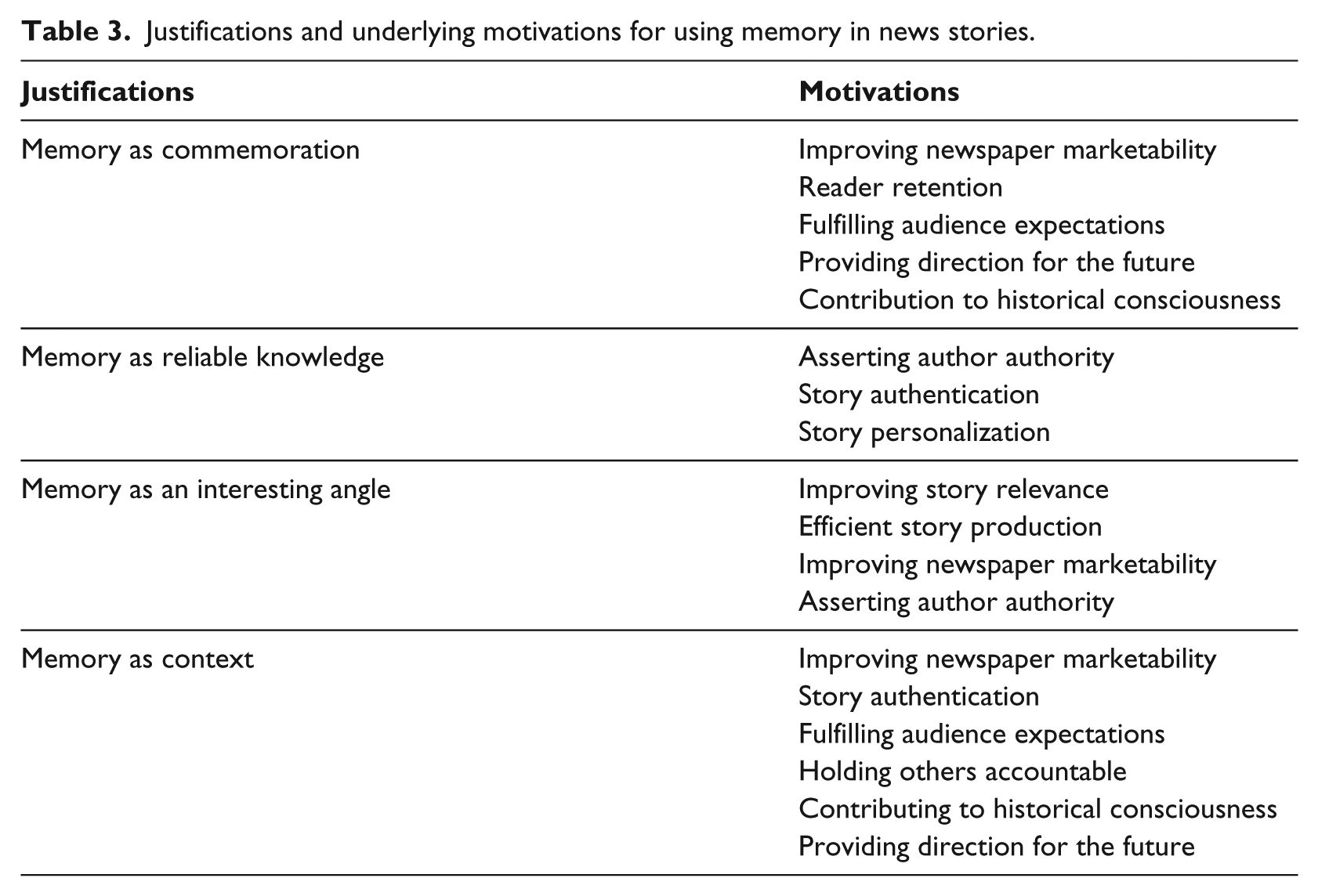
Take, for example, the act of covering anniversaries of local events. While superficially, its justification might be commemoration, the underlying motivations include readership retention, fulfilling audience expectations, as well as contributing to the historical consciousness of the readers. Interestingly, motivations to use memory for pushing story relevance, asserting author authority, and story authentication could only be discovered by means of the interviews, as these cannot be recognized on the content level alone.
Furthermore, as the content analysis already implied, memory frequently finds its way into the newspaper after active decision-making by journalists themselves. The interviews made clear that this is even the case with reactive memory types like milestone anniversaries and culturally objectified forms of memory. In addition, the interviews illustrated how journalistic actors are influenced by professional, cultural, ideological, economic, and political conventions, while knowledge of these surrounding power structures seemed to equip them for using memory deliberately and strategically.
At this point, we coin the term strategic motivations to describe the interplay of multilevel incentives for doing memory work. We can assume that this is driven by underlying strategic elements that correspond to the aforementioned individual, professional, cultural, ideological, economic, and political forces of influence. For example, when journalists use memory to authenticate and personalize news stories, or to try and increase the relevance of their stories, this may hint toward underlying individual and professional strategic elements. The inclusion of memory can also be driven by economic strategic elements, for instance, when memory is used to improve efficiency by revisiting relatively recent, or yearly recurring topics. Similarly, when local newspapers go out of their way to create special sections that commemorate past local events, this might be done not only to fulfill audience expectations and thereby meet the economic aims of the media outlet, but also to fulfill a sense of duty to the readership—hinting toward both economic and ideological strategic elements.
In fact, one of the most intriguing insights of our study is that memory use frequently seems to be driven by ideological strategic elements. Journalists are motivated to use memory due to a sense of duty or responsibility to fulfill audience expectations, hold politicians accountable or to contribute to society’s historical consciousness. Importantly, we may also be able to discern underlying ideological and individual strategic elements when journalists use memory in response to current societal attitudes, for instance, to provide direction in times of perceived threats and future uncertainty. While the strategic elements are in need of further investigation still, it has all in all become clear that journalists are flexible when it comes to researching the past, choosing sources, and creating story angles, which puts them in a powerful position to shape, edit, and pass on memory.
Conclusion and outlook
At the beginning of this article, we iterated our aim to further knowledge on non-commemorative memory in journalism. While this inconspicuous form of memory has only received limited scholarly attention, its role in shaping societal memory and providing orientation points for the future is not to be underestimated.
By no means can this study fully explore the diversity and complexity of memory work in journalism, but it does offer both a robust overview of non-commemorative memory types in contemporary news coverage, and valuable actor-based insights into journalists’ motivations for doing memory work. Combining quantitative content-level results with qualitative actor-based insights has helped us gain a better perspective on the construction of memory in everyday journalism—beyond the usual focus on commemoration.
Our analysis offers a typology of at least two levels that help to describe, systemize, and explain journalistic memory work by means of memory types on the level of media content as well as justifications on the surface and underlying motivations on the level of media production. As mentioned earlier, this interplay of incentives could hint toward the existence of strategic elements on various levels of influence, which require more systematic investigation than this article can offer. Intriguingly, our findings indicate that journalists use memory preemptively, for instance, to evaluate contentious topics like climate change and immigration. Piecing together strings of memory in news reports, journalists can either sensitize their readers to these threats, or mitigate fears hoping to improve societal cohesion. Essentially, we see here that the relationship between memory and journalism is not so much a matter of “news” versus “old” or “surprise” and “expectation,” but rather a question of contextualization of past, present, and future. Following Kitch (2008: 317) who underscores journalism’s centrality in broader cultural memory formation, we, therefore, argue for more chronological flexibility within the “paradigm of news.” Concurring with the growing theoretical and empirical attention for prospective elements and the predictive power of mediated memory, we, therefore, support the view that the present is not the most relevant time period for journalism.
Taking the intrinsic power of journalistic memory work into account and how it might steer public opinion in orientation toward an uncertain future, it is highly interesting to learn more about strategic motivations and journalists’ agency to use memory in journalism. Especially, when uncertainties and perceived threats affect the overall mood in society—as we have seen in the examples brought up in our interview study—it is important to keep in mind the thin line between constructive and potentially harmful parallels that journalists draw between past, present, and even future. Without a doubt, this touches ethical questions that concern the field of professional journalism, including objectivity, advocacy, and being a watchdog for society, to name a few. Further integration of content and actor-based approaches could help to better comprehend the societal power and impact of journalistic memory construction.
Footnotes
Funding
The author(s) disclosed receipt of the following financial support for the research, authorship, and/or publication of this article: The study was funded by the interdisciplinary cluster of excellence Integrated Climate System Analysis and Prediction (CliSAP) (EXC 177) at the University of Hamburg, funded through the German Research Foundation (DFG) and the Center for a Sustainable University (KNU).
