



Abstract
As in Marianne Hirsch’s (2008) notion of ‘devoir de memoire’, this poem-piece, from a new series, uses the role of creation and imagination to strive to ‘re-activate and re-embody’ distant family/historical transcultural spaces and memories within the perspective of a dispersed history of a Middle-Eastern minority, the Sephardi/Jewish community. There is little awareness that Sephardi/Jewish communities were an integral part of the Middle East and North Africa for many centuries before they were driven out of their homes in the second half of the twentieth century. Using a multi-modal approach combining photography and poetry, this photo-poem series has for focus my female lineage. This piece evokes in particular the memory of my grandmother, encapsulating many points in history where persecution and displacement occurred across many social, political and linguistic borders.
Introduction
She Came from Kasaba focuses on the attempt to inscribe the memory of my maternal grandmother, Regina Eskinazi, whose ‘journey’ took her to many ex-Ottoman cities such as Smyrna (Izmir), Cairo, Tiberias and Beirut, and through many borders and languages. Yet, she never left her Ladino ancestral culture. In this exploration of my female lineage, I find that little has actually filtered through the generations except for a few photographs, Ladino songs and expressions. Although this piece alludes to many past potential spaces of transcultural and transgenerational memories, it also points to the inevitable erosion through continued instability, persecution and migration. In addition to ‘postmemorial work’ (Hirsch, 2008: 111), this scripto-visual piece touches on the deeply engrained ‘subliminal expectation of catastrophe’ (Hoffman, 2004: 238) accumulated over many generations, and also the unconscious duty to interrogate and represent the multi-layered connections of traumatic memories that are translated and passed on from one generation to the next.
This photo-poem is driven by an impetus, at times latent but always present, to recover transgenerational and transcultural memories over a span of many generations while acknowledging a process of interruption, dispersion and continued impasse. Although the photographic image introduces a promise of referentiality, there is a sense of an incessant transformation and mediation of the past and its tenuous traces and remnants. Tracing a ‘journey’ through several ex-Ottoman cities, the poem touches not only on the interludes of peace and tolerance but also on the continued multidirectional, transgenerational and transcultural exchanges that proliferate on many social media platforms and in many creative spaces.
She Came from Kasaba In a violet hour, magnified jewels Hurled rivers of feet, Laden with anguish to the East. While a sequence of bitter waves Drank the breath of ancient scrolls Others, in upturned turrets, Screamed thunders of felt, Sending ripples to unending lairs. She came from Seville or Smyrna, Looking to a sea where two worlds met, Her gaze enchanted by flights Of spires and minarets. I was told her skin was as the caress of lilies. Did a scent of powdered perfume linger in her room? I might have her lashes or frown, Did she sleep under a cloak of cinnamon boats and spume? Murmuring to a string of moons, Their traces erased as they passed With twisted tongues and many faces. They built houses of wings and ashes, Shrouded by atoms of other sunshines and radiant blossoms Bathing in a mother’s sour milk on dark branches. She came from Cairo or Kasaba, Her auburn hair curled inside her neck. She slept inside me for many years And came to find me, Bearing garlands of dormant babble and blue lips full of fright That extinguished like batwings or tinsel Into a tunnel of light. I was born where she lies, Entombed with visions of inverted towers and sighs And swarms of mute lullabies. Her name was that of a queen But she is as frail as a dream. © Leslie Hakim-Dowek 2017
Photo 1. (My Grandmother), Archival photograph with overlay.
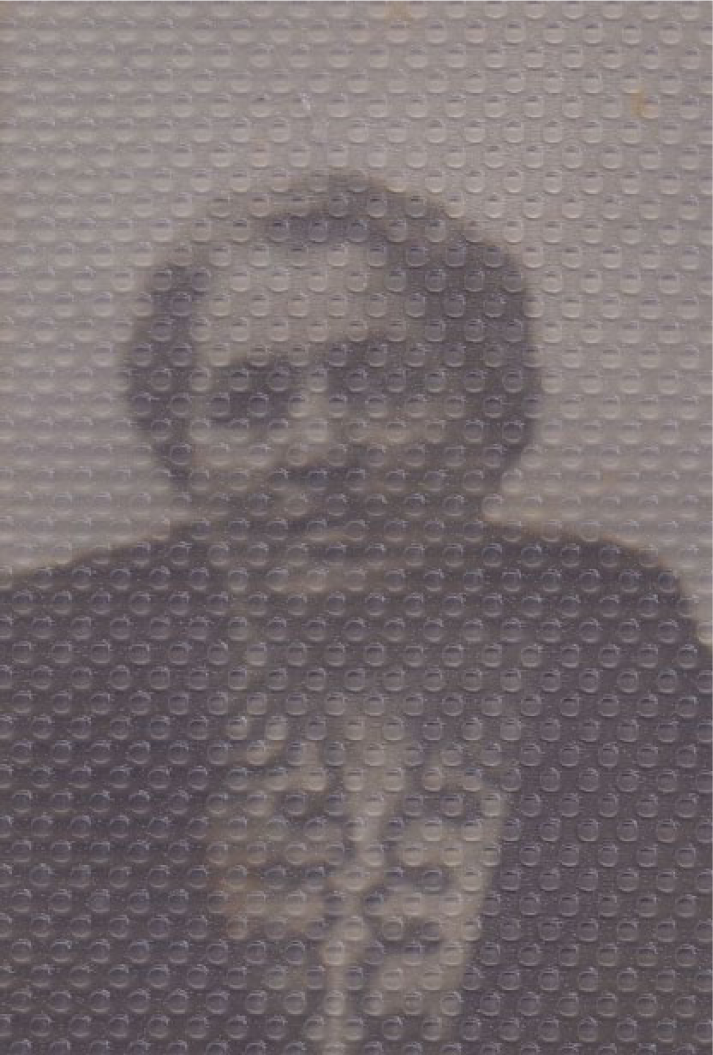
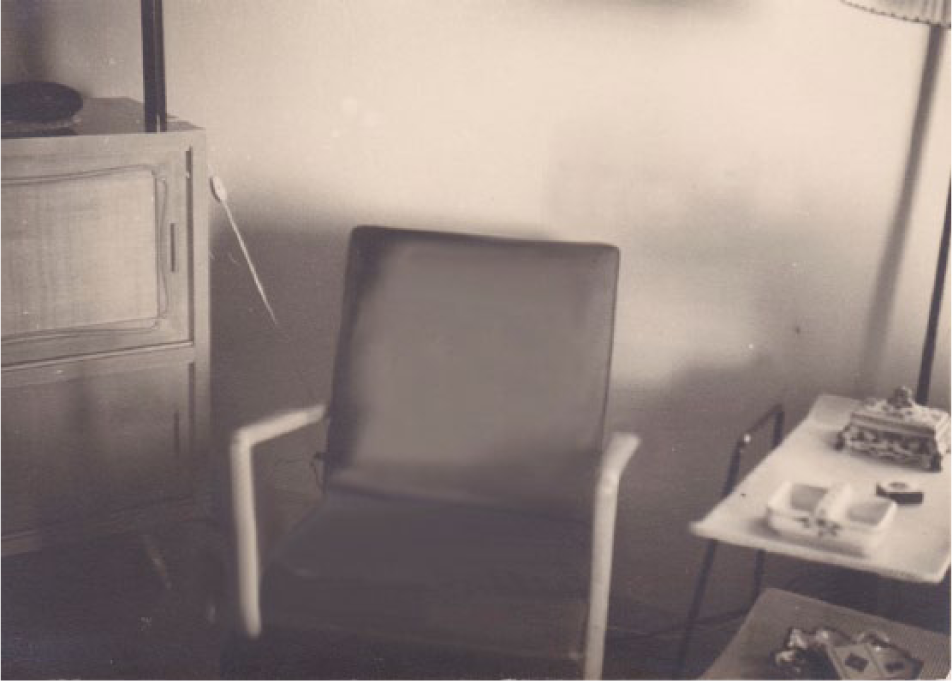
Photo 2. (Chair), Archival photograph
Footnotes
Author biography
 . She has widely exhibited here and abroad including group exhibitions such as iCrossing curated by Yasmina Reggad and Max Houghton for the Brighton Fringe; The Dead curated by Val Williams and Greg Hobson for National Media Museum and Montreal ‘Mois de la Photo’; Modern Art Oxford; Manchester City Art Gallery, Impressions Gallery. She undertook a portrait commission for the Olympics in London 2012 organised by The Photographers’ Gallery and Gulbenkian Foundation. Her work is included in many private and public international collections.