



Abstract
This creative piece explores traces and erasures of a Cypriot Ottoman heritage by transposing autoethnographic and psychogeographical practice to Europe’s southernmost capital, Nicosia. It walks the border zone in Nicosia, once the site of the river Pedios, later a major Ottoman commercial street, a boundary from 1958 to 1974, and since then, a Dead Zone and the internationally contested border between the Republic of Cyprus and the unrecognized Turkish Republic of Northern Cyprus. Photography and writing are presented in conjunction with pages in Ottoman Turkish by my great-grandfather, the poet Imam Mustafa Nuri Effendi, who made a notebook from the English periodical The War Pictorial while incarcerated as an enemy alien in Kyrenia Castle by the British during World War I. I explore how these pages speak of my transcultural Ottoman, Turkish-Greek-Cypriot and English heritages and of changes in Cypriot culture in the century between his war and ours.
Introductory note, by Gabriel Koureas
Nicosia, the capital of Cyprus, is divided by a military-controlled border that separates the Turkish-speaking community to the north from the Greek-speaking community in the south. The last divided city in Europe is scarred by wars and ethnic conflicts that have left open wounds in the fabric of the city. This division follows on a long history of conflict and colonization. The Achaeans settled in Cyprus from 1200 BC to the twelfth century when the island was occupied by the Lusignans; they were followed by the Venetians in the sixteenth century and then by four centuries of Ottoman rule which lasted until 1878, when the island passed into British hands. In 1960 Cyprus achieved independence from British rule, but the newly achieved sovereignty was marred by years of ethnic conflict that left the island physically and psychologically scarred by the 1974 partition into Turkish- and Greek-speaking sectors.
You can’t get lost in the walled city
Daedelus’ fugitive disinformation, a nomadic Ottoman passion, a palimpsest of amnesias, a river, a shopping street, a boundary, a barricade, a border (figure 1). This walled city is a labyrinth of war under the rule of a secret dream. On waking in the morning of the pale blue apocalypse, in the spring time of the little brides, the blood poppies, long after the streets lost all their names, it’s still impossible to get lost in the old city.
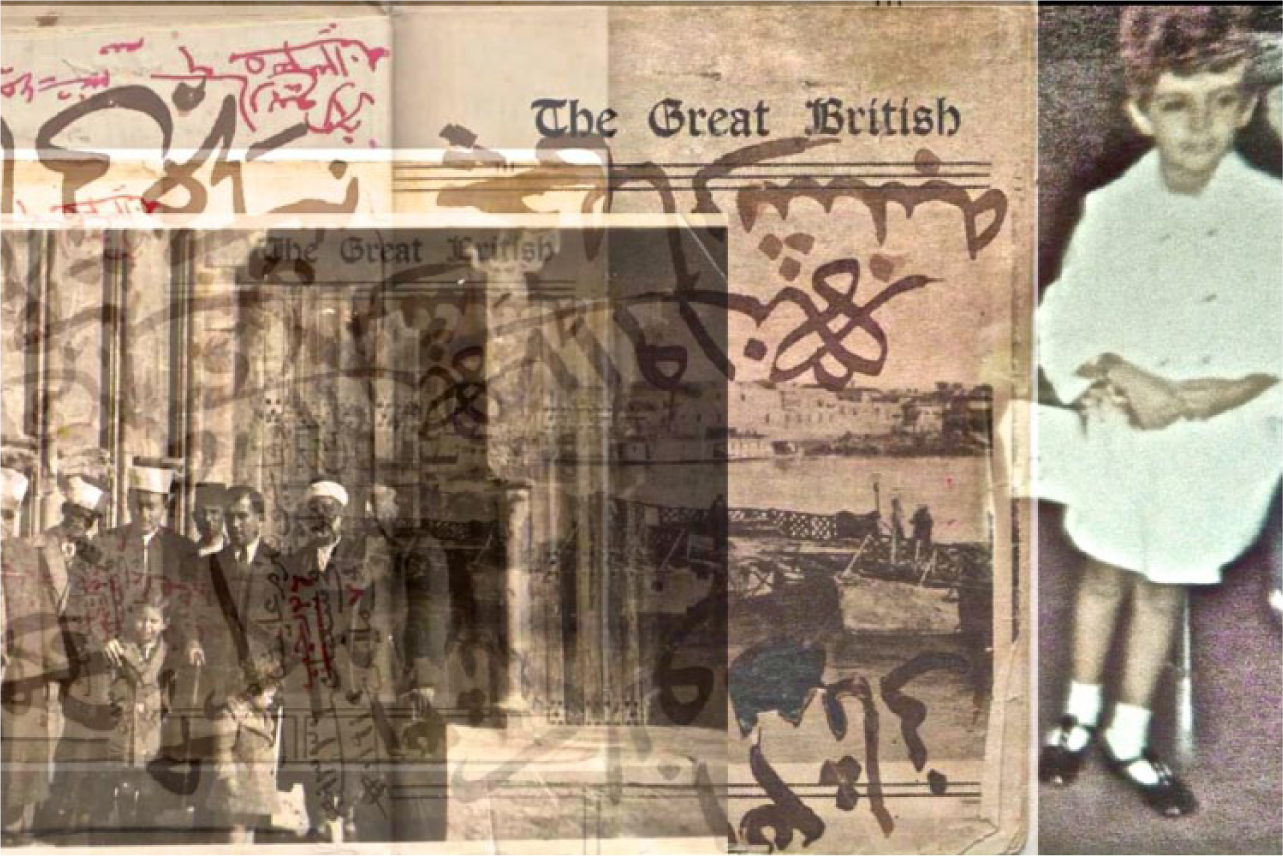
A Patrimonial Palimpsest Alev Adil 2012 Digital Collage.
Nicosia Girl
It’s performance time Nicosia girl, the traces and erasures of your footprints, the vestige of your gestures, your ghost on the balcony, are dancing for me.Memory, a secret agent of war, sets the scene: a bridge, a labyrinth, a graveyard. Dance your inherited amnesia, a heritage in an undeciphered script, your political dread, your amour projection, your sentimental terrorism, double-shadow, violent architect, my assassin.
Ledra 1973 (a green line memory)
When I was a child there was lots of sex; and car crashes. I heard them talking when I was supposed to be asleep, their voices and the tinkling jazz of ice.Their conversations and the fug of their cigarette smoke would drift to the shadowy shores of my room. Straight through the windscreen on the mountain roads; suicides, fur coats, sunglasses, concain, Craven A, spies. They used to play cards after I had gone to bed. Some with passion and intensity, others with the grim determination of prisoners doing time. Love affairs, international conspiracies, double agents, rumours of war. Adults swathed in scent and smoke, gorgeous with boredom and the fatalism of wasted lives. Green lines, international law, the incipient wrinkles, the writing on their foreheads always spelt out the past and future tense of war.
Milk the moon
Did your father milk the moon just for you pour luminous liquid poison in a cold stone cup? Did your mother sew a tiny sparrow into your breast beating against your bones? What did you inherit? Did they tell you everything you could see, just as you closed your eyes? How many languages do you speak? Can you speak the breeze in the mountains, a smattering of summer rain, of the silence just before the dawn? Tell me now lover while I’m listening, unlace your courage leave it folded on the chair. We’re hungry for life like wolves. We’re not done crying for the moon.
Roses and Nightingales
The ghosts won’t starve, we won’t perish. We owe ourselves to death. So strange what the heart chooses. We were two nightingales in flight, who mistook one another for roses. We sang such songs until unruly dawn, though the flower was imaginary and the gardens of Fener long gone. And still the memory of the bloom in the dream is a very real thorn.
Waiting for a sign at Palmira
On madness, omens and interdictions, inspired by Lady Hestor Stanhope.
Waiting for a sign at Palmira: not merely the sudden bloodying ascent of the sun, nor the descent of a frozen moon, an old man searching the mountains for a terrible stone while a wolf bays alone, telling a nomad people to settle to call this, now, their home. A dove is carrying an olive branch across the desert sea. Waiting for a sign at Palmira: hope a tiny scorched thing in the bright blindness of noon. The years are shifting shape and distance, like the undulating dunes. There is some secret hidden in these ruins. There have been others before us cast adrift in the same stillness and silence. The stillness that dreams us and the silence that tells us it is so.
Waiting for a sign at Palmira.