




Abstract
A large body of literature assumes post-conflict societies can and should mediate public memory towards frames conducive to a reconciled future. However, this article argues that such a drive marginalises survivors of political violence who narrate the past as still-present wounds. The linear temporality of transitional justice presumes an idealised trajectory through time, away from violence and towards reconciliation. However, this idealised temporality renders anachronistic survivors who depend on the prolongation of traumatic pasts for the possibility of political change. Using the case of former Ulster Defence Regiment in Northern Ireland, this article examines this prolongation through the lens of Ulster Defence Regiment survivors’ resistant place-memory along the Southwest run of the Irish border. Through the performative retemporalisation of everyday places and landscapes, survivors demand that their resistant memories and narrative frames of past violence still belong and still have active political resonance in transitional political space.
Resisting anachronism
We have been driving west for about 20 minutes now from the town where the person I shall call Henry lives, towards the Irish border. The further we go, the fewer cars we meet, the farmhouses grow sparser, and the countryside becomes lines of fenced pastures dissolving into rolling drumlins. At the location in Figure 1, Henry asks me to stop and pull the car to the side of the road.

Irish border road (location withheld). Photo by author.
Henry clambers out carrying a manila folder bulging with paper and begins taking black-and-white photographs out of the folder, framing them against the landscape. These photos were taken just after Henry was blown up by a Provisional Irish Republican Army (IRA) bomb. The gash in the road clearly visible (Figure 2) was right here, where we are now parked.
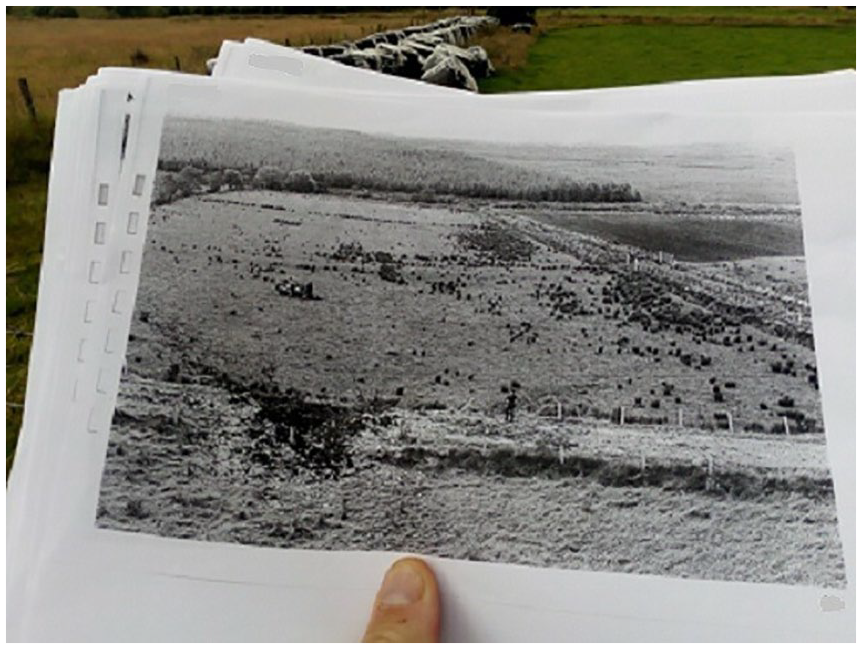
Henry’s photos. Photo by author.
Henry explains to me that the bombers were lying face-down against the edge of the gully visible in Figure 1, along the bank of the small stream there that forms the Irish border. The night before Henry was blown up, or perhaps over the course of several nights before, those men dug a trench the length of the field, inserted a trip wire into it, and planted a bomb by the edge of the road. Then they had waited for the night when Henry’s unit would patrol this road again. Henry was seriously injured in the blast, but two other members of his patrol, including a loved one, did not survive. I ask Henry why it was so important to bring me here, to show me this place in person. In lieu of an answer, Henry turns and accuses the quiet farmhouses on the hill behind us. ‘You’re telling me that none of these people saw anything?!’ he scoffs.
I turn to consider Henry’s contention. People standing at those windows possess an untroubled line-of-sight over the road and the field, over what probably is their land. Yet the men came and they said nothing. As I think this, it strikes me just how quickly both I and Henry have assumed an unbroken temporal continuity, that those houses and those imagined people are the same, stretched somehow across time, how the same intimate geographies that surrounded the planting of the bomb still surround us now. It is clear that, for Henry, these photographs he holds are always superimposed on this place; in this place, Henry exists in multiple times.
Henry chose to bring me to this place specifically, out of the range of other places he could have brought me. By asking me to witness the violence inflicted here as simultaneously past and present, Henry subverted the dominant narration of contemporary Northern Ireland as an allegedly ‘post-conflict’ society. By asking me to witness what was done to him here, the micro-geography that surrounded the act, and the ‘phantoms, histories, remnants, submerged stories and ways of knowing’ still haunting this field that Jonker and Till (2009: 306) refer to as ‘spectral traces’, Henry rejected a story of Northern Ireland as progressing through difficult interregnums out of violence and towards a ‘shared future’ characterised by ‘reconciliation’ (e.g. Aiken, 2010; Brewer, 2010). Mueller-Hirth (2017) argues that the story Henry rejects is underwritten by the ‘dominant linear temporality of peace processes and transitional justice’ (p. 187). That story requires a particular form of survivor, one who internalises that dominant temporality, one who ‘moves on’ from or ‘works through’ what was done to them in an appropriate amount of time. Henry and other survivors who refuse to let the past stay in the past become anachronistic.
This article examines how and where Henry and other former members of the Ulster Defence Regiment (UDR) seek to re-inscribe their stories of life and death into the land along the Southwest run of the Irish border, often in the face of the dominant temporality of political transition that seeks to force the Northern Irish past into more sanitised or reconciliatory forms. I argue throughout this article that Henry and other ex-UDR participants are resisting what Reid (2013) refers to as ‘temporal domination’. Temporal domination has been theorised in other contexts, but only recently have these analyses been extended to post-conflict societies (Hinton, 2018; Mueller-Hirth, 2017). Yet even recent excellent work in this vein has not adequately conceptualised how and where resistance to temporal domination occurs, in spite of a large body of work that argues keeping the past alive in present place is an essential tool of colonised, marginalised or traumatised peoples (Bosco, 2006; Doss, 2012; Maddrell, 2016; Robinson, 2018; Till, 2005). This article thus argues that engaging with temporal resistance in post-conflict societies may necessitate a micro-geographical lens, one capable of a close examination of the specific meaningful places through which temporal resistance is performed and enacted.
The next section will lay out the theoretical basis for my arguments. The third section presents both a short contextual history of the UDR and summarises how temporal domination functions in post-conflict Northern Ireland. The fourth section presents my methods and ethical orientations. The final sections present a small selection of the resistant stories ex-UDR participants recounted to me. Adopting Bakhtin and Till’s concepts of ‘threshold’ and ‘wound’, I will argue that place is the crucial nexus through which UDR survivors resist temporal domination. In wounded thresholds along the Southwest border, UDR survivors seek to prolong the past in the present in order to claim the right for their stories, experiences and politics to belong in transitional space.
Place and temporalities of transition
Mueller-Hirth (2017) argues that victimhood in post-conflict societies is often in temporal conflict with ‘the demands of national reconciliation’ (p. 203). Adapting Reid (2013), she argues that transitional societies exert temporal dominance over the bodies of survivors. Reid defines temporal domination as the neoliberal state’s ability to force marginalised people to wait indefinitely, thus exerting power and control over the bodies of its subjects. This bears similarities to the way temporality has been theorised in carceral studies and studies of indefinite detention (see Butler, 2004; Moran, 2012; O’Reilly, 2018; Tazziolo, 2018). While certainly applicable to survivors in Northern Ireland, who are often forced into ambiguous liminal zones of waiting (for justice, for compensation, for public acknowledgement, etc.), Mueller-Hirth (2017) argues that in post-conflict societies, temporal domination is broader than enforced waiting (p. 203). She argues that temporal dominance is also enacted through the ubiquitous social and political pressure exerted on survivors to conform to the proper temporality of transitional justice. Survivors are temporally dominated by ‘contradicting “proper” [transitional justice] time and defying societal expectations about the time their victimhood should last’.
Temporal conflicts in post-conflict societies are also structured by competing orientations towards the role of the past in the present. Transitional temporality demands a ‘clean break’ between past, present and future and survivors who fail ‘to conform to the appropriate time . . . are dismissed as anachronistic and can become fixed in permanent liminality’ (Mueller-Hirth, 2017: 203). Murphy and McDowell (2019) also mobilise ‘permanent liminality’ to argue for a new ‘transitional optics’ that can subvert ways of viewing post-conflict space and the ways in which people act, move and assert interests within that space. Castillejo-Cuellar (2014) examines transitional legal initiatives, arguing that they work to circumscribe the temporal frame through which longue durée processes of structural violence are enacted on marginalised people. The violence of historical injury transcends the break between past and present, which transitional legalism is structurally unequipped to countenance. This is ‘an epistemological blind spot endemic to law’, a circle that transitional regimes seek to square by forcing historical injustice through ‘discourses of “national unity and reconciliation”’ that elide injustice’s presentist effects and circumscribe the temporal frames in which it can be legally considered (p. 48).
Indigenous scholars and their allies are imminently familiar with these types of criticisms. Many argue that national reconciliation strategies are flawed mechanisms for redressing Settler-colonial injustice due to their reliance on an artificial separation of past injustice from ongoing land claims and treaty violations, ongoing denials of Indigenous self-determination and the ongoing infliction of structural violence on Indigenous peoples and land (Corntassel and Holder, 2008; Povinelli, 2012; Short, 2008). Rifkin (2017) builds on these insights to argue that the Indigenous understandings of multiplicity, story and being-in-time are not reducible to ‘settler time’ ‘a singular, given time – a unitary flow – largely contoured by non-native patterns and priorities’ (p. 3). In this, he builds on Elizabeth Freeman’s (2010) concept of chrononormativity, which argues that dominant heteronormative ‘teleologies of living’ produce a ‘natural’ movement and progression through life, of appropriate domesticity, rhythms of sexual reproduction, forms of inheritance and acceptable futures (p. 5). Freeman illustrates how ‘queer becoming-collective-across-time’ (p. 11) is predicated on injury, wounding, displacement and bodily experiences that stand outside of these chrononormative frameworks (also Halberstam, 2005). Rifkin and Freeman’s analyses extend the reach of the concept of temporal domination, encompassing not merely programmes of national reconciliation, but also the heteronormative and colonial cultural modalities that impose a dominant temporal frame on ‘post’-colonial liberal societies.
But what these otherwise excellent studies often elide or understate is the crucial role of place as a generator of marginalised consciousness and strategies of resistance (Barker and Pickerill, 2012; Basso, 1996). Humanistic and phenomenological geographers have long understood meaningful human places as possessing innate temporal multiplicity (Lippard, 1997; Malpas, 2012). Place in this tradition is not a passive backdrop on which events occur, but an active mediator of human life and the intersections of past and present (Till, 2005). Allen Feldman (1991) argues that there are particular types of spaces that are temporally ‘uncodifiable’, inherently resistant to temporal domination (p. 68). These are spaces he refers to as ‘defiled’ spaces where an excess of death ‘transgresses the classificatory order’ (p. 67). Feldman argues that through the ritualised ghost stories told about this space, local communities enact and perform a living cartography of death and haunting. Within defiled space, particular locales (what I would call places) serve as clusterings of performed narrative memory, to the point where the locales (places) are ‘deterritorialised’ to such an extent that they are ‘detached . . . and appear out of place and out of time’ (p. 68). ‘Defiled space never goes away’ (p. 67). These places within this space, argues Feldman, cannot be recruited into a linear chronology where time progresses in taken-for-granted ways. Thus, when it comes to where temporal domination has the potential to be enacted and performed, we should look to these places, these clusterings of multi-temporal memory and narrative, that sit ‘detached’ from the flows of temporal power and linear progression.
In Bahktin’s (1981) literary theory, the places Feldman describes are ‘chronotopes of the threshold’. A chronotope generally is an intersection of space and time where ‘time . . . thickens, takes on flesh, becomes artistically viable; likewise space becomes charged and responsive to the movements of time, plot, and history’ (p. 84). The threshold is a specific chronotope ‘connected with the breaking point in life, the moment of crisis, the decision that changes a life’ (p. 248). The threshold is a liminal and prefigurative point in space and time where the protagonist is faced with the loss of a known past and projected into an unknown present and future. The threshold is associated with negative characteristics of liminality and temporal domination (indeterminacy, waiting, enforced ambiguity), but it is also imbued with subversive potential. It is point in a larger narrative arc where existing structures of time and space are able to be broken down and re-imagined. Recent work by Karen Till (2012, 2017) suggests further ways in which seeing places as a threshold can help scholars, memory activists and artists re-imagine violent pasts in the context of a continuously unfolding present. For Till (2017), ‘place is a threshold through which the living can make contact with those who have gone before and those who have yet to come’ (p. 307). That threshold often takes the form of a ‘wound’, a spatial and temporal fracture where past violence perpetually resurfaces. But that wound can also be a place of care, a place where resistant mourning and memory-work is possible (Till, 2008, 2012). Wounded places are those thresholds where it is possible to resurrect, name and confront the injustices of the past, and through these challenges, subvert dominant temporalities that seek a clean break in time.
This understanding of place as potentially subversive threshold resonates with the work of other scholars examining the ongoing experience of surviving violent trauma, from political terror to inter-personal violence to the ‘slow violence’ of environmental degradation and traumatic urban dislocation (Pain, 2019). Experiencing trauma fractures time and often projects survivors into divergent temporal and narratological realities (Herman, 1993; Laub, 1991). Yet too often, the political voices of survivors who start from this position of temporal and narratological fracture are dismissed by pathologising their resistances as traumatic stress disorders (Edkins, 2003), which have a problematic genealogy of being uncritically imposed in post-violence and post-disaster contexts (Fassin and Rechtman, 2009). While many survivors of violence suffer trauma-related psychological and somatic symptoms, dominant narratives and temporalities of post-conflict societies can depoliticise and delegitimise the prolongation of the past into the present for resistant political purposes. Drawing on the Freudian distinction between mourning (a natural progression of grief) and melancholia (a pathological refusal to let grief go), Muñoz (1997) argues, Melancholia’ for blacks and queers of any color, is not a pathology but an integral part of our everyday lives . . . a mechanism that helps us (re)construct identity and take our dead to the various battles we must wage in their names – and in our names. (pp. 355–356, cited in Doss, 2012: 81)
Both Freeman’s analysis of Queer mourning (2010) and the essays in Milstein’s (2017) edited collection powerfully accentuate Muñoz’s argument.
Indigenous and Queer scholars and their allies, scholars concerned with political trauma and scholars critical of the dominant temporality of transitional justice all invite pressing questions regarding how transitional temporal frames are constructed, how temporal dominance and chrononormativity are enacted and, crucially, how and why they are resisted. This article builds on these perspectives but adopts a micro-geographical, place-based lens to examine how ex-UDR survivors seek to subvert dominant temporalities through resistant memory-work. I now turn to a short contextual history of the UDR and post-Troubles Northern Ireland.
The UDR and post-Troubles Northern Ireland
The UDR was an auxiliary unit of the British Army comprised of Northern Irish men and women serving in a part- or full-time capacity near the areas where they lived. During the Northern Irish conflict known as ‘The Troubles’ (1968–1998), 206 members of the UDR lost their lives and numerous others were injured. The Troubles were fought primarily by three categories of belligerent: Republican paramilitaries (chiefly the Provisional IRA), whose campaign ostensibly focused on the political reunification of the island of Ireland, Loyalist paramilitaries (chiefly the Ulster Defence Association (UDA) and the Ulster Volunteer Force (UVF)), whose campaign ostensibly focused on protecting the political union between Northern Ireland and Great Britain, and the security forces, including the British army, British intelligence, the local police force (Royal Ulster Constabulary (RUC)) and the UDR.
After the Partition of Ireland, from 1921 to 1972, Northern Ireland was ruled by a devolved Unionist government that institutionally discriminated against its Catholic-Nationalist minority population, especially in the sectors of political representation, employment and housing (Ó Dochartaigh, 2004). The precursor to the UDR was the Ulster Special Constabulary, known as the ‘B Specials’, formed in 1920 as a volunteer reserve police force, armed and organised along quasi-military lines. The B Specials were dissolved in 1970, due to both their implication in sectarian repression in the early years of the Troubles and concerns over a police force carrying out military-style operations (Ryder, 1991). Following the recommendations laid out in the Hunt Report, the role previously filled by B Specials would be transferred to a new unit, the UDR, a locally recruited auxiliary force integrated into the British military command structure and subject to army discipline. The Hunt Report emphasised the necessity of recruiting Catholics into the UDR to counteract appearances of sectarianism, but by the early 1970s virtually all Catholic recruits had left, either by choice or intimidation (Potter, 2008).
The UDR’s comportment during the Troubles is a matter of intense debate. Despite adopting more rigorous vetting processes to prevent paramilitary infiltration (Ryder, 1991), there remains compelling evidence that, throughout the 1970s, some UDR members shared intelligence with and even moonlighted as Loyalist paramilitaries, and throughout the Troubles, UDR weaponry found its way into hands of Loyalists (Cadwallader, 2013; Pat Finucane Centre, 2014). While the true extent of the local Northern Irish security forces’ (RUC, UDR) collusion with Loyalist paramilitaries may never be adequately determined, while in uniform and on-duty the UDR is responsible for only eight deaths throughout its 20-year deployment 1 (McKittrick and et al, 2008). And in this article’s narrow study area, the rural Southwest, there was little to no Loyalist presence throughout the Troubles (Cusack and McDonald, 1997), and thus few local opportunities for collusive crossover. In Fermanagh and the neighbouring border areas of Tyrone, the vast majority of killings were perpetrated by Republicans. 2
The UDR patrolled the porous 500-km border and key security installations along it and could also be deployed to assist specific police and army actions (Potter, 2008). Unlike regular British soldiers, however, UDR men and women did not generally return home to fortified barracks, but to towns, villages and rural farmhouses. Part-time UDR men and women held other employment while off-duty, as shop owners, tradespeople, farmers and so on. This unique status rendered them inherently vulnerable to Republican assassination. The majority of the 206 UDR men and women killed were killed off-duty, in targeted assassinations (unlike Henry’s loved one). In rural and primarily agrarian areas, their geographic isolation resulted in a perpetual sense of threat, hypervigilance and a disruption of daily rhythms and routines (Patterson, 2013).
Turning now to post-Agreement Northern Ireland, the Northern Irish Peace Process has largely accepted what Rigney (2012: 251–252) argues is axiomatic to transitional justice, that social memory should be ‘mediated’ to privilege futurist narratives of a ‘peaceful and just coexistence’ or what Brewer (2010: 166–171) terms ‘re-remembering for the future’. While the Good Friday Agreement elided the past out of fear it could derail a political solution, two major reports were commissioned to examine the legacy of the past, the Bloomfield Report of 1998 and the Eames-Bradley Report of 2009. Both were undergirded by Mueller-Hirth’s (2017) ‘dominant temporality of transitional justice’, and Rigney’s mediating memory, emphasising reconciliation, moving on and a clean break with the past at every opportunity (see McGrattan, 2013; Robinson, 2018).
Yet in spite of this axiomatic push towards mediating reconciliation, the political-institutional system in Northern Ireland seems paradoxically set up to prevent it. The Good Friday Agreement inaugurated a consociational regime, consociationalism admitted even by its foremost progenitor to be a form of ‘voluntary apartheid’ (Lijphart, 1971: 11). Indeed, the consociational peace has paradoxically discouraged reconciliation and incentivised division at the macro-political level (Graham and Nash, 2006; Mac Ginty, 2016). In this sense, Castillejo-Cuellar’s (2014) contention that reconciliation and national unity are techniques to elide legal-institutional failings is particularly telling. Within this void, the duty to mediate reconciliation was taken up by the community and voluntary sectors. Many community-based and non-governmental organisations attempted to promote shared storytelling, witnessing and ethical remembrance (Aiken, 2010; Shea, 2010), but these initiatives sat uneasily within a political system populated by former belligerents and were subjected to ongoing difficulty in accessing public resources. Victims and survivors who refuse or prove unable to conform to the initiatives and socio-political pressures promoting reconciliation, healing and moving on can be cast as recalcitrant and anachronistic (e.g. Brewer, 2010: 163–193) and their foundational logics portrayed as ‘lasting impediment[s] to peace’ (Graham, 2014).
Protestant-Unionist survivor communities seem to especially mistrust reconciliation (Dawson, 2007; Lawther, 2014). One reason for this may be that since 2003, the largest Catholic-Nationalist party in Northern Ireland, and partner in the consociational Executive, 3 has been the former political wing of the IRA, Sinn Fèin (SF). The ex-UDR members I worked with in this study repeatedly informed me that the reason they distrusted discourses of reconciliation in Northern Ireland was because they alleged reconciliation had been weaponised against them by SF. Manning (2017) argues that reconciliation in transitional contexts can be a ‘free-floating signifier’ that derives its operative value from the contextual practices that invoke it (p. 93). Examining SF’s quasi-official reconciliation strategy (Sinn Féin, 2015) illustrates how the ambiguity surrounding reconciliation in Northern Ireland can be put to work for political ends. The official strategic framework for improving community relations in Northern Ireland was known as A Shared Future (OFMDFM, 2005). It conceptualised reconciliation as ‘mutual recognition and trust’ (p. 2). A Shared Future was superseded by Together: Building a United Community (OFMDFM, 2013), a text in which reconciliation is left undefined and ambiguous throughout. SF’s strategy calls for a process of ‘uncomfortable conversations’ between the two major ethnopolitical blocs, a process the document frames as bravely begun by Republicans and not reciprocated by Unionists (Hedges, 2016). More specifically, it uses A Shared Future’s conceptualisation of reconciliation to demand ‘recognition’ of SF’s preferred narrative of the Irish past, a narrative that presents Republican violence against the security forces as a justifiable campaign against a colonial occupier. The refusal to recognise SF’s conflict framing in turn can be framed as a refusal to reconcile, allowing SF to narrate survivors of Republican violence as ‘backwards’ and anachronistic, as not as far along on the temporal continuum of transition towards reconciliation. In this context, reconciliation can mean both ‘reconcile with’ the other community, but it can also be a weapon of anachronism and depoliticisation: ‘Reconcile yourself to’ the current political reality and the harm that was inflicted on you.
Methods
While ‘place matters’ has become almost axiomatic for human geographers in past decades, few have actively operationalised place in their methodological praxis (Anderson et al., 2010). In this study, I operationalised place through walking research, a family of methods relying on movement-based ‘in situ’ research (Evans and Jones, 2011; Robinson and McClelland, 2020). These methods can be especially useful in capturing place-based ‘perceptual memories’ (Degen and Rose, 2012: 3284), yielding compelling narrations of places rooted in exposure to surrounding sensory environment (Holton and Riley, 2014), and excavating layers of historical memory present in place (Anderson, 2004).
In 2018, I participated in four border tours of Fermanagh guided by ex-UDR and ex-RUC local men and women (Edwards, 2017). I also engaged in seven walking/driving interviews with other ex-UDR men and women, both one-to-one, and in small groups of up to three participants. The tours and the interviews ranged from 2 hours in length to most of the day. I made an ethical decision not to electronically record journeys with ex-UDR participants. In Northern Ireland, scholars must carefully navigate memories of being subjected to unwanted surveillance in public space and geospatial and audiovisual technologies can heighten those perceptions (Hocking et al., 2018). In light of these risks, I employed a more classical ethnographic approach, generating reflective data through field notes and photography. After each journey with ex-UDR participants, I drafted short ethnographic vignettes of particular moments and places in the journey that seemed especially important to record. The following sections rely primarily on a small selection of these vignettes and further analysis of my field notes and photographs. Because I did not electronically record journeys, respondents’ speech reported throughout this article is a reconstruction based on personal shorthand and field notes. I encouraged all participants who were pseudonymised in a vignette to review the vignette and ensure I had represented their communication to their satisfaction.
That’s Monaghan
The proceeding vignette occurred during a tour guiding a group from another area of Northern Ireland comprised overwhelmingly of other ex-UDR men.
Rosslea is a small village in Fermanagh with a population of approximately 600 sitting directly on the Irish border. Rosslea is an entirely Catholic-Nationalist village. The border here is formed by the River Finn, which snakes around Rosslea so that it is surrounded on three sides by the Republic of Ireland’s County Monaghan. Approaching Rosslea, the coach hired for the day pulls to a stop near an abandoned building perhaps 500 metres west of the village (Figure 3).

Former general store near Rosslea, co. Fermanagh. Photo by author.
Our guide I will call James. He tells us this was the last Protestant business in Rosslea, a general store. It was bombed four times and then, one day, IRA men simply walked in and executed the proprietor, a man named Douglas Deering. Deering was not a member of the UDR or the security forces; the IRA’s explanation for his targeting was that Deering was a Justice of the Peace (Patterson, 2013: 129–130). James, however, like many in the area, believes Deering was targeted to cleanse the border of Protestants. ‘You see’, James begins, ‘what happened out here we see as ethnic cleansing. The family tried to carry on in the village after Mr. Deering was murdered but they was boycotted and put out of business’.
James turns in front of us in a semi-circle, gesturing with his arms away towards the nearby hills surrounding us: In that direction, those hills, that’s Monaghan. Over there, Monaghan. That way, Monaghan as well. It was easy for them to slip away across the hills after they done their dirty deeds and then they’re into the Republic where they’re safe.
I step away from the group to take a picture of the road leading into the village, struck suddenly by how James’ story has re-cast the quiet village and the surrounding hills as a landscape from which terror and death can emanate without warning. A car drives by us on the road away from Rosslea, the driver looking at us out the window, and this simple expression of curiosity at a strange crowd of men clustered around an abandoned building makes me extremely nervous. I feel surveilled and looking around at the other men, many of them glancing in trepidation up at the hills or at the back of the now-disappearing car, I sense they feel the same. James has come to stand beside me. Sensing, I think, what I and the other men are feeling, he reassures us: ‘We won’t be taking you into Rosslea’.
Later on that same journey, I am sitting in the back of the coach next to a pleasant older man who looks bemusedly on as I furiously scribble in my notebook. I look up as James begins to describe the road that we are currently on, which is meandering back and forth across the Irish border. ‘Oh now we’re in the Republic’, James laughs and quips, ‘we’ll be issuing the flak jackets and bulletproof vests shortly’. A moment later, ‘You can all breathe, we’re back’. James is being whimsical, but he knows exactly where the border is. I am struck by how he still lives here, on this border, surrounded by the memories of people he knew shot dead along it, of his own relatives displaced from it, forced to move towards the interior of Northern Ireland by the omnipresent threat of depersonalised death, like the Deering family. Monaghan, to James, is not merely the place-name of an Irish border county but a repertoire from which a cold brutality sits patiently, given succour in Rosslea and its surrounding hills, waiting to be unleashed.
Over my dead body
I am sitting in a car at a T-junction with two people I shall call Jenny and Daniel, waiting for them to decide where to go first. To the right will take us into the village of Derrylin, the left will take us to the Irish border. ‘Would you ever go into Derrylin on a normal day?’ I ask idly, trying to get a sense of their intimate geographies. Derrylin is widely known as a Catholic-Nationalist village. Jenny laughs softly under her breath. ‘No, I’d say we wouldn’t’. Both Jenny and Daniel are ex-UDR. Jenny’s loved ones, a UDR-man and his wife, were both assassinated by the IRA nearby to where we are now in a savage cross-border home invasion. After they were killed, the hearse containing their bodies tried to traverse Derrylin to the cemetery in Enniskillen, the only town in Fermanagh. We pull into a car park in Derrylin and Jenny begins the story: On the way back [to Enniskillen], they were having a céilidh
4
in the school there. When they heard the hearse was coming, they all come out and down into the road. They were laughing and cheering. They come down into the road and blocked the hearse. Couldn’t get by. They had to get the [armoured] Land Rovers down from Enniskillen before [their] bodies could be buried.
‘The abbatoir, Jen –’ Daniel prompts her gently. I have heard the story before but I have only now realised that the people in it were Jenny’s loved ones. To understand this story, you must know that Jenny’s loved ones had a surname reminiscent of a common farm animal.
‘The night [they] were killed’, Jenny intones, ‘someone rung the local abbatoir giving their address and saying there were two fat [surnames] ready to be collected’.
‘I suppose I see why you wouldn’t want to go into Derrylin’, I say lamely.
‘We have long memories in this area’, Daniel murmurs.
We drive together down the narrow border road towards the house where they were assassinated (Figure 4). Throughout this summer, I have driven down other roads like this one with other ex-UDR respondents and I am beginning to see them like they do. The tall hedges to the side of the road inhibit visibility, so the threat would probably come on foot. The road is long and narrow, any car turning down the road would be quickly registered. Jenny shows me what used to be a farm shed on her loved one’s property: She used to walk down [here] from the house at night with a lantern. Other times, when [my loved one] was on patrol, she’d come to the top of the road, looking back down on it, scanning for strange cars. See she always said they’d come for [her UDR partner] over her dead body. And when she opened the door, they shot her first, to get in to shoot [him]. So they literally did come for him over her dead body.
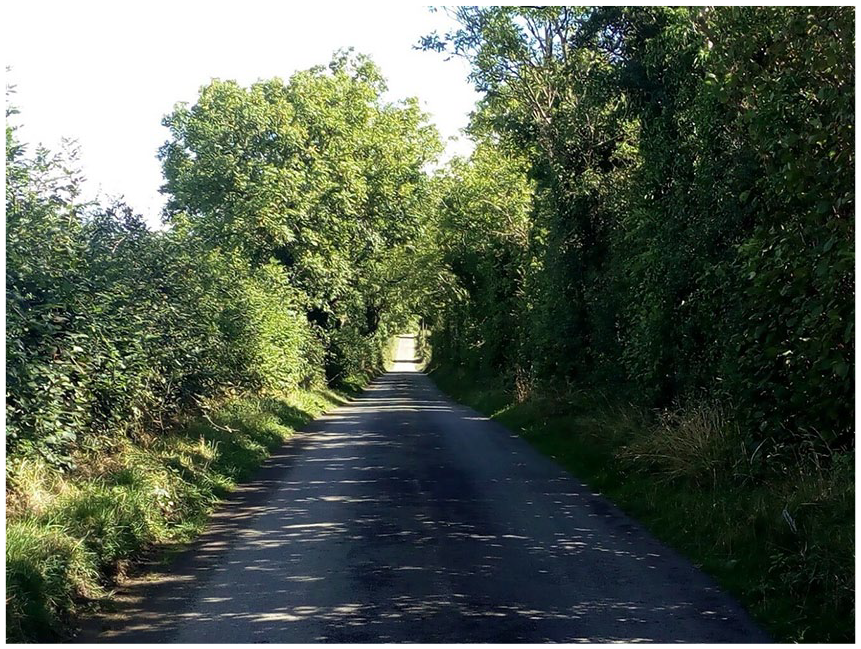
Border road (location withheld). Photo by author.
I think back to Daniel coaxing Jenny to re-curate the abbatoir story. This is not the only story I have heard from ex-UDR participants where the details of the slaying are so unsettling that I have no coherent response to them either as a scholar or a human being. I believe ex-UDR stories foreground brutality as an evocative counter-memory to Republican public justifications of violence and reconciliatory elision. But there is more to it than that. Witnessing Jenny, Daniel, Henry, James and other respondents’ stories reveals how these forms of brutality were enabled by isolation of this landscape and facilitated by the encoded sectarian micro-geography of the border. Here, UDR men and women lived lives of perpetual anxiety and terror, often for decades. Here, as the memory of the céilidh illustrates, their neighbours, their colleagues, their tradespeople, even children, all might be agents of dehumanisation, even death. Their landscapes are archipelagic, a network of islands of severe insecurity, this bend in the road, this section of the village, all known and categorised along a spectrum of fear. The brutality of the story refracts Jenny’s ongoing geographic alienation from the rural borderland that was and is her home. And more to the point, it remains radically present not only in her memory, but in her everyday life, mobility and perception. Perhaps the final vignette, this one with a man I call William, will serve to illustrate this further, but not only illustrate this multi-temporal reality, but how this is the reality that ex-UDR survivors seem absolutely determined to communicate to me, me who is not of this place.
Cutting turf
I find William to be a somewhat laconic man and I am not initially sure how he takes to the unstructured request I give to all of my participants: ‘Take me to places in your local area that you think are important for me to understand and tell me about them’. He takes me initially to what might be referred to as more ‘traditional’ places of UDR memory: A roll of honour in a local Anglican church, a cemetery where many UDR men and women are buried, and a place on the border where his unit was attacked by the IRA. It is only at the end of our journey that he surprises me, directing me into boggy hills above a certain part of Fermanagh where there is no permanent human habitation. At one point, William indicates I should turn onto a dirt track in a poor state of repair, through an open livestock gate, and further up into the hills. He offers no explanation as to where we are going and I am reluctant to press him. After about 2 miles up the rack, he suddenly requests I stop. Surrounding us is the furrowed, turned-over acreage of a turf bog (Figure 5). ‘This is where I come to cut turf’, William explains.

Turf Bog, co. Fermanagh (location withheld). Photo by author.
I am a bit perplexed, which must be evident on my face, so William continues, ‘This is [my family’s] plot. And when I was in the UDR, I would come up here occasionally, usually between May and September, and I cut my turf’.
It finally begins to dawn on me why William has taken me here. Up here, miles from any house, William was completely isolated. This is a perfect place for an assassination. ‘So if anyone knew you were coming up here . . .’ I prompt.
‘Aye’, he says, nodding, but that was something you lived with. Something you had to live with. I didn’t stay long when I was up here. I varied my route, my times, you see, you never wanted to fall into a regular pattern of habits, that’s when they’d get you.
A little too eagerly, I asked William a blatantly leading question, ‘Do you think cutting turf was somehow an act of resistance?’
William regards me keenly for a moment. ‘No, not really’, is all he says.
But this simple act of inviting me to share this place is a powerful story. William employs the turf bog to vivify for me the perpetual sense of disruption he, his family and his colleagues had to continually live with. Earlier in our journey, William told me how he had never been able to leave his children at their school because of assassination risk and I sensed in him a profound regret at missing out on that mundane ritual of caregiving and love. Here, in this bog, William carved out a place where, in spite of the severe risk to his person, he would be able to commune with the natural rhythms of rural life he was perpetually denied. This place is not any more meaningful to William than the roll of honour where he somberly reads the names of his colleagues and friends who were killed, or their gravestones where we stood, but it is a place he is completely insistent that I understand. That I understand its significance, its importance, what it symbolises and why he deploys it is a crucial aspect of William’s ongoing memory-work and temporal resistance.
Prolonging the past
In this article, I have employed theoretical frames learned in part from theorists within Indigenous, Queer, feminist, decolonial and/or subaltern traditions in order to understand the temporal and place-based resistances of members of a former unit of the British military in what many Irish nationalists consider a context of past and ongoing colonialism. My approach here follows ground laid by Switzer and Graham’s (2009) study of RUC-memory and Kirk Simpson’s (2009) work on truth recovery in Northern Ireland. Switzer and Graham argue that RUC memory-work should be seen as ‘subaltern’ due to the British government’s ‘memorial agnosticism’ and SF’s ‘manipulation of narratives of victimhood’ (p. 157). I have argued elsewhere this perspective better encapsulates the UDR (Robinson, 2018: 126). Simpson criticises a ‘facile binary’ that ‘essentialises’ politicised survivors in Northern Ireland as supporting either past authoritarianism or paramilitarism (p. 41). When read with McDowell’s (2008) feminist examination of the commemorative landscape, these studies reveal that survivors in Northern Ireland do not fit neatly into dominant frames of coloniser-colonised, and those left outside of those frames have been systematically deprived of the opportunity to establish a foothold in the narratological contest over how to represent Northern Ireland’s past. I prefer to think of UDR-memory as marginalised as opposed to subaltern; however, a central imperative of subaltern studies informs this work: ‘Bringing in the voices of those usually rendered marginal or silent in other accounts’ (Sharp, 2011: 272). Bringing in marginalised voices depends not merely on a refusal to reify ‘facile binaries’, but also the scholarly frames and methodological orientations that carry the potential for alternative ways of seeing place, temporality and narrative.
All of these stories I witnessed in my journeys with ex-UDR men and women had a common thread, every story was a politicised, performative retemporalisation of everyday places and landscapes. The stories demanded my acknowledgement that the past in these places is an unresolved wound. Ex-UDR men and women possess a diverse set of memories and narratives, like any population, yet every participant told me, sometimes implicitly, but often explicitly, that their stories demonstrated that the violent past still had resonance here.
I will close by reflecting on Daniel’s comment ‘We have long memories in this area’. Daniel probably meant ‘We will never forget what happened here’, but his particular turn of phrase caught my attention. I believe it is also possible to read Daniel’s statement and especially his choice of the adjective ‘long’ through the lens of the Bergsonian ‘duration’, the prolongation of the past into the present through an interpenetration of heterogeneous feelings between human subjects that Bergson argues is the source of empathy, the ability to put oneself into another’s place across time (Bergson, 1910[2014], 1946[1999]). In Northern Ireland’s seemingly endless search for a shared future, the Bergsonian lens suggests that actually sharing the future necessitates a radical empathic openness not only to a multiplicity of possible stories, but also a multiplicity of temporalities, including those which inconvenience the idealised futurity of transitional regimes.
Yet even recent excellent work exploring temporalities of waiting, perpetual liminality and victimhood has not adequately considered how powerful resistance to dominant temporalities can be enacted through the wounded, chronotopic place, through the threshold. At the place of the wound, the threshold where the breaking point of life occurred, resistance comes through the prolongation of the past in the present, a form of place-based memory-work that resists the temporal separation of the past (violence, authoritarianism), from the present (transition), and the future (reconciliation, liberal democracy). The memory-work that ex-UDR people engage in at the wounded threshold is a resistant temporal performance, facilitating witnessing, outrage and, ultimately, radical empathy.
Footnotes
Acknowledgements
The author wishes to thank the Southeast Fermanagh Foundation for their help and support with this research. The author also wishes to thank Sasha Brown, Shaul Cohen, Maureen Hetherington, Aoife Kavanagh, Andrew McClelland, Sara McDowell, Georgina Perryman, Karen Till and three anonymous reviewers of Memory Studies for providing insightful comments on earlier drafts.
Declaration of Conflicting Interests
The author(s) declared no potential conflicts of interest with respect to the research, authorship, and/or publication of this article.
Funding
The author(s) disclosed receipt of the following financial support for the research, authorship and/or publication of this article: This research was made possible by a grant from the Irish Research council: EBPPG/2016/361.
