



Abstract
Queer and trauma theory both concern internal experiences that challenge normative social frameworks. Considering the roles of queerness within trauma and memory studies opens interpretive pathways for otherwise discredited or inaccessible meanings. It also relates survivors’ receding knowledge to those currently “queered” or endangered. With a focus on childhood and mother-child relationships, this article maps intersections of memory studies, queer theory, and trauma theory, applying subsequent insights to an “autotheoretical” analysis of the author’s own transnational, post-Holocaust family across four generations. It explores the possibility through queer studies of excavating new post-traumatic meanings and relating those meanings to present contexts.
Keywords
“I don’t think queer theory has come into memory studies and one would certainly think that it would in relation to generations, time, temporality and the important ways of rethinking these that queer theory has brought us.”
“[Q]ueer theory and trauma theory are fellow travelers because they seek ways to build not just sexuality but emotional and personal life into models of political life and its transformation.”
The field of memory studies increasingly understands post-traumatic experience and narration as gendered phenomena, but it has yet to fully engage what Shoshana Felman (1991: 7) calls the “strangeness,” what I read as the “queerness,” of these phenomena. As Dori Laub and others have indirectly suggested, post-traumatic testimonies offer queer perspectives, because they convey the failure of normative language to account sufficiently for lived experience (Gorden, 2011; Laub, 2005). According to Ann Cvetkovich, queer theory’s denaturalizing capacities also rely specifically on conceptions of trauma. Surveying the work of Judith Butler, Leo Bersani, Michael Warner, and Biddy Martin, Cvetkovich writes, “many of the key texts and critics in the field of queer theory have made use of the category of trauma in mounting critiques of normativity” (Cvetkovich, 2003: 46). Like trauma theory, queer theory takes interest in elusive internal experiences that sit in tension with normative social frameworks. While trauma theory attends to ruptures of representation, memory, and meaning-making, queer theory denaturalizes assumptions about what constitutes the authority of those structures, even before their rupturing. With expansive curiosity and open-mindedness, queer theory asks, what actually defines a credible subject, and what counts as a socially worthy body, subjectivity, temporal orientation, family unit, or intimate relationship? Narratives of “recovery” and post-traumatic normalization have understood survivors’ experiences primarily against those of the non-survivor majority population. However, attention to queerness within post-traumatic family studies opens interpretive pathways for revealing otherwise discredited or inaccessible meanings. It also bridges receding memories and strategies of survival with those subjects “queered” or endangered in the present. A striking amount of creative work by queer and trans descendants of Holocaust survivors, for example, explores connections between post-Holocaust subjectivity and queerness, including Jill Soloway’s Transparent (2014–2019), Micah Bazant’s Tim Tum: A Trans Jew Zine (1999), and Lev Raphael’s Dancing On Tisha B’av (1990). Cvetkovich’s influential 2003 study of marginalized post-traumatic affect also considered creatives like Lisa Kron, who perform queer feelings in relation to family Holocaust histories. However, scholarship focused specifically on post-traumatic family memory through lenses of queer theory is only beginning to emerge (Gelfand, 2018; Horvat, 2019).
The present article expands queer theoretical engagement in trauma studies by theorizing synergies between “queered” mother-child dynamics, queer childhoods, and postmemory. It uses “autotheory,” a methodology that emerges from Maggie Nelson’s critical memoir The Argonauts (2015). Autotheory, Lauren Fournier writes, is a practice of engaging “theory, life, and art from the perspective of one’s lived experiences,” often “toward feminist and queer ends” (2019: 643, 645). Accordingly, I position several generations of my own post-Holocaust family and explore how queer embodiment and atypical relational affinities in this intersubjective narrative inform investments in post-traumatic family memory and its accompanying meanings. My aim is not to argue that a post-traumatic legacy necessarily “causes” queerness or vice versa but rather to explore how a relationship between the two might convey new meanings. Against emphases placed on a desired normalization within post-traumatic narratives, a queer lens focuses on subversive social critique and the preservation of endangered (inter)subjectivity.
A queer perspective on post-traumatic family studies
Survivors of war, genocide, and historical trauma interact in varying ways with the social worlds in which they find themselves “afterward.” Holocaust survivors in the United States, for example, were expected to return from their experiences of rupture to contexts of social optimism and traditional values emphasized to rebuild “the nation” and “the family” (Cohen, 2007). To varying degrees of success, some survivors eagerly pursued normative social roles in efforts to forget the war and to partake in their new surroundings. Yet they were perceived as “others” in the postwar public sphere, their narratives reviled, avoided, and subdued (Laub, 2005; Shandler, 1999; Steir-Livny, 2019). Elie Wiesel relays how people treated survivors in the postwar years as “disturbing misfits” (Greenspan, 1999: 50). Historians tended to view survivors and their families as unreliable witnesses, and psychiatrists generally pathologized those who evinced post-traumatic symptoms (Laub, 2005). Auschwitz survivor Ruth Elias (1998) recounts, “we wanted to fit in again, to adjust to normal social relationships. Often we behaved in ways that were quite different from what was expected of us, and we were frequently criticized for it” (228–229). It is not surprising that some survivors remained actively uncomfortable with a full return to any form of public or social life. Beyond facing the challenges of the postwar environment, survivors carried unforgettable wartime insights about the malleable contingency and potential danger of “normal” social systems and power dynamics. To return to “society” thus required one to resolve a violated trust in normative social life. “[W]ho could believe in such a return?” asks Ida Fink (1987) toward the end of her fictionalized recollection of first discerning her endangerment in Nazi-occupied Poland (14). Such socially-wary survivors evinced perspectives that parallel the foundational tenets of queer theory, problematizing the nature of dominant realities from the margins. Their children also sometimes internalized feelings of social otherness that lent to cultural critique and even, perhaps, to queer orientations. Arlene Stein (2015) compares the consciousness-raising of survivors’ descendants in the 1970s to a discourse of “coming out” in queer communities: “Mirroring the script fashioned by gays and lesbians,” she writes, “coming out as a child of survivors was a process that followed, more or less, a trajectory leading from shame and silence, to speech and an identification. . .” (88).
Queer theory offers conceptual pathways for a non-clinical understanding of meaning-making processes among “de-normalized” survivors and descendants. Critical conceptions of queer childhood, for example, share striking elements in common with Hirsch’s (2008, 2012) notion of postmemory, in which “one’s own stories and experiences” are “displaced, even evacuated, by those of a previous generation,” inducing a creative investment in the past (107). While Hirsch illuminates how a parent’s traumatic history might dominate a child’s own narrative, Kathryn Bond Stockton (2009) understands queer children as dominated by other overarching narratives – those of a prevailing social structure that condemns the child’s emerging identity and desires as impossible or unwelcome. Stockton paints queer childhood as a ghostly self-evacuation under the prohibition of claiming one’s own (stigmatized) internal reality – at least until adulthood. While an adult may retroactively claim to have been a queer child in the past, children are generally prohibited against asserting queerness in the present. Thus, queerness generally begins as its own “unclaimed experience,” to use Cathy Caruth’s (1996) often-cited characterization of trauma. Like other traumatic experiences, a queer childhood that cannot fully know or process itself in “real time,” beckons belated intrusions of fragmented memories, yearnings, and “strange” feelings or behaviors that lack a place in the dominant society’s structures of meaning (Sedgwick, 1991). Such a child, perpetually misidentified and even threatened into “hiding” or “self-evacuation,” is, like the postmemorial child, one whose own hiding, passing, and surviving might prime an early emotional affinity with family narratives of similar themes that emerge from more dire contexts. Like postmemorial children who negotiate between traumatized caretakers and the wider society that induced their parents’ traumas, queer children are continuously forced to evade or negate their own internal realities to remain safe and connected to a power matrix that cannot see or include them as they know themselves to be (Bruhm, 2004; Kidd, 2011).
To be sure, important differences exist between queer and postmemorial experiences of childhood. The postmemorial child is affectively subsumed within the memories of powerful others, while the queer child emerges in affective contrast to powerful others (by identifying or desiring in ways that conflict with social laws). Postmemorial children are haunted by the ghosts of parents’ memories, while queer children are themselves made into living ghosts, forcibly obstructed from their own feelings in ways that erase or displace their emotional vitality. Postmemorial children grow in historical proximity to collective violence and loss, while queer children may grow in any family or cultural situation. These differences notwithstanding, what the queer child and the postmemorial child share in common is the experience of affective estrangement and investment in realms beyond those immediately discernible. Both grow in close relation to narratives that dislocate and police their emotional lives, even as they grant those overriding narratives meaningful distinction within their own forming subjectivities. Both sorts of children may feel mysterious to themselves. While queer children quickly become ghosts, closeted within the dominant social fictions that lack a meaningful place for them, postmemorial children find their identities foreclosed under the weight of family mythologies of endangerment and survival, and they imagine themselves in relation to those stories through ghostly backward projections.
According to Hirsch and Stockton, postmemory and queer early development both also lend to affective investments in fantasy and creativity as means for grasping sensitive but elusive inner worlds. Hirsch refers to the survivor descendant’s “imaginative investment, projection, and creation” as a means of filling in gaps and considering one’s own experience in dialogue with the dominating family narrative. Stockton takes interest in queer childhood for its “frequent fallback onto metaphor (as a way to grasp itself)” (11). This queer child grows “sideways,” imagining new alternative growth processes, such as merging with the animal world or building extended metaphors of experience, in order to avoid the pain of not belonging within the expected trajectory of growing “upward” or “forward” toward a normative future (3, 11). Those who are both queer and postmemorial might “grow sideways” in direct relation to the traumatic family past that overwhelms them. Their elusion of normative expectations in the present and future may take the shape of projecting the queer self into the inscrutable past or seeking to define the queer self though that “abnormal,” “exceptional,” or inscrutable past. Bazant’s Tim Tum: A Trans Jew Zine (1999) illustrates this synergy. The artist’s position as a child of two Holocaust survivors colors the piece’s perceptions of what it means for a person to hide an endangered identity and to “pass” according to constricting social laws. Bazant, who uses plural pronouns, gestures to the “invisible boy” buried inside of themself. “Starved” and “blinded,” this “boy” survived by “hiding in the sewers of [Bazant’s] self” where “everything is red and hurts.” The artist retroactively comforts this buried self, offering, “You will walk above ground. Someday you will be special but you will wear no special marking” (7). On the following page Bazant quotes Robert Marshall (1991) on those few Jews who survived in Lvov by hiding in the sewers, emerging blind and emaciated after Soviet liberation. Thus Bazant’s suppressed queer childhood imaginatively takes shape through introjection into the endangerment and darkness of a WWII-era Polish landscape. Allowing these different experiences of hiding and survival to exist separately in their own contexts but also to speak to each other – a complexity sustained by the form of the “zine” – Bazant’s conception of self empathizes with survivors’ narratives in ways that draw upon the artist’s own (separate) experiences of embodied agony as a trans person in a transphobic culture.
Considering potential affinities and points of connection between queer, post-traumatic and postmemorial childhoods, the following analysis spans several estranged childhoods within a single post-Holocaust family. With permission from the interviewees, I draw on semi-structured interviews I conducted in 2018 with my mother, Sarit, in her home in upstate New York, and with my maternal grandmother, Esther, in her home in Hadera, Israel. Interviews occurred in the languages of subjects’ greatest fluency: English for Sarit and Hebrew for Esther. While my personal proximity to the subject matter poses limitations to objectivity, it also heightens my sensitivity to subtleties of in-group meaning. Because I approached both subjects with significant prior knowledge of their biographies, I was able to draw from past conversations in the service of offering support as they pieced together narrative coherence around emotionally challenging or historically confusing segments, thereby facilitating perspective-taking and content synthesis. Without speaking for all survivor families in a generalizable manner, the analysis explores how socially queered children of each generation grow in sensitive relation to the emotional dynamics of a caretaker traumatized or raised in a legacy of trauma. Without erasing the differences between childhoods queered by drastically different kinds of circumstances – life-threatening dangers and world-shattering losses, postmemory, or atypical experiences of gender or desire – I argue that a commonality of internalized otherness and denaturalized social meanings may function intergenerationally as a conduit of emotional solidarity around motifs shared by queer, post-traumatic, and postmemorial perspectives: forceful, but durable kinship bonds; conscious attention to physical and emotional survival; and creative relationships to dominant social meanings, especially those of the gendered and sexual body.
An intergenerational account
Since my early childhood, I have been arrested by the knowledge that Esther, the woman who raised my mother in Israel, was a hunted child who hid inside holes in the ground and survived injuries from Nazi bombs. But no one in our family seemed to know the details surrounding these harsh narrative contours. Unlike my sisters, who avoided the topic, I wondered about it obsessively. In the summer of 2013, as a graduate student research assistant at the United States Holocaust Memorial Museum, I learned more about Esther’s family through newly available records of the International Tracing System at Bad Arolsen. 3 Sharing these German documents with Esther elicited a mix of emotions. At age eighty, she finally learned her late grandparents’ names and gained concrete confirmation of what befell her own parents during the Holocaust – her father’s August 1942 murder in Majdan Tatarski and her mother’s survival of Majdanek and Stutthof between 1942 and 1945. New stories and details emerged, including some of her earliest sensory recollections from age three in the Lublin ghetto, a chapter she had previously concealed. She felt newly inspired to describe wartime memories, some of which appear below. Throughout our conversations, her impassioned eyes commanded my attention to the testimony she offered, one that fluctuated between memory and hypothesis as she sought to integrate what she had experienced and what, she assured me, she could not then have understood or known. Even after hours of listening, breaking eye contact with her felt like an act of abandonment. But when our conversation ended, Esther described the feeling of having “closed a circle.”
Dora and Eta
In December 1938, my grandmother Esther was born “Eta,” the third child of a modern Orthodox Jewish family with a private tailoring shop in Białystok, Poland. Her mother, Dora (1898–1976) was forty years old at the time and often traveled for business. Within Eta’s first year of life, shortly after the family had relocated to Lublin, the Nazis invaded Poland. By 1941, Eta, along with her family, became prisoners of the Lublin ghetto. Somehow her parents arranged for Eta to escape and hide on the nearby farm of a middle-aged Polish woman, Mrs. Veronovitch, who had been the gatekeeper of the apartment building in which Eta’s family had lived. Eta recalls crying for her parents, quieted by Mrs. Veronovitch, who warned her about the dangerous people who might find and kill her. Incapable of conceptualizing the scale of the danger surrounding her, Eta believed these events were happening to her family alone. She hid for about a year in Veronovitch’s cellar, addressing her Polish caretaker as her mother, and losing a grasp of who she was. She has vague memories of other hiding places, as well. More generally, she recalls a pervasive feeling of being constantly on the run, as well as entering a catatonic state in which she learned to anticipate and follow orders.
Around the spring of 1945, Dora, having survived about sixteen months of Majdanek, two years of Stutthof, and a death march, somehow reunited with her daughter. 4 They hid with the Minsk partisans for several months in a forest between Poland and the Soviet Union. 5 This episode came to an end in the aftermath of a Nazi air raid in which a bomb fragment punctured Eta’s lung and back. Dora seized and shielded her daughter with her own body inside one of the holes dug in the ground, Dora suffering a concussion in the process. A Jewish partisan leader rescued the two of them, loading them onto a train herding wounded soldiers from the war front back to the Soviet side. Esther remembers blood flowing “like water” in the train car, packed with dismembered bodies. Immobilized by her injury, Eta screamed for others to restrain Dora, who, with hair flying wild in the rushing air, contemplated falling to her death from an open door of the moving train. After surgery and months of hospitalization in Tashkent, Uzbekistan, where the train had stopped, Eta found herself with Dora’s sister Riva, who lived in the area and had located them. 6 With Dora hospitalized in a coma for over a year in Tashkent, Eta attended kindergarten and part of first grade there, almost forgetting Dora as she began to address Riva in Yiddish as her mother, reorienting her own identity yet again. Esther recalls looking “like a boy,” her head shaved to prevent lice. To Aunt Riva, Eta demonstrated the anxiety of a forest creature: after a burglar once broke into the house with an axe, Eta hid under a couch for multiple nights, Riva unable to find her. Life in Tashkent was harsh, and food was scarce. Between school, cleaning the house, and scavenging for food, Eta would sell used newspapers from home, chewing on tar to stave off her hunger. She was repeatedly made to play with toys on the floor of Dora’s hospital room. Ultimately, as the narrative goes, Eta’s voice, along with Riva’s pleas, restored Dora’s consciousness. Though fearful of the decrepit woman with the shaved head who claimed to be her mother, Eta quickly accepted her new role as Dora’s only reason for staying alive. In a photograph of them, Eta’s countenance is stiff and reserved despite the affectionate pose, their heads pressed against each other (Figure 1). 7 Eta’s generous eye contact with the camera, however, suggests a hunger for connection. Dora seems to be looking in two different directions at once; her distracted gaze and tensed facial muscles suggest exhaustion but also endurance. Eta awkwardly holds a ball – a photographer’s prop that visually resists the childhood normalcy and playful ease it is meant to signify. The juxtaposition of this ball against Dora’s entranced expression and kerchiefed head conjures stereotypical, ominous images of fortune-tellers, lending the photograph a kind of future-oriented cosmic power within our family mythology.

Dora and Eta in Tashkent, Uzbekistan.
Returning home from the hospital with Riva and Eta, Dora began work in the kitchen of a weapon factory. Dora argued constantly with Riva, leading Eta instinctively to defend and protect her mother – “Don’t yell at her! She’s my mother, not yours!” It was not long, perhaps a matter of weeks after Dora’s recovery, until the two relocated to Szczecin, a port city that had been transferred from German to Soviet and Polish control after the war. 8 They arrived by train most likely in the winter of 1946. Esther recalls the strangeness of settling into an apartment that, adjacent to the rubble of buildings destroyed by the Soviet army, had been deserted by fleeing Germans, the furniture still in place, groceries left in the cupboards. Eta describes experiences of palpable antisemitism among local Poles, including neighbors who expressed their shock and disappointment at the reappearance of Jews in their vicinity. Silencing such hostile onlookers, Dora would shriek back through tears, “They killed our family! Did I not suffer enough?!” Internalizing full responsibility for her caretaker’s stability, Eta became sensitively attuned to Dora’s emotional rhythms and potential triggers. Separation anxieties and mutual fears of abandonment pervaded their relationship. Intuitively, without being asked, Eta did the housework for Dora, who worked as a nurse’s assistant in Szczecin, in order to save her mother from the beatings of the men with whom Dora became involved and who wanted to come home to a proper household. One of these men was a Jewish survivor of Bergen Belsen who suffered the aftermath of a head injury; Eta, now aged eight or nine, despised him for yelling at and hitting her mother but earned his love and affection as a safety measure. His head is mostly missing from the only surviving photograph of him, seated beside Eta (Figure 2). She tells me that she appeased him out of fear, in order to protect Dora. As Esther describes it now, she had no childhood; her early life centered on physically surviving and subsequently on preventing Dora from suffering.
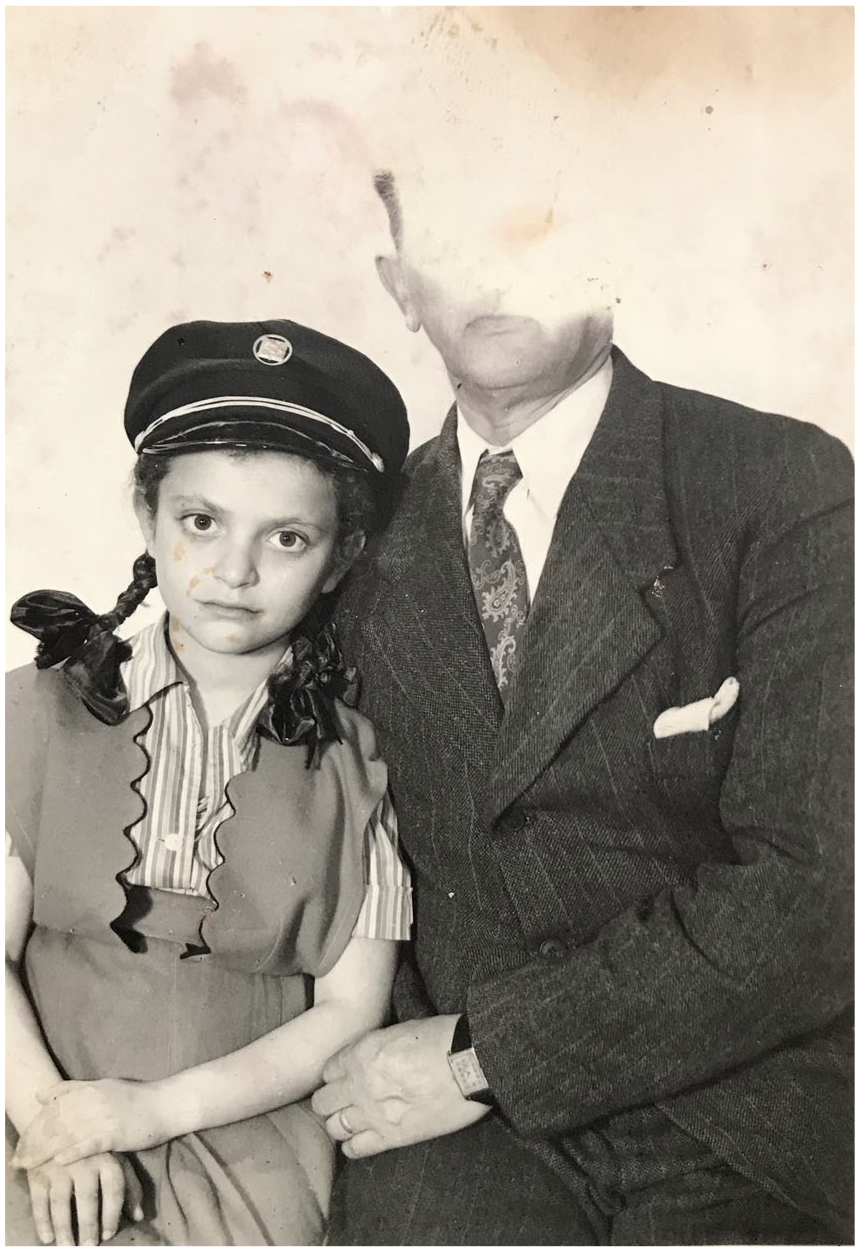
Eta in Szczecin with Dora’s partner, a Bergen-Belsen survivor.
While Eta functioned as her mother’s emotional protector, Dora was physically protective of Eta, who needed to beg and cry in order to join on school field trips. Eta attended an I.L. Peretz school, as well as Zionist youth gatherings organized by Dror and HaShomer Hatzair (Figure 3). The latter hosted a summer camp at which Eta sang as a soloist; she even contemplated immigrating with the other youth members to Kibbutz Gan Shmuel in Israel. On the last night before the voyage, however, she realized she could not leave Dora. With conditions deteriorating in Szczecin, however, Eta convinced Dora to relocate together to the new State of Israel. Departing from the Polish port at Gdynia on the Panamanian ship Protea, they shared a bunk bed on a ship packed with passengers. As Dora would later recount to her daughter, an Italian captain on the ship had noticed Eta and offered Dora money to acquire her as a young bride for his son. Dora refused him. Entering Israel in 1950, Eta was approaching age twelve.

Eta at a Zionist youth program in postwar Poland (second row, middle, behind child in polka-dot dress).
The relationship between mother and daughter proved continuously challenging as Eta, the war-torn Jewish girl, became Esther, an attractive young Israeli youth whose social life finally blossomed. For two years Esther and Dora lived in the “Machaneh Dalet” section of Pardes Hana’s Beit Olim, an area designated for new immigrants. For the first time, Esther felt she was allowed to be a carefree youth (Figure 4). Yearning to have a bicycle as her peers did, she recalls practically fasting for a month, eating only in secret, to persuade Dora, who cleaned others’ houses for pay, to purchase one. Upon receiving her first bicycle, Esther could not contain her excitement; she rode it immediately, despite the laws of Shabbat. Spotted by others, she was subsequently shamed by the principal of her Orthodox school, a Talmud teacher who forced her to stand on a cafeteria bench and receive his condemnation before the entire school for violating the Sabbath. This experience, along with what she later understood to be inappropriate physical advances from another religious teacher who fixated on her (Figure 5), contributed to her decision to reinterpret Judaism on her own terms, beyond the laws of Orthodoxy or organized religion, more broadly. She would keep the bicycle for decades as a sort of testament to her defiant insistence on a joyful life, repeatedly repairing it, watching her children and grandchildren ride it (myself included), and eventually gifting it to a new immigrant.
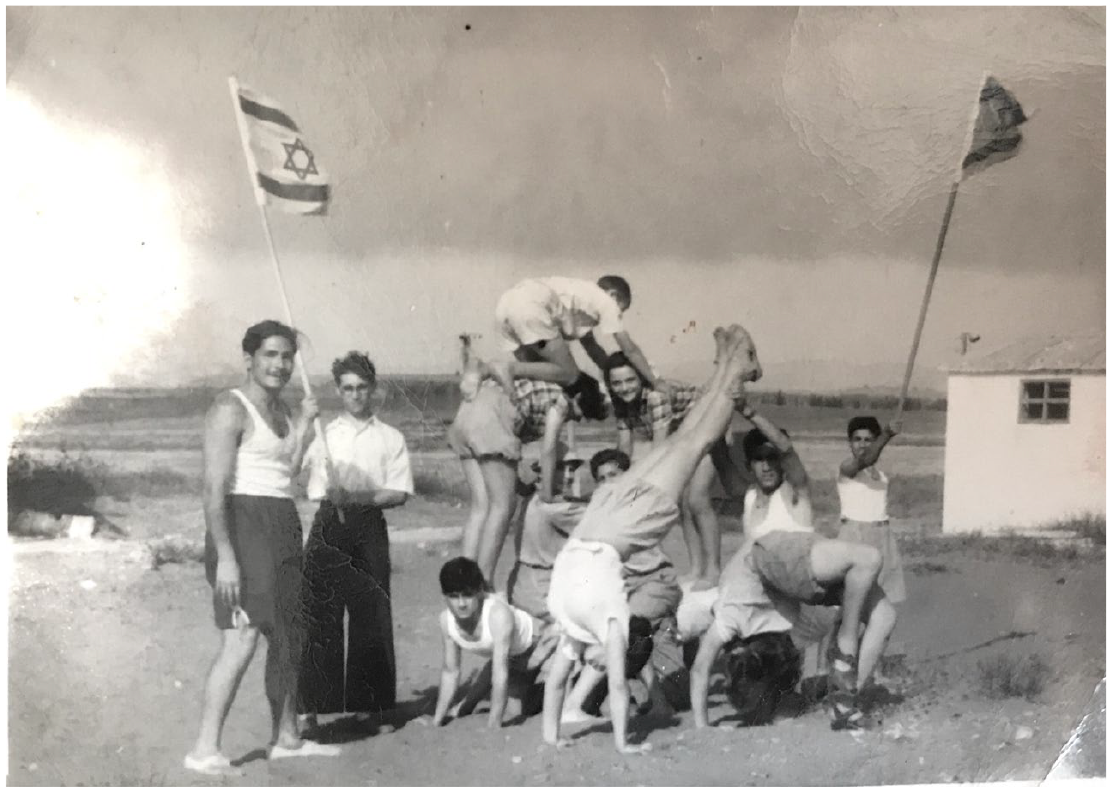
Esther (second from the top of the pyramid, on the right) with Ulpan Hanoar peers.
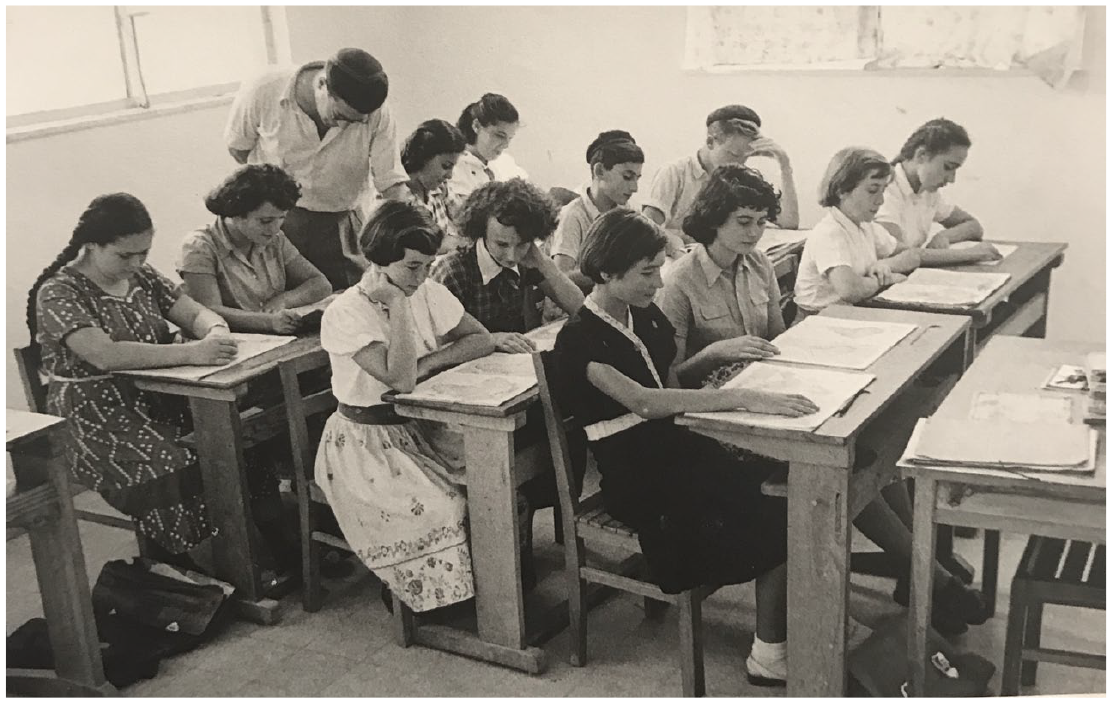
Esther (under teacher’s gaze) in an Orthodox school, Pardes Hana.
Throughout Esther’s teenage years, she continued to function as housekeeper while her mother worked, but she also danced to records with friends from Ulpan Hanoar and enjoyed social outings to the beach and dunes. For about two years, she led local children in weekly gatherings for singing, dancing, games, and Yiddish theatrical skits, which she translated to Hebrew. The following year, after graduating high school, she wished to enlist in the army. The Israeli government, however, preferred that she remain at home to care for her mother, due to Dora’s classification as a Holocaust survivor. Esther had an unshakeable determination to shed her past for an optimistic dream of a healthy, happy family. She became romantically involved with Moshe, a dapper Romanian immigrant six years her senior, who spotted her at one of the youth bonfires. Dora, however, consistently disapproved of her daughter’s decisions and cheerful outward disposition. Even after Esther became engaged, Dora continued to suggest alternative marriage prospects. By Dora’s estimation, Moshe, a gentle, secular man with a slight build and no money to speak of, was ill-suited for her daughter. But Esther discounted her mother’s opinions about romantic relationships; Dora herself went through so many men that Esther had nicknamed her “Elizabeth Taylor.” It seems to me that Dora, who periodically cried to Esther about her murdered husband and sons, remained emotionally arrested in a destroyed past and unavailable for vulnerable relationships in the present.
Photographs of Esther from the years of Moshe’s courtship convey my grandmother’s active stylization of her own persona. Often lifting her hands, jutting her hip, or meeting the camera head-on with an emotive gaze, she fashions herself as a model or a “lady,” posing with issues of LaIsha, a leading Israeli women’s lifestyle magazine that sponsored the “Miss Israel” pageant (Figures 6 and 7). These visual traces display Esther’s delight in her newfound capacity to self-consciously exploit the social conventions previously inaccessible to her. She shows me a photograph of herself as a “second place” beauty queen in her town’s pageant, noting with feigned indifference that many believed she was, in fact, prettier than the winner (Figures 8 and 9). Esther poses sometimes for the camera and sometimes for a live audience. Her self-curation sometimes separates her from those seeking to interact organically with her in the context of the photograph – a visual testament to the determination of her own self-making. In this period Esther continued to struggle against Dora, who, Esther believes, wanted all aspects of her daughter’s life to remain under Dora’s control. Perhaps the latter felt her role in Esther’s life threatened by Moshe, whom Esther curiously addressed as “Abba” (father) in the years before their children were born, adopting a new caretaker as she had done at least twice before – with Mrs. Veronovitch and with her Aunt Riva. Indeed, Esther claims that Moshe filled the role of her lost father and helped heal her spirit in their early years of marriage, holding her through night terrors and directing her away from the traumatic past. Even now, Esther contrasts Moshe with other men, insisting that he is more empathetic; he is a man who cannot bear to see his wife in any pain. Reflecting in her old age, Esther praises Moshe’s generosity of self in the service of caring for her feelings; Moshe, she says, would return from a day of physical labor and insist on helping her with the remaining housework, including washing and hanging the children’s cloth diapers. With Moshe, Esther enjoyed a playful style of relation. The two made a habit, for example, of dressing in drag for annual Purim parties, Esther playing a mustached policeman, one year, to Moshe’s feminine sex-worker costume. The couple’s fluid and lighthearted dynamic threatened to erase the emotional weight of the previous years Esther shared with Dora, who remained troubled and very much alone.
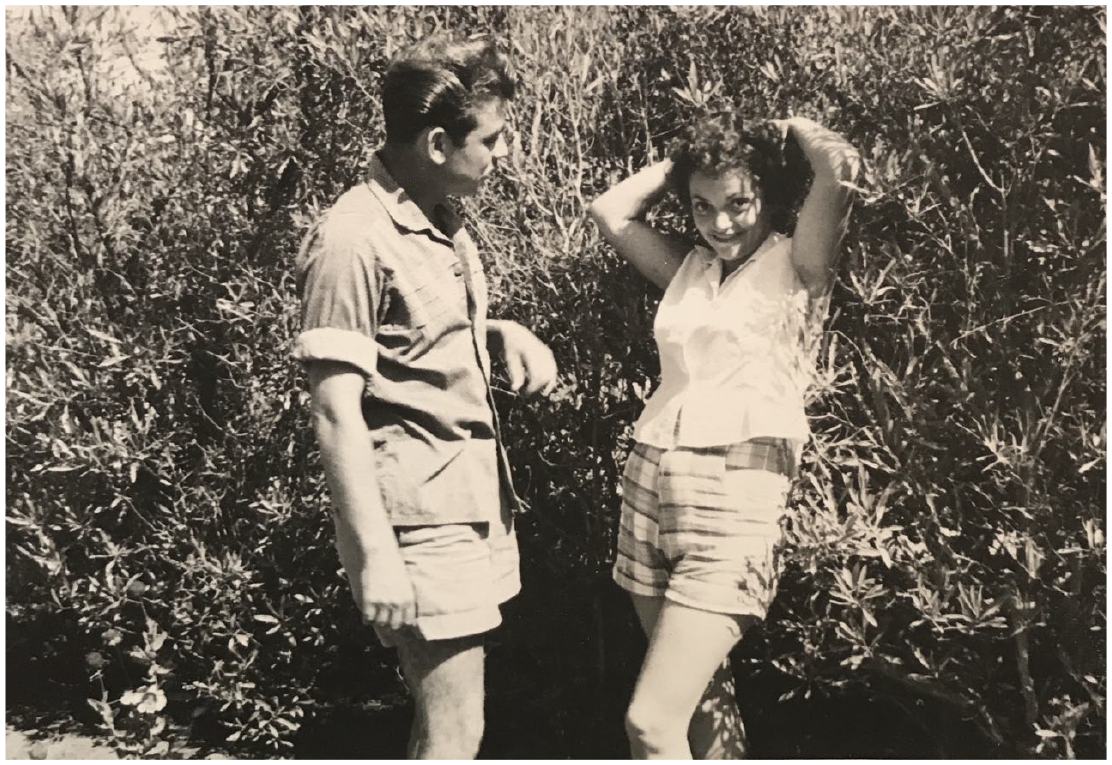
Moshe and Esther.

Esther poses with an issue of LaIsha.
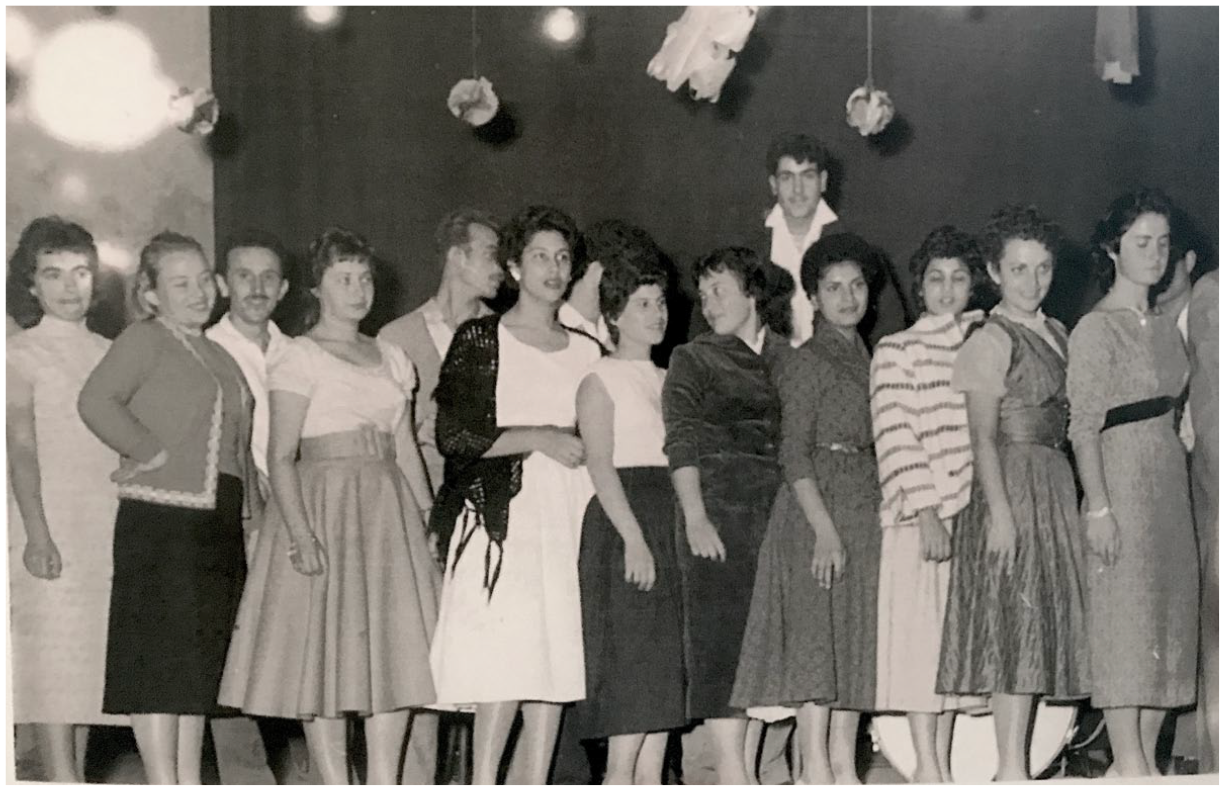
Esther in a Pardes Hana beauty pageant (second contestant from the right).
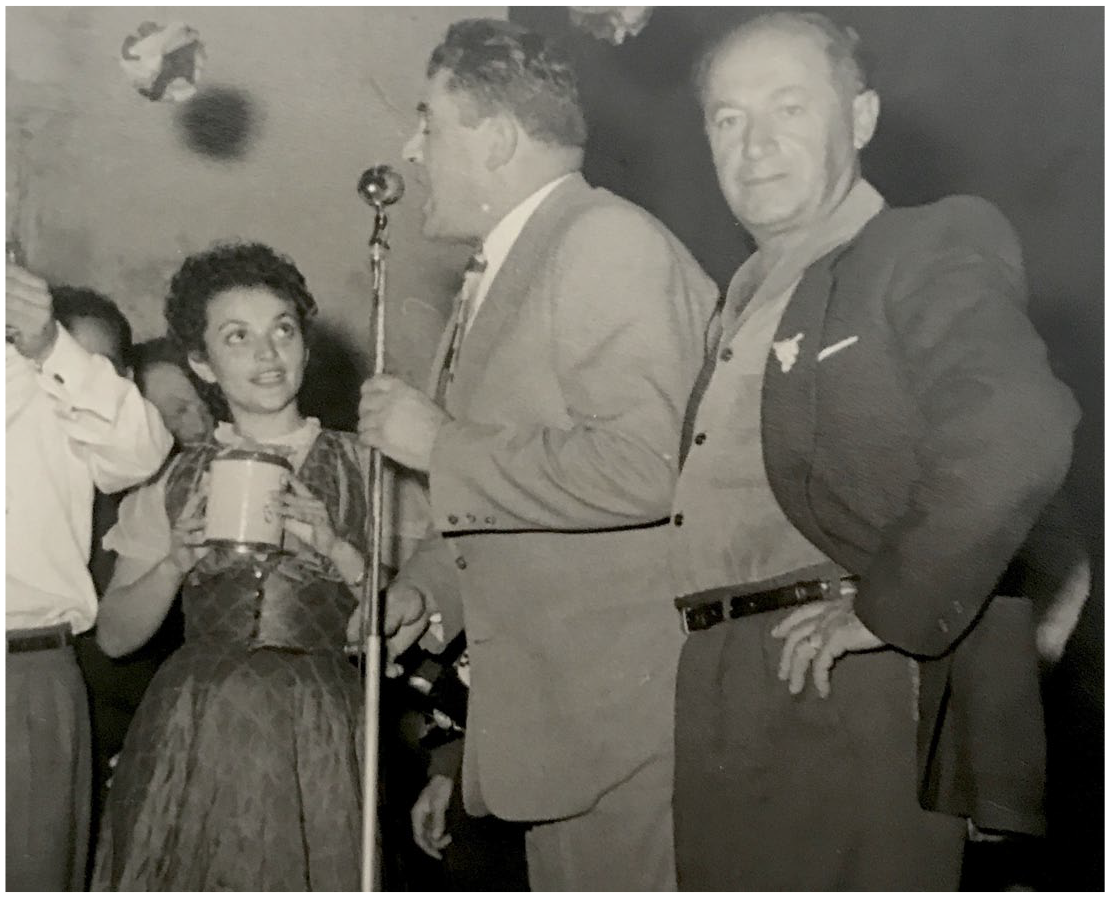
Esther wins second place.
As a ganenet (kindergarten teacher), Esther spent her career nurturing children of the age at which her own traumas solidified. Throughout her teaching career, Esther would specialize in working with children with speech and behavioral challenges, bringing her expansive creativity and emotional openness into this work. She was placed by Misrad Hachinuch (the Department of Education) in socioeconomically disadvantaged communities to teach children with special needs (Figure 10). Understandably, she found particular reward in the process of socializing emotionally disturbed and developmentally challenged children, eliciting their expression and imagination. Esther would also draw on related talents after retiring, volunteering at a local nonprofit call center to speak with solitary elderly people, often Holocaust survivors, who called the organization for companionship and emotional support. She prides herself on having known how to empathize with their loneliness but also how to listen to their weighty ruminations on the past and bridge them into the present. When Esther’s own mother passed away in her sleep, Esther would struggle with guilt for having failed at the internalized responsibility of sustaining Dora’s life.
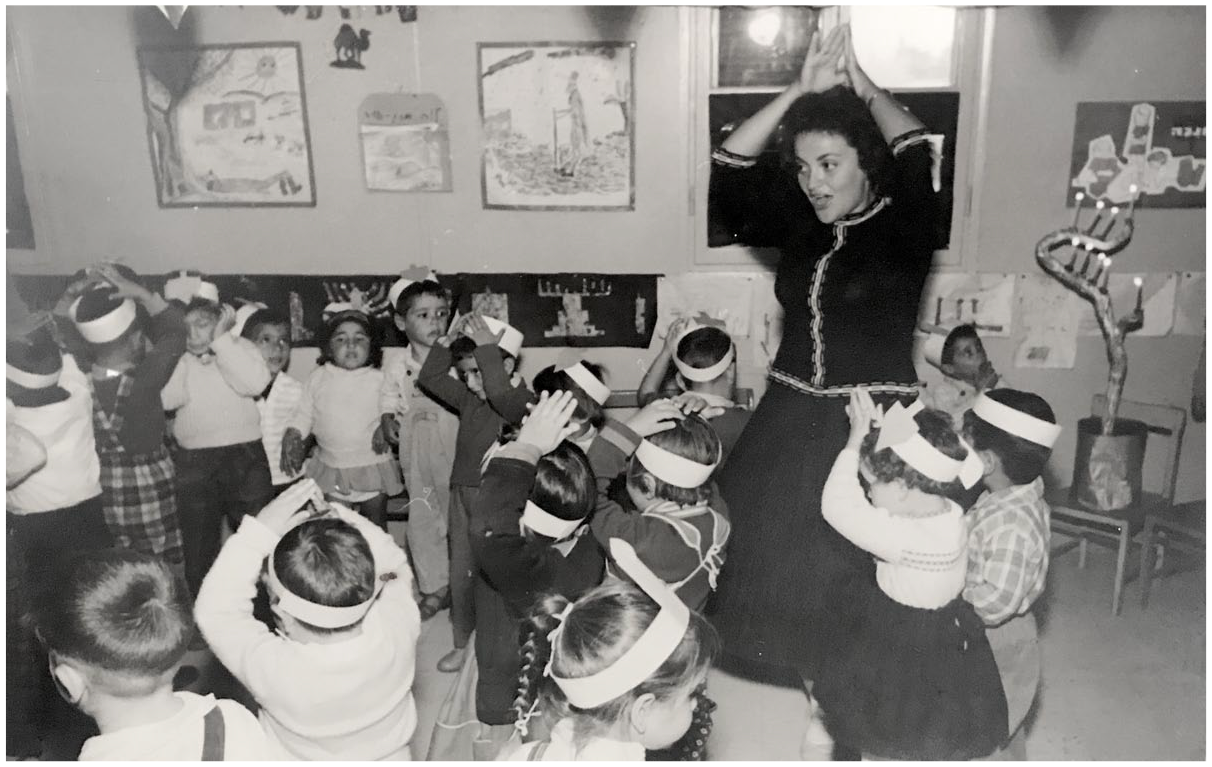
Esther leading her class during Hanukah.
Esther and Sarit
When Dora first discovered that Esther had been hiding a pregnancy from her for several months, Dora grabbed at her own face in terror. Doctors had warned Esther about the dangers of childbirth for her, given her wartime injuries and physical trauma. Taking her model of motherhood from neighbors in Pardes Hana for whom she had babysat, as well as from her mother-in-law, Esther strove to imitate what she saw of the warm homes and socially adjusted families she idealized but never knew firsthand. Anxiously protective of Sarit (b. 1962), she covered her daughter’s carriage with a net to protect her from germs and from the advances of strangers. After returning to work from maternity leave, she struggled to find an adequate babysitter for Sarit, finding fault with each one before deciding to quit her own job and stay home. When Sarit was about 7 years old, Esther opened a new preschool in her home, which she called “Gan Esther” (Esther’s Preschool).
Sarit struggled to share Esther with the many children who flooded her home, offering Esther assistance with her work in order to gain more time with her mother. In one photograph, Sarit looks into the distance, a hand on her hip and downcast eyes suggesting impatience, as Esther embraces a child in her preschool group and smiles intently at the camera (Figure 11). Unlike Dora, whose house was generally closed to visitors, the blinds often drawn, Esther’s home, as Sarit recalls it, was like a “train station,” always full of life and people, much to the dismay of her introverted daughter. By middle school Sarit also needed to share her mother with foster daughters – three teenage girls who lived consecutively with the family for periods of one-to-two years each. Esther was emotionally exhilarated by the prospect of nurturing these foster children, who grew to call her “Imma” (Mother). She would sit for hours with them to talk through their troubles and sensitivities.
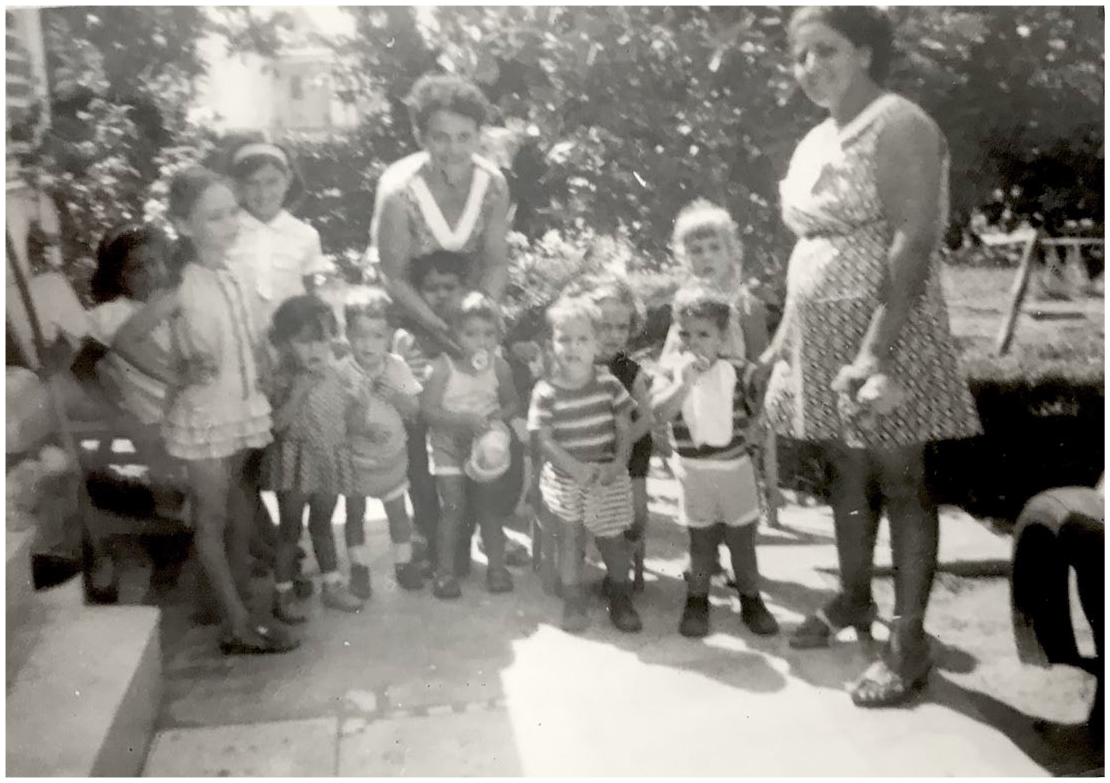
Sarit (left) and Esther (center) with participants of “Gan Esther” at her home in Pardes Hana.
Though Esther believes that it was her destiny to survive the war to offer maternal support to people in need of empathy and emotional nurture, she sometimes felt overwhelmed by her own daughter’s needs, which impacted her more acutely. The instant Sarit would return from school, Esther recalls, she would cry out for Esther, who felt pressed to drop everything to listen attentively to Sarit describe every detail of her day. Esther nicknamed Sarit “Ruach” (Hebrew for “wind” and “spirit”), noting how heavily her daughter made her presence felt at home. Esther had established an intensely connected emotional rhythm with Sarit, who came to rely on it. She enabled Sarit to hold tightly to her mother in ways that Esther could not hold to Dora in her own early life, but in ways that also set Sarit apart from others and induced separation anxiety. Sarit claims that her two biological siblings, a more light-hearted younger brother and sister whom she helped parent, were spared the heavy stories of Esther’s past, or they refused to listen to them. The word Esther and Moshe use most often when describing Sarit’s childhood is “malka” (queen). A “miraculous,” celebrated child born against medical odds and in defiance of genocidal intentions, Sarit internalized an enduring sense of being set apart from others, made to feel precious and special. Simultaneously, however, her social circumstances challenged this message, as she struggled to maintain her self-sacrificing mother’s attention and learned to feel somewhat ashamed for having needs and desires of her own. Sarit aligned herself with her grandmother Dora, who was also “special” but shamed: in the 1960s, years before the nation revised mainstream perceptions of survivors as broken people unfit for the new state, Dora lived as a Yiddish-speaking recluse, her language queered vis-à-vis the state’s official Hebrew, which firmly sought to overtake the diasporic Yiddish language. 9 Sarit would often play in Dora’s yard, which stood directly between her house and Esther’s. She sometimes helped wash her grandmother’s back and taught Dora some Hebrew. Dora paid Sarit a lira per lesson, conversing in a simple, limited vocabulary.
Esther, Sarit believes now, felt responsible for Dora’s wellbeing and incapable of setting boundaries with her. Dora demanded pity and unyielding attention from Esther, even as she interfered with and disapproved of Esther’s life. Sometimes when Dora had nightmares about the Germans, she would run across the yard in the dark and bang her fists on Esther’s bedroom window, screaming “save me” in Yiddish, and frightening her daughter awake. She unloaded her anxiety and despair on Esther without inhibition. Esther recalls feeling the need to be “Wonder Woman,” flying across the yard and shifting her emotional demeanor to address both Dora’s unrestrained despair and Sarit’s need for cheerful nourishment. Dora complained, “How can you waste your money to celebrate a child’s birthday? How can you celebrate at all when your father was murdered?” Once, after Dora disappeared from town without a word, Esther found her in Ramla, having married someone Esther had never met. Dora nervously brushed aside her daughter’s concern by joking about having found a Romanian just like Esther had done. Dora then forcefully repeated the phrase, “I cannot be alone. I cannot be alone.” There is a defeated sadness in Esther’s eyes as she remembers this story, slowing the pace of her speech, her eyes meeting mine but also passing through them, arrested within the memory. Around eight months after Dora’s marriage, Dora called Esther crying that her new husband was a swindler and that she needed Esther to save her. As much as Esther suffered her mother, she was beholden to Dora and empathized deeply with her pain, her overwhelming loneliness and fear of abandonment as Esther struggled to move forward and to forget their shared traumatic past.
Becoming a mother helped Esther understand Dora’s behavior. As much as Esther nurtured and cared for her children, she struggled to hide her pain and terror from them. Sarit and her siblings heard Esther scream in her sleep, and they worried about what it meant when, collecting herself after alarming moments of rage or panic, Esther insisted, “You’re lucky that I’m not even less normal after what I’ve endured.” Sometimes Esther hinted at her traumatic experiences to Sarit when they were alone. Sarit had repeating nightmares about Esther. In one of them, Esther deposits Sarit in a forest and flees the scene without looking back, leaving Sarit terrified and alone. In another, Esther takes out her own eyeballs before bed – the way one might take out a pair of dentures. Esther’s eyes remain a dominant, arresting visual metaphor in our family mythology – widened, terror-stricken, love-inducing eyes, perpetually watering with tears that will not fall in our presence, hiding pain from inscrutable memories.
Sarit recalls the tone of her childhood home as oppressively serious and morally didactic compared to others’ homes, Esther overwhelmingly dictating this tone, even as she overflowed with cheer and love. Of Esther’s three biological children, Sarit was undeniably the “memorial candle,” to use Dina Wardi’s (1992) term. As much as she demanded Esther’s attention, she was the only one to elicit and absorb Esther’s serious side in return, and she sensitively protected Esther’s emotional state, even as she struggled to locate herself under its weight. Sarit felt that it was her job to bring Esther joy, to protect her fragile peace. Bookish and retreating by nature, Sarit ambivalently performed happy extroversion to help reassure Esther that the latter had raised her to be healthy, rather than serious or troubled – an anxiety Esther repeatedly needed dispelled. Simultaneously afraid of Esther and lovingly devoted to her, Sarit felt the need to police herself. Esther used to call Sarit an “old soul,” but Sarit believes she was made to feel old, to face adult problems prematurely, in order to function for Esther. To this day, Sarit complains that Esther leads two disconnected lives – one is hidden darkness and horror, and the other is a “Julie Andrews dream” of cheerful, romantic ideals. Sarit remains emotionally disarmed by Esther, fiercely and lovingly protective of her, but also frustrated when Esther insists that she successfully shielded her children from her pain and gave them the happiest “normal” childhood. Esther overcame enormous feats to remain relatively stable and positive as a mother; still, Sarit feels that she, like Esther, missed important aspects of childhood due to her own susceptibility to a mother’s unintentional demands.
At the end of her high school career, Sarit was selected to represent Israel as one of the nation’s exchange students to be sent to the United States in 1980. Though initially fearful of separating from her family, Sarit found herself enamored by the emotional style of the American household, which she perceived as so much “lighter” than what she had known at home. After returning to Israel to complete army service, Sarit immigrated back to upstate New York at age nineteen, marrying my gentle American father. In a portrait of Esther and Sarit on the morning of Sarit’s wedding, the latter appears as the epitome of normative bridal modesty, looking downward as Esther’s penetrating gaze seeks access to the psychology of the daughter leaving her orbit (Figure 12). Watching her wedding video with me, Sarit draws my attention to her own tenacity and defiance, which she enjoys as somewhat comical. A petite and lace-covered nineteen-year-old who speaks English with a heavy accent, she delays the marriage proceedings, insisting that someone translate the Aramaic ketubah (marriage contract) to Hebrew for her before she will agree to sign it. She then contests the terms of the antiquated contract template, which indicates her “worth” to the husband in goats rather than in a contemporary currency as is done in Israel. A room of disgruntled men in suits – the rabbi, ritual witnesses, and her new father-in-law – struggle to appease her in broken Hebrew. Somewhat shocked by her brazenness, they promise her that the ketubah is a standard one. Eventually, turning to face the back of the room, she finds Esther, whose eye contact reassures her, and the ketubah is finally signed. Watching the video now, with what seems like pride and a hint of amusement at her own behavior, Sarit draws my attention to how she has always prioritized her own convictions above others’ expectations of her, unafraid to challenge the authorities, “even back then.” I note that her need for Esther’s approval may be the exception to this rule in her character.

Sarit (left) and Esther in Albany, NY.
Drawing on what it felt like to play the role Esther needed of her, Sarit’s convoluted individuality, which she struggled to identify and assert, became inextricably linked with a stance of martyrdom and suffering. A young woman in a foreign country, she lived by a self-imposed, almost ascetic lifestyle, eventually earning a PhD in adult education and running a business. As an American woman, she allowed herself to be an introvert who often hid herself at home like Dora, minimizing outside visitors. Her younger sister, my aunt, continues to associate Sarit with Dora, whom she remembers as similarly rigid and harried but also exceptionally bright. Sarit also became a teacher, performing animated extroversion at work, as she had learned to do in Esther’s home.
Sarit and I
As a mother, Sarit continuously fluctuated between asserting a stark individuality and clinging tightly to us, her children, fearing abandonment; together we all walked the tightrope between loving communion and necessary self-erasure, proud individuality and isolation. I believe she suffered from internal rigidity in conflict with a need to free herself as an individual, as she repeatedly expressed through strong opinions, strict rules, and highly particular preferences. As I would dramatize in my own graphic narrative work, these tensions around self-control, individuality, and loneliness could be symbolized through the serious way in which we related to names, finding it more threatening than endearing when “outsiders” assigned us nicknames. Sarit encouraged us to claim and guard the terms by which we understood ourselves and set ourselves apart from others, but we were not to set ourselves apart from her. We were to strive to embody exemplary, distinctive qualities that would distinguish us as her children, despite others’ expectations.
Our move to Israel during my preschool years lasted only for about six months. This was, in part, due to the outbreak of the 1990 Gulf War, during which we were repeatedly made to wear gas masks in a basement shelter. I also struggled socially in Israeli preschool, refusing to speak Hebrew and spending recess by a fence through which I watched my older sister in the grade above mine. Back in the United States, I remained a serious, analytical, and hypersensitive child. Sarit insisted that I, more than my two sisters, was the closest copy of her, and possibly even a “reincarnation,” she felt, of her grandmother Dora, a figure with whom she identified and through whom she extended her own “memorial candle” status to me. In her male child she saw Dora’s erratic wildness, perceiving me as hyperactive and demanding, in contrast to my older sister, who was even-tempered and self-sufficient like our quiet father, a patient and mild-mannered dentist. Our younger sister, too, my mother would associate more with my father’s female relatives. I was Sarit’s “chosen” one, the imagined projection of her postmemorial genealogy. Perhaps part of what she saw in me was my own queer alienation. As a gender-frustrated gay person growing up in the late 1990s and early 2000s in a largely homophobic suburban context, I felt obscure and pressed to selectively conceal my identity and desires from others – an emotional condition with similarities to my mother’s feelings as Esther’s “memorial candle” and as a young immigrant woman in suburban America. I was a creative and expressive boy who secretly loved dress-up, drag, visual art, and fantasy. Hiding from a social matrix I perceived as coercive and unjust, I treasured the queer and “feminine” parts of myself that might have been targeted and eroded had I more fully assimilated to the norms of my peers. I found myself at odds with the cultural confines of stereotypical masculinity and was more flamboyant, emotionally intense, and serious than other children, especially other boys, I felt. I fluctuated between feeling fearfully hidden and shamefully exposed. I harbored anxieties about kidnappers and had repeated nightmares in which I was selected for imprisonment inside a machine of black, red, and white that would be projected into an abyss in outer space (only years later did I make the connection between those three colors and the Nazi flag). Usually too sensitive to take a joke, I sought refuge from social strife by relentlessly courting the approval of authority figures. But adults often ordered me to smile and seemed perplexed as to why I was not more child-like, why I did not more easily “have fun.” For me, what was “fun” was often deemed queer and thus generally took place in private, away from the coarse expectations of American boyhood, which flattened and limited my expression, shunning the emotional “excess” that colored my interior world.
My greatest refuge was in the rare bonds of mutual understanding I shared with my sisters and mother. Sarit’s love, specifically, was intertwined with the idea that I was “just like her” and different from others. She offered a narrative in which the two of us were special martyrs who ignored what others thought of us, took nothing for granted, and cultivated the ability to analyze ourselves, each other, and our family’s relationships with great precision and sophistication, even if this cost us our social belonging. At the root of this almost sacred web of connection was, for me, the family mythology of my grandmother Esther’s childhood, conflated with my mother’s narrative of solitary immigration as a foreign young woman. Feeling like a social outsider potentially endangered by my sensitivities, and emotionally preoccupied by what I perceived as a troubling but intoxicating family history, I often visualized the moment in Esther’s narrative in which a Nazi air raid left her with a hole in her back, as a child hiding in the forest. Esther’s story, I felt, spoke to me directly as a closeted, forming subject heeding social dangers and alienated by my disavowal of traditional masculinity – the physical dominance, violence, and callousness. Additionally, Sarit’s identification with narratives of “strange” women who triumph by asserting themselves against unjust masculine laws – such as in the films My Fair Lady (1964), The Sound of Music (1965), and Beauty and the Beast (1991), which we repeatedly viewed together – spoke directly to my own desire to overcome shame and isolation without surrendering my emotional sensitivities and queer social stances. I believe that my early sense of myself as socially queer led me to place added weight on the bond I shared with my mother and thus to anxiously invest in attuning to her emotional patterns, further identifying with the heritage of endangerment, hiding, and solitary survival that she embodied.
Inspired by Art Spiegelman’s Maus series (1980–1991) and Alison Bechdel’s Fun Home (2006), I created a graphic narrative in 2009 during a five-month professional hiatus after graduating college with a studio art degree. Briefly delaying entry into graduate school or a full-time job, I “grew sideways,” to use Stockton’s term, but also dove inward and backward, seeking a roadmap to an uncertain future by reconnecting with the narratives that had defined my family and shaped my sense of self. Entitled “Part Hole,” the project aesthetically conveys feelings around my development and the dominant role of my mother’s and grandmother’s narratives in my upbringing. Comics scholars describe the graphic narrative form as especially suited to expressing hybridity and ambivalence; it conveys an inherently fractured reality negotiated between narration, image, thought, and speech, and its protagonists move between panels and pages, occupying multiple spaces at once (Baskind and Omer-Sherman, 2008; Chute, 2008). Approaching what felt like a tangled and perplexing subjectivity, I conceptualized the project through metaphor, gravitating toward four primary symbols through which to graphically convey my inner world within the context of my family: a web, a black hole, a fountain, and a tree. A web stood in for our near-telepathic interconnectedness; a black hole represented the ever-present threat of meaninglessness and isolation beyond our deep, empathic bonds; a fountain conveyed the dynamic of a seamless, cyclical performance concealing pressurized, repetitive internal mechanisms; and a tree, in contrast to a fountain, modeled a longed-for but inaccessible way of being in the world – a rooted, serene, and unselfconscious one. Conveying the condemnation – and perhaps related eroticization – of traditional masculine attributes in the boy protagonist’s forming subjectivity, the project reveals how ruptures of forming self-conception in relation to normative social expectations function for the child protagonist as the very sites of postmemorial identification. These sites of marked social difference and embodied vulnerability, which elicit calls for resourceful endurance, lead the child protagonist to connect with Esther’s experience and its lasting effects. The distinctiveness I felt as a socially isolated queer boy merges graphically in “Part Hole” with the post-Holocaust Jewishness that colors my maternal family history as it took root in me. The project connects the distinctiveness I felt as a Jewish son of an Israeli in an American suburb with the fragile pride to which I clung as a boy whose perceived value rested on incorporation within my maternal family history and distinction from peers, especially from other males (Figures 13 and 14). The narrative ends with the boy’s confrontation of the limits of aligning himself so fully with his idealized mother’s feelings; hiding in a backyard ravine, he seeks refuge in the ground, visually recalling Eta’s hiding in the forests of Minsk; he contemplates the ironic wildness he perceives inside his home in relation to the stillness of nature outside.

©Golan Moskowitz
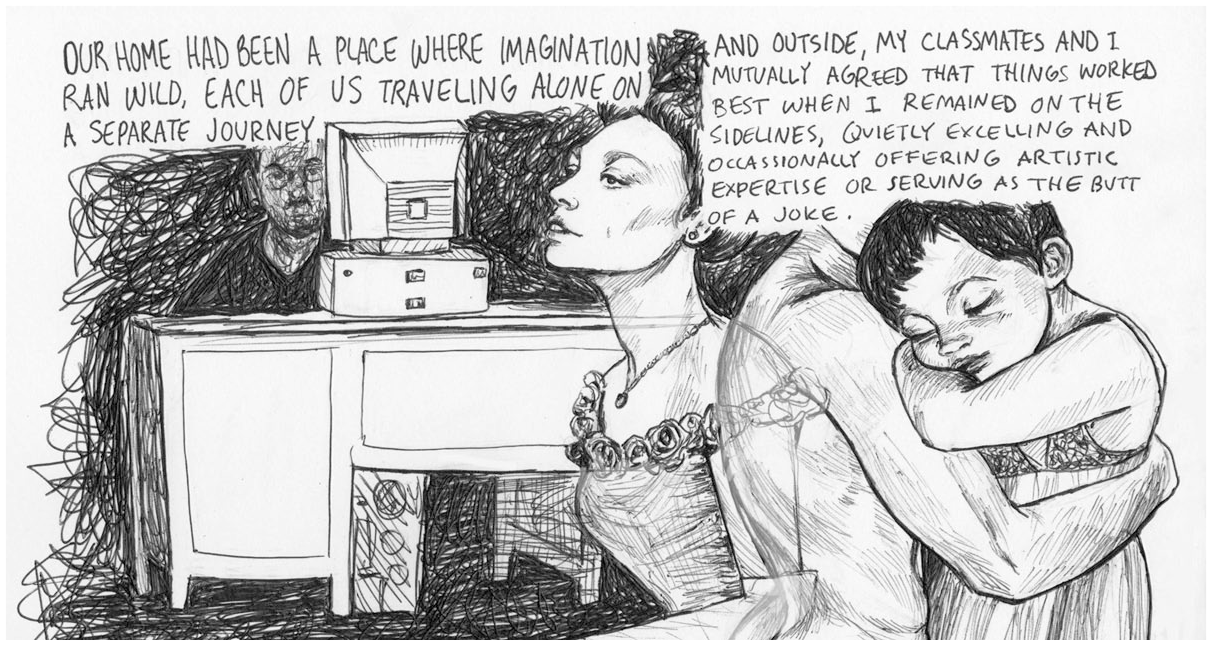
©Golan Moskowitz
At the heart of “Part Hole” is my retroactive claim to a queer childhood that I was not fully allowed to know or inhabit at the time but whose constraints aligned me most directly within the motifs of my family’s post-traumatic self-estrangement and internalized rupture. The project demonstrates how subjects in some post-traumatic families might find special meaning in queered standpoints and experiences and in the work of subverting dominant social frameworks, revealing the contingency of social meaning and safety along such vectors as gender, sexual orientation, and family structures. For example, my queer boyhood fantasies of feminine performance convey a search for emotionally congruent realms beyond the expectations of, in this case, a boy’s growth toward normative manhood and reproductive temporality. These help sustain my embodied connection to our family’s values and its most difficult history against pressures of normalization that would diffuse such an inward focus in favor of social assimilation.
“Nonknowledge” and bonds of reflexive estrangement
Whether oriented toward past, present, or future, a shared aim of queer theory and trauma theory is to process amorphous, intrusive, and misunderstood elements of experience in the service of liberating marginal or silenced perspectives. As Cvetkovich argues, queer people have needed to rely on firsthand memory and “moments of intense affect” in order to name, document, and testify to meaningful experiences that are traditionally and perennially silenced or attacked in dominant cultural spheres, and in order to maintain collective queer cultures across generations within those dominant spheres. These needs and challenges speak directly to those of survivors of historical trauma vis-à-vis non-normative elements that endure as marginal and meaningful (Cvetkovich, 2003: 26–27). In the present study, queer ruptures in normative behavior or expression function paradoxically as pillars that hold the family’s most weighty and important emotional content together, even as this content resists cohesive narrative structures and broader cultural expectations. Such ruptures are direct calls for loved ones to bear witness to covered or secret realities of affect and body that cannot be voiced elsewhere – stolen childhoods, losses of family or identity, terrors of endangerment, physiological need, prematurely “old souls,” necessary self-evacuation, and feelings that defy gender or other social laws. While these ruptures demand much of those trusted to be their witnesses, of those relatives who can never fully understand or heal them, they also offer vital emphases within the space of the family on active self-making, shared vulnerability, and the close interpersonal bonds such revelations may foster.
The interpersonal patterns analyzed here support an argument that queered subjects are primed for participation in empathic exchanges rooted in self-estrangement by virtue of growing within social structures that exclude and erase them. Esther, for example, is marked by the absences that colored her own childhood and early relationships with caretakers, and she comes to generate personal meaning by functioning across multiple contexts as a nurturing, maternal figure, particularly as a teacher and foster mother to youth estranged by social and physical disadvantage. Sarit and I also each relate our own work to internal processes that we connect with our family heritage – struggles to achieve authenticity without isolation, and safety without self-erasure. Our processing reflects Chris Weedon’s (1996) conception of the postmodern subject as a site of “discursive struggle,” a subject who recognizes the multiplicity of narratives in which any given subjectivity participates and negotiates relative meanings (102). As I convey in “Part Hole,” social expectations of cisgendered heteronormativity, for example, induce my own need to “pass” and “hide,” pulling me into solidarity with narrative tropes of our family’s past. To be “part hole” is to have already internalized in one’s body markers of what Felman describes as the “nonknowledge” of literary knowing – indications of places where any given totalizing system of knowledge inevitably falls short of conveying internal experience (Sun et al., 2007: 3).
Though I interpret the present post-Holocaust family account through a focus on the subjects’ socially critical and creative outlooks, one must also recognize that trauma and post-traumatic family memory do not inherently produce “sideways growth” or expansive perspectives. To be sure, traumatic memory can sometimes serve to reinforce nationalist or otherwise hegemonic notions of race, ethnicity, gender, and sexuality. Children raised in the shadow of war, for example, might adopt reactionary or chauvinist ideals. Esther, for her part, performs a traditional hyper-femininity as a self-stylized 1950s beauty queen in search of the social normalcy for which she yearns after the war, and she longs to serve in the Israeli army to protect the Jewish State. On the other hand, Esther’s example is also a queer one in that she seems to understand social roles as performative constructs to be strategically employed toward survival and as media for emotional release, rather than as expressions of core identities. Other family stories, of course, may evince stronger linkages between post-traumatic or postmemorial childhoods and the formation of essentialist orientations.
The present analysis has examined relationships between affectively queer (boundless, flexible, critical, creative) kinship styles and ruptured relationships to broader social orders, ranging from those of cisgendered heteronormativity to basic physical safety. Throughout the generations, dominant social norms and ideologies prove to be of secondary importance to close kinship relationships – whether biological, foster-family, or “adopted” – and to the fulfillment of one’s convictions, especially when such convictions resist social constraint. The intersubjective processes at work within this manifestation of family life may reflect wider observations made about post-Holocaust kinship and its valuation of in-group emotional investment over matters of broader social standing, including those of gender. Speaking for herself and other offspring of survivors, journalist Helen Epstein (1977) recalls, “while most of our contemporaries were busy throwing their parents’ values out the window, we were trying to measure ourselves by their standards. We studied our parents; we took on their values.” She quotes another daughter of survivors who recalls that for her parents, “Their social life was with their children. [. . .] My parents never did anything separately. And we children were usually included.” Valuing deep connection even across unthinkable disparities of experience, subjects in the present study resist falling victim to “masculine” authority and the potential dangers historically associated with it: corrupted social laws, tangible threats of violence, and psychological isolation. A determined avoidance of these perceived dangers colors Esther’s and Sarit’s spousal choices, as well as my own queer stance toward my attributed gender identity as a male-bodied person.
Photographs and drawings function here as the embodied texts of this gendered family narrative. They magnify and preserve sensory symbols, such as eyes and eye contact, offering a means of reading the affective dynamics at play across family relations. Eyes push and pull, shifting shared emotional energy between social and temporal landscapes, sometimes eliciting connection, and sometimes asserting active, or even defiant self-making. As the included photographs convey, Esther’s unapologetically demanding eye contact claims space and commands others to witness her affective realities as both a child survivor and a charismatic woman in the postwar world. “Part Hole” demonstrates the transgenerational weight of these ocular exclamations and pleas. It visualizes the ways in which Sarit’s and Esther’s eyes flood the artist’s conceptions of social meanings and become welcomed sensory fuel for sustaining his contemporary commitment to the holes and gaps in those meanings as they reverberate within his own queer consciousness.
Cultural context, of course, also impacts perceptions of “normative” or “queer.” Esther and Sarit both seek refuge in new worlds, pursuing greater social freedom and emotional ease – Esther as a war-torn Jew in the new State of Israel, which enables her to experience a playful adolescence, Sarit as an Israeli survivor’s daughter in the United States, where capitalist individualism promotes self-made identities. Their migrations, however, ultimately also reinforce their queerness as outsiders who carry ruptured and foreign emotional landscapes. A young Esther, for example, is publicly shamed for placing her pursuit of happiness above Sabbath restrictions, and she is obstructed from serving in the Israeli army – a social rite of passage for Israeli youth – due to her mother’s classification as a Holocaust survivor. These experiences further propel her toward “adopting” a sensitive and playful father figure for a husband, working with an early-childhood population, and cultivating a highly individual, private relationship with Judaism. Sarit is doubly queered as a foreigner in the U.S. and as a “yoredet” in Israel – one who “descended” from her homeland, a classification that bears some social stigma for “deserting” the State (Amit, 2018). On the other hand, she is also normalized and empowered by those elements of American culture that idealize trauma and revere those who display traces of their own survival; Cvetkovich describes American culture as, in part, a sentimental and voyeuristic “trauma culture” that makes exemplary spectacles of those who have endured hardship (Cvetkovich, 2003: 15). Still, the high levels of parent-child intertwinement in the family’s emotional fabric sit uneasily within American culture’s longstanding celebration of rebellious individuality and defiant youth culture. American family styles, as Sarit observes as an exchange student, contrast with the tightknit European Jewish family’s collective pooling of resources traditionally valued for survival, as well as with the Israeli family’s rootedness in a more collectivist, publicly Jewish culture that connects Jewish family life to the nation’s very existence (Remennick, 2000). Thus, American culture allows Sarit to be the distinct, even “special” individual she has been made to feel she is, but it also queers her, as a mother so intensely intertwined with her own children and hyper-protective of her domestic bubble.
The present study supports a reading of post-traumatic family stories as, beyond narratives of healing and gradual “normalization,” stories about the potential insanity of normative social structures themselves, as well as the ways in which sustained forms of queerness serve as connective tissue across the subjects and kinship bonds that survive normalized persecution and erasure. My own twenty-first-century queerness and transnational identity, for example, compels me to find solidarity and meaning in Esther’s experiences of incoherence and endangerment, as well as to empathically witness Esther’s engagement with some of the “open circles” within her own internal story, as she finds in me a rare listener receptive to narrative elements that transgress normative social laws. Queerness may serve as a channel of solidarity for subjects who are creative under duress and defiant in their insistence on self-determination, whether through eluding, strategically employing, or reconfiguring dominant social meanings. Lacking public contexts within which to give sufficient meaning to their emotional worlds, as shaped by the effects of historical violence and subsequent estrangements from the social order, such subjects remain strangers to themselves, in some respects. This “reflexive estrangement,” however, facilitates the preservation of traumatic and culturally marginalized forms of memory against resounding collective pressures to assimilate and to forget. It also inspires and works as a conduit for the mediation of that memory within contemporary contexts through creative practice, conscientious self-fashioning, and empathic solidarity across generational and experiential differences. In other words, the queer condition and cultivation of being “strange” to oneself and to others may operate as a springboard for mutually empathic investments across diverse experiences of rupture, as well as between marginal and dominant cultural modes.
Queer theory offers an enticing and broad framework for understanding qualities that set post-traumatic and postmemorial subjects apart from others in ways that empower rather than pathologize. Such subjects may be conceived as self-made performers who participate in a constructed social reality while preserving meaningful energies from beyond that reality, safeguarding against cultural complacency, myopia, or blindness to dangerous shifts in a given political climate. They may also serve as critical analysts and creators who grapple actively with their own estrangement in contemporary contexts in ways that enable majority cultures to better understand themselves from alternative vantage points. The cultivation of reflexive estrangement aligns post-traumatic, postmemorial, and queer narrative tropes through a common denominator of denaturalizing collective public spheres in favor of what those publics have lost, overlooked, or even destroyed. To be sure, postmemorial and queer perspectives do not always achieve such positions of insight and are not uniquely immune to the lures of political reactionism. While the present study has focused primarily on one family’s account, future studies may build on this work to deepen our understanding of the processes by which a prism of queerness reinterprets post-traumatic and other stigmatized subjectivities to reveal what most nourishes or diminishes their capacities of perception, creative fluidity, and unusual forms of connection and resilience in individual and collective dimensions. As Hirsch and others have argued, we need not confine the affective potential of postmemory to the biological family alone, as “affiliative” forms of postmemorial investment include any who offer themselves as empathic witnesses to marginalized narratives, caring for those whose stories “would otherwise fall out of history” (Hirsch in Altınay and Pető, 2015: 392). In this regard, the present analysis also supports mutual learning and sensitive connection between those who carry (post)memory of collective trauma, those whose contemporary lives are displaced by normalized violence or erasure, and those compelled to work against the normalization of coercive injustices.
Footnotes
Declaration of conflicting interests
The author(s) declared no potential conflicts of interest with respect to the research, authorship, and/or publication of this article.
Funding
The author(s) disclosed receipt of the following financial support for the research, authorship, and/or publication of this article: This study was supported by a travel grant from the Crown Center for Middle East Studies.
