




Abstract
This paper looks at the ways in which the Bugis of South Sulawesi, Indonesia remember their distant past. The example of Allangkanangngé ri Latanété, a palace site of the legendary polity of Cina, exemplifies how memories are mediated by cultural practices and socio-historical factors, as well as how they are included and excluded from histories, over a long period of time and through massive social changes. These social changes include the transition from a non-literate to a literate society, the demise of Cina and rise of agricultural kingdoms, colonialism, independence, and the advent of the digital age. The case of Allangkanangngé and Cina exemplifies how forgetting can serve new political situations; the way in which popular folk culture can maintain a memory despite historiographical oblivion; and the extent to which the Indonesian government is willing to appropriate history for nationalist purposes. It also exemplifies how history and memory can be synergistic or separate at different points in time.
Introduction
The distinction between history and memory is problematic at best. The two forms of relating to the past are often presented as being diametrically opposed rather than as working with each other (Schwarz, 2010: 47). When the relationship between the history and memory is considered, it is often telescoped into chronological divisions which impose a strict notion of temporality. One example of such thinking is the binary conceptualization of Ferdinand Tönnies. In his consideration of the transition from traditional to modern social forms, he posits that memory and the set of practices that accompany it belong to traditional society (Tönnies, 2001: 105–107). Written in the late 19th century, his book Community and Civil Society exhibits a sort of nostalgia for traditional society and the social elements that he argues were dislodged by the neutrality of social sciences (Terdiman, 1993: 39–44; Tönnies, 2001: 10–11). Another example is the tripartite conceptualization of Pierre Nora. According to this triptych, the past and the present coexisted harmoniously during the pre-modern era, after which there was a long interregnum of the modern era before relations between the past and the present were completely severed during postmodern era (Schwarz, 2010: 57). Nora refers to “a fundamental collapse of memory” that resulted from industrialization, globalization and the concomitant “disappearance of peasant culture, that quintessential repository of collective memory” (Nora, 1989: 7). Nora accords due consideration to the interaction between history and memory, but he still sees them as diametrically opposed. He argues that history conquers and eradicates memory (8) and that this annihilation is preventable through the establishment of lieux de mémoire or “sites of memory.” In practice he spearheaded an initiative to consciously preserve such sites across France which, according to his views, would otherwise be lost to postmodernity.
This perceived dichotomy between history and memory has been noted by Schwarz. He describes a number of different ways in which various historians have argued for the dominance of one or the other, and notes that they all distinguish between modern and traditional ways of dealing with the past (Schwarz, 2010: 48). This strict distinction between traditional and modern is also problematic because the line between the chronological periods is often as blurred as the line between history and memory. In reality, many practices and characteristics that are used to define tradition and modernity regularly cross super-imposed chronological boundaries. For example, cultural theorist Vijay Misra refers to diaspora as “the exemplary condition of late modernity” but when historians look back across the ages it quickly becomes apparent that diaspora have always existed (Curtin, 1984: passim; Mishra, 1996: 426; Wellen, 2014: 3). 1 Arguably academia has imposed an artificial boundary between tradition and modernity that is just as blurred as the boundary between history and memory.
This article seeks to examine the interaction between memory and history over half a millennium. It uses a complicated example from a lesser-known society with not only distinct and varied historiographical traditions but also exceptionally fluid boundaries between oral and written registers. The example shows memory and history interact and coexist, serving and deceiving each other at different junctures and completely ignoring each other in other instances. It includes a site of memory, the significance of which was well-preserved in the collective memory of the local community despite centuries of historiographical obsolescence. These memories were not “swept away by history” (Nora, 1996: 2). On the contrary, they endured and came to serve archaeology and history admirably.
The case in point is Allangkanangngé ri Latanété (Bugis, hereafter B: the palace site on the ridge), arguably the most important historical archaeological site in South Sulawesi, Indonesia. This hilltop, hereafter Allangkanangngé, was one of the palace sites of Cina, an early Bugis polity completely unrelated to China. Over the course of half a millennium, a sense of the significance of this site survived numerous radical changes. These changes include the demise of Cina, the transition from a non-literate society to a literate one, the rise of new agricultural kingdoms in Cina’s former area of influence, colonialism, independence, an Islamic revolution, nationalist historiography and the advent of digital age. Despite the metamorphic nature of these changes, there has been no fundamental collapse of memory among the local population. On the contrary, memories of Cina have endured centuries of historiographical oblivion. In modern times, like other regional traditions, they have been revitalized and accorded additional space in 21st century Indonesia; and even been used to serve the nationalist agenda.
It would be possible to use Bugis words to talk about history, memory and time, and describe a parallel world, distinct from western academic traditions. It would be easy to argue that western epistemes are not universally applicable because, of course, they are not. A prime example is the non-existence of a Bugis word for “literature,” neither as it is conceived of in the West, nor as in the same sense as the word “sastera” which came from Sanskrit through Javanese to Malay (Pelras, 2016: 18). But to argue that the Bugis case is so distinctive that it cannot even be described in English would exoticize not only the Bugis relationship to the past but also the Bugis themselves. It would also obstruct meaningful comparisons with other societies. Therefore, this article uses the words “history” and “memory” in hopes of contributing a Bugis example to international discourse with as little misrepresentation as the English language allows.
It would also be possible to use this case study to argue that the distinction between history and memory is invalid, especially as there is no consensus as to the differences between the two. But such an argument seems at best counterproductive, especially in a journal already full of articles challenging the meanings of history and memory. To insist that history and memory are one and the same and that there is no distinction between the two is to disregard the academic and epistemological traditions surrounding history as it developed as a field of study, and simultaneously to disrespect the variety of practices and accounts of the past that do not fit into this academic mold. It seems therefore that the example of Allangkanangngé and Cina can best contribute to academic discourse by serving as a counterpoint to the discourse surrounding the (pe)r(e)ceived dichotomy between history and memory.
To examine changes in the relationship between memory and history in a meaningful way, it is necessary to define what is meant by each term. For purposes of this discussion, therefore, memory is defined as records of or references to the past in oral tradition, cultural practices or creative literature. History is defined as a record of the past written after an attempt to collect, compare and criticize the available evidence. To examine the way memory and history interact over the course of more than half a millennium, it is likewise necessary to distinguish between different chronological periods. This discussion is therefore divided four arbitrary periods: pre-historical, historical, modern and digital.
“Arbitrary” is an understatement because the quadripartite division does not actually work. As will be seen, practices for dealing with the past flow between the different periods. Nevertheless, because understanding Allangkanangngé and Cina requires a tremendous amount of background information regarding Bugis historiography, archaeology and Indonesia, the periodization is used as a heuristic device. The first period is the pre-historical period before the advent of writing in South Sulawesi around 1400. The second is the historical period from the advent of writing through roughly the middle of the 17th century at which point there were discernable developments in the historiographical traditions of South Sulawesi. The third is the modern historical period during which Cina was relegated to the realm of mythology. The fourth is digital age during which Indonesia has experienced radical political and social changes including, but by no means limited to, enhanced freedom of the press and greater appreciation for local cultures; and during which the understanding of South Sulawesi’s distant past has advanced dramatically.
Locating Allangkanangngé
Home to around 270,000,000 people of more than 300 different ethnicities, Indonesia is the fourth most populous country in the world. Its 17,500 islands stretch over 5000 km along the equator. The Bugis originate from the province of South Sulawesi located on southwestern peninsula of Sulawesi. Previously known as Celebes, Sulawesi is the spidery-shaped island between Borneo and the Moluccas. The distance from one extremity to the other being about a thousand kilometers, it has never been culturally unified. Currently numbering about 6,400,000 people, the Bugis constitute the largest ethnic group. Historically they have mostly been farmers in the fertile rice lands of the southwestern peninsula. Meanwhile, a highly-visible minority has emigrated and worked in a variety of capacities across the archipelago. Bugis immigrants dominated the commerce of some areas and the politics of others. They also served so extensively as mercenaries that the word Bugi came to denote a soldier from any part of the archipelago in European service (Yule and Burnell, 1903: 124). Their reputation for fierceness appears in part be based on a war dance known as aruq. Whatever the cause, the Bugis outside of South Sulawesi have a reputation for being forthright and robust.
Within South Sulawesi the Bugis population is divided across seven regencies or districts. There are also Bugis minorities living in areas traditionally dominated by other ethnicities, most notably in the provincial capital of Makassar. The Bugis lands are divided into polities such as Tanete, Luwu, Soppeng, Wajo and Bone. These divisions are based on historical kingdoms (or complex chiefdoms) the boundaries of which, in many instances, have been remarkably consistent over the past four centuries (Caldwell, 1995: 395). That being said, the earliest Bugis chiefdom of Cina, in which Allangkanangngé was located, has disappeared completely from the map; or, more accurately, it declined before the advent of historical record keeping, let alone mapmaking, among the Bugis. 2
Allangkanangngé is located in the village of Sarapao, 6 km southeast of the district capital Sengkang in Wajo, 3 South Sulawesi. It is one of two sites associated with Cina, the other one being La Paukeq which is located in the village of La Paukeq, previously known as Sumpang Aleq. Allangkanangngé is the palace site of Cina ri Aja and La Paukeq is the palace site of Cina ri Lauq. 4 Cina ri Aja and Cina ri Lauq are subpolities or subchiefdoms which appear to be have been of consecutive importance. The area in which they are located lies in the Cenrana valley which is now dominated by wet-rice agriculture.
Much is known about the archaeology of Allangkanangngé. The hill was surveyed by archaeologists in 1993 by Kaharuddin; in 1997 by Ian Caldwell and Ali Fadillah; in 1998 by a team of researchers from a project called OXIS which is an acronym for the origins of complex society in South Sulawesi; and again by Ali Fadillah in 2005. Archaeological evidence from Allangkanangngé shows evidence of continuous occupation from the 13th through 17th centuries. There is evidence of food preparation and serving, iron metallurgy and burials at Allangkanangngé (Bulbeck et al., 2018; Hakim et al., 2018). In the vicinity there is evidence of an expansion of rice cultivation and winnowing on the hill dating back to the 14th century (Bulbeck and Caldwell, 2008).
The archaeology of Allangkanangngé is best understood in conjunction with the archaeology of Luwuq, a polity more than 300 km to the northeast of the Cenrana valley. It is clear from the archaeological record that people from the Cenrana valley settled near Malangké on the northeast coast of the Gulf of Bone. Linguistic, genealogical and historic archaeological evidence further indicates that these settlers were Bugis from Cina, that they established mutually beneficial trading relations with other ethnicities upstream and that they united the various peoples of the region, forming what came to be known as Luwuq (Bulbeck and Caldwell, 2000: 103–107). Luwuq produced iron which, although not proven conclusively according to archaeological methods, was almost certainly used to make the tools for the clearing of forests in the Cenrana valley, thereby preparing the lands for agriculture. Then, when new agricultural kingdoms emerged, they swallowed Cina piecemeal and Luwuq assumed Cina’s reputation as the first Bugis polity (Caldwell and Wellen, 2017).
As a result of remembering and forgetting, recording some details and omitting others, Allangkanangngé is known as the palace site of Cina, but Cina has been relegated to the realm of the mythological. Cina is not commonly recognized as the first Bugis polity. Indeed, whether or not Cina ever existed has been the subject of some debate.
Cina and Allangkanangngé in the pre-historical period: Memory before history
The mythology from which Cina is commonly known is called the La Galigo. Remarkably consistent, this cycle of narratives describes seven generations of a divine family. Especially prominent are the adventures of Sawérigading, a prince of Luwuq, who married his cousin Wé Cudaiq, a princess of Cina. While Sawérigading travels widely, the prestigious polities of Cina and Luwuq figure prominently in the La Galigo, especially in the early sections.
The La Galigo has assumed a prestigious reputation in world literature because it is frequently hailed as the world’s most voluminous literary work. Comparisons between the La Galigo, estimated to include at least 6000 pages, and the Mahabharatha are popular. Because the La Galigo probably was not conceived of as a single “work,” however, it is misleading to discuss its length, even despite its internal coherence and consistency (Macknight, 2003a: 351–352). The La Galigo is not actually a single epic, but rather a series of episodes from a previously widespread oral tradition. It appears to have assumed its “modern” form before the 16th century (Pelras, 2016: 19). Historical archaeologist Campbell Macknight argues that it resembles other Austronesian traditions but that it is especially well developed and well preserved (C. C. Macknight, 2018, personal communication; Macknight, 2003a). Literary scholar Sirtjo Koolhof takes an alternate view and suggests that the innumerable manuscripts represent “viral” growth or poor development (Sirtjo Koolhof, 2018, personal communication). Either way, as the great scholar of the La Galigo, R. A. Kern, observes, the fact that a relatively small number of Bugis people produced one of the most extensive bodies of poetry in world literature is noteworthy (Kern, 1954: v).
While extant in manuscript and now in book form, the La Galigo displays the hallmarks of oral composition. The many episodes do not appear to have been merely repeated from memory, but rather recast repeatedly by performers (Koolhof, 1992: 144–145). They were intended for a primarily aural audience, first in a pre-literate society and later in a society where literacy was not widespread. The linguist B. F. Matthes and Koolhof record that the La Galigo was performed on festive occasions such as weddings (Koolhof, 1992: 70) but Bugis manuscript expert Muhammad Salim also recalls his neighbor in Sidenreng Rappang declaiming it regularly in her yard when he was a child. It appears to have served two main functions: entertainment and a repository of cultural knowledge. It includes customary ceremonies as well as models of daily behavior that, it has been argued, in ensemble constitute an idealized prototype for Bugis society (Macknight, 1993: 20; Pelras, 1983: 63). For example, the episode in which Patotoqé or “He who directs fate” punishes a ruler for throwing away rice in a fit of anger can be considered as a parable to treat rice with respect. That being said, the La Galigo also includes models of absolutely dreadful behavior such as mistreatment of slaves. Like other mythologies the world over, the La Galigo contains stories of admirable and brave, as well as foolhardy and cruel, deities.
Several scholars have argued that the La Galigo describes an early stage of the peninsula’s history. One of them is Abdurrazak Daeng Patunru who wrote books on the history of Boné, Wajoq and Gowa as well as numerous articles in the journal Bingkisan. 5 His works often closely reflect indigenous historiographies and have been important in the maintenance of traditional historical knowledge, especially in the face of declining literacy rates in the indigenous language. In his history of Boné (Abdurrazak, 1968) he discusses a La Galigo period (“zaman La Galigo”). This parallels phrasing in the Chronicle of Boné (Macknight et al., 2020). Abdurrazak’s discussion is little more than a plot summary but the mere fact that he considers La Galigo to be a period in the history of Boné suggests his acceptance of the La Galigo’s historical accuracy. He also argues that stories about the characters of the La Galigo traveling on rafts constitutes evidence of early Bugis seafaring skills (1995 reprint, 2–5).
Another scholar who advances the notion of a La Galigo period in the history of South Sulawesi is Zainal Abidin. He too refers to an age of La Galigo (“masa Galigo”) in the title of a section of a book. He follows Kern in calling it the prehistory of Sulawesi Selatan (Abidin, 1999: 16; Kern, 1954: 5) and talks about the symbolic value of the story of seven generations without government following the demise (drowning) of the rulers in the La Galigo. Abidin (1999) is careful to specify that the La Galigo constitutes a literary work rather than a history text (p. 16). He does, however, accord credibility to certain episodes from the La Galigo, such as the existence of Wawanriuk (p. 17). Elsewhere Abidin (1974) refers to the La Galigo as a “story of the past” (p. 169).
The concept of an “age of La Galigo” is very appealing, and it becomes even more so when compared to Homeric times as Gilbert Hamonic did in 1983 (Hamonic, 1983: 46). The comparison is also very appropriate because ultimately neither text can be used as a historic source with any sense of scientific rigor. As Campbell Macknight points out, the information contained in the La Galigo is too atomized to be used as anything more than supporting evidence. The details are interesting but without independent evidence it is impossible to relate one detail to another (Macknight, 1993: 21–23). He further cites historian Emily Vermeule who argues that “Homer has been rejected as evidence, with a pang.” Her reasons relate to the possibility of cumulative changes in the text made “by successive improvisations of oral poets.” (Macknight, 1993: 33 note 107) Given the oral nature of the La Galigo’s transmission, it is easy to imagine similar changes in Bugis mythology. Macknight concludes that that “the concept of an ‘age of I La Galigo’ must be strenuously resisted.” (Macknight, 1993: 22) The concept has not completely faded from popular or academic consciousness, however, and it remains current among some 21st century scholars (Akhmar et al., 2019: 52). 6
One of the few Western scholars to have taken the La Galigo seriously as a source of information about a distant Bugis past was the anthropologist Pelras (1996: 50–51). Pelras contends that “By putting together pieces of information scattered throughout texts from the La Galigo cycle and setting them against oral tradition one can obtain a picture of the political situation and state of civilization in South and Central Sulawesi and the surrounding world before the 14th century; this may or may not tally with reality, but its coherence and plausibility are striking.” He describes Bugis society as portrayed in the La Galigo, noting in particular its “strongly hierarchical” nature and the manner in which trade enabled the procurement of luxury goods and, consequently, the development of material culture and the enhancement of rituals and ceremonies. Pelras also points towards “a prestigious . . . dynasty with Luwu’ and Cina as its main centres” described in the La Galigo (Pelras, 1996: 56, 61, 76–85). He does not, however, claim that the La Galigo constitutes an accurate representation of the past, only that it is strikingly coherent.
Another way in which Cina was remembered during the prehistoric period was through references to the sacred ancestors who founded Cina. While oral traditions from the pre-historic period are obviously impossible to recreate, certain elements pertaining to genealogy are frozen in written records, constituting frozen oral traditions. This is the information that was remembered from oral tradition and recorded at the time of the advent of writing. It is best understood within the context of the genealogies in which frozen oral traditions are preserved.
Genealogy is extremely important among the Bugis. This is because the societies of South Sulawesi are very status conscious and status is ascribed, meaning it is determined on the basis of birth, rather than achieved. In such a context, ancestry is extremely important to status. Consequently, documenting ancestry serves as a means of securing a high status and concomitant advantages for existing elites and their descendants (Caldwell and Wellen, 2016: 121; Macknight, 1993: 7). It is therefore probable that recording genealogies was the main impetus for the adoption and adaption of writing by the Bugis. Interestingly, the need to demonstrate one’s genealogy was felt with new urgency during the colonial era when high-ranking nobles were exempted from the corvée labor that the Dutch required from commoners. Nobles were inspired to record their genealogies on large sheets of paper in as much detail as possible, sometimes extending as many as twenty-four generations into the past (Pelras, 2002: 123–124). It is from this era that some, but not all, of the now extant Bugis genealogies date. Other genealogical records were copied during the late 19th century at the behest of B. F. Matthes.
Bugis genealogies usually begin with a divine couple. They provide the name of a heavenly-descended male and the place where he descended to earth and the name of a godly female and the place where she ascended from a divine underworld. The inclusion of these divine ancestors accords a high status to everyone ostensibly descendant from them. Such an archetypical couple is generally followed by the names of several rulers and the places with which they were associated. This sparse record of divine and high-status individuals can be considered a frozen oral tradition. It reflects the information that was retained in society at the time when writing developed among the Bugis. Thereafter there is a sharp quantitative increase in the information contained in the genealogies. (Caldwell and Wellen, 2016: 123, 127). The information contained after this sharp increase is likely to have been recorded incrementally, generation by generation. It does not, therefore, pertain to the pre-historical period.
These frozen oral traditions record the names of the prehistoric rulers of Cina. These are contained in a genealogy describing a family residing in the rice-growing lands of the upper Cenrana valley. There exist at least nine different versions of what can be regarded as one work. 7 B. F. Matthes refers to this text as the “list of the descendants of Simpurusia, the first, heavenly-descended ruler of Luwuq” (Matthes, 1875: 34). Ian Caldwell refers to it as the “Royal Genealogy of Cina” (Caldwell, 1988: section 2.4). The attributions to both Luwuq and Cina are easily accounted for by the fact that Cina and Luwuq share a mythical heavenly ancestor, Simpurusia, thus both titles are accurate in their own way. After the demise of Cina, this shared ancestry also facilitated Luwuq’s assumption of Cina’s reputation as the oldest Bugis kingdom. Given the importance of precedence in Austronesian societies, considerable prestige came with this reputation as well. 8
Significantly, none of the extant versions use the word “Cina.” The omission of the word Cina constitutes a very interesting example of forgetting. It suggests that the record is designed to preserve the memory of the lineage, not the polity. Even if one espouses a very inclusive, diachronically flexible definition of “nation,” it is difficult to imagine how such a text could be used to create or buttress any sort of national identity. It seems probable that the genealogy’s main function originally was to secure the high status of Cina and Luwuq’s ruling elite. That the word “Cina” does not appear in these has contributed to Cina’s omission from historiography.
The relationship between memories and histories of Cina and Allangkanangngé during the pre-historic period is, arguably, non-existent. This is not to say that the Bugis did not have a relationship to the past during this period but rather that they did not yet have history as defined for the purposes of this article. How clear the memories of Cina were is also questionable and the question is ultimately unanswerable. It is clear, however, that there were memories of Cina. These are found in the La Galigo cycle and in various genealogies. The main purposes of the memories of Cina in the La Galigo were likely entertainment, and development and continuation of the cultural canon. Meanwhile it was the memories of the divine ancestors, and not the memories of Cina as a polity, that served to consolidate the high status of ruling elites.
Cina and Allangkanangngé in the early historical period: History selects memories
When the Bugis first began committing things to writing, it was not an easy process. Bugis manuscripts were originally written on strips of palm leaves. These were sewn together to make a long strip which was then rolled up. The rolled manuscript was then inserted into a reader with two spools that enabled the manuscript to be scrolled from one to the other, much like a cassette tape (Macknight, 2016: 58–59). Paper appears to have been available since perhaps as early as the 16th century (Caldwell, 1988: 14; Pelras, 2016: 20); but it was texts on palm leaves that marked the advent of the writing among the Bugis.
The Bugis script is derived from an Indian prototype which was modified in the archipelago. Even in the absence of sufficient evidence in the form of intermediary scripts to establish a definitive link between the scripts used to write Bugis and Old Javanese, it was long assumed that they both descended from the same ancestor. More recent research suggests that the scripts of South Sulawesi, as well as the Philippines and Sumatra, are of a different origin, specifically Gujarati. While this origin may seem implausible at first, there is historical evidence attesting to the significant role of Gujarati traders in the commerce of the Southeast Asian archipelago (Miller, 2013: 11; Miller, 2016: 276). There are Bugis historical records describing events which can be dated to the 14th century, but from qualitative and quantitative differences in the amount of information available, it appears likely that writing arrived among the Bugis around 1400 (Caldwell, 1988: 169–171; Macknight, 1975: 132). Records pertaining to the 14th century do not allow for the cross-referencing of individuals, nor do they generally contain the same sort of bibliographical and anecdotal information that is found in records for the 15th and 16th centuries.
The shift from the pre-historical to the historical period is very easy to see in the genealogical record. As previously described, the first few generations of most Bugis genealogies contain very sparse details about divine ancestors and early rulers. Then suddenly, around 1400, many more details become available. These may include the names of children and their spouses, the political offices people held, individuals’ accomplishments, posthumous titles, and teknonyms, are included in the genealogies (Caldwell and Wellen, 2016: 123, 127). The division between the prehistorical and historical periods is readily visible in the genealogy of the rulers of Baringeng, a polity in the Cenrana Valley and now part of Soppeng (Figure 1). The first six generations constitute the frozen oral traditions, that is, what was remembered from oral tradition at the time of the advent of writing. The much more copious information that follows constitutes the historical section of the genealogy.
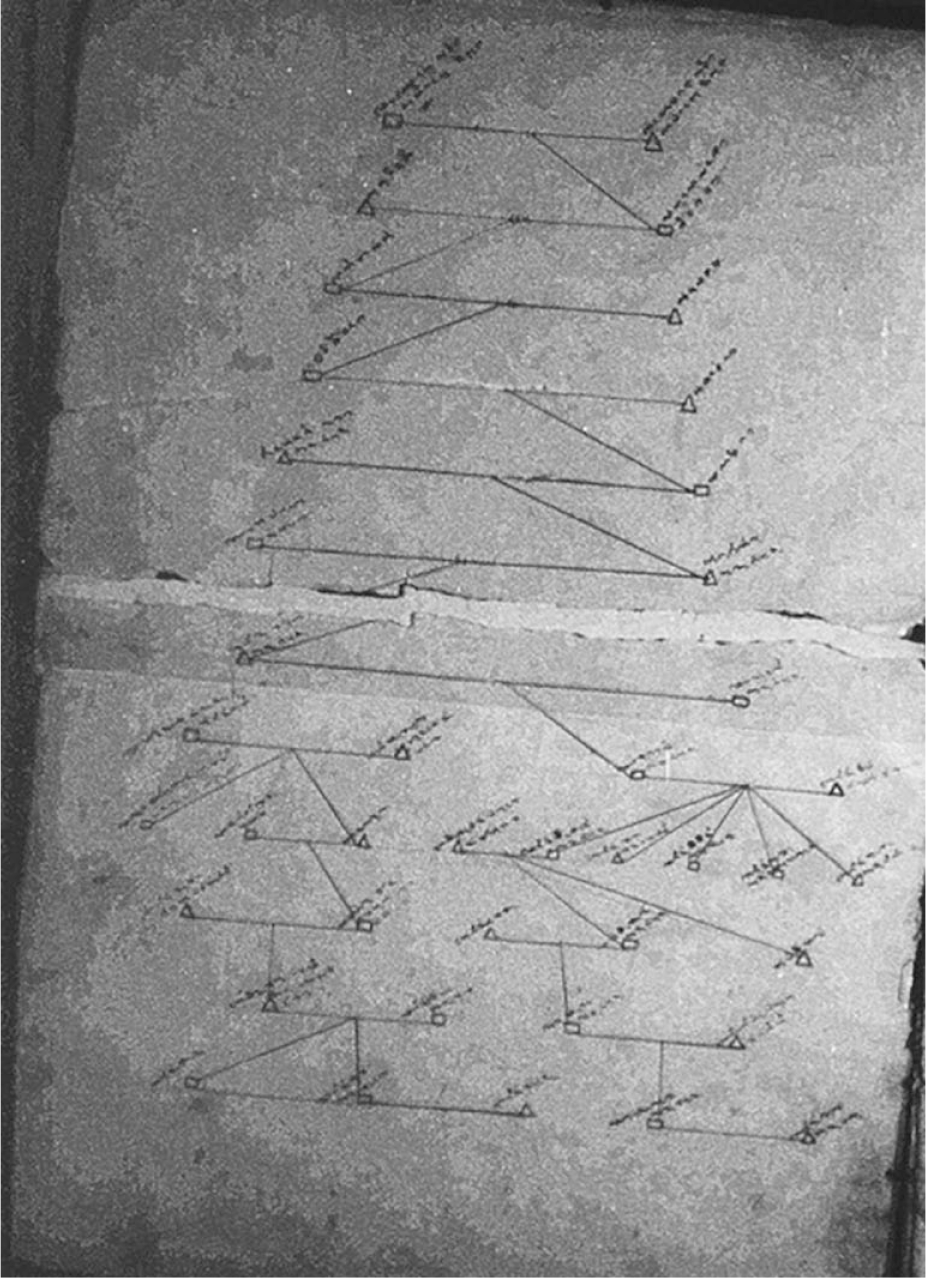
This genealogy of the rulers of Baringeng exemplifies the manner in which oral traditions can be frozen in time. It clearly shows the quantitative difference between information pertaining to the period before the advent of writing for which there are just two names per generation, and the period after the advent of writing for which there is much more information (Silsilah Arung Baringeng owned by Amran Latif, Proyek Naskah Unhas, No. 01/MKH/24/Barru/UP Rol 15 No. 24).
While the desire to record descent may have been the impetus for the adoption of writing, there developed a vast corpus of written literature. This includes episodes from the La Galigo and other oral traditions committed to writing, treaties, vassal and domain lists, poetry, and manuals pertaining to religion, military tactics and sex. Perhaps the largest category consists of texts pertaining to the past which are known as attoriolong meaning “about the people before.” This category includes diaries that were kept by elite members of society, historical poems, origin stories and chronicles. As this literature developed from the 17th century on, there may have been a concurrent rise in historical consciousness.
A number of factors would have influenced the rise of a historical consciousness among the peoples of South Sulawesi. These include contact with Muslims from the Malay world and elsewhere and with Europeans, especially Portuguese, in Makassar. Early 17th century rulers of Gowa and Talloq were exceptionally curious about the outside world and they developed an extensive library. Numerous members of Talloq’s court were reputed to speak fluent Portuguese and Karaeng Pattingalloang was said to have “had read with curiosity all the chronicles of our European kings” (Macknight, 2000: 329 citing Alexandre de Rhodes). The tradition of writing chronicles in South Sulawesi appears to have developed among the Makasars (Macknight, 2000: 329). It appears that the Chronicle of Gowa served as the model for the Chronicle of Boné which in turn served as models for the chronicles of other Bugis lands such as Wajoq and perhaps Tanété. 9 The chronicles are peculiar within Bugis historical literature because they are longer than other historical texts and because they are written using a restrained tone and straightforward prose (Macknight et al., 2020: 14–15). A third distinguishing feature of chronicles is that they exhibit evidence of deliberate selection of data for inclusion (Druce, 2009: 66–67). Cense argues the chronicles mark the start of true historical writing among the peoples of South Sulawesi and Macknight takes this a step further and argues that they mark the advent of a real historical consciousness (Druce, 2009: 71 citing Cense, 1951: 51 and Macknight, 2000: 322). Either way, it was indeed during the 17th century that the process of ascertaining, or speculating, which memories were suitable for inclusion in historical literature became more critical.
Chronicles are a distinguishing feature of Bugis historiography but they were only written in a few Bugis kingdoms. 10 Cina does not have one. Nevertheless, certain historical texts from the Cenrana valley refer to Cina. Most of these references are indirect and there are precious few texts that mention Cina by name. One rare example is the history of the founding of Pammana. 11 This text relates how La Sangaji Ajippammana, the twenty-second ruler of Cina, died childless. He therefore asked the ruling council and leaders of Cina to rename the polity after him (Abidin, 1983: 466; Matthes, 1864: 158–159). Aside from this text, Cina is only mentioned obliquely in Bugis historical sources. By “obliquely” it is meant that there are references to what probably was Cina without mentioning Cina by name. For example, the Chronicle of Boné relates how Boné expanded into Cina’s lands, specifically into Mampu (Macknight et al., 2020: 89). Here the Chronicle does not mention Cina by name but, considering the location of Mampu to the east of Amali, Mampu was very likely part of Cina. Similarly, the origin story of Soppéng suggests that what is now known as Soppeng was formed from the unification of West Soppéng, East Soppéng and Cina’s former tributary lands in the Walanae Valley. The text does not mention Cina by name, but may refer to its elites as “those whose ancestry could be trace to the age of Galigo” (Caldwell and Wellen, 2017: 307, 313). A statement in the Chronicle of Boné is likely a reference to Cina’s rulers. It reads “the earlier kings who went back to (La) Galigo had already organized (the conduct of) negotiations as well as of giving orders.” (Macknight et al., 2020: 84) This suggests that former rulers, that is, those of Cina, influenced the traditions of Boné and that the new kingdoms did not arise in a political vacuum.
There are also obscured references to Cina. One of these comes from the Chronicles of Wajoq which indicate that Sengkang was one of Luwuq’s four ancestral lands (Abidin, 1985: 202; Caldwell and Wellen, 2017: 315). This obscured reference differs from an oblique reference in that Luwuq is mentioned by name. The reference is, however, obscured because it would have been more accurate to have written Cina. Confusion may have arisen from the non-existence of Cina at the time of writing. Alternatively, the actual name of the polity may have been considered of lesser importance than the lineage of the ruling family. Because the genealogies of Luwuq and Cina both point to the same divine ancestor, Simpurusia, the lineages were confounded.
On the basis of the indigenous histories of the Cenrana Valley, it appears that there was a multifaceted memory loss regarding Cina. One element of the memory loss may have been forgetting. Cina had already ceased to exist when the tradition of historical chronicles developed in South Sulawesi during the seventeenth and eighteenth centuries (Macknight, 2000: 325–327). Therefore, Cina as a polity, as opposed to as a mythological kingdom, may have been largely forgotten, or only vaguely remembered, when the chronicles were written. A second element of this memory loss may have been inadvertent omission. Historians in the Cenrana valley might have considered it superfluous to mention Cina by name because they were focused on something else, specifically the lines of rulers and the histories of the newer kingdoms. A third element may have been intentional omission in order to bolster the image of the newer kingdoms and their ruling lines. Austronesian societies accord tremendous prestige to founding figures. Therefore, portraying rulers as pioneers and descendants of pioneers could have been preferable to portraying them as the heirs of Cina’s political system. It is reasonable to expect that the paucity and indirect nature of references to Cina in the historical sources from the Cenrana Valley resulted from a combination of all three factors; but it is of course impossible to interview the scribes and know for certain.
If an anachronistic term is permissible, the chronicles could be considered “nationalist” in the sense that they primarily record aspects of history that suit the political and social interests of the kingdoms and courts the describe. This is by no means unique among the Bugis. Historian Henri Chambert-Loir has demonstrated how traditional histories from elsewhere in Indonesia, specifically in Bima, were charged with legitimizing current governments in Bima (Chambert-Loir, 2000: 220–221). Like histories the world over, it appears that Bugis historiography is, unsurprisingly, influenced by politics and society.
The Royal Genealogy of Cina provides insight into how the Cina’s history may have been used during the 17th century. It appears likely that La Tenritatta Arung Palakka appropriated the genealogy of Cina to enhance his status. The Royal Genealogy of Cina begins with Simpurusia who, in the Bugis context, is one of the most, if not the most, prestigious ancestor a person can have. Fifteen generations later appears La Tenritatta Arung Palakka (Caldwell, 1988: 88–99). La Tenritatta Arung Palakka rose to great power through his military achievement but, within the context of South Sulawesi, achievement was insufficient for high status. High-status ancestors are also required. Although La Tenritatta could claim some status from his family links to rulers in both Soppéng and Boné, as the most powerful ruler in 17th-century South Sulawesi it seems likely that he would have wanted the most prestigious ancestor. He may have requested a genealogy linking him to Simpurusia, thereby manipulating genealogy to serve his social and political need for high status. As the member of a prestigious Soppéng family (Andaya, 1981: 43), it may also be the case that La Tenritatta Arung Palakka was descendant from the rulers of Cina. Either way, the fact that a version of the Royal Genealogy of Cina including La Tenritatta Arung Palakka this genealogy was committed to writing suggests that Cina’s prestigious lineage still retained importance in 17th century Bugis society.
The rise of the new historiographical genres allowed for new ways of remembering and forgetting. Written histories recorded Cina’s demise in oblique ways and made obscured references to its political influence. These were not, however, sufficient to keep the memory of Cina as an actual historical polity alive. Cina was therefore relegated to the realm of a mythological land during the modern historical period.
Cina and Allangkanangngé in the modern historical period: Separation of history and memory
With Cina having been written out of Bugis historical texts, Luwuq assumed the reputation of being the oldest Bugis kingdom and the concomitant prestige. This reputation came to prevail among both westerners and the Bugis themselves. The period following the Makassar War (1666–1669) might be considered as a transitional period. Thereafter, Luwuq’s prestigious reputation grew and Cina was relegated to the realm of the mythological.
A remarkable source for the history of South Sulawesi is the report of Admiral Cornelis Speelman, the Dutch commander during the Makassar War. The end of this conflict marked a new era in the Dutch presence on the peninsula. Thereafter the Dutch interfered directly and extensively in local affairs and enforced their own regulations among certain segments of the population. While their main interest was commercial, they were concerned with any aspect of local politics or social affairs that might influence trade and kept detailed records of their observations, activities and correspondences. Among the vast quantity of archives compiled, Speelman’s report is still exceptional. Having firmly re-established VOC presence in Makassar, he appears to have recorded as much information as he could for the benefit of his successors. His report includes population estimates, geographic descriptions and detailed histories based not only on what he witnessed but also on what he heard from others.
Speelman’s report is dated 1670 which is, incidentally, around the time that the Bugis were developing their own tradition of writing chronicles. By this time, Cina had long ceased to exist. It is therefore not surprising that Speelman does not mention it. Speelman does, however, mention Luwuq. He notes its former greatness, and how it lost strength with the rise of Makassar and Boné but maintained its prestige. 12 Speelman does not say that Luwuq was the oldest Bugis kingdom, but the enduring prestige he mentions resonates with Austronesian ideas of precedence.
It is not clear exactly when Luwuq assumed the reputation as the oldest Bugis polity. Cleary this happened at least as early as the 19th century. The 19th-century Dutch governor of Celebes D. F. Van Braam Morris refers to Luwuq as the “cradle of Bugis civilization” and the mightiest realm of Celebes from the tenth through the fourteenth centuries (Van Braam Morris, 1889: 546). Using the La Galigo as evidence, he further argues that Luwuq held sway over all the other lands of Sulawesi. Meanwhile Bram Morris does not accord any political importance to Cina. He does, however, mention Cina as the home of Wé Cudaiq and destination of Sawérigading (Van Braam Morris, 1889: 526, 551). This mention attests to Bugis mythological consciousness during the 19th century.
There was recognition of the relationship between the Cenrana valley and Luwuq, but it puzzled observers. James Brooke wrote “Ancient Luwu, however, embraced, according to Sir Stamford Raffles, the country to Chinrana, including the left bank of the Welluna. It is probable; but where, then, was Wajo?” (Mundy, 1848: 155). 13 Apparently Brooke did not consider the possibility that Luwuq’s component in the Cenrana valley had been swallowed up by new agricultural kingdoms. That is understandable because he was trying to understand the rise of Bugis civilization on the basis of Luwuq’s history, which is tantamount to trying to understand the rise of English civilization on the basis of Australia’s history.
Another observer, John Crawfurd suspected that the great lakes region, thus not Luwuq, may have been the original home of the Bugis. His suspicion appears to be based not on mythology or reputation but rather at least in part upon geography. He mentions that the waters in the great lakes region are navigable and that shores of the lakes are fertile, well cultivated and populated (Crawfurd, 1856: 74). While he does not mention Cina, he apparently considered the region’s fertility to be conducive to the rise of complex civilization. He may have even doubted how a multi-lingual population living in a swamp and surviving on the pith of palm-trees ever give rise to an agriculturally productive, monolingual society.
There are also memories of Luwuq in other parts of the archipelago. For example, numerous local histories from Timor mention Lub Lubu Makassal which refers to Luwuq-Makassar. People from Sulawesi are also explicitly credited with importing iron technology (Spillet, 1999: 140, 185, 313). While the Makasars are credited with introducing iron, the ore itself is likely to have come from Luwuq. Similarly, Luwuq is mentioned in the 14th century Javanese eulogy the Desawarnana (Robson, 1995: 34). 14 These references attest to the importance of Luwuq and its iron in the archipelago. Ascertaining how well-known these references to Luwuq are in popular, contemporary Timorese and Javanese historical consciousness would require further research. Clearly, however, Luwuq and its iron were not forgotten.
The 19th century Bugis ideas regarding the history of Cina and Luwuq are harder to trace than European ideas. This is partially because the tradition of writing chronicles did not continue to develop anywhere except Wajoq. The chronicles of Gowa, Talloq and Boné were written and then recopied. Additions and alterations were made here and there, but the overarching outline of these three chronicles remained largely the same. In contrast, the tradition of writing chronicles developed further in Wajoq. Here the paramount ruler of Wajoq La Mappayung Puanna Salowang (r. 1764–1767) ordered La Sagajo Puanna La Sengngeng, the regent of Bettempola, to write Wajoq’s history. The result was the Lontaraq Sukkuna Wajoq which seems to represent an attempt at an all-inclusive history. Subsequent regents of Bettempola added to this work. A significant portion of one version was then translated by Abidin (1985) and published in Indonesian. The Lontaraq Sukkuna Wajoq portrays Wajoq prior to the advent of humans as a thickly forested land replete with animals such as boars and deer (Abidin, 1985: 52–53). The portrayal of Wajoq as an open land is a common feature of the Wajorese origin stories. Descriptions of brave settlers opening new lands enhance the prestige of the community founders and their descendants. It is only in the founding story of Pammana, the part of Wajoq in which Allangkanangngé is located, that refers to Cina. In this story, it is explicitly stated that Cina is the old name for Pammana (Abidin, 1985: 65). At least on the local level, therefore, Cina appears to have been a source of prestige during the 18th century when the Lontaraq Sukkuna Wajoq was written.
Presumably it was only on this very local level that Cina’s prestige was preserved as Luwuq’s widespread reputation for being the oldest Bugis kingdom grew. Luwuq’s precedence became deeply embedded in the historiography. A striking example of this is Abdurrazak Daeng Patunru’s contention that Soppéng was founded by people from Luwuq (Abdurrazak, 2004: 94). An erudite connoisseur of Bugis historical manuscripts, Abdurrazak presumably based this contention upon indigenous sources. Whatever his source, the scenario he portrays is almost completely backwards. Soppéng had not yet coalesced into its present form when Luwuq was established, but it was people from the vicinity of Soppéng, or the areas to the immediate northeast of Soppéng, that went to Malangké and founded Luwuq (Bulbeck and Caldwell, 2000: 103–106).
There are a number of rituals currently in practice that may also have been used in the past. They might have helped memories of Cina and Allangkanangngé survive historical oblivion. Local archaeologist Aldi Mulyadi contends that Allangkanangngé has been in continuous use. 15 The concurs with the archaeological record indicating that Allangkanangngé was lightly used during the eighteenth and nineteenth centuries. It is not known, however, exactly how. If continuity can be assumed on the basis of rituals currently practized that contain elements of pre-Islamic beliefs, then it follows that Allangkanangngé was ritually used during the eighteenth and nineteenth centuries as well. These practices do not resemble the sort of topophilia or “unconscious attachment to place” that Randy Hester describes in his article “Subconscious Landscapes of the Heart” (Hester, 1985: 11). On the contrary, the local population’s attitude towards Allangkanangngé constitutes conscious reverence for a site and the heavenly ancestors associated with it.
This reverence is most immediately apparent in the presence of scores of model houses on and around the platform at Allangkanangngé (Figure 2). According to Aldi Mulyadi, people make pilgrimages to Allangkanangngé when they need assistance or wish to achieve something special. They make oaths, promising to return to Allangkanangngé if their endeavors are successful or if they recover from an illness. Later they come back to the hill to fulfill their pledges. People then build model houses exactly the same as the actual houses which they construct after enjoying good fortune. Realistic replicas, the model houses are a measure of success (Aldi Mulyadi, 2017, personal communication).
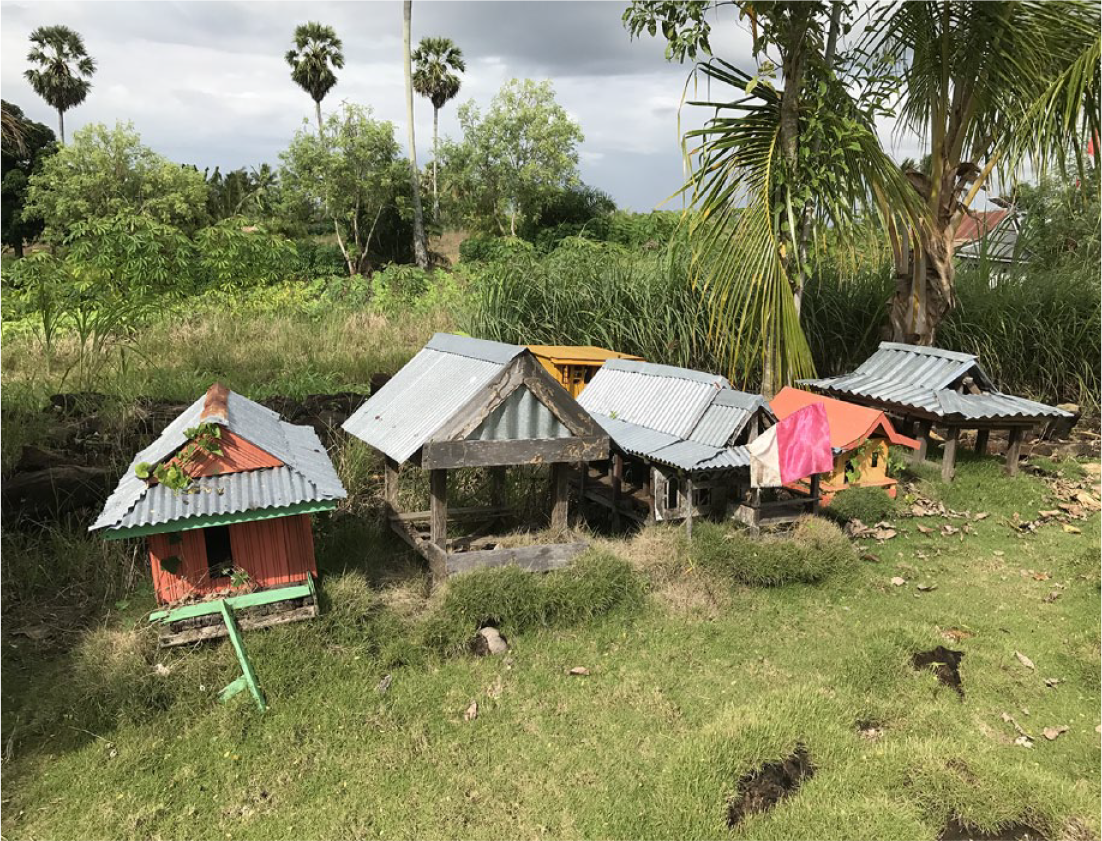
Miniature houses at Allangkanangngé.
Another manner in which this reverence is manifested is in ceremonies, ceremonies which also help to preserve the memories associated with the site. The hill is regularly used for pre-planting ritual known as pesta panin (Indonesian, hereafter I: harvest party). Replicating what they hope to do during the harvest, people symbolically husk rice and ask that the seedlings be blessed. The ritual focuses on the goddess Sangiang Seri who is conceived of as a shy girl. These rituals sometimes use a shaman known as a pinati (B). Sometimes people also sacrifice chickens or goats (Aldi Mulyadi, 2017, personal communication). These ceremonies resemble the sorts of commemorations that Nora describes are intentionally held at lieux de mémoire but, at least in the 21st century, they are organized by the local community rather than by the government. While impossible to verify, it is easy to imagine that similar ceremonies were held during the eighteenth and nineteenth centuries, and that these helped to keep the memory of Allangkanangngé as a palace site of Cina alive.
If current use can be projected onto the past, then Allangkanangngé might also have been a destination of pilgrims during the eighteenth and nineteenth centuries. While visiting the site as a cultural tourist in July 2017, the author by chance met two pilgrims, the cousins Jamaluddin and Hassani. Jamaluddin, age 49, hails from Ujung Semoling and lives in Parenring. This visit was his first visit to Allangkanangngé. His maternal grandmother was from Sarapao and she appeared in a dream and instructed him to come to the hill. He had heard that of all Bugis kingdoms, the oldest one was here. Jamaluddin was accompanied by his cousin Hassani, age 52, who lives in Watansoppeng. Hassani came for first time two years ago after recovering from illness. Hassani reported that others had been cured of skin diseases after coming here. He also said that he has frequently heard that Allangkanangngé is Cina. It should be said, however, that none of the small houses frequently built by pilgrims appear to date from the eighteenth or nineteenth centuries and projecting Jamaluddin and Hassani’s behavior on to the past is risky business.
It nevertheless appears that, in the case of Cina and Allangkanangngé, the paths of history and memory diverged significantly during the modern era. Luwuq’s reputation as the first Bugis kingdom was consolidated in Dutch and English language histories. Excluded from the historical record, Cina was firmly relegated to the realm of the mythological. Meanwhile, the continuation of the pre-Islamic rituals suggests that memories of Cina’s splendor, or at least that of its divine founding ancestors, were preserved at Allangkanangngé. Thus writing took over history as defined for purposes of this article but not memory. In an effort to reconcile the memories contained within the mythological record with the historical record, an age of chaos or darkness was conceived. Known as periode kegelapan (I, dark period), this was thought to be in between the period of the gods and the historical period (Depdikbud, 1978: 21). This idea gained currency but was ultimately untenable. Memory and history continued on different trajectories.
The separate trajectories of memory and history in this period is surprising because there is a very fluid boundary between oral and written literature among the Bugis. Many genres of Bugis literature can exist just as well as oral traditions as they can as written traditions and move freely from one register to the other. Granted the former allows greater freedom of expression than the latter but written texts can be used as an aide mémoire for the performance of oral traditions (Pelras, 2016: 33). The two are not as distinct as they are in the West. In the Bugis context the content is more significant than the form of preservation or register in which the content is preserved. Within this context texts from the La Galigo cycle are accorded tremendous respect. But the representations of Cina preserved in the La Galigo are still memories. Specifically they are memories preserved in literature and not critically selected evidence compiled into a historical text. The literary canon preserved memories of Cina which, in turn, would have facilitated the maintenance of folk memories about Cina. But the written historical record omitted Cina entirely. Histories of Cina appear to have been preserved in the oral register on the very local level because Allangkanangngé never lost its ritual and spiritual significance, but the overarching historical narrative relegated Cina to the realm of the mythological. The long period during which Cina was consigned to historiographical oblivion made it all the more spectacular when oral traditions about the significance of Allangkanangngé informed archaeological research, eventually leading to a new understanding of the rise of early Bugis society.
Cina and Allangkanangngé and the new paradigm in the digital age: Synergy of history and memory
The fourth and final period examined in this essay is one of complex and dramatic changes. The digital age arrived with exceptional speed in parts of South Sulawesi. During the 1990s the internet was on the rise in Makassar but many people in Bugis lands were still without telephones. They later skipped the phase of land lines and went straight to mobile phones. The smart phones that are now found even in rural areas offer many new ways for the sharing of histories and memories. At the same time as this digital revolution there was also a political revolution in Indonesia. Within a decade Indonesia went from being an authoritarian state to a democratic success. This has been accompanied by enhanced artistic expression and freedom of the press. This has fed a dramatic rise of ethnonational historiographical discourse which now co-exists alongside nationalist historiography. Meanwhile, academic understandings of Cina and the rise of complex civilization among the Bugis have changed radically. Yet despite the technological possibilities for communicating this new understanding and the enhanced cultural space available for ethnic histories, the lost kingdom of Cina has hardly entered historical consciousness.
Cina, Luwuq and the La Galigo in modern ethnonationalist historiography
As Indonesia’s borders were shaped by the aftermath of European imperialism, the creation of a national identity and the development of nationalist historiography have been important, intertwined issues. Nationalist history has been carefully curated by the government to promote the integration of the archipelago into a singular, governable political unit. One key theme has been anti-colonial struggle. Another key theme has been the military nature of this struggle, an emphasis which serves to promote acceptance of the role of the military in society. Both of these themes are applied to wide-ranging situations in Indonesia’s history. Under Sukarno (1945–1966) and Suharto (1966–1998), these two themes were localized by the honoring of historical figures from different parts of the archipelago. More than one hundred individuals were canonized as pahlawan nasional meaning “national heroes,” most commonly for their roles in anti-colonial or revolutionary struggles. The framework of national heroes, canonized by law and celebrated annually, provides a framework for disparate regions to contribute to the national history and for the government to harness the archipelago’s diverse histories for nationalist purposes. In some instances, an unrealistic unity has been projected upon the past to support the anti-colonial narrative. This is exemplified by the portrayal of three disparate anti-colonialists as pahlawan tiga sekawan meaning “three hero friends.” This refers to three anti-colonialists from three disparate regions. There is no evidence of them having known each other and yet their stories were merged and appropriated to serve the nationalist historical narrative (Fogg, 2019: 1–5).
Since the end of the Suharto administration in 1998 there has been significant change towards political decentralization and regional autonomy. Historiographically, this has resulted in the proliferation of historical debates in the public sphere and the rise of ethnic consciousness (Van Klinken, 2005: 237, 247). This has also occurred simultaneously with the relaxation of laws limiting freedom of the press and the rise of the internet. The result has been a staggering increase in the production and circulation of historical media. Much of the focus has been upon the 1965 attempted coup and the mass killings (Ashton et al., 2019: 95). Arguably, however, the most striking development is the rise of ethno-nationalist historiographical discourses across the archipelago (Van Klinken, 2005: 248). This historiography can and does serve political and/or economic purposes. For example, in recent years there have been campaigns to canonize historical figures as national heroes so as to facilitate the political purposes of their descendants (Fogg, 2019: 17). On the cultural level, however, there has also been sincere delight with the increased recognition and celebration of local cultures.
One of the manifestations of this has been renewed appreciation and use of local wisdom or kearifan local. This trend is not specific to Indonesia, but the rise in regional autonomy since 1998 has resulted in the accordance of additional importance to local wisdom across the archipelago. It has been key in the development of cultural tourism, especially on Bali where the tourist industry is expected to include Balinese cultural nuances (Pradana, 2017: 188). Local wisdom has also played a role in the management of natural resources in diverse areas. Examples include Papua where a local philosophy known as tiaitiki functions as a control against the overuse of maritime resources (Persurnay, 2018: 4–5). Indonesian identity has long been perceived as the amalgamation of the archipelago’s diverse cultures, but arguably there is more space for local culture in the 21st century than at any other moment since independence.
The province of South Sulawesi is no exception. Since 1998 South Sulawesi has witnessed significant, localized instances of these national trends, both political and cultural. B. J. Habibie (1998–1999), the first president immediately after the fall of Suharto, was from Parepare on the west coast of the peninsula and his Bugis heritage was a source of tremendous pride in South Sulawesi. A week prior to the end of his brief administration, he authorized the reversion of the name of South Sulawesi’s capital from Ujung Pandang to Makassar, reflecting its prestigious past as a center of international trade. Within a few years, eleven of the province’s twenty-four regencies had called for separation, resulting in the creation of the province of West Sulawesi in 2004 (Morrell, 2001: 437–438). In the cultural realm, increased regional autonomy is marked by two trends in South Sulawesi. The first is a resurgence of Islamist politics. While this is a widespread trend, in South Sulawesi it evokes memories of the mid-20th century Darul Islam rebellion that aimed to transform Indonesia into an Islamic state. There has not been much of a resurgence of Kahar Muzakkar’s ideas, but the Islamic resurgence calls this past to mind. The second is a resurgence of interest in the Bugis mythological literature the La Galigo which is a source of regional pride and the inspiration for a variety of theatrical performances and publications (Robinson, 2011: 219–220). The La Galigo has also been the subject of two major international seminars held in Barru in 2002 and Watansoppeng in 2018 (Macknight, 2003b; Macknight and Hadrawi, 2019).
The La Galigo has loomed large in post-1998 South Sulawesi. Irrespective of whether or not the La Galigo has been accepted as a historical source in academic discourse, it has assumed a very significant role in popular culture. Indeed in 2016 one reporter even hailed the La Galigo Indonesia as the real Indonesia. 16 Furthermore the La Galigo quite literally has represented Indonesia on the international stage. In 2004 Robert Wilson staged a theatrical performance entitled I La Galigo which was based on the La Galigo. It debuted in Singapore, after which it was performed in Europe, Australia and the United States. Only in 2011 was it staged in Makassar, the capital of South Sulawesi, where almost all tickets sold out (Varney et al., 2013: 182–183). Arguably the production may have facilitated the inclusion of some manuscripts of these Bugis mythological narratives in UNESCO’s Memory of the World register as mention of the theatrical adaptation was included in the application (Paeni and Tol, 2010: 6).
The La Galigo is also featured in social media. As of July 2019, the FaceBook page of I La Galigo Passompe’E is followed by 12,011 people who post on a variety of topics including Sawérigading’s trip to Cina. While #Sawerigading shares Tweets about football in Luwu 17 and the genealogies contained in the La Galigo, references to the La Galigo on Twitter are dominated by a diving shop based on Bali. There is also a La Galigo Foundation with an as of yet small-scale online presence. They are an agricultural project, aiming to help cacao farmers in Sulawesi. They draw inspiration from lessons in the La Galigo, in particular the cutting of a Wélénreng tree which encourages treating nature with respect, 18 but their Facebook and Instagram accounts pertain to the environment and cacao cultivation rather than Bugis culture.
The La Galigo features very prominently in the Lontara Project. 19 This project seeks to promote the La Galigo in particular and Indonesian culture in general among Indonesian youth. It uses familiar channels such as FaceBook, Instagram, audio clips and comics to reach a wide audience. The La Galigo is well represented on the project’s website which has a section entitled “La Galigology.” A complete synopsis of the La Galigo is left to the realm of academics but there is a three-paragraph summary. The website also contains information about Sawérigading’s travels and the famous and longest La Galigo manuscript NBG 188. Furthermore, there is also an article comparing the La Galigo to The Lord of the Rings which serves to link traditional Bugis culture to an internationally popular English literary work. A passionate group of young Indonesian writers and artists, including members of the Lontara Project, is producing a picture book about entitled Pakkuruq Sumangeq: La Galigo Visual Book (Buana and Jiecess, forthcoming). The introduction states that they draw their inspiration from the 19th century scribe La Rode who illustrated a copy of the La Galigo now kept in Middelburg, the Netherlands. However, part of the inspiration stems from the experiences of one of the Lontara Project’s founders, Louie Buana.
The Indonesian cultural activist Louie Buana became acquainted with the La Galigo when he moved to Makassar in 2003. This was the year after the La Galigo seminar in Barru in March 2002 and there was considerable information about the La Galigo on television and in the newspapers at that time. For example, the newspaper Fajar published a syndicated version of stories from the La Galigo every week. Buana remembers looking for information about the La Galigo in Gramedia bookstore and, because he was still in elementary school, being disappointed that there was nothing with pictures. As a university student in Yogyakarta, he met other students with roots in Sulawesi who wanted to improve the image of South Sulawesi. Working independently from the South Sulawesi diaspora culture group KKSS, 20 Buana and three others started the Lontara Project in 2012. Reactions to the project have been largely positive and Buana was invited to attend an international conference about the La Galigo in Soppeng 21 in December 2018. While he had prepared a lecture pertaining to customary law, his field of study, the lack of young people at this festival and the manner in which participants were using their smart phones inspired him to make a speech that might appeal more to the younger generation; thus he spoke about aspects of the La Galigo that he saw in the Netherlands, including La Rode’s illustrated version. 22
While the Lontara Project is emblematic of the rise in ethno-nationalist historiographical discourses described by Van Klinken, it is but one of many. Many other people have used social media to discuss and promulgate information about early Bugis history.
Luwu(q) attracts more attention on social media than the La Galigo, almost certainly because of the existence of the three regencies of Luwu. With 50,357 members as of July 2019, the Sejarah Tana Luwu FaceBook group aims to share information about the history and culture of Luwu(q). There are dozens of twitter accounts featuring #Luwu but these are largely relating to contemporary events, sports and politics in Luwu rather than public history. Information about the history of Luwu does appear on twitter, however, in the accounts of such organizations as Tribun Timur and KepriTV. More popular avenues for disseminating information about early Bugis history than Twitter or FaceBook are blogs. These allow for longer posts with detailed information and more opinions. For example, in 2013 one blogger by the name of Etha Sriputri wrote a blog entry about the history of Luwuq that consisted of almost 50,000 words. It sketches the history of Luwuq from its origins until the mid-20th century and includes many citations. As the writer was somehow affiliated with Hasanuddin University and only wrote two entries, it might be that she simply created the blog as an online forum for her research papers. Even in instances of more concise entries, there are also examples of short-lived blogs. A blog by Reza Suarga only features one post. It pertains to Bugis history with an emphasis on pre-colonial and overseas Bugis history. 23 A little over a year after Reza’s blog appeared, this content was translated into Indonesian and posted on a blog by the name of Suharto Atto. 24 This blog deals with a wide variety of subjects ranging from how to sleep well during Ramadan to lyrics of popular Katy Perry songs. Indeed, the subjects are so diverse and so distantly related to history that it seems probable the post about Bugis history was selected on a whim. Be that as it may, such blogs represent a public interest in early history. They also represent an enthusiasm for sharing cultural heritage.
Another blogger named Muhammad Rijal posts much more frequently about South Sulawesi and his blog includes seventeen entries categorized as culture. 25 Among these are posts about the early history of Luwuq. One particularly interesting post dates from 2012. Entitled “Is ‘Luwu’ an Ethnicity? And is Toraja included among Luwu’s twelve children?” it interrogates the meaningfulness of Luwuq as a category. 26 The post addresses this issue from a variety of perspectives. One perspective is that of the La Galigo which, according to Muhammad Rijal, suggests that Toraja, Baebunta and Pamona were not yet part of Luwuq at the dawn of the Galigo age. He further argues that that Toraja and other affiliates of Luwuq joined later through conquest or voluntary association. The blogger also tries to establish a link with Majapahit on the basis of convoluted (and obsolete) geography and suggests that this link with Majapahit may have inspired Torajans to join Luwuq. Thirdly the blogger looks at modern administrative divisions in Sulawesi and argues that even though modern laws split Toraja and Luwuq, the ancestors did not. The arguments are by no means conclusive. However, the post acknowledges the close relationship between Torajans and Luwu(q) Bugis and suggests a public recognition – or at least the need for public recognition - of this relationship as well.
Academic research presents a picture that is not entirely dissimilar. Linguistic research, for example, has revealed a close relationship between the Torajan and Bugis languages, much closer than the relationship between Bugis and Makassarese even though those two languages are often grouped together (Mills, 1975: 217–219). Archaeological research shows that Luwuq was a polity founded by Bugis migrants from the Cenrana Valley who established important relationships with their new neighbors near Mori and Baebunta (Bulbeck and Caldwell, 2000: 103–104). These neighbors included Torajans who descended from the hills into what eventually became known as Bugis lands and became important to Luwuq’s military machine and its iron industry. Some of these hill peoples eventually converted to Islam and assumed new ethnic identities. Thus, while Muhammad Rijal’s reasoning is arguably flawed and certainly does not follow the same logic as academic discourse, his idea that the Torajans and Luwuq Bugis are close is correct. One might surmise that, even though the results of recent research are not well known, there is some sort of memory or recognition of a connection between the Luwuq Bugis and the Torajans. Interestingly, Muhammad Rijal does not mention the Bugis slave raids into Tanah Toraja.
Cina attracts less attention than Luwu(q) on social media, but it is still discussed. In 2015 a Wajorese software developer named Alifah Alif Ayli Yoes posted a video entitled “Hikayat Allangkanangnge.” 27 The film’s substance is a documentary about Allangkanangngé that appears to have been made as part of a school project. The film presents a timeline that is very much in line with archaeological research, such as the rise of Luwuq and Cina around 1200–1400, their loss of influence to the newer kingdoms of Boné, Soppéng and Wajoq, and the decline in the use of Allangkanangngé during the 17th century. There are also videos of interviews with the cultural custodian Bapak Salama and a visit to Allangkanangngé. The video accords tremendous importance to La Sattampugi as the first ruler of Cina and argues that the ethnonym Ugiq, which is Bugis for “Bugis,” comes from his name. The makers of the video appear to have a good knowledge of archaeological data pertaining to Allangkanangngé as of 2015. At this point in time, the results of the 1999 excavation, but not the larger, more extensive 2005 excavation, of Allangkanangngé had been published and translated into Indonesian. Perhaps Bapak Salama’s perspective is a mixture of his own knowledge, retained in the memory of his community, and information gained from interaction with the archaeologists.
In contrast with the video “Hikayat Allangkanangnge,” other popular videos present a more outdated vision of Luwuq’s antiquity. On 1 December 2018 Muhammand Ikhsan Ibrahim posted a video entitled “The History of Sulawesi 40,000 BCE – 2018 CE.” 28 This is part of an educational series of videos about the historical geography of Indonesia. It pushes the disproven idea that Luwuq is the oldest Bugis kingdom to the extreme. “To Luwu” appear as an ethnic group around 200 AD and Luwuq itself around 600 AD. Luwuq is portrayed as covering half of Sulawesi by AD 1000. Cina appears on this video’s map around 1200. Then, this video portrays Cina as being very small by the late 15th century and as having completely disappeared by 1500. That Cina has disappeared by 1500 is almost certainly correct but not that it post-dated Luwuq by six (!) centuries. Furthermore, it is very problematic to represent Cina as a geographically bounded and contiguous polity. That being said, Cina’s inclusion in this recent video about the history of Sulawesi is significant. In this video Cina is represented as a polity that actually existed as opposed to a mythological kingdom. The timing is also very curious. It is possible that the producer was aware of 21st century research pertaining to Cina, and this may have influenced the representation of Cina as polity. However, the video still portrays Luwuq as older than Cina, which may exemplify how deeply engrained the idea that Luwuq is the oldest Bugis polity has become.
In this historiography Cina has played a very small role. Cina’s small place in contemporary popular historical literature is well exemplified by the fact that there is no entry for Cina in the Historical Encyclopedia of South Sulawesi until 1905. Cina is, however, mentioned in passing in the entry for I La Galigo. This entry states that Cina is the origin place of Wé Cudaiq. It does not mention Allangkanangngé but rather Sumpang Aleq. Sumpang Aleq is the former name of La Paukeq and the site of Cina ri Lao which archaeological evidence indicates somewhat eclipsed Cina ri Aja of which Allangkanangngé was the palace site. This may indicate that the memory of La Paukeq is more recent or better remembered in the author’s sources or by the author’s informants. According to the La Galigo, Wé Cudaiq was a princess from Cina and the wife of Sawérigading. That there is neither an entry for Wé Cudaiq in the Historical Encyclopedia of South Sulawesi until 1905 nor for Cina (Mappangara, 2004: 97–98) strongly suggests that both are relegated to the realm of the mythological. Although memories of Cina were retained by elders like Bapak Salama, Cina was not something that most academic historians took seriously, nor was it part of the overarching Bugis historical narrative.
Allangkanangngé as a lieu de mémoire
In recent decades there have been huge strides in academic understandings of the rise of Bugis civilization. These depended upon local memories of Allangkanangngé as a palace site of Cina. Memories of Cina had been canonized in the La Galigo, but without information from the local community, archaeologists would not have known where to dig. In this case the localized memories of the communities in Sarapao and La Paukeq villages had a huge impact on archaeology and history. In contrast, the impact of archaeology and history on memory has been negligible. By and large, Luwuq continues to be remembered as the oldest Bugis kingdom.
The extent and role of Cina was, in a sense, the missing piece in previous academic understandings of the rise of Bugis civilization. The OXIS project established scientific basis for associating Allangkanangngé and La Paukeq with Cina, but researchers assumed that Cina’s importance had been exaggerated in the La Galigo. Because other parts of the valley were occupied by the polities of Wajoq, Soppéng and Boné, they also assumed that Cina was small and to the east of Allangkanangngé (Ian Caldwell, 2014, 2019, personal communication). Only in 2014 when Caldwell and Wellen systematically interrogated the geography of the Cenrana valley genealogies did it become apparent that Cina was a significant pre-historic entity. Their research demonstrated that Cina exerted influence over a wide area and that it was subsequently incorporated into new agricultural kingdoms which still exist today. The results of this research were published in 2017 and immediately translated into Indonesian.
This new paradigm is significant because it reconciles the mythological and historical records. When presenting the findings at a conference in Makassar in December 2015, Caldwell noted the gleeful reception of the audience. Attendants were visibly pleased with the manner in which this new paradigm reconciles the differences between the images of early Bugis history presented in mythology, historical chronicles and archaeology (Ian Caldwell, 2016, personal communication). The reconciliation also suits the agenda of local scholars who, even if they do not believe the La Galigo, still have an emotional attachment to it. Nevertheless, there has been little impact on public history. An astute observer at the La Galigo conference in Soppeng in December 2018 was not able to discern if there already was or was not yet an awareness of a new paradigm for early Bugis history in which Cina played a significant role (C. C. Macknight, 2019, personal communication). Despite the importance of the discovery and the speed with which knowledge supposedly travels in the information age, it had not appeared on Facebook. Visitors to Allangkanangngé like Hassani have heard about Cina as the first Bugis kingdom, but this information comes from their elders and not from the media. Clearly memories of Allangkanangngé were better preserved among the local population than among professional historians. Meanwhile, people in Luwuq still sometimes associate Cina in the La Galigo with China in East Asia and they may prove resistant to the new paradigm in Luwuq because it undermines Luwuq’s claim of being the oldest Bugis kingdom. While remembered, Allangkanangngé ri Latanété is popularly known as the location of Wé Cudaiq’s palace (Louie Buana, 2019, personal communication).
The regional and national governments have responded very differently to the new paradigm. Both are trying to use Cina for their own purposes.
On the local level, the Wajorese government is trying to use Cina to diversify the tourist industry. Currently most tourists come to Wajo to see Lake Tempe, and the government would like to promote other destinations. Steeped in ritual and mythology, Allangkanangngé has the potential to attract cultural tourists. At some point between the archaeological verification of Allangkanangngé as a palace site of Cina during the 1990s and the publication of “Finding Cina” in 2017, the government of Wajo decided to build a new road to Allangkanangngé in hopes of developing it as a tourist destination. The construction of the road might reflect a social need for easier access to the site. With the rise of regional autonomy in Indonesia, local traditions are being revitalized. There are, however, competing demands for resources and changes in the local government, and as of January 2019, the road had not yet been completed. While the cultural climate is favorable, Allangkanangngé has not (yet?) experienced a boom in popularity with tourists (Aldi Mulyadi, 2019, personal communication).
On the national level, a writer for the Indonesian government’s website has tried to use Cina to push the national historical narrative back in time. In June 2019 an article about Cina was published on a website of the Indonesian government. 29 Published without a byline, it is entitled “The Datu-realm Cina, History of an Ancient Bugis Kingdom” (Kedatuan Cina, Riwayat Kerajaan Bugis). It summarizes the article “Finding Cina: A New Paradigm for Early Bugis History” which Caldwell and Wellen published in 2017. It further makes a comparison between the decline of Cina and the decline of Cirebon. It states that “the disappearance of Cina, around the 16th century, resulted from the start of the domination of other realms that also partly resulted from colonialism.” The most striking element of this comparison is the implication that the demise of both Cina and Ceribon were due to colonialism. Whatever the role of the Dutch in the decline of Ceribon, the demise of Cina cannot be attributed to colonialism, not even partially. This unrealistic comparison exemplifies a tendency to employ history for nationalist purposes.
As is the case with other nationalist historiographies, it would appear that accuracy is not of paramount importance to the Indonesian nationalist historical discourse. Klaus Schreiner has argued that the Indonesian nationalist historiography casts the entire history of relations between the peoples of Indonesia and the Netherlands, spanning more than four centuries, as an anti-colonial struggle (Schreiner, 1997: 271). For example, in the aforementioned case of the three hero friends, their struggles were first appropriated and then unrealistically amalgamated in order to promote unity and nationalism. In the case of Cina, the anti-colonial sentiment gets pushed back even further in time to the 16th century, prior to the advent of Europeans. The anti-colonial or nationalist view of the fall of Cina espoused in the website article is not only impossible but also extremely limiting. It precludes the dynamics of pre-colonial history and, concomitantly, Indonesia’s pre-colonial past. The anonymous author could have glorified the manner in which people from the Cenrana valley imported iron so as to expand agriculture long before the advent of the Europeans. He or she chose instead, however, to relate this history to colonialism, regardless of chronology. The dynamic Schreiner describes is thereby pushed backwards into the pre-colonial past.
The Wajorese and Indonesian governments’ interests in Allangkanangngé and Cina might prelude the institutionalization of Allangkanangngé as a lieu de mémoire à la Nora. It remains to be seen if the new paradigm will trickle down and how Bugis society will respond to it, let alone if the construction of the road will be completed and what the effects might be on Sarapao. But social recognition of the academic paradigm, and institutionalization of the site as a tourist destination might be superfluous within the context of memories of Allangkanangngé and Cina. Indeed, history might be superfluous in comparison to the strength of these memories. Despite Cina’s historiographical oblivion, the local population has maintained memories of Cina and Allangkanangngé. Furthermore, there is no discernable sign of them losing interest.
“That other form of memory”
Cina and Allangkanangngé provide an unusual opportunity to examine the ways in which memory and history interact. History did not supplant memory, nor vice versa; rather they played off of each other in different ways over the course of half a millennium. During the pre-historical period, Cina possessed cultural capital. In particular Cina’s founders, who may or may not have been real people telescoped back into a mythological past, were a source of prestige. This is reflected in the La Galigo cycle and in the frozen oral traditions contained in the genealogies of Cina, Luwuq, Baringeng, Bunne and Timurung, all of which start with Simpurusia. Memory predated history.
By the advent of the historical period, Cina had long ceased to exist. It was not entirely forgotten but it was certainly less relevant to social circumstances than previously. Thus as historians made conscious decisions about what they wrote, they largely excluded Cina, including only shadows of Cina’s legacy. History included memories selectively.
As Cina receded further into the distant past during the modern period, its prestige was co-opted by its rump kingdom Luwuq. The idea that Luwuq is the oldest Bugis kingdom became deeply engrained in Western and Indonesian historiography. Meanwhile, memories of Allangkanangngé and Cina persisted. Following a completely different path from history, they were maintained through mythology and ritual.
Having survived centuries of historiographical oblivion, memory came to history’s rescue. It informed archaeological research, allowing for the positive identification of Allangkanangngé as a palace site of Cina. This allowed for a geographically-informed inquiry into the indigenous historical sources of the Cenrana valley which in turn allowed for the reconciliation of the archaeological, mythological and historical records.
What happens next, in the digital era of otonomi daerah (I, regional autonomy), remains to be seen. What is clear, however, is that memory is resilient. It can serve, feed, resist and synergize with history. Indeed, the ways in which memory and history can and do interact are so varied that they cannot conveniently be telescoped into Tönnies’ or Nora’s chronological periods. They resist the imposition of temporality. This may be exceptionally true among the Bugis. Even after the rise of a new historical consciousness during the 17th century, older ways or relating to the past persevered. Furthermore, even half a millennium after the introduction of writing, orality remained the main medium for transmitting the past among the Bugis (Druce, 2016: 98–99; Druce, forthcoming).
The ways in which memories and histories of Cina and Allangkanangngé interacted over the centuries are clearly and undeniably dependent upon particular circumstances. Perhaps most significant among these is the overlap between the written and oral registers described by Pelras. In a valuable article about the imbrication of oral and written literature among the Bugis, Christian Pelras argues that the two worlds overlap in ways that are alien to western culture. He points out that “an oral utterance is, by its very nature, ephemeral. The wish to make it endure is, if one thinks about the matter, a long shot. The reality is, though, that this can come off and human memory can sometimes measure up to that other form of memory which written texts provide.” (Pelras, 2016: 33–34) This is what happened in the Cenrana valley.
Footnotes
Acknowledgements
The author researched and wrote this article as part of her duties as an employee of the Royal Netherlands Institute for Southeast Asian and Caribbean Studies
Declaration of conflicting interests
The author(s) declared no potential conflicts of interest with respect to the research, authorship, and/or publication of this article.
Funding
The author(s) received no financial support for the research, authorship, and/or publication of this article.
