



Abstract
This article analyses the role commemoration of Fascist and anti-fascist martyrs played in the battle for political influence in the Italian diaspora of the United States during Mussolini’s early rule. It is structured around two case studies: the socialist leader Giacomo Matteotti, killed in Rome in 1924, and Giuseppe Carisi and Michele Ambrosoli, two Blackshirts killed in the Bronx on their way to the Memorial Day parade of 1927 in New York. Through an examination of sites of memory and commemoration ceremonies held in both Italy and the U.S., it adds a transnational element to the study of the role of secular martyrdom in the construction of collective identity, concluding that the transnational exchange evident in commemoration of both case studies added to the propagandistic power of the martyrological narrative by drawing meaning from geographical distance from Italy.
In September 1927, Domenico Saudino, the Italian American writer, anti-fascist and later councillor for the Italian Socialist Federation in the United States, wrote to Albino Zattoni, one of the organisers of the New York-based socialist association the Matteotti League. In his letter, he expressed his discontent at the inclusion of Fascist Blackshirts in the upcoming Columbus Day celebrations of October 1927, concluding: ‘But we will have our own counter-commemoration, as we have in other years, and hopefully our loudspeaker will be more powerful than that of the Blackshirts’. 1 Saudino’s letter points to the major theme of this article: the way Fascist and anti-fascist rituals in U.S. public space became part of the battle for political influence in the Italian diaspora.
Marking a point of divergence with existing research into the commemoration of martyrs during the ventennio (Berezin, 1997; Falasca-Zamponi, 1998; Foot, 2009; Staderini, 2008; Suzzi Valli, 2008), and reflecting an increased focus on ‘the “travels” of memory’ (Erll, 2011: 11) in memory studies more broadly, this article addresses the public, transnational commemoration of Fascist and anti-fascist martyrs during the early years of Mussolini’s rule. Through analysis of two case studies – commemoration of Giacomo Matteotti, the socialist leader killed in Rome in 1924, and Giuseppe Carisi and Michele Ambrosoli, two Blackshirts killed in the Bronx on their way to the Memorial Day parade of 1927 – the article considers the functions and implications of transnational memory practices (defined here as those influenced by more than one nation state – in this case, Italy and the U.S), arguing that the locating of commemoration several thousand miles from Italy strengthened the martyrological narrative through the inherent suggestion that personal sacrifice could not be contained by the nation state. Forming part of Mussolini’s early imperialist rhetoric, the ceremonies held to commemorate fallen Blackshirts in New York celebrated the global reach of Fascist ideology. Anti-fascists counteracted these public performances of Fascist support through commemoration of martyrs like Matteotti, who symbolised the violence of unchecked Fascist power. In short, the transnational transmission of martyr memory broke the boundaries of the nation state and created a space in which Fascists and anti-fascists could use the powerful symbol of the martyr to exert influence within and beyond Italy’s borders.
The notion of secular martyrdom in Italy has inspired critical inquiry among scholars: Riall’s (2010) work examines the use of ‘martyr cults’ by religious and nationalist movements during the Risorgimento; Mancini’s (2015) monograph Il martire necessario charts the evolving narrative of martyrdom from Unification to the fall of Fascism; Falasca-Zamponi (1998), Suzzi Valli (2008), Staderini (2008) and Foot (2009) have considered the rituals and rhetoric of Fascist martyrdom; Gundle’s (2000) work on the civic religion of the Resistance reflects on the construction of the partisan martyr – a theme examined by Schwarz (2010) in his study of the new Republic’s commemoration of its dead post 1945; while Scolari (2017) has identified the creation of state martyrs during Italy’s Years of Lead. This existing scholarship has continued to privilege the nation state as the ‘container-culture’ (Erll, 2011: 7) of the collective identity that has been built upon the pantheon of martyrs at various turning points in Italian history, mapping martyr memory onto Italy’s national territory. This article seeks to redress this focus on Italian territory as the container of martyr memory and considers the intentional transposition of memory into new national contexts and the subsequent creation of transnational martyrological narratives that represent and celebrate personal sacrifice as existing above and beyond the nation.
Erll (2011: 8) has argued for a move away from the nation state as the framework for memory studies more broadly and highlights the ‘fuzzy edges of national memory’, blurred by the many ‘social classes, generations, ethnicities, religious communities, and subcultures [who] all generate their own, but in many ways intersecting, frameworks of memory’. Erll (2011: 8) therefore proposes Welsch’s (1999) concept of ‘transculturality’ as a way to think about culture, which extends ‘across and – eventually, as a result of the contemporary process of globalisation – also beyond cultures.’ This notion of ‘transcultural memory’, Erll (2011: 9) writes, can be used as an ‘umbrella term’ (which includes the transnational and diasporic studies) denoting a ‘research perspective [. . .] directed towards mnemonic processes unfolding across and beyond cultures.’ Given Italy’s many diasporas, to borrow the title of Gabaccia’s (2000) work, as well as the transnational exchanges that occurred in Fascist and anti-fascist circles as each movement sought international influence, I contend that this transcultural research approach is particularly relevant to the study of this period as both groups sought to gain support in Italian communities abroad. I will argue that the transnational quality of memory was an intentional feature of Fascist and anti-Fascist commemoration of their respective martyrs, and one that conveyed a powerful ideological message.
The article begins by considering the historic use of the term ‘martyr’ within Socialist and Fascist culture. Next I provide an overview of migration from Italy to the United States in the 20th century, including an outline of how support for Fascism in Italian communities of the United States evolved, and an introduction to the development of Italian American anti-fascism. The subsequent analysis is divided into two parts: the first half examines commemoration of Giacomo Matteotti as a form of protest against support for Mussolini in the U.S., considering commemorative rituals and a planned monument. The second half considers public commemoration of Carisi and Ambrosoli, who were first honoured as martyrs in New York public space before being transported back to Italy for a second funeral. Together, the case studies present the national and transnational spheres of remembrance in public space, showing how they interlocked and influenced one another.
Martyrdom relies upon individuals or institutions to create the martyrological narrative; it is, after all, ‘rhetorically constituted and discursively sustained’ (Castelli, 2004: 173). In order to understand the construction and maintenance of the martyrological narrative, the analysis here focuses on how martyr memory was discussed by and conveyed to the public through speeches, newspapers, rituals and monuments. The article seeks to address the following questions: What role did commemoration of an Italian anti-fascist martyr play in the Italian diaspora of the United States? How did Mussolini’s regime leverage the memory of two Blackshirts killed in the Bronx?; And what role did secular martyrdom play in the day-to-day struggle between Fascism and anti-fascism in the United States?
Martyrdom and political identity
Stories of martyrdom have historically been incorporated into both socialist and fascist culture, as examined in existing scholarship. Te Velde’s (2013) work on early socialism and 21st-century populism considers the origins of socialist parties in the late 19th century and highlights early socialists’ uncertainty about entering formal politics. He writes (2013: 37): ‘The religious language was connected to this phase. It signified that their movement was more than ordinary politics: it was a “faith”, with a “Messiah” and so on’. The term ‘martyr’ was part of this quasi-religious culture, and many slain socialists including Matteotti were remembered as such. In his work on the socialist death cultures of Belgium and the Netherlands, De Spiegeleer (2014: 200) addresses commemoration of foreign martyrs as a means of galvanising support for the global movement, ‘for the imagined community of socialist martyrs was an international one’, proof that the movement’s ideological aims were applicable around the world.
From the very early stages in the development of Italian American anti-fascism, Matteotti’s image featured in allegorical representations of renewal after sacrifice, symbolising hope that anti-fascism would succeed. Figure 1 is an example from the U.S. context, and shows the blending of the religious and political that typified Matteotti’s representation. A small undated drawing by the immigrant cartoonist and socialist Fort Velona, an important figure in the development of Italian American anti-fascism (Bencivenni, 2011: 191), Figure 1 shows Matteotti in front of a rising sun, his head surrounded by rays of light. 2 Reminiscent in structure and form of the santini prayer cards typical of Catholic commemorative culture, it is evidence of the quasi-religious character of socialist culture.
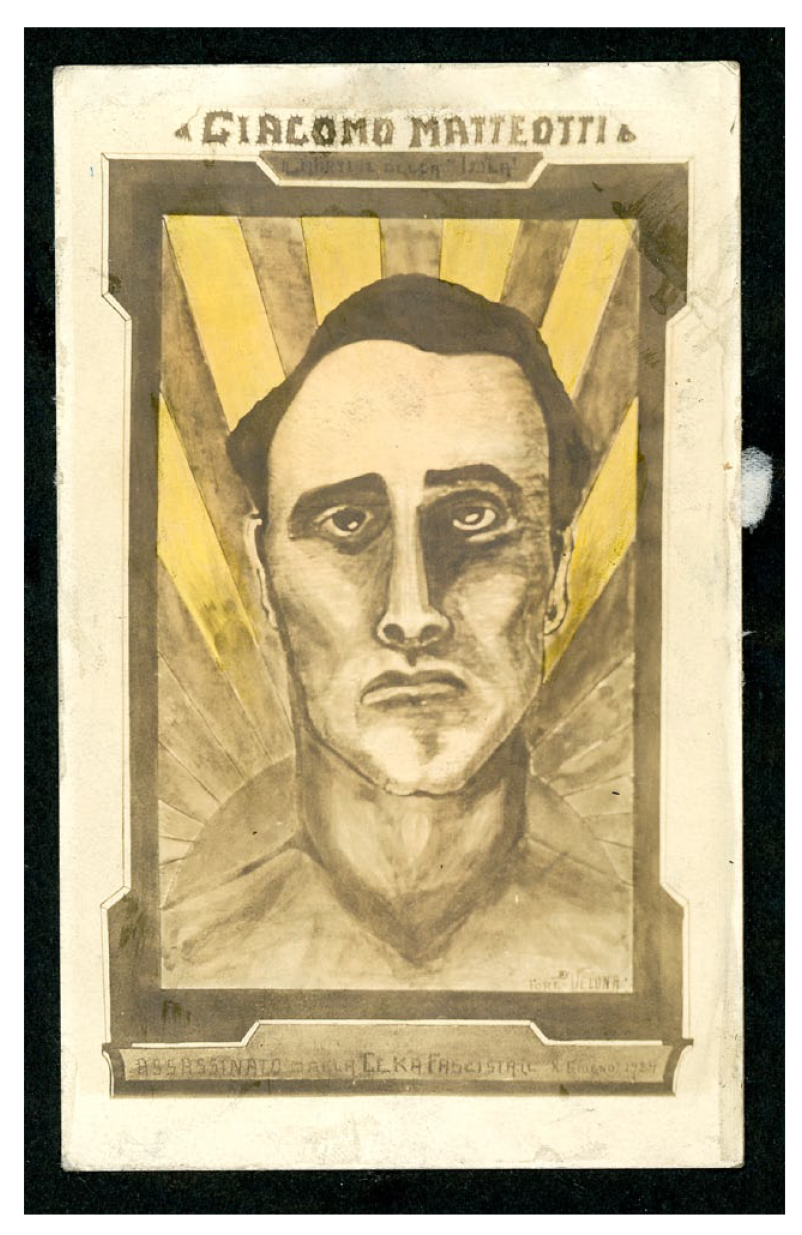
Fort Velona’s drawing of Matteotti, titled Il martire dell’idea. Immigration History Research Centre Archives, University of Minnesota, Fort Velona Papers, Box 1.
Beyond socialism, political martyrdom has typically been expressed in quasi-religious terminology, reflective of the sacralisation of modern politics more broadly. One component of what Emilio Gentile identifies as the secular religion of Fascism, the study of martyrdom exposes the diversion of religious aesthetics, rituals, relics and spectacle towards the nationalist project. Fascist martyrs formed part of Mussolini’s efforts to construct a political religion (Gentile, 1990), which ‘wove the themes of blood and martyrdom into an official narrative’ (Falasca-Zamponi, 1998: 426). However, like Mussolini’s ambitions for the regime itself, Fascist martyrdom was not confined by the boundaries of the Italian nation state, and commemorative events were organised for the fallen in Fascist communities abroad. The development of Fascism and anti-fascism in the American context is the subject of the next section.
Fascism and anti-fascism in the United States
The great migrations to the U.S. of 1880–1920 saw around 35 million emigrate from eastern and southern Europe; the largest nationality was Italian, which represented 5 million (Cannistraro and Meyer, 2003: 6). They were initially labour migrants, the majority of whom ultimately intended to return to their families in Italy richer than they had departed (around the turn of the century 50% of migrants to the United States returned to Italy) (Gabaccia, 2000: 94). Most settled in Italian communities throughout the U.S.; these so-called ‘Little Italies’ had the highest degree of residential segregation of any of the migrant groups from 1910 to 1950 and created a space outside of anti-Italian sentiment (Cannistraro and Meyer, 2003: 11).
Little Italies also led to insulated communities with their own calendar of events, and spaces in which radicalism could spread (Cannistraro and Meyer, 2003: 12). Since the turn of the 20th century, the left-wing Italian population in the United States had included socialists, syndicalists, anarchists and, soon after, communists (Bencivenni, 2011: 18). Though they were bound by the shared aims of workers’ emancipation, social equality and the end of capitalism, Bencivenni (2011: 18) has argued that ‘serious disagreements existed about the goals of the revolution and the tactics to be adopted vis-à-vis the state’, reflecting many of the divisions that could also be found among the left in Italy. After World War I and the Russian Revolution, radicalism diminished under the clampdown on far-left radicals, but Mussolini’s emerging totalitarian regime gave this fragmented movement a new focus, ‘compelling them to reorganise in the name of democracy and freedom’ (Bencivenni, 2011: 30).
Italian anti-fascism was immediately a transnational movement. Many anti-fascists fled Italy to form part of what Killinger (2010) terms ‘antifascism-in-exile’, though they maintained ties to their home country (see Rampello, 2015). As Cannistraro (1999: 4) has argued in his study of Fascism in Italian communities of the U.S., the study of the diaspora and migration conveys the constant contact with the homeland and reciprocal exchange between Italy and the U.S. This exchange was often financial. The prominent anti-fascist broadcaster and journalist Girolamo Valenti, who is addressed in detail later in the article, was one link in the chain connecting anti-fascist communities in Italy and North America. In 1923, he organised a series of street meetings held in Chicago’s Italian neighbourhoods in response to a letter sent by Matteotti to the US-based Italian Socialist Federation, founded in 1902, asking them to raise money for the victims of Mussolini’s regime. By the end of that summer, more than $1500 was sent back to Italy, in what is believed to have been the first example of organised financial support for anti-fascism sent from the United States to Italian shores. 3
According to Cannistraro (1985: 21), Italian American anti-fascism first appeared in the United States ‘during the consolidation of Mussolini’s dictatorship in 1924–1925’. Given the timing of his death, Matteotti quickly became a unifying symbol of social equality and workers’ emancipation behind which the fragmented movement could rally in its early stages. During this period, Matteotti’s memory was carried from Italy to North America by migrants and exiles through channels including letters, commemorative postcards, and articles and images published by US anti-fascist newspaper networks. His memory was subsequently honoured in U.S. public space in protest against Mussolini’s ambitions to exert his influence abroad.
Mussolini’s motivation to extend his influence to North American shores was initially financial; he sought to retain the loyalty of Italian citizens, guaranteeing the continued flow of remittances and ensuring a stock of manpower in the event of future wars (Pernicone, 1989: 223). On 30 April 1921, the first American branch of the Fasci all’Estero opened in New York City (Cannistraro, 1999: 14). In the mid- to late 1920s, a number of local Fasci were established in boroughs throughout the city, including an auxiliary branch for women; there were soon 70 fasci in the United States, with membership totalling 7000 (600 of whom lived in New York) (Cannistraro, 1999: 56). These branches were charged with building the myth of the ‘good Italian’ as one who dutifully and publicly served the Duce from abroad (Ugolini, 2012). Geographical distance from Italy was not to prevent devotion to Fascism, as commemoration of Carisi and Ambrosoli showed. 4 However, much to Mussolini’s discontent, the Fasci often proved hard to control and did little to dispel perception of Fascist violence (Cannistraro, 1999: 24–44). The dispatches of Washington ambassador Gaetano Celasani to Mussolini speak of the reputation of the leaders of the New York Fasci all’Estero as hardened criminals of low moral standing (De Caprariis, 2000: 161). The deaths of two Italian American Fascists, who were commemorated as martyrs, gave Mussolini the chance to emphasise the suffering of local Blackshirts and underscore the violence of the regime’s opponents.
Fascism continued to extend its influence in Italian American communities in the late 1920s, when the 1100 lodges of the Order of the Sons of Italy in America – the largest formal organisation for Italian Americans – turned pro-Fascist (Cannistraro, 1999: 23). Catholic Church representatives in Little Italies had strong alliances with diplomatic representatives of Mussolini’s regime, and leading figures in Italian American communities, who worked together to quash radicalism and promote nationalism (Cannistraro, 1999: 10). There were financial links between the U.S. and the regime, too. In 1926 J. P. Morgan Company made a $100,000,0000 loan to Mussolini’s government, ostensibly as a means of helping Italy to resuscitate her economy and move a step closer to paying her war debts to the US totalling almost two billion dollars (Diggins, 2015: 152). In anti-fascist circles in North America, however, this was perceived as a loan that supported Mussolini’s consolidation of power and the American business community was seen as complicit. It is within this divided context that anti-fascists commemorated Matteotti.
Commemorating Matteotti in the U.S
On the afternoon of 10 June 1924, Giacomo Matteotti left his home in Rome to visit the Chamber of Deputies library where he was preparing the response of the Socialist Unitary Party (of which he was secretary) to the Fascist administration’s budget. Ten days prior, he had given a courageous speech in parliament condemning the fraudulent elections through which Mussolini had taken power and calling for their annulment. It was widely reported that as he exited the Chamber, he instructed colleagues to begin preparing his funeral oration (Canali, 2009: 151). As he set out from his home on 10 June, men connected to Mussolini’s regime waited in a car on the nearby Arnaldo da Brescia embankment. When they saw Matteotti approaching, they attacked and kidnapped him, before speeding out of Rome. Matteotti was brutally assaulted and died in the back of the car; his corpse would not be found until mid-August. 5
Matteotti was quickly commemorated as an anti-fascist martyr, even prior to the discovery of his body. Aware of the symbolic power of martyrdom and concerned by the emerging public rituals of memory at the place of his kidnap, the Fascist regime stated that nobody could stop to pray within 10 metres of the site, banning the flowers and commemorative ribbons that had been laid (Caretti, 1994: 43–44). These restrictions were part of what Caretti (1994: 163) terms ‘the denied memory’ of his disappearance, denoting the regime’s attempt to weaken symbolic resistance as it coalesced around Matteotti’s death. Commemoration therefore became an act of defiance. But though Italians in Italy could not openly commemorate Matteotti, their compatriots in the United States were able to remember Matteotti publicly, evoking his memory as a symbol to counteract the Fascist propaganda that had spread to Italian communities of the U.S. Historians have considered reaction to Matteotti’s death in the States, focusing on the response of the media (see Nazzaro, 1975: 50–65) or reaction of the U.S. Department of State to the Italian Embassy (Diggins, 2015: 150–151), but despite the undeniable importance of the murder in the development of Italian dictatorship, the propagandistic power of his memory in the Italian diaspora is yet to be fully examined.
In its early stages, the regime enjoyed the tacit (and sometimes explicit) support of the U.S. government and the national press, which praised the industrial and economic development of post-war Italy and Mussolini’s strong leadership. The Italian language press quickly became a mouthpiece for the emerging regime, and enjoyed a wide readership; according to Pernicone (2011: 267) the New York-based dailies Il Progresso Italo-Americano and Il Corriere d’America published 100,000 and 50,000 copies respectively in the early 1920s, and almost 90% of the Italian-American press was Fascist or pro-Fascist during this period. Italian American anti-fascists needed a powerful symbol to counteract the emerging regime’s propaganda, and Matteotti’s death provided just that. Ceremonies were immediately held to remember Matteotti throughout the U.S., some of which attracted tens of thousands; on 29 June 1924, an event in Boston drew more than 70,000 (Nazzaro, 1975: 59). In the years after his death, ceremonies took place in cities including New York, Philadelphia, Boston, Washington D.C. and Chicago. However, they were not confined to the largest metropolises; 1928 saw ceremonies in Woonsocket, Rhode Island, Torrington, Connecticut, and Reading, Pennsylvania (Il Nuovo Mondo, 1928: 5).
A symbol of workers’ emancipation and social equality, Matteotti’s memory had mass appeal among the fragmented Italian American left. Figure 2 shows publicity material for a commemorative event held in New York. It is addressed to the broad category of ‘citizens, workers and lovers of liberty’ and declares the participation of many political groups in the event as an act of solidarity, showing the unifying function of his memory. Moreover, the publicity material places as much emphasis on the ceremony’s role as an occasion to protest Fascist violence as it does on its commemorative purpose, highlighting the dual function of the martyrological narrative: to commemorate and to condemn. 6
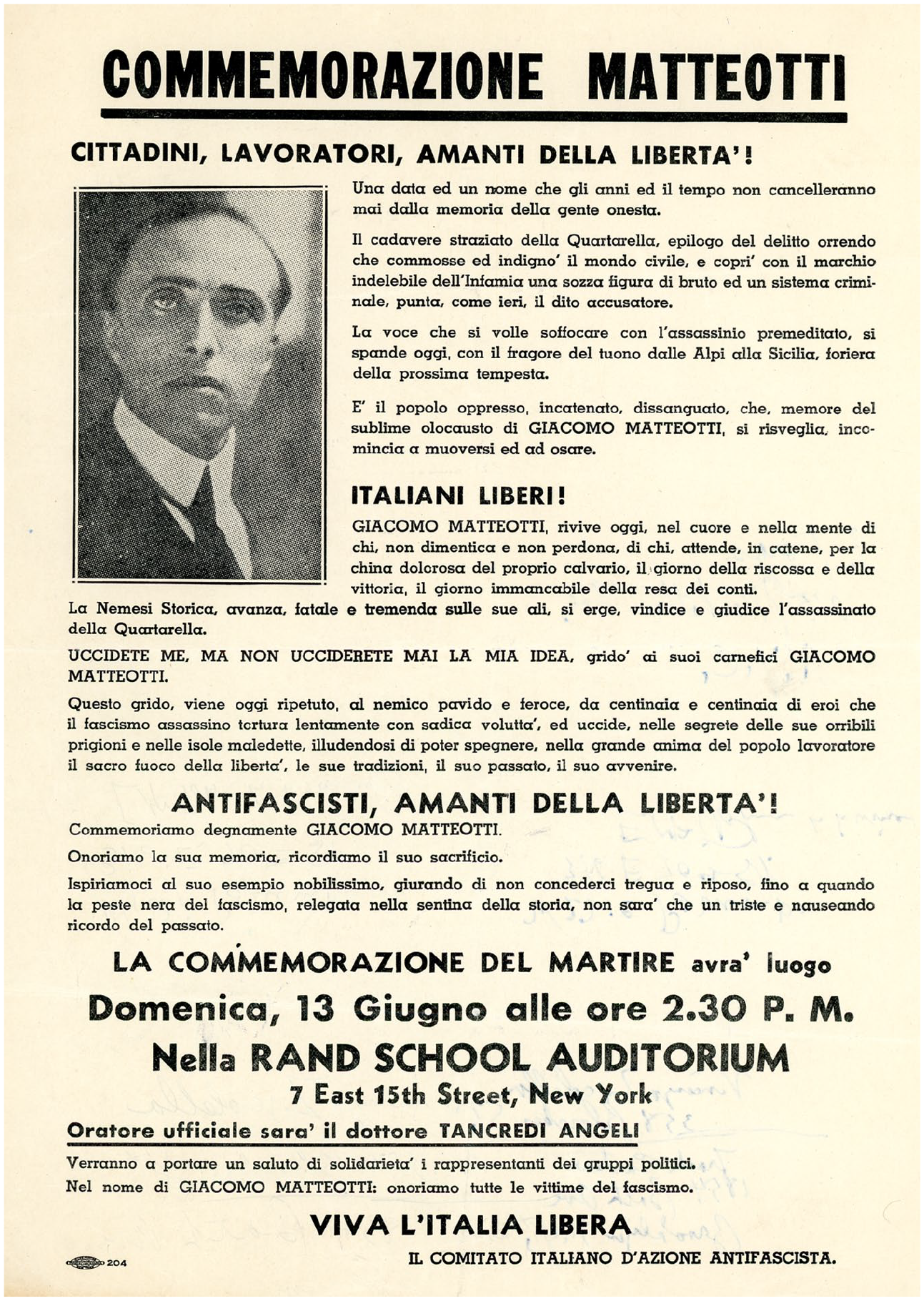
Publicity for a commemoration event in New York, undated but likely 1926. Immigration History Research Center Archives, University of Minnesota, Fred Celli Papers, Box 1.
Commemoration of Matteotti in the U.S. displayed three characteristics that made it distinct from ceremonies held in Italy: the involvement of business and labour unions, the participation of non-Italian anti-fascists, and the use of the English language. Each of these characteristics were evident in a ceremony on 17 September 1924 in Baltimore organised by Locale Italiana 51 of the union the Amalgamated Clothing Workers of America, which was one of many alternative funeral ceremonies held for Matteotti globally. These rituals offered mourners the chance to remember Matteotti and, by honouring the values Matteotti represented as above and beyond the nation state, to symbolically commit to the fight against Fascism in the U.S. The ceremony opened with a ‘sacred silence’ before the stage curtain lifted, accompanied by an orchestral performance of Chopin’s funeral march, to reveal a large portrait of Matteotti surrounded by lamps and a wreath of red roses (Betussi, 1924: 5). Flowers were provided by Henry Sonneborn & Co., which claimed to manufacture 3000 suits per day in the early 20th century, had a large factory in Baltimore and hired thousands of immigrant workers. The support lent by an American company to this event commemorating a prominent Italian anti-fascist was significant given the many public expressions of approval made for Mussolini by the American business community, which, according to Diggins (2015: 146–147) ‘responded to Fascism with hearty enthusiasm’.
A ceremony held in New York provides another example of the transposition of Matteotti’s memory to the U.S., and included two of the aforementioned characteristics that made these commemoration ceremonies distinct: namely the participation of international anti-fascists and the use of the English language. On 26 June 1924, 2500 people attended the rally in New York; a further 1000 were left outside the Carnegie Hall due to venue capacity. The three-and-a-half-hour gathering began peacefully, with speakers standing in front of a portrait of Matteotti draped in black. Several speeches were given in English and Italian by anti-fascists from ‘all the civilised nations of the world’, and a resolution read out calling for the American government to reject Mussolini’s recent ambassadorial appointments (Il Lavoro, 1924). An article in The New York Times (1924) described the crowd’s response as a ‘riotous outburst’, as they rose to their feet, jumped on their chairs and let out a ‘series of lusty “boos”’. Physical clashes ensued between anti-fascists and supporters of Mussolini (thought to have been in attendance under cover), with violence and police intervention occurring at the very moment the rally addressed support for Mussolini’s regime in the United States.
These ceremonies provide an example of the transposition of Matteotti’s memory from Italy to the United States. The participation of American business and labour unions, the involvement of international anti-fascists and the use of the English language made these ceremonies distinct, and point to the emergence of a transnational memory culture. They gave Italian American and international anti-fascists an occasion to honour Matteotti’s memory and the universal values of anti-fascism, but they also afforded an opportunity to condemn the growing support for Mussolini’s regime in the U.S. As such, these transnational commemorative practices show the inherent flexibility of martyr memory as it is carried beyond the original ‘container culture’, to borrow Erll’s (2011: 7) term, by exiles, immigrants and newspaper networks and directed towards new, transnational conflicts.
Alongside these temporary commemorative events, Italian American anti-fascists proposed a permanent monument to Matteotti in New York – the first planned monument to Matteotti globally. As Carter (2019: 220) stated in his recent examination of the landscape of memory linked to the Fascist Italo Balbo in Italy and the U.S., ‘physical monuments [. . .] are designed to represent and fix in the public space (and collective mind) a particular memory of an individual, group, event or achievement’. Indeed, this public monument to would have fixed the memory of Fascist violence in New York public space – a city that had already experienced violent clashes between fascists and anti-fascists. Its planned construction is the subject of the next section.
The monument to Matteotti in New York
The year after Matteotti’s death saw the launch of Il Nuovo Mondo, which quickly became the ‘most important organ of antifascism in the United States’ (Bencivenni, 2011: 95). It was deemed so significant that the Italian ambassador in Washington sent regular updates to the Italian foreign ministry regarding its work and financial situation (Diggins, 1967: 580). In 1925, the paper was edited by Girolamo Valenti, a Sicilian socialist, labour organiser and journalist described by the regime as ‘head of the antifascist committee in the United States’. 7 Valenti would go on to become one of the primary memory agents in commemoration of Matteotti.
On 21 March 1926, his paper launched a fundraising campaign for a monument to Matteotti. The initial article (Bellanca, 1926: 1) points to the immediate transposition of Matteotti’s memory into the U.S. national context through reference to the values of justice and liberty that feature in the Pledge of Allegiance and the positioning of memory as relevant to all emigrants:
Today Giacomo Matteotti is a symbol, and not only in Italy. And the time has come for us to show it. [. . .] Onwards Italians of North and South America, let’s finish this sublime work that will stand as a monument to the honest and selfless love of all emigrants to the sacred cause of justice and human liberty.
The campaign opened with a $100 contribution from the editorial and administrative boards of the newspaper. The next day, Il Nuovo Mondo (1926a) documented the overwhelming response of the anti-fascist community:
Yesterday morning numerous subscribers had been waiting for our offices to open to make their contribution. One of our phonelines was busy for the whole day taking donations and replying to questions about the erection of the monument. The idea was met with the enthusiasm of the Italian workers in America.
On the 27 March, Il Nuovo Mondo (1926b) published The Value of Symbols, which addressed the positive response to the fundraising campaign, stating: ‘Everyone has understood that the exaltation of the Martyr is the condemnation of the assassin’. The article then called for similar monuments to be erected in Italian communities around the world emphasising the connective quality of martyr memory. It continued: ‘A monument is only a symbol. But when symbols represent a profound and sincere movement of consciousness, they radiate their own emotive and persuasive force. The monument to Matteotti will symbolise the immortal power of freedom, which no tyranny will ever be able to extinguish in the hearts of men’.
Campaign organisers wrote frequently of the ‘persuasive force’ of public monuments. Like toponyms, which Alderman and Inwood (2013: 2) argue ‘are expressive and constitutive of the politics of citizenship, conferring a greater degree of belonging to certain groups over others’, the locating of monuments in public space is often considered a sign of institutional recognition of the values they represent. A visitor to any Italian city, for example, will quickly be confronted by names including Giacomo Matteotti and Antonio Gramsci on street signs and monuments erected in the post-war period. These names tell us something about Italian national identity, defined as both the narrative promoted by the state of its identity and the way a nation’s citizens understand themselves as a people (as well as the relationship between the two). Given the density of New York’s Italian community, this monument to the first prominent anti-fascist martyr would have been an outward symbol of its anti-fascist politics and an act of defiance against the rising tide of Fascist support in the States. Indeed, one letter to the paper (Il Nuovo Mondo, 1926c) said the proposed monument signalled ‘a new era for Italian antifascism in America’ due to its prominence in public space.
By the 19th July, donations via the newspaper had closed, raising a total of $8321 (Il Nuovo Mondo, 1926d). However, there is no further mention of the monument in the paper after this point, and the project never saw the light of day. Though it is unclear why, the increasingly public demonstrations of Fascist support in New York at this time may have made its eventual construction impossible. The year after the initial fundraising, 1927, was a particularly violent year in terms of the Fascist and anti-fascist struggle (Pernicone, 2011: 183). Moreover, that year event organisers invited the Fascist League of North America to participate in the Memorial Day parade. These national celebrations are defined by McCrone and McPherson (2009: 1) as ‘commemorative devices in time and place for reinforcing national identity’; to permit the performance of certain political groups in such events is a sign of assent of the values they represent. The inclusion of Blackshirts in the Memorial Day parade was, unsurprisingly, contested by anti-fascists. In an unpublished typescript, Valenti, who had been a reserve in the US Army, described a letter he sent to the official in charge of the parade protesting ‘against letting the black shirts dishonour and disgrace the memory of our great American soldiers who had died for freedom and democracy’. 8 Nevertheless, permission remained. The outcome of the violence that day created the first transnational Fascist martyrs, and they were honoured as such during a large-scale ceremonies on the streets of New York and Naples.
‘We die everywhere for Italy’: Public celebration of fascist sacrifice in the U.S
On 30 May 1927, a group of around 14 Blackshirts set off from their homes in the Bronx to participate in the Memorial Day parade. Shortly after, two of the party were killed by anti-fascists on the stairs of the Third Avenue Railway. The first victim was the Calabrian-born tailor Giuseppe Carisi, who had arrived in the U.S. in 1906. He had stopped to buy a newspaper on the steps of the station when he was stabbed. The second victim, Michele Ambrosoli, a printer, was born in 1906 in Potenza and had arrived in the U.S. in 1920. He was shot coming to Carisi’s aid. 9 The double murder stirred tensions between Fascists and anti-fascists in New York; rallies were held in the suspects’ defence – one attracted more than 300, with media reports suggesting that it was Mussolini and his policies that would really be on trial rather than the suspects, Calogero Greco and Donato Carillo (Rice, 1927: 6). At trial, Judge Cohn, who presided over the case, reminded the jury that whether Mussolini’s government was ‘tyrannical’ or ‘excellent’ should not affect their deliberation (The New York Times, 1927b). The pair were acquitted on 23 December 1927.
The clash created the first Italian American Fascist martyrs. Their bodies lay in state at the local fascio in the Bronx for several days, accompanied by an honour guard (Pernicone, 2011: 385). The pair’s funeral on 4 June included a parade through the streets of New York, accompanied by floral arrangements, one of which spelled out ‘Mussolini’ in white roses (Diggins, 2015: 129), reinforcing links to the Duce and showing the way Fascist martyrs were upheld as spectral leaders to emulate. According to Corriere della Sera (1927), the procession attracted more than 50,000, including the Italian ambassador De Martino, who flew in from Washington D.C., the Italian consul, representatives of the fasci and a representative of American veterans. Signifiers of Italian and North American national identity were present throughout; this was a transnational event. A report in the Fascist newspaper Il Popolo d’Italia described the covering of Carisi’s casket with the U.S. flag (he was enlisted in the American army during WW1), while Ambrosoli’s was draped in the flag of Italy, highlighting the martyrs’ transnational connections. Both caskets were accompanied by uniformed U.S. war veterans and Blackshirts, who walked alongside the bodies until they reached the Italian church of Monte Carmelo (Il Popolo d’Italia, 1927a). Speaking from the steps of the church, Giacomo Caldora, president of the Il Duce Fascist Alliance, declared: ‘We are going to pay our last respects to these two Italian martyrs’ (The New York Times, 1927a). He then called for their memory to be honoured, rather than avenged, emphasising Fascist non-violence and undermining the reputation of Blackshirts as violent. A mass was then held for the dead. Finally, the caskets were transported to the Saint Raymond cemetery in the Bronx (accompanied by 25 cars full of flowers), where they were temporarily buried in a public service.
On 14 June, the bodies were loaded onto the Conte Rosso ocean liner and shipped back to Naples – the port from which both had left Italy for the U.S. – positioning la patria as their ultimate resting place. As trains carried the bodies of Fascist martyrs across Italy during commemoration ceremonies, stopping at relevant stations along the way and becoming part of the ceremonies’ symbolic meaning (Berezin, 1997: 66), the journey of the Conte Rosso became an important part in the construction of the transnational martyrological narrative. Six uniformed Blackshirts formed a guard of honour for the duration of the journey, demonstrating that even (or perhaps especially) in death, the fallen remained a central part of the regime, which had gone to great lengths to honour and repatriate their bodies (Il Popolo d’Italia, 1927b). This journey provided a secular and transnational example of traslatio - the Latin term denoting the formal ceremonies held to honour the movement of sacred remains and relics to a significant resting place. Crowds of 150,000 welcomed the ship back to the Pisacane dock on 25 June (Pernicone, 2011: 386). An article in Il Popolo d’Italia (1927c) described the importance of repatriating the bodies of martyrs and typifies the imperialist rhetoric employed in Carisi and Ambrosoli’s commemoration:
The fascist homeland has reclaimed the glorious bodies. Fascism does not want its martyrs to be buried in foreign lands and condemned to the solitude of cemeteries without flowers and sunshine. They must return here, to the blessed land for which they knew to die [. . .] No tears for the two martyrs who fell in overseas lands like two soldiers on the battlefield, but pride, strength and honour for our fascist race which never ceases to offer young blood to the sacred cause.
Footage of the event can be viewed online via the Istituto Nazionale Luce and reveals its scale - all shops and offices were closed for a day of public mourning. 10 A second funeral procession then occurred, with the caskets again draped in U.S. and Italian flags and loaded onto an artillery procession, while a live band played both Giovinezza – the official hymn of the Fascist Party – and the Star-Spangled Banner, combining elements of Italian and American cultural memory.
A long procession through the streets ensued until the caskets reached the basilica of San Francesco di Paola, where they were blessed. Next, S. E. Grandi, undersecretary of State for Foreign Affairs, stood beside representatives of Italian and Italian American Fascism and, speaking on behalf of the government, described Carisi and Ambrosoli as ‘our martyrs for the Fascist revolution’, who came from afar ‘to tell us that we die everywhere for Italy, because Italy is everywhere, to tell us that Italy has no borders because our faith has no borders. Oh how alive are these glorious dead!’ (Il Popolo d’Italia, 1927d). Grandi’s words ascribed an imperialist purpose to the two deaths; Carisi and Ambrosoli were remembered as having lost their lives on the streets of New York in the name of Fascism, reminding mourners that Fascism could and should not be bound by the nation state. This expansionist rhetoric made explicit what was suggested by the incorporation of the journey of the Conte Rosso into the commemorative ritual. His words were met by a Fascist salute from the crowds, who responded to Grandi’s declaration of the two names with the shout ‘Presenti!’, emphasising the eternal life of the martyrs after death. 11 A funeral then took place inside the basilica.
The place of Carisi and Ambrosoli’s public funeral processions in New York and Naples in the construction of Fascist collective identity is worthy of further analysis within the context of martyrdom more broadly. In Salvation at Stake, Gregory (1999) considers the public nature of the executions of early Christian martyrs, asking how this shaped collective identities. Christians of different creeds memorialised some martyrs, but excluded others, and the collective mourned their martyrs according to the specific doctrines to which they adhered. Public executions, Gregory (1999: 7) writes, were ‘a powerful arena for evangelization’ as bystanders were moved, or repelled, by the behaviour of the martyr in death. Collective identities were cemented at the foot of the martyrological stage.
It is my contention that the public nature of the funerals held to honour Carisi and Ambrosoli in New York and Naples had a similar evangelizing impact, cementing a sense of collective belonging. As Berezin (1997: 246) has argued in her study of Fascist political culture, ‘rituals were vehicles of solidarity – communities of feeling – in an ideological project’. The pair’s unwavering commitment to the regime and their stoicism in the face of anti-fascist persecution abroad were repeatedly referenced throughout commemorative events, and their sacrifice was tied to Fascist expansionism through the iconography and rituals of Italian and American cultural memory that saturated the ceremonies in New York and Naples. As with the early Christian martyrs who suffered at the hands of a powerful majority, organisers of the two funerals were able to represent the slain Blackshirts as a persecuted but powerful minority, celebrate their moral superiority and encourage mourners to emulate their commitment to Fascism despite their geographical distance from Italy, creating ties of solidarity among the collective and encouraging emulation.
The martyrological narrative enacted at both funerals suggested that Carisi and Ambrosoli did not die in vain; rather, as Grandi’s words on the Pisacane dock made clear, they lost their lives in order that collective commitment to Mussolini’s regime in Italy and abroad might strengthen. Public, transnational celebration of their martyrdom conveyed a particular ideological message: death was part of collective struggle and progress, neither of which could, or should, be bound by the borders of the nation. This duty to honour martyr memory through a collective re-commitment to Fascism among the living was also felt privately. A telegram sent by Carisi’s family to Mussolini on Christmas Eve 1927 stated: ‘our beloved poor Peppino fell for the honour of Italy and for the Fascist cause. The thought will always comfort us in our pain and give us the strength to live and better serve’. 12
Conclusion
Matteotti, Carisi and Ambrosoli were publicly commemorated as martyrs and the term is key to the analysis in this article. But what are the implications of the term within political conflict? And how do transnational commemorative practices change the martyrological narrative? To label someone a ‘martyr’ gives death a posthumous purpose. As analysis of both case studies has made clear, martyrdom is future facing - the term ascribes a legacy to the dead and it can contextualise death within a broader conflict (real or imagined), representing the death as having contributed to the pursuit of an end goal (Middleton, 2011: 29). Martyrs are powerful, multifaceted symbols, able to ‘elicit devotional zeal and encourage affiliation with a cause’ (DeSoucey et al., 2008: 105). As Mussolini’s regime was all too aware, transnational commemorative practices had the propagandistic power to represent the cause for which the martyr died as global; transnational martyrs were useful symbols in the regime’s promotion of its imperialist ambitions. The funerals held for Carisi and Ambrosoli in New York and Naples were connected by the long journey of the bodies across the Atlantic - an essential component in the creation of political meaning within the martyrological narrative, emphasising that despite the 7000 km separating the martyrs from their homeland, their commitment to Fascism was steadfast. The first Italian American Fascist martyrs were important symbols in Mussolini’s attempts to increase support in the diaspora, celebrating the power of Fascist values to shatter the confines of the nation state.
Crucially for my analysis of Matteotti’s memory, the concept of martyrdom also draws attention to the agency of the killer and makes them ‘the principal actor’ of the event; to be sacrificed requires a sacrificer (Portelli, 2007: 196). Italian American anti-fascists used commemoration of Matteotti as an occasion to honour his memory and to draw attention to the threat of unchecked Fascist power, as support for the regime strengthened in the civil and business communities of the United States. Alongside these commemorative events, the planned monument to Matteotti in New York was intended as a permanent declaration of anti-fascist identity in U.S. public space at a time when Blackshirts had been granted permission to participate in US national holiday processions, giving Mussolini’s supporters opportunities for the visible performance of Fascist power in the metropolis.
The stories, iconography and public rituals of secular martyrdom formed part of the day-to-day fight for political influence in the diaspora, where commemoration had transnational aims. A symbol of sacrifice in the name of a conviction and a means to draw attention to the evil of the perpetrator, martyrs are doubly expedient cultural symbols and these transnational martyr stories wielded great propagandistic power for Fascists and anti-fascists alike. In the early stages of Mussolini’s rule, memory of Fascist and anti-fascist martyrs was transposed into new national contexts, where commemoration took on new meanings. Far from weakening the symbolic power of the deaths, the transnational quality of public commemoration strengthened the meaning that could be derived from the martyrological narratives, suggesting that sacrifice had occurred in the name of ideological values that transcended national borders and extending the political battleground to new national contexts.
Footnotes
Acknowledgements
I would like to thank the staff at the Immigration History Research Center Archives, University of Minnesota, for their help locating archival material and for permission to publish that material here. Thanks are also due to the staff at the Kluge Center, Library of Congress, and to my friend Victoria Witkowski for her help accessing archival material in Rome. Finally, I am grateful to the three anonymous reviewers of this article for their generous and constructive feedback.
Declaration of conflicting interests
The author(s) declared no potential conflicts of interest with respect to the research, authorship, and/or publication of this article.
Funding
The author(s) disclosed receipt of the following financial support for the research, authorship, and/or publication of this article: Some of the research for this article was conducted thanks to a Grant-in-Aid Award from the Immigration History Research Center Archives at the University of Minnesota. Material was also gathered during a fellowship at the Kluge Center, Library of Congress, held during my AHRC-funded PhD.
