



Abstract
How do we understand the relationship between memory and place in the context of Extended Reality (XR) migration museum exhibitions? The study combines a global mapping of XR within migration museums, a user analysis of Cologne’s virtual migration museum, and practice-led research with the UK Migration Museum to argue that XR places in Web 2.0 constitute a multiplication of memory’s significant localities. These include a migration memory’s place of beginning (the location of a migrant experience), the place of production (where the memory is transformed into representation) and the place of consumption (where the mediated memory is engaged with, looked at, heard). Mnemonic labour involving digital frictions at each of these sites constitutes a form of multiple place-making with complex feelings, meanings, and (dis)connections. This points to an innovative approach to understanding and curating XR experiences with museums that recognises the significance of the labour of place.
Introduction
COVID-19 has transformed the relationship between place and Web 2.0. With large scale population confinement on an international scale, forms of work, play and socialisation that previously inhabited the public sphere have entered the home through digital mediation. This has resulted in new forms of global access and hyper-local place-making (Ryan, 2020; Sherman, 2020), as well as highlighting and exacerbating existing inequalities and exclusions relating to both digital and spatial affordances (Holmes and Burgess, 2020; Kingman, 2020). Public memory institutions have not been immune. With lockdowns starting in early 2020, museums worldwide closed their physical exhibition spaces, pivoting to engage with audiences through Web 2.0 by extending and creating augmented and virtual reality exhibitions, events and galleries (Char, 2021).
These transformations highlight the need for memory scholars and museum professionals to develop more complex understandings of digital memory and its relationship to place. Our own multi-modal research, which began prior to the pandemic but which, like everything else, has been reconfigured by it, is concerned with this relationship in the context of a specific case study: the use of Extended Reality (XR) by museums of migration. XR refers to any environment involving a virtual element. This includes Virtual Reality (VR) – full immersion in a simulated experience – and Augmented Reality (AR) – the superimposition of virtual objects into the real world. While the value and quality of XR technologies is frequently assumed to lie in their ability to replicate a sense of presence (Milk, 2015), we argue that much of the progressive potential of XR in migration museums lies both in drawing connections and in revealing tensions between multiple places. It is the labour of memory – of migrant storytellers, of museum curators and of users/visitors – that both makes these connections possible and makes their difficulties visible and which, we argue, can inform a conceptual understanding of the relationship between digital memory and place.
The article begins by explaining our research rationale, design and methodologies. This is followed by a mapping analysis of XR and place-making in migration museums and a user analysis of Dokumentationzentrum und Muzeum über Migration in Deutschland (DOMiD), a virtual migration museum in Cologne. This leads into our conceptual framework for understanding place and memories in XR migration exhibits that guides our critical reflections on our practice-led research involving an XR prototype developed with the UK Migration Museum. Finally, we suggest how this could contribute to a broader conceptual framework for thinking about XR, memory and place in the context of Web 2.0.
Methodological approach: Multi-modal practice-based research
Our research was concerned with how migration museums could engage with the meanings of place whilst overcoming its constraints: to communicate beyond the physical and conceptual boundaries of the museum or nation whilst acknowledging the meaningful ‘locatedness’ (Radstone, 2011) of migrant storytellers, digital creatives and museum visitors/users. How, we ask, can XR convey transnational migrant memories of place to visitors who are unable (or unwilling) to visit the museum itself for a variety of reasons, including the unprecedented closure of museum doors due to the COVID-19 pandemic lockdowns?
Our research methods were multi-modal with a primary emphasis on practice-led, socially engaged research involving the design, curation and user testing of XR memory places in collaboration with a public memory institution. A practice-led approach is recursive, moving back and forth between analysis and practice, to elicit new conceptual frameworks that would not otherwise be possible through extractive methods only involving interviews, surveys or textual analysis (Skains, 2018).
Although practice-based research has long been a method in design, engineering and medicine (Reason and Bradbury, 2001), as well as within the arts and humanities, including museum studies (Bertens and Polak, 2019), within memory studies researchers ‘rarely involve themselves with artistic and activist place-based memory practice’ (Till, 2008: 101). However, increasingly we see collaborative practices between academics and activists, or academics who are also activists (Gutman, 2016; Gutman and Wurstenberg, in press; Reading 2016). Our approach builds on this, as well as practice-led memory research work on places (McLaughlin, 2017; Mikelli and Dawkins, 2020) and migration (Darcy, 2008; Lenette, 2017).
Migrant storytellers played a key role in ‘Remixing Memories’, the practice-based element of our research. In particular, the workshopping process included migrant storytellers and four student researchers with experiences of migration, which informed the design and stories for the XR prototype and framed the questions for the practice-based research. Their stories – which conjured up mnemonic places of beginning both within and beyond the UK – were told and shaped within the context of the museum. The museum already had a physical exhibition called Room to Breathe in which memory places were a central element of the design, enabling visitors to move through a UK border point, a migrant bedroom, a kitchen space, a school room and streetscape that included a barber’s shop. The Museum wanted a university research team to work with them to explore XR’s potential for creating digital memory places to communicate migrant stories to a broader and more diverse audience beyond the walls of the museum.
Our methods also included a survey and user analysis of selected museums. For the survey we mapped migration museums internationally to determine whether and how they were using Web 2.0. We then conducted a more detailed user-experience analysis of one of the museums that has made most extensive use of XR: the DOMiD virtual migration museum in Germany. This analysis provided us with insights prior to and during the process of developing our own prototype with the Migration Museum in the UK. The analysis consisted of downloading the virtual museum to a PC and playing through the different dimensions of the experience with auto-ethnographic notes on different articulations of memory and place. How were migration memories situated in these digital spaces? How did this encourage or discourage the user from relating these memories to their own sense of place?
It has been argued that despite seemingly offering new affordances for memory making, ‘digital memory culture’ has left users/consumers with ‘no power over the conceptual framing, narrative emplotment and visual display’ of the collective past (Kansteiner, 2014: 405). Thus, one of our key concerns was to understand the different ways in which migration museums could enable active mnemonic place-making for users/visitors. From the mapping, user analysis and literature review we developed a framework for understanding the multiple places (dis)connected through the digital memory space of an XR exhibition. We considered the relationships between what Said (1975) terms ‘places of beginning’ (the original locations of migrant experiences), ‘places of production’ (where the memory is transformed into representation), and ‘places of consumption’ (where the mediated memory is engaged with, looked at or heard). We then used this framework to analytically inform, conceptually frame and reflect on the development of a prototype XR exhibition with the UK Migration Museum in which we sought to critically grapple with the challenges and benefits of the multi-places afforded through digital technologies.
Mapping XR place-making in migration museums
Globally, there are 45 migration museums, which vary greatly in terms of the places, people and narratives they remember (Migration and Museums, 2020). Examples range from Poland’s Museum of Emigration in Gdynia to the Museum of Partition in Amritsar, India to PortoM, the anarchist ‘anti-museum’ in Lampedusa, Italy. Despite their differences, all ‘incubate personal, cultural and social memories’ to tell a story of migration and belonging (Whitlock, 2017: 431).
A growing academic literature has explored the ways in which museums stage migration memories and the ways in which the topic of migration has instigated innovative re-thinking of museum design, theory and practice (Baur, 2017; Cimoli, 2013; Curti, 2012; Levin, 2016). The production of immersive and interactive spaces has long been a common approach in museums of migration (Biggs, 2020; Nightingale, 2016), and some recent interactive exhibitions have relied on digital representations of refugee experiences (McFadzean, 2010). Other projects have looked to immersive memory places beyond the walls of the museum. For example, theatre performance in places of war transform sites of original traumatic experience into sites of production for the representation of memory (Jeffers, 2010). Another project involved the co-development with young migrants of a video game, an example of a ‘serious game’ with critical moral and ethical imperatives (Bordergames Collective, 2010).
XR is becoming more commonplace in museums of migration as a technique for creating immersive and interactive memory spaces (Irom, 2018). It has been noted that these digital spaces lack some of the immersive physicality of traditional dioramas (Biggs, 2020), yet it is also clear that through Web 2.0 they have the potential for reaching more (and different) people. They introduce a new and potentially productive variable into the established politics of migration museum immersion: the individual ‘place of consumption’ that is no longer tied to the physical place of the museum.
Our mapping research showed that in 2020, among the 45 migration museums in operation, 4% are online only, 40% include physical immersive dioramas, 45% combine dioramas with multi-media and 6% use digitally immersive XR experiences. The latter include the Museo Interattivo delle Migrazioni in Belluno, Italy, which offers a mobile phone XR experience, and the Tenement Museum in New York, which during the COVID 19 lockdowns of 2020 began offering virtual tours. However, the most extensive use of XR identified in 2020 was the virtual migration museum developed by DOMiD.
User analysis: DOMiD Virtuelles Migrations Museum
The DOMiD Virtuelles Migrations Museum tells the story of migration in Germany since 1945 in 3D. It can be downloaded for free by any online visitor and accessed through a virtual reality headset, a PC/MCA desktop or Android/iPhone. The digital contents draw from DOMiD’s 150,000 testimonies, letters, documents, interviews and films as well as the creation of 80 digitised objects. The application opens with a virtual schematic of eight places, including a school, a shopping district, a factory and a dormitory, with tabs that toggle between 1945 and 1973; 1974 and 1989; and 1990-present day. Users have the option of navigating the site in German or in English, though some audio content is only accessible in German.
The virtual exhibition is mnemonically framed through the place of the nation, with the emphasis on German history and migration policy. This is, however, an abstract, de-territorialized ‘Germany’ composed of generic spaces rather than representations of any particular place. From each virtual space, users can access captions providing historical background as well as various digitised artefacts. Descriptions often link artefacts to geographic places of beginning but do not associate them with specific migrant stories. A photo of a teapot, for example, has the caption: ‘Red teapot from a dormitory for labour migrants, Stuttgart. CA. 2000,’ and a photo of a Vietnamese woman is described as ‘Deportation of a Vietnamese contract worker. Berlin-Schönefeld airport. 1990’. There are also, however, links to video interviews of named individual migrants. The various interviewees – Nguyen The Tuyen from Vietnam, Elena S. from Kazakhstan, Amadou T. from Ivory Coast – remediate their memories from a neutral, white-walled office rather than individual memory places that may have been meaningful to the storyteller.
The aggregate experience of the virtual museum was thus richly layered and highly informative but tended to flatten and homogenize any sense of specific place. The stories of individual migrants told in their own voices, while very much embedded in the virtual museum, required some hunting and excavation to access. While these aspects of the DOMiD virtual museum were frustrating in some ways, we also realized that they provided users with a productive sense of the frictions involved in trying to incorporate distinctive migrant stories into homogenized national narratives. The absence of verisimilitude with specific places and locations can produce for the user what Hughes (2014) describes as the sense of being both in place and out of place (p. 75). The gaps and tensions between the place of production where memories are articulated and the places of original migrant experiences serve to generate what Bromley (2012) describes as a ‘place of the placeless’ (p. 349).
Our user analysis of the DOMiD virtual museum highlighted the labour involved in mnemonic place-making within Web 2.0: not just the hidden labour of the digital creatives but also the digital labour of the user particularly at points of ‘digital frictions’ (Kinder and McPherson, 2014). These lags and hesitations (Weinbren, 2014: 142) in which the tensions of memory become core in digital media (Branigan, 2014: 69) could sometimes make the user experience of place seem awkward, strange, unreal or frustrating. For example, the user moves through three different playground environments from the 1950s, 1970s and 1990s, but the soundtrack of children’s voices is identical, the digital trees in each place are the same and the clock is always set to 10:10. The user is only able to move so far before being invisibly, algorithmically stopped: as the user plays through the programme, it sometimes grinds to a halt, makes the user wait, and then fails to load, leaving gaps where the user hopes to find out more about a given object. When the user tries to move on to another room, pausing to read its textual introduction, the soundtrack from the previous schoolroom continues, providing an auditory lapse or palimpsest.
In some cases, these frictions were infrastructural (poor internet connection or the speed of the user’s device) but most arose from the constraints of VR as a medium impacting on the narrative and graphic design of the experience of place. Such frictions have the effect of displacing the user, creating a sense of the invisible boundaries of bureaucracy, the chronic waiting, ‘the turbulent stillness’ (Martin, 2011: 192) that characterize the experience of migration and displacement. Furthermore, inspired by Tsing (2011), we see these moments of ‘friction’ in the user experience as indicative of the ‘awkward, unequal, unstable, and creative qualities of interconnection across difference’ (p. 4). Our analysis highlighted how XR could heighten users’ awareness of the tensions and disconnections between the different places that it evoked: the places of beginning where migrant experience originally happened, the places of production where memory was distilled and represented, and the places of consumption in which the museum visitor/user views and listens to those representations.
Digital memory places: Towards an analytical framework
The (dis)connections and (dis)placements arising between memory and place have been extensively discussed within memory studies. While foundational memory studies naturalised the place of the nation (Nora, 1989) and marginalised experiences of movement and migration, memory scholars have since re-imagined memory from the standpoint of mobility and interconnection (Bond et al., 2016). As Creet and Kitzmann (2014) put it, ‘what if memory is not a product of stability, but quite the opposite, that it is always attended to migrations?’ Memory was re-conceptualised in terms of movement rather than in stasis (Erll, 2011), with the movement of people (migration) and the movement of images/words/data (Web 2.0) often being framed as the primary facilitators in the increasingly fast and fluid world of mobile memory. Yet the idea that ‘memory travels’ is a ‘metaphorical shorthand’ (Erll, 2011: 12) that can obscure the very peoples, places and processes it is supposed to articulate, highlighting the need to engage with the ‘locatedness’ of transnational memory through its local instantiation, its ‘condensations and displacements’ (Radstone, 2011: 120).
Thus memory scholars have increasingly paid attention to the locally enacted dimensions of transcultural memory (Keightley and Pickering, 2012) with creative acts ‘placing’ memory in documentary film and fiction (Silverman, 2017) and in feminist zines and magazines (Chidgey, 2018). Migration museums are seen as sites of creative mnemonic practice, where memories of migration and belonging are staged (Lanz, 2016; Whitlock, 2017). Framing memory as creative practice helps to reveal the ‘mnemonic labour’ obscured in digital and transnational memory (Reading, 2019). Focusing on labour and locality within digital and web-based memory practices also reveals how both places and memories are made and unmade. This connects with critique from a range of disciplines that challenges the assumption that encounters on the internet are de-materialised, dis-embodied, equal and placeless (Dean, 2009; Reading and Notley, 2015). Web-based approaches make the museum as a ‘discrete bounded space’ (Whitehead and Lanz, 2020) seem antiquated: museum collections can be accessed from smartphones and computers (amplified with COVID-19); video and VR installations transport visitors to far off places; and museum visitors stream, experience and remember their visit to the museum through social media networks which stretch globally (Kalin and Frith, 2016). The museum is conceptually, physically and digitally expanding beyond its physical walls (Curti, 2012) often facilitating rather than replacing site-specific, hyper-local museum work (Capasso, 2012: 90).
Work on place within cultural geography offers some productive leads for thinking about the ways that the labour of memory both shapes and is shaped by locality. Cresswell (2004) defines place-making as a range of activities that invest space with meaning. From this we suggest that investment in Web 2.0 places involve mnemonic labour: places are made (meaningful) as they are invested with memories. Place-making and memory-making are intertwined processes. Furthermore, our emphasis on the relationship between these different places – and the ways that memories travel between, divide and connect them – resonates with Doreen Massey’s call to re-think place in terms of relations (Massey, 1991). Rather than imagining place as bounded, stable and defined from within, we should see that places are articulations of positions within networks of social relations. XR and web-based migration museum experiments can thus be seen as place-making precisely in the sense that they reach out of and between multiple places.
This nuanced engagement with the multiple places of digital memory resonates with discussions that emphasise the political and ethical value of rendering processes of representation visible (Chouliariaki, 2013). The depiction of migrant suffering is in many cases both a truthful representation and a politically strategic approach, but it can also become voyeuristic and dehumanising (Sigona, 2014; Whitehead and Lanz, 2020). Representations of migration in art, advocacy and journalism have recently revolved around two facets of good practice. First, migrant voices should be platformed and centred in the process of their representation (Wroe, 2018). Second, the process of representation and mediation should be visible. As Irom (2018) has argued in relation to VR refugee experiences, ‘ignoring the structures of representation defangs the possibilities of humanitarian communication’ (p. 4270). He therefore calls for a more critical approach to the use of XR in exhibitions concerned with refugeedom, migration and displacement. Far from being ‘the ultimate empathy machine’ (Milk, 2015), immersive experiences may purge users of moral guilt whilst failing to challenge the power imbalances which cause and amplify human displacement (Irom, 2018; Whitehead and Lanz, 2020).
This critique and the more sensitive use of XR for advocacy has centred around a closer scrutiny of empathy. As Coplan (2011) argues, a productive empathy is less about momentarily swapping places with another person than engaging with the self-other distinction itself (p. 40). It requires a sense of shared humanity while demanding a consideration of what makes human lives so different and unequal. Or, as Irom (2018) writes, ‘how far can VR push the spectator from this affordable empathy to a risky empathy wherein the spectator is willing to revisit the self–other relationship and perhaps even entertain the thought of addressing the unequal power dynamics embedded in that liaison’ (p. 4274).
Building on this, we sought to explore and develop a form of XR immersion which – rather than entirely transporting the viewer to another place – instead creates ‘risky empathy’ (Irom, 2018) by overlaying and (dis)connecting different places. Extending concerns about the passivity of the digital memory consumer (Kansteiner, 2014: 405), we suggest that it is the labour of place-making, including the labour of the consumer, that might then provide integrity to staging migration memories through XR.
UK Migration Museum: Remixing places of migration
Our practice-based collaboration with the UK Migration Museum aimed to stage memories of migration within an XR experience digitally capturing and remixing pre-existing museum assets from the museum’s Room to Breathe exhibition, including the exhibition rooms, migrant artefacts such as clothes and letters, and migrant stories told through videos, audio, and photographs. A narrated walkthrough of the resulting XR prototype experience can be viewed in https://vimeo.com/kingsdigitallab/rtb. One of the implications arising from our multi-place framework is the political, ethical and practical value of making visible the labour of placemaking by migrant storytellers, curators, digital creatives and users in producing and engaging with XR exhibitions.
Initially, we sought to replicate the places represented in the Room to Breathe exhibition and make this experience accessible through VR headsets, tablets or mobile phones to visitors excluded for reasons of distance, mobility, economy or time. The physical exhibition was composed of a set of connected rooms. An entry area was designed to evoke a border entrance with first encounters with immigration bureaucracies and featured an anxiety-inducing soundscape (see Figure 1). The visitor then entered a bedroom, followed by a streetscape with barbershop, a kitchen and a schoolroom. Each exhibition room had a distinctive feel, and so the XR team experimented with different digital capture styles to convey the specific ambience of these memory places, including a ‘point cloud’ rendering of the bedroom (Figure 2 right) and an abstract school room (Figure 2 left).
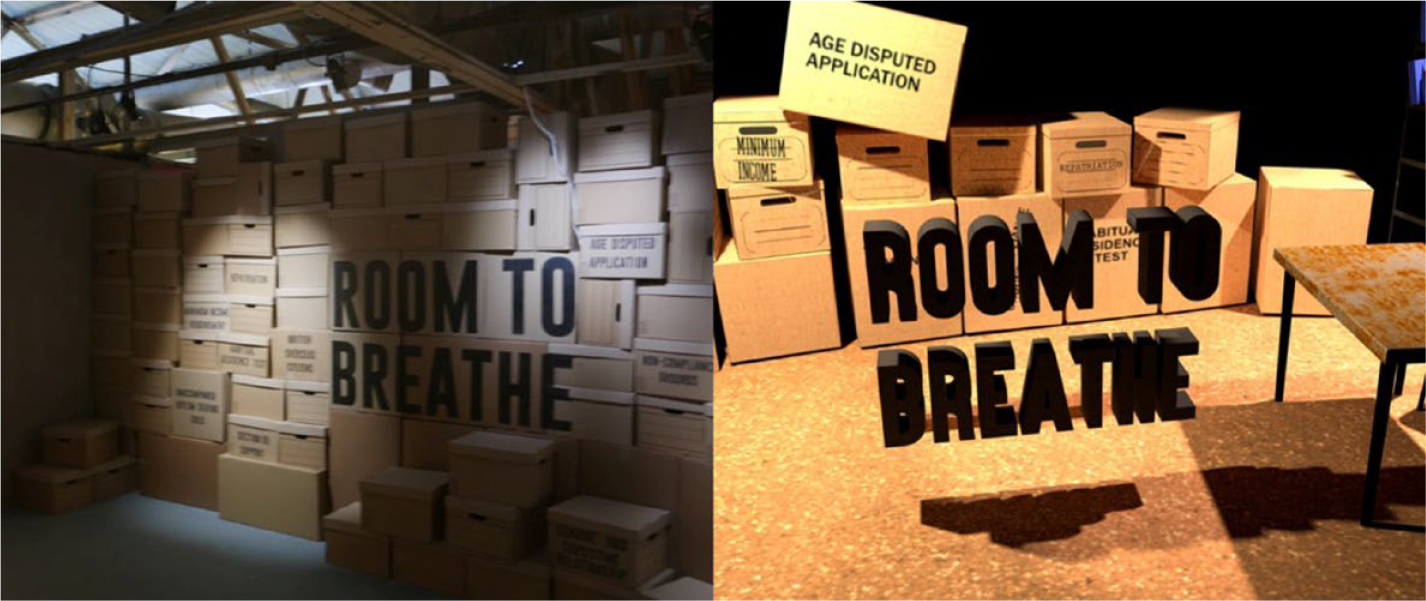
(left) The room to breathe exhibition entrance and (right) the landing page of the AR experience (https://sketchfab.com/kingsdigitallab/collections/room-to-breathe).

Exhibition rooms rendered in different VR styles: (left) schoolroom (right) bedroom (https://sketchfab.com/kingsdigitallab/collections/room-to-breathe).
During these experiments, however, our focus shifted away from facilitation of immersion in virtual reconstructions of the exhibition rooms. Recognising the importance of migrant voices in making decisions about representation of migrant experience (Wroe, 2018), we consulted with a variety of stakeholders as we started the project. At a workshop convened before serious digital work began, the project team discussed aims and options with museum curators, migrant storytellers, representatives from migrant advocacy groups, academics from a range of disciplines and XR content creators. The stakeholders were clear that while verisimilitude and immersion in relation to the original exhibition had value, what was more important, and what offered more possibilities for experiencing the museum exhibitions digitally, for adding value to visitors’ mnemonic experience of place, was facilitating users’ access to a variety of distinctive migrant stories that were then embedded within the XR places.
Visitor engagement with the places in the museum exhibition involved deeper dives into the unique individual stories and related artefacts that hung on the walls, lay on tables or were nestled inside the furniture. As Anand (2019), the lead curator of Room to Breathe, emphasized, the exhibition rooms were intended to play an instrumental and facilitating role in relating migrant narratives. There could have been ‘millions of different rooms and different ways to present these stories’, she noted, but each room was designed to be ‘a place where you have lots of stories that aren’t necessarily about a room [at all]’.
So, alongside the creation of a virtual archive of the exhibition, through 360° photographs of entire rooms, we conducted an Analytical Inventory of the location of individual items within each environment, considering each item’s role as a gateway to a particular migration story and the multiple places that each story invoked. It was understood that the virtual interpretation of Room to Breathe would entail both new constraints on, and new opportunities for, user interaction. Rather than the haptic experience of picking up and handling physical objects, users of the XR experience can manipulate the stylized renderings of selected objects in order to access recordings of individual migrants’ stories. Listening to these brief sound recordings serves, in many ways, as the ‘main event’ of the XR experience. These migrant stories are loosely related to the generic place in which they are encountered – bedroom, kitchen, classroom, streetscape – inviting them to think about the universal, convergent aspects of such places. But the stories do not involve specific descriptions or referencing of those places. Instead, users rely on the storyteller’s voice to conjure the layering of place-making that constitutes a migrant narrative: what it feels like to inhabit somewhere after having previously inhabited somewhere else (Woodrow, 2017). The recollections of a woman who came to the UK from Nigeria in the 1960s demonstrate how meaningful place memories are constructed through fragmentary but powerful invocations of multiple other place memories. In recalling the dorm room in which she lived, she focused not on any physical features of the room but instead on the sound of her roommate playing the violin (the stylized digital object providing access to the migrant’s story), which both sparked curiosity about the roommate’s migration story and provided ‘some sort of therapy’ in her own struggles to navigate dislocation and re-rooting in a new environment.
The XR version of the Room to Breathe exhibition thus sought to provide users with dynamic virtual memory places that re-mixed, rather than precisely replicated, the physical exhibition. The key to this re-mixing, we found, was appreciation of the richness and versatility of the stories related in the voices of individual migrants. Interviewees’ succinct but vivid descriptions of meaningful objects and formative moments could discursively conjure multiple places of beginning, allowing for relocation in different rooms to generate new connections and contexts for the memory places being invoked. Our treatment of the audio testimony of Maurice, an immigrant from Nigeria, provides an illustrative example. In the original exhibition, his migration story had been embedded in the bedroom, accessible as part of a video clip of him being interviewed outside of his childhood home. But his story also included an anecdote about his first experience of tasting a British chocolate bar, which he linked to the desire ‘to be like other children’. Since this anecdote resonated with other migrant stories about the tensions between the foodways of home and food expectations encountered at school, we decided to move Maurice’s story to the virtual classroom, where other recollections on this theme could be found. The audio was now made accessible to users by touching a virtual chocolate bar lying on a desk (Figure 3 right).
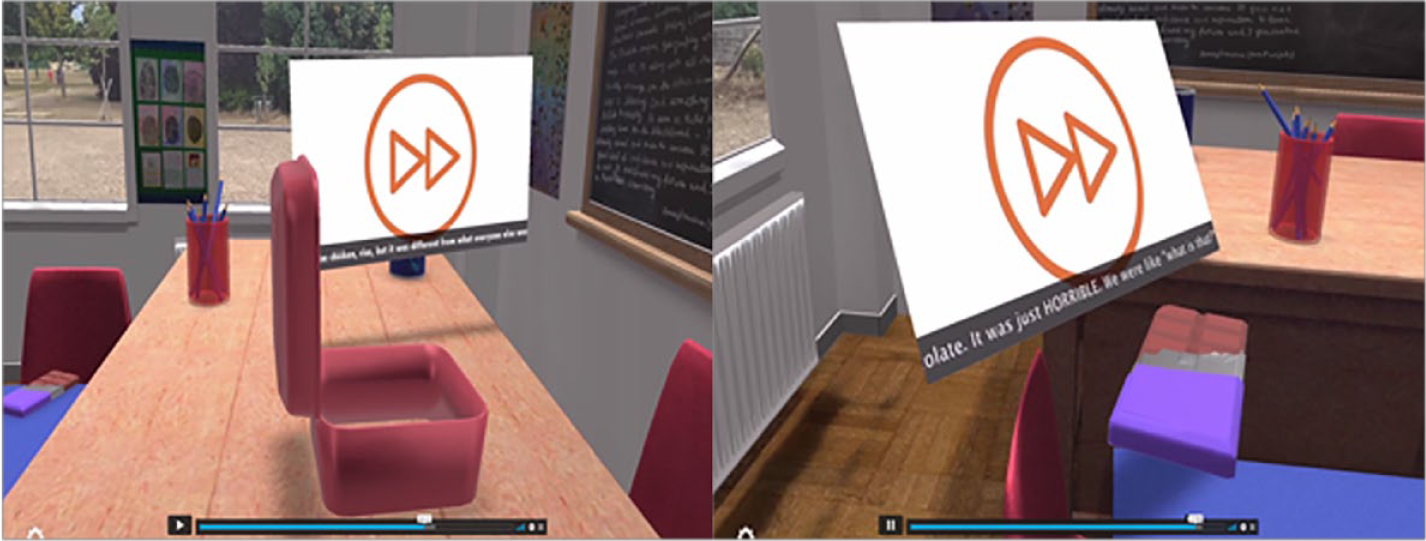
Virtual school room with interactive story objects: (left) ‘all you wanted in the world was to have what everyone else had.’ (right) ‘Chocolate. It was just horrible.’ (https://vimeo.com/448849848).
Technical and practical considerations also shaped our ongoing rethinking of what this XR experience could and should do. While the experience of visual immersion offered by VR would be novel and thus appealing to many potential users, we recognized that access to the VR headsets necessary for this fully immersive experience remains very limited for individuals and even for institutions. An augmented reality experience, by contrast, would be designed for use on tablets or smartphones. Since expanding accessibility was a primary goal of our project, this seemed a decisive advantage. As user analysis of the DOMiD virtual museum illustrated, accessing a data-heavy application, intended for headset-facilitated immersion, on a laptop, tablet or phone could generate a glitchy and discordant experience rather than a smoothly immersive one. The frictions within the DOMiD experience were a product of the limitations of VR as a medium as well as infrastructural issues such as the user’s broadband speed. So, instead of trying for the impossible (creating a smooth, immersive, ‘frictionless’ experience), we thought about how XR could make some frictions critically productive by rendering visible the gaps, seams, and tensions between places of mnemonic beginning, production, and consumption. As we noted earlier, digital frictions can combat the problematic tendency for XR to be seen as a means of transcending subjectivity (Irom, 2018: 4270), reminding viewers of the unequal processes of representation and mediation which connect them to the migrant memories they encounter. The XR experience that we produced offered a 3D window into, but not full immersion within, digital renderings of rooms of the exhibition. Digital lags, rifts and fissures may make for a more challenging experience at the site of consumption, sparking opportunities for ‘risky empathy’ (Irom, 2018). It is in these moments of friction that the tricky work of interconnection across difference gains traction (Tsing, 2011: 5). The user must employ what we term here the ‘labour of place’ to generate and process the way the places and stories being represented seep into and jar with their own situated and everyday surroundings. For example, when manipulating and moving around with the iPad to experience the virtual school room and linked stories, we found users ‘bumped into’ real people and the boundaries of the physical room they were in, which in turn disoriented their sense of place in the XR world and required active re-engagement and re-centring.
In imagining the potentially productive tensions between places of mnemonic beginning, production and consumption, we sought input through a democratic production space in the form of a second workshop. We tested an early prototype XR experience with users, bringing together migrant storytellers from the first workshop, our student researchers with migrant backgrounds, and UK school educationalists and designers from VR production companies. Testing and discussing the prototype meant we were able to embed, in our view, some of the democratic potential of XR within the production process. We incorporated ideas from the workshop participants who focussed feedback on the dissonances and disconnections between multiple places, including the relationship between the XR application as a site of memory production and the concrete settings where it would be experienced by museum visitors or remote users. Participant J noted the appeal of full immersion: ‘I didn’t want a reminder of the outside world when in augmented reality. I wanted to stay in it. Reality was a distraction.’ But most stakeholders agreed that the experience did not promise to ‘transport’ users somewhere else entirely but instead prompted reflection on the user’s sense of place alongside the place-making memories of others. Participant S said it was ‘good not to try and reproduce exactly the museum experience.’ Participant A suggested that the tablet and phone were ‘much better than VR because you still know where you are’. Participant D, a migrant storyteller, said using the XR on the tablet allowed ‘you to chat with others’ and ‘to build relational culture’. As Whitehead and Lanz (2020) argue, the political potential of migration museums lies in the possibility that visitors might make a connection between their own experiences and those of others (p. 200).
We had originally imagined a wide range of users potentially engaging with the museum through the XR experience. But since the Migration Museum has close connections with a secondary school outside London that has a Digital Museum Club, this was chosen to provide a test site, to be followed by rollout to a wider number of schools with the observance of user experiences. There was extended discussion at the second workshop of the desirability of social interaction at the place of ‘consumption’, with pupils working through the XR experience in pairs and then engaging in further structured discussions of migration. Indeed, this was another advantage of the AR format: unlike a VR experience that can only be accessed by an individual through a headset, users could navigate the AR experience together. However, sudden UK school and museum closures in 2020 due to COVID-19 halted the rollout. So, to ensure potential users input into the experience design we pivoted to an analysis of pupil feedback on the original Room to Breathe exhibition from their visits prior to the pandemic. Importantly, this showed that young people were drawn to a mix of the familiar (places and experiences to which they could relate and people with whom they identified) and the strange (places, observations or reactions that they had never encountered before or had never occurred to them).
Accordingly, with the views of pupils in mind, we focussed the XR prototype on providing teenagers with a balance between elements of the familiar and universal while stretching their experience into encountering and recognising diversity. To do this we digitally captured and remixed food memories from migrant storytellers in the museum’s exhibition kitchen and made them a key interactive feature in the digital classroom. Food memories have powerful invocations of place, with descriptions of the tastes, smells and textures of dishes featuring heavily in migration memories (Lupton, 1994; Rozin and Gohar, 2011). Nostalgic longing for a distant home triggered by reminders of that place’s food culture is a common theme in such stories (Holtzman, 2006). Experiences of exclusion based on rejection of one’s family food cultures are also common (Douglas, 1984). But accounts of individuals’ own affective relationships with particular types of food, especially novel ones encountered after relocation, could vary greatly. A man whose parents came to the UK from Spain, for example, describes how his parents devoted their lives to a restaurant that specialized in full English breakfasts. By contrast, Maurice, the migrant from Nigeria quoted earlier, found incomprehensible other UK residents’ fondness for cheese and chocolate, which seemed to him almost inedible (Figure 3 right).
The stories that migrants tell about food, as wider research has shown, tend neither to depict complete immersion in a single static culture of origin nor assimilation into a single destination culture, whether imagined as national (British) or global/cosmopolitan (Diner, 2003; Holtzman, 2006; Lupton, 1994). Like stories of migration more generally, they involve intensive but often ambivalent engagement with multiple places and practices over time, providing listeners with opportunities for partial but never entirely complete identification (Kalčik, 1984; Sutton, 2001). In our curation of migrant food stories within the XR experience we remixed food memories that were illustrative of the disorientations felt by migrants to their sense of place, capturing the tensions of multiple places, of being betwixt and between. For example, we connected to a familiar but digitised lunchbox a food memory of a woman who recalled that her mum had insisted that she not have school dinners but have home cooked food in her lunch box when ‘All you wanted in the world was to have what everyone else had’. She wanted sandwiches and crisps not your ‘different smelly food’ (Figure 3 left). Another story, accessed through a poster of a chilli pepper on the wall of the schoolroom, describes a woman being raised by Nigerian parents in London and then being called ‘English’ when she went to live in Nigeria because she ostensibly had no tolerance for chilli peppers.
In our XR prototype, we sought to enable some of what might be seen as the democratic possibilities of XR through creating an active digital memory place where experiences of connection and disconnection – of the familiar and the strange – sparked opportunities for place-making between multiple locations: the Migration Museum, King’s Digital Lab, the school, the home and the many places evoked by migration memories. For example, the unfamiliar migrant food memory of eating chocolate for the first time – what we call the place of beginning – is accessed through touching the chocolate bar, defamiliarized in its digital rendering and then placed within the familiar setting of the classroom, which is also ‘made strange’ through the use of generic design. These multiple disorientations and digital frictions require users to ‘labour’ between multiple senses of place – the place of beginning, the place of production and place of consumption – all invested with different memories and meanings, that the user works to tie together through new (dis)connections. The research team thus found that our own mnemonic labour at the site of production – at the workshops or in the King’s Digital Lab – was in part about giving migration memories ‘room to breathe’. We sought through the digital frictions of XR to allow migrant story-tellers’ memories to evoke multiple places beyond the museum, and thereby to facilitate risky empathy through an active process of engagement and place (un)making by the user at the site of consumption.
Conclusion: Web 2.0 and the multiple places of digital memory
This article sought to understand the relationship between memory and place within XR migration museum exhibitions. We argue that the value of XR is not the extent to which it can provide ‘complete immersion’ in another place. The democratic possibilities of creating XR exhibitions can be included in the production process and generated through the frictions and (dis)connections they open up between multiple places. As migration memories ‘move’ through Web 2.0 they maintain an important link to their ‘place of beginning’. Yet this place becomes part of a broader ecology of memory places, including the place where the memory was recounted or digitised (place of production) and the place where users have downloaded, listened to, and engaged with that memory (place of consumption). Labour at each of these sites constitutes a form of place-making as spaces are invested with new meanings, memories and connections. In this way, our research points to an innovative methodological and conceptual approach to understanding and indeed curating XR experiences with museums, framed through the idea of mnemonic labour that connects and disconnects the multiple places of digital memory.
With Chouliariaki (2013) and Irom (2018), we argue that spaces of advocacy should centre migrant voices whilst also keeping the processes of mediation and structures of representation visible. We show how multimodal memory research, which includes recursive practice-led methods, can inform the development of a conceptual framework for how to understand Web 2.0 places in relation to XR and migration museum exhibitions. Our democratic and participatory workshop approach, our mapping and user analysis of other exhibitions and our inclusion of XR migrant experiences pointed to the important role of audiences in engaging with digital memories of place, complicating claims about the inherent passivity of the digital memory consumer (Kansteiner, 2014). We explored how XR as part of migration museum projects can create space for ‘risky empathy’ (Irom, 2018) as visitors are encouraged to see the unequal connections that link us to places of memories and experiences of migration and displacement. Mnemonic multi-places created through Web 2.0 may then have important democratic possibilities because the place of mnemonic consumption has become, to some extent, the place of mnemonic production, with online museum visitors being able to upload, augment or interact with digital memories in new ways.
In part, we invoke the concept of the ‘labour of place’ to counteract latent assumptions about the disembodied and free-flowing nature of digital memory work. Digital memories are tied to multiple places in meaningful ways and their movement is powered by the labour of individuals, capturing, downloading and uploading in specific locations. Furthermore, the ‘labour of place’ speaks to our case study in a number of other specific ways: the labour of migrant communities in making a place of their own; the labour of migrant storytellers in evoking placements and displacements beyond the museum; the labour of museum workers in creating virtual and physical places of memory; and the labour of the museum visitor (or XR user) in imagining the place of another within a familiar place (the classroom) through the unfamiliar (a food memory) and accordingly (we hope) in re-considering their own sense of place and belonging. As Rouf (2020), the Special Events Associate from New York’s Tenement Museum, observed about the Tenement Museum's Web 2.0 responses to COVID 19, ‘the ability to bring in more digital media pieces helps us communicate beyond the place itself’. In this way XR can enable visitors to remain in place while going beyond place, with all the important mnemonic risks this involves.
Footnotes
Acknowledgements
Many thanks to Dr Sarah Fine and Dr Leonie Ansems de Vries, King’s College, London who were part of the wider team for the King’s Together 'Remixing Migration' project. We also would like to thank the migrant storytellers, researchers and museum workers who participated in the workshops with particular thanks to Aditi Anand, Arianna Ciula, Alexandra Kubica, Abira Hussein, Akvile Terminaite, Vinya Mehta, Liberty Melly and Sophie Henderson.
Funding
The author(s) disclosed receipt of the following financial support for the research, authorship and/or publication of this article: The Remixing Migration research project was funded by King’s College London through the award of a King’s Together grant.