



Abstract
The article explores a case of memory ‘travel’: a commemorative practice, which emerged as a grassroots initiative in Russia to mark Victory Day, and quickly spread up the state hierarchy and across borders, becoming in a sense global. The focus is on the transformations in the course of its expansion and its subsequent adoption in Bulgaria. I examine how this practice changed the format of Victory Day in Bulgaria, and, on the other hand, how the agents, contents/messages, practices and forms of remembrance changed, in intended and unintended ways, in the course of their adaptation to the Bulgarian context.
The case I explore here can be seen as an example of mnemonic ‘glocalisation’ – using the concept introduced by Robertson (1995) to make sense of the processes whereby cultural products or phenomena are diffused from one place to another and adapted to the new locality. Robertson’s thesis is that the adaptation to a new context modifies the original product. While this is hardly a surprise, my aim is to investigate what the changes are and how they occur in a particular case. I shall examine a commemorative practice, which emerged as a grassroots initiative in Russia and quickly spread up the state hierarchy and across borders as part of a geo-politics of memory. The conceptual tools to capture its transformations are, first, the idea of ‘travelling memory’: a conceptualisation of transcultural memory as fundamentally dynamic, ‘incessant wandering of carriers, media, contents, forms, and practices of memory’ (Erll, 2011: 11). Unpacking the notion of travel in this way, Astrid Erll offers an operational model, which I shall use to explore how mnemonic actors have ‘localised’, that is adapted to the Bulgarian context, the media, contents/messages and forms of a specific commemorative practice. I will show that while the media and the forms remained the same or very similar, the carrier groups and their messages changed. Next, to make sense of the change, I use Gluck’s (2007) differentiation between ‘official’ and ‘vernacular’ memory whose interplay feeds into public memory. Vernacular memory, which is both unofficial and limited to localities and groups, is not necessarily oppositional. Still, it was rather sternly contained in authoritarian societies, including the Soviet Union and communist Bulgaria. Therefore the recent tendency towards vernacularisation of the memory of WWII (i.e. anchoring it in family and community remembrance) is an example of intriguing ‘travel’ between political and social contexts.
Setting the scene: Two competing celebrations
For decades, 9 May has been celebrated in Bulgaria as Victory Day following the Soviet commemorative calendar. Since Bulgaria’s EU membership (2007) it has also been marked as the Day of Europe. The two celebrations take place at different sites and times, target different audiences and do not refer to each other. The Day of Europe engages mostly young people, offering events in the ‘infotainment’ mode. The main initiatives come from the Representations Office of the European Commission and the Information Bureau of the European Parliament. Bulgarian official bodies, NGOs, universities and schools hold their own events to mark the day.
Victory Day has a rather fixed format, inherited from the communist period. The main event is a commemoration in front of the monument to the Soviet Army in Sofia. The official celebrations before 1990 included ceremonies attended by high-ranking military and communist-party figures. The aura of sacredness was also due to historical reasons: the liberation of Bulgaria from Ottoman domination came as a result of the Russian-Ottoman war in 1877–1878. Since then, Russia has been celebrated as liberator – a theme prominent in Bulgarian cultural memory (commemorative calendar, monumental art, symbolic topography). It was therefore easy for the communist regime to forge a myth of the ‘double liberator’. Thus, due to both historical memory and propaganda efforts, the invasion of the Soviet Army in September 1944 was generally not interpreted as occupation, in contrast to the prevailing attitudes in the Baltic and Central-European countries. These interpretations, sustained by a powerful ideological apparatus, ensured that the Soviet Army, the Soviet Union and the Bulgarian-Soviet friendship were the core of 9-May celebrations. Recent historical analyses have offered alternative perspectives, and common sentiments have undergone dramatic diversification, but – again unlike other Central- and East-European countries – the alternatives to the Soviet-era narrative have not garnered full consensus.
Since 1990, Victory Day has lost its official character and has been appropriated by the political left, represented by the Bulgarian Socialist (ex-communist) Party (BSP) and its satellite NGOs. They have organised the annual celebrations for the past decades following their own agenda. One reason for the easy political appropriation of Victory Day is that compared to Russia, Ukraine and Belarus – countries that suffered enormous losses of soldiers and civilians – 9 May did not have such a deep and traumatic meaning for individuals and families in Bulgaria. Staged as a formal expression of friendship with the Soviet Union, it could not touch on individual sensitivities with any comparable depth or intensity.
I have done ethnography of Victory Day since 2013 (Koleva, 2015). That year, the event was geared to the upcoming elections. Most of c. 300 participants were elderly people – BSP members and sympathisers who came to support their party. Some had biographical ties with Russia/Soviet Union (work, study, marriage). Since 2014, in the wake of the annexation of Crimea, the role of the Russian Cultural centre and the Russian diaspora has become more visible than before.
The competing celebrations exemplify wider European memory battles around WWII, especially on the responsibility for triggering the war and the contribution to the Allies’ victory. After the EU accession of the ex-communist countries, the European memory narrative, hitherto centred on the Holocaust and anti-fascism, was challenged to acknowledge the Eastern Europeans’ experience of another type of totalitarianism. The Resolutions of the European Parliament on the 60th anniversary of the Second World War (2005), and on European Conscience and Totalitarianism (2009) officially, albeit cautiously, launched a comparison of Nazism and Stalinism contesting the mnemopolicies of the Russian Federation. 1 The answer was an activation of its mnemonic diplomacy. 2 The ‘Russification’ of the 9-May celebration in Bulgaria apparently follows the dynamics of this larger-scale geopolitics of memory. I shall try to show the specificity of the Bulgarian case by exploring a change in the format of the 9-May celebration – a trans-border initiative, called the Immortal Regiment (IR). It started in 2012 and quickly spread in Russia and among the Russian diaspora. What I have found intriguing is that only in Bulgaria, a ‘clone’ of the IR was registered: an NGO with the same aims and statute as the Russian original. Indeed, there is an eponymous foundation in Serbia, but its aims, symbols and activities are different, acquiring at times nationalist overtones. 3
I have followed the activities of the Bulgarian IR since its inception in 2016: mainly the annual marches, their organisation and media coverage, but also its online presence. I aim at a deeper understanding of this commemorative genre and the changes it has undergone when adopted transnationally. My hypothesis is that the success of the movement is due to its vernacularisation strategy: it has mobilised family memory to re-invigorate the increasingly formalised WWII commemorations. This ‘travel’ across official and vernacular memory has had a certain unifying and solidarity-building effect in Russia, but not in Bulgaria.
Following Erll’s model outlined above, I shall start with a brief account of the original movement and its transnational expansion; then I will focus on its Bulgarian ‘clone’ to look in greater detail into the changes resulting from the ‘travel’ of this memory practice across geographical, national and political borders.
The Immortal Regiment in Russia: Claiming Victory Day
Having started as a local initiative, the IR was registered in 2014 as a ‘historical-patriotic movement’ with a mission to safeguard and transmit personal and family memory of WWII, steering away from political, commercial or PR tasks. It has a loose non-hierarchical structure with its main activities locally based and organised by volunteer coordinators. In a situation of diminishing participation of veterans, seen as a direct and ‘authentic’ link to the war past, the movement has sought to re-invigorate the celebration of Victory Day by encouraging people to (1) bring to the parade a poster with the photo of a predecessor who took part in the war as soldier, sailor, guerrilla fighter, worker at the home front, prisoner of war or besieged (‘blokadnik’), and (2) tell his/her story on the website. The inclusiveness of the list of war participants is noteworthy: it extends the categories of persons to be commemorated beyond the usual notion of war veterans. ‘The Regiment – it is the millions of people gone and their descendants’, the Statute proclaims. 4
The march: Enactive remembering
The initiative started in 2012 in Tomsk. In the following years, marches mushroomed in Russia: in 2013, over 120 localities followed the Tomsk example; in 2014, over half a million participants joined the march. In 2015, the initiative was included in the federal programme for the 70th anniversary of the victory. Thereby, the support of the local administrations all over the Russian Federation was secured. This generated understandable fears that the civic initiative was being appropriated by the authorities – especially in Moscow, where President Putin marched in the first row carrying his father’s portrait. With or without bureaucratic intervention, the website reports over 4 million participants. The newsreels commented that there had been no such unity across years, generations and families before. 5 However, after the march, photos of dumped posters appeared in social media. This raised doubts that the march had been jeopardised by the excessive zeal of the organisers, compromising the initial idea to rely on personal and family memory. 6
With the growing popularity and state support, the movement split into an ‘official’ and a ‘popular’ one 7 with chronic tensions between them, and various forms and degrees of conflict or collaboration with local authorities. Concerns about the voluntary and apolitical character of the movement are raised in a special rubric on IR website reporting violations of the Statute: political or administrative pressure, advertising, etc.
The chronicle: De-privatisation of family memory
In addition to the spectacular annual marches, a database was set on the website, collecting photos and stories of war participants. Anyone can register and fill in the template. Often the same author posts data about more than one family member, for example maternal and paternal grandfather, or (grand)parents’ couple. I have not come across anonymous entries. Since 2016, a Search Centre has been established, helping descendants to find out the fate of disappeared relatives.
Since the start of my observations, the database has grown from 404,300 entries in December 2017 to over 466,300 in March 2020. In its current version, the website does not show total numbers, but it is certain that they grow steadily. For example, the database for St. Petersburg consisted of 12,308 entries in March 2020 and of 18,450 a year later. Even a cursory look shows a clear hierarchy of remembering with military at the top: combat is the focus of WWII memory and fighters are ‘worthier’ to be remembered than victims and civilians. Thus for St. Petersburg (former Leningrad), under siege from September 1941 to January 1944, mostly army ranks are included in the database, while civilians (‘blokadniki’) comprise only around 10%. In this respect, the ‘regiment’ does not succeed in offering an alternative to the official commemorative culture.
What the IR does achieve is to re-invigorate the memory of WWII remediating it through performance (the march) and through the online archive. In both formats, private loss is upgraded to the level of the global catastrophe. The reference to this global context is however not the only form of IR’s globalisation. In the next section, I will focus on IR’s ‘travel’ across borders and its consequences for the meaning and message of the movement.
The ‘victory’ of the Immortal Regiment and its costs
Already in 2013 the IR commemorative model was adopted in other countries, to include 90 countries in 2019. 8 The participants in the marches are predominantly Russian expatriates. 9 The spread of the movement abroad relied on local coordinators in each country, supported by the Coordination Council of Russian Compatriots, under the auspices of the Ministry of Foreign Affairs of the Russian Federation. Its mission is the consolidation of the ‘Russian World’, that is the Russian ethnic-cultural space. 10 The database on the website acquired global dimensions too, covering over 50 countries, some of which were not involved in WWII. Thus, the geographical scope of the database obviously reflects the geography of present-day Russian diaspora, rather than WWII itineraries. For Bulgaria, 39 populated places are listed, including all regional centres and a few localities on the Black Sea coast where Russian citizens reside on a permanent or seasonal basis. 11 However, for some of these, there is no evidence of any activities.
Spreading globally, the IR was integrated into Russian cultural diplomacy 12 to become an asset to its ‘soft power’, that is a way to promote its agenda using the resources of art and culture, history, media and communication technologies. Thereby, the carrier group transcended the limits of family and local communities towards an ethno-national scale, adopting a different agenda. From another perspective, the spread of the IR to countries where Soviet soldiers did not set foot during WWII, highlights the fluid boundaries between the local/regional and the global in the field of memory.
Meanwhile, the IR movement has drawn considerable research attention. The most frequent questions tackle its political uses. It is viewed ‘simultaneously as a state-sponsored project deeply intertwined with official policies towards historical memory and as the collective representation of local, bottom-up commemorative initiatives’ (Nemtsev, 2019: 1). While this hybridity 13 may well account for its huge popularity, it has caused trouble to analysts. Arguments vary from appraisals of IR’s democratic nature and (potential) subversive power to criticism of its colonisation by the establishment. Some authors have noted that for Russians, the memory of WWII has never been reduced to the official narrative; it has been very personal and intimate. Consequently, IR is interpreted as citizens’ protest against the monopolisation of war memory by the state. It ‘talked about the war in a different way and in fact subverted the state monopoly on the interpretation of the war past’ (Kurilla, 2018: 8) stressing that WWII was also about loss and mourning. Acknowledging this message, critics have pointed out that the IR march de-valorises individual tragedies by turning them into mass spectacle (Nemtsev, 2019).
But why is the IR march so easily permeable to politicisation? Family memory is a kind of vernacular/communicative memory, which is not politically articulate. Privileging it and striving to keep it apolitical has ironically led to a lack of reflexivity regarding its political dimensions. 14 As a result, official and vernacular memories have turned out to be surprisingly congenial to each other. The mnemonic narrative forged by the IR has lent itself to an easy identification with the Soviet historiographical narrative, challenged in the 1990s and re-installed after Putin’s advent to power – namely the discursive isolation of the Great Patriotic War (1941–1945) from the Soviet Union’s overall participation in WWII (esp. the cooperation with Nazi Germany in 1939–1941). Moreover, some slogans of the last years (‘To Berlin’, ‘We can do it again’) are explicitly aggressive and anti-European. 15
Gabowitsch (2018) has explored the subversive potential of ‘flat’, that is non-hierarchical de-centralised movements, among them the IR. His conclusion is that although such movements are flexible and democratic, allowing participants to decide on their degree and manner of involvement, they are vulnerable in the Russian context. While the initial impulse behind IR was apparently critical, only a couple of years later the movement came to be seen as hegemonic, reflecting the constellation of power in nowadays Russia. Its appropriation by the state diluted whatever subversive messages it might have had (Gabowitsch, 2018: 310). 16 As a result, the very participation in the marches – in spite of the tensions between official and vernacular interests – can be seen as support for the regime.
While this conclusion is quite convincing, it must be noted that critics have limited their observations to the march, disregarding the archive. Certainly the former, with its spectacular scale and performative intensity, is well worth the attention it has received. The latter however – like similar user-generated archiving and commemorative initiatives on the web – has a horizontal structure and a ‘miscellaneous’ quality subverting the power of selection, classification and hierarchisation inbuilt into institutional archiving practices. This does not make it immune to reproducing the hegemonic discourse (see Bernstein, 2016). Still, with its modular structure and its focus on family genealogy, it articulates and supports vernacular (small-scale, concrete and personalised) remembrance, which seems to be ‘talking past’ manipulative intentions. The march ‘sutures’ diverse experiences, memories and myth-histories in a common emotional tissue (Oushakine, 2013), which fuses commemoration of the dead and solidarity with the living. Without such exuberance, but in a no less engaging way, the database offers a space for collaborative ‘memory work’ which moves from the public recognition of family intimacy towards a kind of public intimacy – a direction of the memory ‘travel’ that I call vernacularisation.
The IR march and its export can be viewed as a way of wielding neo-imperial soft power through the community of Russian compatriots, especially in the neighbouring countries (Braun, 2015). While this is also true for Bulgaria, I would like to consider the case from another perspective – that of a possible glocalisation, with its intended and unintended consequences.
The Bulgarian Immortal Regiment: What is in a copycat?
Bulgaria’s experience of WWII was complicated and not easily lending itself to linear commemorative interpretations. After an initial period of neutrality Bulgaria joined the Axis in March 1941 to change sides in early September 1944. Thereafter, the Bulgarian Army participated in military actions on the side of the Allies. Over 8000 soldiers fell in battle, over 9000 disappeared. However, these losses remained marginal in the historical narrative and commemorative politics of the communist regime, focused exclusively on the underground resistance in 1941–1944 and greatly exaggerating its scope and importance. This focus was clearly visible in the memorial landscape of communist Bulgaria (Kelleher, 2009). While hundreds of monuments to the Soviet Army, to the partisans and their helpers were installed (many of them still in place), there was no central memorial to army ranks. The apparent explanation of this ‘asymmetry’ in the public memory is the effort of the regime to inculcate certain ideas of the past, ensuring its own legitimacy. 17 Consequently, in contrast to other countries, there were no public commemorative practices to support private mourning for the war dead. Thus the Bulgarian Immortal Regiment – though a precise ‘copycat’ of the Russian one – was established in different circumstances, by different agents and with different messages. While adopting the statute and symbols of the Russian grassroots initiative (the original IR), it has a clear political identity: the founder and chairman of the IR Foundation is also head of the anti-NATO and anti-EU Union of the Communists in Bulgaria (est. 1995), and former head (2000–2013) of the Che-Guevara movement – organisations identifying themselves as ‘radical Left’. Other major mnemonic actors are pro-Russian NGOs, BSP and some nationalist constituencies. The political instrumentalisation of the march is clearly seen in its media coverage as well. 18
The march: Changing the format of Victory Day
Since 2016, when the first IR march took place in Sofia, the ‘choreography’ of the 9-May celebration has changed. Instead of gathering directly at the monument to the Soviet Army, as before, many participants convene at the memorial to the Unknown Soldier and march c. 1 km to the monument. Their arrival gives the start of the ceremony. Mostly Russian speech is heard among the partakers in the march, and almost two-thirds of the posters they carry are of Soviet Army soldiers. In 2018, a small group of men in leather jackets headed the march – members of the Bulgarian chapter of the Night Wolves, a Russian nationalist motorcycle club supported by Kremlin. 19 In the back rows, a flag of the separatist ‘Donetsk people’s republic’ was seen. Around 300 people marched, while a total of 500–600 attended the commemoration at the monument. In comparison with the celebrations in 2013–2014, the average age of the participants was lower. The Russian ambassador and MPs from BSP and nationalist fractions delivered speeches. In 2019, BSP and nationalist politicians joined the march but did not participate in the ceremony. However, Victory Day was acknowledged by President R. Radev who took part in two consecutive ceremonies: he laid flowers at the memorial to the Unknown Soldier to the acclaim of the participants in the IR march, and then he attended to the EU flag in front of the Presidency to honour the Day of Europe.
While the presence of political and state representatives is worth attention as a way of legitimising the event and placing it in the larger context of Bulgarian-Russian relations, it is only one dimension of the mnemonic constellation. To thicken the description, I am turning to the grassroots/bottom-up aspects of the IR march – the ‘rank and file’ of the Regiment. They were my usual interview partners, first in a random sample, later in a more targeted one, whereby I looked for Bulgarians carrying portraits, and I talked with them in the first place. With some of them we met more than once. Let me focus in some detail on this sample. In 2018 and 2019, representatives of the Bulgarian War Veterans’ Union marched carrying big laminated posters with lists of the names of fallen Bulgarian soldiers in WWII. Others carried portraits of participants in the 1941–1944 resistance – either their relatives or acknowledged heroes. Some of the individuals on the portraits had no connection with WWII: they were victims of the repressions of an earlier period, 1923–1925.
In 2019, many portraits were the same as the year before, including those of Lenin and Stalin, of Soviet and Bulgarian poets and of heroes of the resistance during WWII. Worth noting however, Bulgarian participants, mostly elderly people, carrying photos of their own predecessors who fought in WWII were slightly more in number. They were the majority of my interviewees. I approached them with questions about their relation to the individuals on the photos; about the stories of those predecessors; about their own motives to join the march and bring portraits. They willingly engaged in conversation answering my and each other’s questions, explaining their kinship ties with the people on the photos and telling their stories. A woman said that she had learned from the Russian participants the year before and had decided to follow their example, bringing her father’s portrait. In turn, she encouraged a friend to do the same. Some interviewees gave detailed accounts of their relative’s antifascist activities before 1944, but knew next to nothing about their war experiences. Others, on the contrary, talked about the war. I heard heroic stories and tragic stories. A man in his 80s recited his father’s war itinerary and insisted that ‘not only the partisans were heroes’ and that the war was ‘against fascism, not necessarily for communism’. Another one carried the portraits of both his parents: his father’s, because he fought on the front-line, and his mother’s – because she raised her four children alone. Along with A4-portraits attached to stands following the IR template, many participants carried portraits in wooden frames, obviously taken off a wall. The very situation of holding one’s father’s portrait and telling his story to a stranger seemed to shape the reminiscences in a specific way. My impression was of a willingness to set aside themes that could have triggered contention – a strategy of ‘circumventing meaning’ (Murakami, 2014: 343) observed in cases of potential mnemonic antagonism. My conversation partners were reluctant to engage with ‘big’ questions, such as the ones of historical responsibility. The teleology of their stories did not reach beyond their predecessor’s and their own lives, allowing them to distance themselves from the historical context and retreat from its consequences.
In other Bulgarian cities, marches have taken place on a smaller scale for the past couple of years. In Blagoevgrad, the march of 2018 comprised some 50–60 people, mostly Russian speakers. In Plovdiv, about 100–120 people took part. In addition to the ‘double liberator’ myth, featured on a banner with the words ‘Thank you Russia 1878–1944’, there was a poster with photos of ‘Donbas heroes’, separatists from Eastern Ukraine. Somewhat different was the format of the commemoration in Rousse, a city in North-East Bulgaria, where a Russian war cemetery is situated. 20 The ceremony, led by a brass band and attended by the mayor, took place in front of the monument to the Soviet Army. Russian expatriates marched carrying portraits of (presumably) their predecessors, and Bulgarian participants carried portraits of the central figures of the local antifascist pantheon. After the march, an Orthodox memorial service was held at the war cemetery and some food, wine and vodka were distributed in memory of the dead, in compliance with the Orthodox tradition. While this commemoration was close to the international trend of re-focusing from heroes/martyrs to individual victims of the war, the participants showed no awareness of such patterns of remembering outside the Russian-Bulgarian context.
Compared with my observations in 2013–2014, the upsurge of performative remembrance inspired by the IR significantly re-activated Victory Day commemorations. They are better organised and better attended than before. Their profile has been raised by the attendance of official Russian guests whose rank is much higher than that of their ceremonial ‘hosts’ from Russofile NGOs. The Russian Cultural Centre announces the event in its programme and coordinates local initiatives. In addition to the pro-Russia constituency and BSP sympathisers, other groups and agendas (anti-NATO, anti-EU, Ukrainian-separatist, nationalist, radical-left) have found their way into the event with their slogans and symbols. Albeit on its periphery, their presence dilutes to some extent the messages intended by the IR organisers.
In terms of mnemonic content, the changes are even more intriguing. Firstly, respect is paid not only to a monolithic and impersonal ‘Soviet Army’, as before, but to soldiers identified with their names, photos and stories in an act of (perhaps somewhat sentimental) cross-generational recognition. The categories of those commemorated include not only front-line combatants and not only Russians/Soviets; the stories told about them are less exemplary and more intimate. Albeit hesitantly, Bulgarian army soldiers are commemorated as well, thus changing the memory narrative of the communist era, where they did not fit.
The chronicle: hierarchies of remembrance
Closely following the format of the Russian IR, the Bulgarian one also supports a database. Unlike the Russian original, where users have direct access to upload their stories, photos and documents, the Bulgarian site asks users to send materials to the admin. A comparison between the Russian IR chronicle – region Bulgaria, and the Bulgarian IR chronicle reveals further differences.
Firstly, the Russian database for Bulgaria is organised by populated place, evoking the idea of shared locality and collective/local memory. The authors are obviously members of transnational families who thus link to their parent’s country of origin. Kinship ties are usually specified, while genres vary from detailed and personal stories to brief biographical accounts. In the Bulgarian database, the entries are predominantly encyclopaedia-style (place and date of birth, occupation, date and cause of death). 21 In over 100 cases, the authors are anonymous, and so remain the persons meant to be immortalised: there are no photos or personal documents, while communist-propaganda clichés abound (‘killed by the fascist capitalists’, ‘inquisitioned by the police’). The dates of upload testify to a campaign for filling in the database in mid-April 2016 when some 50 names beginning with ‘A’ were entered in alphabetical order. The Bulgarian IR site seems to have been planned as a memorial, rather than a space for active family remembrance. The ‘Search’ functionality, instrumental in the Russian case, is lacking in the Bulgarian version.
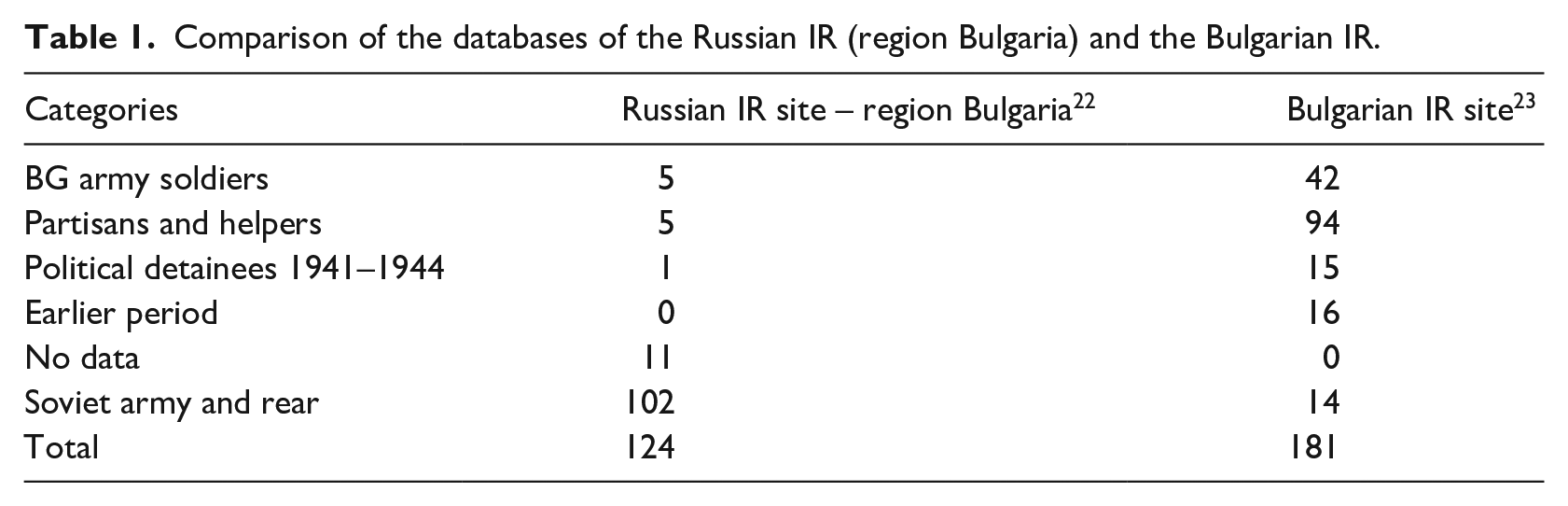
Next, as seen in the Table 1, the comparison demonstrates different conceptions of who should be remembered and for what. While army soldiers predominate in the Russian database, for the Bulgarian one partisans and their helpers comprise the largest category. This hierarchy, where the antifascist underground comes first, reproduces the communist official memory, highlighting only the communist-led resistance, whether or not related to WWII. For instance, an entry honours the organiser of a terrorist act in Sofia on 16 April 1925, where over 130 were killed and 500 injured. Thus the database faithfully follows the communist-antifascist mnemonic template ignoring whatever does not fit: there is no room for non-communist anti-fascism, for example parliamentary opposition, and the army – the core of the Russian database – is largely glossed over. Against this backdrop it should be noted however, that the entries about army soldiers are the ones most closely following the Russian model: most of them authored by descendants, accompanied with photos and including some personal remarks. Again, it can be hypothesised that the Russian archive privileging family memory, has served as a model.
Comparison of the databases of the Russian IR (region Bulgaria) and the Bulgarian IR.
Do the two regiments belong to the same army?
The pragmatic perspective, to which I subscribe here – viewing memory as a situated practice rather than an ‘artefact’ – draws the attention to the performative aspects of meaning-making: what people say and do can be regarded not only in terms of symbols and meanings, but also ‘as actions which produce affects and effects in the world’ (Rigney, 2016: 68). The comparison of the two cases along the dimensions of carriers/agents, media, forms and content/messages, helps to understand not only how social, cultural and political contexts shape commemorative practices but also how affective and material settings mediate their meanings. While the mnemonic practices are the same, and the ritual grammars, that is rules of symbolic coding and communication, are similar, a number of significant changes have occurred as a result of the IR’s ‘travel’ across borders and (political) cultures.
As far as the practices are concerned, a vernacularisation of public/official memory is observed in both cases. In terms of Assmanns’ dichotomy, communicative memory ha splashed back onto cultural memory. The appealing intimacy of family remembrance, combined with the crowdsourcing approach, has kindled agency and a sense of ownership. Participants in the IR marches are protagonists, not mere spectators. As Oushakine (2013) has demonstrated, such an enactive remembering relies on an emotional relation to the past based on the activation of de-contextualised symbols and tropes. In both cases, the ‘affective management of history’ does not offer a cognitive, intellectual perspective on the past, but rather a more personal and deeply felt one, shared within a community it strives to unite. Vernacular reminiscences have given new life to what has increasingly been growing into an empty ritual shell; people have filled it with their own stories and meanings, and have done so actively. No wonder that the filling has included a wealth of mass/pop-cultural elements: St.-George’s ribbons, military accessories, dressing up, etc. 24 As a consequence, contentious messages – nationalist, Stalinist, separatist, anti-European – have acquired a benign consumerist gloss.
The outlined differences in the commemorative agendas have led to changes not only in the forms but also in the content/messages. While in both cases the initiative relies on emotional commitment, in Russia it is motivated by a desire to bracket out differences, and in Bulgaria – to reaffirm and reinforce them. While the Russian Regiment has focused on individual symbolic and bodily activity and has sought distinctly apolitical symbols, the Bulgarian is rather hybrid, including characteristics of an organised political performance. While in the Russian case family solidarity has played (initially, at least) a leading role, due to the intergenerational transfer of family memory, in Bulgaria there is a clear identification with a politically defined culture of memory. In the former case the carrier community is designed to involve generations in the family, while in the latter case these are largely political generations. If for the Russian IR, especially after its spread across borders, this community may be coterminous with the nation, in the Bulgarian case it is rather limited and exclusive in its oppositional situatedness.
Evidently, a comparison of the two cases is complicated by their respective dynamics, which necessitates a modification of the starting hypothesis. In Russia, the IR march initially set aside hegemonic meanings to engage with loss – an underplayed aspect of the war in public, but one kept in family memory. As Winter (2010: 323) has noted, ‘[p]ublic commemoration lasts when it draws out overlaps between national history and family history’. Reconnecting with earlier generations in the family is an integral part of the IR as a commemorative practice with high affective intensity, which certainly accounts for its wide appeal, with or without a subversive potential. With its appropriation by the authorities and its ‘globalisation’, the IR’s content seems to have undergone a metamorphosis into a kind of ‘performative patriotism’ (Arkhipova et al., 2017: 100), similar to the normative version of WWII history coined by Soviet historiography and re-established in the 2000s. Thus the IR has effectively re-invigorated what Tumarkin (2003) has called ‘a cult of the Great Patriotic War’.
In Bulgaria, the memory politics in relation to WWII can be described as recall-induced forgetting, where ‘in conjunction with what is said, silence impairs some memories over others’. (Stone and Hirst, 2014: 322). It is this situation that accounts for the change of the agents and messages of the commemorative practice while preserving its form. The Bulgarian IR has endorsed the inherited communist narrative without much creativity. The ritual was reclaimed not by family memory but rather, by a political (and partly generational) constituency. Thereby, unlike the Russian original, its message is divisive in the present Bulgarian context. On the other hand, while in Russia the establishment has been quick in appropriating the initiative, in Bulgaria the state has largely withdrawn from instrumentalisation of festivities for political control. 25 The newly emerging social and semantic structures have overlapped with the old ones rather than replacing them. The situation of mnemonic pluralism and fragmentation has lent a new meaning and a sense of ownership to what looked very much like a hollow ritual. The celebratory ‘competition’ that juxtaposed the Day of Europe to Victory Day has re-invigorated the latter. To limit myself to one example, the theme of the ‘hijacked holiday’ re-appears in social media every year: some users, ignoring or unaware of Schuman’s declaration of 9 May 1950, see in the Day of Europe a purposeful attempt to eclipse Victory Day. 26 Thus Victory Day is positioned as a counter-celebration to the Day of Europe. 27 The competitive striving for recognition has led to its reinvention through challenging the other narrative: our holiday runs counter to your holiday. The idea is not only to remember but to remember in a particular way, to demonstrate a cohesion around a version of the past: not ‘let’s remember how it was’ but ‘let’s show how we remember’ (Arkhipova et al., 2017: 90). In Bulgaria, this kind of mnemonic solidarity has reproduced the controversies set by political elites and experienced by significant parts of the population. This is why pro-Kremlin political actors invariably strive to capitalise on the celebration – a tendency noticed also in the 1990s Russia (Zorin, 1998).
To sum up, the emergence of the IR and its subsequent ‘globalisation’ reveal an oscillation between official and vernacular memory: from the vernacularisation of the commemoration through anchoring it in family memory, to its appropriation by official memory policies. The IR’s ‘glocalisation’ in Bulgaria has meant a change of its carrier-agents and of its messages in the situation of mnemonic fragmentation and contest. Such changes may be important enough to support the glocalisation-hypothesis but they do not exhaust the subject. Victory Day refers not only to the celebrated event. As Gabowitsch (2015) has noted, it ‘becomes a statement in a dialogue of previous iterations of the celebration’. Indeed, Bakhtin’s (1983) concepts of social heteroglossia and dialogue offer a way to make sense of some more subtle aspects of the IR’s ‘glocalisation’ in Bulgaria. Due to its loose, individualised and non-hierarchical mode of participation, it has offered a space for heteroglossic agendas. This situation has made it possible to activate a community of passive remembrance and to articulate previously silenced memories – those of the Bulgarian army soldiers who perished in WWII and were only privately remembered. While heroes of the resistance form the core of the ‘immortal crew’, the memory of the fallen soldiers has also gained some ground as family, that is communicative, memory, not as a political or national one. This emancipation of family memory has become possible within the ritual grammar borrowed from the Russian original. Thus, as a by-product, the import of a mnemonic practice has strengthened a (sub)culture of memory previously screened out by the exaggerated narrative of the communist resistance. The commemorative forms established by the IR have offered a template for asserting these memories. Bringing the portraits of their predecessors who had ‘only’ been soldiers, participants in Victory Day seem to make a gesture towards a non-hegemonic memory discourse. It does not openly challenge the ‘double-liberator’ myth, but rather ‘talks past’ it. Thus, rank-and-file participants bring in their own agenda, inspired by the vernacular undercurrent of the IR rather than by its globalised content.
Victory Day in Bulgaria does not follow the mnemonic regionalisation of Europe along the Holocaust–GULag line. 28 Neither does it exemplify the collision between the antifascist narrative and the revisionist politics of ‘nationalisation of suffering’ (Luthar, 2017: 197). Still, it seems to prove that sites of memory, ‘while they come into being as points where many acts of remembrance converge, only stay alive as long as people consider it worthwhile to argue about their meaning’ (Rigney, 2008: 346). Being a catalyst for WWII memories, the IR also sets limits to their articulation within its own context. Nevertheless, the democratic form of the initiative has allowed situating such memories alongside (rather than inside) the agonistic commemoration and thereby has to some extent countered its intended ideological and political content. In the Bulgarian case, the Immortal Regiment also exemplifies a ‘memory multiculture’ (Molden, 2016: 131), that is a mnemonic heteroglossia, leading to a plurality of cultures and subcultures of memory.
Footnotes
Acknowledgements
I am grateful to the colleagues from the History museum in Russe Reneta Roshkeva, Nikolai Nenov and Iskren Velikov, to Milena Angelova from Blagoevgrad and Maria Slavcheva from Plovdiv for their field notes and photos, and to Nia Neykova for her help with fieldwork in Sofia.
Funding
The author disclosed receipt of the following financial support for the research, authorship, and/or publication of this article: The fieldwork in 2013 was part of the international project ‘Monument and celebration: Ethnography of Victory Day’ supported by the Franco-Russian Centre for Human and Social Sciences and ‘Memorial’ Society. The work on this article was part of the research project ‘New Cultures of Festivity: Communities, Identities and Politics’ supported by the National Research Fund of Bulgaria, Grant No. 05/7/2016.
