



Abstract
In recent years, there has been a growing scholarly interest in the relationship between history, memory, archiving and trans experiences. This body of work has shown how questioning the praxis of archiving from the vantage point of trans experiences has the potential to problematise cis-heteronormative assumptions around the body, time and space and to queer the epistemological premises around what constitutes archives and archival practices. In this article, we present the experience of the project ArchiviST* – Archivi Storia Trans (Trans History Archives) which aims to create the first archive exclusively dedicated to the history of trans lives and activism in contemporary Italy. The project has been promoted by Trans Identity Movement, the most influential and long-lived trans association in Italy. Since its birth in 1979, Trans Identity Movement informally collected a substantial documentary heritage concerning trans and LGBTQIA+ history as a political practice to preserve the counter-memories of its people and movements. The ArchiviST* project carries out the inventorying and digitising of the materials, together with the collection of original video-recorded interviews with pioneering activists of the trans movement. By presenting a reflection on the process of ‘reconstructing’ an archive in this context, we unpack and explore some of the key issues surrounding trans archiving and collective memories in the Italian context: what counts as collective memory? What types of relationships are established between trans memories and the documents present in the archive? What memories have (not) been told, and what voices and subjects have (not) emerged as protagonists? We encourage a reflexive attitude towards the practice of trans archiving to problematise established historiographical categories, such as time, private/public, political engagement, life history and memory and to recognise the ethical and methodological challenges that such a path poses to historiography and archive research in general.
Introduction: the ‘ArchiviST* – Archivi Storia Trans’ project (trans history archives)
In May 2020, the UNAR (the Italian Office against Racial Discrimination, Department for Equal Opportunities of the Prime Minister’s Office) launched a public call for the creation of the first digital national archive to document the history of the LGBTIQ+ movement in Italy. The project, called ‘ArchiviST* – Archivi Storia Trans’ and promoted by the MIT (Movimento Identità Trans, Trans Identity Movement), was awarded a 1-year grant and was the first archival project entirely dedicated to trans topics and experiences in the Italian context. The history and the memory of the Italian trans 1 movement constitutes a heritage resource of prime importance for a better understanding of the past, the present and the future, both in broader narratives and in narratives concerning LGBTIQ+ movements (Marcasciano, 2018; Voli, 2016, 2018). However, much of this history has yet to be written, not least because of the scattering of documents mostly preserved in private spaces that are not available to a wider public.
This situation contributes to the invisibility of certain types of sources (e.g. pictures, correspondence, flyers and posters related to events, demonstrations, videos and life stories), whose deep historical and social value continues to be ignored both by those who preserve the material and by those who conduct research on this topic. The immediate risks that we can identify in relation to this lack of archival order and organisation are as follows: (1) the impossibility of mapping and assessing the consistency of documentary heritage in the Italian context, especially as related to trans history and memory; (2) missed opportunities for reconstructing trans history and memory in its complexity and in its intersections with the LGBTIQ+ movement and broader social, political and cultural processes in local and international contexts and (3) difficulties encountered in the process of passing down this memory to present and future generations (LGBTIQ+ and beyond).
The ArchiviST* – Archivi Storia Trans project set out to respond to this dispersion through a series of combined actions, including reconnaissance, re-ordering, conservation and promotion. In particular, it aimed to give value to the material held in the MIT’s headquarters, which has never been catalogued, through the following actions: digitisation of existing material to make it accessible to a broader and more diverse public; collection of the life stories of some protagonists of trans history in Italy by gathering oral testimonies via audio and video interviews; gathering new documentation (in particular, visual material, such as pictures, posters, flyers and illustrations) through donations of single documents by private informal archives. 2
As a result, the MIT’s historical archive now has an inventory of 19 archival series and more than 500 archival units, including approximately 9000 documents (some of which were digitised): newspapers and magazines, correspondence, flyers, degree and doctoral theses, project reports, brochures and information material, legal and administrative documents, handwritten and printed notes, programmes of events and demonstrations, posters, audio-visual materials (e.g. video cassettes, interview recordings), photographic documentation (approximately 1700 phototypes) (Image 1).
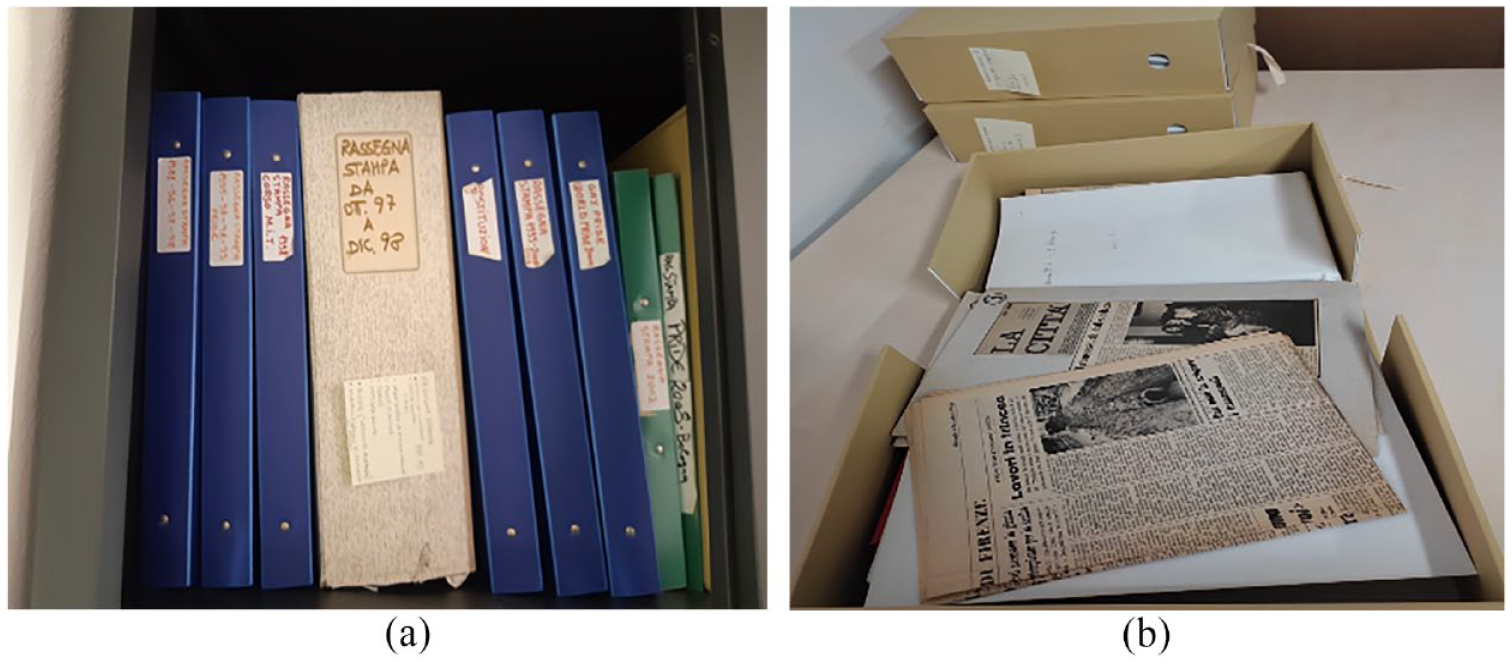
The ‘Press Review’ series, before and after being re-ordered. (a) The first image shows some original folders containing the early collection of articles on trans issues taken from the press and from magazines. (b) The second image shows the folders currently held at the MIT’s archive.
Faced with this large quantity of original material, the horizontal dialogue that emerged from the collaboration of our working group (composed of three scholars and activist-experts on trans and gender issues, the majority of whom identify with the trans spectrum) and our consultants (scholars in archival studies and practitioners) produced a sense of disorientation that led us to ask some fundamental questions: how did this material take shape? Why in this way? What does it tell us about the history of the MIT and about trans memory in Italy? Do these materials have the capacity to challenge traditional archival practices? How can we preserve and make these documents accessible through an archival method and a digital and physical archive that is not static, but is rather in the making and capable of reflecting the complexity of the trans experiences it includes? What (and how many) collective memories will it be possible to build through this archive? These questions have guided us in the complex task of building a trans archive and a trans memory in the Italian context.
We refer to trans memory as the practice and the various experiences of narrating memory (autobiographical and otherwise), starting from a ‘gender outlaw’ (Bornstein, 1994) subjective positioning. In terms of the memory construction process, this has meant that those who have been identified as marginal or external to the dominant (cis-hetero-patriarchal) system, have had to deal with a collective history of – often violent – eradication. As a consequence, they have produced counter-narratives and counter-memories (Foucault, 1977) that seek – as in the specific case described in this article – to challenge official memories, contrasting these with multiple, non-linear, unconventional temporalities and narratives as well as to build their own collective (political) memory (Correa et al, 2019; Dinshaw et al., 2007; Doan, 2017; Freeman, 2010; Halberstam, 2005; Hirsch and Smith, 2002).
The Transsexual Identity Movement (Movimento Identità Transessuale, MIT) of Bologna
The Italian Transsexual Movement arose in 1979 in struggles around Law 164/1982 (Rules Concerning the Rectification of Sex-Attribution) (Voli, 2016, 2018), and officially became a national association in 1981. In 1988, the Italian Transsexual Movement of Emilia-Romagna (based in Bologna) became a local branch of the national group but in 1998 changed its name to the MIT. In doing so, the MIT permanently distanced itself from the ‘pioneers’ of transsexual battles in Italy, with whom differences in political perspectives and practices had emerged over the years. The national group dissolved after only a few years, and the Bolognese branch of the MIT remained (and still is) the longest running trans group in Italy. 3
The history of the MIT’s Bolognese branch – both an association and a health clinic for trans people – is closely linked to the biographies of the trans women who founded it. A key figure from the outset was Marcella Di Folco, a former activist of the national Italian Transsexual Movement and president of the MIT in Bologna from 1988 until her death in 2010. In 1990, Di Folco became a councillor in the Saragozza district of Bologna, the first openly trans person to be elected to public office. Between 1995 and 1999, she was a town councillor for the Verdi Arcobaleno (the Rainbow Greens, which she had co-founded) in the council led by Mayor Walter Vitali of the Italian Communist Party (Image 2). In 1998, she was appointed vice-president of the National Observatory for Gender Identity, of which the MIT was one of the founding members. In the 2001 elections, she ran for the Girasole (an electoral role that gathered the Green Party and the Italian Democratic Socialists), and in 2004 she ran with the Party of Italian Communists for the European Parliament and for the Provincial Council of Bologna. Finally, in 2006 the regional Green Party nominated her for the Senate of the Republic (Cangelosi, 2015).

Marcella di Folco, Green Party candidate in the municipal elections of Bologna, ‘400,000 faces, one city. Marcella di Folco. An extra-large vote that includes everyone’, 1995.
This brief biographical sketch of the MIT’s first president in Bologna is relevant for the reconstruction of the association’s history in that it conveys the image of an activist for trans rights who had a tremendous impact on the MIT and on its ability to foster relationships, both locally and nationally. From the very beginning, Marcella di Folco’s commitment in mainly institutional contexts – combined and overlapping with the political participation of the other founders of the Bolognese MIT (including Porpora Marcasciano) 4 in the collective and social movements of the 1970s and 1980s (i.e. extra-parliamentary, feminist and homosexual and sex workers’ movements) – has given the association and the many activities it promotes a strongly committed character, one that defends trans people’s civil and political rights.
In 1994, the MIT’s clinic for trans health was created. This service was made possible by the association’s collaboration with various institutional subjects, which became a formal agreement in 1994 when the Municipality of Bologna offered the MIT a location to conduct its activities – in particular, a project aimed at the development of an HIV prevention service funded by the Emilia-Romagna region. The combination of these specific circumstances prepared the ground for the launch of the MIT Health Clinic in Bologna, which aimed at welcoming and providing information on health issues to trans people as well as managing accessibility in gender transition processes. It was the first experience – in Italy and in Europe – of a health clinic managed by a non-profit association through an agreement with the Italian National Health Service.
After the opening of the trans health clinic and counselling centre in 1994, and thanks to the related regional funding, the MIT began allocating a small annual budget to the Documentation Centre. This allowed the activists to purchase, between the 1990s and the early 2000s, Italian and international texts on trans and LGBTQ+ topics in various fields (e.g. autobiographies focussing on trans and queer experiences, novels, poetry collections, medical and scientific literature, critical theory, philosophy). This denotes the activists’ deep interest, at that time, in the circulation of knowledge(s) within a trans and a non-trans matrix, and the awareness that it was necessary to influence mainstream knowledge through embodied experiences in view of radical socio-cultural change. In particular, the activity of collecting and conserving documents related to the MIT’s activities and, more generally, to the trans movement was initiated by Marcella di Folco, between the 1980s and the 1990s. As Porpora Marcasciano explained in her interview, 5 it was Marcella who taught her to consider trans memory (and therefore the collection and preservation of related material) as a fundamental political activity.
In the 1990s, the first systematic collection of material – specifically the press review – was prepared as an integral activity of the ‘Moonlight’ project, aimed at the creation and implementation of a support network for sex workers by sex workers. The collection of press reviews – currently the most complete series in the MIT’s archive – aimed at documenting the public debate and mainstream representations related to two topics that circulated at the time: sex work and trans experiences. The purpose of this collection was for the activists from the trans movement and those from the movement for the rights of sex workers to jointly develop a critical analysis and a counter-narrative to the dominant one, which has traditionally insisted on assimilating the trans experience with that of prostitution, omitting from public narrative the discursive violence and marginalisation devices used against trans people in general. This original intention was subsequently confirmed both by the analysis of the documents and the notes contained in the original material and by what emerged from the interviews with some of the people historically active in the MIT or connected to it through their political and life trajectories.
Despite the fact that since the early 2000s, the systematic collection of documents seems to have slowed down, 6 this first attempt at documenting this collection revealed a fundamental feature of the process of constructing a memory of the MIT experience. The activists’ collection of articles concerning trans experiences in the Italian context of the time was not a simple act of retrieving information about the trans presence in the public sphere and in public opinion; it represented a counter-narrative and a reinterpretation of the world from a trans point of view, that is, a reappropriation of the narration by adopting the viewpoint of trans people (Cvetkovich, 2003). This gesture represents in itself ‘a queer lens focuses on subversive social critique and the preservation of endangered (inter)subjectivity’ (Moskowitz, 2021: 2).
‘Reconstructing’ the MIT Fund: ‘sedimentations’ as criteria, dis/organising as a method
The reconstruction of the MIT’s archival collection, which at the moment constitutes the core of the MIT’s historical archive, represented two things for our working group: on the one hand, we had to get to the heart of what it means to organise a trans archive, with its possibilities, complexities and critical issues; on the other hand, we had to trace our genealogies. In our work as archivists/activists, we have tried to question traditional archival epistemologies. Indeed, studying archival practices has meant that we have had to challenge our critical epistemologies, that is, the ‘diverging’ way in which we wished ‘to know’ and ‘to let others know’ what had emerged during the reconnaissance phase (Arondekar and et al, 2015; Bourcier, 2020; Marshall et al., 2015). We understand the archival series, the archival units and the documentary units as ‘sedimented embodied histories’ (Lau, 2018) of collective and subjective bodies, individual and associative experiences, histories that do not remain in their own separate place but intertwine with each other, continuously disorienting and re-orienting the identity of the MIT Fund. In our practices, we took inspiration from Porpora Marcasciano’s activism and literary production by giving value to the meticulous process of collecting and preserving the trans past, weaving it together with the trans present. At the beginning of the 2000s, Marcasciano (2002) described her pioneering work of collecting trans life and trans activist histories in her book Tra le rose e le viole (Among Roses and Violets), a seminal history of trans experiences in Italy from the end of the 1950s to the present day, which the author reconstructs through stories and firsthand accounts – as throwing a net in the open sea to then hoist it back on board full of unknown and unexpected material. Almost 20 years later, in the MIT’s storeroom, we opened drawers (occasionally also with Porpora), unpacked cardboard boxes and clipboards, and hoisted back more than 5000 documents of different kinds, mainly from the late 1970s up to the present, although some pieces dated back to the 1940s.
At first, struck by the desire and the felt necessity to trace a hidden political history and to make it accessible, we were tempted to make sense of the content of the individual documents, to link them together to rebuild pieces related to this history, and to allow them to make sense for the people who would have access to them. We had to take a transversal step back, stumbling on our own convictions about what it means to ‘order’, ‘preserve’, ‘describe’ and ‘enhance’ in a critical way, overcoming our own prejudices about the practice of documentation ‘ordering’ from an archival perspective. To ‘preserve’ the documents of the MIT Fund in this process did not mean ‘to store as it is’, but to ‘let ourselves be disoriented’ by the original logics of conservation and to render those logics visible and traceable, even in their complexity and in their (apparent) disorder. Indeed, if every single document in the fund has a historical value and tells a story, the reasons for which certain documents – apparently very different, almost irreconcilable – end up in the same clipboard while others – typologically and thematically similar – do not, also have a historical explanation.
In this regard, the handwritten letters and drawings by E. (a friend and regular visitor of the MIT association in the 1990s) not only speak of the author and her trans history, but are in dialogue with – among others – the political statements that the MIT signed regarding the rights of trans people in the workplace and the political campaigns for the fight against HIV/AIDS and more inclusive access to sexual health. The press review, whose content contained many reports of institutional violence against trans people and sex workers, engages in a dialogue – and is often preserved together – with flyers of political events and grassroots magazines that document the struggles promoted by the MIT, the Comitato per i diritti civili delle prostitute (Committee for the civil rights of prostitutes) and other collectives active at the time.
These ‘sedimentations’ (or the occasional lack thereof) speak to us about the organisational histories, the personalities, the affective bonds, the conflicts, the phases and the situated political necessities of an association as dynamic and long-lived as the MIT. For instance, we noted how administrative documents have never been preserved in a systematic and thematic way; we found them together with the MIT’s public statements related to the organisation of demonstrations, correspondence and press clippings, thereby demonstrating that the act of preservation was not an act for its own sake but had the political function of supporting actions to change the socio-cultural reality of the time.
This choice could be linked to the willingness – formally demonstrated and carried out by the association (and the individuals who composed it) – to construct collective memory as a daily political practice (through the collection and conservation of documents of various kinds, although often not in a structured or systematised way), through which the members of the association gave meaning to events and experiences belonging to a specific social and political context (Halbwachs, 1992). This willingness went hand in hand with a desire to create visibility and change in the present through a constant presence in the public space, thanks to the development of projects and services dedicated to trans people.
Reconstructing the MIT Fund therefore did not imply making every single document accessible, but describing the sedimentations that characterise the archival units to make the ‘dis/organisation’ (Brewis et al., 2014; Cooper, 1986; Virtú, 2020) of the nexuses between and among these units visible. Our descriptions indicate which archival units we assembled and titled, and which archival units we inherited as they were. As in a genealogy ‘of choice’, the original logic of conservation (which may have even been modified several times in the past) thus merges with our touch, and we avoid letting our work ‘pass’ (Stone, 1991) as a ‘natural’ systematisation of the parts or a ‘neutral’ ordering. 7
Moreover, every document type opens the doors to a different way of looking at the history of the MIT and at different, interdependent methodologies. A good example is the strong connection between photographic documents and oral testimonies. While identifying and describing the context of the photographic documents held at the MIT Fund, we have collectively employed individual memory as a tool for the inventory of the materials, which in many cases, concerned collective events and activities of the MIT association and LGBTQ+ movements in Italy. At the same time, photographs have offered precious support in the process of collecting oral history testimonies, as the people we interviewed opened their ‘private photographic funds’ to us while going through and evoking past events in their lives (Dragojlovic, 2018), in a continuous coming and going of memories between public and personal experiences (Image 3).

Porpora Marcasciano (the MIT’s former president) and Nicole de Leo (the MIT’s current president) during the reconnaissance of photographic materials (through the recognition of places, people and events depicted in the images and, in some cases, of the photographer), prior to archival reorganisation.
The MIT’s oral archive: a trans(feminist) project
The ArchiviST* project consisted in the collection of audio and video interviews with some of the pioneers of the trans movement in Italy. 8 Gathering testimonies represented an integral part of the project, which intertwined and entered into dialogue with the rest of the archival materials that we progressively identified and inventoried (and which revealed traces of the biographies of people we interviewed in a subsequent moment). 9 Our aim to create a trans oral archive followed from a consideration that is intrinsically present in any reflection on trans history itself and, consequently, in the ArchiviST* project. Indeed, the overall goal has been to give space to first-person trans narratives, which have traditionally been marginalised and made invisible by generic historical reconstructions (quite often also by feminist and gendered ones). Nevertheless, it was not ‘just’ a matter of ‘giving voice’ to trans life experiences and stories, but also of observing and questioning, through these lives, the historical processes that have produced those specific experiences – and the narration of those experiences (Brown, 2015).
Our methodology combines an oral history approach with a transfeminist framework, thus engaging with trans studies and the feminist approach, bearing in mind that one of the strongest insights offered by feminist oral history is that, as much as stories represent individual and private experiences, they also connect to collective experiences and the individual stories also become the story of many others. Inspired by Enke’s (2018) statement that ‘I want to invite a transfeminist history that [. . .] “bothers to ask” those who were there what happened’ (p. 10), we consider this transfeminist framework as an embodied experience, with its genealogies, inheritances and epistemologies (Brown, 2015; Garriga-López, 2019; Hill, 2008; Stryker and Bettcher, 2016). This means that while this methodology takes into consideration the interviewees’ subjectivities and their reaffirmation through the self-narration of a unique historical perspective, it is inserted into a specific historical-political-social framework; it is therefore capable of restoring links between the micro (private) level of individual experience and positioning and the macro (and public) level of the surrounding context. Furthermore, our methodology reflects an awareness of the gendered dimension of memory, that is, of the different meanings and signifiers that gendered structures and experiences assume in different historical-social contexts (Leydesdorff et al., 2017). Finally, it pays attention to the relationship between the subjects involved in the interview, namely the interviewer and the interviewee.
In this regard, our construction of the interview guidelines was part and parcel of the process of producing and collecting oral sources and, therefore, trans memory. In fact, it allowed us to simultaneously compare and confront the protagonists’ life stories with each other – without ignoring the differences inherent in their experiences – and to highlight the uniqueness and specificity of each interviewee. We, therefore, opted for an open narrative interview method, albeit one that was able to unfold around thematic nodes specifically related to both the protagonists’ lives and the history of trans experiences in Italy. For example, all the interviews opened with a provocation: ‘In view of the fact that your life story has a historical value, we are interested in knowing how you came to be the person you are today’. In this way, the narrative instantly managed to flow freely, starting from the most significant biographical events that had marked the interviewee’s life, to then eventually be prompted by themes that were relevant to trans history at a collective level (e.g. the perception of oneself as a trans person in the context of origin; presence of models, networks and positive/hostile relationships; periodisation and life phases in relation to the surrounding historical-social context; projects and aspirations; approval of Law 164/1982; relationship with the MIT and political commitment; relationship with memory and with the archive under construction). In all cases, the narration was accompanied by the browsing of photographs, documents and newspaper articles that the interviewee had conserved privately and selected for the occasion (some of which were subsequently donated to the archive for digitisation) (see Image 4).
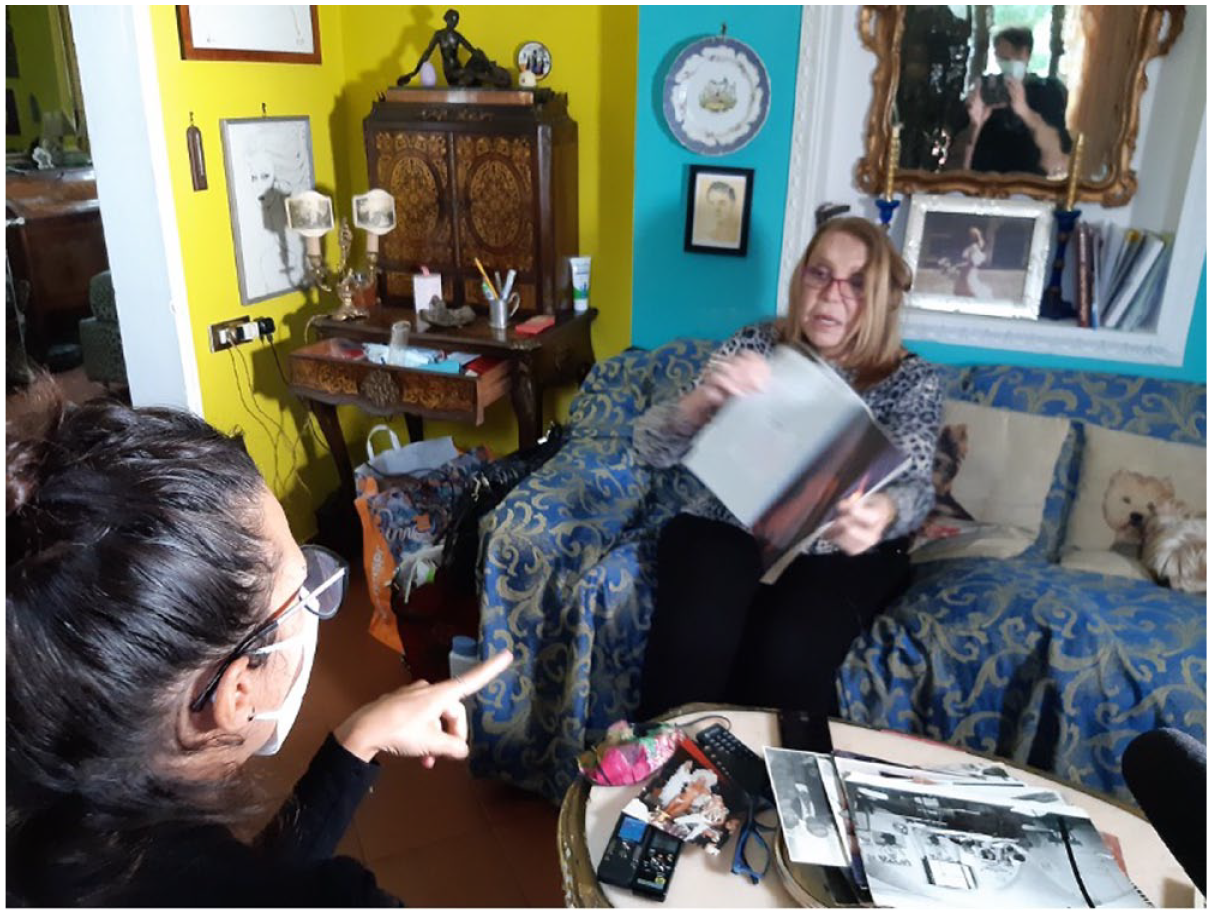
Interviewing Romina Cecconi at her home. In 1967, Romina was the first trans woman in Italy to become publicly known for her gender reassignment surgery (which took place in Switzerland, as it was illegal in Italy). In 1972, the Court of Lucca legally recognised the new gender identity of ‘La Romanina’, as she was popularly known. Romina played a central role in setting up the Italian Transsexual Movement in Florence (her home town) (Cecconi, 1976). Once she moved to Bologna, she continued – and still continues – to be part of the MIT association and its activities. Romina donated part of her private archive to the MIT. (From left to right: Stefania Voli, Romina Cecconi and – reflected in the mirror – Ludovico Virtù recording the video interview).
This methodology has made it possible to question the ‘normative language’ (Moskowitz, 2021) and standardised approach to the life course interview in the humanities and social sciences, in which information about the witnesses’ lives is elicited by the interviewer according to a chronological progression. Trans experiences and trans studies have highlighted the normativity of this method (long used in the medical-scientific environment to define and analyse trans experiences from a pathological perspective), which is incapable of capturing the non-linear and non-standardised temporality of trans lives and memories (Chen and cárdenas, 2019). Also in this regard, ‘dis/organisation’ as an archival practice served as a counter-archival practice where paths of memory construction – be they individual or collective – are multiple, open and complex, hence capable of producing narratives that are non-normative and that can make the invisible visible.
Moreover, prior to and during the interviews themselves, we decided to give priority to the self-defining and self-reflective practices of the interviewees to avoid the risk of a forced standardisation of language. We did so, however, with a specific attention to the historical context of the story being told. Thus, the uneven use that certain interviewees made of terms such as ‘woman’, ‘transsexual’, ‘transgender’ and ‘transvestite’ in the description of their gendered self revealed not only the instability of the definitions that accompanied the historical reconstruction throughout the narration, but also the fact that these definitions are socio-historical constructs produced by the context in which they are immersed (Boyd, 2008; Rawson, 2015). This awareness has helped us to avoid applying and imposing identity labels that are anachronistic or irrelevant in the given context, and which excessively determine the subjects involved. We have considered the witnesses’ memoirs as texts that are open to interpretation, part of a larger process of reproducing meanings, in which identities and biographical paths are continuously reconstructed around historically situated sets of meanings (Boyd, 2008).
We were interested in the witnesses’ life stories, the subjectivity they expressed through their accounts, their emotions and the meaning assigned to their lives, rather than in a historical ‘truth’; nonetheless, we wanted to read their silences (Boyd, 2008: 186), the voluntary or involuntary omissions in their accounts, which also come to light thanks to the interweaving of different sources that the archive makes available, as ‘memory’s potential space’ (Steedman, 2001: 83). 10 In the process of constructing trans oral histories, this attempt to listen – which seeks to go beyond the narrative – and to grasp what remains in the interstices of memory, seemed necessary especially in light of the cultural and social censorship that gender non-conforming experiences have historically suffered, and that has produced, as Murphy, Pierce and Ruiz state, ‘the complex discourse of “the closet”’ (Murphy et al., 2016: 5).
Conclusion
The construction of the MIT’s trans archive presents a set of challenges that are ethical, methodological, political and theoretical; these relate to the capacity to question the past, to build a memory – often starting from the lack of documentary material and testimonies – and to problematise the organisation of this very same material in spaces reserved for conservation and consultation. These challenges also encompass the possibility to construct sources through the collection of memories by means of interviews and with the involvement of privileged witnesses (and their private archives).
The variety of sources present in the MIT’s archive mirrors a complexity and a richness that are generated by the very embodied experiences of those who were involved in the association. For this very reason, the collection of the memories of some of these people constituted a central element of the project. They offer a reflection on the construction of trans memory: on one hand, they highlight the necessity to question the methodologies employed in archival practices, oral history and historical-social analysis alike; on the other hand, they point out the ‘absences’ that reveal, even in a grassroots archive, the power dynamics that materialise within trans movements and trans associations. Owing precisely to these characteristics, the MIT’s trans archive cannot be considered a closed archive or a project that will be completed once and for all, setting the seal on the history of the MIT and the trans movement in Italy. On the contrary, it is an open archive that is in constant dialogue with the continuity and discontinuity of the past. Hence, instead of being a container for a concluded past, the archive is constructed from a present and future perspective precisely because the trans political experience is still ongoing, and because the category of trans (like that of queer) problematises the way in which temporal categories are traditionally understood. These reflections and these practices give space to methodological issues that speak to activists/archivists/historians and that affect not only the very archive (i.e. its shape, consistency and perspective), but also the collectivity that it addresses and, accordingly, the process of constructing collective memory.
If we imagine the MIT’s archive as an ‘unstable’ (Lee, 2017) and open archive in progress, in future research we will need to reflect on what Harrison Apple (2015) appropriately called the ‘politics of absence’ that characterises trans archives, and that inevitably informs the process of constructing a trans memory at the collective level. For example, some of the experiences that have gradually gained importance for the association – first and foremost, ‘male’ trans experiences – are currently less visible in the archive (whose periodisation runs until 2010, for design reasons). The reason for this absence is to be found in the history of trans experience in Italy, marked by the exclusive visibility of trans women until the 1990s (for instance, the archive contains the first official document of the first FtM national coordination, dated 2002). Similarly, the stories of hyper-marginalised trans people – such as migrants or incarcerated people, who have never played a significant role in the management of the association but have been very present as recipients of services and projects – are equally absent. This structural absence also relates to the first stage of interview collection, when we decided to focus on people who were involved in the early stages of the MIT’s creation (or who had exceptional trans life experiences, as in the case of Lucy Salani). This body of interviews is therefore entirely composed of white, Italian citizens. To avoid reproducing, in turn, the invisibility of these experiences, in future phases of interview collection and methodological reflection, we will take into account the many other life stories that are equally fundamental to the path we are trying to outline, namely that towards the construction of a collective trans memory in Italy.