




Abstract
Over the past few years, scholars from a broad range of disciplines have started to explore the role that emotions play in the collective memory of social movements. Against this backdrop, they have proposed that activists do not necessarily commemorate failed struggles by drawing on negative emotions such as suffering and grief. As a case in point, the interdisciplinary literature has drawn attention to the fact that the historical labour movement commemorated even events that ended in bloodshed and defeat, such as the Paris Commune of 1871, through performances and writings that evoked feelings of hope and joy. Analysing commemorative practices by the German labour movement in the late-nineteenth and early twentieth centuries, this article shows that Commune memory differed considerably in Germany. In a first step, the article shows that during the two decades following the Commune’s bloody demise, German socialists remembered the Paris Commune by drawing on hatred, anger, and grief – not hope or joy. In a second step, the article demonstrates that while the 1890s did see the rise of memory practices that emphasized hope, this was a peculiar kind of hope largely detached from the historical event that was commemorated. By the turn of the century, the German labour movement had established a memory tradition that saw the Commune as a painful but necessary step in the forward march of the movement. In a short conclusion, the article explores some of the reasons why memory traditions by the German labour movement differed from the pattern detected elsewhere. In so doing, it shows that the change in the affective repertoire corresponded to a change in the political needs of the movement. The conclusion thus points to how the historical examples discussed here contributes to a better understanding of role of emotions in social movements more generally.
Over the past few years, there has been growing interest in what Daphi and Zamponi (2019) have called the nexus of collective memory and social movements. Numerous studies have appeared since the mid-2010s that explored how social movements draw on and use memories of past struggles, and how mnemonic practices impact the repertoires and strategies of both historical and contemporary social movements (Daphi and Zimmermann, 2021; Doerr, 2014; Eyerman, 2015; Kubal and Becerra, 2014; Merrill and Lindgren, 2020). These studies have highlighted a number of research areas that hold great potential for improving our understanding of how social movements have shaped collective memory, and vice versa (Della Porta et al., 2018). Surveying the emerging field, Berger, Scalmer, and Wicke have identified the study of emotions as one particularly promising area. In the introduction to their volume Remembering Social Movements, they thus conclude that ‘the scene seems to be set for a greater dialogue in which ways social movement studies and memory studies are dealing with the role of emotions in their respective sub-fields’ (Berger et al., 2021: 12).
This dialog has unfolded so far with a strong focus on how negative emotions – from suffering and grief to anger and hatred – shaped social mobilization (Baer and Sznaider, 2019; Harris, 2006; Hartal and Misgav, 2021; Mihai, 2016; Sindbæk Andersen and Törnquist-Plewa, 2015). In a recent turn, however, scholars have started drawing attention to the role played by positive emotions in activists’ commemorative practices. In 2019, this very journal published a special issue dedicated to the study of joy in the memory of social movements (Arnold-de Simine, 2019; Fevry, 2019; Sindbæk Andersen and Ortner, 2019). Also in this journal, Ann Rigney has made a strong case for exploring the role that positive emotions have played in the collective memory of past activism.
In ‘Remembering Hope’, Rigney starts out by diagnosing that memory studies stand in the need of a change of perspective. Ever since it emerged as an academic field about two decades ago, memory studies have been closely connected to the horrors of the twentieth century. Researchers were interested in how tragedy and trauma were commemorated in the present, and in how memory was instrumentalized and transformed. The close connection between the study of collective memory and the wars and genocides of the twentieth century contributed to the perception that the memory of the past is by definition a recollection of the awful. Yet, this is problematic in a number of ways. On one hand, it runs the risk of recreating feelings of collective suffering and endurance that may be used to promote social exclusion in the present. On the other hand, reducing collective memory to negative aspects of the past conceals legacies that provide hope, joy, and inspiration – in short, that provide positive accounts of the past and, in so doing, a potentially more positive imagination of the future.
Against this backdrop, Rigney suggests studying the role played by hope in the memory of past social movements. Rigney is careful to emphasize the open-endedness of hope. Drawing on Eagleton (2015) and Traverso (2016), she distinguishes between naïve optimism on the one hand and the feeling of hope on the other. Unlike optimism, hope does not blindly trust that things will turn out okay. Rather, it builds on the possibility that they might. By emphasizing hope’s open-endedness, Rigney proposes a way out of the dilemma faced by memory studies, namely whether to stick to the linkage of memory and trauma or to reinforce a deterministic notion of hope that informed many of the memory traditions of the nineteenth century, including those of socialism. Rigney does not promote a deterministic conception of hope that interprets progress as inevitable. Instead, she defines hope as the feeling that fuels a desire to act towards achieving something that is not (or no longer) there. Rather than sustaining a naïve belief in large-scale revolution, this kind of hope is a feeling that inspires the countless small steps of everyday resistance against perceived injustice.
Equipped with this understanding of hope, Rigney explores the memory traditions of organized labour in the late-nineteenth and early twentieth centuries. While she touches also on more ephemeral memory practices such as the Revolutionary Calendar that appeared in William Morris’s Commonweal in the late 1880s, her focus is on the international labour movements’ commemoration of the Paris Commune, the short-lived radical democratic workers’ government of Paris that inspired and frightened the world in the spring of 1871 and long after. Rigney uses the case of the Commune and its brutal suppression by French government troops to show that even bloody events that ended in defeat have not necessarily been commemorated by emphasizing suffering, grief, and loss. Quite to the contrary, the international labour movement has often highlighted positive feelings when commemorating the Commune. Against this backdrop, Rigney establishes a ‘general trend: the fact that in its long-term remembrance (if not in its immediate aftermath) the Commune has been a subject of celebration’ (Rigney, 2018: 374).
Rigney is not alone in emphasizing the role played by hope, joy and positive feelings more generally in the commemoration of the Paris Commune. Kristin Ross (2016) has argued that even in its immediate aftermath, the Commune was often the cause for celebration. Dennis Bos’s (2014) comprehensive study of the commemoration of the Paris Commune by the international labour movement also suggests that the Commune was often celebrated rather than mourned. Drawing attention to the commemorative repertoire of organized labour, Tom Goyens has shown that the late-nineteenth-century Commune festivals that radical New York City organized every spring featured ‘an elaborate program of music, singing, declamations, drinking, and dancing’ (Goyens, 2007: 48). Michelle Coghlan’s book on Commune commemorations in the United States makes a similar point. Exploring a variety of sources from theatre productions to novels and the press, she argues that activists in the United States kept the memory of the Commune alive by yearly celebrations, poems and songs. Exploring what she calls ‘anarchic jubilations’, Coghlan suggests that the commemoration of the Commune by the American labour and radical movement was ‘marked by an overriding note of optimism’ (Coghlan, 2016: 98).
According to these interpretations, labour activists in the late-nineteenth and early twentieth centuries produced a strikingly hopeful account of the past, one that reimagined the creation of the Commune as the opening of a realm of possibility that would continue to inspire generations of activists for decades to come. Their transnational commemorative practices – often festive meetings including dancing, singing, and drinking – helped to recreate and transmit this utopian imaginary full of potential and alternatives. As Rigney puts it, the international labour movement thus gave birth to ‘pleasurable practices of remembrance that were at once highly localised in their execution and transnational in their reach’ (Rigney, 2018: 377).
This article does not aim to challenge the theoretical distinction between hope and optimism in the memory of social movements. Nor does it question that hope may have featured prominently in the memory traditions of some movements. What it does challenge, however, is the notion that hope was a universally shared feeling in the collective memory of the Commune among organized labour in the late-nineteenth century. Analysing commemorative writings and coverage of memory events that appeared in the German workers’ press between 1880 and the early 1900s, this article shows that one of the largest workers’ movements of the era drew on an affective repertoire that differed markedly from the pattern described by Rigney and others.
The article begins by analysing commemorative writings and events in the first two decades after the smashing of the Commune. In so doing, it shows not only that feelings of hope were absent from the memory tradition of the German labour movement, but that the latter actively opposed such hopeful interpretations of the Commune. In a second step, the article takes a closer look at the 1890s as a period of transition in memory discourse and memory practice. While the turn of the century did see the rise of hope as an important emotion in collective memory, the sources indicate that this kind of hope had little in common with the open-ended kind of hope outlined above. To paraphrase Eagleton, this was blind optimism rather than hope. In a short conclusion, the article discusses some of the reasons why the German labour movement of the late-nineteenth century differed from trajectories further afield. This will also allow a consideration of how the historical example discussed in this article might improve our understanding of the use of emotions in the collective memory of social movements more generally.
‘A feeling of passionate hatred’: commune commemoration in the 1870s and 1880s
As government troops forced their way through the French capital, Karl Marx was busy in his exile in London compiling a detailed report of the atrocities committed against the people of Paris. On 30 May 1871, a few days after the bloody suppression of the Commune, The Civil War in France appeared. In it, Marx predicted that Working men’s Paris, with its Commune, will be forever celebrated as the glorious harbinger of a new society. It martyrs are enshrined in the great heart of the working class. Its exterminators history has already nailed to that eternal pillory from which all the prayers of their priests will not avail to redeem them. (Marx, 1871: 34)
This juxtaposition of feelings vividly illustrates the emotional spectrum among organized labour in its commemoration of the Paris Commune. This ranged from keeping alive a burning hatred for class rule and social injustice, at one end, to sparking joy and pride for the glorious fallen Communards, at the other. The latter sent a clear message of hope, for it showed that no matter what it was up against, the labour movement would prevail. As Marx put it, ‘[i]t cannot be stamped out by any amount of carnage’ (Marx, 1871: 34). Interestingly, such hopeful readings seem to have had little effect on Commune commemoration in Marx’s country of origin. As the following shows, during the first two decades after 1871, the German workers’ movement remembered the Commune through drawing on hatred and grief rather than joy and hope.
Commemorating the 10th anniversary of the Commune’s brutal defeat, the official organ of the German social-democratic party opened on 22 May 1881, with a long feature story. It read: Of all memorial days that the followers of the proletarian revolution in both worlds celebrate, none are as significant as those final days of the Paris Commune, as the bloody week in May [. . . ] No unnecessary cruelty, no childish vandalism, but also no weakness in the moment of struggle – that is one of the lessons we have to draw from the history of the Commune. [. . . ] The other lesson we already highlighted above: it is the memory of the bloodbath the victors have caused; the smear and slander which the vanquished had to endure; the liberal democrats’ cowardly betrayal of the Commune in the moment of peril.
1
According to the Sozialdemokrat, to commemorate the Commune was to send a clear warning to organized labour never to trust the liberals. The bloody end of the Commune demonstrated that whenever there had been an opportunity for emancipation, liberal reformers had betrayed the common cause and joined the reactionary forces of repression. All across the country, the paper continued, liberal democrats were now reaching out to workers, promising improvement and reform.
Yet the workers remain reserved and suspicious; whether consciously or intuitively, they sense that the bridge between them and the liberals has finally been burnt, that there is a gulf between them that widens every day, and, when the memory of those bloody days in Paris awakens in them, that this gulf is filled with blood, with hot, steaming human blood in the vapour of which crystallizes an enormous manifestation – it is the ghosts of the murdered communards, who show their descendants the terrible wounds inflicted upon them, their faces in the moment of death, twisted with pain, all this as if they wanted to hail us: beware!
2
Images of burning bridges and gulfs filled with blood suggest that the memory of the Paris Commune did indeed serve as an illustration for betrayal and defeat. According to socialist reasoning, the Paris Commune was just the latest, though possibly most dramatic, instance in a pattern that ran like a red thread from 1789 to 1830, 1848 and 1871: proletariat and bourgeoisie might jointly erect the barricades in the struggle against despotic rule, but it was workers who died defending them.
The above-mentioned piece appeared in late May 1881, commemorating the 10th anniversary of the bloody repression of the Commune in May 1871. Does the picture change when we look instead to the commemoration of March 18 instead? Like organized workers elsewhere, the German labour movement commemorated the Commune not only during the week in late May that represented its bloody defeat. Equally important were the few days around March 18, the day of the proclamation of the Commune. While it may not come as a surprise that memories of suffering and grief featured prominently in the commemoration of the Commune’s defeat, we might have expected celebrations of the establishment of the Commune to be more hopeful and festive. Sources, however, show that they were not.
In mid-March 1881, the Sozialdemokrat dedicated its entire first page to the proclamation of the Commune 10 years before. The source reveals that not only did the German labour movement not commemorate the Commune in hopeful terms, but it actively warned against such hopeful interpretation.
3
Socialist articles in Germany regularly reported on Commune festivities, dances, entertainments and banquets held abroad – at a time when either no such amusements took place in Germany, or the workers’ press failed to cover them. As the labour articles noted disapprovingly, these festivities were often used to ‘glorify the days of the Commune’, something apparently alien to the German socialist mind.
4
Acknowledging that labour movements abroad celebrate March 18 as the great day of the proletariat, the German Sozialdemokrat insisted in its 10-year anniversary issue that the bloody week of late May in fact provided a much more important lesson. For the memory of the slaughter of that week in May arouses in us just this one feeling that is so vital for the struggle that lays ahead, namely the feeling of passionate hatred against the cowardly, cruel murderers and the jubilant reactionary forces around the world. To understand that we will have an entire world against us in the fight for bread and freedom, that our enemies will use every means at their disposal to force the working people back under the old yoke, the memory of the cruel revenge of the coldblooded killers, long after the Commune had been put down, that is the most important lesson we have to draw from the history of the Commune.
5
Drawing as they did on hatred and suffering, the commemorations of the Paris Commune served to remind fellow activists that the enemies of the Commune were still the same enemies of the working people. Workers must never forget the Commune, lest they forget how the people of Paris were butchered. In this story, hope and joy had no place.
Sources show that even memory pieces that appeared around March 18 in the days of the Commune’s proclamation focussed on the demise of the Commune, not its beginning. As the Sozialdemokrat concluded in an article that appeared in mid-March the following year, it was not so much March 18 but ‘especially the Charwoche [Holy Week] of the Parisian proletariat, the final days of the Commune [. . . ], that has served to eternalize its memory among the workers of the world’. 6 Building on the Middle High German ‘kar’ meaning care and sorrow, the term ‘Charwoche’ 7 immediately conveys feelings of suffering and grief. Comparing the memory of the Paris Commune to Christianity’s central week of mourning, the socialist paper hammers home the most important lesson that the Commune provided for later generations: When the time of struggle comes, remember the suffering of the Parisian workers, who learned the hard way that the bourgeoisie will always side with the bloodthirsty forces of reaction.
All this demonstrates that, throughout the 1880s, hatred and grief were the dominant emotions in German socialist commemorative rhetoric. These feelings fuelled a kind of memory activism that displayed both defiance and combativeness. On 18 March 1883, police in Stuttgart, for instance, reported that unknown subjects had forcibly entered a local tower the night before, where they had hoisted a large red flag carrying the inscription: ‘To the memory of the Paris Commune’. At the barricaded entrance to the tower, the activists had left a warning to the police that the tower had been wired with dynamite. 8 Such clandestine memory activism was a regular feature during the few days in March and May when the workers’ movement commemorated the Paris Commune. On the eve of 18 March 1882, a group of local activists in the industrial city of Barmen climbed a war monument dedicated to the memory of national unification. The unknown group replaced the German flag at the top of the monument with, as the Sozialdemokrat put it, the ‘bloodred flag of the Commune’. 9 The affective repertoire of Commune memory clearly had an impact on the movement’s repertoire of contention (Tilly, 2004).
We might think that negative emotions such as grief and hatred dominated the German socialist memory of the Commune during the 1880s simply because not much time had passed since the event, with the horror of the bloody suppression still fresh in the mind of many activists. Yet, the celebrations marking the 20th anniversary of the Commune in spring 1891 give little reason to assume that the affective repertoire had changed much. The workers who had gathered across the country for the central festivities of 1891 did not hear speeches celebrating the eternal glory, let alone joyfulness, of the Commune. Instead, they heard that the memory of the Commune provided a negative example, one to be avoided at all costs. Addressing the crowd in Berlin, speaker Curt Baake emphasized that the Commune would always deserve a place in the collective memory of the labour movement because it taught workers the value of unity, preparation and strong organization – everything, in short, that the Commune had lacked. Even 20 years later, it still was the failure of the Commune that provided its most important lesson for posterity. 10 And, as the following shows, this lesson was still framed in rhetoric that drew heavily on negative emotions.
Der wahre Jacob, the leading political magazine close to the recently renamed Social-Democratic Party of Germany (SPD), published a richly illustrated special issue in 1891 commemorating the 20th anniversary of the Commune. The editors argued that, at the first sight, the memory of the Commune provided the labour movement with two equally important insights, namely with the positive and the negative lessons it had to offer. Yet, these only appeared to be equally valuable. On closer inspection, the memory of the failures, flaws and illusions of the Paris Commune provided a much more important lesson for organized labour. More than anything, it taught workers in Germany the terrible consequences of revolutionary zeal not grounded in strong organization.
According to the article, the Paris Commune was a prime example of a revolt that lacked the social basis necessary to support it. The French proletariat simply had not been ready to mount a truly proletarian revolution, let alone to maintain an effective political administration. As a result, the Commune had acted timidly and insecurely, distracted by the radical bourgeois elements in its ranks who had clouded sound analysis and had obstructed important strategic decisions (such as the Commune’s shying away from seizing the National Bank, which according to German socialists was one of its most fateful mistakes). Remembering the Paris Commune, in short, meant remembering why it was bound to fail. 11 Following a detailed summary of the brutal repression of the Commune, the last page of the special issue features a drawing of Père Lachaise cemetery, the infamous place of execution of countless Communards. Against the background of a cemetery wall hung with numerous wreaths, Der wahre Jacob ends this special issue on a gloomy note: ‘May the German proletariat [. . .] never have to live through such a dreadful experience as was the bloody week of May, the week from the 21st to the 28th of May 1871, for the proletariat of Paris’. 12
Der wahre Jacob was not the only socialist paper to publish a special edition commemorating the 20th anniversary of the Commune. So, did the Berliner Volks-Tribüne, another workers’ paper of the time. To mark the exceptional occasion, the special memorial issue was printed on red paper (Figure 1).
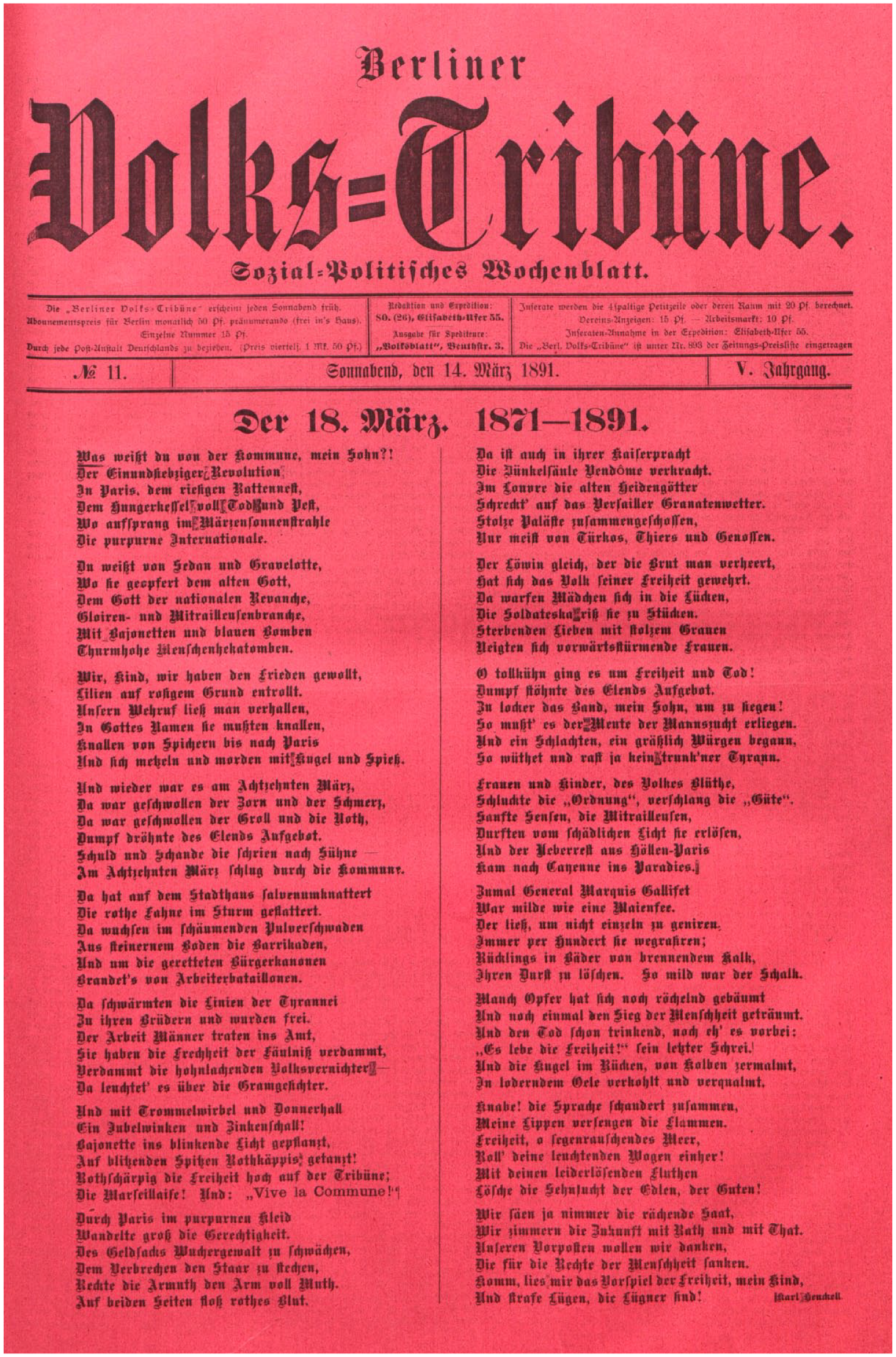
First page of the special commemorative issue of the Berliner Volks-Tribüne, 14 March 1891. Made available by the digitization project "Historische Presse der deutschen Sozialdemokratie online", Library of the Friedrich-Ebert-Foundation. Creative Common.
Interestingly, neither friend nor foe interpreted the red colour as the insignia of the international labour movement, epitomizing unity and solidarity. Rather, liberal and socialist articles largely agreed that the colour represented the blood of the people of Paris. According to the business-friendly Berliner Börsen-Curier, the blood-red anniversary issue clearly served as a visual dramatization of past events, intended to incite violence and a general feeling of vengeance. 13
Socialist editors reinforced the notion that popular feelings had changed little over the course of the past two decades by reprinting articles on the Commune that had appeared in the immediate aftermath of the event. The renamed Vorwärts, recently returned from exile in Switzerland, commemorated the Commune’s 20th anniversary by reprinting a piece that had originally appeared in the socialist Volksstaat in 1873. What the article conveyed was grief, suffering, and loss, not hope and joy. 14
The contributions to the special issue of Volks-Tribüne buttressed the notion that grief and hatred still were the dominant feelings in German socialist memory of the Commune. The feature article produced a long list of the Commune’s shortcomings and flaws, followed by a recollection of the murderous events that led to its final suppression. The author then invites readers to take part in a counterfactual thought experiment: What if the Commune had won? Instead of a Bourgeois Republic, France would now be a Workers’ Republic, and the first step toward a socialist state would have been taken. Once again, the French example would have offered inspiration, and the reactionary turn in Germany under Bismarck would not have been possible. Destined by nature to promote real progress, the two countries of Germany and France would now be friends rather than enemies, and instead of bloody wars and shameful corruption, we would now look toward a peaceful and happy future of mankind.
15
Had the Commune won, it would have offered inspiration for later generations. But the Commune did not win, and it never could have. German socialists did not celebrate the memory of the Commune for the doors it had opened, for the possible worlds it had revealed and for the inspiration and sense of utopia it had created. This chapter in the history of social struggle was firmly closed, locked forever by the murderous forces of the state that had prevailed over an unprepared and immature movement. The special issue ends rather fittingly with a three-page collection of quotes from non-socialist newspapers portraying the horrors of the bloody suppression of the Commune in 1871. The entire issue is one compendious charge against not only the Commune’s murderers, but its political leadership too. It is a striking document, suggesting that hatred, loss, anger and grief still dominated the affective repertoire of socialist memory tradition in late-nineteenth-century Germany.
From hatred to hope: the 1890s as a transitional period
And yet, starting in the early 1890s, we do see signs of change in how the German labour movement commemorated the Paris Commune. One aspect that changed was the structure of memory events and writings. Discussions of what the Commune meant to the workers’ movement were now often preceded by lengthy summaries of the actual events. 16 Until the late 1880s, summaries of events had played a minor role in the commemoration of the Commune. Editors and speakers most likely assumed that people were largely familiar with what had happened in Paris. From around 1890 onwards, however, a new generation of activists was growing up, who had no first-hand recollection of the events. In 1891, the Vorwärts thus promoted a new edition of Lissagaray’s famous Histoire de la Commune by arguing that the book was of great importance, especially for followers too young to remember the events themselves. The book would help them to bear in solemn remembrance ‘the great cause for which Paris once rose and suffered to its death’. 17
Yet, there was also a change in the movement’s affective repertoire. Starting in the 1890s, hope began to make an impact on commemorative rhetoric in the German labour movement. In 1894, the Vorwärts invited readers to reflect on what the memory of the Commune meant for present-day activism: What do the memorial days of March 18 mean to us today, to the organized proletariat of Berlin, of Germany, and the world? Are they more to us than simply days of historical recollection? They were trials of strength, yes, and they are thus pledges for the future; but they are no models for us. History does not repeat.
18
The article continues by arguing that the Paris Commune failed because the movement back then still lacked analytical clarity and organizational unity. Yet, organized labour had come a long way since then. Celebrating the 30th anniversary of the Commune in 1901, the Vorwärts could take back a more hopeful look: Thirty years have passed since the Commune saw the light of day. A child of extraordinary circumstances, it was destroyed under extraordinary circumstances. But just as the French bourgeoisie did not succeed in slaughtering socialism in the June Days uprising [of 1848], so it failed to kill socialism in the bloody suppression of the Commune. On the contrary, socialism in France today is stronger than ever, and it forces the bourgeoisie to accept concessions unthinkable just a few years before. [. . . ] Who knows, when we commemorate the fiftieth anniversary of the Commune, its red banner might fly high over France.
19
As the Vorwärts stated elsewhere, commemorating the Paris Commune helped to reassure activists that a united movement had nothing to fear. From the ashes of the Commune, had emerged a strengthened labour movement, unified and willing to act. According to the article, the international labour movement now drew hope from the memory of the Commune, because the latter showed what lay ahead: Not a minute of rest, no pause in the mighty struggle, no standstill. Forward we go, always forward. [. . .] Today, on March 18, 1897, we remember both March 18, 1848, and March 18, 1871 – we remember our struggles and our pioneers, and, not counting the enemies but pushing them aside, we march forward and ever forward to victory. To the heroes of March 18!
20
German socialists expressed hope for a better future not because of, but despite the Commune. As the above-mentioned comparison with the Christian week of mourning suggests, many activists trusted in the coming of the proletarian revolution as Christians believed in the resurrection of Christ. We look in vain for signs that the German labour movement celebrated the Commune as a symbol of utopia, as the opening up of a new realm of possibilities that would continue to provide inspiration. We hear nothing of the ‘anarchic jubilations’ Coghlan detected in the United States; nothing of the communal spirit expressed and re-enacted in memorial meals and banquets in France; nothing of the merry get-together of socialists in Britain. Instead, the German labour movement increasingly reinterpreted the Commune as a painful but necessary stepping stone on its march through history.
This was very much in line with how the German labour movement remembered other important events at the time. In his analysis of how organized workers commemorated the great miners’ strike of 1889, Jan Kellershohn (2019) shows that later activists publicly remembered the strike as a failure. Yet the evocation of defeat had a specific function. It helped construct a narrative according to which the strike had to fail, because it still lacked the unity and solidarity that would follow from better organization. When activists remembered the 1889 strike 20 years later, they thus highlighted how much had changed since then. Back in 1889, the strike had failed because the movement lacked organization. The only thing that could prevent failure in the future was unity and strength, which required the firm commitment of every miner. This suggests that in the eyes of the activists, commemorating past failures was crucial because it revealed, first and foremost, the conditions for success in the future.
As the century drew to a close, deterministic interpretations of the Commune were becoming increasingly popular in the German labour movement. The Sozialdemokrat drew a telling analogy between the memory of the Paris Commune and the coming and going of the seasons. The article reasoned that with its power to dispel winter as the last remnant of the old, spring was the revolutionary season par excellence, the worthy representation of a force that was both destructive and creative. It was thus only fitting that all memorial days of the proletariat were celebrated in spring. The memory of the Commune taught organized labour that the next revolution would come just as dependably as spring. 21 The Commune thus became just another historical benchmark in a long line from the peasant uprisings of the sixteenth century to the failed revolutions of 1830 and 1848. As a result, the memory of the Commune became increasingly detached from historical experience. This explains why the German labour movement started to move the commemoration of the Commune away from March 18 and late May to May 1 instead. As the Vorwärts explained in 1892, March 18 and May 1 had become the two most sacred days of commemoration for the international labour movement. Yet, while March 18 looked back into the past, honouring the fallen of 1848 and 1871, May 1 was firmly oriented towards the future. It was May 1, therefore, that provided hope for what was to come. 22
Conclusion
Analysing continuity and change in the affective repertoire of the German labour movement’s commemoration of the Paris Commune, this article has shown that the joyful, at times even carnivalesque character that scholars have detected elsewhere was largely absent from mnemonic practices in turn-of-the-century Germany. In the first 20 years after the end of the Commune, negative emotions such as hatred and grief dominated the German labour movement’s collective memory of the Commune. It was only in the early 1890s that positive emotions such as hope found entrance into workers’ collective memory. Yet, hope here did not serve to celebrate an uncertain future, let alone to commemorate the small acts of resistance that might lead there. Rather, this was hope fuelled by blind trust in progress, rooted in the shared belief that the working class had to perform a historical role or mission – often despite what had happened to working people in the event commemorated, not because of it. In the following, I will briefly discuss the reasons behind the change in the affective repertoire of the movement. This will help to clarify the question of just what kind of insights the historical example provides for a better understanding of emotions in the collective memory of social movements.
The fact that negative emotions such as hatred and grief dominated the first two decades of Commune commemoration in Germany was most likely a consequence of the severe repression the labour movement was enduring at the time. From 1878 to 1890, Bismarck’s infamous Anti-Socialist Laws criminalized most socialist activism. Meetings were closely surveilled and censored; many of its leaders were imprisoned, its press driven abroad. When the Sozialdemokrat argued in 1881, from its exile in Zurich, that the single most important feeling in the memory of the Commune was that of hatred, 23 this hatred clearly had a mobilizing function. It taught German workers that to prevail against the forces of reaction, they had to close ranks, build strong organizations, and never collaborate with the hateful enemy. This was crucial at a time when this very enemy was pursuing a carrot-and-stick strategy that built on persecution on the one hand and on luring workers back into the arms of the state on the other, with measures that eventually built the foundations of the German welfare state.
The foregoing points to the need for further comparative analysis. It is unclear, for instance, why experiences of persecution seem to have fueled hateful memory in Germany but not in France. Similar to their German comrades, French activists continued to suffer from persecution and criminalization in the 1870s and 1880s, long after the executions and deportations in the immediate aftermath of the Commune. This did not stop them from commemorating the Commune by organizing festive events that aimed to re-enact its communal spirit. Exploring the emotions in Commune memory comparatively might help shed light on the social and political conditions that shaped the distinct memory traditions of social movements.
Interestingly, the dominant pattern of Commune memory outlined in this article seems to have differed less across the socialist spectrum than the notorious ideological trench warfare of the time might suggest. As Iring Fetscher (1960) has shown, a pragmatist like Eduard Bernstein cared little about the posthumous glorification of the Commune by socialists abroad, including Marx. To Bernstein, the public memory of the Commune served, first and foremost, as a reminder of the reasons for its failure. At least in this respect, Bernstein seems to have been in agreement with his left-wing critics. Just a day before her murder, Rosa Luxemburg (1919) looked back at past instances of violent revolt, and at the lessons these historical events provided for a revolutionary social movement. It is true, Luxemburg argued, that the Commune had ended in terrible defeat. In fact, the ‘whole road to socialism – so far as revolutionary struggles are concerned – is paved with nothing but thunderous defeats. Yet, at the same time, history marches inexorably, step by step, toward final victory!’ Representatives of the Marxist centre saw things similarly. Writing in Die Neue Zeit a decade earlier, Karl Kautsky (1906) argued that the yearly pilgrimages (‘Wallfahrten’) to Paris often fueled a naïve belief that the Commune would eventually return, this time successful. Echoing what by then was well-established rhetoric, Kautsky emphasized that the Commune was bound to fail simply because the French proletariat had not yet reached a level of socio-economic development that allowed it to launch a successful revolution. He, too, believed that the Commune would rise again one day, but not because workers and activists remembered the heroism and valour of the fallen Communards, but simply because the course of History dictated an eventual clash of classes that, if conditions were right, would end in victory. He explicitly opposed the view common among supposedly sentimental voices who, like the author of a recent history of the Commune, interpret the rise of the Parisian proletariat as the ‘Götzendämmerung des revolutionären Karnevals’, that is, as the ‘twilight of idols of a revolutionary carnival’ (Kautsky 1906: 360).
The German socialists’ dismissal of the Commune’s carnivalesque character marks a striking difference between rival movements and political ideologies. The hopeful, joyful and festive nature of Commune memory that scholars have observed not only in France but also in Britain, the United States and elsewhere seems to have been a prominent feature of the anarchist wing of the labour movement in particular. The voices that appear in Rigney’s ‘Remembering Hope’, for instance, are those of the leading figures of late-nineteenth-century anarchism, from Kropotkin, to Louise Michel, to prominent Marxists with clear libertarian tendencies, such as William Morris. So are many of the protagonists in Goyens’ study of anarchist New York City. Coghlan’s analysis of Commune commemoration often reads like a who’s who of late-nineteenth-century anarchism in the United States, from the Chicago-based crowd around the Haymarket martyrs to Emma Goldman. The ‘anarchic jubilations’ that Coghlan detected might have been also ‘anarchist jubilations’.
Yet, what does this indicate? Was anarchism as a theory as well as a social movement more inclined to embrace hopeful readings of the past? Was hope understood as an open-ended emotion celebrating the potential of past utopia more in tune with the political aesthetics of anarchism? Maybe so. Yet, what might have been even more decisive is that none of the anarchists mentioned above (or the movements they represented) ever came close to obtaining political power.
This is what distinguished them from socialists in turn-of-the-century Germany. By 1898, the German SPD was already receiving more total votes than any other political party in general elections; by 1912, it also had become the biggest faction in parliament. Trade union membership was expanding quickly. A whole universe of associations and clubs had mushroomed that catered to the cultural, educational, and social needs of a growing constituency (Berger, 2000; Kocka and Schmidt, 2015; Schmidt, 2015). This young, yet self-conscious movement had no use for nostalgia or for celebrating small acts of resistance in the past against social injustice. What it needed, it seems, were forms of collective commemoration that would help to reassure activists that the recent strategic and political reorientation would bring the movement closer to securing its goals. From the perspective of social movement studies, the historical example discussed here suggests that changes in the affective repertoire of a social movement’s commemorative practices are a good indicator of changes in the movement’s ability to mobilize political resources.
This might also explain why the new generation of social movements that emerged in the second half of the twentieth century started to draw predominantly on joyful emotions, celebrating the Commune as an emancipatory reversal of power and a brief glance into a world that could have been (cf. Rigney, 2018). From the French Situationists of the early 1960s to the commemorations of the Commune’s 150th birthday in 2021, Commune memory no longer serves to mobilize activists nor to assure them of the inevitability of progress. Instead, the memory of the Commune serves as a vision of how hegemony can be challenged. In a dominant political climate that projects social realities as virtually without alternative, remembering the Commune for its counter-hegemonic potential thus serves activists much better than memories of hatred and grief. This marks a stark contrast to the commemorative practice by German socialists more than a century earlier, at a moment in time when political power, unlike today, seemed to be within reach.
The relatively sharp turn in commemorative rhetoric in the early 1890s from ‘hateful memory’ to ‘hopeful memory’ indicates that the use and display of emotions followed a rather pragmatic logic. The German labour movement had, so to speak, less and less need for memory drawing on hatred and grief. Not only did the 1890 repeal of the Anti-Socialist Laws end a period of severe state persecutions, but it also heralded an era of greater political integration. This created new challenges for a social movement that was struggling to reconcile revolutionary rhetoric with bread-and-butter politics. To say that the labour movement ‘used’ an emotion in the collective memory to promote certain goals does not mean that the emotion itself had no relevance for the movement. As Goodwin, Jasper and Polletta have shown, no easy distinction exists between emotions as feelings triggering action on the one side and the supposedly sober and analytical politics of social movements on the other. ‘Emotions can be strategically used by activists and be the basis for strategic thought’. (Goodwin et al., 2001: 9) This is precisely what we see in the German labour movement of the late-nineteenth century. In light of the severe persecution they faced, many activists shared a feeling of indignation and hatred towards the state that crystalized in the memory of the Commune. When political opportunities changed in the 1890s, these changes had to be interpreted in a new light, which reflected back also on the mnemonic practices of the movement.
As the century came to a close, the German labour movement was on its way to becoming an established force in politics and society, despite the legal and political obstacles to equal participation that it still faced. Yet, the more the movement participated in public life, the more this undermined the allure of revolution, which still provided an important narrative for socialist organizing. Remembering the Commune in hopeful terms served the revived German labour movement of the 1890s much better than narratives of hatred and grief: it allowed the movement to place the hope for emancipation into a future that it declared inevitable. The movement could thus participate in everyday politics without sacrificing cherished revolutionary theory and imagery. As Thomas Welskopp (2000: 712–740) has shown, this process had begun already in the 1870s before the passage of the Anti-Socialist Law, but it was only after the end of official state repression that it came fully to the fore.
Against this backdrop, it is not surprising that Commune commemoration by the German labour movement reproduced a decidedly non-open-ended notion of hope. The late-nineteenth century witnessed the birth of a socialist Weltanschauung that, while opposing speculation about what a socialist future might look like, insisted that the eventual collapse of capitalism was inevitable. No matter how fiercely the intellectual pioneers of historical materialism opposed such interpretations, economic determinism became increasingly popular in the German labour movement. Many activists believed that just as gravity causes the apple to fall from the tree, the increasingly bitter conflict between the producers and the appropriators of wealth would inevitably lead to the latter’s demise and the former’s ascent. The memory of the Commune had to adapt to this narrative. By the year 1900, the German labour movement thus commemorated the Paris Commune, first and foremost, as a symbol for its unstoppable march through history. Forward we go, always forward. 24
Footnotes
Acknowledgements
I would like to thank the participants of that conference as well as the two anonymous referees, all of whom have greatly helped to improve this paper.
Author’s note
I presented an earlier version of this article to the Memory and Social Movements conference organized by the Institute for Social Movements in Bochum (Stefan Berger) and the Swiss Social Archives Zurich (Christian Koller) on 18 to 19 June 2021.
Funding
The author(s) disclosed receipt of the following financial support for the research, authorship and/or publication of this article: This project has received funding from the European Union’s Horizon 2020 research and innovation programme under the Marie Skłodowska-Curie grant agreement No 754513 and The Aarhus University Research Foundation.
