




Abstract
Memory has been a central foundation of democracy and civil society in Argentina since the first years of the military dictatorship (1976–1983) when groups occupied public spaces to protest systematic disappearances and state repression that left 30,000 victims. It has taken decades to achieve some form of justice for state terror and repression, much of that shaped by the culture of memory and accountability that hinged on embodied forms of public protest. But what happens to cultural memory when a pandemic precludes traditional forms of gathering? And what does this reveal about how Argentines renegotiate the significance of shared remembering and presence? Building on ethnographic fieldwork in Buenos Aires, this visual essay examines the significance of shared embodied practices of remembering through the lens of pandemic restrictions that invite new insights into the relationship between presence and political belonging. Rather than simply reacting to specific instances of injustice, this essay argues for the significance of cultural memory practices as fundamentally constitutive of democratic culture and civil society in Argentina as it faces new challenges.
On a windy day, my friend Susana and I approached the edge of the River Plate in Buenos Aires. The water so vast that it seemed more like an ocean, the color something between a gray and a brown. In a city as busy and densely crowded as Buenos Aires, such great expanses of space often invite a sense of peace or reflection, a relief from the rhythms and paces of the day-to-day. And yet, this particular space, this particular river, is also where 40 years ago, a military dictatorship had orchestrated so-called “death flights,” dropping the drugged bodies of those they had “disappeared” into the water.
We approached a wall of names together, what I learned was called the Monument to the Victims of State Terrorism (see Figures 1 and 2 ). 1 Reminiscent of Maya Lin’s Vietnam War Memorial, my eyeline tracked the edges of gray stone, the line of sight taking me back to the river. On that wall, I could see victims’ names were spelled out, along with the ages they were disappeared or killed.
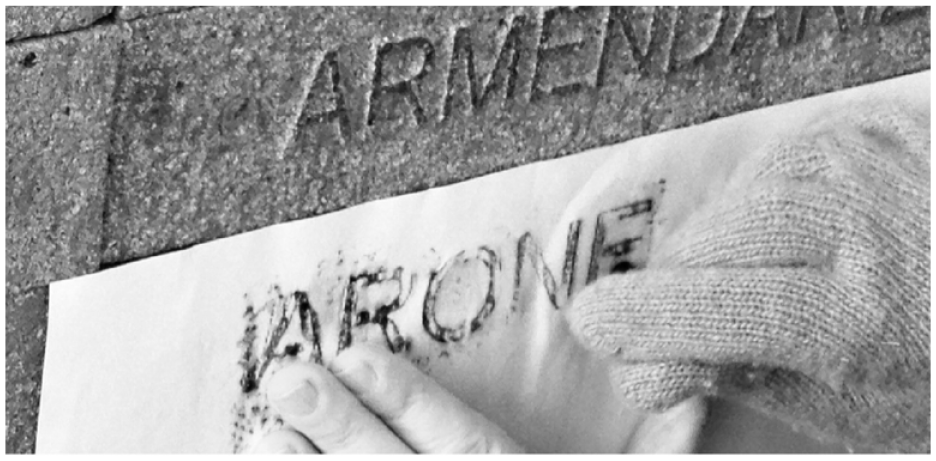
A hand tracing a name that appears on the Monument to the Victims of State Terrorism (Memory Park) in Buenos Aires, Argentina. March 2018.
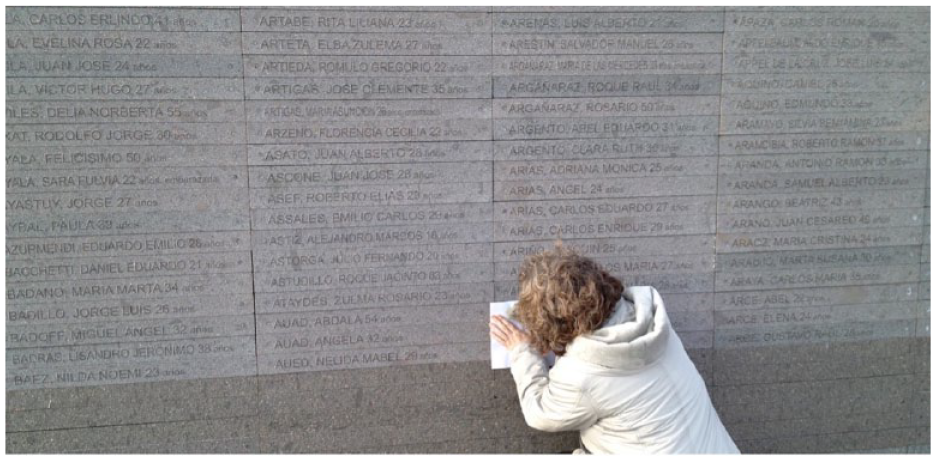
Photograph of the Monument to the Victims of State Terrorism, Memory Park, Buenos Aires. March 2018.
As we approached, she noticed the papers and pencils that were left for visitors. Looking through the names, she found the one belonging to her friend. She crouched down to slowly trace the lead over each letter, starting with the A, moving onto the R and the O and the N and the E. She moved the small pencil slowly over each letter. As the raised letters met with the pencil edge, they left an impression—something tangible she could hold onto. But I also wondered, what does it mean to hold onto this past decades later?
From 1976 to 1983, the junta in Argentina systematically tortured, killed, and disappeared what is estimated to be up to 30,000 people they considered to be “subversive” or dangerous to the regime. 2 For many, they would detain them illegally and through clandestine means, taking them without a trace: “disappeared.” Security forces took them to secret torture centers that were located throughout the country, many like the ESMA (Escuela Mecánica de la Armada or Navy School of the Mechanics) was located within the peripheries of the city itself. During those years, groups like the Madres de Plaza de Mayo (Mothers of the Plaza de Mayo) became a powerful social force, marching every week in the Plaza de Mayo, the central public square in Buenos Aires facing the presidential palace demanding justice for their children who had been disappeared. Their activism became an anchor for human rights in Argentina, important to challenging the dictatorship and in the years that followed.
After democracy returned in 1983, the CONADEP (Comisión Nacional sobre la Desaparición de Personas or National Commission on the Disappearance of Persons) commission collected testimonies to establish the systematic violence of those years, releasing their report, Nunca Más (Never Again) (CONADEP, 2003 [1984]), that became a best seller. Yet, despite such advances, impunity remained a pervasive issue, especially with amnesty laws in the late 1980s that further reinforced the significance of memory to civil society (see Jelin, 2003). The dynamics of memory and justice shifted again in the early 2000s. The Argentine Supreme Court overturned these laws and as of 2005, trials could begin. Since then, there have been over 600 investigations of crimes against humanity and over 1000 convictions, with trials taking place throughout the nation, including Tucumán, Córdoba, and Buenos Aires (Human Rights Watch, 2022). Along with that, thanks to the advocacy of human rights organizations, spaces of terror and torture were also reclaimed as sites of historical memory. This included the Monument to the Victims of State Terrorism and Memory Park (see Figure 3). The ESMA torture center has also been converted into a space of memory that now houses human rights organization offices, a park, and public memory projects, including sculptures and installations.
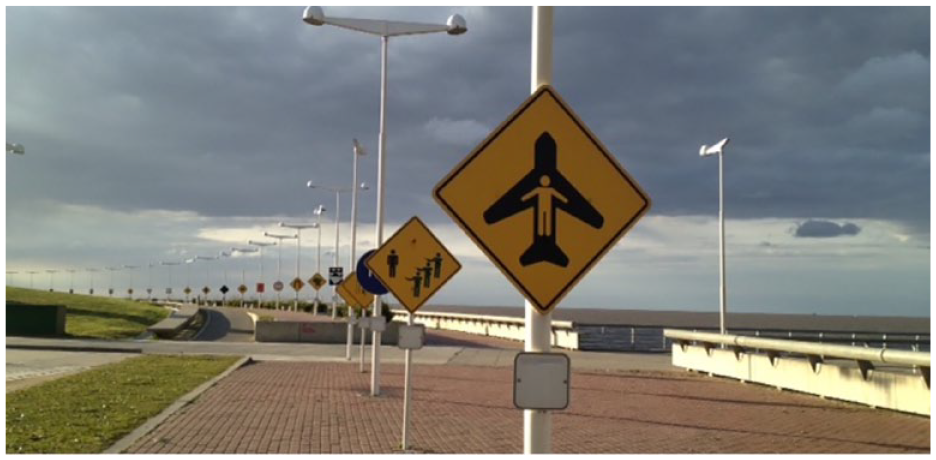
Photograph from Memory Park, Buenos Aires. These signposts reference the dictatorship crimes, including the “death flights.” March 2018.
These memorials and museums are situated in a broader landscape of memory in Argentina that includes such tangible places as well as other embodied practices that serve as symbolic sites. Indeed, regular protests initiated by human rights groups like the Madres during the dictatorship became a weekly site of activism for justice and accountability in the face of the repression and violence of the dictatorship. These protests have continued in the years of democracy. Yet, in 2020, these protests had to stop, with the pandemic restricting in-person gatherings. What does this reveal about the shifting significance of memory in times of crisis? Building on ethnographic fieldwork in Buenos Aires, I examine the evolution of shared embodied practices of remembering in the context of political struggles for justice and truth, including how the pandemic restrictions helped redefine the relationship between presence and political belonging. Rather than simply reacting to specific instances of injustice, this essay argues that the ongoing salience of cultural memory practices underscores their role as fundamentally constitutive of democratic culture and civil society in Argentina.
Situating memory
Post-dictatorship Argentina is a nation where memory seems to be everywhere. Walking through Buenos Aires, you can find traces of memory under your feet. Before your eyes. In the portraits of those lost to human rights abuses, whose images appear suspended in time, the contours of their faces appearing over and over on posters and banners, carried in the hands and on the bodies of mothers and family members and concerned citizens who carry them, resisting the idea that they can simply be disappeared. You can feel this memory under your fingers, if you trace them, as my friend Susana did, over the names of victims of political violence, engraved into the stone of the monuments that now stand, claiming some kind of witness to the political violence of the dictatorship.
Memory has been a key form of activism in Argentina since the 1970s, when mothers whose children disappeared during the military dictatorship protested in the central Plaza de Mayo in Buenos Aires. The state terror and repression inspired a powerful human rights movement that turned memory into a form of activism and citizenship, pivotal for the development of democracy and civil society (see Jelin, 2003, 2021). It has taken decades to achieve some form of justice for state terror and repression, and much of that has been shaped by the culture of memory and accountability that hinged on embodied forms of public protest. Every week, for over 40 years, these mothers returned to the same plaza, standing up for their children and insisting that society not forget what happened to them and that the state provides justice. Indeed, the very terms “Memory,” “Truth,” and “Justice” have become key touchstones for civil society, and literal pillars representing the desire for human rights and justice.
And yet, memory and truth, while central to the “moving forward” so desired after a period of violence or repression, also existed in a state of constitutive tension with justice. The desire to arrive at justice, truth, and accountability is a clear imperative for many societies and nations in the wake of violence and genocide. When immediate justice may not be possible, many societies turn to what has been called transitional justice, describing mechanisms like truth commissions employed by societies who are transitioning from a period of political violence, especially when traditional forms of justice may not be immediately possible (see Roht-Arriaza and Mariezcurrena, 2006). Such practices have indeed served important purposes for societies, offering collective spaces for reckoning with histories and offering recognition for victims’ experiences.
Yet, these processes of transitional justice also invoke certain normative assumptions about progress and moving forward from political violence that imply a linear process of recovery. Embedded in this are understandings of temporality that reshape the perception of past violence. This flattening of the past connects to what anthropologist Alexander Hinton (2013: 87) calls “transitional justice time” where “violent pasts are delimited and narrowed.” Instead, what many communities experience on the ground invokes a past that is more dynamic, moving in and out of the scope and visions of contemporary needs, also positing a temporality that resists any simple teleologies. 3
This is also evident in Argentina, where the activism of the human rights movements like the Madres helped sustain the call for justice in times of rampant impunity when amnesty laws prevented prosecution. Yet, even after the amnesty laws were overturned and human rights trials yielded important advances in justice and accountability, the terrain of justice has also remained uneven. This includes the impunity surrounding the 1994 bombing of the AMIA (Asociación Mutual Israelita Argentina, or Argentine Jewish Mutual Aid Society), the most significant terrorist attack in Argentina’s history, which resulted in 85 killed and hundreds wounded, and remains unsolved and in a state of impunity over 25 years later (see Levine and Zaretsky, 2015; Zaretsky, 2021). As of this writing, despite two trials, the Inter-American Commission on Human Rights has established that Argentina bears responsibility for the impunity (in a 2005 ruling and more recently in 2022). There are other cases that have also assumed pivotal roles in the national imaginary, such as the disappearance of Julio López in 2006, before he was going to give his testimony in the trial of Miguel Etchecolatz related to his disappearance during the dictatorship, as well as the 2017 disappearance of the activist Santiago Maldonado, during a protest related to indigenous land rights (Amnesty International, 2018). Along with this, other challenges include developments like the “2 × 1” ruling, that potentially diminished the punishment for those accused of crimes against humanity. 4
One of the beneficiaries of the “2 × 1” ruling was Jorge Luis Magnacco, an obstetrician responsible for assisting with pregnancies at the ESMA torture center. During the dictatorship, he participated in the labors of pregnant women kidnapped, thereby becoming part of the systematic appropriation of those babies. These children were later given new names and lived under other identities. The group Abuelas de Plaza de Mayo (Grandmothers of the Plaza de Mayo) formed to help search for these grandchildren living under other names with military families, and as of this writing, 131 such grandchildren have been reunited with their biological families. (The search for their recuperation is the focus of the advocacy efforts of the Abuelas de Plaza de Mayo.) 5 Magnacco had received various convictions for his role in the repression. In a trial that began in 2011, he was accused, along with other key figures in the dictatorship like Videla and Bignone, for appropriating children. However, in 2017, following the “2 × 1” ruling, his years served were combined and he was given conditional liberty.
This ability to live freely challenged the notion of juridical accountability that was central to the vision of social repair offered by the trials and processes of justice. This is what inspired the H.I.J.O.S. organization to (Hijos e Hijas por la Identidad y la Justicia contra el Olvido y el Silencio, or Children for Identity and Justice against Forgetting and Silence), to hold an escrache on 17 March 2018 in Buenos Aires, a protest strategy that became popular during the 1990s when impunity was more rampant (see Taylor, 2006). Historically, in escraches, protesters would march to the homes of perpetrators, loudly and often raucously playing music and drawing the attention of neighbors to challenge the idea that a perpetrator can peacefully live their lives without some form of accountability, even if in that moment such accountability would be social and may not be possible through the legal system. 6
Protests like the escrache were pivotal to the human rights activism in Argentina that challenged the dictatorship and continued advocating for memory and justice in the years of democracy. Much of this use of public space to contest the state was inspired by the activism of the Madres, but also evolved through other human rights groups. 7 This also invoked shared embodied presence in public space in ways that are described by Diana Taylor in her writing on presence, which she defines as “an ongoing becoming as opposed to a static being, as participatory and relational, founded on mutual recognition” (Taylor, 2020: 4). We see such engaged participatory presence in the use of public space to demand memory and justice in Argentina for other instances of impunity, like the AMIA bombing noted above (where every week from 1994 to 2004, the group Memoria Activa would gather in the public square facing the High Courts; see Zaretsky, 2021). Such gatherings, though, were also about imagining another future together. In this way, they were enacting presence in the way described by Diana Taylor more broadly, as “com[ing] into presence as a strategic ‘we’ to reimagine other ways of acting and thinking in the world” (Taylor, 2020: 20–21). The powerful annual commemorations on 24 March—the Day of Remembrance for Truth and Justice that marks 24 March 1976, the date of the coup—have also been a significant way for Argentines to demonstrate their citizenship and reimagine what it means.
Various societies engage memory in the public sphere to negotiate political belonging. Indeed, contestation of memory has been an important framework for thinking through how societies navigate the past. We see this in Michael Rothberg’s recent work on the Holocaust memory debates in Germany, where he notes that the “dissonant narratives of migration and contemporary conflict challenge the truisms of German memory” (Rothberg, 2022: 1318). The value of such dissonance and other forms of memory wars and politics has become an important way of analyzing how societies not only come to terms with the past, but also demonstrate how communities and nations are defining and redefining their sense of citizenship and belonging. 8
Here, I am not focusing on dissonance or contestation per se, but what a crisis or challenge to traditional forms of memorialization can inspire, and importantly, reveal about the role of memory in Argentina. While embodied forms of protest were so central to challenging the dictatorship and developing practices of public citizenship in the post-dictatorship years, they were also disrupted by the COVID-19 pandemic. The weekly protests of the Madres, held every Thursday afternoon since 1977, were suddenly no longer possible in 2020 because of the pandemic. The large-scale 24 March commemorative marches in the streets could not take place, as the streets and plazas were left empty in 2020. With that in mind, below I consider two ethnographic moments in time, pre- and mid-pandemic, to explore the transformation of these practices as ways to reimagine what sharing witness and time can mean when sharing space is not possible, and further, what new practices reveal about the significance of cultural memory for generating political belonging.
March 2018: moving through memory
I was invited to join the 17 March 2018 escrache by a friend, Federico, who commented that it was unusual for such a protest to take place in 2018. Historically, escraches were convened by the group H.I.J.O.S. and were more common in the 1990s during the height of impunity, when amnesty laws precluded the prosecution of many perpetrators. The idea was to take the protest straight to the perpetrators’ home and to disrupt the notion that anyone could live their lives peacefully when they had committed such crimes. The new wave of human rights trials starting in 2005 shifted the landscape of impunity to a large degree, but not entirely. So, in 2018, Argentines turned again to the escrache because a perpetrator was living freely, thereby challenging their vision of the ideals of memory, justice, and truth that had become so vital for society.
When I arrived at the Plaza Lavalle that Saturday afternoon in March 2018, except for the protesters, the area was otherwise empty. 9 As it was a weekend, this was not surprising since this was an otherwise busy downtown courts area. The Plaza Lavalle zone was filled, though, with the sounds and sights of hundreds gathered in front of the High Courts (see Figure 4).
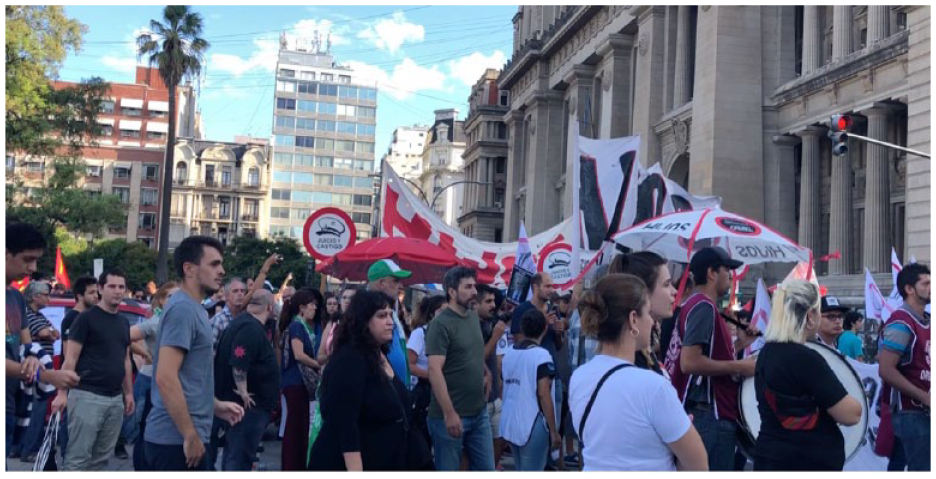
Image of March 17, 2018 Magnacco Escrache, Plaza Lavalle, Buenos Aires. March 2018.
The drums beat consistently, as people started singing and shouting the traditional chants:
These chants translate as: Just like the Nazis, it will happen to you. Wherever you go, we will find you.
Holding signs for the 30,000 disappeared, and other symbols of the dictatorship, such as “Juicio y Castigo” (Justice and Punishment), the large group started the procession down the streets, winding their way to the home of Magnacco.
As we walked, volunteers with bullhorns shouted up to the neighboring buildings, calling out “Vecinos!” (Neighbors), to advise them that they were living near a perpetrator. Continuing to sing songs, we watched as activists spray-painted the garbage receptacles as we passed. One stenciled message read “Magnacco, Ladrón de Bebés de la ESMA” (see Figure 5)—Magnacco: Thief of ESMA Babies.
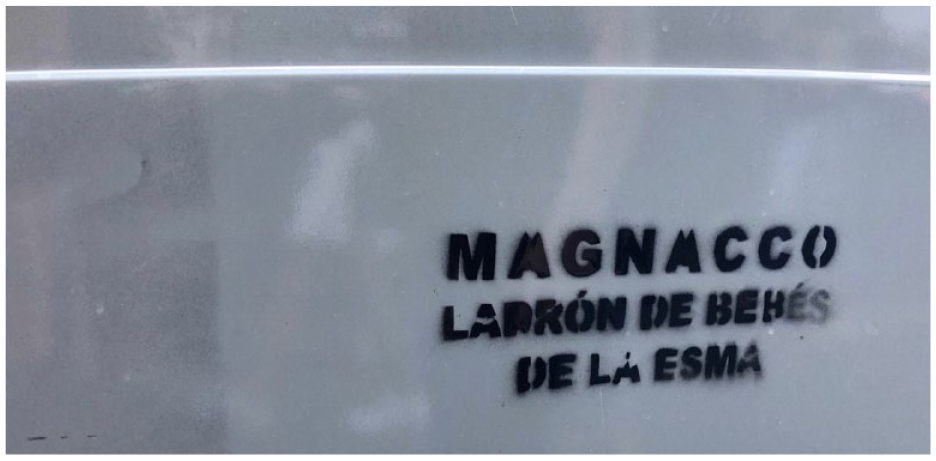
"Magnacco: Thief of ESMA Babies." Garbage Receptable, Buenos Aires. March 2018.
Another, written in rushed handwriting, read “El único lugar para un genocida es la cárcel”—also on a garbage bin (see Figure 6). “The only place for a genocidaire is prison.”
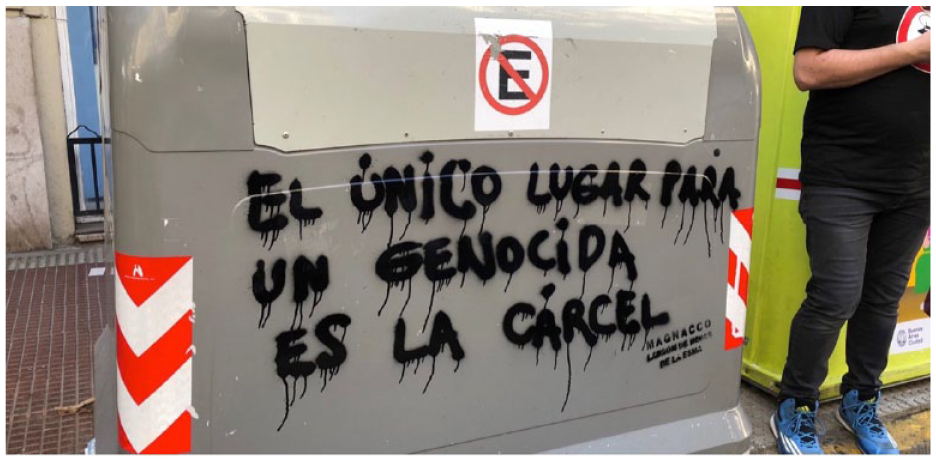
"The only place for a genocidaire is prison." Garbage Receptacle, Buenos Aires. March 2018.
As we continued marching, and shouting to raise the awareness in the streets of Magnacco’s neighborhood, I noticed the street signs.
Up high on the large trees that hung over the avenue, someone had put up a bright yellow sign, that appeared to be a road sign, 10 reading: “a 350 m, Jorge Luis Magnacco, Ladrón de Bebés”—in 350 meters, Jorge Luis Magnacco, Thief of Babies, along with his street address (see Figure 7).
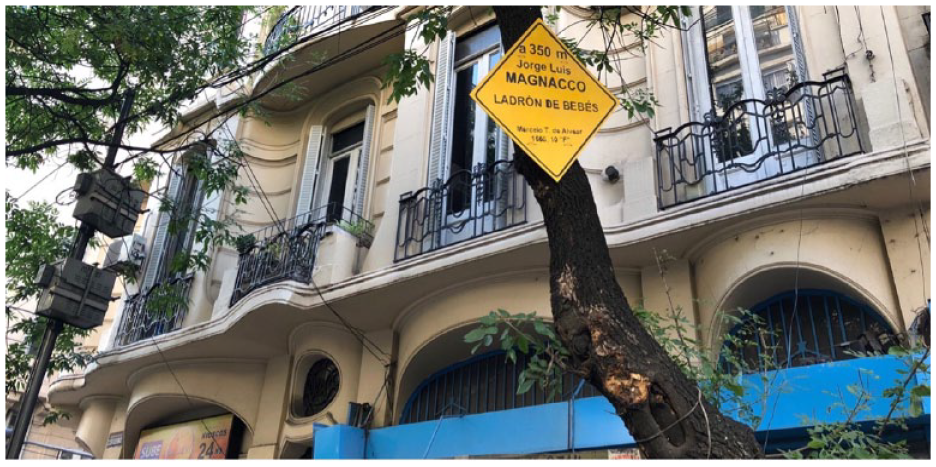
“In 350 meters, Jorge Luis Magnacco, Thief of Babies,” Buenos Aires. March 2018.
As we got closer to his home, in the tree-lined neighborhood of Recoleta, protesters started handing out flyers, and neighbors and passersby stopped to see what the commotion was about—precisely the point of the escrache. Of course, many kept on walking as well, demonstrating the challenges of commemoration.
The road signs continued (See Figures 8 and 9).
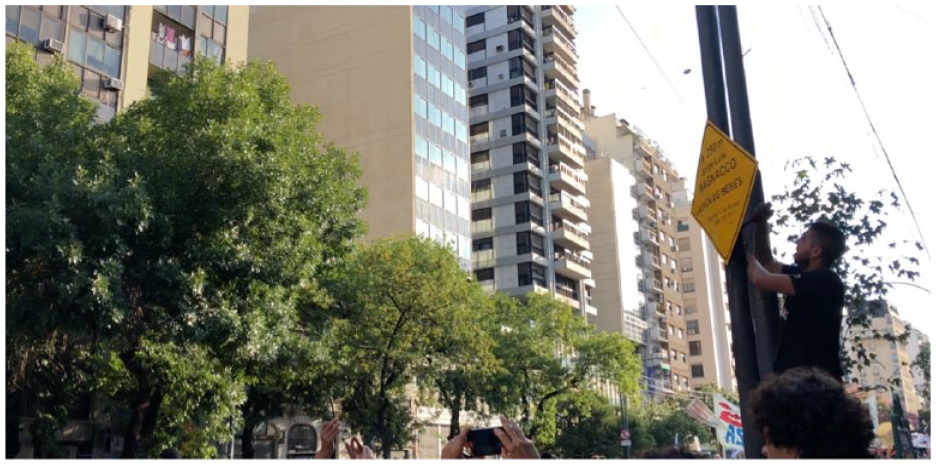
“In 250 meters, Jorge Luis Magnacco, Thief of Babies,” Buenos Aires. March 2018.
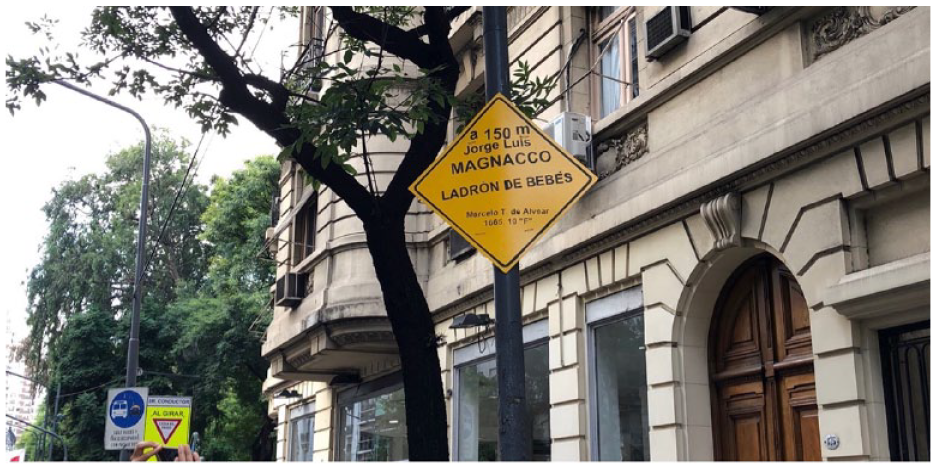
“In 150 meters, Jorge Luis Magnacco, Thief of Babies,” Buenos Aires. March 2018.
250 meters.
150 meters.
And then we had arrived.
Standing in front of this man’s home, looking up at his window on the 10th floor of his building, the group became louder, shouting up to him to demand that his past not be ignored (see Figure 10). Through these protests, it was clear that even if in that moment juridical accountability may not be possible, what they desired was a social accounting—an acknowledgment and recognition of the truth of his crimes.
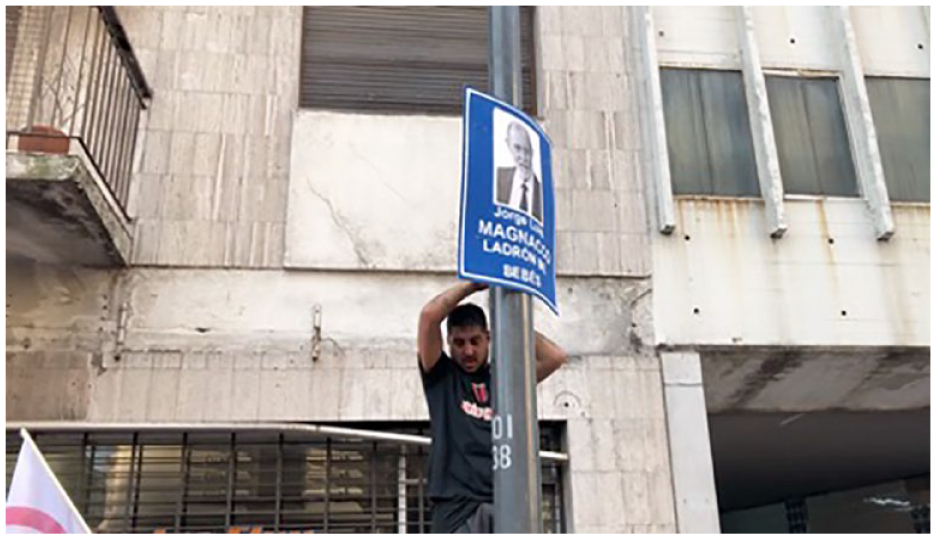
Image of protester putting up poster in front of Magnacco’s residence in Buenos Aires. March 2018.
As we stood there, shouting for justice together, I wondered, what did this shared presence really mean? What did it mean to stand in this space together in this moment, knowing that shortly after this was finished, we would move back into the flows of our routines? And yet, if we turn to the insights of Diana Taylor on presence, she notes that “What I/we means, what it can and cannot know, is necessarily linked to those others with whom we walk and talk” (Taylor, 2020: 30). The act of walking together, then, generates certain forms of relationality and connection, of that “mutual recognition” (following Taylor), so key to the imagining of justice and subjectivity.
So we walked, aware, that the spray paint that was used would be washed away. The street signs that were put up would be taken down. The flyers and the shouts so keenly searching for an engaged listener who cared, would also dissipate into the air, as the sounds of city traffic took over again once we left this street.
And yet, these street signs were also inscribing themselves not just in this moment, but in many others—in established modalities of collective memory in Argentina. Indeed, the yellow road signs invoked a visual lexicon part of a broader cartography of sites in Argentina. This included memorials and monuments and signs on the streets and plazas of the city, that insisted on remembering what took place in that particular site so that it did not simply disappear (like Figure 3, the signposts in Memory Park, along the banks of the River Plate, where bodies had been thrown from planes in the “death flights”). These signposts stood in tension with the absence that existed in these spaces before, and in the case of this March 2018 escrache, the absence that would exist after.
Beyond the signs themselves, there were other discursive symbols—like the slogan “Juicio y Castigo” (Justice and Punishment) on the sign (Figure 4) or the very words in the song chanted as we marched down the street (“como a los Nazis, les va a pasar”—just like the Nazis, this can happen to you). The power of this song and slogans, like the signs, were how they situated this perhaps fleeting moment within hundreds and thousands of such moments and gatherings, consolidating this time with those others as part of this ongoing call for justice that required standing together. This also suggested that civil society and democracy were not simply something that happened after the end of dictatorship, but had to be actively reconstituted in moments when they were at risk. This act of being present, as it shaped “mutual recognition” (Taylor, 2020), also became an ethical act that produced particular kinds of knowledge. Indeed, such shared presence in that space, even if ultimately ephemeral and just one small moment, also became part of an ongoing series of such moments, of what I have called “acts to repair” (Zaretsky, 2021) in the face of the impunity that threatened democracy and rule of law. And yet, what happens if such shared embodied presence is not possible?
March 2020: sharing time
24 March 2020. Just 2 years later. It is striking how much had changed. The new realities of COVID shut down streets and cities everywhere. The 24th of March had a particularly significant meaning in Argentina, though, as the Day of Remembrance for Truth and Justice, a day marking the 24 March 1976 coup that brought the genocidal dictatorship into power. Since those years, the Plaza de Mayo—as the central public square of Argentina, facing the presidential palace—was the symbolic heart of protests, starting in the years of dictatorship and continuing for years after, with the Madres marching there every Thursday afternoon. Usually on that day, crowds pour into the streets of Buenos Aires, flooding it with their bodies as they stand together to commemorate the past and to also invoke a tangible present where they can enact the vision of a democratic civil society that had been taken from them during the dictatorship.
Being able to gather peacefully in public, without fear of repression, was a central way to establish new forms of political belonging. Because COVID made public gatherings impossible, that 24 March in 2020 was the first day since the return to democracy that the Plaza de Mayo stood empty. Instead, people had to stay home. The emptiness made visible in images circulating of the plaza felt particularly eerie to me, given the significance of such public gatherings as the only tool of resistance and challenge to the silence, erasure, and terror of the years of dictatorship. I wondered what a commemoration or protest could really mean if not in person, when so much seemed to hinge on the embodied power of presence (following Taylor, 2020).
On that 24 March 2020, instead of gathering in the public plazas, there was a different gathering—in the virtual spaces of social media platforms like Facebook, Twitter, and Instagram. I, too, participated from afar, many thousands of miles from Argentina in the first weeks of lockdown. Despite that distance, I was, oddly, able to virtually participate in these new forms of commemoration, knowing that such presence relied on an illusion of proximity, even if the illusion of the near was all anyone could hold onto in those days.
On that first 24 March commemorated during the pandemic, Argentines throughout the nation shared posts about remembering the violence of the dictatorship and demanding that “never again” such repression take place. Yet, they also incorporated handmade white scarves—symbolizing the same iconic white headscarf worn by the Mothers of the Plaza de Mayo as their unifying symbol since the 1970s. The same symbol that appears on the very stones they marched on in the Plaza de Mayo (see Figure 11) now became part of a shared digital fabric taking form through a campaign called “pañuelos con memoria” (meaning, scarves with memory).
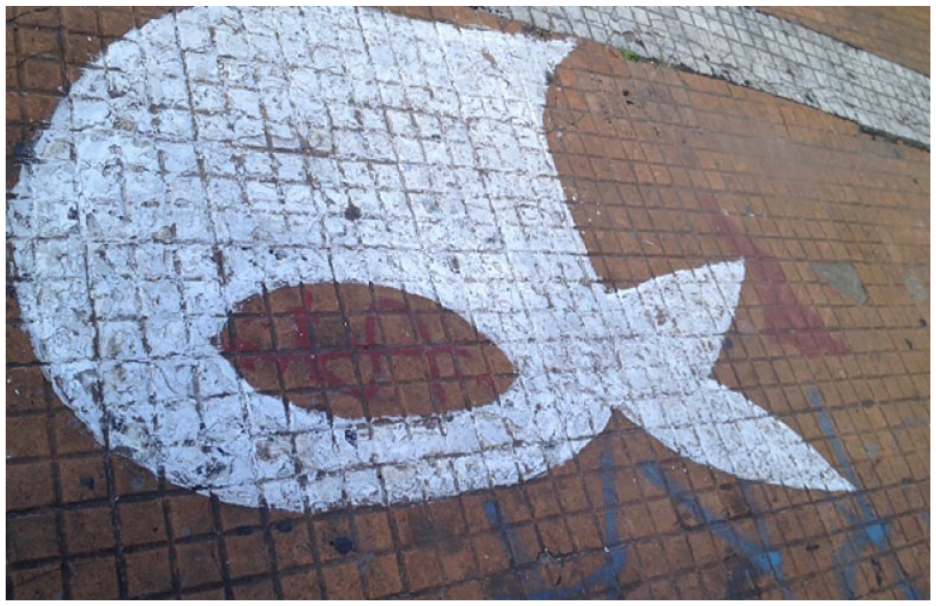
Image of white headscarf on the ground of the Plaza de Mayo in Buenos Aires. Circa 2014.
People posted using hashtags including #pañuelazoblanco (referencing the white scarves), #NuncaMas (never again, the title of the CONADEP commission report about the violence), #MemoriaVerdadJusticia (memory, truth, justice). Citizens across Argentina posted images of themselves, holding up white scarves. These scarves that they made themselves would carrying these words, these discursive threads to other times and other people—including “Son 30 Mil”—They are 30,000—reasserting the history of almost 30,000 disappeared (in this case, resisting a revisionism that suggests there were fewer).
A 24 March 2020 Tweet from the mayor of Villa Gesell posted about a neighbor who had made a scarf in her home to remember the genocide (referencing the violence of the dictatorship), noting, “In this difficult moment, we continue together. . .demanding Memory, Truth and Justice,” also invoking the hashtags of #PanuelosconMemoria and #NuncaMas. 11
Others used their participation in this virtual public sphere to inscribe themselves into this legacy of the white scarves, posting, “We are the granddaughters of the white scarves” in the images they posted to their social media. 12 They further instantiated their connection to these commemorative practices by writing the same words on the scarves that were also voiced at the March 2018 escrache (and that are often invoked in human rights protests): “Como a los Nazis les va a pasar. A donde vayan, les iremos a buscar.” They also included scarves with the words “Son 30,000. Yo No Olvido,” and “Memoria, Verdad, y Justicia.” In this way, even as the plazas and streets were empty, they situated this extraordinary pandemic virtual protest within this shared history of protests through these discursive connections, thus establishing this as a reimagined ritual of political belonging.
Argentines made these white headscarves at home, posting their images to Twitter or Facebook or Instagram, and also hanging their scarves on the balconies and on the doorways of homes, directed outwards to create a shared public reimagining of how this day could be commemorated (see Figures 12 to 15). By handwriting words like “Nunca Más” (Never Again) in the same visual style as the cover of the CONADEP commission report about the crimes of the dictatorship (CONADEP, 2003 [1984]), these scarves also linked this present with the past though this visual lexicon. 13 These posts, then, become another way to situate oneself as a citizen within this history and within the promise of justice for a future without the repression of the dictatorship. And that act of shared imagining, ultimately, became what was so vital to hold onto in the face of the new challenges of the pandemic.
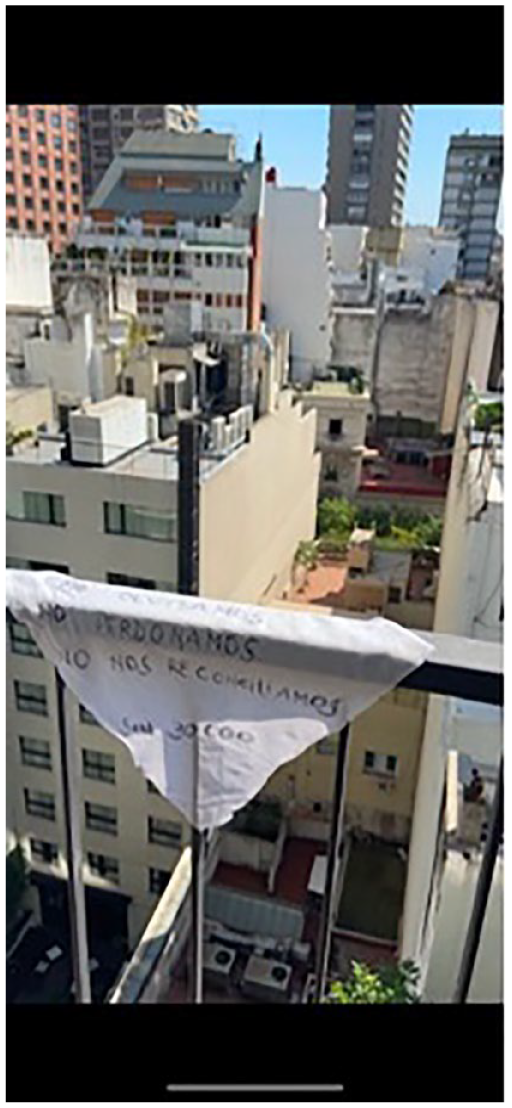
Image of white scarf with handwritten words “No Olvidamos. No Perdonamos. No Nos Reconciliamos. Son 30,000.” (We do not forget. We do not forgive. We do not reconcile. They are 30,000.) 24 March 2020.
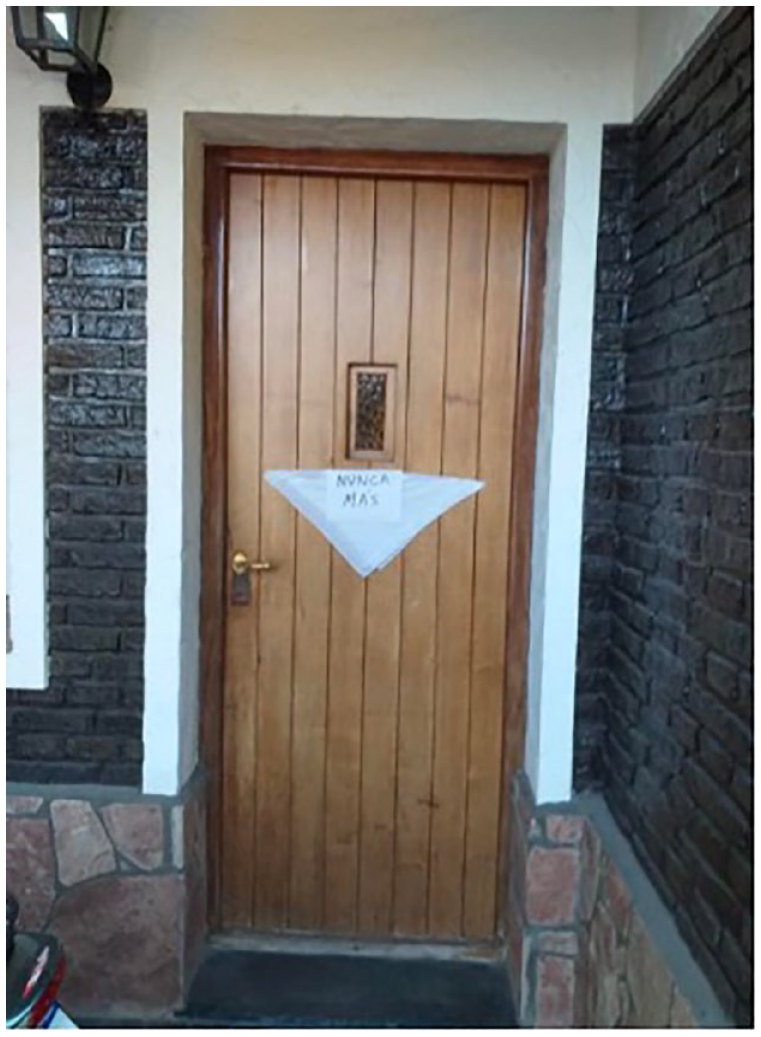
Photo of white scarf noting “Nunca Más” (Never Again) on doorway.
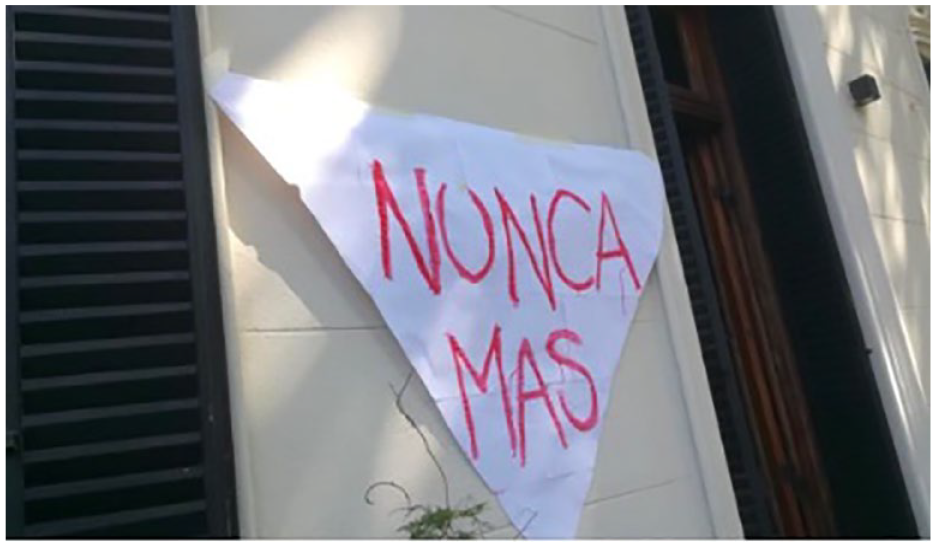
Photo of white scarf with “Nunca Más” (Never Again).
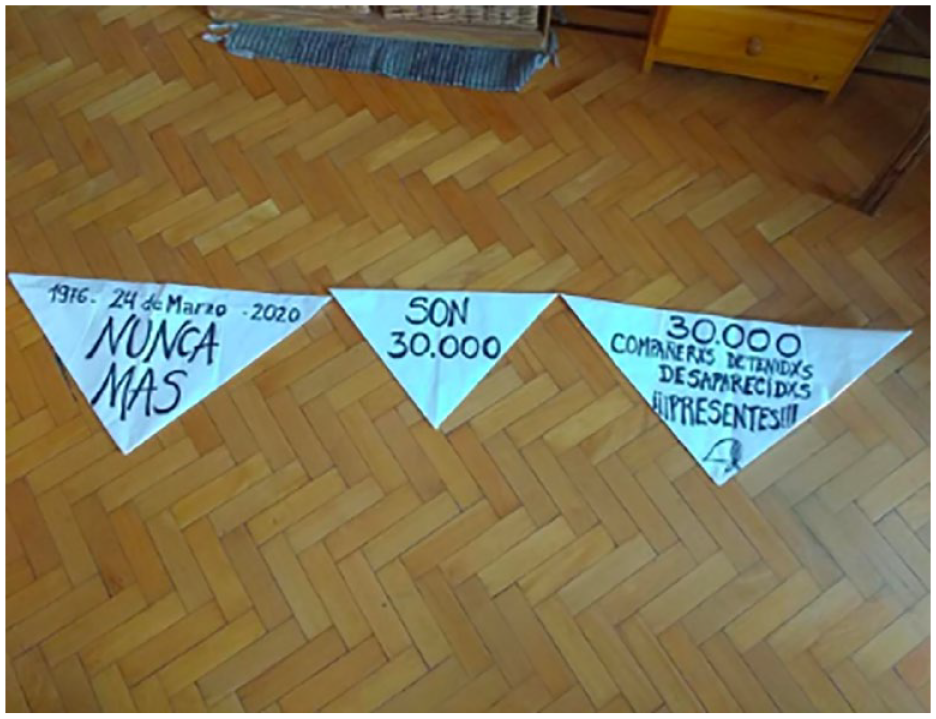
Photos of white scarves denoting “Nunca Más” (Never Again), “Son 30,000” (They are 30,000). “30,000 Compañeros Detenidos Desaparecidos ¡¡¡Presentes!!!” (30,000 Detained-Disappeared Present!!!)
Conclusion
On 24 March 2020, the Day of Remembrance, what mattered for citizens was finding ways to make this remembering one’s own again, using ordinary materials created with the urgency and care of one’s own hands. In his work on counter-monuments, James Young (1992) asks whether rituals of memory necessarily compel remembering, or might instead simply relieve society of feeling the burden of remembering. The sense of care and urgency with which Argentines undertook this new challenge to remember in the context of the pandemic reinforced the salience of such resignifications of commemorative practices in times when they may be at risk. Yet, such acts are always to some degree ephemeral—people move in and out of public spaces, marking time and then moving back to their routines, their presence not necessarily leaving a permanent trace on the streets and surfaces of the city.
There can be nothing like standing together, the “effervescence” that Émile Durkheim had noted was so important to sustaining society, and also, to understandings of shared memory practices. Of course, memory studies has transformed in many ways, considering transnational and postcolonial frameworks. Yet, it may still be instructive to consider how Maurice Halbwachs initially developed the concept of collective memory, as a way to understand what happens to solidarity when members of a group are not together, and cannot engage in an embodied “collective effervescence” (following Émile Durkheim’s work; Coser, 1992: 25). In this tension between the near and far, we see the way memory becomes configurated and reconstructed through present groups and their needs (Halbwachs, 1992: 51).
Such a dynamic process of evolving transformation has been evident throughout the histories of protest in Argentina. Even as the 2020 virtual protest may be quite different from the embodied escrache of 2018 (and the many other protests that have taken place over more than 40 years), both modalities entailed the same desire to collectively demand memory and justice through a shared moment in time, even if through virtual means.
The pandemic, in many ways, carries the marks of liminality, that intermediate state of being “betwixt and between,” as described by anthropologist Victor Turner (1967). It clearly exposed the fragile and vulnerable dimensions of our lives, while also rendering visible what societies value. That, too, is in keeping with how Turner describes liminality as a “a realm of pure possibility whence novel configurations of ideas and relations may arise” (Turner, 1967: 47). A liminal period like the pandemic can be a time of “undoing, dissolution, decomposition,” as noted by Turner (1967: 49), but also one that is “accompanied by powers of growth, transformation, and the reformulation of old elements in new patterns.” In this way, the pandemic compelled a reimagining of cultural memory practices. And through the challenges to in-person gathering, Argentines revitalized the significance of shared presence, thereby affirming why shared practices of remembering matter.
These commemorative practices continued, even if reimagined, affirming that cultural memory was not simply reactive to instances of injustice, but rather, fundamentally constitutive of democratic culture and civil society. Whether standing shoulder to shoulder or at a distance, whether near or far, such shared acts help citizens imagine one another, and through that, helps regenerate the social fabric—part of what is so much at stake in the struggle for repair after violence and trauma.
I asked at the beginning of this essay what it means to hold onto the past, as I watched Susana tracing the letters of her friend’s name, the lead from the pencil gently leaving its marks on her page. Decades after the dictatorship, standing together on the edges of the River Plate, that time felt so far, and yet so near. This March 2022, the plazas of Buenos Aires filled again with people, a return in ways to the modalities of the past. And yet, that liminal time of 2020 also showed us something about the significance of memory, and what it really means to hold onto the past, or perhaps better put, to reach for the past as a way to reimagine the future. Many of these acts—the tracing of a name, the marching through streets that may not bear one’s traces the next day, the posting of an image snapped of a hand-maid scarf—may appear ephemeral. And yet, these practices also reveal something more about what matters to a society. Whether standing shoulder to shoulder, or gathering in a virtual public sphere—what seems to matter most is this desire to continue trying to hold on to the past and through that, to one another.
Footnotes
Acknowledgements
An early version of this essay was presented at the March 2020 Sites of Reckoning hosted at Georgia State University. My thanks to the participants for their feedback. Additional material about temporality was presented at the American Anthropological Association Meeting, November 2022. I would like to thank Jennie Burnet and the anonymous reviewer for their comments, which were very helpful for the development of this essay. My special thanks to Susana Skura for sharing her experiences with me; my special thanks also go to Federico Gaitan Hairabedian for inviting me to the escrache as well as sharing his photos and to Alexis Papazian for permission to use personal photos for this essay.
Funding
The author disclosed receipt of the following financial support for the research, authorship, and/or publication of this article: The author received financial support for this research from New York University.
