




Abstract
Cultural commemoration in the form of embodied memory was practiced in Namibia long before German colonial occupation in the 1880s and the War of Independence against South Africa from 1966 to 1989. In recent years, Namibian artists have been offering alternative forms of embodied memory transmission related to these histories. I argue that much of this work is inextricably linked to a new wave of decolonial activism in the country. These practices highlight questions related to history and memory and are a counterpoint to state-sanctioned memorialization. Some of the recurrent themes are efforts to work through traumatic legacies connected to German colonialism and apartheid, but also to intersectional violence tied to contemporary patriarchy and identity politics. In these settings, queer and feminist methodologies provide a departure point for this embodied memory work in an attempt to go beyond colonial and tribal legacies and nationalized identity politics.
Since Namibian independence in 1990, marginalized groups and individuals—especially members of the OvaHerero and Nama—have increasingly drawn on overlooked or previously suppressed and silenced memories. In part, these memories have been marshaled for the purpose of seeking official recognition and restitution for colonial crimes and genocide (see, for example, Kössler, 2015b; Melber and Platt, 2022; Rausch, 2022). The historian Memory Biwa reminds her readers that alternative sensorial memory practices have been enacted by Namibian societies well before independence. With a specific focus on Nama communities, she reviews “the way in which communities have for decades developed practices in which to recall and re-enact the colonial war by focusing on narrative genres and public commemorations” (Biwa, 2012).
Annual commemorations are often related to the places where original historical episodes took place. Three of the more notable commemorations are Herero Day in Okahandja; White Flag Day or Zeraeua Day in Omaruru, and the Witbooi Festival in Gibeon (Nama: Khaxa-tsûs). Kössler describes the events: “There is also a specific dress, in terms of finery and ethnic markers, in particular among Ovaherero, with uniforms for men and typical dresses for women [. . .] Nama groups also sport distinct colors that identify each group [. . .]” (Kössler, 2015a: 181).
One of the purposes of these events has been to create greater public awareness of the role that the Ovaherero and Nama played in late-nineteenth- and early-twentieth-century resistance against German colonial settlers. Participants argue that, in the battle for memory, their histories have been suppressed—first during apartheid and then in the post-apartheid independence era.
Another burgeoning field of memory transmission is that of “national memorialization,” especially in the form of the built environment. Since independence in 1990 the Namibian government, led by the South West Africa People’s Organization, SWAPO, has actively engaged in a project of national commemoration and has crafted an official memory program through the erection of museums, monuments, and extensive patriotic events. In addition, a public holiday known as “Heroes’ Day,” commemorating the Namibian War of Independence, has been added to the national calendar. Multi-million-dollar constructions include the Independence Memorial Museum as well as the vast memorial complex known as Heroes’ Acre at the outer periphery of Windhoek, the capital of Namibia, and more recently the SWAPO headquarters in Windhoek crowned by a large gold-colored statue of Sam Nujoma, the first president of independent Namibia, holding a child. The public memorials and buildings erected by SWAPO both emphasize and endorse “the pre-independence history of SWAPO and its allies,” but also form part of maintaining a “. . . strong discourse of ‘Namibianness’” in order to limit “ethnic divisiveness in the country” (Wallace and Kinahan, 2011: 314).
These two broad and significantly different forms of memory transmission—traditional commemoration and state-sanctioned memorialization—play an important part in forming social, cultural, and political identity in Namibia. My article will, however, focus on a more recent kind of memory transmission in the form of activism and embodied performance work which I refer to as “practices of self” (Brandt, 2020b: xvii–xxi). I argue that these emerging memory practices, in contrast to tribal or community performances and commemorations as well as official state declarations of collective memory and hegemonic memorialization, belong broadly to a wider burgeoning youth movement and underscore intersectional activism in the country.
“The right to protest”
In the past few years, Namibian activists have gathered in campaigns to decolonize public spaces, but also to highlight the intersectional nature of their protest. In a conversation with one of the key promoters of the movement, Hildegard Titus describes how she became involved: I have been doing this work on a case-by-case basis, but the intersectional nature of the issues became even clearer to me during the Coronavirus pandemic. People from activist spaces were coming together last year in ways I had not seen before. [. . .] I felt so powerless at some point, that I had no choice but to do whatever I could in the spaces that were available to me to highlight these things that I felt were important. Namibians are struggling in many contexts. [. . .] I really began to see how joined up issues of inequality are, and how past injustices still ripple through the present. [. . .] It is with this knowledge—of the intersectional nature of oppression and inequality—that I turned to protests. By protesting in public we are drawing attention not just to the single grievance, but to the wider structures and how they connect us as people.
These “practices of self” run parallel to and are entangled with this burgeoning movement. For artists and activists such as Titus there is a strong awareness of how place and identity are mutually constituted and impacted by socio-historical and political factors. 1 These “practices,” connected to a rise in urban activism, are firmly rooted in the postcolonial moment, not only in Namibia but also in the context of South African movements such as Rhodes Must Fall and Fees Must Fall and regional enactments of global movements such as Black Lives Matter and Me Too (see preface in Brandt, 2020).
This emerging cultural expression of embodied memory has very loose disciplinary boundaries. It includes a diverse repertoire conveyed through gestures, dress, the spoken word, movement, dance, song, and other performances. Motivations for the work of these artists and activists diverge but are often interconnected, ranging from the need to protest, to a desire to explore questions of personal identity and belonging, and to produce of new forms of knowledge. They also are a deliberate means of healing to reclaim space and a sense of self-determination, especially in relation to the body (Brandt, 2020b: 4). Artists have different reasons for choosing embodied performance, but in the case studies in this article, I demonstrate that they are also concerned with legacies of colonial, racial, and gendered violence.
Commemoration practices
Even if these new “practices of self” form highly individualized artistic expressions, the works also deliberately reference and activate collective memories, which at times echo themes and concerns of more traditional commemorations. They are often located at sites of historical significance such as the Alte Feste (old fort) and the Curt von François monument in Windhoek, and Shark Island on Namibia’s southern coast. One of the first significant works of this nature—which I discuss in my book Landscapes Between Then and Now (Brandt, 2020b: 135–137) is the site-specific performance in two parts: The Mourning (2016) and The Mourning Citizen (2019), presented in 2016 and 2019 at the Alte Feste. Driven by the Namibian dancer and choreographer Trixie Munyama, which involved a collaboration between a group of Namibian artists. These works offered significant and powerful interventions in what was once the epicenter of white male coloniality—the old German colonial fort known as the Alte Feste. One of the reasons why this site is important is that the former prisoner-of-war camp where OvaHerero and Nama were held during the war and genocide was close to the fort and the Independence Memorial Museum. In the performances, both the site and bodies of the performing artists were regarded as vessels and archives for memories of the living and the ancestral. Colonial imagery from the Namibia National Archives and other sources were repurposed in the first installation. Writer and columnist Martha Mukaiwa described The Mourning as “a hypnotic war cry rallying the nation to fight forgetting” (Mukaiwa, 2016).
In the other performances that I cite as examples, dress plays a significant role, while elements of ritual, symbol, and adornment are at times also included. Yet, unlike annual commemorations which incorporate traditional dress and adornment and normally involve entire communities and last for several hours, sometimes days, the more individualized practices are usually performed on a far smaller scale, involving perhaps only one or two artists or a small group.
Although dramatically different in form, both kinds of memory transmission reflect on Namibian histories. Traditional commemorative practices are in the primary service of preserving tribal belonging and memory, especially mourning and honoring key ancestors. In these “new” practices of self, there is at times a seemingly contradictory relationship toward aspects of tradition and communal identity. There is both a desire to transgress tradition through different configurations of meaning-making, as well as a wish and curiosity to connect with aspects of the past, be it references to the meanings of the dress or, for example, the “tree of life” or the “holy fire” in Herero cosmology, or earlier pre-colonial festivals in Aawambo culture (Taylor, 2021; Uzera and Hoveka, 2022). Within this lies what appears to be a paradox: there is a need to work with—and work through—aspects of tradition as an expression of healing, belonging and identity, while by the same token there is a desire not to place certain traditions related to coloniality and at times oppressive, largely patriarchal customs at the center. Rather, these performances reimagine the self and celebrate a more complex pluralistic identity (see, for example, Mukaiwa, 2016).
This ambivalence toward traditional/tribal or state-sanctioned memory practices is expressed by Gift Uzera, one of the artists in the three case studies that I will discuss in this article. He says that, as a young Namibian artist, he found it difficult to relate to statues or memorial events that seem disconnected from the questions and concerns of the current generation (Uzera, 2022).
The Day Curt Fell
At around 7.30 am on the morning of 23 November 2022 in the central business district of Windhoek, the artists Gift Uzera and Muningandu Hoveka and myself met in front of the Windhoek City municipal headquarters to perform and record a jointly curated intervention. Uzera and Hoveka climbed up to the plinth of a bronze statue that was due to be removed later that morning. In poses of defiance, they took turns to read their letter of farewell to the monument: As artists, we are envisioning new rituals. We are carving out spaces of rest, peace, and connection in our cities. In our future, queer folk and women can feel at home in their own culture, while unapologetically embracing other communities, because we know that we can exchange with others without losing ourselves. There is joy and revelations in the plural—in the hybrid. We see ourselves as a new generation transforming problematic ideas and constraints. With enduring respect, we are challenging notions of gender, identity etc., and are unlearning (self-)policing and censorship to appease the cultural gatekeepers. (Uzera and Hoveka, 2022)
The statue represented the German colonial officer Curt von François, the man regarded by colonizers and the apartheid regime as the city’s founder. The bronze statue was unveiled in 1965 in what was then known as Kaiserstrasse (renamed Independence Avenue). Von François is known for carrying out the notorious massacre at Hoornkranz in April 1883 in which numerous Nama women and children were killed (see, for example, IPPR, 2020; Melber, 2022).
The removal of the von François monument was motivated by an activist initiative that was started in 2020 by mostly young Windhoekers shortly after the murder of George Floyd in the United States on 25 May that year. Titus describes the intersectional concerns behind the protest at the time: [. . .] although one of the demands was the removal of the Curt von François statue, we were protesting interrelated things. We were protesting gender-based violence (GBV), racial oppression—we were protesting police brutality. [. . .] It is easy to overlook how these issues affect one another and specific groups. Namibians tend to withdraw into a bubble. (Titus, 2021a: 178)
The intervention in 2022 consisted of several short, choreographed vignettes at the site of the contested memorial. 2 One of the sequences performed by Uzera and Hoveka involved slowly crouching down and standing upright again and again, raising their hands to the sky with their backs turned to the monument (Figure 1). Hoveka wore traditional attire, a Herero dress in shimmering green and a headdress known as an otjikaiva. Uzera, who self-identifies as gender non-conforming, chose to wear two outfits, both undergarments of the Herero dress. The first was a full-bodied pink dress made from old lace, and the second a skirt made of sheeting cloth used in state hospitals before independence and imprinted with the SWA logo (“South West Africa” before it became Namibia in 1990).
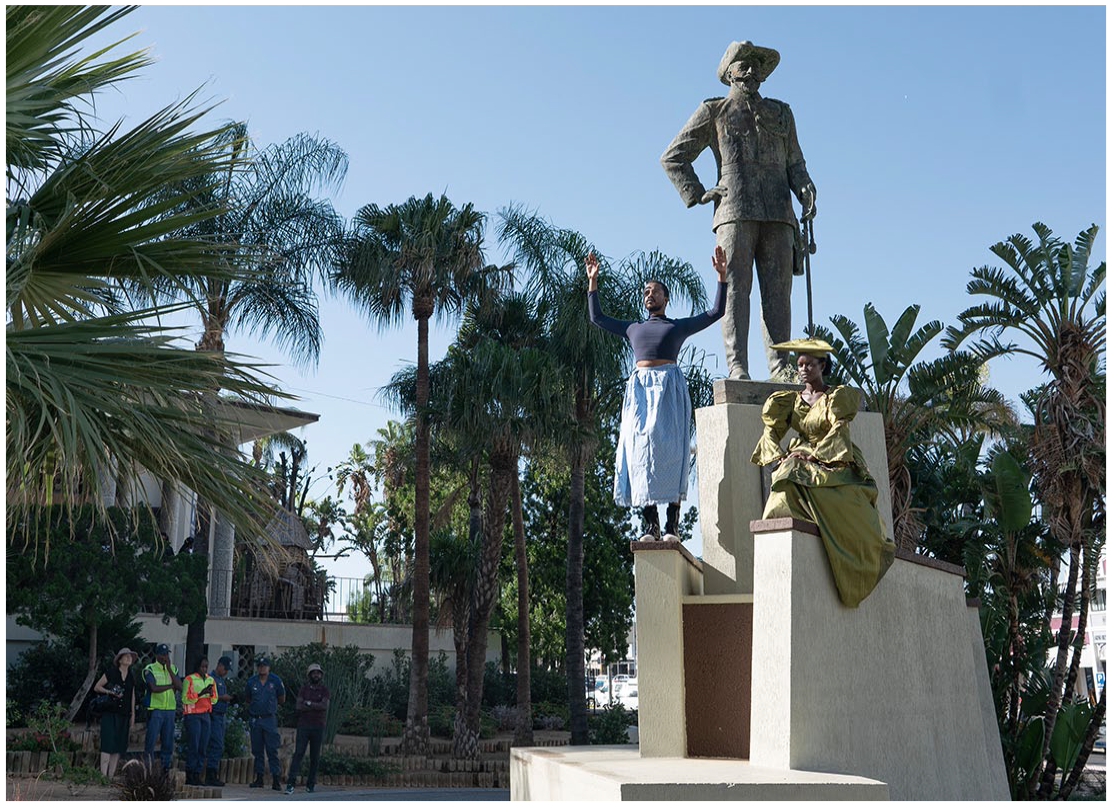
Gift Uzera, Muningandu Hoveka, and Nicola Brandt, Resistance, Windhoek, Namibia, 23 November 2022. Copyright of the artists.
In Herero communities, the act of wearing a dress is a long-held tradition. It is a powerful form of embodied memory that activates different associations in the different contexts in which it is worn. The dress, like the military-style uniforms worn by Herero men at commemorative events, is regarded as traditional Herero attire, with special significance related to the OvaHereros’ connection to the German occupiers. One argument is that the wearing of the dress represents a defiant stand—showing the colonizer that the dress and the military uniform can be appropriated at will (Wilson, 2023). I quote a portion of Peter Katjavivi’s account of the dress: We are told that these striking dresses are derived from the Victorian era and that, in the late nineteenth century, German missionaries were responsible for encouraging the Herero women to wear clothes that were commonly used in Europe at the time. So, Christianized and increasingly urbanized Herero women began to wear long dresses and headdresses. (Katjavivi, n.d.)
According to Wilson (Wilson, 2023), more can be read into the adoption of the dress: “An indigenous group adopting the clothing of a colonizer is often a matter of survival amid cultural, religious, and economic upheavals, but it can also be a strategy for reclaiming power.” The Herero dress does not come without iconographic complexity. It is a vessel of cultural and memory transmission. Furthermore, the fact that predominantly married women are entitled to wear the dress also denotes that respected older women are seen as mediums of specific cultural assets such as social privilege and standing.
To return to the intervention of 23 November: Hoveka says it was the first time that she wore the dress. As someone growing up in the urban center away from traditional homesteads and not entirely fluent in Otjiherero, she felt that, according to customary rules, she was not fully entitled to wear it. And yet, in the act of putting on the dress, she describes how she felt a sense of coming into being and embracing her power and beauty. In this process, both artists were subconsciously questioning cultural markers and at the same time demonstrating respect and awe for their tradition.
As the crowds started to gather at around 9 am at the site of the removal, and as the monument was gradually being disassembled, Hoveka—in one of the sequences—climbed to the top of a free-standing ladder at the same height of the statue’s base. At this point two Herero men—first one and then another—approached us and insisted that she get down from the ladder and take off the dress. They took issue with the way she was wearing it and the situation in which she was wearing it. As an artistic performance and an act of protest, it was clear that the new context in which the dress was worn was quite unusual for some onlookers. (Several journalists came up to Uzera and Muningandu to interview them.) This was especially so in the unfamiliar pairing with a queer performance—tradition alongside radical contemporaneity—which simultaneously accentuated the gendered performativity of the dress.
It soon became apparent that it was not only the pairing of Hoveka’s wearing of the dress with a queer performance that was upsetting to the men who confronted her. It was also the fact that Hoveka, as a young woman, was not conforming to the gendered expectations and tradition associated with the dress. In the recording of the performance, one man is heard saying: You are being unfair to any other Herero-speaking person that is looking at you and how you are wearing it . . . We did speak to you and tell you that how you are representing us is a false representation of us as a nation. [. . .] Anybody else looking at you and the way you are wearing this outfit will feel downgraded, insulted. We plead with you to take it off now. Not later than now. This is nothing to do with freedom and the justices of the world. (Untitled, 2022)
For these men, the wearing of the traditional Herero dress by Hoveka (and, in this instance, her being up on a ladder in the dress), was unacceptable. Particularly alarming was the undertone of violence in their repeated threats to push Hoveka off from the ladder if she did not obey. Unable to complete the performance, she climbed down the ladder. One of the men followed her and continued to hurl accusations.
With the men’s objection to Hoveka “(mis)appropriating” her culture in the name of artistic expression, the multivalent meaning of the traditional dress was once again revealed. For a moment, the incident overshadowed the larger symbolism of the monument’s removal. An Otjiherero-speaking scholar who witnessed the event, said that the men felt threatened by the power Hoveka exuded and seemed to struggle with the presence of a queer person and a white woman collaborating with her; at the same time, she was not respecting the dignity of their culture. They were not able (or willing) to distinguish between lived reality and decolonial imagination in the enactment of this work.
A particularly interesting aspect of the scene was that the two men did not target Uzera. He thinks that it is because his identity falls outside their interest and understanding. As a queer, Black individual he experiences complete erasure in the eyes of certain heteronormative gazes. Hence, at this stage of his artistic activist work, wearing the undergarment is as far as he will go in a public performance. Wearing the entire outfit, including the headdress would certainly aggravate certain onlookers and possibly also make him vulnerable to attacks. Hesitant after the threatening occurrence, Uzera decided to continue without the ladder and instead stood on the adjoining raised terrace of the municipal building and proceeded to do a slow dance as the monument was lifted. To cite Alok Vaid-Menon, the American writer, performance artist, and media personality who performs under the moniker ALOK and who elevates topics concerned with gender politics, race, and trauma: “We are not new, you have naturalized our disappearance, and now we are in these public spaces which we were not allowed to be for decades, and we are showing you what love looks like in public”(ALOK: The Urgent Need for Compassion—The Man Enough Podcast, 2021).
For many activists in this intersectional movement in Namibia, queer identity is regarded as the most decolonial act of being, a freedom to be exactly what one chooses – to break away from fixed identities, which were especially entrenched by colonial ethnographic representation and under apartheid’s racial classifications. As much as Uzera wants to feel free to choose how to express himself and have full bodily autonomy, he also wishes to respect his elders, especially as both he and Hoveka are also seeking an understanding and connection to their own customs and traditions.
For many Namibians, the von François monument had strong associations with the German colonial war and subsequent genocide. These experiences loom especially large “in the memories of Namibians in the south and center today, most of whom have strong relational ties with victims and survivors” (Kössler, 2015a: 179). The removal of the monument in tandem with the performance highlighted different issues. Hoveka, for example, sees her feminist agenda and performance work as being closely allied to trans-rights; for her feminism is not feminism if it is trans-exclusionary. All freedoms are inextricably linked. This sentiment returns to the underlying message of the activist movement, which is to combat structural violence, inequality, sexism, patriarchy, and homophobia, which are seen as a perpetuation of coloniality.
Emerging activists in Namibia see themselves campaigning across a range of intersectional issues, including decolonizing spaces, women’s rights, and LGBTIQ + rights. In the past few years, Namibia has seen a flourishing of diverse civil society organizations, businesses and grassroots activists committed to this work.
3
The organization Equal Namibia’s leading activist Omar Van Reenen describes how these individuals and organizations aim to: provide a safe-space for the community and allies, to gain awareness about sexual orientation and gender identity; to educate communities about important health precautions and their right to healthcare; to celebrate queer art and expression; to create awareness of the continued struggle for civil rights and liberation; to commemorate queer individuals who work to eradicate discrimination and to promote the community’s human rights [. . .] It is about creating visibility for our community and celebrating the need to have pride in our visibility, as visibility is our greatest tool to build and be united in community against homo-bi-transphobia. (Mukaiwa, 2022b)
Namibia’s history of colonialism and apartheid and our own path as young citizens in a post-independent nation are tied up in the symbolism of this work. The performance work speaks directly to the desire to imagine new futures and trans-feminist spaces and to take an explicit stance against ethnicized identity politics. In their letter to the monument, Uzera and Hoveka emphasized that “the act of allyship plays a critical role in offering solidarity and creating a more inclusive environment” (Uzera and Hoveka, 2022). As a Namibian of European descent, I understood my role in this collaboration to be precisely that; an act of allyship and self-reckoning in line with the philosophy at the core of ALOK’s work: “I shouldn’t have to understand you to love you, I want you to be safe and free existing in the world” (ALOK: The Urgent Need for Compassion—The Man Enough Podcast, 2021).
In my wish to create meaningful bonds, Sadhana Bery’s work is perhaps relevant. In her essay “White Empathy: A Technology of White Supremacy,” she draws attention to the limits of white empathy when it comes to understanding or relating to racial and historical injustices, but then she asks: What else can we consider, if we cannot consider empathy? She is haunted by the lines written by James Baldwin: “To encounter oneself is to encounter the other: and this is love. If I know that my soul tremors, I know that yours does too: and, if I can respect this, both of us can live” (Bery, 2022: 129–130).
Baldwin’s words resonated once again in Uzera and Hoveka’s letter to the monument in the early morning hours before it was unbolted and before the two men arrived: “With enduring respect, we are challenging notions of gender, identity etc., and unlearning (self-) policing and censorship to appease the cultural gatekeepers” (Uzera and Hoveka, 2022). In this momentary incident, they gently challenged the gatekeepers, and made a gesture toward acknowledgment and healing—an invocation of restoration and transcultural connection across tribal and gender lines. As Titus expressed to me, “It is not about focusing on trauma, but to heal from it. We are tired of pain” (Brandt, 2020b: 137).
Without Question
In the coastal town of Swakopmund there are hundreds of unmarked graves of Ovaherero, Nama, and San who died in the German colonial war and genocide of 1904 to 1908. In 2020, a memorial stone was placed there, replacing a 2007 monument which blatantly undermined the truth of the history of the genocide by referring to “the mysterious circumstances” in which they died. The new plaque carries a far more explicit message: In honour and loving memory of thousands of Ovaherero and Nama men, women, and children who perished at this sacred site. They died in concentration camps of hunger, slave labor, sexual abuse, disease, fatigue, and adverse weather conditions at the hands of German soldiers.
The Namibia Genocide Association hosts an annual restoration and clean-up at the graveyard, and the activist Laidlaw Peringanda sees this initiative as an exercise in embodied memory work. The ritual of tending to graves covered in sand, stone, and dust honors and pays respect to the deceased. Peringanda also regard the ritual at the cemetery as a place for Namibians of diverse backgrounds—especially a younger generation of Ovaherero and German-speaking Namibians—to meet and converse. According to Becker, [A]lthough most decolonial activists are not ethnically Ovaherero or Nama, they have campaigned for reparations by Germany for the colonial genocide of 1904–1908 [. . .] Justice for the genocide is not just an issue for those identified as descendants of the victims. Instead, it should be seen as Pan-Africanist and, ultimately, as a concern of global humanism. (Becker, 2022)
In a conversation with Peringanda (2022), he speaks of an ancestral duty to continue the fight for recognition. Peringanda explains that “the ancestors will not rest until they have received a respectful burial. Their fight for justice continues in me.” Unlike several younger intersectional activists who try to de-emphasize ethnicized identity politics, Peringanda sees his efforts as an act of protest and critique of the current SWAPO-led government whose majority consists of ethnic Aawambo. As further elaborated by Becker (2022), ethnicized identity politics has characterized much of Namibian memory politics.
Hildegard Titus joined Peringanda and others at one of the cleaning rituals at the Swakopmund graveyard as part of her activist work and to pay respect to the ancestors. In her performance work Without Question, Titus implements her own symbolic ritual of cleaning at the site of the graves and the memorial stone. Her performance straddles both the specific colonial histories of the sites she visits and also a broader intersectional issue related to the experiences of Black women. Titus sees her work as a symbolic gesture “to clean and wash off the blood of our ancestors.” The work underscores the continued “correlation between Namibia’s colonial history and the subjugation of Black women” until the present (Titus, 2021b). From this perspective, a Black woman is at the intersection of oppression; it is from this place that she sees things that others do not necessarily see.
Dressed in a domestic worker’s uniform, she begins her performance by wiping down the memorial plaque (Figure 2). From there, she continues to walk to various colonial monuments and heritage sites in the area that “symbolize German Imperial rule and conquest” (Titus, 2021b). The proximity of Titus’s performance both to the graveyard and the suburban homes where largely white, middle-class Namibians reside and employ domestic help, is pertinent. The performance signifies how one’s body and identity are entangled with place, power relations, and memory. Kimberlé Crenshaw’s groundbreaking scholarship elaborates on how this long history of double-discrimination—on the basis of race and on of sex—has placed Black women’s vulnerabilities and needs at the fringes in societies, as well as often at the peripheries of (white) feminist and Black liberation agendas (Crenshaw, 2018: 29). During 2019, Titus performed the same ritual of cleaning at the Curt von François monument at a busy intersection in Windhoek’s central business district. She remarks on the fact that no member of the public stopped to observe her intervention indicating that it was expected that a Black woman in a domestic worker’s uniform would be cleaning the monument. This seemingly “automatic acceptance” stood in sharp contrast to Hoveka’s performance in the Herero dress at the same monument, where two men threatened her with violence.
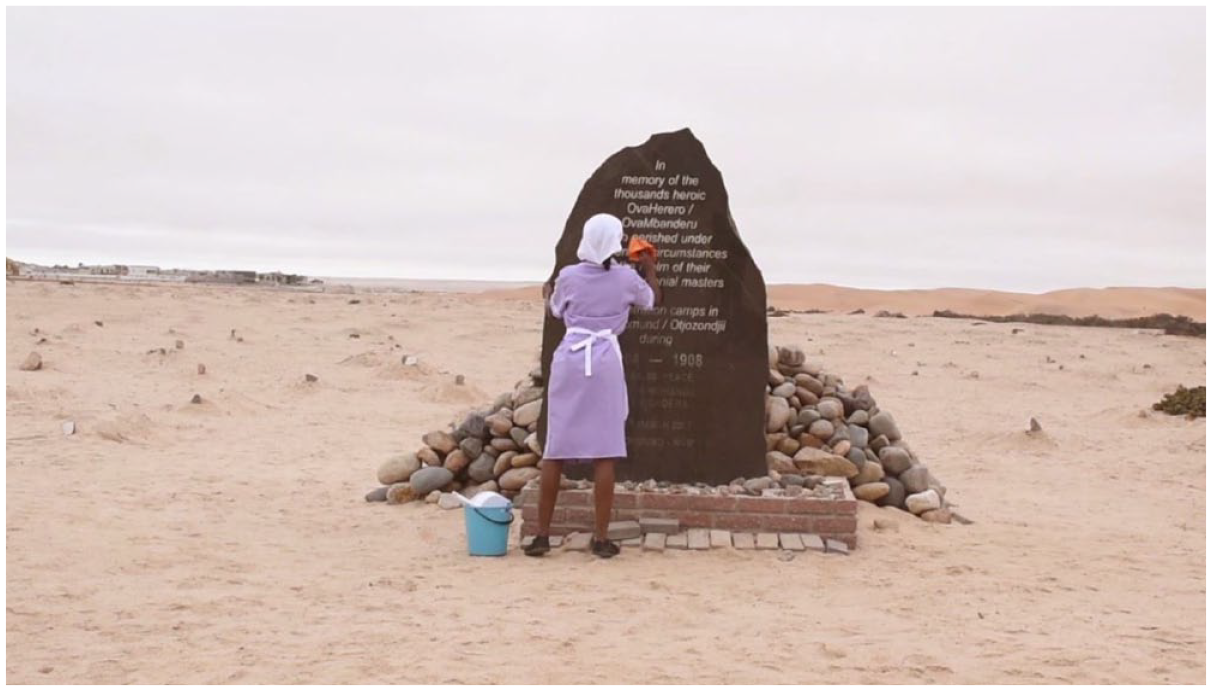
Hildegard Titus, Without Question, Swakopmund, 2019, film still. Copyright of the artist.
Diane Taylor (2003: 86) points out how bodies are “mapped by racialized and gendered practices of individual and collective identity.” In this context, both of the reactions described above, though conflicting, demonstrate that the body can be subject to intersectional violence and disregard. The performance Without Question underscores the invisibility and erasure of certain gendered and laboring bodies, and at the same time it is also a powerful and provocative gesture that speaks out against intersectional violences: sexism, racial oppression, and inequality.
Considering the persistent interplay of legacies of trauma in the present, these artists and activists repeatedly ask what it takes to reckon with the memories and legacies of atrocities and injustices in our daily lives? Titus and fellow activists, in a systematic persistent process, achieved a remarkable feat by getting the City Council of Windhoek to finally remove the colonial monument of von François, a symbol of toxic patriarchy and masculinity. The younger generation of artists and activists no longer wish to have the legacies of colonialism and apartheid placed in the center of their lives but would rather find innovative and healing avenues through which to tell new stories. The removal of Curt was part of a longer journey of psychically reclaiming space and selfhood.
Oudjuu wo makipa etu/The burdens of our bones
The Namibian cross-disciplinary artist Tuli Mekondjo opened her exhibition Oudjuu wo makipa etu / The burdens of our bones in New York in September 2022 with a haunting performance that referenced her travels to the south of Namibia earlier in the year (Figure 3). The exhibition text reads as follows: In Lüderitz, Mekondjo was confronted by the atrocities of forced labor and internment at Shark Island . . . as well as graves of those who lost their lives working on the nascent colonial railway lines. Mekondjo’s sensitive works are an act of remembering—her drawn and embroidered additions evoke spirits and customary burial traditions. [. . .] These works honor those who fought for independence [. . .]. (Hales Gallery, n.d.)

Tuli Mekondjo, Shark Island, 2022. Copyright of the artist.
As an Aawambo woman, Mekondjo’s practice contributes to a broader cross-tribal discourse on restitution and reconciliation. In the position that she took up in front of the memorial on Shark Island to Nama leader Cornelius Fredericks, who was beheaded by German forces in 1904, she drew attention to the struggle and defiance of her fellow Namibians who fought for justice. Shark Island is the notorious place in the south of Namibia where a concentration camp for victims of the Herero and Nama genocide of 1904–1908 by the German occupier, was located.
In her work and in conversation, Mekondjo shows deep empathy and care for the trauma inflicted on the Ovaherero, Nama, and San. As a Black woman born in exile in Angola during the liberation struggle and having lost her mother at a young age, Mekondjo is fully aware of the complexities of intersectionality and does not claim to appropriate or speak for individual or collective experiences. Through her art and performance practices, she attempts to go beyond the boundaries of her immediate experiences to connect with lost ancestors and bring healing. Her approach also evokes James Baldwin’s lines: “To encounter oneself is to encounter the other: this is love.” Baldwin “demands a profound mutuality and reciprocity” (Bery, 2022: 129).
Mekondjo deliberately chooses not to make the dress she wears in her performance culturally specific; she states that she wants to open the conversation beyond fixed cultural and tribal markers. She prefers to activate what “Namibians” share; specifically what Black Namibian women share. “We have all these ancestors within us,” she declares. She hints at the possibility of being able to dream of a common language. She urges the viewers of her work to sense “the trembling souls” of her Namibian brothers and sisters and their ancestors; those who suffered under colonialism, apartheid, and the liberation struggle (Bery, 2022: 130).
Mekondjo seems to be critical of state memorialization that tends to prescribe a didactic, patriotic symbolism. This echoes the wider activist-based skepticism of an “identity-based politics promoted through memory politics and discourses of polycultural nationalism and citizenship” (Becker, 2022). In a way, Mekondjo becomes a counter-monument in her own right. And yet, despite this wish to both hold and go beyond the embodied specificities of identity, Taylor (2003: 86) reminds us that The body in embodied cultural memory is specific, pivotal, and subject to change. [. . .] it is impossible to think about cultural memory and identity as disembodied. The bodies participating in the transmission of knowledge and memory are themselves products of certain taxonomic, disciplinary, and mnemonic systems. Gender impacts how these bodies participate, as does ethnicity.
Even if the decolonial art and activism of artists discussed in this article attempt to transcend this, the above remains true; the intersectional nature of the body is specific and pivotal. Many of the younger generation want to go beyond traditional norms and ethnic markers of their own culture, and yet they also struggle to relate to the idea of “national identity” that at times superficially underscores cross-tribal unification and political agendas that feel remote to their concerns. There is danger in a “politics of widespread inclusion” (Taylor, 2003: 98), which would contribute to the diminishing of a personal culture and sense of belonging. These tensions and contradictions reflect the complexities at the center of emerging “practices of self” and of memory culture. I would like to propose that performance interventions produced by artists at an intensely personal level form an additional outlet for expression that could contribute to the process of healing in a country that faces many challenges. The hope is that these pursuits might help give expression to some of the issues at the heart of the activist movement in Namibia and might inspire a broader and more nuanced individual and civic awareness and involvement.
Footnotes
Funding
The author(s) received no financial support for the research, authorship, and/or publication of this article.
