




Abstract
The Ukrainian Famine of 1932–1933, known as the Holodomor, was denied and covered up by the USSR at the time. Since the late twentieth century, the cultural remembrance of the famine has been marked by a tension between censorship and the disclosure of evidence. Against this backdrop, there has been a drive to retrieve, authenticate and circulate photographs of the famine that draws from the medium’s longstanding associations with veracity. Drawing from scholarship on the memory of famine and on photography of suffering, we analyse photographs from Alexander Wienerberger’s (1891–1955) ‘Innitzer’ album to ask: how are these images remediated in line with different political interpretations and reconstructions of the 1932–1933 famine? This article finds that, through the historicising and affective use of text, sound and visual juxtapositions, Wienerberger’s photographs have been increasingly framed to solicit reactions of belief, understanding and outrage, as they are progressively used as evidence of state violence.
Introduction
In March and April 2022, the Holodomor Museum in Kyiv posted a series of images on Instagram that juxtapose grainy black-and-white photographs with recent pictures of atrocities in Bucha and Mariupol. The images are overlaid with large numbers: ‘1933’ next to the black and white ones and ‘2022’ accompanying those in colour. 1 Both the older and newer photographs are depictions of death and destruction in which the mechanisms behind that suffering are obscured. Figures are bundled in clothes by the side of the road, bodies are strewn on street corners but there are no tanks or soldiers, no perpetrators and no bystanders in sight. Compared with the ‘dramatic pictorial reconstruction’ (Mark-Fitzgerald, 2014: 131) often used to evidence historic and contemporary famines in news and social media, these photographs are relatively static; they do not display graphic violence.
Their potency comes from the text that accompanies them. The descriptions on the posts and the overlaid dates compare Russia’s 2022 full-scale invasion of Ukraine to the Ukrainian Famine of 1932–1933, known as the Holodomor. ‘[T]he very notion of atrocity, of war crime, is associated with the expectation of photographic evidence’ (p. 83), writes Susan Sontag. In this case the associations of evidence, truth and objectivity attached to the medium of photography are dialogic: images of each event reinforce the claims of their counterpart as testimony to the existence of state violence. The Holodomor photos provide a genealogy for the 2022 war and the photos from Bucha and Mariupol suggestively frame the Holodomor as the result of continued militancy carried out by an invading state. In bringing these two events together, so that images of the ongoing war echo those of the historic famine, the Instagram posts gloss over historical details. Present expansionism, on the part of the Russian Federation in the twenty-first century, is presented as a direct ancestor of Stalin’s rule in 1933. The comparative framing of the photographs actualises a claim about the type of violence they depict: longstanding aggression perpetrated by ‘Moscow’.
This is the apotheosis of broader patterns in the cultural afterlives of the Ukrainian Famine. At the time, Soviet denial and censorship prevented widespread awareness of famine, which was largely portrayed as a ‘food shortage’ both within the USSR and abroad. As a result, the cultural remembrance of the Holodomor has been marked by a tension between censorship and disinformation, on the one hand, and the retrieval, disclosure and publicisation of evidence, on the other (Boerman, 2025; Kasianov, 2022; Koziura, 2024; Kudela-Świątek, 2020). 2 Discussions over the death toll (Koziura, 2024: 16), the possibility that the USSR had engineered a famine as punishment for Ukrainian independence (Moore, 2012: 374) and the designation of the famine as a genocide have been fraught. By attesting to the famine as the outcome of political violence, the Museum’s Instagram posts help to amplify this framing of the event in Ukraine and abroad.
In line with suggestions, like Sontag’s, that photography is expected as proof of atrocity, the medium plays a contentious role in the remembrance of the Holodomor (Zhukova, 2019). The denial of the famine included the prohibition of unsanctioned news reports and restrictions on camera use by foreign and local residents alike, with the outcome that there are only around a 100 authenticated images in circulation that show the impact of famine (Babij, 2020a: 5–6). Most available Holodomor photographs are either the work of foreigners, who smuggled their images out of Ukraine, or secret photographs taken by local residents and since found in state files (Babij, 2020a: 7). Photographs by Alexander Wienerberger (1891–1955) have become among the most publicised, including the images featured in the Holodomor Museum’s Instagram posts. The process whereby Wienerberger’s images have been authenticated, explained and circulated can be seen as part and parcel of ‘file fever’ (Verdery, 2013 in Koziura, 2024: 5): a wide-ranging search for documentation that stands at the heart of initiatives to remember the famine.
This article examines the uses of Wienerberger’s photographs as carriers of famine memory, in particular the most widely circulated of his images, that of a child in Kharkiv. We show how these photos have been remediated in relation to framings of the famine as violence and how these framings relate to the conditions of the images’ production. Our analysis moves through the image’s inception, their digitisation in an online directory, their use in recent documentary films and their re-emergence as a comparator to the invasion of Ukraine in the past four years. They appear first as evidence, then as illustration and finally in line with a humanitarian script. With each remediation, Wienerberger’s photos are placed in combination with different media to solicit distinct reactions. The directory renders the images believable, challenging the famine’s denial; the documentaries seek to put them into a historical context, to make viewers understand the conditions under which they were taken; the social media posts build on authentication and demand outrage at a claimed historical continuum between the events of the 1930s and the present day. In defiance of their earlier censorship and despite their divergence from certain tropes of famine photography, discussed below, these images have become legitimised and used as evidence of state violence.
Famine, memory and photography
Like other traumatic events, the discourse around famines often suggests their horror[s] cannot possibly be represented (Kelleher, 1997: 2). Efforts to represent famine are troubled by questions of ‘hierarchies of suffering’ (Ó Gráda, 2009: 90) and ‘grievability’ (Butler, 2009) that render the presentation of a single famine narrative or victim a vexed issue. There is, furthermore, a representational bias against famines which is rooted in their relative lack of spectacle. Functioning as a form of ‘slow violence’ (Nixon, 2013; Parashar and Orjuela, 2021; van Mourik, 2024; van Mourik and Gaynor, 2024), famines tend to be associated with the mundane, at least until their worst stages. Despite their devastating effects they are potentially uncinematic, often drawn out and attritional. Famines resist many of the schemata through which violent pasts are mediated and this resistance to representation is a limiting factor in their remembrance (Orjuela, 2024; Corporaal and de Zwarte 2024).
Traditions and conventions in the photography of famine have been affected by these conditions. Tracing famine photography back to humanitarian efforts in response to the Indian famine of the late nineteenth century, Christina Twomey (2012) paraphrases Sontag, writing that ‘photographic evidence is central to our view of what constitutes atrocity’ (p. 255). Since the birth of the medium in the period that Twomey studies, photographs of famine often adhere to a recurring set of representational tropes based on the Westernised model of the individual victim (Campbell, 2012). The Save the Children Fund’s aid campaign for the Russian famine of 1921–1922 first solidified the visual construction of the ‘hungry, orphaned child’ as the ‘ideal humanitarian subject’ (Baughan, 2022: 43). As Susan D Moeller (1994) points out, in her work on the mediatisation of disaster in the late twentieth century, starving children ‘bring moral clarity to the complex story of a famine’ (p. 98). Embedded in a culture of humanitarian response, photos of famine ‘prompt structures of feeling historically present in audiences, using the somatic form to place viewers in an affective relationship with the subject’ (Campbell, 2012: 88). Like other ‘newsworthy’ (Tuchman, 1980) images, famine photographs must appear striking if they are to gain attention and persist in cultural memory through their circulation. They perform both a documentary and aesthetic function, working at an affective as well as illustrative level, and inculcate the viewer into a relationship with both photographer (usually as witness to suffering) and the photograph’s subjects (as victim of suffering).
The meanings attached to a famine photograph are therefore defined by the medium’s status as ‘a special event that takes place in two modes: in relation to the camera and in relation to the photograph’ (Azoulay, 2015: 23). Exploring a triangulation between distant suffering, humanitarianism and visual representation in famine photography, Fuyuki Kurasawa (2012) argues that the act of viewing images of famine collapses the delineation between events, bringing viewer and subject together to make victims and audience part of the same ‘moral community’ (p. 69). This contention follows intellectual traditions that see ‘the spectacle of hunger’ as a source of affective and somatic power, deranging ‘the distinction between self and other’ (Ellmann, 2013: 54). Within the moral community Kurasawa describes, visual icons perform as actants, altering ‘public discourse and social imaginaries’ (p. 78). Famine photography therefore negotiates a space between emotional response and historical authenticity.
Just as recent humanitarian photography interpellates a viewer who is impelled to act because ‘this is happening now’, the presentation of images of past famines urges the viewer to take note that ‘this happened’. As work on the Irish Famine (1845–1852) shows (Mark-Fitzgerald, 2014), a growing interest in famine photography as a carrier of memory is characteristic of a twenty-first century desire for ‘authentic’ or ‘realistic’ form of documentation; a desire that supersedes a historically contingent approach to the media forms available at a given time. Correspondingly, the collection of famine photographs into digital archives – of the sorts this article draws from – can be framed as responding to a contemporary need to prove the actuality of the events they pertain to. In the case of the Holodomor, a need to prove the famine’s existence intensifies this tendency.
The Holodomor and its afterlives
In 1932 the collectivisation of farms as part of Stalin’s Five Year Plan led to a pan-Soviet famine, that included Soviet Ukraine. 3 Estimates of excess mortality in Soviet Ukraine range from 2.6 to 3.9 million people (Rudnytsky et al., 2020; Vallin et al., 2002; Wolowyna, 2021), the majority of whom died in 1933. The existence of famine was denied by Moscow, by local authorities in the Ukrainian capital of Kharkiv and, from 1934, in Kyiv, as well as by prominent Western journalists. Although information on the famine was shared through networks between those within Soviet Ukraine and their kin abroad, international recognition and condemnation of the famine remained limited.
Despite commemorative initiatives undertaken by Ukrainian diaspora groups in North America, particularly in Canada (Koziura, 2024), any commemoration and discussion of the famine within Ukraine was restricted for many years. No archival documentation of the famine was published in Ukraine until the 1980s (Boriak, 2004: 118): described as a decade of ‘transformation’ in relation to discussion and commemoration of the famine ‘in both scholarly and public forums’ (Moore, 2012: 369). Around this time a designation of the famine as a genocide was spread outside of diasporic circles through the production of documentaries, memorials and the establishment of commemorative rituals and anniversaries. (Although critics note that these initiatives were commonly carried out by members of the Galician Ukrainian diaspora, who had no personal experience of the famine. The diasporic commemoration of the famine, they argue, was a response to the growing memorialisation of the Holocaust in the 1980s and functioned to create a competing narrative of Ukrainian victimhood that obscured the involvement of Ukrainian nationalists in the atrocities of World War II (Himka, 2005; Himka, 2013; Rudling, 2011; Rudling, 2020).) 4
Alongside outright denial of the famine, which framed its commemoration as anti-communist or fascist propaganda and often featured in Soviet sponsored outlets, a critique of ‘Ukrainian victimhood’ as a tactic for obfuscation was furthered by the use of photographs from the 1921–1922 famine to represent the Holodomor. During the 1920s, the authorities allowed photographers and filmmakers into Russia and Ukraine, which led to ‘the largest humanitarian aid campaign in history’ (Kurasawa, 2012: 68) and standardised ‘a genre of humanitarian film and photography for a century to come’ (Baughan, 2022: 44). Photographers would ‘pose their subjects’ (Lana Babij in Canada Institute of Ukrainian Studies, 2021), often scouring the most affected areas for the thinnest child and undressing them in the cold (Baughan, 2022: 41–44). The photographs of this event are undeniably shocking, depicting piles of corpses and skeletal children writhing in pain. Since few photographers were allowed into Ukraine during the 1930s, they could not pose their subjects, photographers had to take photographs ‘on the go’ and could not access the areas most affected by famine. These circumstances made it nearly impossible for them to visually replicate images from the successful 1920s aid campaign. The passing off of photos from the earlier famine as photos of the Holodomor was a practice of disinformation that continued for many years (Himka, 2013; Zhukova, 2019: 4) and helped to undermine claims of the Holodomor’s extent and significance.
After the fall of the Soviet Union and establishment of Ukrainian independence in 1991, the Holodomor soon became a core component of national memory politics. Ukrainian historian Georgii Kasianov (2013) argues that the ‘ideological and mobilising potential of the topic [the Holodomor] was instantly realised’ (p. 167). Depending on their political orientation and ideology, Ukrainian political leaders would either promote an interpretation of the famine as genocide or deny it by subscribing to an interpretation of the famine as part of a pan-Soviet disaster (Kasianov, 2013). During the presidency of the Western-oriented Viktor Yushchenko (2005–2010), the Holodomor was transformed into a ‘symbolic marker for the nation’ (Kasianov, 2013: 177): Yushchenko adopted ‘memory laws’ that made it punishable to deny the genocidal status of the famine. Although academic research at the time indicated a range of 3.5–4.5 million human losses between 1931 and 1934 as a result of the famine, Yushchenko consistently inflated this number to 7–10 million deceased Ukrainians (Kasianov, 2021: 9). 5 Yushchenko also oversaw the construction of the Holodomor Memorial and Museum in Kyiv, with the aim of overcoming regional differences and consolidating ‘the nation as a collective victim of genocide’ (Zhurzhenko, 2014: 231). It is against this politically charged backdrop that Wienerberger’s photos became important to Holodomor remembrance.
Wienerberger’s photos as historical documents
The retrieval and authentication of Wienerberger’s photos, which constitute approximately a third of the 100 or so authenticated photographs of the Ukrainian famine (Vogl, 2015: 269), demonstrates a drive to prove the famine’s existence and scope by historians, often from the Ukrainian diaspora. Wienerberger was not a professional photographer but an Austrian engineer who, by the early 1930s, had worked in the USSR for many years. Taken during the spring and summer of 1933, his photos mostly document the effects of famine in a district of Kharkiv (Vogl, 2015: 268, HREC, n.d-b). Many of these images depict the influx of rural Ukrainians who had come to the city in search of food. Wienerberger, who became increasingly right-wing over the course of his career, had a clear political motive in documenting and publicising the failures of the Soviet regime. 6
With the help of an envoy from the Austrian government, Wienerberger smuggled his photos out of Ukraine and published them anonymously. First in a pamphlet by the ruling Austrian right-wing nationalist party, the Patriotic Front [Vaterländische Front], that sought to convey a negative image of the USSR to working-class Soviet enthusiasts and later in a book by Ewald Ammende, Head of the European Congress on Nationalities, entitled Must Russia Starve? [Muss Russland hungern?] (1935) (Vogl, 2015: 264–265; Kappeler, 2020: 139–140). In 1934, Wienerberger gave an album of twenty-five famine photographs to Theodor Innitzer, the Roman Catholic archbishop of Vienna (Babij, 2020b: 5). The so-called Innitzer album was archived in the Vienna Diocesan Museum with other photos on the same subject (Vogl, 2015: 265) and these photos, including those described at the start of this article, are now a mainstay of representations of the Holodomor.
During the ‘transformations’ to Holodomor remembrance during the 1980s, Wienerberger’s album was ‘rediscovered’ and the photographs began appearing sporadically and without attribution in representations of the famine. These publications included an English translation of Must Russia Starve? and the first feature-length documentary on the famine, Harvest of Despair (Novytsky, 1983), both of which included the photographs alongside specious images of the 1921–1922 famine (Babij, 2024b: 7–8). The images were used as evidence in the World Congress of Free Ukrainians’ International Commission of Inquiry into the 1932–1933 Famine in Ukraine that was set up the following year (HREC, ‘A Note on the Collection: Innitzer Album’): a sign of their growing accreditation. But Wienerberger himself remained a mystery until the late 2010s, when Josef Vogl provided his first biography, Alexander Wienerberger–Fotograf des Holodomor, and Wienerberger’s great-granddaughter Samara Pearce began researching his life, discovering more images of the famine within his oeuvre (Babij, 2024b). Carrying several ‘purpose[s] within [their] frame’ (Butler, 2009: 70), the photographs not only contribute to the remembrance of suffering in the late twentieth and early twenty-first centuries but also to the memory of their clandestine origins, retrieval and authentication.
Of the images in the Innitzer album, the three that appear in the Holodomor Museum’s Instagram posts are among the most prevalent – in particular the image of a child, which is featured in the Innitzer album with the title A Worker’s Child from Kharkiv [Arbeiterkind aus Charkof] (Wienerberger, 1934: 7). Elsewhere, Wienerberger’s captions direct the viewer’s attention to the child’s swollen face as proof of starvation (Wienerberger, 1938: 8): the photograph was instantly framed by its creator as evidence of suffering. Worker’s Child from Kharkiv has a balanced composition, centred on a swaddled child in front of a background of grass, a fence and a large building that is perhaps the factory. The child lifts up their sagging clothes to reveal thin legs with knobbly knees. They wear an expression of discomfort, their eyes looking just below the camera’s lens and brows creased into a frown. Behind them is a scraggly-looking goat; in the foreground, the handle of a basket that they appear to have put down for the photograph to be taken. It is the only image in the Innitzer album in which the subject acknowledges the presence of the camera, albeit with downcast eyes (Figure 1).
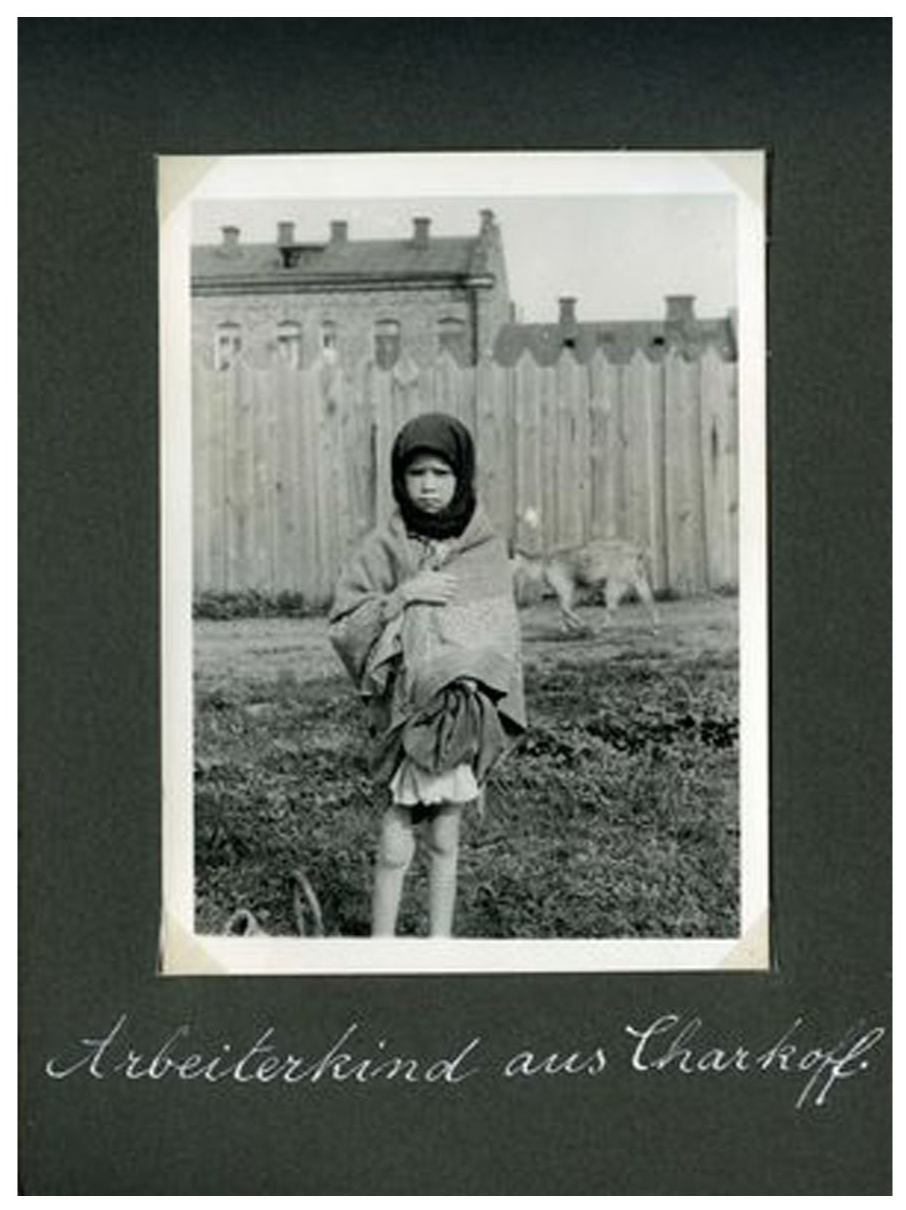
Wienerberger, Alexander. 1933 Arbeiterkind aus Charkoff, in: Die Hungertragödie in Südrussland 1933. Vienna: Diözesanarchiv der Erzdiözese, [1934]: 7. Retrieved from: http://vitacollections.ca/HREC-holodomorphotodirectory/3636365/data. Permission granted by copyright holder.
Appealing to the viewer in this way, in many respects Worker’s Child from Kharkiv fits Campbell’s archetype of the Western individualised famine victim. It adheres to a humanistic tradition of photojournalism that has ‘historically relied on images of the individual (their body and face) in order to signify social issues’ (Campbell, 2012: 87). The discrepancy between the roundness of the child’s bundled body and their emaciated legs repeats tropes from the 1920s famine photos and prefigures the images of children with distended stomachs that have come to define famine photography since the late twentieth century. 7 In the context of the cultural afterlives of the Ukrainian famine, this photograph and its reuse belongs to a representational schemata that emphasises the suffering of innocent children with the aim of emotionally affecting the viewer (Kudela-Świątek, 2020: 62).
Although, within the Innitzer album, this image comes the closest to replicating the tropes of famine photography, it remains distinct from the representations of dramatic suffering anticipated from photographs of extreme hunger. The goat in the background contradicts the misapprehension that there is no food available in famine and the fact that an edited version of the photograph without the goat has been circulated online – including on versions of the Holodomor’s Wikipedia entry (Vogl, 2015: 269) – contributes to a ‘visual fake history’ (Zhukova, 2019: 3) of the famine. This edit (like the use of images from the 1920s in lieu of authenticated Holodomor photographs) indicates a desire to provide evidence of the famine’s horrors and reinforce its reality, while simultaneously fuelling claims of its fabrication. The removal of the goat aims to heighten the dramatic stakes of this image. It is an act that reinforces the extent to which the images in the Innitzer album fail to meet expectations of famine photographs as testimony to extreme suffering.
Following growing interest in Wienerberger’s photographs, the Innitzer album has recently been digitised. In 2021, the Holodomor Research and Education Consortium (HREC) published the ‘HREC Online Holodomor Photo Directory’: an online and open access platform with authenticated and annotated photographs of the Holodomor. 8 The directory grew from its creators’ – Lana Babij, Anastasia Leshchyshyn and Daria Glazkova – recognition that photographs taken during the 1921–1922 famine were often used to depict the Holodomor (Canada Institute of Ukrainian Studies, 2021). Notably the directory contains and identifies many photographs of the 1921–1922 famine, comparatively underscoring the authenticated status of its Holodomor collections. 9 It also lays bare the different visual and affective quality of the earlier photographs, partly as a result of the different conditions under which those photographs were taken. Babij posits that the less dramatic visuality of photographs like Wiengerberger’s forces the viewer to slow down and ‘understand the larger context’ of the 1930s (Canada Institute of Ukrainian Studies, 2021). In line with Sontag’s claim that harrowing photographs are ‘not much help if the task is to make us understand’, but that ‘narratives can make us understand’ (2003:89), Babij explains that ‘it’s not enough to know that a child is in horrific circumstances, I want to know what those circumstances are that create this horror’. 10 Consequently, the photographs in the directory are annotated with bibliographic information on their photographers, metadata and explanatory notes that guide the viewer to recognise these photographs as capturing a segment of a larger atrocity, encompassing both the suffering of the Holodomor and its censorship.
The entry on Worker’s Child from Kharkiv makes a point of acknowledging that the ‘goat probably belongs to a worker’s family, which is thus especially fortunate to have a supply of milk to supplement the very meagre amount of food available via their ration cards or to barter for other necessities’ (HREC, n.d-c). This caption displays the directory’s impression that further information is needed to show the image’s troubling nature. A network of biographical information, multiple scans of sources and details of the photographs’ reproduction have the effect of authenticating Wienerberger’s images within a narrative of the famine’s censorship. Intermediality, in this case, impels the viewer to slow down and consider the larger story at play in all its detail. Through the combination of a discourse of historical truth and an appeal to the viewer’s understanding, the photographs are framed by a broader narrative of Soviet violence and turned into evidence.
Hunger for Truth and Seeds of Hunger: Holodomor photography dramatised
Following their digitisation and authentication, photos from the Innitzer album have been dramatised in a number of documentaries. In two recent films, Hunger for Truth: The Rhea Clyman Story (2018, dir. Andrew Tkach), and Seeds of Hunger: Ukraine 1933 (2022, dir. Guillaume Ribot), the combination of Wienerberger’s photos with text, sound and their positioning in relation to other images imbues them with an immediate affective force. 11 While the directory seeks to generate belief in the Holodomor, these documentaries elicit more emotional understanding of the famine.
Hunger for Truth and Seeds of Hunger tell the stories of foreign journalists Rhea Clyman (1904–1981) and Gareth Jones (1905–1935) respectively, who travelled around Ukraine and wrote and published testimonies of the scenes of starvation they encountered. Clyman was eventually arrested on the charge of reporting false news and deported from the USSR in late 1932. Jones was likewise banned from the USSR and his accounts of the famine in Western newspapers were denied by New York Times journalist Walter Duranty, sealing the wider repudiation of his account. He died at a young age in mysterious circumstances in Mongolia in 1935: a fact that has added a hint of martyrdom to the retelling of his story. Jones more than Clyman has been the subject of numerous commemorative efforts. 12 However, both their stories are increasingly part of a canon of Holodomor remembrance and Wienerberger’s photographs are used in these documentaries to claim the ‘reality’ of Clyman’s and Jones’s testimonies.
Hunger for Truth, which was commissioned by HREC with funding through the Canada–Ukraine Foundation, spends considerable time on Wienerberger’s photographs. The documentary makes use of animation technology to create a multilayered version of the photographs, often overlapping several into a three-dimensional image that the camera can move through. The technology gives the illusion that the viewer themselves is moving along the streets. Combined with a stirring soundtrack, composed of music by contemporary Ukrainian musicians, the effect invites the viewer to become immersed in the Kharkiv of 1933. Unlike the HREC directory, the layering technique does not focus on the historical origins or details of Wienerberger’s photographs but it heightens their drama: the viewer is placed in the scenes they represent rather than outside of them and there is no accompanying text to explain their provenance. Director Andrew Tkach identifies his central dilemma in making the documentary as being how to ‘have an impact and at the same time be 100% factual’. 13 The research process, in which Tkach tracked down the images in the Innitzer archive, attests to the latter concern, while the aesthetic choices indicate the former.
Later in the documentary, Wienerberger’s work is explicitly introduced. Hunger for Truth includes an emotive sequence in which an off-frame hand slowly turns the pages of the Innitzer album. Wienerberger’s handwritten captions, translated into English in the documentary’s subtitles, give these images narrative structure: from ‘One of the first victims’ to the accumulating lists of different places where dead bodies may be found: ‘. . . at the marketplace—’ (Wienerberger, 1934: 12), ‘On the streets—’ (Wienerberger, 1934: 13), ‘Along the avenues—’ (Wienerberger, 1934: 14). As the pages are turned, the music surges to a crescendo; the camera is wobbly, hovering restlessly around the album’s pages. As with the animation technology, the effect is one of dynamism and speed. Tkach posits that documentaries need ‘a rising dramatic structure with a resolution’ in order to make people care about past tragedies. True to this intention, the sequence calls for an emotional reaction of shock or horror or upset. At the same time, the attention given to the material presence of Wienerberger’s album has the effect of insisting on the authenticity of his images and their emergence from a specific historic moment and set of circumstances. The dramatic potential of Wienerberger’s images is actualised by the use of sound and text, alongside technologies and techniques for visualisation. The photographs are used to reinforce the written testimony that Clyman produced for British and Canadian papers.
Seeds of Hunger is less directive in its use of the Innitzer album. The documentary uses most of the photographs in the album but does not extensively reflect upon their origins. Its visual makeup is largely of footage from feature films of the period, making its relationship to historical authenticity ambiguous: the emphasis appears to be on illustration more than evidence. Seeds of Hunger relies on sound to make truth-claims about the famine, using voice actors who read statements from Gareth Jones’s writing and others that testify to the famine’s scale, alongside reports by Soviet officials and articles disputing Jones’s claims. This aural backdrop lends the cinematic footage a set of authenticated historical referents. Around two-thirds of the way into the documentary, a series of Wienerberger’s images appear, standing out from the stylised cinematic footage because of their stillness and the greater physical distance between the photographer and subject. Many of the photos are accompanied by small descriptors, for example, ‘Kharkiv 1933’ (Ribot, 2022: 00:45), which act as verifications of historical ‘fact’. In conjunction with the aesthetic illustrative footage in the documentary, Wienerberger’s photos are used to offer evidence of the actual effects of famine. The viewer’s encounter with images of starving people and cadavers on the street is in stark contrast to the failure of Gareth Jones’s reportage to reach his contemporary publics, to make them see the crisis unfolding in Ukraine and to stir them into action.
The image of the ‘child for Kharkiv’ is used in both films to augment the written testimonies of the journalists whose experiences they portray. In Hunger for Truth this photograph is shown several times in different forms – filmed from the legs up in a slow reveal early on (Tkach, 2018: 00:03) and within Wienerberger’s album (Tkach, 2018: 00:29). When Clyman travels into the areas worst affected by the famine, local peasants tell her that Soviet forces have taken away their produce and that they are starving. ‘I must have looked with disbelief’, an actor reads from her writing in wonder, ‘so a tall gaunt woman started to take the children’s clothes off. She undressed them one by one, prodded their sagging bellies, pointed to their spindly legs to make me understand that this was a real famine’ (our emphasis). As Clyman’s words cover the different parts of the children’s bodies, so the camera moves over the torso and legs of the child in Wienerberger’s image, creating a close correspondence between the narrated and the visualised. Similarly, in Seeds of Hunger the image of the child is overlaid by a voiceover, this time a passage from Jones’s diaries describes the peasants who have come to Kharkiv in search of food: ‘Their pale children cry and hold out their hands as I pass by: ‘Uncle give us bread’’ (Ribot, 2022: 00:44). Alongside these words, the photograph is presented in three framings that move successively closer so that the final shot, as the words ‘give us bread’ are reported, the camera focuses on the child’s face. In both documentaries the combination of image and spoken text re-enacts a past, in which the child on the screen might be one of the starving children that Clyman or Jones describe. With Seeds of Hunger this interactivity goes one step further: providing the child with both a context and a voice. Wienerberger’s image is dramatised by its conjunction with narrative forms of testimony. Conversely, the apparently ‘privileged status as memorial record’ (Mark-Fitzgerald, 2014: 131) of the photographic medium serves to ‘prove’ the journalists’ testimonies. Each of these documentaries takes different ‘strategic’ (Williams, 1993: 13) approaches to historical truth. Seeds of Hunger is palimpsestic: different media build on each other over the course of the documentary, testifying to the depth of the famine’s scale and violence. Hunger for Truth relies on visuality in a way that is expository. The truth, in this documentary, comes from words. For both, however, Wienerberger’s photographs function as attempts to overcome a lack of evidence of the Ukrainian famine.
As Tkach’s statements about his process show, a search for emotional resonance with a contemporary audience is at the heart of Hunger for Truth. Indeed, at the same time as making the documentary for HREC, Tkach produced a longer version that interweaves Clyman’s story with that of a Ukrainian prisoner of war from Russia’s invasion in 2014. Tkach’s longer documentary ‘premediates’ (Erll and Rigney, 2009: 8) more recent mobilisations that use Wienerberger’s images to prove a continuum of Russian state violence that reaches into the twenty-first century. Within these documentaries the photos are framed as dramatic illustrations of the Holodomor’s effects.
Protecting children, then and now: The Innitzer album as humanitarian photography
Several months after sharing the images described in the introduction to this article, the Holodomor Museum in Kyiv posted another such juxtaposition. On 1 June 2022, in honour of the International Day for Protection of Children, the Museum posted a comparison of Wienerberger’s ‘child from Kharkiv’ alongside a photograph of a soldier (presumably Ukrainian) carrying an infant through what appears to be destroyed infrastructure. The Ukrainian national colours – blue and yellow – are used to frame the photographs and highlight the text ‘June 1 – Children’s Protection Day’. The caption of this post uses quotes from an interview with the wife of a Ukrainian soldier who, it explains, spent 65 days in a bomb shelter in the besieged Azovstal steel works in Mariupol with her 6-month-old son. In the interview, she recounts how she was lucky that her infant did not need much food, since her 3- and 5-year-old children were ‘constantly hungry’. The caption gives a more general assessment of the effect of the Russian invasion on Ukrainian children, concluding that: Russia has once again stolen the childhood of Ukrainian children, as it has done many times in the past. As a result of the Holodomor genocide of 1932–33, the communist totalitarian regime killed 4.5 million Ukrainian children . . . We will not forget the tears and suffering of our children. We will not forget and we will not forgive! Remembering makes us stronger.14,15
The text and the juxtaposition of these images, as with previous posts by the Museum, suggest an ongoing echo of the past in current Russian aggression towards Ukraine. This is in line with messaging by other institutions, such as the Ukrainian Institute of National Memory, who following the 2014 annexation of Crimea have spread a ‘new official narrative of Ukraine’s century long fight against the Soviet Empire’ (Zhurzhenko, 2022: 101) that has only solidified since the full-scale invasion in 2022.
The comparison between these two images retroactively casts the historical photograph and the event it is used to represent as the result of state violence. The military presence and destroyed infrastructure clearly point to political, rather than ‘natural’, causes for suffering. Furthermore, the internationally widespread condemnation of Putin’s actions has granted renewed legitimacy to the interpretation of the Holodomor as a genocide, based on politics rather than new scholarship. The role that present-day geopolitics plays in the treatment of the past is clearly visible in the wording used by the European Parliament in a motion recognising the Holodomor as a genocide: ‘current Russian crimes in Ukraine [are] reminiscent of the past’ (European Parliament, 2022). 16
The hypervisibility and recognisability of war in Ukraine as political violence, changes the interpretation of Wienerberger’s photographs, produced during censorship. ‘I inevitably have been looking at photo coverage [of the full-scale invasion] through the lens of the Holodomor photo directory’, says Leshchyshyn, one of the co-creators of the HREC directory. 17 Leshchyshyn compares the many millions of photos coming out of Ukraine in the early twenty-first century with the paltry 100 or so authenticated Holodomor photographs, wondering at the different purposes each corpus might be put to in the future. For her, ‘the positive consequence of this war . . . is that people now take more seriously long-standing Ukrainian claims that they’ve been subject to repressions’. As in the posts of the Holodomor Museum, the famine of the 1930s is fitted within a totalising historical continuum that leads up to the actions of the Russian government in the present day. Wienerberger’s images, now exalted as hard evidence of the effects of famine, are given new emotional resonance through their incorporation within this narrative.
This emotional resonance is strengthened by the reliance of this post on the trope prevalent in famine and humanitarian photography that presents children as a marker of innocence and impartiality and as subjects in need of protection (Campbell, 2012; Kurasawa, 2012). An imperative to protect is underscored through the date of posting (Children’s Protection Day), the caption text (‘We will not forget the tears and suffering of our children’) and the presence of the soldier carrying the infant through a war-ravaged backdrop. The latter element, in particular, changes the dynamics of these photographs. The post seems to posit that, unlike the Holodomor, which can only be commemorated, the war in Ukraine can be stopped and Ukrainian children can be saved. 18 The worker girl from Kharkiv, who looks almost directly into the camera from the past, interpellates an audience who must intervene in the present, as if to put right their past non-intervention. The (masculine) soldier carrying the infant evinces the (potential) success of military intervention and possible protection of Ukrainian children. These images conceive of humanitarian photographs as ‘actants’, framed by a caption calling for a ‘humanitarian’ audience and appealed to as a ‘moral community’ (Kurasawa, 2012: 69) that can take action. The Holodomor Museum’s posts show how, despite their censorship and their divergences from the tropes of famine photography, Wienerberger’s images are actualised as evidence of ongoing violence and a source of outrage in the present that draw from pre-existing scripts on humanitarian response. In turn, the associated impartiality of this humanitarian script is utilised for a divisive and politically charged interpretation of the past.
Conclusion
Alexander Wienerberger’s photos of the 1932–1933 Ukrainian famine now exist within a ‘plurimedial network’ (Erll, 2014) in which they have been mythologised as evidence and, at different moments, have been used to solicit reactions of belief, understanding and outrage. We have studied this plurimedial network across several cases. First, we looked at the furtive origins of Wienerberger’s photographs, tracing their historic background and burgeoning iconicity over the course of the twentieth century in line with broader patterns in the cultural memory of the Holodomor. We saw how HREC’s capacity to authenticate these photographs has enabled filmmakers to integrate the images into stories of journalistic truth-finding that emphasises their status as evidence. This status is highlighted in Tkach’s documentary Hunger for Truth of 2018, which first brought HREC into dialogue with the custodians of the images. Since 2021, the inclusion of the Innitzer album as a central feature of the HREC Photo Directory has facilitated the more affective usage of the photographs in documentary films and social media posts. Ribot’s Seeds of Hunger, produced the year later, intermeshes the photos with feature film footage, in an act that indicates a looser approach to historical specificity than Tkach’s film and a sense that the work of authentication has already been done. In reaction to the 2022 full scale invasion of Ukraine, these images have been further dramatised through visual comparisons and accompanying text, becoming testimony to an ongoing humanitarian crisis and atrocious acts of violence.
In recent comparative studies, famines are conceived as difficult to memorialise due to their slow progression or assumed natural causes. This makes it hard to visualise them generally and even more difficult to visualise them as a form of political violence. Graphic famine photographs of piles of corpses or naked children with distended bellies do not convey complex causes or the notion of a perpetrator. ‘The problem is not that people remember through photographs, but that they remember only the photographs’, writes Sontag (2003), ‘To remember is, more and more, not to recall a story but to call up a picture’ (p. 89). Her work on the transformative power of photography consistently maintains the singularity and stickiness of this medium. Yet for events like the Ukrainian famine, in which a public appetite for images of atrocity runs counter to both the practical difficulties of creating them and the limited material emerging from a censored state, photography depends upon the narrative power of other media. In order to meet the demands made on images to provide evidence of atrocity, Wienerberger’s photographs have become fetishised within their frame, as a defiance of censorship, as well as having ‘broken out’ of their frame to confront the ‘quotidian acceptance’ (Butler, 2009: 11) of war in the present.
As the first study of Holodomor photography in the context of memory studies, this article has confirmed well-established claims that photographic evidence is essential to collective understandings of past atrocities. However, in studying a set of images that are compromised in terms of the conditions of the production and their formal attributes, standing far from the horrific photos that many have come to associate with periods of famine, we have shown the ways in which different media are used interactively to activate photos as images of atrocity. Wienerberger’s images are framed and reframed to create a usable past for those seeking to show the Holodomor as the effect of state violence.
Footnotes
Acknowledgements
The authors thank Colin Sterling for his feedback and the students in the University of Amsterdam’s Cultural Analysis MA programme for their insights on famine photos and memory.
Ethical approval
Ethical approval for the interviews mentioned in this article was provided by Radboud University’s Ethics Committee.
Informed consent
All interviewees completed informed consent statements allowing the use of their words in this article.
Funding
The authors disclosed receipt of the following financial support for the research, authorship and/or publication of this article: Research for this article was undertaken as part of the project Heritages of Hunger: Societal Reflections on Past European Famines in Education, Commemoration and Musealisation (PI Marguérite Corporaal) funded by the Dutch research council NWO, as part of the NWA-ORC programme (NWA 1160.18.197).
Declaration of conflicting interests
The authors declared no potential conflicts of interest with respect to the research, authorship and/or publication of this article.
Data availability statement
This article may be shared in a public data repository.
Notes
Author biographies
 ).
).