




Abstract
Necropolitics have characterised Latin America’s contemporary conflicts and dictatorships. This article draws from 15 in-depth interviews with migrants from post-conflict and dictatorial Latin America (from Guatemala, Colombia, El Salvador, Venezuela, Chile, Argentina, and Uruguay) living in Australia, to explore what happens when memories travel in post-violence contexts. Based on the recollection of fragmented memories of violence and conflict, conceptualised as necronarratives, we narrate how these travel, how these feel in and through the body, and what these do for healing, activism, and survival. Through research that sought to decentre trauma and pain, we also query the role of necronarratives that people choose to remember and retell. In doing so, we contribute to underrepresented mnemonic narratives on Australian-Latin American histories, as well as discussions on non-linear post-violence diasporic memory work, which honours forgetting and remembering from people’s own terms.
Introduction
I remember the feeling that our life has no value . . . For the state, for the government, we were all potential revolutionaries just for being young. That was it . . . And the schools, teachers and professors, they thought there was no value in our life. So, you know, we would drive through red lights, we would ride on top of the trains from one state to the other. Not paying tickets. On the roof of the trains. We would jump off bridges to unknown waters.
Lucia (a pseudonym) migrated from Argentina to Melbourne with her young daughter and partner in the 1980s. In the excerpt above, she narrates how necropolitics felt for young people growing up during Latin America’s contemporary violence due to war, conflicts, and dictatorships. Lucia’s account is set in the context of Argentina’s military junta dictatorship, which lasted between 1976 and 1983 — what the Junta referred to as the ‘Dirty War’. This period entailed the institutionalisation of a cruel and necropolitical apparatus of state terror against its citizens. As Lucia’s account illustrates, living within this violent context shaped her view that ‘life has no value’ – a view that was shared by many participants in this research. Reports suggest that close to 30,000 citizens were forcibly disappeared during the dictatorship, most at risk were students, teachers, journalists, and people involved in labour and human rights movements (Lida et al., 2007). In this article, we engage with the concept of ‘necronarratives’ (Trujillo, 2021) to examine the memories of migrants who travelled to Australia after escaping necropolitical governance in Latin America. As memory scholars, we seek to re-interpret this concept, to demonstrate the embodied, processual, symbolic, mobile, and non-linear aspects of memory as it travels.
We draw from 15 in-depth interviews, 1 with migrants from post-conflict and post-dictatorial Latin America. Laura conducted these in 2021–2022 with people who migrated to Australia, via diverse pathways, due to systemic violence from dictatorships in Venezuela, Chile, Argentina, and Uruguay, and from civil armed conflicts in Guatemala, Colombia, and El Salvador. Based on these, we build on what Ester Trujillo (2021: 76) has conceptualised as necronarratives in her research with second-generation Salvadorans: ‘stories pieced together from memories that are interpreted through a lens of survival, resilience, and healing, and function as a response to U.S. necropolitics and state-sponsored terror’. She notes that the specificity of necronarratives ‘lies in the actuality or in the threat of death, killing, and torture’ (Trujillo, 2021: 77). Drawing on Achille Mbembe (2003), Trujillo (2021: 77) contends that necronarratives reveal ‘the function of the memory narratives as a response to necropolitics, the threat of death as the foundation for governance of a population’. Although Trujillo’s focus is on piecing together necronarratives from family histories, we adopt the characterisation of necronarratives as memory fragments to renarrate how first-generation migrants in Australia reveal necropolitical governmentalities and its affective registers, healing, and survival.
In the next section, we review scholarly literature that engages forced migration, necropolitics, and memory. Then, we briefly explain the methodology, followed by an overview of Latin American post-violence migration to Australia. 2 In the findings, we discuss how necronarratives reveal necropolitical governmentalities and how they feel in the body and in everyday contexts. We further detail how memory and necronarratives travel, highlighting the emotions that accompany them. Finally, based on participants’ recollections of healing, activism, and survival, we explore the potential and limitations of necronarratives in transcending damage-centred, pathologising, and trauma-focused understandings of forced migration and memory.
Memory, forced migration, and necronarratives
Memory scholars such as Julia Creet and Andreas Kitzmann (2011) have pushed the boundaries of the fixity of memory, arguing that migration, rather than location, is the underlying condition of memory. While Creet (2011: 10) recognises the importance of place, she urges researchers to consider the quality of movement that shapes memory, suggesting that ‘memory is always migrating’, and that migration affects how and what we remember. Memory is thus both dynamic and processual; though it takes place in the present, it calls on and modifies the past and productively influences the future (Bal, 1999: vii; Drozdzewski et al., 2016b). This is especially important for understanding migration and memory including forced migration and exile, given that memories shape experiences and encounters in place (Nguyen, 2012; Ratnam and Drozdzewski, 2020), as people choose to remember, retell, and/or forget in the present (Løland, 2020). Importantly, as post-memory scholarship has demonstrated, new generations are shaped by these experiences of the past and present (Hirsch, 2012).
The study of diaspora memory reveals a multiplicity of perspectives and tensions, particularly for post-conflict and traumatic memories (Løland, 2020). Across Latin America, post-conflict memory work has tackled human rights violations during military dictatorships, focusing on testimony, political ideologies, and demands for reparations and justice (Lazzara and Blanco, 2022; Sarlo, 2006). This work has transformed over time to complicate the binary of victim-perpetrator and consider the nuances of political militancy (Lazzara and Blanco, 2022). More recently, memory scholars have addressed the ‘grey areas’ of conflicts, grappling with truth-telling processes, denialist politics, and the ‘impossibility of justice’ (Arias and del Campo, 2009; Rodriguez Castro, 2020). These studies spanning legacies of violence, conflict, forced migration, militarism, and dictatorship provide a rich and complex landscape to examine myriad perspectives, tensions, and narratives of the past.
Focusing on diasporic forced migration, Alejandra Serpente (2015) explores mobile memory landscapes of Chileans and Argentinians in the United Kingdom. Serpente’s (2015:50) work adopts a generational focus, suggesting that the narratives of second-generation Chileans, whose relatives were refugees and political exiles, signal the formation of a ‘wider, mobile diasporic landscape of memory for remembering and mourning the afterlife’. Ester Trujillo’s (2021: 76) research further reveals how second-generation Salvadorans in the United States navigate their families’ fragmented memories as a way to connect to and make sense of their heritage stories. Expanding Trujillo’s (2021) conceptualisation of necronarratives, we explore the implications of necropolitics on the memories of diasporic post-violence migrants. Thinking through a frame of necronarratives emphasises both the necropolitical origins of post-violence memories and the function of those memory narratives (Trujillo, 2021: 77)
Achille Mbembe (2019: 92) describes necropolitics as the capacity of the state to subjugate ‘life to the power of death’. As such, it is a process by which the state expresses its capacity to preserve or take life (Trujillo, 2021: 77). Accounting for more than the ability to ‘make live’ or ‘make die’, however, necropolitics further capture the ways people are exposed to the possibility of death. This includes creating the conditions for death to occur by targeting infrastructure and effectively shutting down life-support systems (Mbembe, 2003:31). Such displays of necropolitics have been discussed in the Latin American context, including the implications of urban violence on individual’s survival capabilities within post-dictatorship Chile (Gutiérrez Muñoz, 2020) and necropolitical governance of right-wing parties and their efforts to separate those who will live from those who will die (Del Rocío Bello Urrego, 2021). Such research highlights the legacies and continuities of necropolitics in Latin America, signalling the significance of exploring how these are felt, remembered, and carried through space and time.
Necronarratives are the stories shaped by fragmented memories of survival under necropolitical governance, including both the threat and actuality of death (Trujillo, 2021: 76). By investigating the journey of necropolitics through necronarratives, we recognise the significant role that the body plays in necropolitical governance: how it is experienced and how it is targeted. Such modes of governance extend beyond the administration of life and death at the population level, permeating everyday life and the micro-scale of the body (Alexander, 2023).
These everyday, corporeal experiences of necropolitics are remembered through and within the body. Indeed, memory studies scholars have revealed the inextricable connection between memory and the body: ‘the ways in which memory is felt, sensed and provokes bodily responses’ (Drozdzewski et al., 2016b: 5; Giese and Keightley, 2024). As Marschall (2018: 8) notes, ‘[m]ultisensory ephemeral stimuli such as smells, sounds, tastes and tactile experiences are equally important in precipitating memories of home among migrants and refugees’. The body may move through sites of memory, and at the same time, ‘the body is also a site’ (Drozdzewski et al., 2016b: 6). The body can also be thought of as a ‘repository of memories’ (Ratnam and Drozdzewski, 2020: 759) or a ‘living memorial’ (Feliu i Samuel-Lajeunesse, 2025: 5) where the past intersects with the present. In reflecting on traumatic memory and the body, Feliu i Samuel-Lajeunesse (2025: 5) explains: ‘a memorial body that participates in a particular economy of affects (of relationships, care and transformation) [. . .] is constituted as a symbolic space of representation that explains a past and a meaningful history’.
It is here that we examine the interplay of post-violence memory, forced migration, necropolitics, and the body. Despite the growing number of Latin Americans in Australia – over 195,350 thousand in 2019 (Kath and Del Río, 2022) – there remains a dearth of research on the memories of Latin American migrants in the country (for notable exceptions see Mason, 2017; Nguyen, 2005). Rather than emerging from composite stories shared by others – as is the case in Trujillo’s (2021) work – the necronarratives shared in this article are the result of fragmented memories unveiled by first-generation migrants. Thus, rather than focusing on intergenerational storytelling, we investigate the interwoven relationship between necropolitics and memory, revealing its functions as it travels. In doing so, we explore how these narratives reveal the emotions, the healing, and the survival of those who carry these memories with them over lands and seas.
Methodology
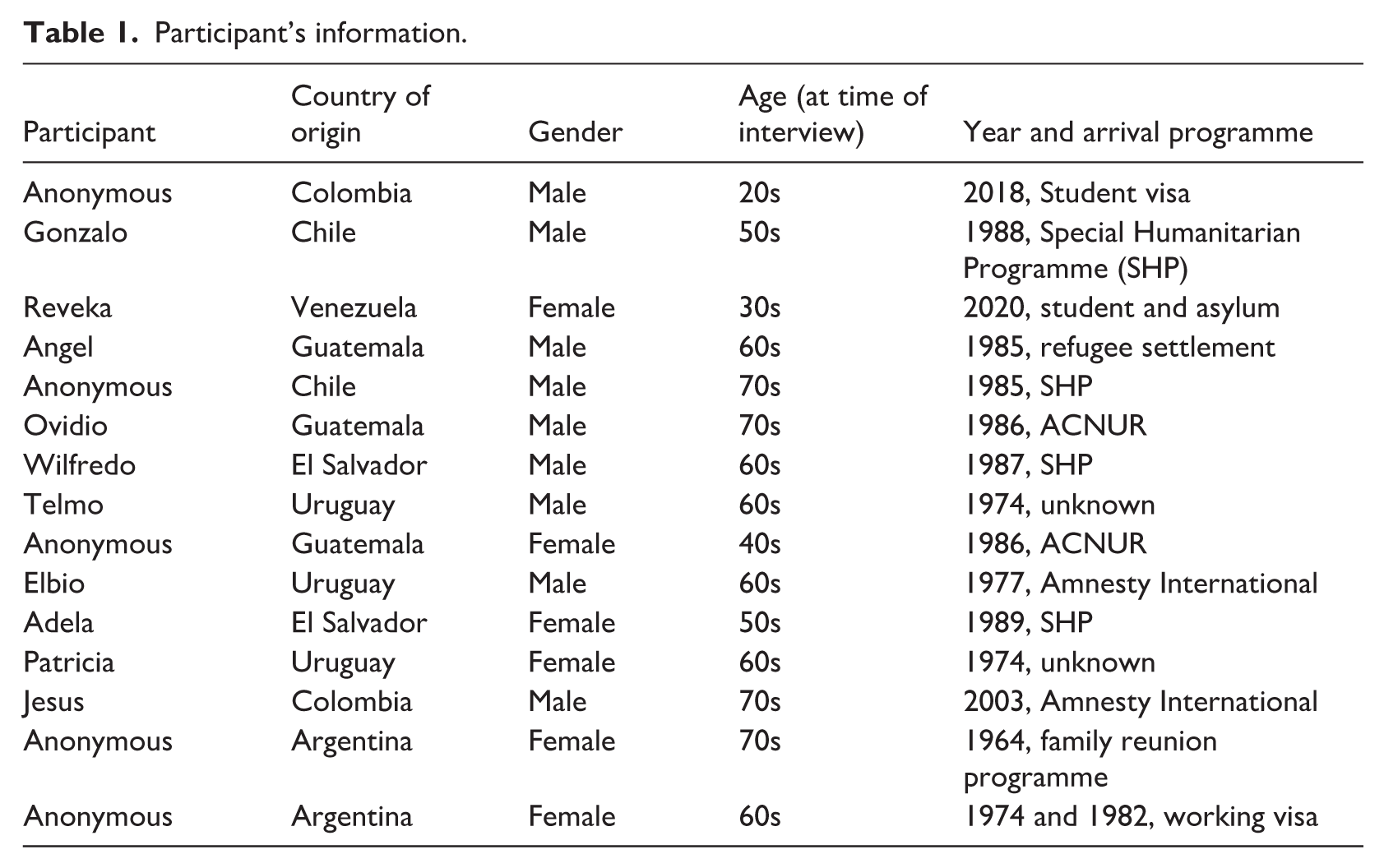
The interviews conducted were contextualised in a larger project of participatory arts research that sought to co-create and share public memories of post-violence Latin American migrants in Australia entitled ‘Fostering South–South dialogues on difficult memories between Australia and Latin America’. All participants spoke Spanish as their first language. 3 Table 1 details their information and diverse migration pathways to Australia. Given the sensitivity of the research dealing with post-violence migration, Laura established and drew from existing relationships with communities of Latin American migrants in Australia before interviewing interested participants. During recruitment, people who personally identified as having migrated due to systemic violence from war, armed conflicts, or dictatorships were interviewed. Self-identification sought to nuance and account for how violence is experienced in a continuum, and for how, in Australia, migration pathways are complex and discriminatory. Importantly, all participants experienced violence due to their families or themselves being involved in teacher and student movements, political opposition, communitarian work, and/or living in conflict-affected areas, which we expand on individually in the discussion of findings.
Participant’s information.
As a Colombian migrant living in Australia over 13 years, and who is actively involved in cultural and activist spaces of the diasporas, Laura was able to communicate in participants’ preferred language and negotiate research relationships. At the same time, research relationships were also mediated through her positionality as a highly educated, bilingual, and middle-class white-mestiza. The analysis of results is also mediated through Bronte’s positionality as a white Australian scholar who has conducted research on the recent military-humanitarian response to Venezuelan migration in Brazil. Thus, our positionalities and interest in post-violence research that privileges the epistemic power of people’s knowledge and experiences, over trauma and damage, have influenced the analysis of results (see Alexander, 2023; Rodriguez Castro et al., 2022).
Importantly, following critiques of epistemic extractivism in memory and conflict studies (Rodriguez Castro, 2023), the necronarratives narrated here were not prompted through a lens of retelling trauma, but rather, emerged through a process of open dialogue in which memory fragments of violence and pain continuously arose in the conversation. These were told in relationality with memories of joy, love, care, and survival. To allow for people to lead and shape the research, the interviews were semi-structured and focused on ‘understanding complexity, contradiction, and the self-determination of lived lives’ (Tuck, 2009: 416).
Interviews lasted between 1 and 2 hours and focused on participants recollecting their life story and the memories that they wanted to share. The interview schedule opened with a broad prompt: ‘Tell me your story . . .’ and then, the dialogue unfolded from there. People were asked to reflect on joy, intergenerational legacies, and their own perspectives of how their stories should be represented. When we analysed these thematically, we found that necronarratives emerged as a recurrent theme. Thus, in this article, we explore how these necronarratives travel, what they reveal, how they feel, and what they do for healing.
Post-violence Latin American migration to Australia
Post-violence Latin American migration to Australia due to civil conflicts and dictatorships dates to the 1960s. Caused by civil wars in Guatemala (1960–1996), El Salvador (1979–1992), and Colombia (1960–2016), right-wing dictatorships in Argentina (1976–1983), Chile (1973–1990), and Uruguay (1973–1985), and the more recent and continuing left-wing authoritarian regime in Venezuela (1999), Australia received at least one significant post-violence generation of Latin American migrants in the 1970s and 1980s. This included humanitarian and family reunion programmes, as well as a more recent programme for refugees from Central and South America. Those who arrived in Australia’s ‘multicultural era’ of the Whitlam government in 1973 also had to navigate the legacies of the difficult histories of the colonial White Australia Policy which, while officially ended, continued to shape racialised migrants’ experiences. Many Latin American migrants and refugees who arrived between the 1960s and 1980s faced racial, linguistic, and workplace discrimination (Carr and Minns, 2014) and experienced down-skilling by working in factories, despite having established professional careers and qualifications from their countries of origin (Latin Stories Australia, 2021).
The initial construction of Australia as a ‘haven’ for refugees in its multicultural era reinforced celebratory, exoticising, and homogenising narratives of ethnic groups who were largely expected to conform to Anglophone Australia (Mason, 2014; Zevallos, 2005). Thus, Latin American migrant and refugee experiences of violence and injustice have mostly been marginalised in Anglophone Australian public spaces (see also Darian-Smith and Hamilton, 2019). Despite a lack of visibility of difficult histories of migration in Australia’s public imaginaries of Latin America, there are long-established memorialisation initiatives and transnational organising of its migrants and refugees (Mason, 2014; Nguyen, 2005; Rojas Lizana and Rojas Lizana, 2022). These processes have allowed people to navigate ongoing transnational injustices, individual and collective trauma, and settlement in Australia. For instance, many left-wing Chilean refugees in the 1980s formed transnational solidarity networks denouncing right-wing state-sanctioned violence and militarisation (Nguyen, 2005). Due to many migrants’ involvement in political and intercultural organising for transnational solidarity with revolutionary movements in Latin America in the 1970s and 1980s, Mason (2014: 554) argues that many ‘Latin American Australians generally occupied a precarious whiteness’ as they challenged state-sanctioned expectations of celebratory multicultural citizenship.
More recent post-violence migration experiences to Australia from countries such as Colombia and Venezuela have received scarce attention. This is despite established literature and interest in a ‘new era’ of highly educated, middle-class, and entrepreneurial Latin American migrants in Australia (Dewey and Fozdar, 2023). However, ‘the reality is much more complex’ (Dewey and Fozdar, 2023: 4502) and many new migrants experience various forms of precarity. Adding to this complexity, our research found that people from this ‘new era’ – some of whom have recently arrived in Australia through student and skilled-work pathways – have also migrated due to systemic violence. Those with asylum and refugee status have accessed smaller Department of Home Affairs programmes or utilised humanitarian organisations advocacy (e.g. Amnesty International) to migrate and/or stay long term in Australia. These migrants have arrived in a context in which Australia has framed forced migration as a ‘security problem’ with shrinking humanitarian programmes and a focus on skilled migration (Darian-Smith and Hamilton, 2019).
Everyday embodied necropolitics
Post-violence memory of necropolitical governance reveals its everyday, mobile, and embodied condition. While often thought of in terms of state governance, the implications of necropolitics seep into and affect all aspects of everyday life. This reveals the normalisation of necropolitical violence and how it travels via diasporic necronarratives entangled with embodied memories of the everyday.
Reveka faced persecution under Venezuela’s Bolivarian regime (1998–ongoing) due to living in a region where political opposition is widespread. Like many people fleeing Venezuela to neighbouring countries as the humanitarian crisis aggravated under President Nicolas Maduro (UNHCR, 2021), she had experienced multiple forced displacements (internal, to Chile, and then to Australia) and was seeking an onshore protection visa in Australia at the time of the interview. Below, Reveka narrates: My sister and I go to the house, we’re having a grill, everything is fine, and suddenly a guy comes in with a gun, pointing it to my head, right in front of me [. . .] And I remember that in the background we were watching the news, and at that moment Maduro was broadcasting on the national network and was talking about the World Day of Peace. So he’s talking there about the World Day of Peace and I’ve got a carajo
4
here with a gun to my head.
Set against a seemingly mundane backdrop of everyday living, Reveka’s memory illustrates the pervasiveness of necropolitical violence. With the TV on in the background and the grill fired up, the threat of death looms and disrupts everyday routines. The ‘memorial body’ (Feliu i Samuel-Lajeunesse, 2025), narrated through the embodied memory of a gun being held to Reveka’s head, represents a past where violence permeated and disrupted mundane life. It illustrates how the normalisation of violence in Latin American contexts feels and seeps into the everyday. While state violence had (and has) different iterations across Latin America, it is regularly normalised through social and cultural landscapes. In Argentina, for example, advertising and television has been used to convince populations of the necessity of state violence for eradicating guerilla violence (Carassai, 2015). While in Colombia’s armed conflict, those who are labelled ‘terrorists’ in media discourse has changed over the years to justify partisan state violence (Palma, 2020).
The pervasiveness of necropolitical violence in everyday life was also evident in Lucia’s childhood, who grew up under Argentina’s dictatorship of the military junta in a lower socioeconomic area. Lucia spent 4 years at an American English School (under a scholarship) and recalls how the building was bombed on three separate occasions: ‘So you know half of the year the school would be closed for renovations [laughs]. So it was part of our lives’. Having left Argentina in 1974, Lucia recalled finding out that her gynaecologist had been jailed for undertaking clandestine abortions. Reflecting on this news, Lucia further signals the embodied and gendered implications of necropolitical violence: ‘It touches every bit of your life, from school to work, to your insides, to your ovulation [. . .] everything it affects you. Everything.’ Lucia’s necronarratives highlight the pervasiveness of the violent re-organisation of everyday life, and how it intersects with gendered violence. As Lucia shares this memory, the excerpt also reveals, the ways in which the body serves as a ‘repository of memories’ (Ratnam and Drozdzewski, 2020: 759) that cannot be separated from everyday life and the affective registers that circulate (Mandolessi et al., 2022).
The necronarratives of everyday violence illustrate how urban embodied mobilities were correspondingly impacted. Reflecting on her childhood in Argentina, Lucia explains her fingerprinted ID card: ‘if you lost it, you were dead [. . .] The police have the power and the army to stop you at any point and ask for this. If you did not have that you’d automatically get locked up’. In Lucia’s telling of the toque de queda, people had to be home by 10 p.m. and were unable to gather in groups of more than four people. Here, necropolitical temporalities further shape the ways in which the body moves and the decisions people make about how to move. As Adela, who studied in the University of El Salvador after relocating from the countryside narrates, I don’t know how to walk in high heels [. . .] because when I lived in my country, my mom used to tell me ‘never wear high heels because we don’t know when we have to run’ . . . There should always be shoes that are easy to run with, because if there are shootings, or someone is chasing you, well, you have to run, I learned that [. . .] And so I learned to always be alert . . . I still do that, even here when I go somewhere I ask ‘where is the exit here in case something happens’ . . .
Adela’s mother was involved in a teacher’s union – organisations prosecuted when the ultra-right took control in the early 1980s in El Savador’s civil war. They fled El Salvador in 1989 through Australia’s humanitarian programme. The embodied memories of everyday fear travel to the present. Anzaldúa (2007: 61) explains that it is a ‘survival tactic’ – pain, or in this case fear, ‘makes us acutely anxious to avoid more of it’.
Indeed, in discussing these embodied memories, gendered implications of necropolitical violence emerge. Adela, noting the constant presence of soldiers around their everyday life, reflects on one experience at home: I remember that one day the soldiers arrived, and we were all there. I had three sisters, all women, my dad was not there, only my mom – five women, and the soldiers started to search and mess everything up. And I remember the soldiers staring at my mom and saying ‘you have very nice daughters’ Oh! Horrible.
The above narratives reveal the targeting of women’s bodies through the militarisation of everyday life. In El Salvador, and other internal armed conflict contexts in Latin America (e.g. Colombia), studies reveal that women’s experiences violence, as well as feminicide, occur both in and out of the home (Zulver, 2016: 171). This highlights the pervasiveness of such violence and its ability to cut through public spheres into the intimate spaces of everyday life. These necronarratives reveal how embodied, gendered manifestations of necropower are embedded within the memories of those who have travelled away. In the Australian context, distance and time have brought critical positionalities of gendered violence from diverse Latin American contexts into dialogue through the sharing of necronarratives and necroresistances. Necropolitics are thus remembered not only in the past, but in the present, individually and collectively, and in relation to possible acts of violence in the future.
By understanding the body as a site that holds and feels memories (Drozdzewski et al., 2016a: 6; Feliu i Samuel-Lajeunesse, 2025), the non-linear movement of these memories emerges via the body. These embodied memories of necropolitical violence shape the present and the future. Telmo, who was part of student and political opposition movements during Uruguay’s dictatorship, narrates how he feels about past experiences of torture when he was 15 years old, and remaining silent despite the suffering in his body: . . . As I have a bullet hole injury from side to side in my right leg, and what [they] wanted was information [. . .] I did not give them anything! So today I sleep peacefully knowing that no one suffered persecution or imprisonment because of me not having said a word . . .
In this case, the wound is a bodily reminder of how Telmo responded when faced with torture. It signals the possibility of healing – both physically and emotionally – and functions as a memory of survival and resistance, for both Telmo and others who escaped persecution.
The narratives shared demonstrate that the everyday, embodied implications of necropolitics are entangled with memories of violence and survival. Amid threats of violence, death, and torture, life continues. Pablo arrived in Australia in 1985 on a humanitarian visa, following prosecution in Chile due to being involved in leftist opposition to Pinochet’s dictatorship – a regime that criminalised, murdered, and prosecuted any form of leftist opposition. He narrates the experience of listening to music with his comrades: ‘you learn to detect how to protect yourself from the security apparatus [. . .] We would listen to Silvio Rodríguez’s 5 music hidden into those large oil drums so that our neighbours wouldn’t hear’. These embodied memories of hiding, of what Rodríguez Madera (2022: 121) calls ‘necroresistance’, signal the quotidian condition of necropolitical violence, and the everyday strategies of survival. Indeed, these memories, alongside Silvio Rodríguez’s music, resonate across the leftist resistance of Latin America’s Southern Cone.
Persecution is an insidious form of necropolitical violence that happens systemically (e.g. for an armed group or authoritarian regimes to take social control) but is also deeply felt in the body as it is forced to move. Most people interviewed described experiencing different levels of persecution given their or their families’ involvement in what was considered a ‘threat’ to authoritarian and violent regimes, which led to various forms of forced displacement. The Guatemalan Civil War (1960–1996) was a 36-year-long conflict that involved persecution, extra-judicial executions, abductions, torture, mutilations, and large-scale massacres of Mayan and rural populations (Ball et al., 1999). Ángel grew up in the western regions of Guatemala, where the conflict was more severe. When he was 15 years old, he experienced persecution for being politically active in student-led movements: . . . So, I always tell my children that one of the experiences that I had, already being very young, was occupying and promoting strikes in other cities, institutes or schools in San Marcos. And this led me to have to flee to the border with Mexico because the police were chasing us. So that was one of the first experiences I had in feeling the vulnerability of saying: ‘well, I feel that I have the capacity to do things’, but at the same time you realise that you are already facing a system that is controlled by police . . . There comes a time when you start feeling vulnerable because you think about your mortality and not so much about the immortality you felt . . .
Ángel’s necronarrative illustrates how, at 15 years old, the possibility of death became more likely than that of living. This is one of the ways that people feel necropolitics, as vulnerability, as they target the body through policing and governance. In July 1982, following the coup of Ríos Montt, his brother was disappeared, and a month later, Ángel fled Guatemala to Mexico. From here, he travelled to Australia in 1985 and arrived via a refugee resettlement programme.
Importantly, the normalisation of violence has shaped the memories of those who have migrated to Australia. Andres (pseudonym) left the violence of the Colombian armed conflict (1960–2016) after many years of family persecution due to his father’s political activism. He shares, I don’t know if it is a point of lack of sensitivity or that it is because we are so exposed to this phenomenon of violence, of knowing that there is a dead person, he is lying there in the street, you have to see him, because you pass by there to your home, for work, for whatever reason, and people there are just, ‘Oh, yes, one more dead’.
This normalisation of violence, as it occurs in people’s everyday lives, is demonstrative of symbolic violence that appears to normalise ‘death’, given the many years living under necropolitical regimes. The following section explores how the embodied memories of everyday, normalised violence, death, and torture travel in and through the body.
When necronarratives travel
The journey from Latin America to Australia is temporally and spatially long. Ovidio, who fled the Guatemalan civil war with his family in 1986 following internal displacement due to political activism and persecution, recalled a conversation with fellow exiles who left to other Latin American and European countries: ‘. . . for the compas [comrades] that are in Australia, the bombings were so intense that they ended up all the way [in] Australia . . . at the very tip [of the world]’. Memories of travelling necronarratives often blurred and challenged linear conceptions of time and bounded space, as memory fragments travelled connecting close and faraway places. In this section, we explore how the body becomes more than just a ‘repository of memories’ (Ratnam and Drozdzewski, 2020: 759) in which necronarratives travel. We narrate how they move, feel, and what they do, demonstrating how movement shapes memory processes (Creet, 2010).
Adela, who settled in Queensland, narrates the feeling of leaving her home country: And I remember that we were on our way to the airport, and I could see the beautiful mountains and everything green, and I saw the coffee plantations because coffee and sugarcane are principal exports of El Salvador. I remember seeing the sugarcane plantations, which are exactly the same in North Queensland . . . And I began to say goodbye. And I thought, perhaps this will be the last landscape that I’ll see of my country . . . And I remember looking through the window as the airplane was getting further away, and I saw the mountains and the green, the farms . . . then the ocean . . . and I felt a horrible sensation in my stomach, not pain, but an emptiness . . . and I was sad, and angry, I felt very angry, thinking because of this war we have to leave . . . I felt something like fear of the future, wondering what would await me on the other side of the world . . .
Memories that travel are embedded in the body and are elicited by everyday landscapes, such as the sugar cane plantations of El Salvador and North Queensland. Adela narrates how the necropolitics of war feel in the body – ‘horrible’ and like an emptiness. Importantly, this demonstrates necronarratives, like memory, do not necessarily have a material or spatial register. Instead, these can be liminal, borderless, and affective, revealing movement and flux.
Our research found that necronarratives also travel through generations as memory fragments are remembered and shared as lessons, feelings, or interactions with parents (Hirsch, 2012; Nguyen, 2012; Trujillo, 2021). Patricia, who fled Uruguay’s military dictatorship to Australia with her family due to their involvement in political opposition in 1974, illustrates how being forced to migrate as a youth feels: I resented having to migrate, but beyond that I understood the reasons. My father always told us, ‘I prefer to be . . . a coward who is alive than a martyr who is dead’ . . . So I was aware that there weren’t options, we had to leave, but it took a toll on me.
Patricia’s memory of this lesson from her father demonstrates the function of memory and necronarratives to explain the reasons for migration to younger generations in the family. It also points to how necropolitics feel, as the power of death is imminent and everyday (Mbembe, 2003). Claudia (pseudonym) is originally from Guatemala, but only spent her childhood there during the war, before her family migrated to Mexico due to political persecution. Following this, Claudia and her family travelled to Australia through a UNHCR programme in 1986. Below, she explains how necropolitics felt as a child: . . . Well apart from that too, one of the memories I think stays more in the mind, as a person, as a boy, as a girl is the fear with which you live, that constant fear that something might happen . . . Even if one does not understand perfectly what an armed conflict is or what is the state of violence in which the country lives, one does not understand exactly why, but one lives in that . . .
This feeling of fear experienced during forced displacement and persecution resonated across many necronarratives shared with us. Although Claudia and Patricia could not fully comprehend the necroscape in which their childhood was embedded, how it was targeted and felt in the body were clear in their memory.
Fear and emptiness were not the only affective registers in the memories that people shared. In the ambivalence of living in contexts of violence (Krystalli and Schulz, 2022; Rodriguez Castro, 2023), and particularly while ‘travelling’ due to exile and persecution, memories of care and love were also shared. For Reveka from Venezuela, travelling during her childhood felt fun: The way I remember it, it was because we wanted to travel, and I’d like to keep it that way. In other words, I want to keep thinking that it was because we wanted distraction, fun, travel, the beach, the family, but I am uncertain if what my parents tried to do was . . . like the film Life is Beautiful.
Reveka’s parents attempted to create an environment of fun, love, and care, as in the movie Life is Beautiful, based on the Nazi violence of World War II. They did this to protect their children from the necropolitical context of everyday life. This demonstrates how fun, love, and care accompany the movement of memory and necronarratives. That is because these affective experiences are also part of post-traumatic memory and in the (re)making of worlds in the wake of violence (Krystalli and Schulz, 2022; Rodriguez Castro, 2023).
Nevertheless, the fear of institutions engaged with necropolitical governance, such as the police and military, also travel through the body intergenerationally. Lucia’s necronarrative of her daughter fearing the police and military in Australia illustrates this: To give you an idea of the trauma. [Daughter] was two and the first few months . . . We put her straight away in a playgroup and we had to go through Toorak Junction [in Melbourne], which was difficult, and there was this lovely police man who came and helped us across the street in the morning. [Daughter] would not stop screaming whenever she saw a uniform and she did that for about three years. Any uniform, she would start screaming, non-stop, total panic attack. And I had to tell the policeman look, it is not you it is a ‘cultural difference’ [laughs]. That’s the way that they taught us in Argentina . . .
Intergenerational trauma and post-memory has been largely discussed in literature of forced migration and memory (Hirsch, 2012; Nguyen, 2012). Lucia’s necronarrative demonstrates how fear of necropolitical institutions and authoritarianism, such as the police and the army in the Southern Cone dictatorships, travels through the body and through generations. It connects the past with the present (Hirsch, 2012). Lucia shared this experience, discussing how the major ‘cultural differences’, as she labelled jokingly, played out in the early years living in ‘multicultural’ Australia.
To finish this section, we also want to acknowledge that silence and forgetting play a role in travelling necronarratives. They serve the purpose of taking care of one’s body from the physical and emotional toll of necropolitical violence, to avoid re-traumatisation and for caring for new generations (see Hirsch, 2012; Løland, 2020; Nguyen, 2012; Trujillo, 2021). Some participants noted that they chose to completely forget about the traumatic experiences and that they did not find value in resharing these. Others explained that the transformation of necropolitical trauma and memories was only possible after many years of processing what had happened, and that they were ready to share. Thus, as memory moves and necronarratives travel through time and space, they are shared unevenly, rupturing the silence only when it is necessary (Trujillo, 2021). In the next section, we query in more depth the purpose and contexts in which people choose to share necronarratives.
On sharing necronarratives for healing, activism, and resistance
In undertaking this research, we sought to decentre trauma-focused and pathologising frameworks and methodologies in memory and conflict studies (Krystalli and Schulz, 2022; Rodriguez Castro, 2023). As Tuck (2009) explains, damage-centred frameworks that focus on documenting harms to achieve ‘reparation’ end up constructing minoritised people through narratives that claim ‘they are broken’ (Tuck and Wayne Yang, 2014: 4). These frameworks are often used in necropolitical contexts in which social, material, and political change and/or justice are never fully realised. In this section, we demonstrate how necronarratives account for the relationality of pain, healing, and survival. In this respect, Trujillo (2021:78) explains that the ‘necronarrative model shapes fragments of historical memory into stories with a beginning, middle, and end. The beginning is the threat of death; the middle is flight from violence; and the end is survival’. However, as we have argued in re-interpreting ‘necronarratives’, these travel and are shared in less linear and fixed timescapes, where symbolic spaces, silence, and new geographies in the present shape how memories are remembered, shared, and used. Considering this, we focus on how pain and suffering also occur in relationality with active practices of healing and activism.
Latin American migrants in Australia have contributed greatly to arts and community sectors, and many have been involved in political organising, especially involving transnational solidarity (see Nuestras Voces Latin Stories Australia, 2021; Mason, 2014). This was also manifest in the interviews, as all participants were either politically active (e.g. via transnational activist organisations) or involved in the arts or community sector (e.g. via education, social work). Having a political or communitarian purpose was often shared in relation to why people chose to share their necronarratives. Below, Telmo shares a memory of living in poverty in Uruguay and the reason for sharing these publicly today in Australian politics: When my father experienced unemployment in Uruguay after working in the National Navy . . . he taught my brother and I to weave fishnets when we were like ten, nine, eleven years old . . . And when we were lucky we would catch a corvina
6
. . . and that is how as my father tried to earn a living, we defended our puchero
7
every day. Why am I telling you this? Because these are the things that defined me, the reason why I became a student and syndical militant.
Telmo further shared that transforming difficult memories into political discourse was important to cope with the guilt that comes with being of ‘the generation that survived’, when many did not. He explained: ‘so that the new generations do not forget, because what we do not tell, what we do not write . . . the truth that we do not tell runs the risk of . . . being left in oblivion’.
Those who were involved in transnational solidarity movements also explain how surviving necropolitical contexts inspired them to continue to be involved in different forms of activism: Ovidio from Guatemala (ASLA solidarity movement): . . . The solidarity is one thing that no one will ever take from you, because it is part of what our pueblos
8
demand and we must maintain that. Jesus from Colombia (Lasnet solidarity network): For me, learning about the problems in Argentina, on top of all Chile’s problems . . . has certainly been a transcendental form of education . . . So, this work with Latin Americans but also with Australians that participate and meet with us, shapes you, it makes you bigger each time, that’s for sure. And for me, it gives me more of a reason about the fact that I’ve risked my life, but that what I have done was really worth it.
Thus, as necronarratives travel in the movement of memory, so do forms of resistance, knowledge, and survival. These get entangled in new places, in connection with other people and in histories. For Jesus, a human rights defender from Colombia who cannot return due to threats to his life, finding and creating transnational solidarities has given him a purpose to live on. As the excerpts above reveal, cross-country solidarities among Latin Americans have become imperative for many who forcibly migrated to Australia. Reveka from Venezuela, who was involved in creative writing and cooking in community spaces for migrants, also reflects on the importance of artistic expression: ‘creating spaces for migrants to get all of those emotions out and to process all of that emotional movement that comes with migration . . .’.
As necronarratives travel, they are also transformed into present-day coping mechanisms in migrants’ new homes. For instance, violent memory fragments of forced displacement and persecution were shared alongside coping with distress in the present. Ángel narrated the very intense years of the war in the early 1980s, when he was a secondary school student in Guatemala City. He connected the death of his brother with coping with persecution as helpful to survive and deal with his mental health in the present: . . . You tell yourself: ‘How come those things happened to me that I was persecuted and everything, sought and everything, but nothing ever happened to me’. So, by 1981, I spent about six weeks secretly [hiding] in Guatemala because I tried to clean myself up, right? . . . And this was curious because I have sometimes thought that this was my experience to be able to survive the lockdown that we have had here in Melbourne.
Thus, the past and the present meet in the retelling of necronarratives (Ratnam and Drozdzewski, 2020). While necronarratives travel, so does ‘necroresistance’ – strategies of survival and endurance (Rodríguez Madera, 2022). These manifest through the feelings and tools for coping with distress.
Importantly, these necronarratives were not only about survival, resistance, and activism. They were also about having a dignified life where necropolitics were not infused in the body and the everyday, saturating all aspects of life. Andres (pseudonym), who left the violence of the Colombian armed conflict and arrived in 2018, shares how living a dignified life felt in place in his new home in Queensland, Australia: It is a place where I am surrounded by nature, the community where I live is absolutely beautiful, calm and for the first time in my life I’ve experienced peace. I have felt as though I am living, that I am no longer in that survival mode, where you are being pursued and they can grab you at any moment . . . instead for the first time I feel completely calm, free.
Thus, there is more to survival than recounting fear and violence. Feelings of peace, ease, love, and joy were central to living beyond necropolitical contexts. Indeed, these feelings and embodied experiences are often neglected when we do memory work about violence (Krystalli and Schulz, 2022; Rodriguez Castro, 2023).
Conclusion
In this article, we sought to explore how necropolitical memory fragments – as necronarratives – function, feel, and travel in the context of forced migration due to Latin America’s contemporary violent regimes. We sought to demonstrate how a re-interpretation of the concept of necronarratives (Trujillo, 2021) contributes to understandings of the movement and embodiment of memory (Creet, 2010) as it travels. It reveals how trans-regional iterations of violence in Latin America travelled across countries (e.g. persecution) in specific ways that are embodied, situated, and context specific. In the movement of memory and the necronarratives shared, the body becomes more than a repository of memories (Drozdzewski et al., 2016b), of physical and spiritual wounds. Thus, it is also a site to process, feel, silence, or retell memories that have a function in the present and future.
At the same time, we remain highly reflective of the dangers of prompting or focusing solely on necronarratives, as this can lead to extractive memory work, research, and forms of re-traumatisation and victimisation. In this research, we sought to purposefully move away from damage-centred frameworks, through open dialogues in which participants were not directly prompted to share traumatic memories and were asked about how they wanted their stories represented and retold. In the process, we found that there is still a space and need for some difficult and painful memories about violence to be shared. As Trujillo (2021:78) highlights, ‘[v]iolence is not a marginal experience – it shapes the narrative’. Thus, we also honour and respect people’s right to forget or refuse to recount necronarratives.
Our focus on how necronarratives travel reveals relational and less fixed timescapes in which memories circulate and are recounted. Many of the necronarratives shared had the purpose of healing oneself and subsequent generations, of enacting activism and resistance, and of helping others overcome trauma. As necronarratives travel through time and space and in and through the body, these get entangled in new places, and in connection to new histories and relationships that allow people to survive, face new forms of violence, and/or live a dignified life where necropolitics do not govern everyday life. We highlight various forms of living a dignified life, including finding peace in Australian suburban living, healing and finding belonging through sharing with other Latin American and Global South refugees and migrants, and finding strength in the necroresistances of dealing with violent state apparatuses that once were the only form of survival. Documenting Latin American-Australian histories and exploring how memory processes occur continue to be critical, particularly if we are to examine the ongoing implications of violent, necropolitical governance for those who, to this day, forcibly migrate from Latin America and other violent regimes.
Footnotes
Acknowledgements
Special thanks to Latin Stories, Lasnet, Asla, Yo Soy Collective, and the Latin American communities in Australia that gave us access and trust with undertaking this careful and important work.

Ethical considerations
This research was approved by the Human Research Ethics Committee at Deakin University, Melbourne 2021-175.
Informed consent statement
Through the written informed consent process of the research, individual participants chose the level of identifiability. Thus, some stories are presented anonymously, and a pseudonym used, while some include participant’s real first names.
Funding
The authors disclosed receipt of the following financial support for the research, authorship, and/or publication of this article: We would like to thank the people who generously participated and shared their story. Thanks to the Alfred Deakin Institute for Citizenship and Globalisation for funding this Project.
Declaration of conflicting interests
The authors declared no potential conflicts of interest with respect to the research, authorship, and/or publication of this article.