



Abstract

Visual and tactile distractions can contribute significantly to procedure failure, just like driving a car with phone in hand; hence, the options of ‘hands-free’ driving came into use, allowing one to use both hands in order to avoid errors and improve safety.
From personal experience, I have encountered a similar experience while attempting to gain vascular access using ultrasound guidance. Difficult situations can arise such as the gel-smeared ultrasound probe and sterile cover repeatedly slipping, resulting in loss of the ultrasound image. Sometimes, more effort is involved in holding the probe in the correct position than in hitting the desired vessel with the needle. In circumstances such as these, it can be invaluable to have an additional hand to assist with the procedure.
To solve the above issue, I have successfully applied a ‘hands-free’ technique to ultrasound-guided vascular access in order to make the ultrasound probe stay in the desired position (Figure 1); I write to share this technique with fellow readers.
Photograph showing the ‘swan-neck’ holder being used to maintain the ultrasound probe position in order to allow a ‘hands free’ technique for vascular access.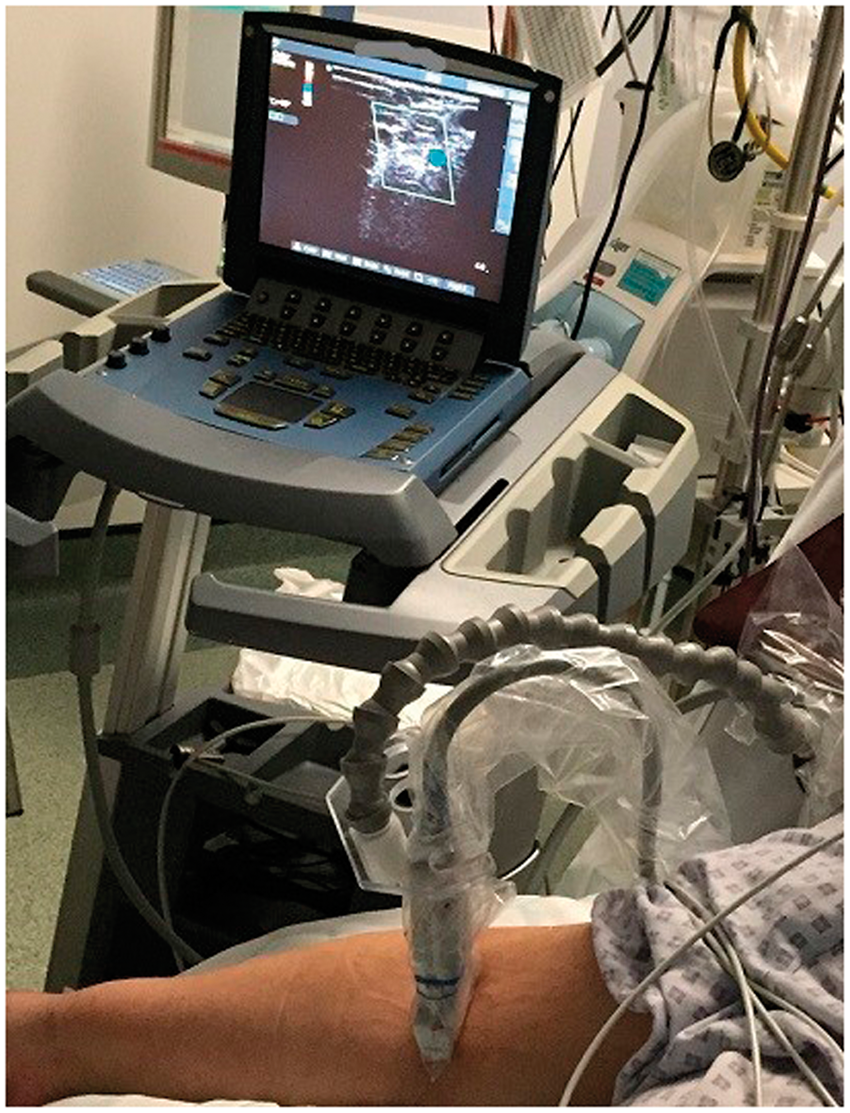
Using the ventilator circuit tubing holder (Figure 2), which is found in most intensive care units and operating theatres, the ultrasound probe and sterile cover can be maintained in the desired position in a hands-free manner. As an alternative, any ‘swan neck’ type of instrument holder can be used allowing three-dimensional manoeuvrability to keep the desired vessel in view, and thus allowing the operator to use both hands. This can allow better focus on the procedure and vessel, leading to higher chances of success.
Hands-free’ technique – a close-up view.
I have applied this technique successfully to insert central venous and peripheral lines (including arterial cannulations). I hope my fellow anaesthetists and intensivists will find this technique useful, and would welcome their feedback
Footnotes
Consent
Patient consent given for the photographs to be published and documented in notes.