



Abstract
Introduction
In 2021, the steering committee members of British Society of Haematology Obstetric Haematology Special Interest Group noted difficulties in opening research studies. This led to the development of a survey to further evaluate this issue.
Method
An electronic survey was distributed to all members of the British Society of Haematology Obstetric Haematology Special Interest Group and to relevant specialty leads of the National Institute for Health and Care Research Clinical Research Network for further dissemination within these networks.
Results
Responses were received from 65 participants (73% consultant grade); mainly haematologists (52%) or obstetricians (39%). Less than a third of participants reported dedicated time for research in their job plan, with only five participants reporting no challenges in opening research studies in obstetric haematology.
Discussion
The survey confirmed significant interest in obstetric haematology research, with barriers to participation. We propose further actions to facilitate increased research.
Background
Obstetric haematology covers a vast and complex array of haematological conditions and yet there is relatively little evidence available to guide patient management. A national Obstetric Haematology Special Interest Group was founded in 2001 by Sue Pavord and Beverley Hunt, 1 becoming the British Society for Haematology Obstetric Haematology Special Interest Group in 2016. In 2020, a steering committee was established to broaden the group's research scope and strengthen the educational programme with greater inter-disciplinary involvement. Members of the steering committee reported significant difficulties in setting up and/or participating in existing international registries, and recruitment to the few studies open. A survey of the wider obstetric haematology community was developed to establish the national experience in the United Kingdom.
Methods
An electronic survey (see supplementary materials) was developed. The survey was launched in April 2022, and disseminated by email to all British Society of Haematology Obstetric Haematology Special Interest Group members, advertised within the British Society of Haematology annual meeting and disseminated via the National Institute for Health and Care Research Clinical Research Network to haematology, obstetric and anaesthesia specialty leads (with a request to further share).
Results
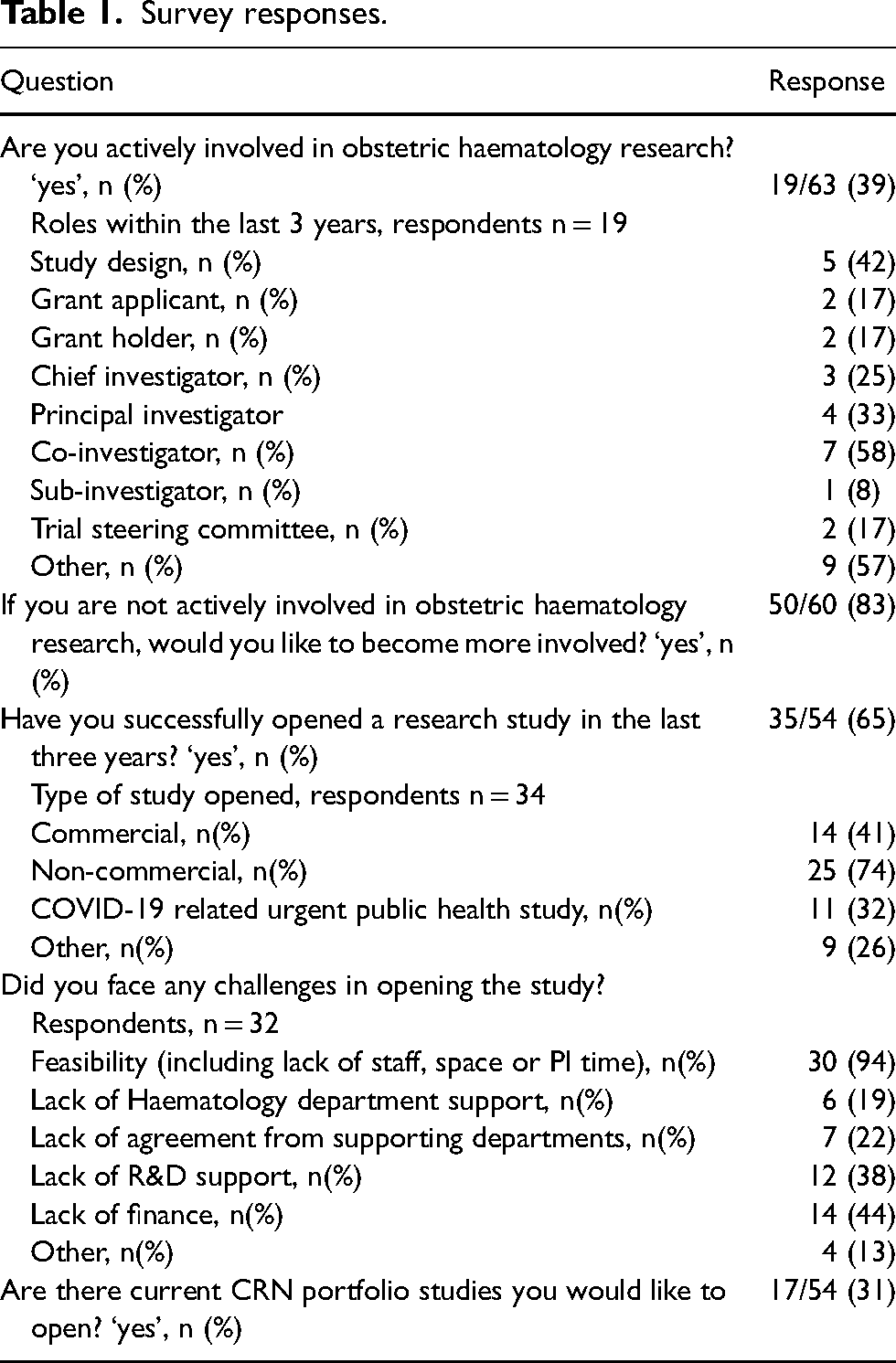
Responses were received from 65 participants (73% consultant grade) and are summarised in Table 1. The majority of respondents were either haematologists (52%) or obstetricians (39%), with approaching a third of participants having dedicated time for research in their job plan (n = 17, 30%). Only five (14.2% of 35 participants who had recently opened a study) reported no challenges in doing so. There was significant interest in specific studies, for example, 60% (31/52 respondents) expressed interest in HYPATIA (ISRCTN19920789). Only 17 participants were contributing to the UK Obstetric Surveillance System antithrombin/protein C survey in pregnancy, with 27 respondents (78% non-obstetric background) unaware of their named local lead. There was also significant interest in participating in Obstetric haematology International Society of Thrombosis and Haemostasis Redcap registries (78% of 55 respondents). The majority of respondents identified adoption onto the Clinical Research Network portfolio (88%) and/or HaemSTAR (national network of haematology trainees interested in non-malignant haematology research) support (52%) as facilitators for contributing to these registries.
Survey responses.
Discussion
Whilst the majority of respondents (83%) were keen to become more involved in obstetric research, overall participation rates are poor. Furthermore, the findings of this survey are likely to be positively biased given those with a pre-existing interest in Obstetric haematology were more likely to participate. The themes identified (significant interest in Obstetric Haematology research, but with frequent barriers) mirror those identified in the Royal College of Physicians survey from 2020. 2 This suggests limited early impact of the Royal College of Physician's research strategy, 3 with the majority of respondents still without dedicated time for research.
Lack of awareness regarding current studies is of concern. To address this, we will monitor the Clinical Research Network portfolio and disseminate information to Special Interest Group members. The lack of formal funding for the International Society of Thrombosis and Haemostasis Redcap registries precludes inclusion on the Clinical Research Network portfolio, rendering participation challenging. We have co-opted a HaemSTAR member to the committee to facilitate and support further obstetric haematology research using the trainee network. A dedicated website for our group is in development; this will enable us to collate relevant resources, promote existing research studies and develop collaborations on projects of common interest. The formation of the UK Thrombosis Research network (www.uk-tren.org) in the last 12 months will facilitate international collaborations via the INVENT-VTE network (www.invent-vte.com).
For decades, randomised controlled trials and well-designed prospective studies in obstetric haematology have been lacking. The number of studies and registries in this domain are now increasing; it is imperative we act to both ensure clinicians in the United Kingdom can contribute, and to progress best practice in obstetric haematology from expert opinion to evidence-based management. We feel that more academic research time needs to be allocated to obstetric haematology to allow progression of this field. This is supported by the Royal College of Physicians/National Institute of Health Research joint recommendations for integration of research into routine clinical care, along with recommendations to regulators, funders and medical education organisations to promote research as a core function. 4 We call on the National Institute of Health Research to include obstetric haematology in their future research priorities. We suggest our findings are relevant to the wider obstetric haematology community particularly in countries where this is under-established as a subspecialty and areas with haematology/obstetric workforce challenges. Given the limited evidence in this domain, our vision is that through enhancing research capability, all women with obstetric haematology diagnoses could be invited to participate in relevant research studies.
Supplemental Material
sj-docx-1-obm-10.1177_1753495X231219296 - Supplemental material for Interest and barriers to research in obstetric haematology – findings from a national survey in the United Kingdom
Supplemental material, sj-docx-1-obm-10.1177_1753495X231219296 for Interest and barriers to research in obstetric haematology – findings from a national survey in the United Kingdom by Lara N Roberts, Michael Bryan, Jahnavi Daru, Beverley J Hunt, Sajida Kazi, Will Lester, Bethan Myers, Sue Pavord, Mari Thomas, Clare Tower and Gillian Swallow in Obstetric Medicine
Footnotes
Acknowledgements
We are grateful to Dr Dan Hart (as former NIHR CRN Haematology lead) for his helpful comments on the survey content, to Ian Nickson and Vanessa Poustie (NIHR CRN) for disseminating the survey, and to Anne O’Connor and Zahra Gibson (BSH Committee Officers) for their support in disseminating the survey and collating responses.
Author contributions
LNR, BJH, BM, SP, GS designed the survey. LNR analysed the results and wrote the first draft, and acts as guarantor for the manuscript. All authors critically reviewed and approved the final manuscript.
Declaration of conflicting interests
The authors declared no potential conflicts of interest with respect to the research, authorship, and/or publication of this article.
Funding
The authors received no financial support for the research, authorship, and/or publication of this article.

Supplemental material
Supplemental material for this article is available online.
References
Supplementary Material
Please find the following supplemental material available below.
For Open Access articles published under a Creative Commons License, all supplemental material carries the same license as the article it is associated with.
For non-Open Access articles published, all supplemental material carries a non-exclusive license, and permission requests for re-use of supplemental material or any part of supplemental material shall be sent directly to the copyright owner as specified in the copyright notice associated with the article.
