2Pregnancy and neonatal outcomes after bariatric surgery in Queensland, Australia: A data-linkage matched cohort study
Jade Eccles-Smith1,2, Alison Griffin3, David McIntyre4, Marloes Dekker Nitert5, Helen L Barrett6,2,7
1Obstetric Medicine, Royal Brisbane and Women's Hospital, Brisbane, QLD
2Mater Research Institute- The University of QLD, South Brisbane, QLD
3QIMR Berghofer Medical Research Institute, Herston, QLD
4Obstetric Medicine, Mater Health, South Brisbane, QLD
5School of Chemistry and Molecular Biosciences, The University of QLD, St Lucia, QLD
6Obstetric Medicine, Royal Hospital for Women, Randwick, NSW
7Faculty of Medicine, UNSW, Sydney, NSW
Abstract
Bariatric surgery to manage obesity continues to increase. In Australia, bariatric procedures doubled between 2005 and 2015 with 80% performed on women of child bearing age.1 Pregnancy following bariatric surgery is associated with mixed maternal and fetal outcomes. Lower rates of hypertensive disorders (HDP) and gestational diabetes (GDM) but higher rates of small for gestational age (SGA) infants and pre-term delivery are reported predominantly from women with previous roux-en-y gastric bypass.2 Limited data are available regarding pregnancy outcomes after laparoscopic sleeve gastrectomy. This data-linkage project analysed the pregnancy and neonatal outcomes of women who delivered between 2013–2018 following bariatric surgery, against matched controls within Queensland, Australia.
A statewide hospital and perinatal data register linked cohort matched study was performed. In total, 2018 births in 1677 women with prior maternal bariatric surgery were registered in the Queensland Hospital Admitted Patient Data Collection and matched with deliveries during 2013–2018 in the Perinatal Data Collection. The first pregnancy following bariatric surgery for each woman was used for analysis. Women were excluded if BMI was missing or if bariatric surgery procedures had been reversed, revised or ambiguously coded. Only singleton pregnancies were included. A total of n = 1282 cases and n = 12,820 controls were analyzed matched on BMI, smoking, age and parity. Continuous variables were analyzed using paired t-tests and categorical variables were analyzed using the Chi-square or Fishers exact test.
Of 1282 women with a singleton delivery after bariatric surgery, 89% had undergone laparoscopic sleeve gastrectomy. In women with previous bariatric surgery, the proportion of assisted reproductive technology use was higher (10.7% vs 8.0%, p < 0.001), proportion of preterm birth (<37 weeks) were higher (10.5% vs 7.8%), absolute birthweight was lower (3223 g ± 605 g vs 3418 g ± 595 g; p < 0.001), lower percent of large for gestational age (LGA) (8.6% vs 14.1%; p < 0.001) and higher rates of SGA infants (10.7% vs 7.3%; p < 0.001) than in matched women. Percent of GDM and HDP were lower in women with previous bariatric surgery (15% vs 20%; p < 0.001) and (4% vs 5%; p = 0.01). There were no other differences between groups.
Screening methods for GDM following surgery are not evidence-based which may contribute to lower numbers of women being appropriately identified. Our results suggest that pregnancy outcomes following maternal bariatric surgery differ from matched controls in a cohort of women with primarily gastric sleeve surgery.
References
1. AIHW, Weight loss surgery in Australia 2014–15: Australian hospital statistics. 2017.
2. Rottenstreich A, Elazary R, Goldenshluger A, et al. Maternal nutritional status and related pregnancy outcomes following bariatric surgery: a systematic review. Surg Obes Relat Dis 2019; 15: 324–332.
3Evaluation of the online asthma in pregnancy toolkit
Vanessa E Murphy1, Michael J Peek2, Peter G Gibson1, Vanessa M McDonald1, Diane Percy3, Kelly Steel1, Karen Mclaughlin1, Marjorie Atchan4, Janet Bristow1
1The University of Newcastle, Callaghan, NSW, Australia
2School of Medicine and Psychology, The Australian National University, Canberra, ACT, Australia
3Asthma Australia, Canberra, ACT, Australia
4Nursing, Midwifery and Public Health, University of Canberra, Canberra, ACT, Australia
AbstractBackground: Asthma is the most common chronic disease in pregnancy, with implications for maternal and fetal health. Resources for clinicians involved in antenatal care are limited. We previously showed that while midwives saw themselves having a role in educating women about their asthma, they lacked knowledge and confidence to carry out this role. We designed the Asthma and Pregnancy Toolkit to meet this unmet need, and to raise awareness of the importance of good asthma management in pregnancy among all health professionals and families of women with asthma.
Methods: A team of over 50 clinicians and scientists from around Australia, UK, Denmark and USA developed the content for health professionals and the Toolkit was launched in December 2022. The Toolkit was endorsed by SOMANZ and Asthma Australia. We evaluated use of the Toolkit with Google Analytics and an online user survey accessible from the home page. Health professional workshops were conducted in the ACT as part of the dissemination plan, with a pre- and post-workshop survey distributed to participants. Participant knowledge and workshop quality was rated on a 5-point Likert scale and confidence on a 4-point scale.
Results: After 7 months, the Toolkit had 33 K page views, 11 K unique users and 18 K visits to the website; users came from 73 countries. After the homepage, the Asthma in Pregnancy and Medications sections were the most visited. The Toolkit survey was completed by 19 people predominantly from ACT (47%) and NSW (42%), including midwives (47%), medical trainees/students (21%), pharmacists (10.5%), individuals with asthma (10.5%), a respiratory physician and health promotion professional. Most (89%) respondents agreed/strongly agreed that their knowledge improved after using the Toolkit, 87.5% agreed/strongly agreed their confidence improved and 94% were likely to use the Toolkit in the clinic. The ACT pre-workshop survey was completed by 24 health professionals: GPs (46%), midwives (42%), pharmacists (8.3%) and a registered nurse, from the public (45%) and private (55%) sectors. Current knowledge was rated very poor-average by 88%; 83% were not at all/somewhat confident with asthma management in pregnancy. Post-workshop surveys completed by 20 health professionals found knowledge improved in 88%. Confidence was rated as confident/very confident by 82%. All participants rated workshop quality as good/very good and were likely/very likely to recommend the Toolkit to women with asthma, and use it in practice.
Conclusion: This preliminary evaluation suggests the Toolkit is meeting the needs of health professionals involved in antenatal care.
4Safety and efficacy of nipocalimab in pregnant individuals at high risk for early-onset severe hemolytic disease of the fetus and newborn: Results from the phase 2 UNITY study
Yosuke Komatsu1, Kenneth J Moise Jr2,3, Leona Ling1, Dick Oepkes4, Enrico Lopriore5, Eleanor Tiblad6,7, Joanne EJT Verweij4, John Smoleniec8, Mark D Kilby9,10,11, Ulrich J Sachs12,13, Russell S Miller14,15, Roland Devlieger16, Jocelyn H Leu1, Arpana Mirza1, Valerie Smith1, Lisa B Schwartz1, May Lee Tjoa1, Shumyla Saeed-Khawaja1, James B Bussel17
1Janssen R&D US, Janssen Pharmaceutical Companies of Johnson & Johnson, Horsham, PA, US
2Dell Medical School, University of Texas, Austin, TX, USA
3Comprehensive Fetal Care Centre, Dell Children's Medical Centre, Austin, TX, USA
4Department of Obstetrics, Department of Fetal Therapy, Leiden University Medical Centre, Leiden, The Netherlands
5Department of Pediatrics, University of Leiden Medical Centre, Leiden, The Netherlands
6Centre for Fetal Medicine, Karolinska University Hospital, Stockholm, Sweden
7Clinical Epidemiology Division, Department of Medicine Solna, Karolinska Institutet, Stockholm, Sweden
8Feto-Maternal Unit, Liverpool Hospital, Liverpool, NSW, Australia
9University of Birmingham, Birmingham, UK
10Fetal Medicine Centre, Birmingham Women's and Children's Foundation Trust, Birmingham, UK
11Medical Genomics Research Group, Illumina, Birmingham, UK
12Institute for Clinical Immunology and Transfusion Medicine, Justus Liebig University, Giessen, Germany
13Department of Thrombosis and Haemostasis, Giessen University Hospital, Giessen, Germany
14Division of Maternal-Fetal Medicine, Department of Obstetrics and Gynecology, Columbia University Irving Medical Center, New York, NY, USA
15New York-Presbyterian Hospital, New York, NY, USA
16Department of Obstetrics & Gynecology, University Hospitals KU Leuven, Leuven, Belgium
17Department of Pediatric Oncology/Haematology, New York Presbyterian Hospital/Weill Cornell Medical College, New York, USA
AbstractIntroduction: The UNITY study evaluates the efficacy and safety of nipocalimab, a neonatal Fc receptor blocker, in reducing the risk of fetal anemia, intrauterine transfusions (IUT), and poor outcomes for pregnancies at high risk of early-onset severe hemolytic disease of the fetus and newborn (EOS-HDFN).
Methods: This open-label, single-arm study (NCT03842189) enrolled RhD or Kell alloimmunized pregnant individuals with singleton pregnancies at high risk for EOS-HDFN based on a prior obstetric history of fetal loss, fetal hydrops, severe fetal anemia, or need for IUT at ≤24 weeks gestational age (GA) due to HDFN. Weekly 30 or 45 mg/kg intravenous nipocalimab was administered between 14–35 weeks GA, with delivery targeted for 37 weeks GA. Follow-up was 24 weeks postpartum for mothers and 96 weeks postnatal for infants. The primary efficacy endpoint is the proportion of participants with a live birth at ≥32 weeks GA without an IUT. Secondary endpoints for antenatal and postnatal management are reported.
Results: Of the total pregnancies (14), one pregnancy was not included due to early elective abortion for an unrelated reason. 54% (7/13) of participants achieved the primary efficacy endpoint of a live birth at >32 weeks GA without IUTs, with a median GA at delivery of 37 1/7 weeks (35 6/7–37 3/7). Twelve of 13 (92.3%) pregnancies resulted in a live birth with a median GA at delivery of 36 5/7 weeks (29 2/7–37 3/7). None of the 13 pregnancies developed fetal hydrops. One pregnancy resulted in fetal demise following complications of an IUT at 22 5/7 weeks GA. Of 12 live births, 11 (92%) neonates received phototherapy for median 87.0 h (12–301). 50% (6/12) of neonates/infants received ≥1 simple transfusion in the first 12 weeks of life. The median number of simple transfusions was 2 (1–6), with 5 of 6 in pregnancies that received IUTs including 1 exchange transfusion. In 7 cases without an IUT, 1 infant had 1 simple transfusion. Four serious adverse events (SAEs) possibly related to nipocalimab occurred: fetal growth restriction, subchorionic hematoma, and fetal heart rate deceleration abnormality in one participant and placental abruption at delivery in another. One neonate delivered at 29 weeks developed a related SAE of neonatal respiratory distress. No maternal or neonatal/infant deaths occurred.
Conclusion: This study demonstrates the potential for nipocalimab to impact antenatal and postnatal management of fetal anemia in pregnancies at high risk for EOS-HDFN.
5Delivery mode has a larger effect than perinatal maternal antibiotic use on the infant and maternal gut microbiome at 6 weeks post-partum
1School of Chemistry and Molecular Biosciences, The University of Queensland, St Lucia, QLD, Australia
2Mater Medical Research Institute, South Brisbane, QLD, Australia
3Faculty of Medicine, The University of Queensland, St Lucia, Qld, Australia
AbstractIntroduction: Previous research has identified delivery mode as an important factor influencing infant gut microbiome composition, with caesarean delivered infants having delays in colonisation of bacteria such as Bacteroides and Bifidobacterium. However, most women who undergo caesarean section receive intravenous prophylactic antibiotics prior to undergoing surgery, which exposes baby to antibiotics perinatally. Hence the primary aim of this pilot study was to evaluate whether delivery mode or perinatal maternal antibiotic use is more important for composition of the infant and maternal gut microbiota at 6 weeks post-partum.
Methods: The profile of 25 mother-infant dyads (n = 9 vaginal delivery-no antibiotics (VnAB), n = 9 caesarean delivery – antibiotics (CS), n = 7 vaginal delivery – antibiotics (VAB)) gut microbiota at 6 weeks post-partum was assessed by shotgun metagenomic sequencing. Quality control was conducted in Galaxy and composition was assessed using MetaPhlAn 4.0. Analysis of results was conducted in R with packages ‘phyloseq’, ‘mixOmics’, ‘vegan’ and ‘ancombc’.
Results: The maternal gut microbiome was less even in women delivered by C-section (p < 0.001) and those exposed to perinatal antibiotics (p < 0.05) at 6 weeks post-partum. Women delivered by C-section also had increased abundance of Prevotellaceae in their gut microbiome. For the infants, mode of delivery (p = 0.007) but not perinatal antibiotics exposure changed the beta diversity but not the alpha diversity of the gut microbiome. When considering the evenness by both antibiotic and delivery mode status, VAB formed an intermediate step between VnAB and CS. Bacteria of the genus Bacteroides were significantly reduced in caesarean delivered infants and these infants also had a reduced abundance of the L-ornithine biosynthesis pathway, which could imply a reduced integrity of the gut wall. However, no differences were detected by antibiotic use status at the genus level. Caesarean delivered infants shared less species with their mothers (p < 0.05) than vaginally delivered infants. However, perinatal antibiotics had no effect on shared bacteria.
Conclusion: In this small sample, it seems both delivery mode and maternal antibiotic use just prior to birth influence infant and maternal gut microbiomes, though delivery mode may be the stronger factor, particularly in infants. As maternal gut microbiomes also seem to be altered by delivery mode and maternal antibiotic use – this raises the question of whether this may have implications for ongoing transmission after birth. However, this was a small study and potentially influenced by batch effects, hence more research is needed in this area.
6The role of maternal antenatal lifestyle and cardiometabolic health in predicting infant outcomes: A MUMS study
Emily Stevenson1, Daniella Susic1, Amanda Henry1,2,3, Megan L Gow2,4,5
1Discipline of Women's Health, UNSW Faculty of Medicine and Health, Sydney, NSW, Australia
2Women's and Children's Health, St George Hospital, Sydney, NSW, Australia
3The George Institute for Global Health, UNSW, Sydney, NSW, Australia
4Discipline of Paediatrics and Child Health, UNSW Faculty of Medicine and Health, Sydney, NSW, Australia
5The University of Sydney Children's Hospital Westmead Clinical School, Sydney, NSW, Australia
AbstractIntroduction: The first 1000 days of an infant's life is a critical period of development, and presents a key window for understanding disease origins and maximising future health. The influence of the maternal antenatal environment in programming fetal development is increasingly recognised, however significant knowledge gaps remain regarding the influence of maternal health and lifestyle on infant growth beyond the neonatal period. This study investigated the impact of maternal cardiometabolic health and lifestyle on infant growth during the first year of life.
Methods: This sub-study of the longitudinal Microbiome Understanding in Maternity Study followed 92 mother-infant dyads throughout pregnancy until twelve months post-partum. Maternal anthropometrics and body composition were collected at each trimester (T). Diet was assessed using the Australian Eating Survey at T1 and T3, and diet quality (Australian Recommended Food Score) calculated. Physical activity was self-reported at T1, T2 and T3 using The International Physical Activity Questionnaire, and individually categorised as ‘inactive’, ‘minimally active’ or ‘highly active’. Infant anthropometrics were measured at birth, 6 weeks, 6 months and 12 months. Changes in weight, weight-for-age z-score and length-for-age z-score were calculated. Rapid weight gain (RWG) was defined as an increase in weight-for-age z-score of at least 0.67 between time points. Conditional weight gain (CWG) was calculated to account for the natural regression of infant growth to the mean, using standardised residuals of the change in weight-for-age z-score, controlling for birthweight, sex and age. Statistical analysis was conducted using IBM SPSS Statistics.
Results: Maternal T1 weight (p = 0.032) and fat mass (p = 0.024) were positively associated with infant CWG from 6 weeks-6 months, and maternal gestational weight gain was positively associated with infant weight z-score change (p = 0.039), RWG (p = 0.003) and CWG (p = 0.044) from 6–12 months. Maternal T1 diet quality was positively associated with gains in infant length z-score from 0–6 weeks (p < 0.001), 0–6 months (p < 0.001) and 0–12 months (p = 0.003). T1 energy intake from core foods was positively associated with infant growth from 0–12 months (weight z-score change p = 0.020, length z-score change p = 0.037, CWG p = 0.028). Physical activity was positively associated with gains in infant weight z-score from 6–12 months (T2 p = 0.011, T3 p = 0.030).
Conclusions: Our results suggest that increased maternal adiposity and gestational weight gain and healthier lifestyle behaviours were associated with increased infant growth. Further investigation is required in larger cohorts with longer infant follow-up to confirm findings and investigate links with future health sequelae.
8Necroptotic markers in urinary extracellular vesicles of women with pre-eclampsia compared with normotensive pregnancies
Vanessa C Heron1,2,3, Marina Katerelos1, Aspasia Pefanis4,5, Mia Leung1,3, Suet-Wan Choy1,2,6, Peter Mount1,3, Kathy Paizis1,2,7
1Department of Nephrology, Austin Health, Heidelberg, Victoria, Australia
2Department of Obstetrics, Mercy Hospital for Women, Heidelberg, Victoria, Australia
3Department of Medicine, University of Melbourne, Parkville, Victoria, Australia
4Immunology Research Centre, St Vincent's Hospital, Melbourne, Victoria, Australia
5Department of Nephrology, St Vincent's Hospital, Melbourne, Victoria, Australia
6Department of Renal Medicine and Department of Obstetric Medicine, Eastern Health, Box Hill, Victoria, Australia
7Joan Kirner Women's and Children's Hospital, Western Health, St Albans, Victoria, Australia
AbstractBackground: Urinary extracellular vesicles (uEVs) carry molecular cargo between cells and their analysis can help evaluate the physiologic state of their parent cell.1 Necroptosis is a regulated process of cell death and has been found to contribute to kidney damage in several diseases.2 While proteinuria and acute kidney injury are potential renal manifestations of pre-eclampsia (PE), the mechanisms by which these changes occur are incompletely understood.
Aim: To determine whether there is differential expression in necroptotic markers from uEVs of women with PE compared to women with normotensive pregnancies (NP).
Methods: A cross-sectional study was undertaken whereby urine samples were collected from 10 women with PE and 10 women with NP, matched to gestation. uEVs were isolated using ultracentrifuge as described by Wolley et al.3 Western Blot was used to confirm the presence of uEVs and necroptotic markers. Necroptotic antibodies analysed included mixed lineage domain-like pseudokinase (MLKL), phosphorylated MLKL (phospho-MLKL), total receptor-interacting protein kinase-3 (RIPK3) and phosphorylated RIPK3 (phospho-RIPK3). Human kidney lysate was used as a positive control.
Results: Women in the PE group tended to be older (mean age 34.29 ± 4.00 years versus 32.16 ± 4.38 years) and have a higher BMI (33.52 ± 6.96 kg/m2 versus 27.93 ± 6.54 kg/m2), however, these differences were not statistically significant (p = 0.272 and p = 0.081 respectively). There was no difference between the mean gestation of the PE group (33.46 ± 2.85 weeks) and NP group (33.97 ± 2.82 weeks) (p = 0.690). There was increased expression of phospho-MLKL in PE compared with NP samples (70% versus 10%, p = 0.004). However, there was no difference in MLKL expression between groups (20% in each group, p = 1). There was no difference in the presence of RIPK3 or phospho-RIPK3, with both antibodies being detected in a single PE sample and no NP samples (p = 0.331). All necroptotic antibodies tested were identified in the human kidney lysate control.
Conclusions: This small study found altered expression of phospho-MLKL in the uEVs of pre-eclamptic women compared to those with unaffected pregnancies, but no difference in the expression of other necroptotic markers. Phospho-MLKL is a specific marker of necroptosis and these findings suggest the necroptotic pathway may regulate the kidney injury seen in women with pre-eclampsia. These findings need to be further investigated and validated in a larger cohort.
References
1. van Balkom BWM, Pisitkun T, Verhaar MC, et al. Exosomes and the kidney: prospects for diagnosis and therapy of renal diseases. Kidney Int 2011; 80: 1138–1145.
2. Sanz AB, Sanchez-Niño MD, Ramos AM, et al. Regulated cell death pathways in kidney disease. Nat Rev Nephrol 2023; 19: 281–299.
3. Wolley MJ, Wu A, Xu S, et al. In primary aldosteronism, mineralocorticoids influence exosomal sodium-chloride cotransporter abundance. J Am Soc Nephrol 2017; 28: 56–63.
9Impact of preconception chronic kidney disease on pregnancy outcomes and postpartum maternal kidney function – A novel analysis of linked perinatal and pathology datasets
Laura Cuthbertson1, Shilpa Jesudason2,3,4, Erandi Hewawasam2,4, Alex Kitsos5, Tim Saunder5, Matthew Jose5,6
1Department of Nephrology, Royal Melbourne Hospital, Melbourne, Victoria, Australia
2Faculty of Health and Medical Sciences, University of Adelaide, Adelaide, South Australia, Australia
3Central Northern Adelaide Renal and Transplantation Services (CNARTS), Royal Adelaide Hospital, Adelaide, South Australia, Australia
4Australia and New Zealand Dialysis and Transplant Registry (ANZDATA), South Australian Health & Medical Research Institute (SAHMRI), Adelaide, South Australia, Australia
5School of Medicine, University of Tasmania, Hobart, Tasmania, Australia
6Department of Nephrology, Royal Hobart Hospital, Hobart, Tasmania, Australia
AbstractAim: To identify women with preconception chronic kidney disease (CKD) and assess the impact on maternofoetal pregnancy outcomes.
Background: Pregnancy is a key goal and aspiration for many women with CKD. While pregnancy outcomes for women with advanced kidney disease including those treated with dialysis or kidney transplantation is well defined, there is significantly less data on the cohort of women with earlier stages of CKD.
Methods: We linked state-wide perinatal datasets (containing births with gestation ≥20 weeks and weight ≥400 g) to pathology data, ANZDATA and other administrative health datasets between 2005–2019. We included all women ≥18 years with ≥1 maternal serum creatinine within 5 years prior to conception (and up to 30 days post-conception) to identify pre-existing stages of CKD. We also followed mothers for up to 2 years postpartum.
Results: Of the total 79,694 pregnancies (in 46,891 women) during the study period, we included 32,240 (in 26,010 women). Of these, 2607 (8.1%) had CKD, the majority stage 1 or 2. On multivariable analysis, pre-eclampsia (aOR 1.34 [1.07–1.65], p = 0.008) was more likely in women with pre-existing CKD. There was no difference in the likelihood of an induced delivery, gestational hypertension, gestational diabetes or delivery by caesarean. Babies of women with CKD were more likely to be born prematurely (≤37 weeks’ gestation, aOR 1.22 [1.08–1.38], p = 0.001) and require special care nursery admission (aOR 1.14 [1.00, 1.30], p = 0.044), but there was no difference in live birth rates, low birth weight or congenital abnormalities. Only 3% of women had pre-pregnancy urine measurement of albumin or protein prior, and therefore it is difficult to comment on the association with proteinuria and outcomes. In the 16,250 individuals with at least one post pregnancy serum creatinine measurement, there was no significant creatinine change in patients with CKD compared to those without CKD up to 2-year postpartum.
Conclusion: Women with early stages of CKD and their babies are at an increased risk of adverse maternal and baby outcomes including pre-eclampsia, premature delivery and requiring special care nursery admission. Women do not appear to be at increased risk of worsening kidney function up to 2 years postpartum, however it should be noted that our CKD cohort largely consisted of CKD stage 1 and 2. This information is highly valuable in helping patients and clinicians make informed, shared, and patient-centered decisions around the motherhood journey.
10Is the sFlt-PlGF ratio test useful in the prediction and diagnosis of pre-eclampsia in pregnant women with kidney transplants?
Jessica Han1, Anna Krelle2, Alice Wookey2, Ciara McCormick2, Paul Champion de Crespigny1,3, Shaun Brennecke2,4, Julia Unterscheider2,4
1Department of Medicine, University of Melbourne, Melbourne, VIC, Australia
2Department of Maternal Fetal Medicine, Royal Women's Hospital, Melbourne, VIC, Australia
3Department of Nephrology, Royal Melbourne Hospital, Melbourne, VIC, Australia
4Department of Obstetrics and Gynaecology, University of Melbourne, Melbourne, VIC, Australia
AbstractBackground: Pre-eclampsia in kidney transplant recipients may be difficult to diagnose due to overlapping clinical features such as hypertension and proteinuria. An elevated ratio of soluble fms-like tyrosine kinase 1 (sFlt-1) to placental growth factor (PlGF) is becoming increasingly recognised as an accurate diagnostic aid for pre-eclampsia (PET).1 However, its role in pregnant kidney transplant recipients has not yet been established.
Aim: To investigate the use of sFlt/PlGF ratio testing in the diagnosis and prediction of PET in pregnant kidney transplant recipients.
Methods: We conducted a 5-year retrospective cohort study of pregnant kidney transplant recipients, who delivered after 20 weeks’ gestation at the Royal Women's Hospital in Victoria, Australia, between 1st January 2018 and 31st December 2022. Patients were identified from the hospital database, and individual patient medical records were reviewed for completeness of data points.
Results: The study included 22 singleton pregnancies in 17 patients. The median maternal age at delivery was 33.0 (28–42) years. Over half of patients (59.1%, n = 13) were nulliparous. The median interval from transplantation to delivery was 6 (2–17) years. 68.2% (n = 15) of patients had pre-existing hypertension, 80% (n = 12) of whom were on antihypertensives prior to pregnancy. None of the patients had pre-existing proteinuria. Two-fifths of the patients in this cohort (40.9%, n = 9) developed PET. 6 of these were classified as severe; 3 of these patients demonstrated concomitant fetal growth restriction and 1 developed HELLP syndrome. sFlt/PlGF ratios were elevated in all patients diagnosed with severe PET, but remained within normal limits in the 3 patients diagnosed with mild PET instead. In the 59.1% (n = 13) of patients who did not develop PET, sFlt/PlGF ratios were tested in 53.8% (n = 7) of them and all were within normal limits. The median gestational age at birth was 36.4 (20.0–40.4) weeks. Each patient had an median of 2.0 (1–11) tests across the duration of their pregnancy, the first at 30.5 weeks’ gestation (19.4–38.4) and the latest at 34.1 weeks’ gestation (24.1–36.4). 40.9% (n = 9) of patients attempted vaginal birth, 22.2% (n = 2) of whom proceeded to caesarean section, making the overall caesarean rate 68.2% (n = 15). The live birth rate was 95.5% (n = 21).
Conclusion: In this cohort of 22 pregnancies in patients with kidney transplant, the sFlt/PlGF ratio test was useful in the prediction and diagnosis of severe PET.
Reference
1. Zeisler H, Llurba E, Chantraine F, , et al. Predictive value of the sFlt-1:plGF ratio in women with suspected preeclampsia. N Engl J Med 2016; 374: 13–22.
23New generation antiplatelet agents for prevention of preeclampsia: Investigating effects on antioxidant gene expression in first trimester placenta
Natasha de Alwis1, Bianca Fato1, Madhavi Khore1, Natalie K Binder1, Lisa Hui2, Natalie Hannan1
1Department of Obstetrics and Gynaecology, Therapeutics Discovery and Vascular Function Group, The University of Melbourne, Melbourne, Victoria, Australia
2Department of Obstetrics and Gynaecology, University of Melbourne, Carlton, VIC, Australia
AbstractBackground: Preeclampsia is a serious complication of pregnancy, and a leading cause of maternal and neonatal death. Aspirin is the only preventative therapy currently available – but has limited efficacy. Previously, we identified that the new generation antiplatelet agents, clopidogrel, prasugrel and ticagrelor could mitigate multiple aspects of preeclampsia pathogenesis (unpublished) – particularly enhancing antioxidant pathways in the placenta at term. Here, we test the safety/toxicity of clopidogrel, prasugrel and ticagrelor on first trimester placenta, and investigate whether they upregulate antioxidant gene expression at this important stage of early placental development.
Methods: Primary cytotrophoblast cells (cells unique to the placenta) were isolated from first trimester placental samples collected at surgical terminations of pregnancy (9–13 weeks gestation). Cells were treated with: 100 µM Aspirin, 1–100 µM clopidogrel, 1–100 µM prasugrel, or 5–25 µM Ticagrelor under 5% oxygen for 48 h. Cell viability was measured via MTS assay. Expression of antioxidant genes Heme oxygenase 1 (HMOX1), Glutamate-Cysteine Ligase Catalytic subunit (GCLC), Thioredoxin (TXN), and NAD(P)H dehydrogenase [quinone 1] (NQO1) were assessed via qPCR.
Results: Cytotrophoblast cell viability was not altered with aspirin treatment, or any dose of prasugrel and ticagrelor. However, the highest dose of clopidogrel (100 µM) significantly reduced cell viability, hence was excluded from further analysis – lower doses had no effect (n = 5). Preliminary data (n = 3) demonstrates that 10 µM prasugrel and 25 µM ticagrelor treatments increased expression of antioxidant gene GCLC, with trending increase in HMOX1 expression. Treatment with aspirin and clopidogrel did not demonstrate altered antioxidant gene expression.
Conclusion: Preliminary studies demonstrate that the new generation antiplatelet agents prasugrel and ticagrelor may increase antioxidant gene expression in the first trimester placenta. Further investigations will examine whether these agents might also improve first trimester placental growth and angiogenesis. This would add important preclinical evidence to support the safety of these antiplatelet agents in early pregnancy, and demonstrate their potential to enhance early placental development – key features of an effective therapy to prevent preeclampsia.
24Assessment of markers of vascular stiffness in women with and without metabolic syndrome who have experienced a major pregnancy complication: An observational cohort study
1University of Adelaide, Faculty of Health and Medical Sciences, SA
2Obstetrics and Gynaecology, Lyell McEwin Hospital, Elizabeth Vale
3Robinson Research Institute and Faulty of Health and Medical Sciences, University of Adelaide, Adelaide
4Cardiology, Lyell McEwin Hospital, Elizabeth Vale
5Faculty of Health and Medical Sciences, University of Adelaide, Adelaide
AbstractBackground: Young Australian women continue to be affected by cardiovascular disease disproportionally to their male counterparts. Women who experience pregnancy complications including hypertensive disorders of pregnancy (HDP), gestational diabetes mellitus (GDM), placental abruption, spontaneous preterm delivery (sPTB), or intrauterine growth restructure (IUGR) are at increased risk of cardiovascular disease and mortality. However, little is known about the vascular health of women who experience a complication of pregnancy and go on to develop post-partum metabolic syndrome (MetS). Our primary aim is to assess differences between novel markers of vascular stiffness in women who had a complicated pregnancy with MetS 6 months postpartum and those who do not have MetS.
Methods: A total of 478 women who had experienced a complication of pregnancy such as HDP, GDM, and placental abruption, sPTB or IUGR were assessed 6 months post-partum as part of the Cardiovascular Assessment after Obstetric Complications: Follow Up for Education and Evaluation (COFFEE) Clinic at the Lyell McEwin Hospital. Metabolic syndrome (MetS) was defined as the Harmonising the Metabolic Syndrome definition. Information was collected on demographics, medical and obstetric history. Markers of vascular function (central systolic/diastolic blood pressure, mean arterial pressure, pulse wave velocity, augmentation index and pulse rate) were assessed with the USCOM BP+. Ethics was approved by Central Adelaide Local Health Network (HREC/16/TQEH/258).
Results: Women with MetS at 6 months post-partum were more socioeconomically disadvantaged than those who did not have MetS (992.12 ± 83.2 vs. 935.12 ± 73.5, p = 0.041). These women were also more likely to have experienced GDM (n = 114 (76%) vs. n = 161 (59%), p = 0.000). Additionally, they had been exposed to cigarette smoke, either through being a smoker (n = 22 (14.9%) vs. n = 22 (8.1%), p = 0.038) or second hand (n = 34 (22.7%) vs. n = 39 (14.3%) p = 0.030) Women with MetS at 6 months post-partum had a higher pulse rate (78 bpm ± 12 vs. 74 bpm ± 10, p = 0.020).
Conclusion: The findings of this study suggest that non-invasive markers of cardiovascular stiffness require further research before they are applicable for use in predicting increased cardiovascular risk in women who have experienced a complication of pregnancy, as both groups of this study being compared are very similar. Additionally, further research is needed into GDM as a specific risk factor for future cardiovascular disease, as well as how exposure to cigarette smoke in the post-partum period affects a woman's likelihood of developing MetS.
25Risk of developing hypertension following postpartum non-steroidal anti-inflammatory drug use: Findings from a systematic review and meta-analysis
Arunima Jain1, Lauren Heath1, David H Tian2,3, Sai Siritharan1, Florensia Natali4, Mudith Jayasekara1, Lauren Thurgate5, Sean KM Seeho6, Anthony Delaney4,5,7, Amanda J Mather1
1Department of Renal Medicine, Royal North Shore Hospital, Sydney, NSW, Australia
2Department of Surgery, University of Melbourne, Melbourne, VIC, Australia
3Department of Anaesthesia and Perioperative Medicine, Westmead Hospital, Sydney, NSW, Australia
4University of Sydney, Sydney, NSW, Australia
5Department of Intensive Care Medicine, Royal North Shore Hospital, Sydney, NSW, Australia
6Women and Babies Research, Faculty of Medicine and Health, Kolling Institute, Sydney, NSW, Australia
7Monash University, Melbourne, VIC, Australia
AbstractBackground: Effective pain management plays a crucial role in optimising recovery after birth.1 Minimising opioid use is preferable given risks of nausea, constipation, sedation and opioid dependence.2 Non-steroidal anti-inflammatory drugs (NSAIDs) are effective and commonly used, but can potentially exacerbate hypertension as evidenced in pooled analyses of non-pregnant hypertensive patients and case reports during pregnancy.3–5 Therefore, guidelines suggest avoiding NSAIDs in women with hypertensive disorders of pregnancy (HDP) where possible, although adverse events have not been consistently reported in randomised controlled trials (RCTs).5–12
Aims: To review the incidence of hypertension and related adverse events following postpartum NSAID use in RCTs.
Methods: A systematic review of eight databases and four clinical trial registries after the year 2000 was performed in July 2020, as detailed in the PROSPERO protocol (CRD42020196054). RCTs which assessed safety and/or efficacy of NSAID use in postpartum women were included, not limited to those with HDP.
Results: The search revealed 12,173 records. Nine studies reported hypertension outcomes with the inclusion of 871 women (median 78, interquartile range 61–100), of which 610 had caesarean and 261 vaginal births.10,13–20 Follow-up duration was 24 h in four studies, and three to 42 days in the remainder. Four of the nine studies included patients with HDP. Study design was heterogenous utilising variable inclusion criteria, NSAIDs (ibuprofen, valdecoxib, diclofenac, celecoxib) and comparators (placebo, herbal, paracetamol, opioid).
There was no standard method of reporting hypertension outcomes with parameters including: incidence of maternal hypertension (1 RCT), postpartum mean arterial pressure (3 RCTs), mean systolic blood pressure or BP (2 RCTs), severe hypertension (3 RCTs), need for postpartum antihypertensives (3 RCTs), mean postpartum stay (2 RCTs) or hospital readmission up to six weeks (2 RCTs).10,13,14,16–18 The RCT which reported incidence of maternal hypertension in women with ‘severe preeclampsia’ found that a greater proportion of women within the NSAID group (36/57; 63%) experienced hypertension (BP ≥150/100 mmHg) compared to those in the paracetamol group (16/56; 29%), with no difference in rates of severe hypertension (BP ≥160/110 mmHg).18 There were no differences in other hypertension outcomes reported by individual RCTs. Additionally, studies did not report data regarding incidence of eclampsia, hypertension at or beyond three months postpartum, acute kidney injury or cardiovascular events.
Conclusions: Our systematic review summarises the limited and heterogeneous data regarding risks of developing hypertension with postpartum NSAID use. Further RCTs with standardised outcome measures and longer follow-up duration will help inform clinical decision-making.
References
1. Bellos I, Pergialiotis V, Antsaklis A, et al. Safety of non-steroidal anti-inflammatory drugs in postpartum period in women with hypertensive disorders of pregnancy: systematic review and meta-analysis. Ultrasound Obstet Gynecol 2020; 56: 329–339.
2. Ullman RSL, Burns E, Mori R, et al. Parenteral opioids for maternal pain relief in labour. Cochrane Database Syst Rev 2010: CD007396.
3. Pope JE, Anderson JJ and Felson DT. A meta-analysis of the effects of nonsteroidal anti-inflammatory drugs on blood pressure. Arch Intern Med 1993; 153: 477–484.
4. Makris A, Thornton C and Hennessy A. Postpartum hypertension and nonsteroidal analgesia. Am J Obstet Gynecol 2004; 190: 577–578.
5. Wasden SW, Ragsdale ES, Chasen ST, et al. Impact of non-steroidal anti-inflammatory drugs on hypertensive disorders of pregnancy. Pregnancy Hypertens 2014; 4: 259–263.
6. Brown MA, Magee LA, Kenny LC, et al. Hypertensive disorders of pregnancy: ISSHP classification, diagnosis, and management recommendations for international practice. Hypertension 2018; 72: 24–43.
7. Hypertension in Pregnancy. Report of the American college of obstetricians and Gynecologists’ task force on hypertension in pregnancy. Obstet Gynecol 2013; 122: 1122–1131.
9. Campbell L, Anastasio HB, Buermeyer A, et al. Avoiding NSAIDs postpartum for hypertensive disorders: a premature decision? Am J Obstet Gynecol. 2018; 218: S50.
10. Blue NR, Drake-Lavelle S, Weinberg D, et al. Effect of ibuprofen versus Acetaminophen on postpartum hypertension in preeclampsia with severe features: a double-masked, randomized controlled trial. Am J of Obstet Gynecol. 2018; 218: S604.
11. Anastasio HB, Campbell LE, Buermeyer A, et al. Nonsteroidal antiinflammatory drug administration and postpartum blood pressure in women with hypertensive disorders of pregnancy. Obstet Gynecol 2018; 132: 1471–1476.
12. Viteri OA, England JA, Alrais MA, et al. Association of nonsteroidal antiinflammatory drugs and postpartum hypertension in women with preeclampsia with severe features. Obstet and Gynecol 2017; 130: 830–835.
13. Carvalho B, Chu L, Fuller A, et al. Valdecoxib for postoperative pain management after cesarean section: a randomized, double-blinded, placebo-controlled study. Anesth Analg 2006; 103: 664–670.
14. Matsota P, Nakou M, Kalimeris K, et al. A single dose of celecoxib 200 mg improves postoperative analgesia provided via patient-controlled epidural technique after caesarean section. Arch Med Sci 2013; 9: 877–882.
15. Munishankar B, Fettes P, Moore C, et al. A double-blind randomised controlled trial of paracetamol, diclofenac or the combination for pain relief after caesarean section. Int J Obstet Anesth 2008; 17: 9–14.
16. Penfield CA, McNulty JA, Oakes MC, et al. Ibuprofen and postpartum blood pressure in women with hypertensive disorders of pregnancy: a randomized controlled trial. Obstet Gynecol 2019; 134: 1219–1226.
17. Triebwasser JE, Hesson A and Langen ES. A randomized-controlled trial to assess the effect of ibuprofen on postpartum blood pressure in women with hypertensive disorders of pregnancy. Pregnancy Hypertens 2019; 18: 117–121.
18. Vigil-De Gracia P, Solis V and Ortega N. Ibuprofen versus Acetaminophen as a post-partum analgesic for women with severe pre-eclampsia: randomized clinical study. J Matern Fetal Neonatal Med 2017; 30: 1279–1282.
19. Pour S, Hakimi S, Delazar A, et al. Eremostachys laciniata as effective as rectal diclofenac suppository in caesarean section pain relief: a triple blind controlled clinical trial. J Endometr Pelvic Pain Disord 2020; 12: 26–34.
20. Makris A, Thornton C, Tooher J, et al. 298 Effect of non-steroidal anti-inflammatory drugs (NSAIDs) on blood pressure in the post-partum period: a randomised controlled trial. Pregnancy Hypertens 2018; 13: S40–S41.
40Resource utilisation and pregnancy outcomes of smartphone-based interactive blood glucose management in gestational diabetes mellitus
Piyumi Abeyawardana1, Sophie Poulter1
1Obstetric Medicine, Sunshine Coast Hospital and Health Service, Birtinya, QLD, Australia
AbstractIntroduction: Treatment of gestational diabetes mellitus (GDM) to optimise glycaemic control and improve pregnancy outcomes requires frequent clinical review of blood glucose levels (BGLs).1 This creates a significant treatment burden on affected women and their healthcare providers. The Sunshine Coast Hospital and Health Service (SCHHS) has transitioned its model of care to include the use of the NET-Health smartphone application-based interactive blood glucose monitoring system. The application facilitates real-time transmission of BGL data to a central server with software identifying glycaemic trends above safe targets and prompting automatically generated alerts to healthcare staff. A pilot study of this application at the SCHHS showed reduced frequency of care and resource utilisation without compromising outcomes.2 Measured patient satisfaction was high.
Aims: This retrospective cohort analysis aims to review all women who have utilised the NET-Health application for management of GDM since its adoption by SCHHS. We will assess whether this new model of care, adapted in large scale, continues to reduce treatment burden on staff and patients compared with the traditional model of care.
Methods: Over 1000 women with GDM managed via the application, who completed their pregnancy between October 2019 to March 2023 will be compared with 149 matched historical control cases who were managed via the traditional model of care prior to the introduction of the application. The primary outcome is resource utilisation measured as occasions of service (OOS). Secondary outcomes include comparison of maternal gestational weight gain, maternal complications, gestation and mode of delivery, neonatal birth weight and neonatal complications.
Hypothesis: We hypothesise that the introduction of the NET-Health smartphone application-based interactive blood glucose management system as the standard of care for management of women with GDM has reduced the treatment burden on patients and the multidisciplinary treating team via more efficient resource utilisation, measured by reduced OOS, without negative impacts on maternal or neonatal outcomes. Data collection for the study is underway and we will present preliminary data pertaining to the impact of the remote monitoring platform.
References
1. Australian Carbohydrate Intolerance Study in Pregnant Women (ACHOIS) Trial Group. Effect of treatment of gestational diabetes mellitus on pregnancy outcomes. N Engl J Med 2005; 352: 2477–2486.
2. Poulter SE, Meloncelli N and Mack M. Use of a smartphone-based, interactive blood glucose management system in women with gestational diabetes mellitus: a pilot study. Diabetes Res Clin Pract 2022; 185: 109224.
41Anxiety, depression and posttraumatic stress disorder six-months postpartum following hypertensive disorders of pregnancy and normotensive pregnancy: A P4 and BP2 sub-study
Mary Anderson1, Lynne M Roberts2,3, Amanda Henry2,4
1Women's Health, UNSW Medicine and Health, Sydney, NSW, Australia
2Department of Women's and Children's Health, St George Hospital, Sydney, NSW, Australia
3St George and Sutherland Clinical Campus, School of Clinical Medicine, UNSW Medicine and Health, Sydney, NSW, Australia
4Discipline of Women's Health, School of Clinical Medicine, UNSW Medicine and Health, Sydney, NSW, Australia
AbstractBackground: Postpartum mental health disorders are common, may be more widespread following a complicated pregnancy and/or birth, and can be detrimental to the woman and her baby. Hypertensive disorders of pregnancy (HDP) affect 5–10% of pregnancies and may be associated with mental health disorders. However, the intersection between HDP and mental health disorders is unclear. Obtaining a greater understanding of psychological consequences, especially in depression, anxiety, and posttraumatic stress disorder (PTSD) following HDP, may allow at-risk women to receive appropriate and targeted screening and support early in the postpartum period.
Aim: To describe the prevalence and severity of depression, anxiety, and posttraumatic stress disorder at six-months postpartum after HDP and compare this to those who had normotensive pregnancy (NP).
Method: Sub-study of the Postpartum, Physiology, Psychology and Paediatric (P4) and Blood Pressure Postpartum (BP2) studies. Baseline demographic and pregnancy data, HDP diagnosis, and birth outcomes were collected from medical records. Women enrolled in the P4 and BP2 studies completed study surveys at six-months postpartum. Surveys included the Edinburgh Perinatal Depression Scale (EPDS), Generalised Anxiety Disorder (GAD-7), and Posttraumatic Stress Disorder Scale (PDS), screening for depression, anxiety, and PTSD respectively (PTSD was only assessed in the P4 study).
Results: At six-months postpartum, 895 women completed questionnaires (n = 415 from P4, n = 480 from BP2). Of these, 27% NP were primiparous versus 73% HDP (p < .001), and HDP-group were more likely to have experienced maternal intensive/acute care (17% versus 1% NP group, p < .001) and/or baby in intensive/special nursery care (38% versus 13%, p < .001). EPDS scores were significantly higher after HDP (median 5, IQR 6) than after NP (median 2, IQR 3) (p < .001). A greater proportion after HDP had EPDS scores suggestive of depression (≥12), n = 63 (11%) versus after NP, n = 11 (4%), with slightly higher rates after chronic hypertension with superimposed preeclampsia (15%) and preeclampsia (11%) than gestational hypertension (10%) or chronic hypertension alone (8%). Proportion of HDP-group having anxiety scores above threshold (≥10) was also higher than NP-group, n = 40 (7%) versus n = 9 (3%), (p = 0.02). There was no statistically significant difference in PDS scores between the groups.
Conclusion: Our study demonstrated significant associations between HDP and postpartum depression and anxiety at six-months postpartum. Therefore, targeted, early postpartum mental health screening and support may be useful in identifying issues with, and improving, women's mental health following HDP.
42Thrombotic thrombocytopenic purpura (TTP) in pregnancy: A case report and review of the literature
Brielle Andreatidis1,2, Jade Eccles-Smith1
1Obstetric Medicine, Royal Brisbane and Women's Hospital, Brisbane, Queensland, Australia
2Obstetrics and Gynaecology, Royal Brisbane Women's Hospital, Brisbane, Queensland, Australia
AbstractBackground: Thrombotic Thrombocytopenic Purpura (TTP) is a serious but rare differential for thrombocytopenia in pregnancy and poses a significant morbidity and mortality burden to the maternofetal dyad.1 The presence of comorbid thrombotic microangiopathies, such as TTP and systemic lupus erythematosus (SLE) have been increasingly commented upon, in case reports, over the past decade, albeit a rare clinical presentation. The occurrence of this during the antepartum period adds another factor of complexity.
Case presentation: We present an atypical case of a successful pregnancy outcome in a 28-year-old female, following diagnosis of TTP at 35 weeks, in the context of previously well-controlled SLE, on a background history of preeclampsia and haemolysis – elevated liver enzymes – low platelet (HELLP) syndrome.
Conclusion: The diagnosis of TTP in pregnancy is challenging due to its nonspecific clinical presentation and the potential for overlap with other pregnancy-related pathologies.2 Correct diagnosis, timely intervention and a tertiary multidisciplinary approach is crucial to achieving positive outcomes. Nonetheless, further research, case presentation and collation of findings, is required to more clearly define presentation, prognosis, and treatment regimens for this life-threatening clinical syndrome.
References
1. Scully M, Thomas M, Underwood M, et al. Thrombotic thrombocytopenic purpura and pregnancy: presentation, management, and subsequent pregnancy outcomes. Blood 2014; 124: 211–219.
2. Chiasakul T and Cuker A. Clinical and laboratory diagnosis of TTP: an integrated approach. Hematology-American Society of Hematology Education Program 2018: 530–538. doi:10.1182/asheducation-2018.1.530.
43FOXF1 mutation: A familial cause of pulmonary haemorrhage and implications for pregnancy
Annabelle Carter1, Sarah Malone1, Belinda Liu2, Ben Dunne3
1The Royal Women's Hospital, Carlton, NSW, Australia
2Respiratory, The Royal Melbourne Hospital, Melbourne, Victoria, Australia
3Cardiothoracic Surgery, The Royal Melbourne Hospital, Melbourne, Victoria, Australia
AbstractIntroduction: FOXF1 mutation resulting in alveolar capillary dysplasia (ACD) is a rare congenital lung disorder and can result in neonatal death. We report a case of maternal pulmonary haemorrhage and FOXF1 mutation affecting two pregnancies.
Case report: A 32-year-old, G1P0 presented with haemoptysis at 33 + 4 weeks gestation. She had one prior episode of haemoptysis at 18 weeks; otherwise no past medical history. She developed massive pulmonary haemorrhage with severe respiratory failure at 33 + 6 weeks requiring intubation. She had an emergency Caesarean section for foetal distress. Imaging and multiple bronchoscopies did not identify a cause for bleeding, which was predominantly left sided. Endobronchial biopsies demonstrated non-specific inflammation. Empiric angioembolisation of left-sided bronchial arteries was performed with no improvement in bleeding. She was empirically treated with antibiotics and corticosteroids. Her bleeding settled spontaneously one week postpartum and she was successfully extubated. She returned to normal respiratory function, with normal CT.
Her baby developed severe pulmonary hypertension, resulting in neonatal death at 2 months. Post-mortem examination diagnosed a maternally inherited FOXF1 mutation resulting in alveolar capillary dysplasia with misalignment of the pulmonary veins (ACD/MPV).
She had a subsequent pregnancy of natural conception. Chorionic villous sampling detected FOXF1 variant present, and decision was made for termination of pregnancy at 15 weeks. Up until this gestation she remained physically well. Due to high risk of recurrence in future pregnancies, decision was made for in-vitro fertilisation with pre-implantation genetic testing. She had successful transfer of an unaffected embryo, and the pregnancy is being monitored with close surveillance and respiratory function testing.
Discussion: We report a case of massive haemoptysis in pregnancy, presumed to be caused by FOXF1 mutation associated with ACD. The working diagnosis was made following post-mortem genetic testing of her child and an absence of other conditions following extensive investigation. Maternal lung parenchymal biopsies haven't been performed due to risk of haemorrhage and limited therapeutic options to prevent bleeding in future pregnancies. Her condition is thought to be unmasked in pregnancy, due to resolution of bleeding after delivery and return to normal respiratory condition post-partum. FOXF1 gene is expressed in lung tissue.1 Mutations can result in ACD/ MPV and often presents as a fatal developmental lung disorder in the neonate.2,3 Only 10% of reported mutations are familial; of these, all are maternally inherited, suggesting paternal imprinting.1,4,5 FOXF1 gene testing can now provide a diagnosis, allowing for appropriate genetic screening and planning in future pregnancies.
References
1. Luk HM, Tang T, Choy KWR, et al. Maternal somatic mosaicism of FOXF1 mutation causes recurrent alveolar capillary dysplasia with misalignment of pulmonary veins in siblings. Am J Med Genet Part A 2016; 170: 1942–1944.
2. Stankiewicz P, Sen P, Bhatt SS, et al. Genomic and genic deletions of the FOX gene cluster on 16q24.1 and inactivating mutations of FOXF1 cause alveolar capillary dysplasia and other malformations. Am J Hum Genet 2009; 84: 780–791.
3. Alsina Casanova M, Monteagudo-Sánchez A, Rodiguez Guerineau L, et al. Maternal mutations of FOXF1 cause alveolar capillary dysplasia despite not being imprinted. Hum Mutat 2017; 38: 615–620.
4. Sen P, Yang Y, Navarro C, et al. Novel FOXF1 mutations in sporadic and familial cases of alveolar capillary dysplasia with misaligned pulmonary veins imply a role for its DNA binding domain. Hum Mutat 2013; 34: 801–811.
5. Deng L, Liu X, Min J, et al. De Novo mutation of FOXF1 causes alveolar capillary dysplasia with misalignment of pulmonary veins: A case report. Medicine (Baltimore) 2021; 100.
44Case report: Transient osteoporosis of pregnancy involving the knee
Alana Christensen1, Mark Morton2
1Flinders Medical Centre, Bedford Park, SA, Australia
2Women's and Children's Hospital, Adelaide
Abstract
Transient Osteoporosis of Pregnancy (TOP) is an uncommon condition that affects women primarily in the final trimester of pregnancy. The condition typically affects the hip presenting with severe, non-traumatic joint pain that limits mobility and leaves the patient susceptible to fracture. The etiology of TOP is not clear. While generally a self-limiting condition, recognition and management, including advice regarding restriction of weight bearing, is important to reduce the risk of fracture. This report describes an atypical presentation of TOP with unilateral knee involvement.
45Management of tuberous sclerosis complex with kidney angiomyolipoma in pregnancy: A case report with overview of current literature
Juliana Ding1, Julia Jefferis2, Penny Wolski1, Nikky Isbel3, Pria Puri2
1Obstetric Medicine, Royal Brisbane and Women's Hospital, Brisbane, QLD
2Kidney health services, Royal Brisbane and Women's Hospital, Brisbane, QLD
3Kidney services, Princess Alexandra Hospital, Brisbane, QLD
AbstractBackground: Tuberous Sclerosis Complex (TSC) is an autosomal dominant condition characterised by non-malignant growths in various organ systems. Pregnancy in these patients requires unique management considerations.
Case report: We describe a case of a pregnancy in a 24 year old female with TSC. Her manifestations of TSC included stable epilepsy with previous removal of brain tuber, skin angiofibromas and multiple kidney angiomyolipomas (AMLs), the largest being 22 mm, with preserved kidney function. She underwent egg retrieval and freezing. CT angiogram of the kidneys following egg retrieval showed multiple bilateral kidney AMLs with the size of the largest increasing to 35 mm, suggesting hormone sensitive growth. She subsequently had a spontaneous conception with monochorionic diamniotic twins. Close surveillance imaging of her AMLs occurred each trimester with non-contrast MRI. MRI at 24 weeks gestations confirmed interval growth of the renal AMLs however there was no aneurysmal change in the blood vessels and all lesions remained under 4 cm. She was offered, but declined, everolimus treatment during pregnancy. The patient did not have any bleeding complications nor required any intervention during pregnancy or post-partum for the AMLs. She had a successful vaginal delivery of live twins after induction of labour at 36 weeks gestation.
Genetics: Prior genetic testing was negative, with repeat testing on an updated platform during early pregnancy confirming a mosaic pathogenic variant in TSC2 with a variant allele frequency of 9%. Advances in genetic testing panels add another complex layer to preconception counselling in TSC with options of preimplantation genetic testing.
Imaging: Preconception imaging of kidney AMLs and vasculature is pertinent to identify and target high risk lesions. However, true bleeding risk during pregnancy for these lesions remains difficult to interpret. Current literature only consists of case reports and case series that report bleeding complications in pregnancy, making it difficult to extrapolate on management. Increase in size of AML during pregnancy is thought to be secondary to oestrogenic effects. We identified that cases in the literature described bleeding complications in large AMLs of >15 cm however there was limited descriptions of the vascular anatomy of these lesions and change in size during pregnancy was rarely commented on.
Conclusion: This case highlights the unique management considerations for patients with TSC through pregnancy, in particular, management of kidney AML.
46Postprandial hyperinsulinemia hypoglycemia in pregnancy: A case report
Julie George1,2,3
1Tan tock seng hospital, Singapore, Singapore
2Yong Loo Lin School of Medicine, Singapore, Singapore
3Maternal fetal medicine, KK women's and children's hospital Singapore, Singapore
AbstractIntroduction: Postprandial hyperinsulinemia hypoglycaemia (PHH) after Roux-en-Y gastric bypass is a complex condition, characterized by increased glucose variability including both hyperglycaemic and hypoglycaemic values. PHH seems to be more prevalent than previously suggested and can be easily misdiagnosed and mismanaged by obstetricians and physicians. The diagnosis is dependent on the choice of diagnostic tool, which has not yet been standardized. Oral glucose tolerance test can be risky and Continuous Glucose Monitoring (CGM) as a diagnosing method is controversial due to a lower accuracy for low glycaemic levels. Maintaining an optimal blood glucose level throughout pregnancy is extremely challenging.
Case description: A 37-year-old primiparous woman with BMI of 35 was admitted at 12 weeks of gestation with recurrent episodes of symptomatic hypoglycaemia despite adequate glucose replacements, orally and intravenously. She had a past medical history of Type 2 diabetes mellitus, hypertension, and hyperlipidaemia with BMI of 40 on multiple medications. She underwent Roux- en-Y gastric bypass surgery 2 years prior to her pregnancy with weight loss of 24 kg and was successfully taken off her medications. Her Hba1c was 5.8% and was on regular iron, calcium, vitamin D, zinc, and multivitamin supplements. During her first antenatal visits, she was started on capillary glucose monitoring and was commenced on metformin by her obstetrician.
Her inpatient stay was complicated with recurrent postprandial hypoglycaemias that were treated with high calorie sugar drinks with worsening symptomatic hypoglycaemia followed by hyperglycaemia that led to being treated with subcutaneous short acting insulins. The obstetric physician consult led to the diagnosis of post gastric bypass related hypoglycaemia. Serum insulin and C peptide levels during the hypoglycaemic episode were borderline high. CGM for 2 weeks confirmed PHH with lack of nocturnal hypoglycaemia. She was successfully treated with small frequent complex carbohydrate high protein diet and acarbose, which reduced the frequency of symptomatic hypoglycaemias and peak hyperglycaemias during her pregnancy. She delivered a healthy baby girl at 38 weeks gestation. The postprandial hypoglycaemias gradually improved postpartum and she was taken off acarbose and continued diet modification.
Summary: The data existing on clinical course of PHH during pregnancy and treatment experience are limited based on case reports. Medical nutritional therapy is the main stay of management, but if ineffective, medications such as Acarbose, Somatostatin analogs, Diazoxide, nifedipine have been used with limited experience and varying results. Multidisciplinary team with experienced dietician is important prior to planning pregnancies to achieve good outcomes.
References
1. Schiller T, Kirzhner A, Zornitzki T, et al. Severe post-gastric bypass hypoglycemia in pregnancy. Obes Res Clin Pract 2022; 16: 272–275.
2. Sheehan A and Patti ME. Hypoglycaemia after upper gastrointestinal surgery: clinical approach to assessment, diagnosis, and treatment. Diabetes, Metab Syndr Obes: Targets Ther 2020:13 4469–4482.
47Clinical audit of a maternal medicine service: Women with cancer first presenting in pregnancy
Mia Harrison1, Mark P Umstad1,2, Wanda Cui3, Iniyaval Thevathasan1, Anna Krelle4, Sarah Price1,4,5
1Royal Womens Hospital, Flemington, Victoria, Australia
2Department of Obstetrics and Gynaecology, University of Melbourne, Parkville, Victoria, Australia
3Department of Oncology, Peter MacCallum Cancer Centre, Parkville, Victoria, Australia
4Department of Obstetric Medicine, Royal Women's Hospital, North Melbourne, Victoria, Australia
5Department of Obstetric Medicine, Frances Perry House, Ramsay Health, Melbourne, Victoria, Australia
AbstractBackground: Internationally, around 1 in 2000 pregnancies are complicated by cancer and the incidence is increasing.1 The reason for this is multifactorial, with potential factors being the increasing cancer prevalence in young persons,2 advancing maternal age,3 increasing body mass index and co-morbidities in women seeking pregnancy,4 and advancements in routine testing such as non-invasive prenatal testing (NIPT) and ultrasonography leading to increased incidental diagnosis.5 Although there is an international registry to report pregnancy outcomes in women who first present with cancer in pregnancy (INCIP),3 there is little published local data.
Aim: To describe the incidence of cancer first presenting in pregnancy in a single tertiary maternal medicine clinic, and the pregnancy outcomes.
Methods: A retrospective audit of all women attending the maternal medicine clinic of a tertiary maternity hospital between 1st October 2021 and 30th April 2023 was performed. Women with the first diagnosis of a cancer during pregnancy (not a recurrence) were included. Women were excluded if they were not pregnant, if there was no documentation of a cancer diagnosis, or if they had not planned to deliver by 1st October 2023. Within the relevant dates, the clinic lists were screened by reviewing the problem list in the electronic medical record. Coding data was reviewed to identify any potential subjects. Ethics was approved by The Royal Women's Hospital Human Research Ethics Committee.
Results: Ten subjects met the inclusion criteria. The mean age was 32.6 years (range 23–43 years). Six women (60%) were nulliparous, and one woman (10%) used assisted reproductive technology to concieve. The cancer types and staging are shown in Table 1. One subject was diagnosed with Hodgkin's lymphoma following an abnormal NIPT test, and two women with ovarian cancer were diagnosed on routine ultrasound. Five women (50%) had identifiable genetic mutations which predisposed them to the presenting cancer. The mean gestation of cancer diagnosis was 22 weeks (range 5–38 weeks). During pregnancy, cancer treatment consisted of surgery (50%) and chemotherapy (20%). Immediately post-partum, an additional 10% of subjects had surgery and 20% started chemotherapy. Only one subject had an expedited preterm delivery and delayed all cancer treatment until the post-partum period. Pregnancy outcomes are outlined in Table 1. One delivery is pending; EDD is 10.09.23.
Cancer diagnosed in pregnancy.
ID
Age at conception (years)
ART (Y/N)
GxPx at conception
Cancer type
Cancer stage (TNM)
Known germline genetic pathogenic variant
Gestation at diagnosis
Cancer treatment during pregnancy
Complications of cancer treatment during pregnancy
Cancer treatment within 6 months post-partum
Gestation at delivery (wks)
Mode of delivery
Fetal weight in grams (birth weight centile)
Pregnancy complications
Congenital malformation
Neonatal SCN or NICU admission in days (cause)
001
23
N
G1P0
Gastric adenocarcinoma
T4aN0M0
Nil
5
S
Severe weight loss, chronic pain
N
38 + 6
ELCS
3388 (60th)
GDM, intractable vomiting
N
4 (opioid use in pregnancy, hypoglycaemia)
002
43
Y
G3P0
Breast cancer
Stage IIb triple negative
BRCA 1
10
S, C
N
C
38 + 5
ELCS
3540 (75th)
PPH
N
1 (TTN, Mosaic 5q deletion)
003
33
N
G1P0
Ovarian endometrioid adenocarcinoma
FIGO Stage IC1, calculated as Stage Unknown (ypT1c1, pNX, cM0)
Nil
9
S
N
004
37
N
G4P0
Ovarian mucinous adenocarcinoma
FIGO Stage 1C (cT1c, cNX, cM0)
Pending
15
S
N
N
37 + 1
ELCS
2904 (63rd)
PET
N
3 (TTN, hypoglycaemia)
005
36
N
G3P1
Meningioma (cavernous sinus)
NA
Nil
36
O (dexamethasone)
Tinnitus
S
39 + 6
IOL, Vag
3840 (82nd)
Nil
N
1 (TTN)
006
43
N
G7P2
Breast cancer
Stage 2–3 ER+, PR+, HER2+
CHEK2
31
N
N
C, S, R, O (endocrine therapy)
33 + 3
IOL, Vag
2402 (78th)
Nil
N
12 (prematurity, RDS)
007
32
N
G1P0
Ovarian clear cell carcinoma
FIGO Stage IC1, calculated as Stage IC (pT1c1, pN0, cM0)
MSH2 (Lynch syn)
33
S
N
C
39 + 3
ELCS
3666 (76th)
PPH
N
0
008
30
N
G1P0
Metastatic paraganglioma
NA
SHD-D
35
N
N
N
39 + 2
EMCS
2972 (16th)
Nil
Left vocal cord palsy
4 (left vocal cord palsy)
009
24
N
G3P2
Metastatic paraganglioma
NA
SHD-B
38
N
N
O (alpha blocker)
38 + 2
EMCS
3930 (96th)
SVT, PPH, LGA
N
10 (TTN/Border)
010
25
N
G2P1
Hodgkin's lymphoma
Stage 2A
Nil
12
C
N
C, R
38 + 1
IOL, Vag
3390 (72nd)
Nil
N
0
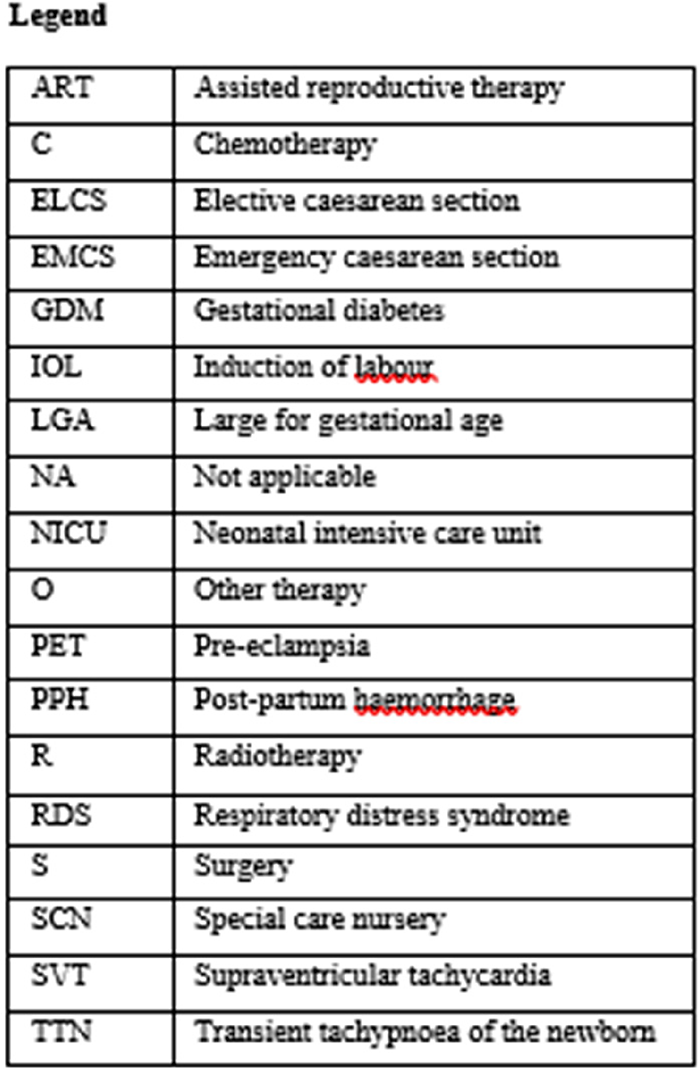
ART, Assisted reproductive therapy; C, Chemotherapy; ELCS, Elective caesarean section; EMCS, Emergency caesarean section; GDM, Gestational diabetes; IOL, Induction of labour; LGA, Large for gestational age; NA, Not applicable; NICU, Neonatal intensive care unit; O, Other therapy; PET, Pre-eclampsia; PPH, Post-partum haemorrhage; R, Radiotherapy; RDS, Respiratory distress syndrome; S, Surgery; SCN, Special care nursery; SVT, Supraventricular tachycardia; TTN, Transient tachypnoea of the newborn.
Conclusion: Although cancer in pregnancy is rare, most women have term deliveries and pregnancy outcomes are reassuring even in women who have cancer treatments during pregnancy. This is consistent with international data.
References
1. Stensheim H, Møller B, van Dijk T, et al. Cause-specific survival for women diagnosed with cancer during pregnancy or lactation: a registry-based cohort study. J Clin Oncol 2009; 27: 45–51.
2. Welfare AioHa. Cancer in adolescents and young adults in Australia. In: Government A, editor. 2023.
3. Maggen C, Wolters VERA, Cardonick E, et al. Pregnancy and cancer: the INCIP project. Curr Oncol Rep 2020; 22: 17.
4. Wolters V, Heimovaara J, Maggen C, et al. Management of pregnancy in women with cancer. Int J Gynecol Cancer 2021; 31: 314–322.
5. Amant F, Verheecke M, Wlodarska I, et al. Presymptomatic identification of cancers in pregnant women during noninvasive prenatal testing. JAMA Oncol 2015; 1: 814–819.
48Hypokalaemia in pregnancy – Prevalence, underlying causes, and an approach to investigation
Jinwen He1, Adam Morton1
1Endocrinology, Mater Hospital, Brisbane, Queensland, Australia
AbstractIntroduction: There have been limited studies regarding the prevalence and aetiology of hypokalaemia in pregnancy. While subject to reporting biases, commonly reported causes in literature include hyperemesis gravidarum, Gitelman syndrome, primary aldosteronism and renal tubular acidosis.1–10 A United States nationwide population study has found hypokalaemia in pregnancy is associated with younger age, African American origin, lower income level, higher comorbidity index as well as complications including gestational hypertension, hyperemesis gravidarum and postpartum haemorrhage.11
Methods: The objective of this study was to investigate the prevalence and aetiology of hypokalaemia in pregnancy. This was a five-year retrospective audit of women who developed hypokalaemia during pregnancy and within 3 weeks postpartum at Mater Hospital, Brisbane from 2017 to 2021. Serum potassium, cause(s) of hospitalization and investigations for hypokalaemia were obtained from hospital records.
Results: One hundred and ten women developed hypokalaemia, representing 0.36% of total births. Hypokalaemia occurred in the 1st trimester in 10% of patients, 2nd trimester in 20%, 3rd trimester in 41% and in the immediate postpartum period in 29%. Ninety-one per cent of patients had mild to moderate hypokalaemia (K 2.6–3.1 mmol/L), while 9% had severe hypokalaemia (K < 2.6 mmol/L).
The most common associations of hypokalaemia were infection (38%), vomiting (18%), hypertensive disorders (12%) and postpartum haemorrhage (9%). There was a disproportionate of women of African descent, as 20% of patients with hypokalaemia were African, while African women only represented 7% of total births. This could be potentially related to the practice of geophagia.
Only 17 out of 110 patients had further investigations to determine the aetiology of hypokalaemia. For the 24 patients with no underlying cause, only 5 (21%) had further investigations. Only 12 patients had assessment of urinary potassium, and this was delayed by a mean of 6 days after the diagnosis of hypokalaemia.
In the 15 patients who had aldosterone and renin levels assessed, 9 had hyporeninemic hypoaldosteronism, which is atypical in pregnancy, as this is usually associated with elevation of both renin and aldosterone levels. We hypothesize that there could be multiple factors contributing to this, including pre-eclampsia, intravenous fluid administration as well as the practice of geophagia.
Conclusions: A major finding was the inadequate investigation of hypokalaemia, especially measurement of urine potassium pre-replacement. This was particularly concerning where an obvious cause was not apparent at presentation. A proposed flowchart for investigation of hypokalaemia in pregnancy is included.
References
1. Walch A, Duke M, Auty T, et al. Profound hypokalaemia resulting in maternal cardiac arrest: a catastrophic complication of hyperemesis gravidarum? Case Rep Obstet Gynecol 2018; 2018: 4687587.
2. Lassey SC and Robinson JN. Rhabdomyolysis after hyperemesis gravidarum. Obstet Gynecol 2016; 128: 195–196.
3. Fukada Y, Ohta S, Mizuno K, et al. Rhabdomyolysis secondary to hyperemesis gravidarum. Acta Obstet Gynecol Scand 1999; 78: 71.
4. Moustakakis MN and Bockorny M. Gitelman syndrome and pregnancy. Clin Kidney J 2012; 5: 552–555.
5. Raffi F, Fairlie FM, Madhuvrata P, et al. Pregnancy with Gitelman's syndrome. Obstet Med 2011; 4: 39–41.
6. de Arriba G, Sanchez-Heras M and Basterrechea MA. Gitelman syndrome during pregnancy: a therapeutic challenge. Arch Gynecol Obstet 2009; 280: 807–809.
7. Landau E and Amar L. Primary aldosteronism and pregnancy. Ann Endocrinol (Paris) 2016; 77: 148–160.
8. Vidyasagar S, Kumar S and Morton A. Screening for primary aldosteronism in pregnancy. Pregnancy Hypertens 2021; 25: 171–174.
9. Seeger H, Salfeld P, Eisel R, et al. Complicated pregnancies in inherited distal renal tubular acidosis: importance of acid-base balance. J Nephrol 2017; 30: 455–460.
10. Srisuttayasathien M. Hypokalemia-Induced rhabdomyolysis as a result of distal renal tubular acidosis in a pregnant woman: a case report and literature review. Case Rep Obstet Gynecol 2015; 2015: 947617.
11. Yang CW, Li S and Dong Y. The prevalence and risk factors of hypokalemia in pregnancy-related hospitalizations: a nationwide population study. Int J Nephrol 2021; 2021: 9922245.
49Hypokalaemic salt wasting tubulopathies in pregnancy: A systematic review
Andrew I T Hebbard1
1Obstetric Medicine, Joan Kirner Hospital – Western Health, St Albans, VIC, Australia
AbstractBackground: Bartter's and Gitelman's syndromes are rare genetic conditions characterised by renal sodium and potassium wasting. Pregnancy is a time of heightened risk for affected patients with the increased potassium and magnesium demands of pregnancy often leading to severe hypokalaemia and hypomagnesaemia with the potential for adverse outcomes. There are no published guidelines for the management of these conditions in pregnancy and a wide range of management strategies have been reported in published studies. The ideal management of these conditions in pregnancy remains unknown.
Aim: To conduct a systematic review of all published literature on maternal Bartter's and Gitelman's syndromes.
Methods: A literature search was conducted of PubMed, EMBASE, and The Cochrane Library – CENTRAL databases without exclusions through June 2023. 557 studies were identified in the initial search and after the removal of duplicates, 328 studies received title and abstract screening. Studies including reports of maternal Bartter's syndrome and maternal Gitelman's syndrome were included for further analysis. 75 full-text studies were reviewed for eligibility and 59 articles were included for final analysis.
Results: Data reported from this systematic review will include maternal characteristics, pre-pregnancy, and pregnancy management; timing and mode of delivery; maternal and neonatal outcomes.
50The association between nutrition, physical activity and cardiometabolic health 6-months following a hypertensive pregnancy: A BP2 sub-study
1Discipline of Women's Health, School of Clinical Medicine, UNSW Medicine and Health, Sydney, NSW, Australia
2Women's and Children's Health, St George Hospital, Sydney, NSW, Australia
3St George and Sutherland Clinical Campus, School of Clinical Medicine, UNSW Medicine and Health, Sydney, NSW, Australia
4NSW Ministry of Health, Sydney, NSW, Australia
5Susan Wakil School of Nursing, University of Sydney, Sydney, NSW, Australia
6Discipline of Paediatrics, School of Clinical Medicine, UNSW Medicine and Health, Sydney, NSW, Australia
7Children's Hospital Westmead Clinical School, University of Sydney, Sydney, NSW, Australia
AbstractBackground: Following hypertensive disorders of pregnancy (HDP), which complicate 5–10% of pregnancies worldwide, women are at an increased risk of long-term cardiometabolic and cardiovascular disease (CVD). These risks may be mitigated by improving lifestyle behaviours, however little is known about these behaviours in the early postpartum period following HDP. This sub-study aimed to describe (a) lifestyle behaviours 6-months following HDP in four subgroups and (b) associations between lifestyle behaviours and cardiometabolic outcomes. Subgroups were chronic hypertension (CH), gestational hypertension (GH), preeclampsia, and preeclampsia superimposed on chronic hypertension (CH + PE).
Methods: This is a cross sectional sub-study of the BP2 study, which is a 3-arm randomised control trial conducted at six Sydney hospitals. At 6-months postpartum the self-reported NSW Population Health Survey assessed diet (fruit and vegetable serves/day) and physical activity (moderate-vigorous activity minutes/week and number of physically active sessions), and the BP2 study survey collected demographic data. Body mass index (BMI), waist circumference and blood pressure (BP) were measured at a study visit. Descriptive statistics, ANOVA and Spearman's correlations were performed using SPSS version 26 in the analysis of this baseline data.
Results: Of 484 participating women (16% CH, 23% GH, 55% preeclampsia, and 6% CH + PE), 62% were overweight or obese and median BMI was in the overweight range. Only 6% met the recommended five vegetable and two fruit serves per day, and 43% did not meet the recommended 150 min of moderate-vigorous physical activity in five sessions per week. Median systolic and diastolic BPs were approaching hypertensive range. Adherence to both diet and physical activity recommendations correlated with more favourable cardiometabolic outcomes, including lower BMI, waist circumference, systolic and diastolic BP. As expected, intake of processed meats, salty snacks and soft-drinks had the converse effect.
Conclusions: Overall, at 6-months post-HDP dietary intake and physical activity did not meet the recommended standards for most women, which may influence their future cardiometabolic health. Interventions which improve these lifestyle behaviours post-HDP are needed to reduce BMI, BP and long-term CVD morbidity and mortality in this high-risk population.
51Could the sFlt-1/PLGF ratio have added benefit in the detection and management of small for gestational age and fetal growth restriction? A prospective blinded observational study
Ruth Hughes1,2, Joanna Gullam1,2, Ian Phillips3
1Department of Obstetrics and Gynaecology, University of Otago, Christchurch, New Zealand
2Obstetrics and Gynecology, Waitaha Canterbury, Christchurch Women's HospitalTe Whatu Ora, Medical doctor: Specialist, New Zealand
3Chemical Pathology, Canterbury Health Laboratories, Christchurch, New Zealand
AbstractBackground: Placental growth factor (PlGF) and the soluble FMS-like tyrosine kinase 1 (sFlt-1)/PlGF ratio are markers of placental insufficiency. These tests have prognostic utility in suspected preeclampsia and there is mounting evidence of their prognostic utility in pregnancies complicated by isolated suspected fetal growth restriction (FGR) and small for gestational age (SGA).
Aims: To investigate the value of sflt-1/PLGF in suspected FGR and SGA, in a NZ population, in predicting perinatal outcome and the association with placental histological findings.
Materials and Methods: This is a subgroup analysis of a prospective cohort study of singleton pregnancies at 20+0-36+6 weeks gestation with suspected preeclampsia as defined by Society of Obstetric Medicine Australia and NZ (SOMANZ) criteria. The subgroup of pregnancies with isolated suspected SGA or FGR (NZ criteria) at recruitment were eligible. The sFlt-1/PLGF ratio was measured at recruitment and at intervals until birth, clinicians and investigators were blinded to the results.
Results: At the time of consent, 76 had isolated suspected FGR or SGA. A sFlt-1/PLGF >38 at recruitment was associated with worse perinatal outcome compared with a normal sFlt-1/PLGF: preterm birth <32 weeks 28.6% v 1.8% p < 0.001, emergency caesarean section 66.7% vs 10.9% p < 0.001, mean (IQR) customised birth weight centile 0.8 (0.3–2.7) vs 8.3 (1.75–15.85) p 0.004, admission to neonatal intensive care 81.0% vs 14.5% p < 0.001. Preeclampsia subsequently developed in 47.5% of those with suspected SGA or FGR and an elevated sFlt-1/PLGF. Placental histology was assessed in 14 of 27 pregnancies with an elevated sFlt-1/PLGF, the most common finding was maternal vascular malperfusion (MVM) and / or a small placenta with infarcts. Nine pregnancies with normal sFlt-1/PLGF had placental histology, inflammation being the most common finding, and none had MVM.
Conclusions: An elevated sFlt-1/PLGF ratio in pregnancies with suspected FGR or SGA occurred most commonly in those with MVM and/or a small placenta with infarcts, and was associated with a high rate of adverse perinatal outcome. sFlt-1/PLGF is a further tool to help distinguish between a fetus that is growth restricted from placental insufficieny from a constitutionally small fetus.
52Considerations in managing the growing population of pregnant patients with cystic fibrosis
Anna Hunt1, Lisa Ward2
1Obstetric Medicine, Gold Coast University Hospital, Gold Coast, QLD, Australia
2Endocrinology, Gold Coast University Hospital, Gold Coast, QLD, Australia
Abstract
Trikafta, a triple combination cystic fibrosis transmembrane conductance regulator (CFTR) modulator, was approved by the TGA and listed on PBS in 2022. Treatment with Trikafta improves fertility in women with cystic fibrosis (CF) through its impact on cervical mucus viscosity alongside improving overall health and nutritional status.1,2 Pregnancy rates in the US doubled from 140 to 280 from 1998 to 2018.3 With the availability of this treatment, pregnancy rates in women with CF are likely to rise.
CFTR modulators have been shown to cross the placenta, it is found in cord blood and at lower levels in breast milk.2.4 Teratogenicity has not been seen and there is limited long-term data hence Trikafta is TGA category 3B.4
We reviewed the cased of a 23-year-old patient with spontaneous pregnancy one month after commencing Trikafta, this was continued throughout the pregnancy. Preconception lung function was good with FEV1 3.45 L (94.8% predicted) which remained stable throughout pregnancy with no requirement for hospitalisation. CF related diabetes (CFRD) required new insulin therapy. CF patients often have had a high fat high calorie diet that may require review when managing diabetes in pregnancy. Induction of labour occurred at 37 weeks, with delivery via emergency caesarean section under general anaesthetic for a fetal indication. Postpartum discharge was delayed due to cough and difficult airway clearance postoperatively. Pregnancy has not been shown to accelerate lung function loss but linked to more pulmonary exacerbations.
This case highlights the need for multidisciplinary management of such patients, with respiratory, maternal fetal medicine, obstetric medicine, neonatology, pharmacy, physiotherapy, diabetic educator and dietetics involved. Preconception counselling should call attention to nutrition, appropriate gestational weight gain, CFRD and its management in pregnancy, the risks and benefits of continuing Trikafta during pregnancy for both mother and child, and the importance of respiratory physiotherapy in late pregnancy and postpartum.
References
1. Tümmler B. Post-approval studies with the CFTR modulators elexacaftor-tezacaftor-ivacaftor. Front Pharmacol 2023; 14: 1158207.
2. Bacalhau M, Camargo M, Magalhães-Ghiotto GAV, et al. Elexacaftor-Tezacaftor-Ivacaftor: a life-changing triple combination of CFTR modulator drugs for cystic fibrosis. Pharmaceuticals (Basel, Switzerland) 2023; 16: 10.
3. Taylor-Cousar JL. CFTR Modulators: impact on fertility, pregnancy, and lactation in women with cystic fibrosis. J Clin Med 2020; 9: 2706.
4. Nash EF, Middleton PG and Taylor-Cousar JL. Outcomes of pregnancy in women with cystic fibrosis (CF) taking CFTR modulators – an international survey. J Cystic Fibrosis : Off J European Cystic Fibrosis Soc 2020; 19: 521–526.
53Hypersulfataemia in a pregnant patient requiring haemodialysis during pregnancy
Julia Jefferis1,2, Isabel Scalia1, Avis McWhinney3, Ann-Maree Craven4, Dharmenaan Palamuthusingam1, Paul Dawson5
1Kidney Health Service, Royal Brisbane and Women's Hospital, Brisbane, Australia
2Faculty of Medicine, University of Queensland, Brisbane, Australia
3Mater Pathology, Mater Health Services, Brisbane, QLD, Australia
4Department of Obstetric Medicine, Royal Brisbane and Women's Hospital, Herston, QLD, Australia
5Mater Research Institute, University of Queensland, Woolloongabba, QLD, Australia
AbstractIntroduction: Sulfate (SO42−) is an important anion utilised in many metabolic and developmental processes and is essential for healthy fetal development, with serum levels upregulated during pregnancy to support fetal requirements. During pregnancy, sulfate reabsorption in the maternal kidneys increases which bolsters circulating levels by ≈ 2-fold (non-pregnant 300 μmol/L, compared to 452 and 502 μmol/L at 10–20 and 30–37 weeks gestation, respectively), providing a source of sulfate for fetal growth and development. Circulating sulfate levels are increased in chronic kidney disease (CKD) as a result of reduced glomerular filtration rate. The kidney is key in maintaining sulfate homeostasis during pregnancy, yet there are currently no studies of how sulfate levels vary in pregnant patients with CKD on chronic dialysis. In view of this, we measured serum and urine sulfate levels in a patient with end-stage kidney failure requiring haemodialysis through pregnancy.
Case report: A 19-year-old female was diagnosed with end stage kidney failure secondary to nephronophthisis at week 17 of first pregnancy (G1P0), after presenting with a urinary tract infection. The patient had no previous nephrology follow-up. Family history was significant for nephronophthisis with CKD also diagnosed in a sibling, determined as Senior Loken syndrome. Initial biochemistry showed a creatinine of 413 mmol/L, eGFR 13 ml/min/1.73 m2 and haemoglobin of 80 g/L. Haemodiafiltration was commenced via tunnelled central line for six hours a day, six times a week, with variable compliance. The patient maintained residual urine output of approximately 2 litres per day. Medications through pregnancy included heparin sodium intravenous on dialysis, darbepoetin alfa 200 mcg subcutaneous weekly, iron polymaltose 100 mg IV, folic acid 5 mg, pregnancy multivitamin, phosphate effervescent 1 g daily and sodium phosphate supplementation in the dialysate. Obstetric scan at 26 + 6 weeks were within expected range. Anaemia was persistent (haemoglobin 80 g/L), despite intensive epoetin treatment. The pregnancy progressed well with a healthy baby delivered by spontaneous vaginal delivery at 39 weeks, weighing 3.41 kg, with no maternal or fetal complications, and no concerns for congenital anomalies.
Results: We found pre-dialysis sulfate levels in this patient were elevated at 831 mmol/L and reduced by 70% after haemodialfiltration. Interestingly, the urinary fractional excretion of sulfate was 0.34, higher than seen in a healthy population at this stage of pregnancy.
Conclusion: This case suggests that sulfate metabolism is altered in pregnant patients with kidney disease, with sufficient sulfate levels to support development of the fetus.
55Successful pregnancy in a patient with 17-hydroxylase deficiency congenital adrenal hyperplasia
Ruveena Kaur1, Megan Ogilvie2, Simon Kelly3, Stephanie Cox1
1Department of Women's Health, Auckland City Hospital
2Department of Endocrinology, Fertility Associates
3Department of Obstetrics and Gynaecology, Fertility Associates
Abstract
17-alpha-hydroxylase deficiency (17-OHD) is a rare form of congenital adrenal hyperplasia, presenting in females with hypogonadism, infertility, and hypertension. Glucocorticoid treatment normalises the endocrine milieu of inadequate oestrogen production, hypocortisolemia, and aldosterone excess.
Oestrogen supplementation encourages follicular maturation, enabling oocyte harvesting, and embryo transfer in vitro fertilisation (ET-IVF). We present the pregnancy outcomes of a patient with 17-OHD, conceiving via autologous oocyte ET-IVF.
A 31-year-old nulliparous female, with a history of 17-OHD (homozygous mutation in c.160_162delTTC of the CYP17A1 gene) presented for pre-conception counselling, while on hydrocortisone 5 mg mane and dexamethasone 0.75 mg nocte. Dexamethasone was changed to prednisone 5 mg at night, and she conceived following her second ET-IVF attempt.
During pregnancy, the patient's glucocorticoid regimen was increased due to symptoms of adrenal insufficiency. By late second trimester, her regimen consisted of hydrocortisone 15 mg mane, prednisone 7.5 mg nocte, and hydrocortisone 5 mg midi as needed. Aspirin 100 mg was commenced for preeclampsia prophylaxis, and adequate dietary calcium was maintained.
The patient had non-invasive prenatal testing, confirming a female fetus. Fetal ultrasound at 32 weeks’ showed new slowing of growth. She became newly hypertensive at 35 weeks’ gestation, without features of preeclampsia, and spironolactone 25 mg was commenced with good effect.
The patient was induced at 38 weeks’ gestation. Her hypertension control deteriorated during induction, with new LFT derangement and proteinuria, now meeting criteria for preeclampsia. Stress dose hydrocortisone was administered in labour. She delivered a healthy girl (weight 2450 g) via ventouse-assisted vaginal delivery. She developed a 1300 mL post-partum haemorrhage requiring return to theatre. The patient returned to her pre-conception steroid regime within 48 h of delivery and has since ceased spironolactone.
To date, eleven successful live births have been reported in 9 women with 17-OHD using autologous oocyte ET-IVF.1 Two pregnancies were complicated by a hypertensive disorder of pregnancy, necessitating delivery at 29+2 and 30+4 weeks gestation.2,3 Six live births have been delivered after 37 weeks.1 The oldest patient with 17-OHD and successful live pregnancy, involved a 43-year-old with chronic hypertension, treated with labetalol during the pregnancy and twice daily prednisolone, who delivered at 37 weeks.4
To date, spironolactone has not been used during pregnancy for women with 17-OHD. Spironolactone was our anti-hypertensive of choice given the fetus was female, organogenesis was complete, and its physiological effect as a mineralocorticoid receptor antagonist. This case report compares the treatment and outcomes in our patient with 17-OHD to other published reports in the literature.
References
1. Oosbree A, Asif A, Hmaidan S, et al. Pregnancy outcomes in in vitro fertilization in 17-alpha-hydroxylase deficiency. Fertil Sterii Rep 2023; 4: 144–149.
2. Bianchi PH, Gouveia GR, Costa EM, , et al. Successful live birth in a woman with 17 alpha-hydroxylase deficiency through IVF frozen-thawed embryo transfer. J Clin Endocrinol Metab 2016; 101: 345–348.
3. Xu S, Hu S, Yu X, et al. 17alphahydroxylase/17,20lyase Deficiency in congenital adrenal hyperplasia: a case report. Mol Med Rep 2017; 15: 339–344.
4. Falhammar H. Successful fertility outcome in a woman with 17a-hydroxylase deficiency. Clin Endocrinol (Oxf) 2018; 88: 607–609.
56Design of a phase 3 study of nipocalimab in pregnancies at risk for severe hemolytic disease of the fetus and newborn
Dick Oepkes1, Eleanor Tiblad2,3, Kenneth J Moise Jr4,5, Enrico Lopriore6, EJT (Joanne) Verweij1, Prasheen Agarwal7, Rattandeep Batra7, Anna Beutler7, Yosuke Komatsu7, Edwin Lam7, Jocelyn H Leu7, Leona E Ling7, Robert M Nelson7, Victor Olusajo7, Claudia Russu7, Shumyla Saeed-Kawaja7, Lisa B Schwartz7, May Lee Tjoa7, Jannine Williams7, Xie L Xu7, Umair Amin7, Waheeda Sirah7
1Department of Obstetrics, Department of Fetal Therapy, Leiden University Medical Centre, Leiden, The Netherlands
2Centre for Fetal Medicine, Karolinska University Hospital, Stockholm, Sweden
3Clinical Epidemiology Division, Department of Medicine Solna, Karolinska Institutet, Stockholm, Sweden
4Dell Medical School, University of Texas, Austin, Texas, USA
5Comprehensive Fetal Care Centre, Dell Children's Medical Centre, Austin, Texas, USA
6Department of Pediatrics, University of Leiden Medical Centre, Leiden, The Netherlands
7Spring House, Johnson & Johnson Pharmaceutical Companies, PA, USA
AbstractObjective: Nipocalimab, a fully human, high affinity, neonatal Fc receptor (FcRn)-blocking monoclonal antibody, inhibits transplacental maternal immunoglobulin (IgG) and alloantibody transfer and lowers circulating maternal IgG alloantibody levels. The potential for nipocalimab safety and efficacy in the prevention of fetal anemia, intrauterine transfusions (IUT), and poor outcomes is supported by results from UNITY, an open-label, single-arm, phase 2 study (NCT03842189) conducted in alloimmunized, pregnant individuals at high risk of early-onset (<24 weeks gestational age [GA]) severe hemolytic disease of the fetus and newborn (HDFN).
Methods: The AZALEA study is a randomized, double-blind, placebo-controlled, multicenter, phase 3 trial evaluating efficacy and safety of nipocalimab versus placebo in alloimmunized pregnant individuals at risk of severe HDFN (N≈120) with singleton pregnancies who have an obstetric history of fetal anemia or requiring ≥1 IUTs, or fetal loss or neonatal death due to HDFN. Participants must have alloantibody titers for RhD, Rhc, RhC, RhE (≥16) or Kell antigens (≥4) and an antigen-positive fetus in the current pregnancy. The study includes a screening period (8–16 weeks GA), double-blind treatment period (13–35 weeks GA), planned delivery at ∼37 weeks GA, and postnatal followup periods of 24 weeks for maternal participants and 104 weeks for neonates/infants. Maternal participants will be randomized 2:1 (nipocalimab:placebo) to receive weekly intravenous infusions. During the double-blind period, weekly monitoring by middle cerebral artery Doppler peak systolic velocity (MCA-PSV) for a value ≥1.5 multiples of the median (MoM) will inform the need for cordocentesis confirmation of fetal anemia and IUT. Subsequent IUTs will be determined by MCA-PSV ≥1.5 MoM and/or time interval since the first IUT timed empirically by the investigator.
Results: The primary endpoint is the proportion of pregnancies that do not result in fetal loss, IUT, hydrops fetalis, or neonatal death. Key secondary endpoints include the severity of HDFN as measured by a composite HDFN severity index, the earliest time to occurrence of IUT or hydrops fetalis, the modified neonatal mortality and morbidity index in liveborn neonates, and the number of IUTs received. Other endpoints including exploratory endpoints are safety, patient- and caregiver-reported outcomes, pharmacokinetics, pharmacodynamics (e.g., FcRn placental receptor occupancy and IgG), nipocalimab immunogenicity.
Conclusion: AZALEA, the first placebo-controlled, randomized, global, multicenter, prospective clinical trial in severe HDFN, is designed to study the safety and efficacy of nipocalimab, a novel, noninvasive treatment to reduce the risk of fetal anemia in high-risk HDFN pregnancies.
57Clinical outcomes of current standard-of-care in pregnant participants and their offspring at high risk of early-onset severe hemolytic disease of the Fetus and newborn: Results from the prospective observational CLARITY study
Dick Oepkes1, Kenneth J Moise Jr2,3, Enrico Lopriore4, Eleanor Tiblad5,6, EJT (Joanne) Vertweij1, Rory Windrim7, Pranav Pandya8, Robert M Silver9, Stephen P Emery10, John Smoleniec11, Olga Ocon-Hernandez12, Rachel K Morris13, Diane D Harrison14, Valerie Smith14, Lisa B Schwartz14, May Lee Tjoa14, Leona E Ling14, Shumyla Saeed-Khawaja14, Yosuke Komatsu14
1Department of Obstetrics, Department of Fetal Therapy, Leiden University Medical Centre, Leiden, The Netherlands
2Dell Medical School, University of Texas, Austin, TX, USA
3Comprehensive Fetal Care Centre, Dell Children's Medical Centre, Austin, TX, USA
4Department of Pediatrics, University of Leiden Medical Centre, Leiden, The Netherlands
5Centre for Fetal Medicine, Karolinska University Hospital, Stockholm, Sweden
6Clinical Epidemiology Division, Department of Medicine Solna, Karolinska Institutet, Stockholm, Sweden
7Department of Obstetrics and Gynecology, Mount Sinai Hospital, University of Toronto, Toronto, Canada
8Fetal Medicine Unit, University College Hospital, Elizabeth Garrett Anderson Wing, London, UK
9Department of Obstetrics and Gynecology, University of Utah School of Medicine, Salt Lake City, UT, USA
10Department of Obstetrics, Gynecology and Reproductive Sciences, University of Pittsburgh School of Medicine, Pittsburgh, PA, USA
11Feto-Maternal Unit, Liverpool Hospital, Liverpool, NSW, Australia
12Fetal Medicine Unit, San Cecilio University Hospital, Granada, Spain
13Fetal Medicine Centre, Birmingham Women's and Children's Foundation Trust, Birmingham, UK
14Spring House, Johnson & Johnson Pharmaceutical Companies, PA, USA
AbstractObjective: Pregnancies at risk of early-onset severe hemolytic disease of the fetus and newborn (EOS-HDFN) are at high risk of poor outcomes. Standard-of-care (SOC) for pregnancies at risk of EOS-HDFN includes non-invasive monitoring for fetal anemia and intrauterine blood transfusions (IUTs) if fetal anemia manifests. Intravenous immunoglobulin (IVIG) or plasmapheresis may be administered to delay onset of fetal anemia and the need for IUT. The CLARITY trial aims to characterize the current SOC, clinical course, and outcomes at global HDFN referral centers for pregnant individuals and their offspring at high risk for EOS-HDFN.
Methods: CLARITY (NCT03755128), a prospective, global, multicenter, observational study, enrolled 15 alloimmunized pregnant participants with singleton pregnancies at high risk for EOS-HDFN based on a prior obstetric history of fetal loss, fetal hydrops, or severe fetal anemia at ≤24 weeks gestational age (GA) and a titer in the current pregnancy of >32 anti-D or >4 anti-Kell with confirmation of an antigen. The primary outcome is the proportion of participants with a live birth at ≥32 weeks GA without an IUT. Other perinatal and neonatal outcome variables are evaluated up to Day 28 postpartum of the last maternal participant.
Results: Primary outcome was achieved by 2/15 (13%) pregnant participants enrolled. 14/15 (93%) pregnancies resulted in a live birth, with a median GA at delivery of 36 2/7 weeks (31 4/7 to 38 0/7). Overall, 13/15 (87%) participants required IUTs, with a median of 4 (1–11) IUTs. The median GA at first IUT was 24 0/7 weeks (13 0/7 to 28 2/7). There was 1 (7%) case of hydrops fetalis. One pregnancy resulted in fetal demise which occurred at 16 5/7 weeks. Postnatal simple transfusions were required by 8/14 (57%) neonates/infants and exchange transfusions were required by 3/14 (21%). 4/13 (31%) maternal participants treated with IUT experienced complications. 7/15 (47%) maternal participants received IVIG. The 2 pregnant participants achieving primary outcome received IVIG. 3/7 (43%) participants who received IVIG experienced IVIG-related complications.
Conclusion: This prospective, observational study demonstrates that pregnancies at high risk for EOS-HDFN managed by SOC continue to experience significant unmet needs. Almost all required multiple IUTs, often starting <24 weeks GA, with a high complication rate even if IVIG was administered. These results highlight the medical need for an effective, non-invasive intervention for the treatment and management of pregnant individuals and their offspring at high risk for EOS-HDFN.
58A rare case of recurrent elevated alkaline phosphatase in pregnancy – Successful treatment of recurrent histiocytic intervillositis after the early initiation of medical therapy
Annabelle Anna,1 Krelle Carter2, Sarah Price1,3,4,5,6, Peter England2,7, Julia Unterscheider2,7, Alina Roman2,7, Joanne Said8, Fiona Chan9, Alison Nankervis1,3,4, Elly McNamara1
1Department of Obstetric Medicine, The Royal Women's Hospital, Melbourne
2Department of Obstetrics, Royal Women's Hospital, Melbourne
3Department of Medicine, The University of Melbourne, Melbourne
4Department of Diabetes and Endocrinology, The Royal Melbourne Hospital, Melbourne
5Department of Obstetric Medicine, Frances Perry House, Melbourne
6Department of Obstetrics and Gynaecology, The University of Melbourne, Melbourne
7Department of Maternal and Fetal Medicine, The Royal Women's Hospital, Melbourne
8Department of Maternal and Fetal Medicine, Western Health, Melbourne
9Department of Anatomical Pathology, The Royal Women's Hospital, Melbourne
AbstractIntroduction: Chronic histiocytic intervillositis (CHI) is a rare placental chronic inflammatory condition with high recurrence rates in subsequent pregnancies. We report a case of recurrent CHI with severe fetal growth restriction with delivery of a liveborn infant at 36 weeks gestation.
Case Presentation: A 36 yo G4P2 was transferred from another centre at 30 weeks’-gestation for management of severe fetal growth restriction (FGR). She had a past medical history of type 1 diabetes mellitus. Her obstetric history included a first trimester miscarriage in 2011, followed in 2012 with an uncomplicated vaginal delivery of a liveborn male infant at 40 weeks’ gestation (birthweight 3046 g). A subsequent pregnancy in 2020 was complicated by severe early-onset FGR necessitating delivery at 29 weeks’ -gestation: the liveborn male infant weighed 495 g. Placental histopathology demonstrated CHI.
Due to the history of CHI, she was started on aspirin and hydroxychloroquine. At 25 weeks’-gestation, recurrent severe FGR <1st centile was diagnosed. She underwent amniocentesis with a normal chromosomal microarray. Her ALP was significantly elevated (pre-delivery peak of 1672 U/L, predominant placental isoform). Serial growth surveillance confirmed fetal biometry <1st centile, with normal liquor volume and doppler studies.
At 36 weeks’-gestation, she underwent an emergency caesarean section within the setting of preterm prelabour ruptured membranes, delivering a 1890 g female infant. Five days post-partum, the ALP was 721 U/L. Placental histopathology revealed increased capillary profiles of the chorionic villi consistent with chorangiosis, increased intervillous fibrin, mild intervillous infiltrate of histiocytes, highlighted by CD68+ immunohistochemistry. There was a minor component of chronic villitis and immunohistochemistry for CD45 highlighted scant lymphocytes. The histopathology of the current placenta when compared to the 2020 pregnancy showed histiocytic infiltrate was less than in the previous placenta, less frequent sheets of cells and smaller aggregates overall. This may relate to the treatment which was initiated.
Discussion: CHI is a rare chronic inflammatory placental lesion characterized by excessive accumulation of maternal CD68+ histiocytes in the intervillous space. It has high rates of first-trimester miscarriage, severe FGR and stillbirth.1 The hypothesised pathogenesis is inappropriate immune response to the semi-allogeneic fetus.2 Limited evidence exists to guide treatment. Potential therapies include aspirin, LMWH, prednisolone, hydroxychloroquine and adalimumab.3 CHI has a strong recurrence rate of ∼80%.4 Recognition of this condition through identification of extremely elevated ALP levels and FGR is critical to management of current and subsequent pregnancies. In this case, a less severe disease phenotype may be related to the early commencement of aspirin and hydroxychloroquine.
References
1. Cornish EF, McDonnell T, Williams DJ. Chronic inflammatory placental disorders associated with recurrent adverse pregnancy outcome. Front Immunol 2022; 13: 825075.
2. Brady CA, Williams C, Sharps MC, et al. Chronic histiocytic intervillositis: A breakdown in immune tolerance comparable to allograft rejection? Am J Reprod Immunol 2020. doi.org/10.1111/aji.13373
3. Moar L, Simela C, Nanda S, et al. Chronic histiocytic intervillositis (CHI): current treatments and perinatal outcomes, a systematic review and meta-analysis. Front Endocrinol (Lausanne) 2022; 13: 945543.
4. Bos M, Harris-Mostert ETMS, van der Meeren LE, et al. Clinical outcomes in chronic intervillositis of unknown etiology. Placenta 2020; 91: 19–23.
59The diagnostic conundrum when three rare diseases present in pregnancy: A case report
Anna Krelle1, Paul Champion de Crespigny1,2,3,4, Sarah Price1,2,3,5,6, Helen Savoia1,7,8, Mark Cleghorn9, Elly McNamara1, Alina Roman1,10
1Department of Obstetric Medicine, The Royal Women's Hospital, Melbourne, Australia
2Department of Medicine, The University of Melbourne, Melbourne, Australia
3Department of Obstetric Medicine, Frances Perry House, Melbourne, Australia
4Department of Nephrology, The Royal Melbourne Hospital, Melbourne, Australia
5Department of Diabetes and Endocrinology, The Royal Melbourne Hospital, Melbourne, Australia
6Department of Obstetrics and Gynaecology, The University of Melbourne, Melbourne, Australia
7Department of Haematology, The Royal Women's Hospital, Melbourne, Australia
8Depratment of Haematology, The Royal Children's Hospital, Melbourne, Australia
9Department of Genomic Medicine, The Royal Melbourne Hospital, Melbourne, Australia
10Department of Maternal and Fetal Medicine, The Royal Women's Hospital, Melbourne, Australia
AbstractIntroduction: Membranoproliferative glomerulonephritis (MPGN) is a glomerulonephritis defined by specific histological findings on kidney biopsy, including thickened glomerular basement membrane and increased mesangial and endocapillary cellularity. We report a case of pregnancy-associated MPGN co-existing with a hypocellular bone marrow syndrome and atypical cardiomyopathy.
Case presentation: A 36-year-old female presented at 27 weeks’ gestation for antenatal care. Initial pathology revealed macrocytic anaemia (haemoglobin 65 g/L, MCV 106 fl), thrombocytopenia (platelets 136 × 10^9/L) and kidney impairment (creatinine 118 umol/L) with haemoproteinuria (protein/creatinine ratio 1300 mg/mmol; 105 × 10^6/L red cells on urine microscopy). Urgent kidney biopsy performed at 27 weeks’ gestation demonstrated histological findings of MPGN, most consistent with a post-infectious aetiology. Infectious precipitants were investigated but not found. Her kidney disease was managed conservatively. Autoimmune and vasculitic screening was negative and pre-eclampsia screening was unremarkable.
Given significant anaemia of uncertain aetiology, she underwent a bone marrow biopsy at 28 weeks’ gestation, showing a hypocellular marrow, mild dyserthropoiesis and non-specific megakaryocytic hyperplasia but without definitive features of myelodysplasia; cytogenetic studies were normal. Differentials included infection, paroxysmal nocturnal haemoglobinuria, Fanconi anaemia and dyskeratosis congenita. The elevated MCV was longstanding, and PNH flow cytometry was normal. Chromosomal fragility studies were inconclusive, possibly suggestive of a mild Fanconi anaemia phenotype or testing artefact during pregnancy. She remained transfusion dependent throughout pregnancy.
At 37 weeks’ gestation, she underwent an elective caesarean-section, delivering a 2.7 kg female neonate, well apart from possible haemorrhagic ovarian and bowel duplication cysts which required neonatal follow-up. Post-partum, she had stable kidney impairment. She became transfusion independent with persisting mild macroctytic anaemia, and she developed a new cardiomyopathy. Given multiple rare presentations in pregnancy, she was referred to genetics. Chromosome microarray identified extensive long continuous chains of homozygosity (LCSH), suggesting consanguinity and an increased risk of recessive genetic disease. Whole exome sequencing identified homozygous pathogenic frameshift variants in HJV, providing a rare diagnosis of haemochromatosis type 2A (MIM# 602390). No pathogenic variants were identified in curated gene lists associated with cardiomyopathy, kidney glomerular disease or Fanconi anaemia.
Discussion: This case is compelling for two reasons. Firstly, MPGN can be classified as either immune complex/monoclonal immunoglobulin-mediated or complement-mediated, distinguished by immunofluorescence microscopy on kidney biopsy.1 This case raises the possibility that pregnancy plays a pathogenetic role in development of immune-mediated kidney disease, including MPGN. Secondly, consanguinity is an important but underappreciated cause of simultaneous presentation of multiple rare diseases. Germline whole exome sequencing may assist in better understanding these presentations and guide clinical care.
Reference
1. Sethi S and Fervenza FC. Membranoproliferative glomerulonephritis – A new Look at an old entity. N Engl J Med 2012; 366: 1119–1131.
60When the numbers just don’t add up in pregnancy – The vanishing act of PTH
Dianna Luong1,2, Kate Hawke2, Eloise Ward2, Penny Wolski2
1School of Medicine, University of Queensland, Brisbane, Queensland, Australia
2Obstetric Medicine, Royal Brisbane and Women's Hospital, Brisbane, QLD, Australia
AbstractBackground: Diagnosing primary hyperparathyroidism during pregnancy is difficult due to changes in parathyroid hormone (PTH), calcium and 1,25 Vitamin D absorption and the presence of parathyroid hormone-related peptide (PTHrP).1 Our case demonstrates that rapid PTH degradation with in individuals, and delayed laboratory processing of samples can influence the interpretation of PTH.
Case: TL, 27 yo F G5P1M4, was transferred to our tertiary centre at 25-weeks’ gestation with pancreatitis. She had recurrent pancreatitis from an unclear aetiology with associated exocrine insufficiency. Previously 2014, she had a caesarian-section at 32-weeks’ gestation due to pancreatitis and severe pre-eclampsia. Retrospectively, she was hypercalcaemic at that time, however, was not previously investigated.
On presentation to our centre in 2022, she was hypercalcaemic (CorrCa 3.12 mmol/L, ionised calcium 1.54 mmol/L). Her creatinine was 43 umol/L and vitamin D 117 nmol/L. The urinary calcium:creatinine ratio was 0.0124.
Initial PTH was low but not completely supressed at 1.7 pmol/L (1.0 pmol/L-7.0 pmol/L). Serial testing of PTH levels unexpectedly varied. A lower PTH level was noted in samples that had delayed processing times (Figure 1). Samples processed immediately found PTH to be inappropriately normal in keeping with PTH-dependent hypercalcaemia.
We hypothesised that PTH variability was impacted by the time to sample analysis. PTH stability was assessed on the Atellica Assay by collecting paired blood samples (SST and EDTA tubes) from 10 individuals (n = 5 pregnant, n = 5 non-pregnant) and comparing them to TL's samples. Each pair was serially measured for PTH second-hourly for 10 h. No significant difference was observed between SST and EDTA samples at baseline. However, as time progressed, large variations in PTH hormone were detected in both SST and EDTA tubes for control subjects (11% reduction and 5.3% increase at 10 h, respectively) (Figure 2). Comparatively, TL's PTH fell even more rapidly during this time by 38.1% and 12.5% in the SST and EDTA tube respectively.
Ultrasonography and 4D-CT of the neck confirmed a 5 × 9 × 6 mm right inferior parathyroid adenoma. TL was refractory to medical therapy and proceeded to a parathyroidectomy on day 26 of admission. Her calcium subsequently normalised and she proceeded to an uneventful term delivery.
In summary, PTH becomes more unstable over time and may degrade rapidly in some individuals, making the diagnosis of PTH-dependent hypercalcaemia challenging. This case demonstrates the immense value in having a responsive chemical pathology team. With their assistance, we were able diagnose and offer curative treatment for a young pregnant woman with significant morbidity relating to hypercalcaemia.
PTH levels (pmol/L) for tl during her admission plotted against the time the samples were collected and processed at the laboratory expressed in hours: minutes.
Table outlining the PTH results collected from both SST and EDTA tubes in patient tl, compared to control (n = 10) tested every 2 h until 10 h from collection time was reached.
Reference
1. Morton A and Teasdale S. Physiological changes in pregnancy and their influence on the endocrine investigation. Clin Endocrinol (Oxf) 2022; 96: 3–11. https://doi.org/10.1111/cen.14624.
61Metabolic parameters and body composition in women five-years after preeclampsia, gestational hypertension, and normotensive pregnancy: A P4 study
Lauren M Moore1, Tony O'Sullivan2, Lynne M Roberts2,3, Megan Gow4, Gregory Davis1,3, Yamema Esber1, Amanda Henry1,2,3
1Discipline of Women's Health, School of Clinical Medicine, UNSW Medicine and Health, Sydney, NSW, Australia
2St George and Sutherland Clinical Campus, School of Clinical Medicine, UNSW Medicine and Health, Sydney, NSW, Australia
3Department of Women's and Children's Health, St George Hospital, Sydney, NSW, Australia
4Discipline of Paediatrics and Child Health, School of Clinical Medicine, UNSW Medicine and Health, Sydney, NSW, Australia
AbstractBackground/Aim: Hypertensive disorders of pregnancy (HDP) impact 5–10% of women during pregnancy. Our six-months postpartum analysis of the metabolic parameters of women with HDP compared to their normotensive counterparts indicated a significant short-term relationship between preeclampsia and metabolic dysfunction. However, the short-to-medium impact on parameters including body composition, anthropometry and serum biochemistry remain relatively unclear. This study aims to determine whether (a) there are significant differences in insulin resistance, body composition and energy balance five-years after preeclampsia, gestational hypertension, and normotensive pregnancy (b) differences identified at six-months postpartum persist through to five-years.
Methods: Metabolic sub-study conducted as part of the Postpartum Physiology, Psychology and Paediatric (P4) follow-up study. Five-years postpartum, women were assessed following preeclampsia, gestational hypertension (GH), and normotensive pregnancy (NP). Metabolic measurements included anthropometry and body composition via multi-frequency bioelectrical impedance analysis. Energy balance data were gathered using the SenseWear Armband (Model MF-SW, BodyMedia Inc.) to determine energy expenditure and a three-day food recall diary analysed using FoodWorks (Version 8, Xyris Software Aust. Pty Ltd, Australia) to determine total energy intake. Comparison of preeclampsia, GH and NP parameters five-years postpartum was performed using Chi-squared, independent-samples t-test, or Mann-Whitney-U as appropriate. Longitudinal data analysis at six-months, two-years, and five-years post-partum was performed using paired testing. A p-value <0.05 was considered statistically significant.
Results: 186 women were assessed: 139 after NP, 35 after preeclampsia, 12 following GH. GH women exhibited higher median weight (84.8 kg) and BMI (29.2) than their normotensive counterparts (65.6 kg, 24.4, p = 0.001). The preeclamptic group had higher fasting insulin than the normotensive group (6.4 µIU/mL versus 5.8 µIU/mL) and higher HbA1c levels (6.0 ± 4.4 versus 5.1 ± 0.3%, p = 0.02). The GH group had higher LDL-cholesterol levels than the normotensive group (2.7 ± 0.7 versus 2.5 ± 0.6 mmol/L) and lower mean HDL-cholesterol (1.3 ± 0.3 versus 1.6 ± 0.4 mmol/L, p = 0.01). GH women exhibited higher waist circumference (105 versus 90 cm), hip measurement (116 versus 102 cm), relative fat-mass (43 versus 34%) and total fat-mass (38.7 versus 24.4 kg), all p < 0.05 compared to the normotensive group, while body composition differences between the preeclamptic and normotensive group were not significant. Energy balance was negative in all cohorts at five-years postpartum, however, findings were not statistically significant.
Conclusion: Five-years following preeclampsia, women exhibited higher fasting insulin and HbA1c levels compared to their normotensive counterparts. Despite a relatively small sample size, GH women demonstrated significantly poorer metabolic outcomes compared to their normotensive counterparts. These results suggest persistent metabolic abnormalities following HDP, which may be amenable to early postpartum intervention.
62Extensive postpartum cerebral venous Sinus thrombosis with associated cerebellar haemorrhage: A case report
Jolene Zhuo Lin Ng1, Renuka Shanmugalingam1, Penelope Motum2, Angela Makris1
1Renal Department, Liverpool Hospital, Sydney, NSW, Australia
2Haematology Department, Liverpool Hospital, Sydney, NSW, Australia
AbstractBackground: Cerebral venous sinus thrombosis (CVST) is a rare neurological presentation of the peripartum period with a reported incidence of 12 in 100,000 patients. With more than 70% of pregnancy-related CVST occurring in the postpartum period, increased risk is related to overall peripartum hypercoagulability further amplified by risk factors such as underlying prothrombotic conditions, obesity, dehydration, infections and hypertensive disorders of pregnancy.
Case report: A 33-year-old G1P1 Caucasian woman presented with seizures ten days postpartum with a three-day history of worsening generalized and retro-orbital headaches. Her medical history was significant for a chronic immune-mediated thrombocytopenia (possible Evan's Syndrome) requiring IVIG prior to delivery, obesity (130 kg), hypothyroidism and anxiety. She was also diagnosed with term pre-eclampsia with new onset hypertension and proteinuria at 39 weeks requiring two antihypertensive agents on discharge from hospital.
Admission CT and MRI brain and neck imaging revealed extensive dural venous sinus thrombosis involving the left transverse and sigmoid sinus extending to the distal internal jugular vein. There was also associated haemorrhage noted overlying the left cerebellar tentorium extending to the subdural space. A wedge-shaped area of delayed nephrogram was also identified within the upper pole of left kidney, later confirmed on CT Renal Angiography to be secondary to left renal vein thrombosis. She was commenced on Levetiracetam (Keppra) and intravenous heparin infusion with close monitoring of the extent of haemorrhage on serial CT imaging. She was subsequently transitioned to therapeutic dose subcutaneous Clexane 110 mg twice daily with anti-Xa level monitoring. Interventional radiology guided thrombectomy was considered however not performed due to overall neurological stability. Her platelet counts remained stable between 85–110 × 109/L during her admission. Thrombophilia screen performed revealed Heterozygous Factor V Leiden mutation with borderline lupus anticoagulant positivity of uncertain significance.
Conclusion: CVST is a rare yet important diagnosis to consider in the management of postpartum patients often presenting with a wide range of neurological symptoms. Timely diagnosis and intervention is crucial to prevent major consequences such as seizures, major haemorrhage and permanent disability from stroke.
63An evaluation of the sFlt-1/PlGF ratio in preeclampsia and gestational diabetes mellitus
Sarah B Noonan1, Gabriel D Jones2,
Shaun P Brennecke3,4
1Melbourne Medical School, The University of Melborune, Melbourne, Victoria, Australia
2Nuffield Department of Women's and Reproductive Health, University of Oxford, Oxford, UK
3Department of Maternal-Fetal Medicine, Pregnancy Research Centre, Royal Women's Hospital, Melbourne, Victoria, Australia
4Department of Obstetrics and Gynaecology, University of Melbourne, Parkville, Victoria, Australia
AbstractBackground: An imbalance between anti-angiogenic and pro-angiogenic factors plays a role in the development of preeclampsia (PE). The ratio between two such markers, soluble fms-like tyrosine kinase 1 (sFlt-1; anti-angiogenic) and placental growth factor (PlGF; pro-angiogenic), can be utilised to predict a subsequent diagnosis of PE up to four weeks in advance.1 Gestational diabetes mellitus (GDM) is associated with changes in angiogenic biomarkers.2 However, there is an incomplete understanding of whether GDM has an influence on sFlt-1 or PlGF, and how this may affect the accuracy of predicting PE onset with the sFlt-1/PlGF ratio.
Aim: To investigate whether there is a significant difference in the sFlt-1/PlGF ratio in individuals with PE and GDM compared to those with PE and no GDM.
Method: A retrospective analysis of 3841 sFlt-1, PlGF and sFlt-1/PlGF biomarker ratio measurements was performed on data acquired between September 2016 and September 2022 at the Royal Women's Hospital, Melbourne. Exclusion criteria included: multiple biomarker tests, pre-existing diabetes, renal disease, anti-phospholipid syndrome, systemic lupus erythematosus, fetal chromosomal abnormalities, multiple pregnancy, and pregnancy induced hypertension. 1416 biomarker ratio measurements remained for analysis. Cases were partitioned into four groups: GDM + PE, GDM + No PE, No GDM + PE and No GDM + No PE. The sFlt-1/PlGF ratio was compared between GDM + PE and No GDM + PE cases at 28 days, 14 days, and 7 days before delivery.
Results: At 7 days before delivery, the median sFlt-1/PlGF ratio was 28.0 (IQR, 13.0–55.25) in No GDM + No PE groups, 90.0 (IQR, 49.0–180.0) in No GDM + PE groups, 17.0 (IQR, 8.75–31.5) in GDM + No PE groups and 135.0 (IQR, 66.0–315.0) in GDM + PE groups. As expected, PE pregnancies had a significantly higher median sFlt-1/PlGF ratio than no PE pregnancies (Mann-Whitney test, p < 0.001). Of note, GDM + PE pregnancies had a significantly higher median sFlt-1/PlGF ratio than No GDM + PE pregnancies (Mann-Whitney, p = 0.025). A similar trend of sFlt-1/PlGF values was also observed across all four groups at 14 and 28 days before delivery.
Conclusion: These results indicate a potential need to consider GDM status when interpreting sFlt-1 and PlGF biomarker values when ruling in or out a diagnosis of PE, and suggest current cut-off values may need to be re-evaluated for use in this patient population.
References
1. Nuzzo AM, Giuffrida D, Moretti L, et al. Placental and maternal sFlt1/PlGF expression in gestational diabetes mellitus. Sci Rep 2021; 11: 2312.
2. Zeisler H, Llurba E, Chantraine F, et al. Predictive value of the sFlt-1:plGF ratio in women with suspected preeclampsia. N Engl J Med 2016; 374: 13–22.
64Phospholipase A2 receptor antibody positive membranous nephropathy in pregnancy: A case report
Alessandra Orsillo1,2, Nishanta Tangirala1,2,3,
Mark Morton2,4, Shilpa Jesudason1,2
1Central and Northern Adelaide Renal and Transplantation Service, Adelaide, SA, Australia
2University of Adelaide, Adelaide, South Australia, Australia
3Women's and Children's Hospital Foundation, North Adelaide, South Australia
4Women's and Children's Hospital, Adelaide, South Australia
AbstractIntroduction: Primary membranous nephropathy is a common form of nephrotic syndrome worldwide. It is an uncommon yet important condition in pregnancy. The identification of pathogenic autoantibodies has been transformative to diagnosis and management of primary membranous nephropathy, with 70% of cases associated with antibodies to phospholipase A2 receptor (PLA2R) on podocytes1. There are limited reports of cases of membranous nephropathy in pregnancy, and in particular, the utility of PLA2R in pregnancy.2,3,4,5
Case summary: We present a case of a 35-year-old woman from Pakistan who has a history of nephrotic syndrome diagnosed at age 18 overseas, and treated at the time. In Australia, she presented in 2020 to the renal service after an early first trimester spontaneous abortion with a relapse of nephrotic syndrome. Biopsy confirmed membranous nephropathy and a PLA2R of 115 IU/mL (normal <13.9 IU/mL). She was referred to an obstetric nephrology service for pre-pregnancy counselling and advised to delay pregnancy until disease control was established. Disease remission was not achieved through first line management, and she was subsequently given two doses of rituximab. She fell pregnant 3 months following rituximab despite counselling against this. She was managed closely by a multidisciplinary team of obstetric nephrology, obstetric medicine and maternal-fetal medicine services. In the first trimester, there was evidence of disease remission, clinically and biochemically, with low PLA2R (2 IU/ml), suppressed B cells and less than 1 g/proteinuria/24 h. However during the second trimester she became increasingly nephrotic with hypertension and peripheral oedema. The PLA2R increased to 51.2 IU/ml at 20 weeks’ gestation with an associated 7 g/proteinuria/24 hours. Tacrolimus was initiated to regain disease control and by 30 weeks gestation there was a reduction in proteinuria and antibody levels. However, with progressive hypertension and concerns for pre-eclampsia, the patient was admitted to hospital and delivered a healthy male infant via emergency caesarean section at 34 weeks gestation. There was evidence of trans-placental transfer of PLA2R antibody, with levels of 15.2 IU/mL in the infant, although he had only mild proteinuria which spontaneously resolved and no features of overt nephrotic syndrome. There have so far been no detected adverse infant outcomes from rituximab exposure.
Conclusion: This case illustrates the utility of PLA2R in pregnancy. We found PLA2R titres reflected disease activity of membranous nephropathy with associated rise in proteinuria, creatinine and hypertension. Maternal-fetal transfer of PLA2R has been demonstrated in this case, however, had no clinical consequences to the neonate.
2. Liu Z-N, Cui Z, He Y-D, Zhang Y-M, Wang F, Wang X, et al. Membranous nephropathy in pregnancy. Am J Nephrol 2020; 51: 304–17. 3 3.
3. Uchino E, Takada D, Mogami H, Matsubara T, Tsukamoto T and Yanagita M. Membranous nephropathy associated with pregnancy: an anti-phospholipase A2 receptor antibody-positive case report. CEN Case Rep 2018; 7: 101–6. 4.
4. Al-Rabadi L, Ayalon R, Bonegio RG, Ballard JE, Fujii AM, Henderson J, et al. Pregnancy in a patient with primary membranous nephropathy and circulating anti-PLA2R antibodies: a case report. Am J Kidney Dis 2016; 67: 775.
65The South Australian maternal kidney disease in pregnancy database – A first look retrospective cohort study of pregnancy in early chronic kidney disease
1University of Adelaide, Adelaide, South Australia, Australia
2Central and Northern Adelaide Renal and Transplantation Service, Adelaide, SA, Australia
3Women's and Children's Hospital Foundation, North Adelaide, South Australia
4Australia and New Zealand Dialysis and Transplant Registry, Adelaide, South Australia, Australia
AbstractIntroduction: Pregnancy outcomes in women with early stage chronic kidney disease (CKD) are poorly captured. We aim to advance the data infrastructure available by the establishment of the South Australian pregnancy database, to develop knowledge and care in these medically complex pregnancies.
Methods: A database accessible to four major sites with obstetric nephrology care was created on a Redcap platform, to capture all women with CKD who had pregnancy counselling or a pregnancy event. Information collated included the cause and severity of CKD, other pre-existing maternal medical conditions, whether pre-conception counselling was received, as well as maternal and infant complications. Kidney function was followed up at 6 and 12 months post-partum. The first retrospective data collection using this database was conducted within a single centre. Though data from all pregnancies, regardless of duration, was collected, this retrospective study focussed on those >20 weeks gestation. All patients between January 2018 to February 2023 who had chronic kidney disease stage 1–3 prior to pregnancy or in the first term of pregnancy were included. Patients with a renal transplant, CKD 4–5 and who were receiving dialysis prior to pregnancy were excluded.
Results: Our data captured 38 women with stages 1–3 CKD managed within the obstetric nephrology service. 27 of these women received pre-conception counselling. The majority (28/38) had CKD 1; the remainder evenly split between CKD 2 and 3. There were a total of 47 pregnancy events, all of which led to live births; 44 were singleton and 3 were twin pregnancies. 45 pregnancies had documented delivery dates and of these, 17 (37.8%) were delivered pre-term. Of the premature deliveries, at least 7 had emergency caesarean section, most commonly for obstetric indications. There were 9 episodes of pre-eclampsia.
Conclusion: This first retrospective analysis exemplifies the utility of establishing an ongoing database with capture of cases from the major tertiary, obstetric units across South Australia. In the future, additional sites will link into this database as well as our statewide electronic medical record systems, and data will be collected prospectively. Over time, this statewide database will provide valuable insights into chronic kidney disease of all stages in pregnancy.
66Lactation intensity and reduction in the prevalence of metabolic syndrome after a maternal complication of pregnancy (The LEMON Study): An observational study protocol
1Robinson Research Institute, The University of Adelaide, Adelaide, SA, Australia
2Adelaide Medical School, The University of Adelaide, Adelaide, SA, Australia
3Department of Cardiology, Lyell McEwin Hospital, Elizabeth Vale, SA, Australia
4Division of Women's Health, Lyell McEwin Hospital, Elizabeth Vale, SA, Australia
AbstractIntroduction: Major pregnancy complications such as preeclampsia and gestational diabetes mellitus are associated with development of type II diabetes mellitus and coronary heart disease, which are becoming ever more prevalent in young women. Despite clinical recommendations to optimise CVD risk factors after a complication of pregnancy, tailored lifestyle programs have poor adherence and are not suited to the lifestyle of a postpartum mother. Breastfeeding (lactation) is associated with reduction in hypertension and diabetes later in life; however, there has not been a direct focus on elucidating how breastfeeding affects certain components of cardiometabolic health in women with a previous pregnancy complication within the early postpartum period. This project aims to determine if lactation intensity is associated with a reduction in the rate of metabolic syndrome in women with a maternal complication of pregnancy at 6 months postpartum.
Methods: The LEMON study is a prospective, observational cohort study to be conducted at the Lyell McEwin Hospital (LMH), which services a region with some of the highest rates of coronary artery disease, diabetes, smoking and obesity in metropolitan Australia. Women between 18 and 45 years of age eligible if they are being referred to the Cardiovascular Obstetric Follow-up for education and evaluation (COFFEE) clinic for a major complication of pregnancy, including preeclampsia, gestational hypertension, and gestational diabetes mellitus (GDM), and preterm delivery, delivery of a small for gestational age infant and placental abruption. Women will complete online questionnaires on breastfeeding frequency for 6 months prior to their first clinic appointment. Lactation intensity will be ascertained using a calculated intensity ratio, which assess the number of breastfeeds per day in relation to all other forms of feeding over the course of 6 months. This will be assessed in relation to metabolic syndrome, which is the cluster of the most dangerous coronary heart disease risk factors (obesity and two or more of the following: hypertension, impaired glycaemia and/or elevated triglycerides or reduced HDL-C) and is a precursor of T2DM and CAD.
Conclusion: This study will enable us to quantify how lactation at different intensities over 6 months can affect the development of metabolic syndrome in young women with a previous complication of pregnancy thereby leading to targeted therapeutic strategies in cardiometabolic disease risk optimisation and improving guidelines for postpartum follow-up after a complicated pregnancy.
67Insulin resistance in children exposed to gestational diabetes mellitus in utero: A systematic review and meta-analysis
1Robinson Research Institute, The University of Adelaide, Adelaide, SA, Australia
2Adelaide Medical School, The University of Adelaide, Adelaide, SA, Australia
3Department of Cardiology, Lyell McEwin Hospital, Elizabeth Vale, SA, Australia
AbstractIntroduction: Gestational diabetes mellitus (GDM) prevalence is increasing rapidly, affecting 1 in 7 pregnant women. It has been shown that offspring exposed to GDM in utero are at increased risk of poor cardiometabolic health later in life, therefore it is important to elucidate the physiological changes that could be occurring at a young age to promote impaired metabolic health, in order to devise treatment and preventative strategies in this cohort. Insulin resistance is the first stage of diabetes development, and to date, there has not been a comprehensive systematic review and meta-analyses which has assessed markers of insulin resistance in offspring exposed to GDM in utero.
Methods: Studies assessing markers of insulin resistance (HOMA-IR, insulinogenic index, abdominal obesity, b-cell function) in offspring exposed to GDM in utero were screened throughout the literature. We included studies that defined GDM based on the International Association of Diabetes and Pregnancy Study Groups (IADPSG) definition, or prior definitions. The PRISMA guidelines were followed in conducting this systematic review. Methodological quality was assessed using the National Heart, Lung and Blood Institute (NHLBI) Quality Assessment Tool for Observational Cohort and Cross-Sectional Studies
Results: A total of 2165 studies were identified from the literature search, of which 96 studies were eligible for full text review, and 49 were included in the systematic review and 23 analysed within the meta-analyses. Offspring exposed to GDM in utero had higher waist circumference (MD 2.40 (95% CI 1.59, 3.21, 21,138 participants) and a lower insulin sensitivity based on Matsuda Index (SMD −0.91 (95% CI −1.72, −0.09, 263 participants). Subgroup analyses for age at assessment revealed that waist circumference was greater in offspring exposed to GDM in utero who were > = 10 years of age at assessment compared to those that were exposed to normoglycemic pregnancy in utero (MD: 3.21 95% CI 2.06, 4.37, 1943 participants).
Results: Offspring exposed to GDM in utero have higher abdominal waist circumference than those who are exposed to normoglycemic pregnancy. These offspring may benefit from monitoring of obesity and insulin resistance to reduce the risk of chronic disease later in life.
68Managing severe gestational hypertriglyceridaemia: Lessons from a complex case
Umesha Pathmanathan1, Abigail Anderson2, Suji Prabhaharan1, David Watson2, Kunwarjit Sangla1,3
1Obstetric Medicine, Townsville University Hospital, Townsville, QLD, Australia
2Obstetrics and Gynaecology, Townsville University Hospital, Townsville, QLD, Australia
3James Cook University, Townsville, QLD, Australia
AbstractIntroduction: Lipid homeostasis significantly changes during pregnancy to ensure adequate nutritional support to the foetus. This includes an average 2–4-fold increase in triglycerides by the third trimester. Usually, this is well tolerated by women with normal baseline triglyceride levels and metabolic pathways.1 However, in the presence of genetic abnormalities affecting triglyceride metabolism or secondary exacerbating factors such as medications or uncontrolled diabetes; severe gestational hypertriglyceridaemia can occur.2 This poses significant maternal and foetal risk, including that of acute pancreatitis, hyperviscosity syndrome and pre-eclampsia.3,4 Although requiring aggressive treatment to optimise outcomes, the existing management practices rely on observational data and case reports, revealing a gap in the available literature.5
Case report: We report the case of a 39-year-old female, G4P2T1 31 + 5 weeks gestation, living in regional Queensland. She was transferred to a rural tertiary referral centre with Maternal Foetal Medicine and Obstetric Medicine expertise after an incidental finding of severe hypertriglyceridaemia [41.4 mmol/L (<1.5 mmol/L)] on routine bloods. Her pregnancy-related complications included a new diagnosis of both pre-eclampsia and diet-controlled gestational diabetes mellitus (GDM), with a large for gestational age (LGA) foetus on a 31-week ultrasound, measuring at the 93rd centile. She was also treated with therapeutic enoxaparin after a presentation with pulmonary embolism at 27-weeks gestation. Her past medical history is pertinent for class III obesity and smoking.
On admission, she was commenced on a low fat, low carbohydrate diet and high dose fish oil two grams twice daily. She declined fibrate therapy. She was placed on an insulin infusion, titrated to 3–5 units per hour according to her blood glucose readings, with 5% dextrose as background maintenance fluids. There was initial improvement of her triglycerides to a nadir at 18.7 mmol/L and a decision was made to commence plasmapheresis at 32 + 4 weeks. She required three plasmapheresis sessions before being successfully discharged at 33 + 3 weeks gestation with triglycerides of 5.7 mmol/L. She was regularly monitored in the community, with weekly plasmapheresis sessions aiming to maintain triglycerides to less than 11 mmol/L. Her blood pressure remained well controlled on anti-hypertensives during this period. She went on to deliver a healthy term infant at 37 + 0 weeks gestation via an elective repeat lower uterine caesarean section.
Discussion Points: 1. Indications for checking and monitoring triglycerides in pregnancy to capture gestational hypertriglyceridaemia. 2. Options and dilemmas for managing hypertriglyceridaemia during pregnancy – both gestation and pre-existing. 3. Monitoring and predicting outcomes of pregnancy with severe hypertriglyceridemia
References
1. Goldberg AS and Hegele RA. Severe hypertriglyceridemia in pregnancy. J Clin Endocrinol Metab 2012; 97: 2589–96.
2. Wong B, Ooi TC and Keely E. Severe gestational hypertriglyceridemia: a practical approach for clinicians. Obstet Med 2015; 8: 158–67.
3. Kleess LE and Janicic N. Severe hypertriglyceridemia in pregnancy: a case report and review of the literature. AACE Clin Case Rep 2019; 5: e99–e103.
4. Wiznitzer A, Mayer A, Novack V, et al. Association of lipid levels during gestation with preeclampsia and gestational diabetes mellitus: a population-based study. Am J Obstet Gynecol 2009; 201: 482. e1–8.
5. Gupta M, Liti B, Barrett C, et al. Prevention and management of hypertriglyceridemia-induced acute pancreatitis during pregnancy: a systematic review. Am J Med 2022; 135: 709–714.
69A case of de novo postpartum eclampsia an ongoing emergency since 1860
Lara LS Strakian1, Raiyomand RD Dalal1
1Obstetric & Gyanecology Department, Campbelltown Hospital, Campbelltown, NSW, Australia
Abstract
Worldwide, the incidence of postpartum eclampsia is on increasing trend at 16–18% of all eclamptic seizures.
A 28-year-old woman, G3P3, was brought in by an ambulance to the emergency department 11 days postpartum with loss of consciousness and seizure like activity at home. She had an uncomplicated pregnancy and elective repeat caesarean delivery with no evidence of pre-eclampsia throughout the antenatal and immediate postnatal period. She had a family history of tubular interstitial renal disease; brother with kidney transplantation and sister with advance chronic kidney disease. Sister also had pre-eclampsia. Collateral history from the family revealed that she was tired and sleep deprived since the time of delivery. On the day of presentation, she was feeling unwell, collapsed and became unresponsive for 45 min with associated urinary incontinence. On emergency triage, she was unconscious with GCS 3 but was maintaining airway, hypertensive 185/110 mmHg and hyper reflexic both upper and lower limbs bilaterally symmetrically. There were no other focal neurological deficits. She had an extensive work up in form of blood tests, CT brain/ angiogram, lumbar puncture and EEG which were unremarkable. MRI brain did not reveal any infarct or venous sinus thrombosis. There was no proteinuria. After excluding all other causes, the impression was made of post-partum eclampsia. She was resuscitated with loading dose of MgSO4 and two bolus IV Hydralazine and Labetolol for hypertension. After 30 min, GCS came back to 15 with occasional confusion.
She then was admitted to ICU under multi-disciplinary team care; Intensivist, obstetrician, renal physician, and neurologist. She had aggressive blood pressure management with Nitroprusside Sodium, Hydralazine, Labetolol and Amlodipine and was commenced on anti-epileptics; Levetiracetam and Lacosamide with ongoing MgSO4 infusion for 48 h. Despite adequate blood pressure control and no further seizure episodes during the one week of stay in ICU, she remained confused and delirious with fluctuating sensorium for a prolonged period of 2 weeks. This, was attributed to cerebral irritation and dysfunction, and possibly due to large dose of Levetiracetam. Subsequently, she also developed behavioural disorders and agitation. The differential diagnoses by psychiatric team were post-partum psychosis or depression. She was commenced on Olanzapine and the Levetiracetam dose was reduced. This resulted in a significant improvement in her behavioural and mental status. She was ultimately discharged home after a total of 2 weeks hospitalization on anti-hypertensive agents and anti-epileptics with regular follow up at renal and neurology outpatient clinics.
70Report of a rare case of nephrotic syndrome first diagnosed during pregnancy
Lara LS Strakian1, Raiyomand RD Dalal1
1Obstetric & Gyanecology Department, Campbelltown Hospital, Campbelltown, NSW, Australia
Abstract
Nephrotic syndrome is estimated to occur in around 0.012–0.025% of all pregnancies.
A 33-year-old woman G3P2, presented to the Obstetric Day Assessment Unit at 24 weeks gestation with non-specific lower abdominal pain of one week duration and generalized body swelling for the past month. She also reported shortness of breath, chest pain and significant weight gain of 30 kg in 7 weeks. This was a high risk pregnancy in view of: high Body Mass Index (BMI) 48 (body weight 176 kg), overt hypothyroidism on Thyroxine 150 microgram daily. Additionally, in her previous pregnancies she had Insulin required gestational diabetes, macrocosmic baby with 3rd degree perineal tear, pre-eclampsia and primary postpartum haemorrhage. During the current pregnancy, she was booked to antenatal clinic and was commenced on low dose aspirin from early pregnancy. Morphology scan at 20 weeks was normal.
She was admitted for further evaluation. She had anasarca but remained normotensive. The 24 weeks fetal growth ultrasound was normal. Investigations revealed elevated creatinine of 83 mg/dl, urine protein creatinine ratio of 945.3, low serum albumin of 5 g/dl, and normal SFLT/PLGF ratio of 8. Anti GBM <2, ANA >1280, both AntiRo, Anti-ribonuclear antibodies were positive, SSA positive, PLAR2 Ab negative, normal complements.
The impression by renal medicine team was first onset of Nephrotic Syndrome in pregnancy. She was commenced on pulsed IV Methylprednisolone for 3 days then 80 mg daily for 4 weeks. Along with fluid restriction to 1.5 L daily, low salt diet, daily weight measurement, Frusemide 80 mg IV with 20% Albumin twice daily. Aspirin was ceased and she was commenced on prophylactic dose of Enoxaparin. Insulin had to be initiated because of steroid induced hyperglycemia. She was transferred to a tertiary care hospital for a renal biopsy and was managed under a multidisciplinary team, including renal medicine, endocrine, obstetrics, and dietitian. During the hospitalization, she developed E. Coli UTI and was treated with Nitrofurantoin. She had 2 renal biopsies which were indeterminate, the first one revealed skeletal muscle only with no renal tissues, the second one showed sclerosed glomerulus sub capsular in location, not able to perform further testing. She was commenced on Tacrolimus daily and Plaquenil 200 mg daily. The Enoxaparine was converted from prophylactic to therapeutic dose. She is currently 28 weeks gestation undergoing regular close antenatal care and fetal monitoring with serial fetal growth ultrasound.
73A pilot study exploring barriers and facilitators to attendance at the six-week postpartum check
Naomi CA Whyler1, Sushena Krishnaswamy1,2, Sarah Price3,4,5, Michelle L Giles1,3,6
1Department of Obstetrics & Gynaecology, Monash University, Melbourne, Victoria, Australia
2Department of Infectious Diseases, Monash Health, Melbourne, Victoria, Australia
3Department of Obstetric Medicine, Royal Women's Hospital, Melbourne, Victoria, Australia
4Department of Obstetric Medicine, Frances Perry House, Melbourne, VIC, Australia
5Department of Medicine, University of Melbourne, Melbourne, VIC, Australia
6Department of Infectious Diseases, University of Melbourne, Melbourne, VIC, Australia
AbstractBackground: The postpartum period marks an important time for the mother-baby dyad. Early maternal review by a medical practitioner is advised to address various topics1 including contraception, breastfeeding, perinatal mental health, and post-delivery care. Individual recommendations may include oral glucose tolerance test after gestational diabetes, and blood pressure check after hypertensive disorders in pregnancy. International data suggests non-attendance at postpartum check ranges from 15%2 to 49% in certain populations.3 Attendance rates among Australian women are not well-documented.
Methods: We conducted an exploratory study to evaluate barriers to attendance at postpartum appointments to inform a future randomised controlled trial. Women were recruited after birth, but before discharge, and underwent telephone survey at eight weeks’ postpartum to discuss attendance and barriers to attending the six-week check.
Results: We recruited 72 women who delivered between 12/04/2023 and 27/06/2023 across three sites. Mean age was 32 years, with 35/72 (49%) birthing for the first time. All pregnancies were singleton. Most were born overseas (45/72, 63%) with 39/72 (54%) of culturally/linguistically diverse background. Most (41/72, 57%) received public hospital-based antenatal care; 17/72 (24%) received private antenatal care and 14/72 (19%) public/GP shared care. Similar numbers underwent vaginal delivery (39/72, 54%) versus Caesarean section (33/72, 46%; with 21/33 elective). Sixteen (22%) had an antenatal diagnosis of gestational diabetes, and 9/72 (13%) had a hypertensive disorder of pregnancy. For this interim report, 48/72 participants were 8+ weeks’ postpartum; 39 responses were completed, and four withdrawn. Nearly all (33/39, 85%) had attended a six-week check, and organised their own appointments (30/39, 77%). Only 1/12 (8%) women with gestational diabetes reported having had the postpartum oral glucose tolerance test at the time of the survey; 3/4 (75%) of those with hypertension in pregnancy had undertaken a blood pressure measurement. Barriers to attendance were discussed; six participants reported difficulty booking a convenient time. Suggestions to improve the postpartum transition included assistance with booking postnatal checks prior to hospital discharge; and access to a postpartum specialist clinic.
Conclusion: A high proportion of women in our study attended the recommended six-week postpartum check, but there was suboptimal compliance with recommended postpartum tests for those with higher risk pregnancies. Increased assistance with making the transition from hospital-based perinatal care back to community care was reported as desirable. The results of this pilot study will inform postnatal interventions in our future randomised controlled trial to improve post-partum follow-up in women with antenatal complications.
References
1. Milroy T and Frayne J. Postnatal care: the general practitioner’s visit. Australian J General Practice 2022; 51: 105–110.
2. Bryant AS, Haas JS, McElrath TF and McCormick MC. Predictors of compliance with the postpartum visit among women living in healthy start project areas. Matern Child Health J 2006; 10: 511–516.
3. Thiel de Bocanegra H, Braughton M, Bradsberry M, Howell M, Logan J and Schwarz EM. Racial and ethnic disparities in postpartum care and contraception in California’s medicaid program. Am J Obstet Gynecol 2017; 217: 47. e1–e7.
74The P4 study: Post-partum body composition in normotensive vs hypertensive pregnancies
Jennifer J Yang1,2, Megan L Gow2,3,4, Lynne Roberts1,2, Gregory K Davis1,2, Tony J O’Sullivan5,6, Amanda Henry1,2,5,7
1Discipline of Women's Health, UNSW Medicine and Health, Sydney, NSW, Australia
2Women's and Children's Health, St George Hospital, Kogarah, NSW, Australia
3Westmead Children's Hospital Clinical School, The University of Sydney, Sydney, NSW, Australia
4Discipline of Paediatrics and Child Health, UNSW Medicine and Health, Sydney, NSW, Australia
5St George and Sutherland Clinical Campus, UNSW Medicine and Health, Sydney, NSW, Australia
6Department of Endocrinology, St George Hospital, Kogarah, NSW, Australia
7The George Institute, Sydney, NSW, Australia
AbstractIntroduction: Gestational weight gain is expected due to physiologic body composition changes during pregnancy. Women experience 1–3 kg of postpartum weight retention on average. Increased weight retention is a risk factor for long-term obesity, diabetes and associated cardiometabolic diseases. This risk is greater in women who experienced a hypertensive disorder of pregnancy, possibly mediated by postpartum body composition changes, however normative postpartum body composition data for comparison is not available in the literature. The aims of this study were to: (1) establish a reference range for body composition in normotensive women at 6-months postpartum, including for Caucasian versus Asian populations (2) compare body composition 6-months postpartum between women who had normotensive pregnancies (NP), gestational hypertension (GH) and preeclampsia (PE), and (3) assess major determinants of postpartum body composition.
Methods: This study represents cross-sectional analyses at 6-months postpartum from the Postpartum, Physiology, Psychology and Paediatrics (P4) prospective cohort study. English-speaking women with live singleton births were included. Demographic data were collected from medical records, and women completed a survey including details of their health and their baby. Body composition was determined via bio-impedance analysis, using a multi-frequency body composition monitor (Fresenius Medical Care, Australia). The study population was split into NP, GH and PE groups. Amongst NP, the body composition of two sub-populations were studied: Caucasian women and Asian women. Multiple linear regression was performed to examine predictors of body fat percentage (BF%).
Results: 388 women were included: 280 NP, 21 GH, 87 PE. 95% reference range for body fat percentage (BF%) was 17–54% amongst all NP, and 18–54% for Caucasian versus 14–51% for Asian women (p = 0.02). Average postpartum BF% was highest after GH (44 ± 7%), followed by PE (39 ± 9%) and lowest in NP (36 ± 9%) [p < 0.001 between groups]. Weight, fat mass and adipose tissue mass were also higher in GH/PE groups, whilst lean tissue mass and fat free mass were lower than NP. Significant predictors of post-partum BF% in multiple linear regression were GH/PE, Caucasian ethnicity, gestational diabetes mellitus, higher antenatal Edinburgh depression score, and cessation of breastfeeding by 6 months, explaining 13% of total proportion of variance in BF%.
Conclusion: A postpartum body composition reference range for NP, which differs between Caucasian and Asian women, was established. Experiencing GH/PE was independently associated with significantly increased postpartum BF%, which may contribute to known longer-term obesity and cardiometabolic risk.
75Thiopurine metabolites as a novel tool to guide azathioprine dosing in pregnancy: An interim analysis
Paul Champion de Crespigny1,2,3,4, Anna Krelle1, Sarah Price1,2,3,5,6, Peter Hughes2,4
1Department of Obstetric Medicine, The Royal Women's Hospital, Melbourne, Australia
2Department of Medicine, The University of Melbourne, Melbourne, Australia
3Department of Obstetric Medicine, Frances Perry House, Melbourne, Australia
4Department of Nephrology, The Royal Melbourne Hospital, Melbourne, Australia
5Department of Diabetes and Endocrinology, The Royal Melbourne Hospital, Melbourne, Australia
6Department of Obstetrics and Gynaecology, The University of Melbourne, Melbourne, Australia
AbstractBackground: Mycophenolate-based immunosuppression regimes have complicated reproductive planning for women with kidney transplants. Most women are advised to transition from mycophenolate to azathioprine prior to conception.1 Although azathioprine dosing is weight-based, the optimal level of immunosuppression for pregnant women has not been established. Established data suggests that thiopurine metabolite levels correlate with the risk of marrow suppression and hepatic toxicity. We aim to understand the role of thiopurine metabolites in pregnancy with respect to azathioprine dose and pregnancy outcomes.
Methods: We conducted a 3-year retrospective audit of pregnant women with a kidney transplant taking azathioprine at a tertiary maternity centre in Melbourne, Australia, between 1st January-2021 and 1st June-2023. The electronic medical record was screened for women meeting inclusion criteria and individual records were reviewed by two research staff to establish a consensus. Data on thiopurine metabolite levels collected at least once during pregnancy, pathology results of liver and bone marrow function, and pregnancy outcomes were collected.
Results: We identified 17 subjects who met inclusion criteria including two subjects with kidney-pancreas transplants. Mean maternal age at conception was 35 years (29–42). The median 6-Methylmercaptopurine (6-MMP) and Thioguanine Nucleotide (6-TGN) level was 664 pmol/8 × 10^8 RBC and 335 pmol/8 × 10^8 RBC (113–697) respectively. The median MMP:6-TG Ratio was 1.54 (0.4–27).
The median pregnancy haemoglobin was 99 g/L (85–133) and there was no evidence of acute bone marrow suppression at any time-point. The median change in alanine aminotransferase (ALT) throughout pregnancy was 4 U/L (0–52), with 2 patients having a 2-fold rise in their baseline ALT. The median change in aspartate aminotransferase (AST) throughout the pregnancy was 5 U/L (0–63), with only 1 patient having a 2-fold rise in their baseline AST.
Three subjects developed severe intrahepatic cholestasis of pregnancy (ICP). One of these cases had a significantly elevated 6-MMP level (7440 pmol/8 × 10^8 RBC) and the other a 6-MMP level above the median at 779 pmol/8 × 10^8 RBC. Other significant pregnancy outcomes are reported in Table 1.
Adverse pregnancy outcomes in kidney transplant recipients during pregnancy.
Adverse pregnancy outcome
Number (n = 17)
ICP
3 (18%)
AFLP
0 (0%)
Preeclampsia
4 (29%)
HELLP
1 (6%)
Extreme pre-term delivery
1 (6%)
Fetal death >20 weeks’ gestation
2 (12%)
Conclusions: Thiopurine metabolites were highly variable between patients. There were no significant episodes of bone marrow suppression or hepatic toxicity. However, three subjects (18%) developed severe ICP which may be associated with azathioprine use.2,3 Ongoing research into thiopurine metabolites within this unique population may guide dosing and improve pregnancy outcomes.
References
1. Gaston R. Maintenance immunosuppression in the renal transplant recipient: an overview. Am J Kidney Dis. 2001; 38: S25–35. doi: 10.1053/ajkd.2001.28923.
2. Céruti H, Kayem G, Guilbaud L, et al. Intrahepatic cholestasis of pregnancy associated with azathioprine: a case series. J Gynecol Obstet Hum Reprod 2021; 50: 102083. doi: 10.1016/j.jogoh.2021.102083.
3. Lauterbach R, Linder R, Vitner D, et al. Azathioprine-induced cholestasis of pregnancy-A new insight on azathioprine safety in pregnancy. Eur J Obstet Gynecol Reprod Biol 2020; 250: 271–272. doi: 10.1016/j.ejogrb.2020.05.002.
76A clinical case demonstrating association between azathioprine and overlap intrahepatic cholestasis and atypical acute fatty liver of pregnancy: A case report
Anna Krelle1, Paul Champion de Crespigny1,2,3,4 and Sarah Price1,2,3,5,6
1Department of Obstetric Medicine, The Royal Women's Hospital, Melbourne, Australia
2Department of Medicine, The University of Melbourne, Melbourne, Australia
3Department of Obstetric Medicine, Frances Perry House, Melbourne, Australia
4Department of Nephrology, The Royal Melbourne Hospital, Melbourne, Australia
5Department of Diabetes and Endocrinology, The Royal Melbourne Hospital, Melbourne, Australia
6Department of Obstetrics and Gynaecology, The University of Melbourne, Melbourne, Australia
AbstractIntroduction: Intrahepatic cholestasis of pregnancy (ICP) and acute fatty liver of pregnancy (AFLP)1 are important pregnancy complications associated with poor maternal and fetal outcomes. We report the case of a DCDA twin pregnancy with an overlap of ICP and atypical AFLP associated with azathioprine use for Takayasu arteritis.2,3
Case presentation: A 37-year-old G1P0 lady with an IVF DCDA twin pregnancy had a past medical history of Takayasu arteritis, diagnosed in 2016 with coeliac, left common carotid, left subclavian, axillary and brachial artery involvement. She was initially managed with prednisolone, then maintenance therapy azathioprine 125 mg daily. In pregnancy her disease was stable on azathioprine (erythrocyte sedimentation rate 40 mm/hr and C-reactive protein 10 mg/L). Her pregnancy was uncomplicated except for gestational diabetes mellitus, diet controlled. At 29-weeks’-gestation she developed pruritis and diagnosed with ICP (non-fasting bile acids 62 umol/L) with mildly abnormal liver function tests (LFTs) (aspartate aminotransferase (AST) 49 U/L and alanine aminotransferase (ALT) 36 U/L). She was commenced on ursodeoxycholic acid.
At 31-weeks’-gestation she presented with hypoglycaemia, worsened LFTs (AST 53 U/L, ALT 30 U/L, gamma-glutamyl transferase 478 U/L, alkaline-phosphatase 112 U/L), bilirubin 67 umol/L (conjugated bilirubin 55 umol/L) and coagulopathy (INR 1.8.) She was asymptomatic without evidence of haemolysis, thrombocytopenia, pre-eclampsia or HELLP. Her twins demonstrated normal growth on USS with normal DVP and fetal doppler parameters. A liver ultrasound showed normal liver parenchyma, with gallbladder calculi but no biliary tree dilatation or intraductal calculi. Given the obstructive LFTs, she underwent an MRCP that was unremarkable. She met 5 Swansea criteria for AFLP, not meeting full diagnostic criteria. Her azathioprine was withheld given the possibility it contributed to her LFT derangement, especially given raised metabolites (6-MMP 15,661 pmol/8 × 10^8 RBC, 6-TGN 526 pmol/8 × 10^8 RBC, ratio 29.8). She developed worsened LFTs and coagulopathy, hence a decision was made to deliver her twins via emergency cesarean-section, delivering healthy twins of 1.6 kg and 1.7 g. Day 6 post-partum her LFTs improved. Her azathioprine was reintroduced at day 10 at 75 mg daily. One week later her LFTs improved, with significantly lower azathioprine metabolites (6-MMP 793 pmol/8 × 10^8 RBC, 6-TGN 165 pmol/8 × 10^8 RBC, 6-MMP/6-TGN ratio 4.8). She is planned for rheumatology follow-up with repeat imaging to assess the status of her arteritis.
Discussion: This case details a presentation of ICP with overlap of likely atypical AFLP, in the setting of azathioprine use for Takayasu arteritis. It suggests there may be an association between azathioprine use and both ICP and AFLP (3), especially in the setting of raised azathioprine metabolites.
References
1. Nelson D, Byrne J and Cunningham F. Acute fatty liver of pregnancy. Clinical Obstetrics and Gynaecology 2020; 63: 152–164. doi: 10.1097/GRF.0000000000000494.
2. Céruti H, Kayem G, Guilbaud L, et al. Intrahepatic cholestasis of pregnancy associated with azathioprine: a case series. J Gynecol Obstet Hum Reprod 2021; 50: 102083. doi: 10.1016/j.jogoh.2021.102083.
3. Lauterbach R, Linder R, Vitner D, et al. Azathioprine-induced cholestasis of pregnancy-A new insight on azathioprine safety in pregnancy. Eur J Obstet Gynecol Reprod Biol 2020; 250: 271–272. doi: 10.1016/j.ejogrb.2020.05.002.