




Abstract
It ‘disputes with the human intellect, and sometimes has intellect itself, and although the will of a man may wish to stimulate it, it remains obstinate and goes its own way’.
Leonardo da Vinci (1452–1519) commenting on the penis
These words were written several centuries ago at a time when there were cultural and religious restrictions. However, da Vinci was prepared to discuss and create anatomical diagrams of male genitalia in spite of such curbs. Many generations later there still seems to be a taboo concerning men’s health care, which is underutilised and less well provided for when compared with that of women.
This article looks at how women can play an important role in ‘standing by their man’ and encouraging him to seek appropriate medical attention.
Leonardo da Vinci (1452–1519) surely must have been one of the most influential and intelligent renaissance men. He designed prototypes for the chain link used on bicycles, a rudimentary helicopter, as well as being a superb artist, architect and anatomist. Her Majesty the Queen has a private collection of his anatomical diagrams including various anatomical drawings of the penis. His jottings often appeared alongside such diagrams and were sometimes difficult to decipher as they were written ‘mirror-image cursive’ from right to left. This was probably because he was left-handed, although others say it was in order to protect his thoughts from prying eyes.
When looking at men’s health it is first necessary to ascertain what is involved: Firstly, it can be defined as: One arising from physiological, psychological, social, cultural or environmental factors that have a specific impact on boys or men and/or where particular interventions are required for boys or men in order to achieve improvements in health and well-being at either the individual or the population level.
1
The World Health Organisation
2
added a further important statement: Men’s health in old age has to do not only with the presence or absence of disease. Availability and quality of care are also important.
Harbingers of doom
We ignore men’s health at our peril because conditions such as erectile dysfunction (ED) and testosterone deficiency syndrome (TDS) can be harbingers of doom. ED is a marker for cardio vascular disease, diabetes, lower urinary tract symptoms and is an early marker for endothelial dysfunction. Indeed ED if ignored can lead to an early death. 3
Similarly, TDS is associated with increased mortality and co-morbidity. 4 Both of these conditions are gender specific.
The role of the health care professional
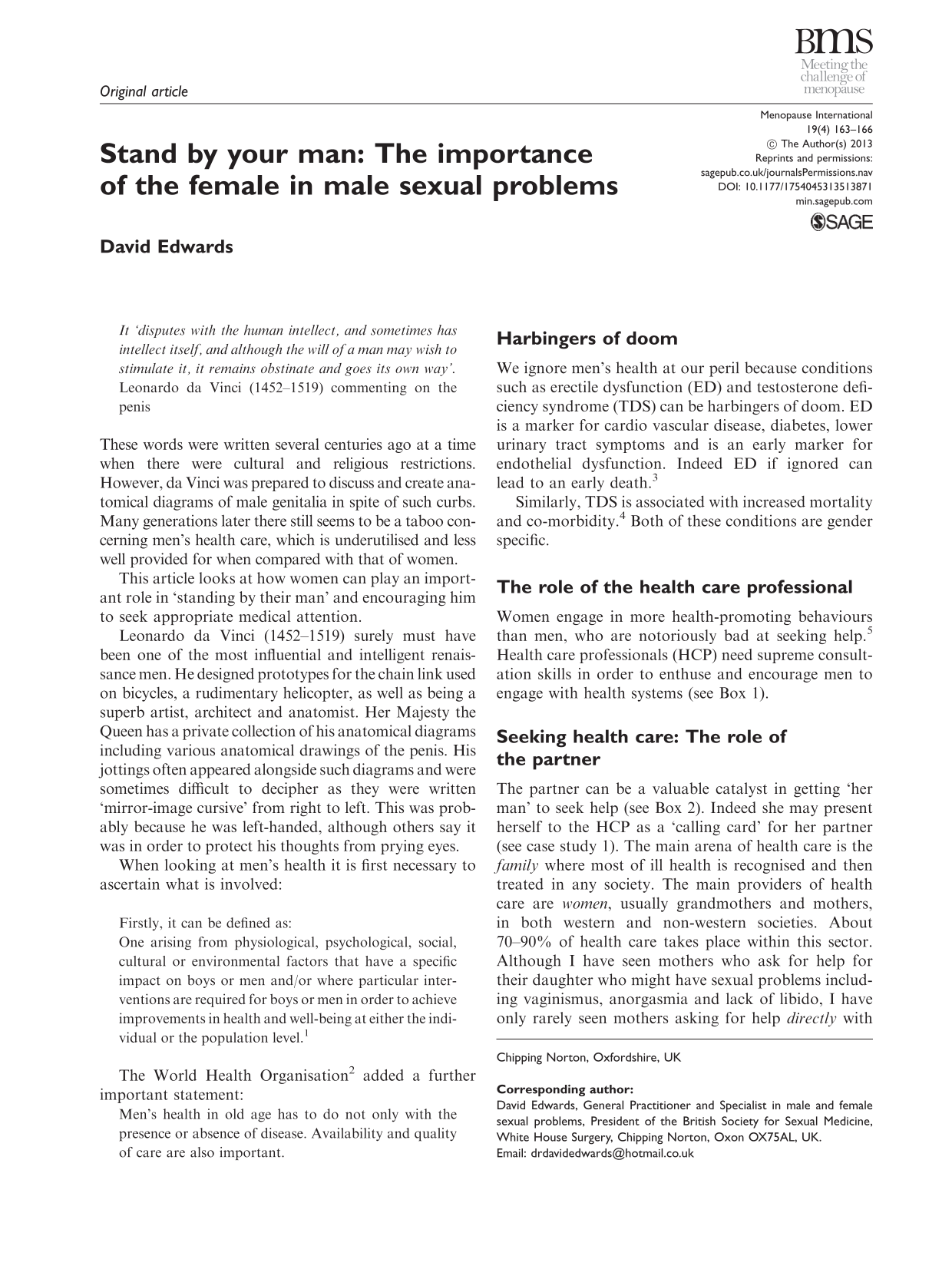
Ways in which the health care professional can help men.
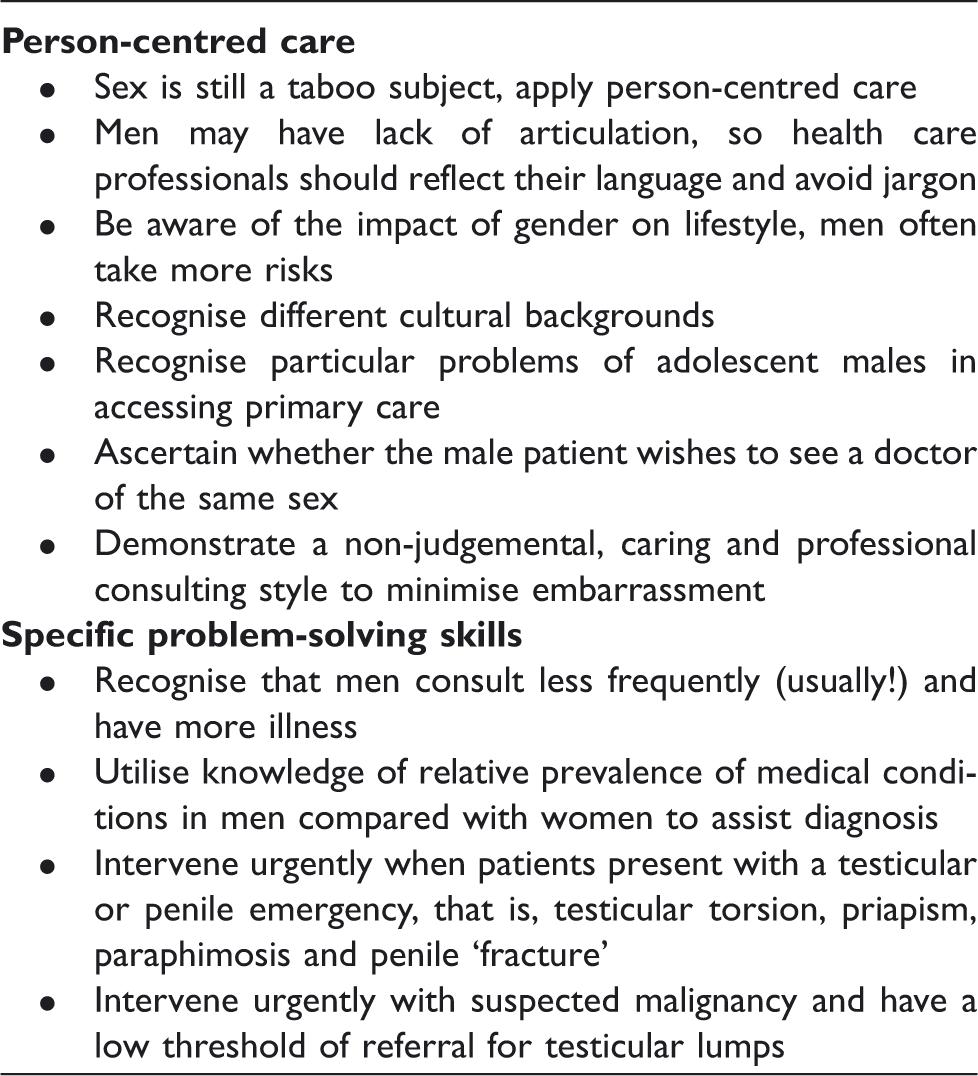
Seeking health care: The role of the partner
Cherchez la femme!
I have, however, seen many mothers sent by their husbands to look at penises in their children! Usually there is nothing wrong with the organ, and probably reflects his own concerns and worries. Reasons for not consulting an HCP are multifactorial and often include embarrassment. Anthropological opinion also comments that when a man does experience an illness or disability it ‘can reduce a man’s status in masculine hierarchy, shift his power relations with women, and raise his self-doubts about masculinity’.
6
Studies confirm this male reticence in seeking help. For example, despite the serious psychological and quality of life consequences of premature ejaculation, few men seek treatment. In the Premature Ejaculation Prevalence and Attitudes survey, only 9% of men with self-reported premature ejaculation had consulted a doctor.
7
Similarly, on average men with ED will suffer for 17 months before seeking medical help.
8
Having ‘got your man’
Once either the HCP or patient has decided to pluck up courage to take things further it is important not to lose him by poor consultation skills.
Taking a basic sexual history:
Listen, look interested and maintain good eye contact and be encouraging with both verbal and non-verbal cues. Do not fiddle with the computer, your mobile or the patient’s notes. Adopt a caring, non-judgemental and professional consulting style. Ascertain what actually happens (and what does not) during sexual activity. Be prepared for anything that might be said.
Case study 1
Sarah, a 28-year-old bank employee, came to see me with headaches. After probing the history a little deeper she burst into tears saying that she wanted to get pregnant ‘like all my friends’. They had been trying for 18 months; after some enquiries as to what ‘actually happens' she said that more often than not Colin her husband ejaculated before vaginal entry. Although he could perform again she felt that he had ‘wasted the best of his sperm on her thigh’. When she raised the issue he got angry saying it was her fault ‘for being so attractive’. He sometimes drank too much but then he could not get it up a second time and now tends to avoid having sex altogether. She then quietly mentioned that when she had got particularly broody she had considered ‘going with someone from work who looked like her husband and had flirted with her at a party… Colin would never guess but when I am in control I tell myself not to be so stupid as I love the rest of Colin if only his penis would get under control’.
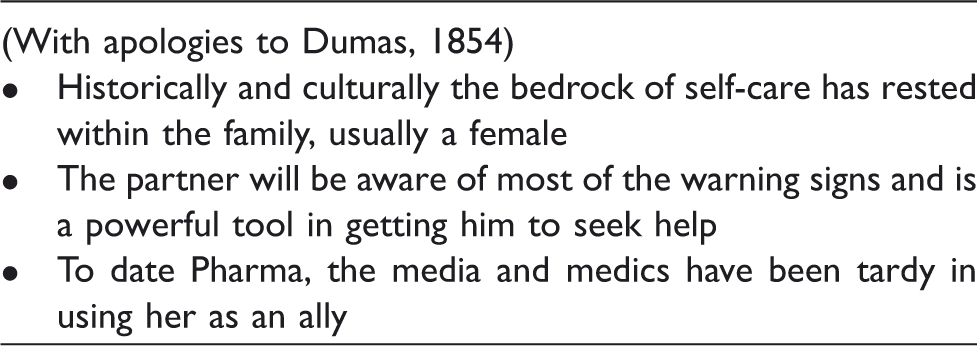
Using a COSH (Contract Of Sexual Health) in order to help the patient
When consulting patients, and ideally their partners as well, I try to initiate the following regime in order to help the patient to help himself (see Box 3). The provides on ongoing programme for the patient and his partner and the clinician and wider primary health care (PHC) team, utilises individual skills of health workers, should include ‘DOs’ not just ‘DO NOTs’ (see Box 3), empower and enthuse the individual. Do not have a ‘one size fits all’ attitude, and proceed gradually, remember the patient thought he was just coming in for penis pills! How to facilitate using the contract of sexual health. smoking: smoking cessation, hypertension: treat to target/modify, hyperlipidaemia: improve, abdominal obesity: dietary advice, diabetes and prediabetes; 30% of my ED patients have a raised glucose: try to improve HbA1c and blood glucose levels, increase fruit and vegetable intake, excess alcohol: inform and modify where necessary, physical inactivity: refer if necessary, ask the patient to choose, that is, do not inflict a gym if he would prefer to walk, psychosocial stresses: one of the most difficult areas to modify in my experience, and
The relationship between men’s and women’s sexual problems
It is not unusual for women to have sexual problems relating to the menopause or post-reproductive health or indeed can sometimes present at any age from teens to old age. These may include reduced libido, lubrication issues and vaginismus. The reasons for this can be psychological, or conditions such as diabetes, cardiovascular disease and cancer. It is important not to forget about iatrogenic causes from prescription drugs such as anti-depressants, chemotherapy, beta blockers and analgesics. Medicine is rarely spilt in a Descartian division as the problem is often due to a mélange of causes which could also include the sexual problems of her partner. It is therefore of paramount importance that when making an assessment of the female patient, who is presenting sexual problems, that the clinician enquires about such difficulties in her partner. Obviously, this needs to be carried out in a considerate and professional manner by the clinician in a consultation scenario that offers privacy and time. It is common for women and their partners to both have sexual dysfunctions. Nevertheless, multinational data showed that all aspects of sex (e.g. intercourse, foreplay, ability to achieve orgasm and attraction to partner) are very important to men and women. 11
Research shows that as a man’s erectile function and sexual satisfaction improve then the sexual satisfaction of his partner improves.12,13 This makes yet another case for standing by your man.
In summary, men tend to be stubborn, proud and embarrassed creatures that may need encouraging to engage with health care services. Women can provide the catalyst in order to get him to seek help.
The words that Tammy Wynette sang many years ago ring true today, as far as a male seeking healthcare ‘cause he's just a man’.