



Abstract
According to legal tradition, the ideal judge is entirely dispassionate. Affective science calls into question the legitimacy of this ideal; further, it suggests that no judge could ever meet this standard, even if it were the correct one. What judges can and should do is to learn to effectively manage—rather than eliminate—emotion. Specifically, an emotion regulation perspective suggests that (a) judicial emotion is best managed by cognitive reappraisal and, often, disclosure; (b) behavioral suppression should be used sparingly; and (c) suppression of emotional experience is rarely helpful. We argue that the dispassionate-judge ideal presents a barrier to achieving the flexibility necessary for adaptive judicial emotion regulation. We suggest a new ideal, that of the emotionally well-regulated judge, and propose several directions for future research to strengthen ties between law and psychology, with particular attention to the study of emotion.
The great political philosopher Thomas Hobbes once wrote that judges should be “divested of all fear, anger, hatred, love, and compassion” (Hobbes, 1651/1904, p. 203). More than three and a half centuries later, this ideal remains firmly entrenched in Western legal and political culture. Consider the outcry when U.S. President Barack Obama suggested he would nominate a Supreme Court Justice with “empathy” (Hasnas, 2009, p. A15). An emotional judge, politicians and the public insisted, is by definition a bad judge. One U.S. senator went so far as to say that an emotional judge might put “nothing less than our liberty … at stake” (Hatch, 2009, p. 13).
But judges are people, and people naturally feel emotions—particularly when exposed to emotionally vivid stimuli, as judges routinely are. Imagine spending your day listening to testimony about a little girl whose parents negligently allowed her to starve; watching a divorcing couple trade insults in front of their children; then finalizing the adoption of a needy child. Most of us would cycle between emotions such as disgust, anger, sadness, hope, and joy. Yet the judge is supposed to feel nothing.
A long-standing judicial ideal, then, stands in sharp conflict with the reality of flesh-and-blood judges. This disconnect with regard to judicial emotion—that is, the range of emotions that any given judge may experience and/or express while carrying out his or her job responsibilities—operates at an intersection between law and psychology that is both theoretically rich and empirically promising.
For several decades, the growing law-and-psychology movement has sought to expose psychologically naïve legal assumptions about how humans think, feel, and behave, and to align legal theory and practice more closely with reliable data (Ogloff, 2002). For example, as eyewitness testimony has been shown to be surprisingly unreliable, the law governing admission of such testimony is changing (State v. Henderson, 2011). Similarly, evidence about emotions’ nature, function, and impact has begun to inform—and replace—the naïve theories of emotion that traditionally have undergirded law (Maroney, 2006). This has set the stage for considering whether law’s expectations of judges are aligned with contemporary psychological theories and data. In the case of judicial emotion, we argue that legal and psychological perspectives are needlessly misaligned, and that the former should be adjusted in light of the latter.
Our primary thesis is that the field of emotion regulation—which is concerned with the processes that influence which emotions we have, when we have them, and how we experience and express them (Gross, 1998)—provides a useful framework for understanding how judges do, and should, manage the emotions they inevitably experience. To ask judges to be dispassionate is to ask them to engage in emotion regulation. However, the traditional legal ideal of literal dispassion creates a regulatory challenge going both to ends and means.
As to ends, affective science strongly suggests that the legal ideal of dispassionate judging is harmful, as it privileges the goal of emotion elimination. Given that emotion now is understood to be a sophisticated, evolved capacity that helps us navigate environmental challenges (Tooby & Cosmides, 2008), the said goal is normatively suspect. Emotion serves a host of valuable functions that are important to judging—for example, supporting moral reasoning (Keltner, Horberg, & Oveis, 2006; Young et al., 2010), motivating appropriate and timely responses to transgressions (Maroney, 2012), and facilitating connection with the human interests at stake (Brennan, 1988). Indeed, judges sometimes assert that emotions play an important role in their work, and they increasingly look to psychology to illuminate what that role might be (Posner, 2008).
As to means—our primary focus here—we maintain that the ideal of dispassion discourages judges from developing adaptive forms of emotion regulation. Indeed, it encourages maladaptive behavior. Several decades of empirical data, which we briefly summarize in what follows, demonstrate not only that judicial emotion elimination is unrealistic, but also that certain regulatory strategies are likely to be far more adaptive for judges than others.
We thus advance a new ideal of the “good judge.” In our view, good judges should seek not to eliminate emotion entirely, but rather to manage emotion skillfully in light of the diverse professional challenges they face. With this analysis we hope to contribute to the development of a workable framework within which theorists and empiricists may investigate both the rhetoric and the reality of judicial emotion. Such interdisciplinary dialogue holds great promise for scholars of both psychology and law who have largely failed to collaborate on questions of judicial emotion (Klein, 2010). Extant treatments of the subject, still few in number, have been generated by and directed to a legal audience (Maroney, 2011a, 2011b; Nussbaum, 1996; Posner, 2001), despite the fact that emotion and its regulation represent particularly vibrant areas within contemporary psychology (Gross, 2007, in press; Koole, 2009). In turn, psychologists’ understanding of emotion regulation can be advanced by close examination of this applied context. Further, incorporating emotion will enrich the psychological study of judges’ mental processes, an area of growing interest (Klein, 2010). By showcasing the emerging dialogue regarding judicial emotion to a psychological audience, we intend to model how disciplinary isolation, when broken, yields to interdisciplinary insight.
We set the stage for this discussion by considering the role of emotion in law generally. Once neglected, this intersection is now the site of robust academic debate and, increasingly, empirical research, trends that recently have expanded to include examination of judges’ emotions. We then present evidence that judges experience emotions, must expend effort to regulate those emotions, and lack any guidance from legal theory as to how to do so. The psychology of emotion regulation, we propose, provides such guidance. We bring these interdisciplinary strands together to identify the regulatory processes that hold the greatest promise for helping judges manage their emotions while remaining true to their professional obligations. We close by pointing to promising areas for future research to further close the gap between law and the psychological study of emotion, particularly as applied to judges.
Law and Emotion: Enemies or Bedfellows?
Law traditionally is thought to be based on reason, not emotion (Bandes, 1999). The underlying assumption, rooted in Western Enlightenment philosophy, is that emotion is a primitive sort of reaction unsuited to higher-order pursuits (Maroney, 2011a; Solomon, 2000). Consequently, legal thinkers often conceptualize law as a mechanism by which rational deliberation is protected from emotion’s pernicious influence (Maroney, 2006).
Over the last century, however, psychological research has shown that emotion is necessary to survival, social cohesion, and practical reason (Tooby & Cosmides, 2008). Inspired by these findings, recent legal scholarship has begun to consider the functions of emotions. Such scholarship may focus on a particular emotion—say, disgust—and analyze the function that emotion plays, or could, or should play, in law—for example, in the criminalization of sexual behaviors such as necrophilia (Nussbaum, 2004). A similar approach may be taken with psychological phenomena deeply implicating emotion. Empathy, for example, might affect how one values a party’s claims (Henderson, 1987), and affective forecasting errors might skew the legal structuring of future events (Blumenthal, 2004). Scholars consider how adoption of a particular theory of emotion, such as a cognitive appraisal theory, drives how emotion ought to be understood in legal contexts (Kahan & Nussbaum, 1996). Conversely, scholars also consider how a particular theory of law might affect how law operationalizes emotion. A law-and-economics perspective, for example, might treat emotion as a predictable factor in the personal cost–benefit analyses on which legal rules are premised (Huang, 2000). Focusing on a specific legal doctrine allows a tight inquiry into how emotion plays out in that domain, such as capital sentencing (Bandes, 2009) or the law of evidence (Brown, 2011). Finally, scholars have begun to interrogate emotion’s impact on law’s dramatis personae, including legislators, jurors, defendants, witnesses, lawyers, and judges (Maroney, 2011a, 2011b). Whichever approach is taken, the overarching goals of law and emotion scholarship are to illuminate the emotional aspects of legal problems, investigate these aspects through interdisciplinary analysis, and integrate that understanding into normative proposals (Abrams & Keren, 2009).
Our present project concerns a particular legal actor, namely the judge, and positions itself in opposition to an entrenched theory of law, one that insists that good judging is contingent on the elimination of emotion. It takes on an emotional phenomenon, that is, the process by which emotion is regulated. Finally, it adopts a set of theories, based in the contemporary affective-science literature, as to the relative costs and benefits of the methods by which humans regulate emotion.
The Reality of Judicial Emotion
Law’s expectation of dispassion reflects an aspiration as to how judges ought to behave. Dispassion is thought to facilitate unbiased decision-making and to enable a neutral image that inspires public trust (Anleu & Mack, 2005). Anger, in particular, may seem to threaten fairness, impartiality, and decorum; indeed, Richard A. Posner—a judge with the U.S. Court of Appeals and a prominent legal scholar—once wrote that we ought to “beware” the “angry judge!” (Posner, 2008, p. 110).
To demand dispassion is to assume either that judges are able to stave off emotional experience altogether or that they are able to intercept and disable such experience. While the former may at one time have had intellectual purchase, the contemporary view is aligned with the latter (Maroney, 2011b). Indeed, U.S. Supreme Court Justice Sotomayor—whose nomination prompted the “empathy” firestorm—testified that, while judges “are not robots,” they must recognize their feelings and “put them aside” (Sotomayor, 2009, p. 71). Thus, the contemporary legal expectation of dispassion rests on the assumption that judges’ emotions are activated by their work, but that they both can and should isolate and neutralize them. The first of these assumptions is well-founded; the second often is not.
Judges do in fact experience a wide variety of emotions in the course of their work. The dispassionate-judge ideal complicates the search for evidence that this is so, as judges face criticism (even derision) for making their reactions known (Posner, 2006). However, a bit of digging reveals judicial emotions’ traces. Posner, for example, has acknowledged that “it would be misleading to say that good judges are less ‘emotional’ than other people” (Posner, 2001, p. 245). Alex Kozinski, the Chief Judge of the U.S. Court of Appeals for the Ninth Circuit, has spoken frankly of a case that evoked deep feelings of fear and dread, as he compared the defendant’s failings with his own (Kozinski, 1997; Maroney, 2011b). A survey of Australian magistrates showed that emotional challenges characterized courtroom working environments. As one described it, judges cannot help but be affected by “seeing absolute misery passing in front of you day in, day out, month in, month out, year in, year out” (Anleu & Mack, 2005, p. 614). Reported legal cases, media reports, and even courtroom videos are replete with examples of judges becoming irate with incompetent attorneys, disobedient witnesses, defiant defendants, and even one another (Maroney, 2012). One Justice of the Wisconsin Supreme Court actually accused another of choking her during a heated professional argument (Maroney, 2012). Emotionless judges are mythical beings, like “Santa Claus or Uncle Sam or Easter bunnies” (US v. Ballard, 1944, p. 94).
It is also true that, by and large, judges appear to think it important to put such emotions aside, and they frequently attempt to do so. One, for example, stated that he must disregard the fact that the juvenile defendant’s wretched life circumstances “made [his] heart weep” (Commonwealth v. White, 2006, p. 658). But putting emotion aside is no easy matter. A criminal-court judge in Minnesota described nearly bursting into tears when listening to a victim impact statement and having to deliberately compose himself (Schuster & Propen, 2010). One Australian family-court magistrate reported frequent feelings of “sadness” and “having trouble walking away” from her work (Anleu & Mack, 2005, p. 613). The surveyed magistrates made clear that they consider this a difficult, and unacknowledged, form of work (Anleu & Mack, 2005)—what Hochschild would call emotional labor (Hochschild, 1983).
Given the dispassionate-judge ideal, it is not surprising that judges report feeling inadequately trained and supported in their emotional labor. An Australian judge reported feeling forced to choose between remaining too emotionally sensitive or growing a “skin thick as a rhino,” either of which would impede job performance (Anleu & Mack, 2005, p. 612). Indeed, the myth of dispassion appears to make judges’ emotional labor more difficult. Minnesota judges complained that because the legal system aims “to strip away emotions,” they become “insulated and numb” (Schuster & Propen, 2010, p. 89).
Judges experience emotion, expend energy to cope with it, and find that effort difficult. Part of the difficulty is that law offers them no guidance. For this, we need to turn to the psychology of emotion regulation.
An Emotion Regulation Perspective on Judging
An emotion regulation perspective begins with the assumption that humans necessarily are emotional at times, and focuses on how we manage those emotions (for an overview and meta-analysis, see Webb, Miles, & Sheeran, 2012). Management is essential because, despite our contemporary appreciation of emotion’s value, emotions are not always helpful. An emotion may be too intense, as with the fear of failure that sometimes paralyzes musicians, or not intense enough, as with the cold (“inhuman”) lack of empathic response in the psychopath. Emotions may also be of the wrong type, as when one reacts to a friend’s achievements with jealousy. Skill in bringing the experience and expression of emotion more in line with one’s goals is a critical facet of “emotional intelligence” (Wranik, Barrett, & Salovey, 2007, p. 393). Further, sensitivity to and compliance with cultural emotion norms advance social acceptance and group cohesion (Beer & Lombardo, 2007).
Emotion regulation is particularly essential at work, where one is expected to feel and display emotion differently than in private life. Flight attendants, bill collectors, social workers, and college professors operate within distinct emotional cultures; indeed, all occupations construct emotion norms, conformance with which influences workplace success (Hochschild, 1983; Steinberg & Figart, 1999). The dominant norm for those in “professional” occupations—like law—is some level of dispassion, which tends to confer societal confidence and respect (Anleu & Mack, 2005, p. 599). Doctors, for example, historically have been socialized toward an “ideology of affective neutrality” (Smith & Kleinman, 1989, p. 59). When judges try to achieve dispassion, they are—like doctors—engaging in emotion regulation to attain and project professional competence.
What form might such regulation take? The commonly used process model divides emotion-regulatory processes into five families, each targeting a different stage of the emotion-generative process and leading to a distinct profile of experience and expression (Gross, 1998). Another approach proposes that regulatory efforts target one of three essential aspects of emotion—attention, knowledge, or embodiment—in order to serve one of three functions—hedonic, goal-oriented, or person-oriented (Koole, 2009). These (and other) models are largely mutually compatible: both distinguish cognitive reappraisal (which modulates knowledge) from expressive suppression (which modulates response), and both acknowledge a range of motivations (Webb et al., 2012).
Using the process model, it is possible to identify and define specific strategies and substrategies within the broad families, and to map onto that integrated model the extant data. For example, attentional deployment might consist of either distraction or concentration, while response modulation might consist of suppressing either the experience or the expression of emotion (Webb et al., 2012). It is also possible to use this framework to analyze complex emotion regulation approaches, such as mindful acceptance, which may include several specific strategies, such as attentional deployment (directing attention to thoughts and feelings) and cognitive change (adopting a neutral, curious stance rather than negatively evaluating those thoughts and feelings).
No regulatory process is by its nature “good” or “bad”; all have both occasional utility and maladaptive manifestations, the difference being largely dictated by context (Gross, 1998). Attempts to influence emotions also may have paradoxical or unintended effects, just as efforts to influence thoughts do (Gross, 1998). Translating the emotion-regulation literature to a real-world context, then, requires close attention to any given strategy’s relative dangers, costs, and benefits, given the constraints and goals at play within any particular context.
Judicial Emotion Regulation
Judges can, and likely do, make use of many, most, or even all of the emotion-regulation strategies embraced by the process model. But these strategies are not all equally well-suited to the judging context. By considering the unique features of that context, we predict which strategies will likely be more or less adaptive.
Situation Selection
Judges may try to choose cases based on their predicted emotional impact. For example, a judge may seek appointment to drug-treatment court because she believes she will take pride in helping addicted persons, or avoid family court if she believes exposure to distressed families will be depressing (Anleu & Mack, 2005). Judges thus may attempt to influence the types of stimuli to which they will most commonly be exposed.
This strategy likely has some efficacy, particularly if a judge correctly predicts her reactions to environments with recurrent features. But that efficacy is limited. Even within a family, criminal, or probate court, judges are certain to encounter diverse triggers: joyous adoptions and acrimonious divorces, defendants who turn their lives around and those who do not, families fighting over scarce assets and wealth being fairly and generously distributed. In state systems, judges may be unable to choose their assignments, or may need to serve in an undesirable court while awaiting assignment elsewhere. Moreover, many state-court judges sit in courts of general jurisdiction with virtually no control over the subject matter of their cases. This generally is true of the entire U.S. federal judiciary: Jurisdictional limits on federal cases (high-value disputes between persons from different states, or questions of federal statutory or constitutional law) shape the docket, but that docket remains extraordinarily diverse.
Nor can judges reliably take a retail rather than wholesale approach to controlling emotional triggers. Judges can recuse themselves from individual cases only for specific reasons, such as avoiding the appearance of bias in cases implicating personal interests, and avoiding unwanted emotion is not one of those reasons. In fact, the U.S. Supreme Court has held that a judge’s emotional reactions will not require recusal unless they pose a serious threat to fundamental fairness (Liteky v. United States, 1994).
Situation Modification
Whatever level of control a judge has over her docket, she may attempt to control how emotional situations unfold in her chambers and courtroom. For example, she might read a brief describing a predatory fraud on the elderly poor only when she can play pleasant music, sip tea, and take breaks; select certain cases to be decided without argument; communicate with difficult colleagues only in writing where possible; and delegate aggravating tasks—such as interacting with annoying attorneys on scheduling issues—to a clerk. However, courtroom-management responsibilities may foreclose many modifications. The judge generally may not, for example, walk out of the courtroom during highly upsetting testimony, much as she might like to.
Perhaps the most significant limitation on judges’ ability to modify situations so as to satisfy intrinsic—that is, self-directed—regulatory goals is the need to perform extrinsic emotion regulation—that is, to shape the emotions of others (Gross & Thompson, 2007). Modifying courtroom situations to influence others’ emotional experience and expression is a critical judicial function. Judges routinely decide whether to expose jurors to vivid evidence, balancing its informational value against a prediction as to its emotional impact (Federal Rule of Evidence 403). They actively manage emotional displays in the courtroom by allowing crying victims to take breaks, ordering lawyers to argue quietly and respectfully, or having disruptive spectators removed. Situation modification for the benefit of others may not address the judge’s own emotion-regulatory needs. To decide whether jurors should be allowed to view gruesome autopsy photos, she must look at them closely herself. Though she can allow a purported victim of child sexual abuse to testify outside the defendant’s presence if doing so will spare that witness serious emotional trauma (Coy v. Iowa, 1988; Maryland v. Craig, 1990), she cannot avoid the defendant no matter how repugnant she finds him. In managing the emotional experiences of others, the judge must place herself squarely in the situations whose effects she is attempting to control.
Attentional Deployment
If, as suggested earlier, many situations cannot be avoided or significantly modified, a judge might direct her attention only to those situational features that evoke a desired emotion. She might, for example, focus on a drug-court defendant’s success in treatment, rather than his failure to look for employment.
Judges’ obligation to attend carefully to cases will limit this strategy as well. This is particularly true with regard to distraction, one common type of attentional deployment. The judge cannot selectively “tune out” testimony, arguments, and presentation of evidence without running an undue risk of neglecting her duties. A lawyer might, for example, make an objectionable argument while the judge is thinking of something else, and failure to catch and correct that error might lead to poor outcomes, such as reversal on appeal. The judge may also have a difficult time later remembering important information about the case. Distracted persons demonstrate impoverished recall of the situations from which they are distracting themselves (Sheppes & Meiran, 2008). Judges’ attention needs to be fairly distributed among a case’s relevant aspects, no matter their emotional salience. Therefore, while attentional deployment strategies might further the hedonic goal of avoiding unwanted emotions and feeling desired ones (Webb et al., 2012), they are likely to frustrate judges’ goal-oriented functions of professional competence and care.
Cognitive Change
If the judge cannot avoid, alter, or ignore an emotionally salient situation, she may change how she thinks about it, thereby altering her response (Gross & Thompson, 2007). One sort of cognitive-change strategy is to change one’s appraisal of the stimulus. For example, if the judge thinks about the drug-court defendant as someone who is doing his best to look for work in an economically depressed area—rather than as unmotivated—she may feel sympathy rather than anger. She might also decide to conceptualize her role solely as facilitating that defendant’s recovery, lessening her emotional investment in his employment status. Similarly, a judge who gets angry when attorneys are late, or when a cell phone goes off in the courtroom, can remind herself that busy lawyers often encounter unexpected delays, and that forgetting to silence a cell phone is common even among conscientious persons (O’Brien, 2004).
A second sort of cognitive change, that of deliberate perspective-taking (Webb et al., 2012), also holds promise for judges. Empirical research shows that perspective-taking helps even laypersons achieve relative emotional neutrality. Experimental subjects asked to view disturbing images “with the detached interest of a medical professional,” and to “think about them objectively and analytically rather than as personally, or in any way emotionally relevant” to them, reliably feel and display fewer emotions than control subjects; they also display enhanced memory of those images (Richards & Gross, 2000, p. 415; see also Hayes et al., 2011). A meta-analysis confirms that perspective-taking has some efficacy in altering emotional response—indeed, its small-to-medium effect size approximates that of changing one’s ideas about the underlying stimulus (Webb et al., 2012).
Adopting a professional attitude is a form of cognitive precommitment that can change how the mind processes stimuli. To a doctor, a wound becomes less disgusting than informational. Similarly, competent judges learn to treat vivid stimuli as professionally relevant rather than personally provocative. Such an orientation helps the judge process stimuli through the lens of specific goals—for example, discerning the autopsy photo’s informational value—and that cognitive lens can change the stimuli’s emotional salience. Indeed, it is a reasonable hypothesis that if in the described experiments one were to substitute the word “judge” for “medical professional,” the laboratory outcomes might be identical. Perhaps the dispassionate-judge ideal has acquired such cultural traction because it is thought to encourage judges to regulate emotion by taking a third-person perspective in all instances.
The perspective-taking function of the dispassionate-judge ideal is, however, likely of only intermittent utility. Laboratory studies show that the technique is effective during a short period of time when the emotional stimulus is anticipated. In the real-life, fluid, and unpredictable situations facing judges (and doctors), they are likely to become emotional before they are able to start trying to control these emotions, which may limit the effectiveness of cognitive change (Sheppes & Meiran, 2008). To be sure, judges, like doctors, may become habituated to recurrent triggers; they also will be more practiced at adopting the desired perspective. Still, every judge will encounter situations that puncture even the most practiced professionalism. One judge, apparently chagrined after being captured on camera yelling angrily at a mother accused of child neglect, reflected: “I reacted humanly; I’ll try not to do that in the future” (Maroney, 2012, p. 1242). Another judge, after sentencing a defendant (convicted of child rape) who repeatedly called him an obscene name, candidly acknowledged that he “lost [his] cool” (Schuster & Propen, 2010, p. 93). Such reports are consistent with evidence that intense negative emotions, such as anger, are relatively harder to control, including by way of cognitive change (Webb et al., 2012).
It is reasonable to conclude, then, that cognitive change represents an important strategy for judges as it can alter the meaning and perceived personal significance of stimuli, but that cognitive strategies cannot be relied upon to extinguish judicial emotion, particularly in novel or highly charged situations.
Response Modulation
As the prior discussion suggests, not every emotional stimulus can be rethought. A child’s tragic death, for example, is bound to provoke emotion except in someone who has shut herself off to human suffering. In another incident captured on camera, a criminal defendant leans forward and spits in the judge’s face (Maroney, 2012). While it might be possible for the judge to recast that experience, its most likely interpretation—as an expression of defiance or hatred—is probably the most accurate.
Judges facing undeniably provocative stimuli therefore may try to alter their emotional responses. Behavioral suppression, a form of response modulation, involves inhibiting the bodily responses to which emotion predisposes the judge. In the spitting video, for example, one can see a look of surprise cross the judge’s face, which then quickly reverts to a relatively neutral expression. Even casual courtroom observation suggests that judges often put on (or attempt to put on) such a “poker face”; an impassive face and still body are part of what the public expects.
Two important outcomes can flow from behavioral suppression. First, the judge models decorum, making the courtroom easier to manage (Anleu & Mack, 2005). Second, the judge blocks perception of her appraisals. This latter move is sometimes important: imagine a situation in which the judge believes that a witness is shading the truth, but in which the jury is entrusted with making the credibility determination. The judge needs to mask her disgust with the witness lest the jury see the information it imparts about her opinion of the witness’ credibility (Maroney, 2011b). Inhibiting expression is relatively effective in down-regulating outward behavioral indicators of emotion (Webb et al., 2012), and therefore serves an important function in shaping the perceptions and emotions of others (Niven, Totterdell, & Holman, 2009).
Behavioral suppression of judicial emotion therefore sometimes is called for. However, it takes significant work to achieve. Suppression consumes cognitive resources, impairing logical reasoning (Baumeister, Bratslavsky, Muraven, & Tice, 1998; Dunn, Billotti, Murphy, & Dalgleish, 2009) and memory (Richards & Gross, 2006). Those functions obviously are central to the judicial task. Nor does incurring those costs ensure change in the judge’s emotions. Behavioral suppression does not lessen the experiential intensity of negative emotion; in fact, it may magnify physiological responses (Gross & Levenson, 1993; Webb et al., 2012). Behavioral suppression’s extrinsic-regulation function thus is not reliably linked to an intrinsic one. Further, in the real world suppression may be hard to maintain. Consider that shortly after the spit-upon judge adopts a neutral facial expression, the video shows that she leans backwards, crosses her arms across her chest, and stares at the defendant with what looks like an angry glower.
A judge may try to bypass the need for behavioral suppression by aiming to suppress emotional experience directly, perhaps by sheer force of will. One judge, for example, described himself as “an iceberg, but there is no heating” (People v. Carter, 2009, p. 5). Unfortunately, attempts to suppress emotional experience or thoughts of an emotion-eliciting event have not been shown to have meaningful effect on emotional outcomes (Webb et al., 2012). Ironically, pushing emotions out of the mind can increase actually their intensity—particularly when under stress or cognitive load (Wegner, 2009), two conditions that commonly attend judging. Experiential suppression can harden into a repressive coping style, associated with poor health outcomes (Chambers, Gullone, & Allen, 2009) and callous arrogance (Koole, 2009). These outcomes pose obvious dangers to judges. The former may increase burnout, while the latter may feed abuses of power. Indeed, in a case removing a judge from office, the court relied upon testimony from the judge’s treating psychiatrist that his single-minded desire for emotional control routinely backfired, leading to a repressive coping style characterized by instability and abuse (In re Sloop, 2007).
Finally, judges might respond to emotion by using emotional disclosure, or describing an emotional episode to another person or persons (Rimé, 2007). Emotional disclosure is a response-oriented strategy insofar as it is engaged after emotional onset, but its goals may include facilitation of other regulatory strategies. Enlisting the perspective of others can help one rethink underlying appraisals, and can equip the person to more deliberately choose or modify future situations by reflecting openly on their past emotional impact. While some of these laudable goals may be pursued through introspection, evidence suggests that a social-sharing aspect is often beneficial. Judges who employ this strategy may choose to reveal their emotional reactions to family, friends, colleagues, or even the public—for example, by allowing emotion to infuse written opinions and in-court statements.
Though it directly defies the ideal of judicial dispassion, such emotional disclosure holds great promise (if, as discussed in what follows, done for the right reasons). Though thinking and talking about emotions does not generally lessen their intensity, it enhances self-knowledge and can help one live with emotion more comfortably (Koole, 2009; Rimé, 2007). Judge Kozinski, for example, believes that by sharing his feelings he has become better able to appropriately integrate them into decision-making (Maroney, 2011a). When a Los Angeles judge wrote an article discussing his frequent anger at lawyers, parties, and jurors, it represented an important step in his journey to lessen that anger and lengthen his career (O’Brien, 2004). It is reasonable to conclude that the social sharing of emotion holds a similar range of potential benefits for judges as it does for people more generally. Unfortunately, emotional disclosure is highly stigmatized in judges (Posner, 2006), likely reducing their use of this strategy and certainly reducing the openness with which they do so.
However, as do all emotion-regulation strategies, disclosure has potential downsides. Using declarative language to describe emotional experiences and reactions can be destructive, as when one spreads messages of hatred or vitriol. Ironically, the judicial emotion whose expression is least stigmatized is anger (Maroney, 2012). U.S. Supreme Court Justice Antonin Scalia, for example, is known for the anger and even contempt with which he infuses his dissents (Wrightsman, 1999). Anger is a powerful, confrontational emotion, one that generally imputes blame to a fellow human being; it therefore has unique potential to fray social bonds (Maroney, 2012; Potegal & Novaco, 2010). Moreover, giving voice to anger sometimes increases its intensity, rather than simply failing to decrease it (Bushman, 2002). Judges who directly express anger—particularly if they do so vehemently and frequently—risk irreparable damage to their reputations, impairment of important relationships with colleagues, and accusations of abuse and misconduct (Maroney, 2012). The same may be said of expressions of contempt, which invariably communicate a belief in the object’s inferiority (Maroney, 2012). Emotional disclosure, then, can be highly adaptive or concretely destructive, depending on the judge’s objectives for disclosure, the manner of disclosure, and the emotion at issue.
A New Ideal: The Emotionally Well-Regulated Judge
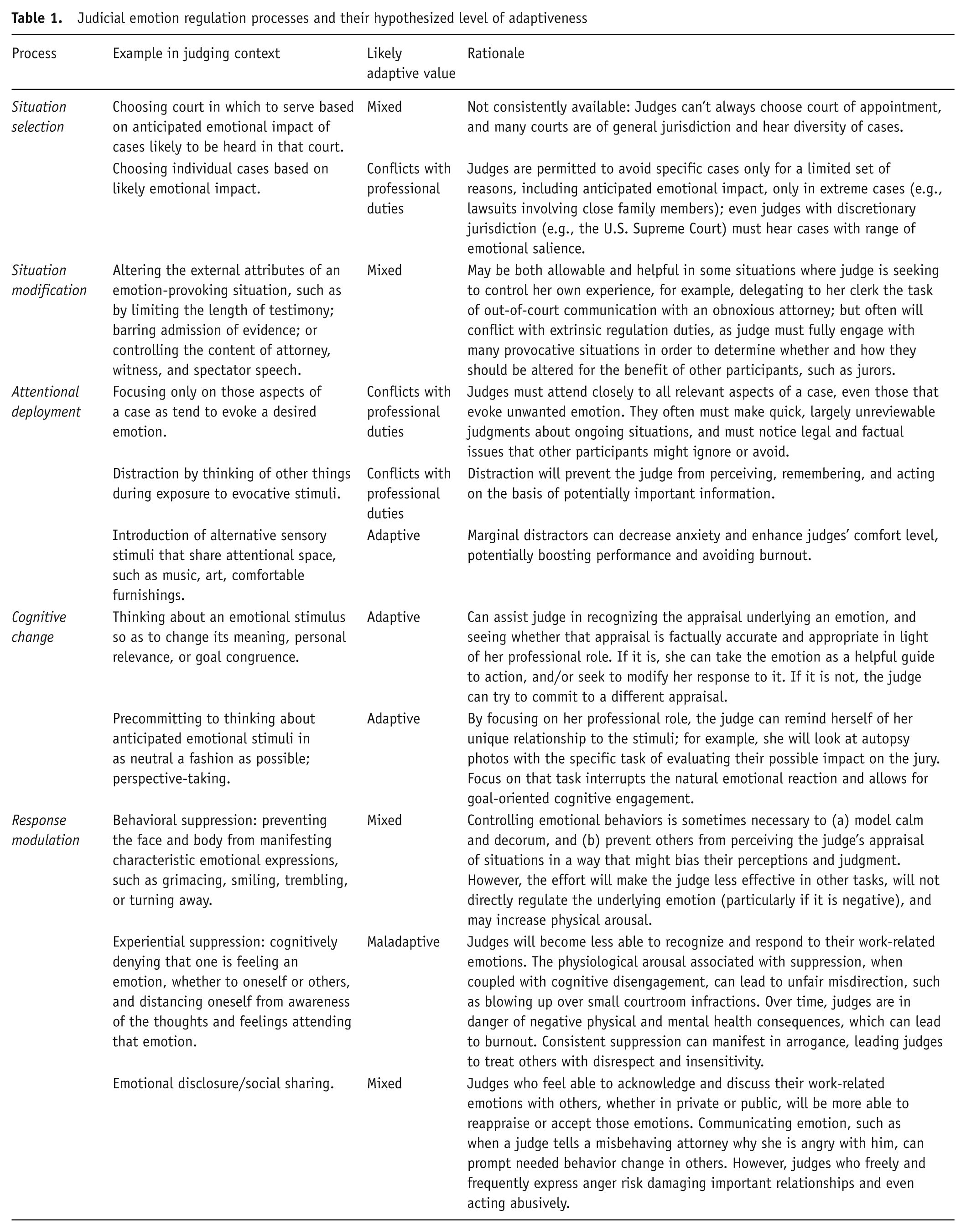
Judges have emotions. But what is crucial is what they do with these emotions. Our analysis, whose hypotheses are summarized in Table 1, suggests that the emotion-regulation strategy most likely to be both appropriate and effective for judges is cognitive change. Cognitive change promises a tool with which judges may harness the power of reason, enabling them to perceive (and potentially rethink) their underlying appraisals and encouraging them to interpret stimuli through a professional lens. Emotional disclosure often will be positive as well, as it may provide an opportunity to enlist others’ perspectives in processing, rethinking, learning from, and coping with work challenges. However, certain forms of disclosure—such as a judge using a newspaper interview to share publicly his hatred for a colleague (Maroney, 2012)—can be destructive. Situation selection and modification, as well as attentional deployment, are likely to have some utility, but often will be either unavailable or in conflict with job requirements. Behavioral suppression is sufficiently costly that it should be reserved only for situations in which it is necessary to extrinsic emotion-regulation duties. The evidence also strongly suggests that experiential suppression is a particularly poor choice. Finally, given the range of situations judges encounter, flexibility is judges’ greatest asset—as it is for all humans (Eisenberg, Hofer, & Vaughan, 2007).
Judicial emotion regulation processes and their hypothesized level of adaptiveness
One major barrier to such flexibility is the dispassionate-judge ideal itself. A blanket prohibition on emotion hampers a differentiated examination of the role emotions play in judging; judges therefore are hindered (or at a minimum not helped) in their ability to label, identify, and understand their emotions, abilities critical to concepts of emotional intelligence (Barrett, Gross, Conner, & Benvenuto, 2001). If judges have internalized the traditional legal narrative that emotion is stubbornly irrational, they will be predisposed toward commensurately simplistic regulatory strategies, and experimentation is unlikely to seem worthwhile (Gross & John, 2007; Wranik et al., 2007). Context-sensitive regulation thus is hamstrung by unrealistic insistence that good judges either feel no emotions or are able effortlessly to set them aside.
In contrast, realistic assessment of regulatory options, coupled with assessment of their differential appropriateness and impact, can help judges meet the challenges of their vital work. Rather than expecting judges to regulate emotion in an empirical vacuum, we may draw on empiricism to formulate a new ideal: not the dispassionate judge, but the emotionally well-regulated one.
Directions for Future Research
We have proposed that the insights of affective science are highly relevant to understanding how judges meet the daily challenge of regulating emotion. We further have integrated those insights into new theory of how judges should meet that challenge. The exercise reveals promising directions for future research.
First, empirical research on judges’ emotions remains scarce. Much of the extant evidence is accessible only through what might be described as a treasure hunt, trolling through judicial opinions, media reports, and the like. We could learn an enormous amount were we to study judges directly, exploring their perceptions of the emotional aspects of their work. In addition to the two small studies we reference (Anleu & Mack, 2005; Schuster & Propen, 2010), we are aware of only one such effort. A team of Swedish researchers has received funding to analyze judicial emotion through observation and qualitative interviews (T. Maroney, Å. Wettergren, & S. Bergman-Blix, personal communication, April 30, 2012). The theoretical model we propose could both justify and inform such empirical investigations. Such research may illuminate critical contextual factors—for example, hearing criminal rather than civil cases; working in relative isolation (as U.S. trial judges do) or in a group (as U.S. appellate judges and many European trial judges often do); and operating under an inquisitorial or adversarial structure. The emerging literature on group-level emotional processing and experience (Hess & Kirouac, 2000), as well as on the sociology of emotion (Kemper, 2000), would be highly relevant to these questions. Exploration of individual differences might advance understanding of judicial “temperament.” Comparative work might yield important insights into the role of culturally divergent social constructions of judging. In addition to advancing our understanding of this understudied area, empirical research could facilitate development of professional training programs.
Second, research could explore the parallel between law and medicine. Doctors’ emotions have long been as stigmatized as judges’, and research suggests that medicine’s historical commitment to dispassion has been just as paralyzing. Canadian researchers found that oncologists believed emotional “detachment” was expected of them and struggled with grief that felt “shameful and unprofessional”; this combination impaired quality of care (Granek, 2012). Despite such findings, medicine is several steps ahead of law. Medical pioneers have begun to cultivate doctors’ “emotional intelligence” through professional training and changes to the medical-school curriculum; such efforts show promising results (Grewal & Davidson, 2008; Satterfield & Hughes, 2007), and might be adapted to the judging context.
Finally, emotion researchers and legal scholars ought to explore collaborative partnerships such as the one we attempt to model here. Given the many legal contexts other than judging to which affective science is relevant, the possibilities are varied and rich. This interdisciplinary effort promises to change the relationship between law and emotion—and, by extension, law and psychology—from one of frequent conflict and tension to one of growing harmony and synergy.