



Abstract
Cultures, institutions, and social roles powerfully shape affective experience. Four types of social affect—cultural sentiments, characteristic emotions, structural emotions, and consequent emotions—characterize relations between culture, social structure, and individual affective experience within social interactions. This article briefly reviews findings from contemporary research traditions about these forms of affect and finishes with simulations comparing predictions about social emotions across cultures. The results of that simulation study illustrate how we might use data and tools from affect control theory to investigate differences in basic cultural sentiments, as well as predictions about the core types of social emotions—those associated with identities, those associated with structural relationships, and those evoked by a social event.
Theorizing about the relationship between feelings, culture, and structural order is a core concern of sociology. Durkheim investigated the Arunta aborigines in Australia to understand how intense, shared feelings result from religions rituals and transform the profane into the sacred (1912/2001). Marx (1884/1988) described how alienation from feelings about oppression interferes with recognition of class interest and can result in collaboration with an oppressive regime. Contemporary sociology of emotion continues to inform us about the way that affect infuses institutions, identities, and interactions—and the way that emotion operates as consequence and force within those interactions and settings (Robinson, Clay-Warner, & Everett, 2008). This article reviews a sampling of contemporary sociological research that illuminates how affect shapes group and institutional dynamics as well as the power of culture and situated action to mold affective experiences. The article closes with a theoretical simulation that illustrates an approach for integrating the analysis of culture more squarely into this research literature.
This review focuses on two main types of affect—sentiments and emotions—that capture how culture operates in two levels of social life. Here, sentiments refer to trans-situational, generalized affective responses to specific symbols in a culture. These include meanings associated with identities, actions, and social settings. Sentiments are widely shared within a linguistic culture, but can vary between cultures and subcultures. Osgood (1962) called these “affective meanings” to distinguish them from the more denotative types of meanings of labels that we find in dictionaries. Osgood and others found that three abstract dimensions of sentiments—evaluation (good vs. bad), potency (powerful vs. weak), and activity (lively vs. quiet)—represent affective reactions to a wide variety of concepts in a wide variety of national cultures, even while the content of sentiments varies cross-culturally (Osgood, 1962; Osgood, May, & Miron, 1975; see review in Scholl, 2013). Sentiments serve as cultural abbreviations in the form of affective associations that allow us to compare feelings toward various identities, behaviors, and institutions across groups, cultures, and time.
The other form of affect of interest in this article, emotion, refers here to temporary feeling states evoked by symbolic processing of events and that involve corporeal manifestation. This article distinguishes three types of social emotion—characteristic, structural, and consequent emotions (MacKinnon, 1994). Individuals experience characteristic emotions when performing a role or identity perfectly, or, consistent with internalized cultural expectations for that role. These emotions reflect the meanings of the activated identity. Structural emotions refer instead to recurrent emotions that individuals experience in the context of role relationships. These include the dominant emotion a mother feels when interacting with her son, or that a nurse feels when interacting with a patient. Situations—and relationships—constrain the degree to which experiences can be perfectly confirming. Consequent emotions are feelings individuals experience in the context of specific, situated events. Consequent emotions arise from the particular configuration of identities, action, and context relevant in the social event itself.
Affective Sentiments
Much of the research examining affective sentiments within and between cultures comes from the affect control theory tradition. Heise (2001) found that the identity and behavior sentiments in the US, Germany, Japan, China, Canada, and Northern Ireland are highly correlated in evaluation, and that the US correlates at about 0.8 or higher with all of these cultures. The activity of U.S. sentiments predict the activity of sentiments in Canada, Germany, and Japan well (correlations around 0.7), but not Northern Ireland or China. Schneider (1999) compared U.S. and German sentiments for over 400 identities. His results provocatively reveal that violent and sexual-erotic identities and behaviors have highly differentiated sentiments in German culture but not in U.S. culture, where those sentiments substantially overlap. Consequently, German students associated passionate emotions with sexual-erotic identities; American students associated more deviant and violent emotions with these identities.
In another comparison of German and U.S. sentiments, Schneider and Schröder (2012) present a cross-cultural, over time, study of change in cultural sentiments toward authority in Germany and the United States. They document a change in authority stereotypes in the US from a transactional management style to a charismatic management style and a change in authority stereotypes in Germany from a transactional/coercive management style to a more purely coercive management style over a similar time period.
Characteristic Emotion
Social institutions shape cultural identities and selves which, in turn, shape emotional experiences (MacKinnon & Heise, 2010). Several recent articles have used nationally representative data to investigate how institutional identities relate to emotional experience. Such patterns may or may not reflect the experience of characteristic emotion, which arises from the perfect confirmation of an identity. Analysis of recent feelings by gender may not capture feelings within interactions in which gender was a salient identity, for example. Such findings do, however, give us an opportunity to see how patterns of emotional experience vary across core social identities. Using nationally representative data, Simon and Nath (2004) found that men and more educated respondents reported more frequent feelings of calm and excitement; while women and less educated respondents reported more frequent feelings of sadness and anxiety. Men and women reported experiencing shame and anger with similar frequency; but women experienced anger more intensely and for longer. Lively and Heise (2004) also found that individuals’ arrangement in demographic space shapes emotional experience—especially the configuration of co-occurring emotions. In general, more education predicts greater emotional activation, higher occupational prestige predicts more emotional pleasantness, and larger family income predicts more emotional dominance. Collett and Lizardo (2010) analyzed the relationship between the experience of anger and occupational status (identified by income and education). They found that individuals at the extreme ends of the status and prestige hierarchy are more likely to experience anger than those of medium status.
Again, analyses of emotion across core demographic and institutional identities are unlikely to map nicely onto characteristic emotion—partly due to issues of identity salience and partly because of opportunities for role conflict. Aggregations of emotional experience by large social categories in these studies undoubtedly combine both identity-confirming and identity-disconfirming experiences across a number of activated identities. If characteristic emotion arises from an ideal performance of a social identity or role, what happens when two conflicting roles are activated? Combining ecological and identity arguments, Smith-Lovin (2007) theorizes that the parallel processing of identity enactments can lead to mixed emotions. Lizardo and Collett (2013) test an elaboration of this argument and find that structural features likely to activate multiple contesting identities, such as size and heterogeneity of the audience, predict rates of embarrassment. These examples call our attention to the importance of role relations for identity performances, and the contingency of our emotional responses on those relations.
Structural Emotion
Structural role relationships constrain the degree to which we can perfectly confirm our identities. Some roles or identities may have an ideal counterrole with whom situated interactions could ideally confirm both roles (e.g., husband–wife). Other identities may require interaction with a number of different roles in order to be confirmed, on average, across a series of interactions (e.g., nurse–patient, nurse–doctor). Thus, while characteristic emotions occur only in identity-confirming events, structural emotions can occur in identity-confirming or identity-disconfirming events (MacKinnon, 1994). Structural emotions arise from interactions within socially structured relationships. They refer, for example, to the typical emotion a mother experiences when interacting with her daughter in ways that confirm both the mother and daughter identities.
Some of the more basic information that we have about structural emotions comes from experimental literature on social exchange. In their theory on relational cohesion, Lawler and Yoon (1996) demonstrate that the configuration of power within and between exchange partners leads to predictable patterns of emotion. Individuals tend to experience more positive emotion when interacting with partners who are equal to themselves in power dependence (Lawler & Yoon, 1996). Greater total power between the two partners also leads to more positive emotion (Lawler & Yoon, 1996). Applying principles of exchange theory to interactions between humans and technology, Shank (2012) found that technological actors tend to dampen the intensity of emotional responses to both just and unjust behavior.
In a creative study demonstrating how structural emotions can serve as both signal and social force, Taylor (2011) showed how social arrangements influence biological outcomes (hormones) which in turn reproduce structural inequality. In particular, she found that being a gender minority in workplace interactions produces a biological stress response (measured with cortisol), that in turn affects task performance.
Francis (1997) conducted a qualitative investigation of two support groups—a divorce group and a bereavement group—observing, unsurprisingly, that people entered both groups with negative identities and the unpleasant, powerless, and low activation emotions. Divorced individuals felt responsible for the breakup of their marriages while bereaved spouses felt responsible for their partner’s pain and death. Bereavement and divorce both involve the end of an ongoing structural relation. Consequently, they prevent the typical behaviors used to restore positive identities within a relationship and check negative emotion spirals. In the absence of being able to redefine the event (divorce, death), Francis found that support group leaders managed identity meanings of group members and of their former partners. Leaders reinforced valued identities for group members that would generate positive feelings from new events. More surprisingly, group leaders helped relabel the former partners in negative ways, attributing them responsibility for the divorce or death. In this way, the group leaders kept members from being immobilized by negative structural emotions evoked by role relationships within which they could no longer interact.
Consequent Emotion
Consequent emotions can occur in identity-confirming or identity-disconfirming events and are contingent on the specific behaviors of individuals. The majority of both qualitative and experimental research on interaction and emotion focuses on the investigation of consequent emotions. At the core of relational cohesion theory, and its theoretical cousin, the affect theory of social exchange is the finding that successful exchanges lead to positive emotion (Lawler, Thye, & Yoon, 2000). Consistent with this theory’s focus on emotions as social force as well as social outcome, their research also finds that positive emotion, in turn, leads to greater group cohesion and commitment. In his research extending theories of human–human interactions to describe interactions with technology, Shank (2012) finds that social interactions and trust relations with technological actors are governed by very similar processes as interactions with humans. In a quasi-experimental study, Robinson and Smith-Lovin (1992) found that praise for a social performance generated positive emotions for individuals regardless of social self-esteem, even though low social self-esteem individuals preferred to interact critics of their performance (who confirmed their negative self-identities). They interpreted this as confirmation of affect control theory’s model of consequent emotion, in which the character of emotion is predicted by a combination of identity meanings and the degree to which local events confirm those meanings.
In a vignette study, Heise and Calhan (1995) also found support for affect control theory predictions about specific consequent emotions that should arise from particular social interactions. Heise and Weir (1999) later examined scatter plots of distances from the affect control prediction and the frequencies with which respondents chose an emotion and found that the distributions of these errors provided even more nuanced support for the theory’s predictions. Reported emotions were usually very close to the theoretical emotion predicted by affect control theory and emotions far from the theoretical emotion predicted by affect control theory were rare.
Schröder and Scholl (2009) used a similar measure to test predictions from the German affect control theory equations about consequent emotions in a laboratory study of leadership style. In their experiment, participants interacted in a mock organization, with half of the groups being primed with an authoritative leadership style and half primed with a democratic leadership style. They compared actual observed behaviors and emotions with those predicted by the theory and found support for the predictions, in both the pattern of observed behaviors and emotions as well as the correlations among the distances between predicted and observed behaviors/emotions.
An Illustrative Simulation
Several of the studies described in this article rely on ideas or predictions from affect control theory to understand the role of culture and structured interactions in shaping affective experience. Affect control theory invokes all four types of social affect described in this review—sentiments, characteristic emotion, structural emotion, and consequent emotion. In a recent article, Rogers, Schröder, and von Scheve (2014) make a case for affect control theory as a platform for connecting theorizing about emotion from different disciplines and across differing levels. The final part of this article turns specifically to this theory, and uses computer simulations to illustrate how affect control theory might help us understand how cultural sentiments shape the experience of social emotions.
A full description of affect control theory is beyond the scope of this short article, but fuller descriptions and reviews of the empirical literature can be found elsewhere (Heise, 2007; Robinson & Smith-Lovin, 2006). Affect control theory rests on the assumptions that (a) actors react to social situations in terms of symbols, and the meanings that those symbols carry for them, (b) meanings that symbols have are largely shared within a culture, leading actors to be able to role-take, viewing the situation from the position of other actors and anticipating their reactions to the interaction, (c) actors are motivated to maintain meanings associated with activated identities, (d) meanings can shift within situations as a result of one’s own or others’ actions, and (e) emotions act as signals about how events are maintaining or failing to maintain self-identities within an interpersonal situation. The theory uses the dimensions of evaluation, potency, and activity described before to index the meanings of behaviors, emotions, and identities.
The theory is mathematically stated and rests on a set of impression-change equations that describe the way that affective meanings shift as a result of interactions. These equations are mathematically manipulated to implement the affect control principle: the assumption that individuals behave to maintain or restore affective meanings associated with activated labels. The “affect” referenced in this affect control principle has the same meaning as sentiments in this article. And, as noted in the previous lines, sentiments vary from emotions. Accordingly, an additional set of equations are used to predict emotion in affect control theory. The content of these emotion equations reveals the extent to which emotions are produced by features of the activated identities, features of the event itself, and the interaction between the event and the identity. The impression-formation equations, and the emotion equations, are estimated using observed inputs (in the form of sentiment ratings and event ratings) within a particular culture. At present, there are full sets of impression-formation equations for the US, Canada, Japan, China, and Germany. 1
Combinations of the impression-formation equations, the behavioral equations that implement the control principle, and the emotion equations can be used to make specific predictions, in a given culture, about consequent emotions arising from specific labeling of identities and events. Characteristic emotions are predicted as a weighted function of identity sentiments. Predictions about structural emotions make use of identity sentiments of both the actor and the recipient of that action. In all of these calculations, both sentiments and weights vary by culture (see Heise, 2007, for details). These calculations can be used to generate predictions within cultures or compared across cultures to make predictions about cross-cultural variation in emotional responses to events. The following simulation study illustrates the potential usefulness of affect control theory for investigating affect and emotion cross-culturally.
Characteristic, Structural, and Consequent Emotions across Cultures
Table 1 displays sentiment profiles used as inputs for this simulation study. Each profile contains three numbers, representing, in order, the evaluation (goodness), potency (power), and activity (expressiveness) associated with each concept. The sentiment ratings can vary between 4.3 and −4.3. 2 The profiles from the US, China, Japan, and Germany were retrieved from the sentiment dictionaries housed in Java INTERACT (Heise, 2001). The sentiment profiles for the Arabic concepts come from a pilot study conducted by Smith-Lovin, Heise, Abdul-Mageed, Freeland, and Rogers (2010) in preparation for an international data collection project now underway in Egypt and Kuwait. This is not intended to serve as a rigorous comparison between these cultures. Such a comparison would require using the original (native language) concepts, and choosing sets of multiple related concepts to make sure small differences in the denotative meaning of the translated words were not driving the focal comparisons. Moreover, the Arabic data provided here do not in any way represent a culture, having been collected from a convenience sample of Arabic speakers from different cultures of origin, all residing in the United States. These ratings can, however, serve as an illustration of how one might start such a cross-culture comparison, and give us some insight into how the characteristic, structural, and consequent emotion predictions vary with cultural sentiments and cultural equation data.
Cultural sentiment profiles a for identities used in simulations

Note: aOnly male sentiments were available for the Arabic comparisons, so these simulations used male sentimenets for all other cultures. bThe sentiment profile is for kangofu, Japanese for “(female) nurse”. cThe sentiment profile is for r’eyesh alemmerdat, Arabic for “head nurse”. dThe sentiment profile is for mureshed, Arabic for “advisor”.
The routine institutional identities of neighbor, nurse, student, and teacher are positively evaluated in all of the cultures, according to the sentiment profiles in Table 1. The most negatively evaluated role in each culture was the identity of patient. In the US, Canada, and Germany, a patient is seen as having a mildly positive, mildly weak, and quiet identity. In both Japan and China, this role is evaluated as bad, weak, and quiet. In the Arabic pilot data, the sentiments run closer to good, mildly powerful, and slightly expressive. The most positively evaluated identity varied across these cultures. In the US and Canada, teacher has the most positive sentiment profile, and the most powerful. In Germany and China, students are more positively evaluated. All of the identities except patient were rated very positively by Arabic speakers, but neighbor was seen as the most positive and powerful of all. In every culture except China, teachers were seen as more powerful than students. In China, teachers and students were rated as similarly powerful, but students were seen as considerably more active than teachers. Neighbors are positive identities in all of the cultures, but especially among the Arabic-speaking raters.
Table 2 displays the calculated profiles for the characteristic emotion associated with each of these identities in the six “cultures.” 3 Below the profile is a label (in English) for the concept that is closest to that profile in the dictionary for that culture. 4 Consistent with the fundamental sentiments in Table 1, the patient is expected to experience neutral to mildly positive emotions when confirming this role, except in China and Japan. Those cultures anticipate patients will feel more negative emotions by default—with (English) labels corresponding to feelings like heavy-hearted, or joyless.
Predicted a characteristic emotion by culture and identity

Note.
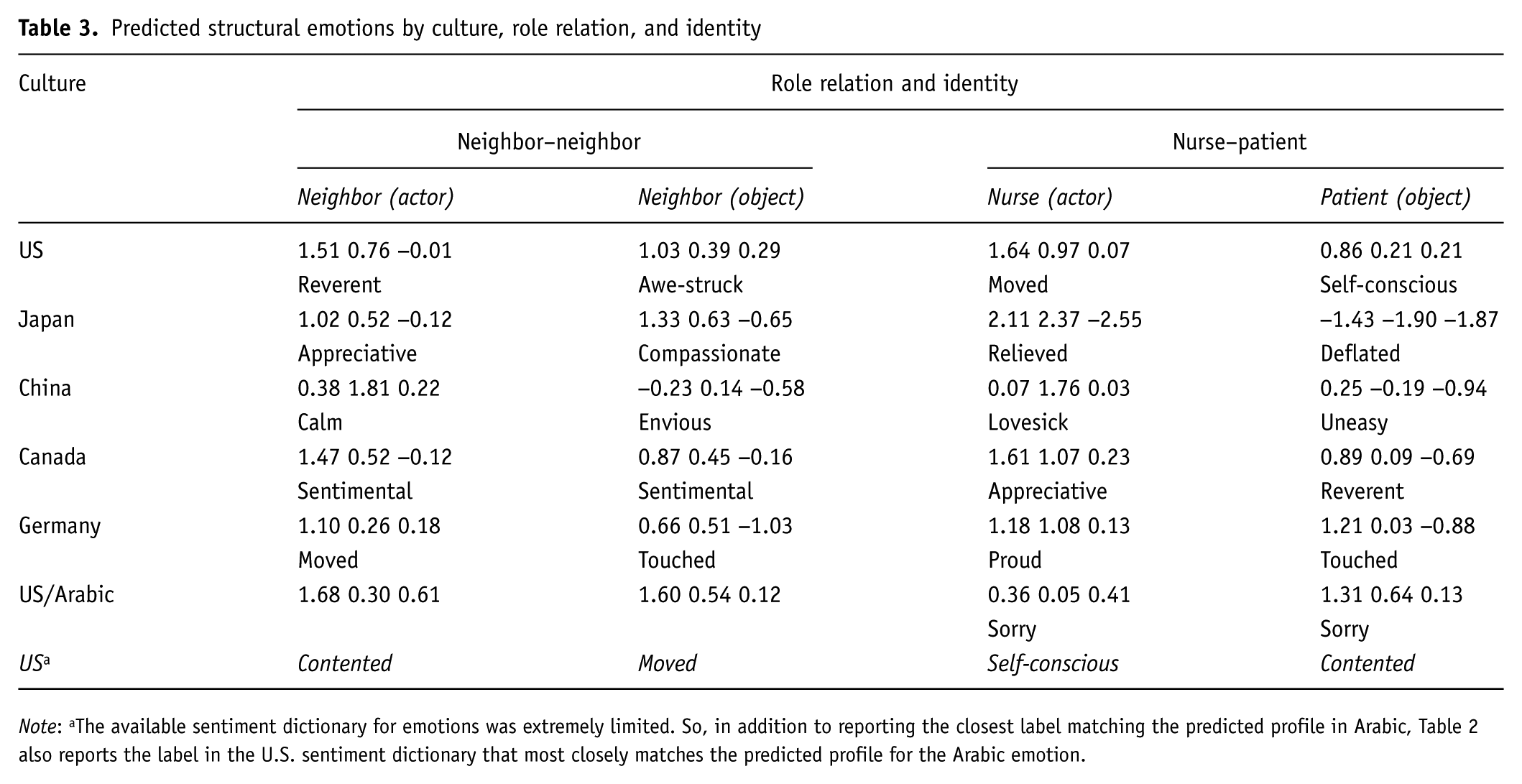
Table 3 displays the sentiment profiles and labels for the structural emotion calculations in the role pairings, neighbor–neighbor and nurse–patient. In this table, the first identity serves as the actor in an event optimally confirming those identities (as much as possible), and the second identity serves as the object, or recipient of the behavior. When a neighbor behaves in normative ways toward a neighbor, both neighbors are expected to experience relatively positive emotions in all of the cultures except China, where the predicted valence is more neutral, but the acting neighbor is expected to feel more powerful than the neighbor on the receiving end of the behavior. In the US, Canada, Japan, and Germany, the structural interactions between nurses and patients inspire more positive and more powerful routine emotions for nurses than for patients. In the Chinese data, a nurse’s emotion is not more positive, but it is considerably more powerful.
Predicted structural emotions by culture, role relation, and identity
Note: aThe available sentiment dictionary for emotions was extremely limited. So, in addition to reporting the closest label matching the predicted profile in Arabic, Table 2 also reports the label in the U.S. sentiment dictionary that most closely matches the predicted profile for the Arabic emotion.
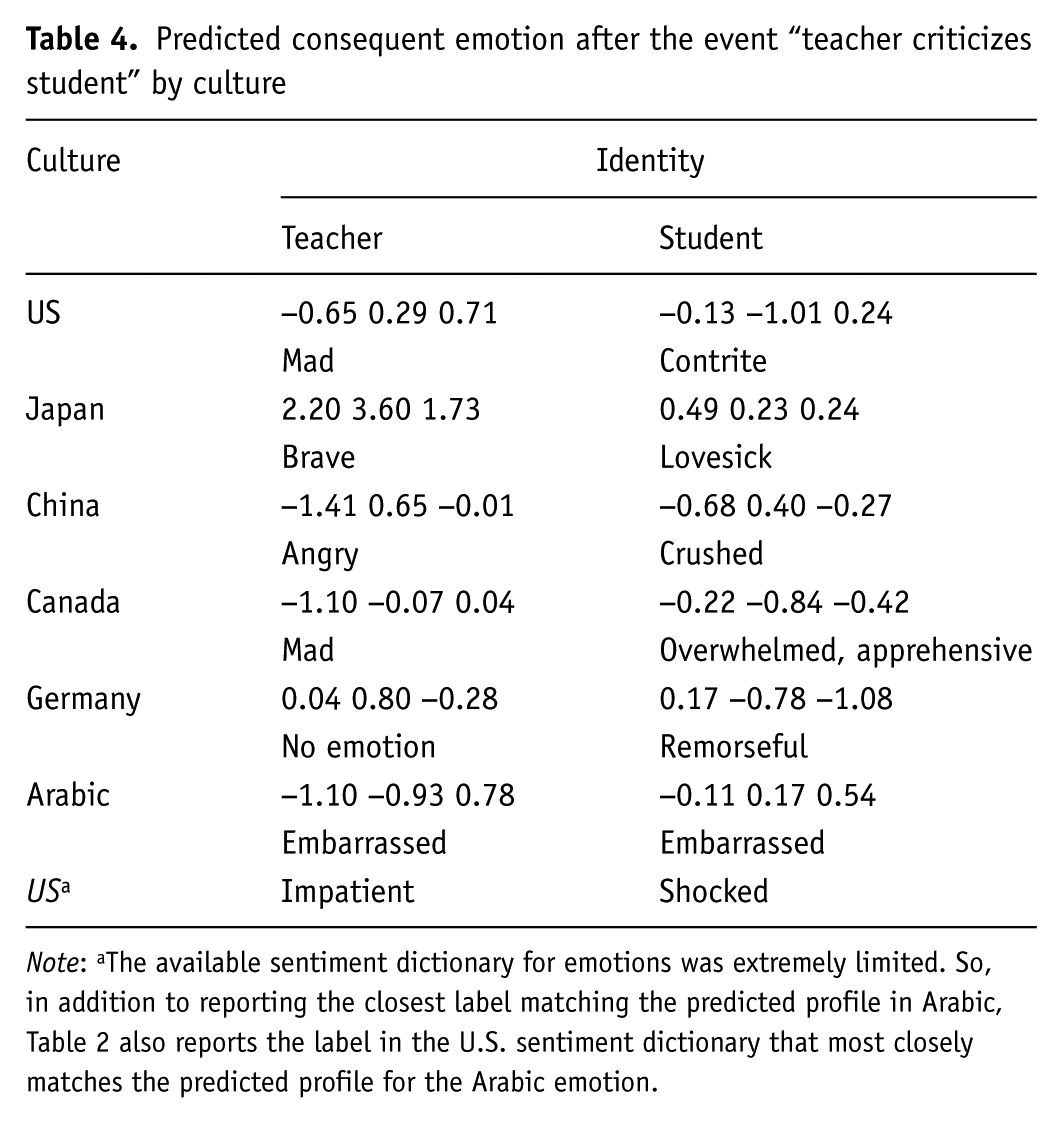
Table 4 displays the predicted sentiment profiles for the consequent emotions experienced by a teacher and a student after the event: teacher criticizes student. This event inspires fairly different predicted emotional reactions across these cultures, in ways that are related to the input sentiment profiles associated with these identities. In particular, in all of the cultures except Japan and Germany, a teacher is expected to feel bad after criticizing a student (mad or angry in the US, China, and Canada). In the German data, the teacher is expected to feel more neutral and slightly powerful, while the student should feel neutral and a bit weak. Interestingly, in the Japanese data, where there is a greater power difference between the roles of teacher and student, the teacher is expected to feel good, powerful, and lively (brave), while the student feels more neutral.
Predicted consequent emotion after the event “teacher criticizes student” by culture
Note: aThe available sentiment dictionary for emotions was extremely limited. So, in addition to reporting the closest label matching the predicted profile in Arabic, Table 2 also reports the label in the U.S. sentiment dictionary that most closely matches the predicted profile for the Arabic emotion.
Conclusion
Cultural meanings infuse interactions and shape our affective experiences by guiding our interpretation of events, evoking feelings about our core identities, and guiding our structural practices. Theory and research on four types of social affect—cultural sentiments, characteristic emotions, structural emotions, and consequent emotions—is only beginning to reveal the powerful relationship between culture, social structure, and emotion. The simulations presented here illustrate how we might use the cultural data and calculation tools from affect control theory to investigate differences in basic cultural sentiments, as well as predictions about the core types of social emotions—those associated with identities, those associated with structural relationships, and those evoked by a social event.
Footnotes
Author note:
This research was supported by Office of Naval Research Grant N00014-09-1-0556 to Lynn Smith-Lovin and Dawn T. Robinson.
1

3
The Arabic calculations are based on impression-formation equation estimates from the Arabic pilot data, combined with emotion equations from the US. The Arabic equations used here are available from the author.