



Abstract
Empathy facilitates everyday social interactions and has often been linked in the literature to prosocial behavior. Robust evidence has been found for a positive relationship between experiencing empathy and behaving prosocially. However, empathy, and the empathy–prosocial behavior relationship in particular, has been studied mostly in combination with negative emotions. Less research has been conducted on empathy for positive emotions, and the link between positive empathy and displayed prosocial behavior has not been intensively investigated so far. The purpose of the present article is thus twofold: first, we review and summarize research evidence on empathy for positive emotions, and second, we propose that people’s motivation to maintain an experienced positive affect is a viable mechanism linking positive empathy and prosocial behavior.
Past research has often looked at the link between empathy and prosocial behavior and generally found a positive relationship (Eisenberg & Miller, 1987). Most of the conducted research investigated the empathy–prosocial behavior relationship in connection with a situation of need and/or negative emotions of the target (e.g., Bagozzi & Moore, 1994; Batson et al., 1997; Brehm, Powell, & Coke, 1984; Dovidio, Allen, & Schroeder, 1990; Maner et al., 2002; Stocks, Lishner, & Decker, 2009; Stürmer, Snyder, Kropp, & Siem, 2006). Considerably less attention has been paid, however, to positive empathy (Sallquist, Eisenberg, Spinrad, Eggum, & Gaertner, 2009) and especially to the link between positive empathy and prosocial behavior. In fact, Rameson and Lieberman (2009) note that there is no justifiable argument as to why empathizing with the positive affective states of other people should be less relevant for smooth and fulfilling social relationships than empathizing with negative emotions. We think this imbalance should be addressed, as we encounter and share not only other people’s sadness, misery, and pain in our daily lives but also their joy, happiness, and elation; and we also intend to help those who we perceive to be joyous and happy (Hofelich & Preston, 2013; Telle & Pfister, 2012).
Recently, the role of empathy as a means of social communication has been emphasized and elaborations have been proposed from different perspectives, such as the three-person model (Breithaupt, 2012), the ecologically valid assessment approach (Dziobek, 2012), cross-cultural aspects (Hollan, 2012), and (neural) self–other overlap (Eisenberg & Sulik, 2012; Morrison, 2012; Preston & Hofelich, 2012). In the present article we further expand the role of empathy and propose that the experience of positive empathy can elicit prosocial behavior.
Definition of Empathy
In 1909, the word “empathy” was first used by Edward B. Titchener, who translated the term from the German word “Einfühlung,” which literally means “feeling into” (Keen, 2006; Lipps, 1903; Titchener, 1909). However, although empathy has been extensively researched over the last century, scholars have failed to reach a consensus on the exact definition of the empathy construct (Engelen & Röttger-Rössler, 2012). The notion that empathy encompasses both cognitive and affective components that serve separate functions but work in concert to evoke empathy, has been emphasized decades ago (Feshbach, 1978) and is still contemporary (Decety & Jackson, 2004) and generally accepted. Hollan (2012) convincingly argues that empathy should be understood as a context-dependent response. Understanding the social context allows the empathizer to reconstruct why others have a particular emotion, not only that they have an emotion.
It should be noted that the affective response elicited by empathy is not a simple function of the observed affect, but can be regulated, that is, heightened or decreased, by emotion regulation mechanisms (Eisenberg et al., 1996; Gross, 2007). More specifically, the vicarious affective response elicited by observing another’s intense negative emotion (i.e., distress), may cause an empathic overarousal which leads to personal distress in the empathic observer (Batson, Fultz, & Schoenrade, 1987; Eisenberg et al., 1994; Hoffman, 1981), unless inhibited.
The discovery of mirror neurons in macaques (di Pellegrino, Fadiga, Fogassi, Gallese, & Rizzolatti, 1992) and of analogous systems in the human brain (Iacoboni, 2009) provided support for a potential neural basis of empathy. In accordance with the ideomotoric approach (W. Prinz, 2005), mirror neurons suggest that there is a common representation of perception and action; thus, simply observing another person’s intentional action will trigger corresponding motor neurons, and by projecting on the limbic system may trigger associated affective responses (Iacoboni, 2009). Iacoboni (2009) concludes that mirror neurons play a vital part for human empathy.
Integrating these approaches, de Vignemont and Singer (2006) put forward a very clear definition of empathy, stating that empathy is experienced when all of the following conditions are fulfilled: “(i) one is in an affective state; (ii) this state is isomorphic to another person’s affective state; (iii) this state is elicited by the observation or imagination of another person’s affective state; (iv) one knows that the other person is the source of one’s own affective state” (p. 435). We will use this definition because it focuses on the affective component of empathy. For the purpose of the present article, this focus is particularly important, because we will primarily look at the affective responses that stem from perceiving a positive affective state such as happiness or joy in others.
Empathy for Positive Emotions
A commonality of all proposed empathy definitions is that they do not limit the experience of empathy to negative emotions. The definitions refer to affective states or emotional experiences in general and thereby encompass the entire emotional spectrum, ranging from negative to positive valence (Preston & de Waal, 2002; Strayer, 1980). Rozin and Royzman (2001) state that the term empathy has no specific positive or negative valence and is, thus, neutral. Although empathy is traditionally linked to negative emotions, some scholars describe constructs that specifically link empathy with positive emotions. Light et al. (2009), for example, state that empathic happiness is “the tendency to vicariously experience feelings of goodwill and pleasure in response to someone else’s display of positive emotion” (p. 1211). This definition of positive empathy is similar to the one proposed by Sallquist et al. (2009), who conceptualize it as “an expression of happiness or joy that results from comprehending another person’s positive emotional state or condition” (p. 223).
We adopt Sallquist et al. (2009) definition and will use the term positive empathy to refer to the positive affect elicited in people in response to their perception of the positive affect of another person. Thus, we use the term in a subjective, self–other overlapping sense (Preston & Hofelich, 2012) of perceiving another person’s positive affect, activating a similar positive affective state in the observer.
Studies on positive empathy involving children show that they experience positive empathy at similar or even higher levels than negative empathy (Feshbach & Roe, 1968; Levine & Hoffman, 1975; Strayer, 1980). Research looking at the experience of empathy in adolescents and adults found, for example, that empathy covaried significantly stronger with people’s experience of positive social events, (e.g., going out to eat with a friend/date, than with negative social events; Nezlek, Feist, Wilson, & Plesko, 2001). Moreover, adults showed comparable levels of self-reported affect for happiness and sadness (although happiness tended to be higher) in response to happy and sad events described by other people and their corresponding facial expressions (U. Hess & Blairy, 2001). As an effect of positive empathy, Gable, Reis, Impett, and Asher (2004) found that showing positive empathy expressed via an enthusiastic response to positive affect and positive events happening to one’s romantic partner improves the quality of the relationship.
Positive empathy and negative empathy have been found to be related. For example, Light et al. (2009) report a moderate relationship between experienced empathic feelings for negative and positive emotions in children. The children observed the experimenter expressing feelings of pain for 30 seconds, immediately followed by observing a 30-second pain relief period. Children’s empathic concern during the observed pain period correlated r = .38 with their expressions of a positive empathic response when the experimenter displayed relief and happiness after the pain had stopped.
A longitudinal study by Sallquist et al. (2009) somewhat supports the results of Light et al. (2009). They found significant positive correlations between dispositional positive empathy, measured with the Dispositional Positive Empathy Scale (Sallquist et al., 2009), and empathy/sympathy, measured with the Empathy/Sympathy subscale of the Infant-Toddler Social and Emotional Assessment (ITSEA; Briggs-Gowan & Carter, 1998) in preschoolers. The correlations ranged between r = .19 and r = .43 and were dependent on the person who rated the empathic behavior (mother or father; note that no significant relationships are reported for the ratings of another caregiver) and on the two different times of assessment. According to the authors, these positive and significant but only moderate correlations suggest that positive empathy and negative empathy are not completely orthogonal processes but should also not be regarded as the same.
Research evidence indicates that not all emotions are equally empathized with. In a study by Duan (2000) participants felt more empathic emotions for other people when they described happy or sad emotions compared to, for example, anger or shame. Interestingly, participants also empathized significantly greater with rarely experienced pleasant emotions such as pride and relief, compared to feelings of anger and shame. Moreover, an increased motivation to empathize tended to result in more empathic emotions for happiness than for sadness of the target person (Duan, 2000). Explaining these results, Duan argued that people might be more intrinsically motivated to empathize with a positive than with a negative affect, because positive empathy involves low costs but high benefits, that is, the experience of a pleasant emotional state. This line of reasoning follows Feshbach and Roe (1968) who suggested that positive empathy is more rewarding than negative empathy, which creates unpleasant feelings. For example, children have been found to respond more often empathically to happiness of their peers than to other emotions (Strayer, 1980). To conclude, people experience empathy for positive emotions to a similar, if not even greater, extent than empathy for negative emotions. Hence, it seems worthwhile to take a closer look at potential behavioral effects of positive empathy.
The Impact of Experiencing Positive Affect on Prosocial Behavior
Concerning people’s behavior, one finding that consistently emerges is that positive affect fosters prosocial behavior (Aknin, Dunn, & Norton, 2012; Baron, 1997; Carlson, Charlin, & Miller, 1988; Isen, Clark, & Schwartz, 1976; Kelley & Hoffman, 1997; Veitch, DeWood, & Bosko, 1977). Eisenberg, Fabes, and Spinrad (2006) define prosocial behavior as actions which are voluntarily performed to increase the welfare of another. Autonomously acting prosocially can not only contribute to the recipient’s well-being and improve interpersonal relationships (Caputi, Lecce, Pagnin, & Banerjee, 2012; Weinstein & Ryan, 2010) but can also create positive affect and well-being in the person who displays such behaviors (Dulin & Hill, 2003; Dunn, Aknin, & Norton, 2008; Steger, Kashdan, & Oishi, 2008). Therefore, people might be intrinsically motivated to show prosocial behaviors when they experience positive affect, because acting prosocially appears to be a viable means to maintain this pleasant affective state (Aknin et al., 2012).
Veitch et al. (1977) decoupled the mood induction procedure participants underwent in the laboratory from the helping opportunity, which they were exposed to “after” the experiment. Using news broadcasts of either a positive or negative valence, the authors induced the respective mood in their participants. Participants who had listened to the “good news” spent three times longer helping a confederate looking for a lost contact lense after they had left the laboratory than did participants who had listened to “bad news.” The correlation of r = .62 between the time spent on helping and the reported affect was significant and substantial.
In her early work, Alice Isen showed that people are also more helpful in naturalistic settings after receiving a small gift, which was used to induce positive affect (Isen et al., 1976). She reports that people were more likely to make a phone call for a stranger after receiving a packet of stationery from a confederate. This effect lasted for approximately 20 minutes before it completely wore off (Isen et al., 1976). Further, Isen and Levin (1972, Study 1) observed that giving out cookies increases people’s agreement to a help request subsequently formulated by a seemingly unrelated person, when the nature of the helping task did not dampen participants’ positive affect. Moreover, it seems that it does not even require a small gift to facilitate prosocial behavior. Under some circumstances receiving a smile has been found to produce similar effects (Vrugt & Vet, 2009). Helping behavior was found to be even increased when a different person than the recipient of the help smiled at the participant prior to a spontaneously arising opportunity to help (Guéguen & de Gail, 2003).
Isen and Simmonds (1978) take their results in support of the positive affect-heightened prosocial behavior relationship as indicator for a mood maintenance motive that actually incites helping behaviors when positive affect is experienced. This proposition has also been put forward by other scholars, who argue that helping behavior is diminished when the act of helping involves clearly negative material that threatens or even disrupts the individual’s positive mood (Forest, Clark, Mills, & Isen, 1979).
In the following we will review evidence suggesting that people are intrinsically motivated to maintain their positive mood. Building on this research, we will then extend this overview by outlining evidence supporting a mood maintenance motive for showing helping behavior. Finally, we will draw on this research and propose a link between positive empathy and prosocial behavior, which research has largely neglected so far. Figure 1 illustrates our proposed model on which we will further elaborate in the remainder of this article.
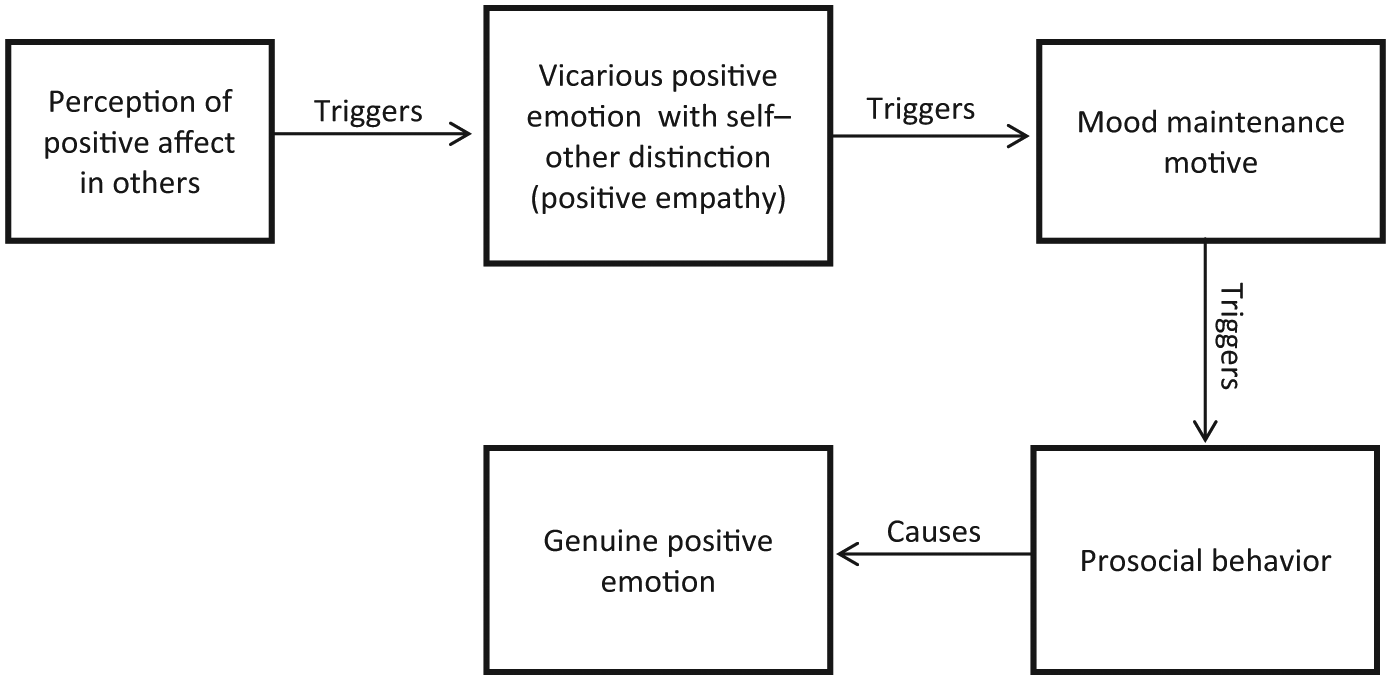
Schematic model of the positive empathy–prosocial behavior relationship.
Mood Maintenance
Several studies have provided evidence for a mood maintenance motive underlying people’s actions and behavior (e.g., Hirt, Devers, & McCrea, 2008; Isen & Simmonds, 1978). In a study by Mischel, Ebbesen, and Zeiss (1973), participants who were provided with feedback about their success on an achievement task spent significantly more time reviewing positive information about themselves than did participants in the failure or control group. The authors argue that the extended period of attention to positive information in the success condition occurred because participants experienced positive affect due to their success and were motivated to prolong this affective state. Similar to Isen and Levin (1972), they further propose that when a positive affective state is experienced, people are not only inclined to prolong this affective state but are also motivated to avoid negative information or actions that could dispel their positive affect. Hirt et al. (2008) present evidence that people are not just protective of their positive mood but that they also try to prolong and/or enhance it, if necesseary even by adjusting tasks to make them less mood threatening.
Additional support for the mood maintenance hypothesis comes from research related to human risk-taking behavior. Demaree, Burns, DeDonno, Agarwala, and Everhart (2012), for example, found that when faced with a high risk of losing a monetary gamble, participants who experienced positive affect became more risk averse. This change in risk-taking behavior was found to be fully mediated by changes in self-reported affect. Nygren, Isen, Taylor, and Dulin (1996) report similar findings and found people experiencing positive affect to refrain more from gambling than neutral controls, when a meaningful loss could be incurred. This behavior was observed even when the probability of winning was favorable (Nygren et al., 1996). These observations are in line with the mood maintenance hypothesis because mood-threatening outcomes (a great loss) were avoided, which is reflected in decreased risk taking.
Is Prosocial Behavior Triggered by Mood Maintenance?
The mood maintenance hypothesis is a very simple and widely supported explanation as to why positive mood leads to increased prosocial behavior. J. D. Hess, Kacen, and Kim (2006) emphasize that once in a positive mood, people are best able to prolong this mood by engaging in behaviors that are most likely to yield a positive response. People who experience positive affect may therefore be motivated to display certain behaviors because they might have the (implicit) expectation that these behaviors will support the maintenance of their positive affect (Cunningham, Shaffer, Barbee, Wolff, & Kelley, 1990; Handley, Lassiter, Nickell, & Herchenroeder, 2004; Wegener & Petty, 1994).
Helping others can be one of such behaviors because helping can contribute to improve one’s mood (Dulin & Hill, 2003; Williamson & Clark, 1989). More specifically, recent research indicates that spending money on others and giving treats to others contributes to and prolongs people’s positive affect and well-being (Aknin et al., 2013; Aknin, Dunn, et al., 2012; Aknin, Hamlin, & Dunn, 2012; Dunn et al., 2008). Moreover, the relationship between experienced happiness and prosocial spending of money has been shown to be circular and self-reinforcing (Aknin, Dunn, et al., 2012).
A similar positive loop has also been suggested by Isen, Shalker, Clark, and Karp (1978), who propose that experiencing positive mood facilitates the access to positive cognitions, which enables the individual to maintain and prolong a positive affective state. Further, they also claim that displaying positive behavior, such as helping, is a constituent part of this loop because it is regarded as producing further positive feelings when it is successfully performed. This is in line with the notion that helping behaviors are perceived to be rewarding (Harbaugh, Mayr, & Burghart, 2007; Weiss, Boyer, Lombardo, & Stich, 1973).
Although there is evidence for the mood maintenance hypothesis, not all scholars agree and some studies have provided equivocal support for this motive. Cunningham et al. (1990) note that mood maintenance might not be the main and driving motivation of people who show helping behavior. In their study participants were willing to help in a rather boring task and volunteered more for a social helping task than for an attractive hedonic task, which represents evidence against a mood maintenance motive. This claim is somewhat supported by Miller (2009), who states that besides a desire to get into or prolong a pleasant affective state, other motives might also trigger prosocial behavior. In particular, in cases of empathically induced helping behavior in distressing situations, a desire to altruistically comfort the other’s need appears to be a viable motivational force to act prosocially (see Batson & Shaw, 1991; Stocks et al., 2009).
Manucia Baumann, and Cialdini (1984) presents further evidence against an instrumental view of helping to maintain positive mood. These researchers pretended to fix participants’ positive mood for 30 minutes with a placebo drug, whereas another group’s positive mood was not fixed. Comparing the groups in terms of the amount of helping behavior displayed, which involved making phone calls to collect information from blood donors, no difference between groups was found. However, the mood maintenance hypothesis would predict that participants with the “fixed” mood would engage in significantly less helping behavior, because helping would not be needed to maintain the temporarily unchangeable mood. Therefore, based on their findings, the authors advocate a concomitant view of helping, that is, a tendency to help will occur as an unintended side effect of being in a state of positive mood.
However, the validity of these study findings has been questioned. For example, using a similar experimental procedure (the “mood fixing” technique) as Manucia et al. (1984), Hirt et al. (2008) found support for a mood maintenance motive. Moreover, Wegener and Petty (1994) argue that participants in the Manucia et al. (1984) study might have been afraid to experience feelings of guilt after the effects of the mood-fixing drug had worn off if they did not help (Massi, 2005), which then might have triggered the helping behavior. They also raise the question whether participants might have hoped to keep their positive mood at a high level beyond the duration of the experimental procedure by means of showing prosocial behaviors.
Both explanations imply that people might consider not only short-term effects of helping but also more long-term consequences of doing “the right thing” in light of potential hedonistic tendencies (Kämpfe & Mitte, 2009; Larsen, 2000). Wegener and Petty (1994) propose that the results reported by Manucia et al. (1984) do not falsify the assumption of the instrumentality of helping to maintain positive mood, as only short-term but not long-term effects of helping were considered. Hence, mood maintenance remains to be a viable candidate mechanism that contributes to increased prosocial behavior.
Why Positive Empathy Can Trigger Prosocial Behavior
We have reviewed evidence that suggests that (a) empathy can be felt for positive emotions, which is known as positive empathy, (b) people generally desire to maintain and prolong experienced positive affect, and (c) experiencing positive affect can promote prosocial behaviors as this can serve to maintain the pleasant affective state. Tying these research findings together, we propose that positive empathy is also capable of triggering prosocial behaviors toward people who experience a positive affective state, such as happiness.
The phenomenological experience of positive affect, as an effect of positive empathy, is indistinguishable from positive affect elicited by other factors. However, empathy is characterized by a self–other distinction (Decety & Jackson, 2004). This means when positive affect is experienced as a result of positive empathy, the empathizer is aware that the initial source for the positive affect is not a genuine own positive experience, but stems from the perception of the other person’s happiness (Decety & Jackson, 2004; Decety & Lamm, 2006; de Vignemont & Singer, 2006). In addition, it has been proposed that an empathically induced affect is not likely to be as intense as a genuine affective state originating in the self (J. J. Prinz, 2011). With the empathizer knowing that the positive affect currently experienced is somewhat “second hand” and less intense compared to the other person’s affect, the reviewed literature on mood maintenance might lend a viable explanation for our proposition that positive empathy can trigger and mediate prosocial behavior toward people who are perceived to be happy.
Refering to the schematic overview of our model (Figure 1), we now describe the chronological steps of the positive empathy–prosocial behavior relationship in more detail:
A person displays a pleasant affective state (e.g., happiness) and is perceived by another person in the immediate environment.
The observing person catches and shares the pleasant affect, while still knowing that the original source of the affect lies in the other person and not within the self (Decety & Jackson, 2004; Decety & Lamm, 2006), that is, positive empathy is triggered (Sallquist et al., 2009).
The empathic feelings experienced facilitate positive thoughts and cognitions and prompt positive behavior that is likely to be felt as rewarding (Isen et al., 1978). Thus, a motivation may arise to further increase and prolong the empathically sparked pleasant affect, because the experience of pleasant affect can be considered a general human pursuit (Augustine, Hemenover, Larsen, & Shulman, 2010; Kämpfe & Mitte, 2009; Larsen, 2000).
Hence, when an opportunity to help arises either spontaneously (e.g., Guéguen, 2012) or is directly formulated (e.g., Isen & Levin, 1972), the likelihood that such an opportunity is seized increases. This is because it can serve as an immediate means to maintain or even genuinely add to the empathic positive affect experienced previously, as long as it does not involve mood-threatening material or behavior (Aknin, Dunn, et al., 2012; Isen & Simmonds, 1978; Williamson & Clark, 1989; Yinon & Landau, 1987).
This model describes a simplified and idealized but plausible order of steps. It outlines how positive empathy may be elicited (Step 1 and Step 2) and why positive empathy may translate into prosocial behavior (Step 3 and Step 4). Because empathy in general is regarded as an antecedent of prosocial behavior (e.g., Roberts & Strayer, 1996), it seems likely that positive empathy needs to be elicited first, before it can cue prosocial behavior. The proposed model is based on the assumption that people have a certain desire to maintain and prolong the empathically experienced positive affect. Therefore, all outlined steps are assumed to be necessary for the described positive empathy–prosocial behavior relationship.
This sequence may occur when the recipient of help is the same person who initially displayed the positive affect (Vrugt & Vet, 2009) and elicited the positive empathy in the helper; but it might also be observed when the recipient is a different person, unrelated to the one who initially triggered the positive affect (Guéguen & de Gail, 2003; Isen et al., 1976). The mood maintenance hypothesis does not require that the target of prosocial behavior is the same person who triggered the empathic response. Thus, we may want to help some third person in order to maintain our positive mood, regardless if he or she actually needs help, and regardless of the recipient’s affective state. However, the standard situation will be that the source of the empathic response is also the recipient of prosocial behavior; or that we simply help because we observe another person in distress.
This motivation to maintain the induced positive affect does not need to be explicit and might operate outside of a person’s awareness. There is evidence which shows that facial expressions, for example a smile, are automatically processed conceptually upon presentation, even when they are irrelevant in a given situation and therefore could be ignored (Hofelich & Preston, 2011; Preston & Stansfield, 2008). Such an automatic and embodied response to perceived positive affect might already be sufficient to evoke the desire to experience similar emotions.
Another mechanism that can build up over time is that people repeatedly feel good after having behaved prosocially, which might create the implicit expectation that this type of behavior will produce similar affective states on future occasions. This would be regarded as a positive feedback loop, very similar to the one demonstrated by Aknin, Dunn, et al. (2012), but developed over a longer period of time. The affective outcomes of past prosocial behavior need not necessarily be present consciously when helping opportunities are encountered in the future. Thus, instead of being explicitly and actively pursued, the motivation to maintain or create a pleasant affective state may well be of an implicit nature.
The desire to maintain a pleasant positive affective state draws on the general assumption that people have hedonistic tendencies. They are thought to pursue happiness and aim to increase pleasant affect while decreasing unpleasant affect (Augustine et al., 2010; Kämpfe & Mitte, 2009; Larsen, 2000). This hedonistic principle has, however, been qualified by the claim that under certain circumstances people attenuate their pleasant affective state due to social constraints such as the presence of other people (Erber, Wegner, & Therriault, 1996).
In the case of positive empathy in interpersonal helping situations, however, it seems unlikely that people actively engage in mood regulation strategies to suppress, attenuate, or even reverse the empathic pleasant affect. The suggestion that mood regulation is undertaken because particular emotions may not be appropriate in a given social situation (Erber & Erber, 2000; Erber et al., 1996) might not necessarily apply here. This is because the empathic pleasant affect originally arises due to the perception of the other person, who exhibits a similar positive affective state in that particular situation. Thus, the observer need not be afraid that reciprocating the perceived affect could be inappropriate or inhibit successful social interaction.
A helping request is usually a request for collaboration. For example, in collaborative negotiation situations, it has been shown that people prefer the experience of pleasant affective states, and happiness in particular, over rather unpleasant affective states (Tamir & Ford, 2011). Thus, engaging in prosocial behavior, and thereby accommodating the situational need of the other person, may be an immediate means to sustain or even heighten the empathic pleasant affect, especially in communal relationships (Williamson & Clark, 1989). Research evidence provided by Yinon and Landau (1987) supports the assumption that prosocial behavior shown by people who are in a positive affective state may be driven by a mood maintenance motive. It also contributes to achieving the collaborative goal and autonomously displayed prosocial behavior can strengthen social relationships and yields mutual benefits (Caputi et al., 2012; Weinstein & Ryan, 2010).
Although we believe that the mood maintenance hypothesis is a viable explanation for the hypothesized positive empathy–prosocial behavior relation, it should be acknowledged that there might be other mechanisms that promote helping behavior once positive empathy has been experienced. For example, the experience of positive empathy might make people more optimistic (see Masters & Furman, 1976), which might then promote helping through the perception that their efforts will be useful, or more likely to be reciprocated in the future. As in the mood maintenance case, if these optimistic expectations are met, this behavior would lead to the experience of a genuine, even if slightly delayed, pleasant affect.
These mechanisms could work in concert to jointly promote prosocial behavior. They also might be differentially prompted depending on other situational characteristics, such as type of target or situation (kin vs. nonkin; ingroup vs. outgroup member; emergency vs. everyday situation; Graziano, Habashi, Sheese, & Tobin, 2007; Hein, Silani, Preuschoff, Batson, & Singer, 2010). Still, a motivation to maintain a pleasant positive affective state appears to be very basic to human nature (Augustine et al., 2010; Larsen, 2000) and therefore might be involved across different situations. Our hypothesis regarding mood maintenance underlying a positive empathy–prosocial behavior relationship, and its potential interplay with various other mechanisms is still largely untested. The specification and disentanglement of the different mechanisms involved and their conjoint operation in prompting prosocial behavior prior to the experience of positive empathy thus seem to constitute a promising topic for future research.
Future Research
Future research building on our proposed model needs to examine whether positive empathy actually facilitates prosocial behavior via people’s desire to maintain and prolong an empathically induced positive affect. If this motivation is explicit and conscious, a similar approach analogue to the one used by Handley et al. (2004) could help by simply asking for the reasons why people displayed prosocial behavior. If mood maintenance operates on an implicit, nonconscious level, however, then implicit and nonobtrusive measures need to be employed to reveal people’s prosocial motivations.
Since there is more research on behaving prosocially in situations where people show negative affect or experience negative situations, it would be interesting to examine whether the same biases that have been found in these situations also apply to the positive empathy–prosocial behavior relationship. These biases, for example, include the entitivity bias, that is, greater donations to targets with positive traits who are perceived to be members of a coherent group/unit (Smith, Faro, & Burson, 2013), and the identifiable victim effect, that is, greater helping behavior toward individually identified victims in contrast to unidentified or “one out of many” statistical victims (Jenni & Loewenstein, 1997; Slovic, 2007; Small & Loewenstein, 2003). Genevsky, Västfjäll, Slovic, and Knutson (2013) have shown that participants gave higher donations to orphans shown as photographs in contrast to silhouettes, and that increased donations were mediated by positive affect, but not by negative arousal; that is, even though the target was in a situation of misfortune, prosocial behavior was triggered by positive affect. Dickert and Slovic (2009) have shown that empathic feelings of sympathy are reduced if attention is distracted from the person eliciting the empathic response. This suggests that empathy requires attentional resources; circumstances that divert attention such as multiple sources (in contrast to a particular individual), distance in time and space, or abstract instead of concrete information will also reduce the empathic response. We assume that this effect also holds for mood maintenance behavior, that is, the target of prosocial behavior must be in the focus of attention to serve as a means for mood maintenance.
An important issue that needs to be addressed as it clearly distinguishes the positive empathy–prosocial behavior relationship from the negative empathy–prosocial behavior relationship is the motive why the prosocial behavior is shown. While there seems to be robust evidence for an altruistic motive often underlying the negative empathy–prosocial behavior relationship (e.g., Batson & Shaw, 1991) our model of an underlying mood maintenance motive for the positive empathy–prosocial behavior relationship indicates an egotistic motive. This is because the prosocial behavior would be primarily driven by benefits for the empathizer, that is, an enhanced and prolonged positive affect, with the resulting benefits for the other person being secondary. Hauser, Preston, and Stansfield (2014) proposed that it is a motive for social affiliation which motivates helping behavior toward happy target individuals. They found that in a normal everyday context, helping behavior was stronger toward happy targets, whereas in a more severe hospital context, helping behavior was more pronounced toward sad patients. Hauser et al. (2014) suggest that direct interaction with a target is supported when the target is happy, whereas indirect interactions such as donations might also be elicited with respect to targets showing distress.
According to the mood maintenance hypothesis, positive empathy will elicit prosocial behavior towards happy as well as toward sad persons in need, but it necessitates a happy person in the first place to elicit positive empathy in the observer. Strictly speaking, the mood maintenance mechanism does not necessarily require that the target person needs help at all. We may buy a precious gift for our spouse to keep up our positive mood, even if our spouse would be totally happy without the gift. However, mood maintenance is not the only mechanism driving prosocial behavior; the established negative empathy effect might well be stronger in many situations. Future research using forced-choice dilemma where a decision has to be made between helping a happy person and thereby maintaining one’s positive mood, or helping a person in distress and thereby temporarily sacrificing one’s pleasant affective state, might clarify the conditions and relative force of egotistic and altruistic motives. For an overview of the debate on egoistic versus altruistic motives of empathy-induced helping behavior shown toward distressed people in need and how they were tested see Batson and Shaw (1991).
Future research should also assess a possible co-occurence of positive empathy and negative empathy. In order to examine this issue, research needs to find a way to simultaneously map positive and negative valence on a target to empathize with, since empathy is largely bound to specific targets, for example specific situations or perceived emotions of people. Initial evidence suggests that empathy in general is diminished, but not completely absent when the target person provides the opportunity to simultaneously show positive empathy (based on, for example, the perception of a positive facial expression of the target person) and negative empathy (based on, for example, verbal/contextual information about a sad event that happened to the target person) toward her (Telle & Pfister, 2012). More research needs to be undertaken to further clarify this specific relationship.
Lastly, as mentioned at the beginning of this article, proper empathic emotions and resulting prosocial behavior appear to be influenced by emotion regulation capabilities (Eisenberg, 2000). A down-regulation of an overarousal of negative empathy is thought to prevent experiencing personal distress. If the negative overarousal cannot be down-regulated, the resulting personal distress could lead to a strong focus on the self and the desire to reduce one’s own distress (Batson et al., 1987; Eisenberg et al., 1994). Therefore, a down-regulation prevents the experience of too much personal distress in the empathizer, enabling him to stay focused on the other person. Thus, an appropriate down-regulation of empathic overarousal can facilitate the display of prosocial behavior to relieve the other’s distress. Emotion regulation capabilities might also affect the emergence of prosocial behavior when positive empathy is experienced. Here it might be an “up-regulation” which may initially increase the empathic positive affect and then triggers corresponding prosocial behavior, in order to produce a stronger and genuine positive affect in the empathizer. Thus, future research should compare the effect of emotion regulation capabilities on positive and negative empathy in conjunction with prosocial behavior.
Following our line of reasoning, future research should specifically investigate situations when a person empathizes with a smiling and happy person who asks for a favour. Formally, positive empathy should act as mediator between the perceptions of positive emotion in other people and displayed helping behavior. It is an open question what the precise functional form of these relationships is, that is, if the empathic response is proportional to the perceived positive affect, or if the amount of prosocial behavior is proportional to the empathic response. In particular, the mediating function of positive empathy is thought to be moderated by the empathizer’s desire to maintain the positive mood experienced by observing positive affect in others (Preacher, Rucker, & Hayes, 2007). Factors that might inhibit the mood maintenance mechanism should also obstruct prosocial behavior; for example, social norms or moral principles might interfere with mood maintenance.
Conclusion
To conclude, we propose that helping behavior is shown in response to the perceived positive affect of other people and that this behavior can be triggered by positive empathy. Positive empathy might elicit a motivation to maintain the empathically induced positive affect by creating experiences that elicit a greater, genuine positive emotional response, substituting the vicarious empathic affect. With this proposition we highlight an existing gap in the current literature on empathy, as previous research has predominantly focused on situations characterized by empathizing with and helping in response to perceived negative affect of others in distress.
We hope to have sparked interest and the curiosity to investigate this proposed link. Conducting further research to shed some more light on the raised issues is surely worthwhile because we encounter not only other people’s plights in our daily social interactions but also their good fortunes; and we do not only help sad people but we are also inclined to offer help to those who approach us with a smile.
Footnotes
Author note:
We thank Michael Pätzold for his valuable comments on an earlier version of this manuscript.
Declaration of Conflicting Interests
None declared.