



Abstract
This comment challenges essentialist “brain biased” interpretations of emotions from a historical perspective. (Digital) humanities research shows that the embodying of emotions is historically contingent. Emotion metaphors do not so much reflect what is happening in our brain or in other parts of the body: they reflect what people think/thought is/was happening in and outside their body.
Wie brein heeft moet zijn bloed door rede laten koelen (He who has brains, should let his blood be cooled by reason) (Vos, 1698, p. 72)
Over the last decade the number of researchers working in the field of the history of emotions has exploded. Although their work covers an impressive variety in topics and methods, historians of emotions all seem to agree on one point: the current conceptualization of emotions is unduly based on the presumption that we can work with one shared definition of emotions and feelings. Historians have received support from other scientists in criticizing essentialist views that present emotions as universal, a-historical, physical impulses, with a narrow focus on basic emotions (Boddice, 2014; Frevert, et al., 2014).
As an emotion historian researching early modern cultural history, I do agree with Lakoff’s (2016) opinion that emotions are contested concepts, although I would prefer the term “contingently contested concepts” over “essentially contested concepts,” since emotions can always be “essentialized” (Ball, 2002). I would be happy to side with Lakoff, and contingently contest the current notion of emotions as universal concepts.
However, I am afraid that Lakoff’s (2016) notion of emotions is more essentialist than he himself states. I would contest the neurological bias in Lakoff’s interpretation of the physical wiring of emotion words and metaphors. Why would embodied emotions be (solely) dependent on the brain? With Damasio, Lakoff (2016) states that emotions are body states that are “somatically marked” in the brain and that our metaphor systems and emotional systems, as they are both located in the brain, are “all part of the same integrated system of circuitry” (p. 4).
Let us challenge this “brain biased” interpretation from a historical perspective. The embodied experiences of premodern people were quite different from ours (Frevert, 2011). In the Dutch language, the word for “emotie” (emotion) only appears late in the 19th century. Before 1800 affects were indicated with words like passies (passions), hartstochten (fervors), gemoedsbewegingen (moods), driften (urges), or sentimenten (sentiments).
During the 19th century the (moral) philosophical approach to passions and sentiments was replaced by the psychological view, exchanging the older notions of passions and sentiments with a new theory on emotions as innate, subconscious driving forces, central to the individual and his/her notion of the self. This shift is essential, for it is the cause of our difficulties in understanding the early modern view of emotions, so very different from our own.
While affects in classic and medieval philosophy and theology were part of a higher, mental sphere, situated between consciousness, reason, and judgment, the sentiments of the early modern period were more directly embodied, in the heart, the mind, and in the humoral system: in the blood, phlegm, yellow bile, and black bile. Emotion metaphors were derived from these notions. The most telling examples, since they are now absent in our bodily experience of emotions, are the words connected to black and yellow bile. Yellow bile, secreted by the spleen, is bitter and could create choleric outbursts, or, as could black bile, lead to emotional suffering and melancholy. So, when indicating sadness, early modern authors highlight the bitterness of the feelings: “bitter schreien,” “bitter lijden,” “bitter klagen,” “bitter harteleed,” (crying, suffering, complaining bitterly, bitter heartache).
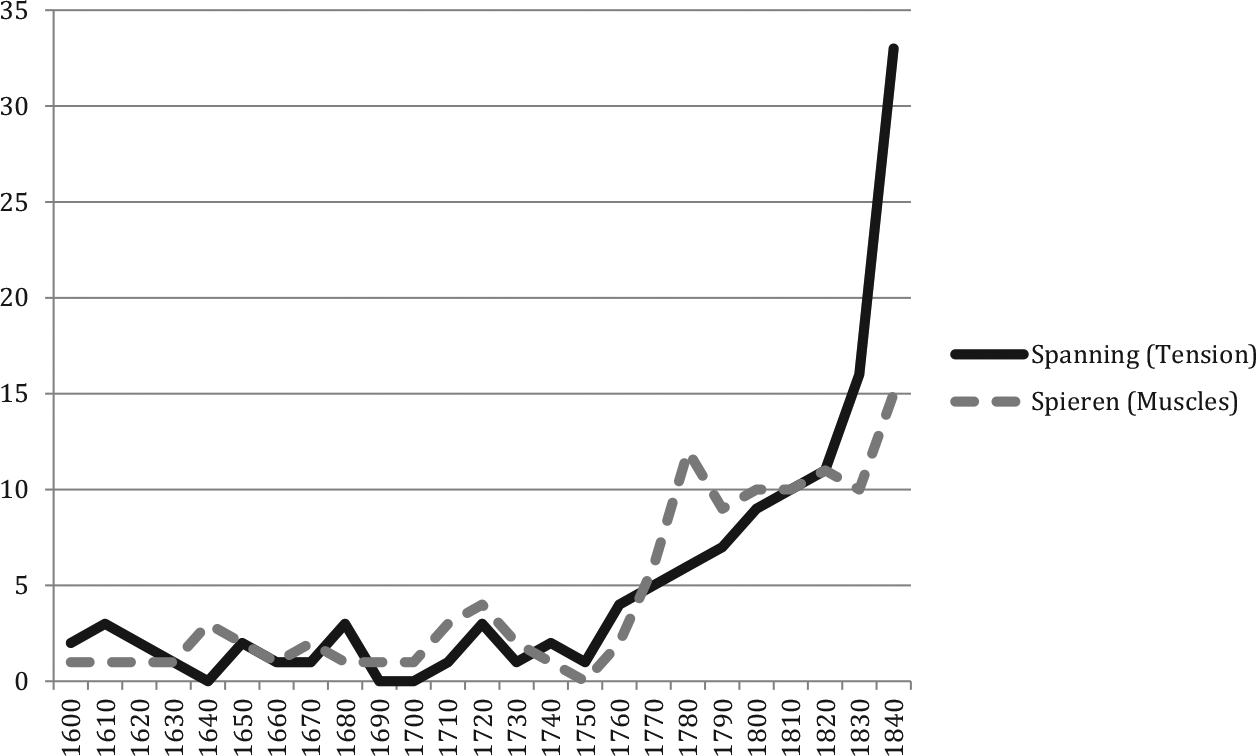
“Spanning” (tension) and “Spieren” (muscles) in Dutch literary texts 1600–1840 (percentage of total words in digitized texts).
Passions could originate in the body, but they could also come from outside. Emotions could be evoked through the humoral system by physical impulses: a body warmed up by the sun could evoke heated passions (Paster, 2004). “Angst” (fear) could both have an inner drive, but could also have a divine origin (Bähr, 2013). Happiness, still closely connected to “fortune” or luck, really “happened” (McMahon, 2006). Happiness could “impact,” thus creating a downward movement instead of an upward movement, as would be expected in our current physiological view. Passions literally could “grip” people, anger could strike you like lightning. So, when people evaluated their emotions, they would not necessarily do so in terms of the self or in terms of outbursts from inside out.
Now, while the “bitterness” of sad experiences or the “sweetness” of love might have become metaphors to us, centuries ago, they were strongly embodied. “Sweet passion” or “sweet love” in early modern texts are literally sweet, since love and being in love are triggered by a surplus of warm, sweet blood. People in love did not have butterflies in their stomach, since theories about the connections between the belly and the brain through the nerves did not exist. Skin seems to be rather absent as a locus of emotions. Only at the end of the 18th century, Dutch texts start to describe sentiments in terms of nerves, highlighting tension, sparkles, and shocks. Before 1750 people could shiver from fear, but they would do so because of the dynamics of their blood and heart, not of their nerves: “Helacy! hoe mijn bloed In heuverende angst, mijn laffe hert doet beven” (Alas! how my blood, in shivering fear, makes my cowardly heart quiver) (Rodenburg, 1616). Sparkles were felt, but in the heart, or bursting out through the mouth and nose (“Vuur springt uit myne oogen! En Neus en Mond!…. heb toch mêedogen!” [Fire springs from my eyes! And nose and mouth… Have some pity, please!] (Frese & Schaaf, 1746)).
Only later in the 18th century, when the fascination with electricity is building up, is the concept of love connected with lightning, sparkles, tension, and nervousness. Then, the muscles become the locus of affective tension: “ze schijnt mijne ziel nieuwe kracht, mijne spieren een nieuwe spanning te geeven” (“she appears to supply my soul with new power, and my muscles with new tension”).
With the development of Digital Humanities, we can now get some quantitative results for this kind of questions. The digital text repository Nederlab (www.nederlab.nl) provides 9,000 literary texts from the 13th century up to now. Searching this portal brings us over 500 different texts that use the word “spanning” (tension) one or several times. Graph 1 clearly indicates the growing frequency of the term since the 1760s, and it shows that at exact the same time, the interest in “spieren” (muscles) is exploding.
So to conclude, I would state that emotion metaphors do not so much reflect what is happening in our brain or in other parts of the body: they reflect what people think or thought is/was happening in and outside their body.