



Abstract
While philosophers have discussed the emotion of contempt from antiquity to the present day, contempt has received less attention in psychological research. We review the defining features of contempt, both as a short-term emotion and as a more long-lasting sentiment. Contempt is similar to anger in that it may occur after (repeated) social or moral transgressions, but it differs from anger in its appraisals, actions, and emotivational goals. Unlike anger, contempt arises when a person’s or group’s character is appraised as bad and unresponsive to change, leading to attempts to socially exclude the target. We discuss associative, self-regulatory, and social distancing functions of contempt and present a dynamic social model of contempt versus anger.
Contempt has a strange history within the study of emotions. Writers from Aristotle to Hume, Kant to Nietzsche, have treated it as a meaningful expression related to morality and social relations, but not always with the same standing as other emotions. This ambivalence has continued into the modern psychology of emotions (e.g., Ekman, 1994; Ekman & Heider, 1988; Prinz, 2007). In contrast to other moral emotions with which it is frequently classified—chiefly, anger and disgust—contempt has not developed a coherent empirical literature of its own.
In this article, we review empirical findings on the characteristics and functions of contempt and related emotions, especially anger. We present three main arguments throughout this article. First, contempt is a discrete emotion, different from anger, disgust, or hate; its core feature is that contemptuous people look down on their targets and try to ignore or exclude them. Second, contempt can also take the form of a long-lasting sentiment toward a person or group, building either on previous instances of ineffective anger or on stereotypical perceptions. We elaborate on both these points in the first section, The Characteristics of Contempt. Third, the “cool” rather than “hot” features that prevail in contempt and make it a less prototypical emotion also suggest that it may have a self-regulatory function. We consider this and other functional outcomes in the next section, The Consequences of Contempt. Our final, more speculative section titled The Controversy of Contempt engages with whether contempt is a morally justifiable emotion.
The Characteristics of Contempt
Is contempt a basic emotion, a mixed emotion, or perhaps not a distinct emotion at all? Each of these views has been defended by one or more scholars (e.g., Clore, Ortony, & Foss, 1987; Ekman & Heider, 1988; Izard, 1971, 2007; Johnson-Laird & Oatley, 1989; Lazarus, 1991; Ortony & Turner, 1990; Prinz, 2007; Tomkins, 1963, 1984). In order to determine its status as discrete emotion, we consider whether contempt is: (a) semantically distinct from other emotion terms; (b) unique in the kind of situations that provoke it; (c) accompanied by distinct appraisals and action tendencies; (d) unique and universal in nonverbal expression; and finally, (e) distinctive in its physiological signature.
Does Contempt Have Distinctive Referent Terms?
Like it or not, much research on emotion uses verbal measures. Indeed, many theories of specific emotions base their categories on the available, distinct words in the language they use (for critiques see Barrett, 2006; Wierzbicka, 1999). However, lay-language terminology is still an important facet of a multicomponent view of emotion. In addition, whether an emotion is seen as psychologically basic often depends on whether it is semantically basic (see Ortony & Turner, 1990, for an analysis of the concept of basic emotions). Thus, one aspect of judging contempt’s distinctiveness is to find whether it forms a distinctive category across languages.
Starting with English, a problem arises. Although “contempt” and its synonyms (“scorn,” “disdain,” or “aversion”) are often classified as emotion words, English speakers do not readily use them. Fehr and Russell (1984) found that respondents mentioned the word “contempt” only twice when asked to list as many emotion words as they could in a minute (“anger” was listed 149 times, and “disgust” 27 times). In addition, no participant in a study of emotion words in six European languages by van Goozen and Frijda (1993) spontaneously mentioned contempt or its synonyms in a free-listing task, though such words existed in all six languages. Going beyond Indo-European languages, distinct “contempt” words appear much less frequently across languages than, for example, words for anger and sadness (e.g., Hupka, Lenton, & Hutchison, 1999; Shaver, Murdaya, & Fraley, 2001).
A cluster analysis of the English emotion lexicon based on a sorting task (Shaver, Schwartz, Kirson, & O’Connor, 1987; see also Storm & Storm, 1987) found that “contempt” clustered together with disgust, but “scorn”—often seen as a synonym for “contempt”—fell in with “anger.” However, Jameson (1996), replicating the sorting task with the same words but a slight difference in methodology, found “contempt” to cluster with “anger” and “scorn” to cluster with “hate.” Scherer, Shuman, Fontaine, and Soriano (2013) sorted numerous emotion terms on the basis of two appraisal-related dimensions: valence (or goal conduciveness) and potency (or control). This placed contempt in the same quadrant as disgust, anger, and hostility. In short, contempt and its synonyms often cluster together with hate or disgust, and on a more abstract level, also with anger.
Thus, even in languages in which “contempt” has a distinct word, speakers do not often use it. Still, the scarcity of its referent term does not mean that contempt cannot have distinct causes, characteristics, and implications; only that people find it hard to agree on how to talk about them.
Does Contempt Have Distinctive Eliciting Situations?
Research sometimes identifies contempt as a reaction to a moral transgression. Rozin, Lowery, Imada, and Haidt (1999), proposed that contempt, anger, and disgust are elicited in reaction to violations of three distinct ethics (the CAD triad hypothesis; cf. Shweder, Much, Mahapatra, & Park, 1997). Anger is elicited when individual rights (autonomy) are violated, disgust when purity or sanctity (divinity) is violated, and contempt when social hierarchy or duty (community) is violated. More specifically, contempt in this scheme responds to being disloyal, disobedient, or disrespectful, or breaking the rules of a community. These authors found support for their proposed correspondences among U.S. and Japanese participants, using verbal as well as facial-expression identification measures of emotion.
However, various studies beyond this first test of the CAD hypothesis (Hutcherson & Gross, 2011; P. S. Russell, Piazza, & Giner-Sorolla, 2012) have not found the one-to-one association proposed. Apparently, contempt appears not just in reaction to community violations (e.g., social obligations, duties, social hierarchy, loyalty), but also to autonomy violations (e.g., offenses against individual freedom, fairness, justice, etc.). Such events evoke a mixture of negative feelings, such as anger, moral disgust, and contempt (see e.g., Hutcherson & Gross, 2011; Marzillier & Davey, 2004; Simpson, Carter, Anthony, & Overton, 2006). Fischer and Roseman (2007) also found that when participants were asked to recall a personal contempt event, it was almost always one in which they had also felt a great deal of anger. Thus, the unique characteristic of contempt does not clearly lie in the type of events that provoke it.
Does Contempt Have Distinctive Appraisals and Action Tendencies?
Perhaps the distinctive feature of contempt is not which objective situations set it off, but how the situation is judged. Anger and contempt, for example, have both similar and dissimilar appraisal components, and this explains why similar events or social groups are capable of eliciting either emotion, given slight changes to the individual’s appraisal (cf. Frijda, 1986). Both emotions involve blaming another for intentional, unfair wrongdoing. But contempt also involves the appraisal that the other is inferior, maybe not even worth one’s energy or attention, because he or she has a bad character (Fischer & Roseman, 2007). In the case of anger, we blame the other for doing wrong and blocking our goals. However, in contempt we despise the other as stupid, incompetent, or immoral (see also Hutcherson & Gross, 2011)—deriding their disposition more so than their act.
This different appraisal pattern accompanies a larger feeling of control in anger than in contempt. We may think we can change the ones we are angry at, whereas we have given up this hope for those we hold in contempt. The dispositional nature of contempt is illustrated in the following quote from Alberto Moravia’s book Contempt (1954/1999), describing a marriage falling apart: “But why do you despise me?” (the husband asks) “Because I do,” she cried all at once; “because you’re made like that, and however hard you try, you can’t change yourself” (p. 219).
Appraisals of the other’s inferiority and of lack of control also carry distinct motivational tendencies. Roseman (2001) referred to contempt as belonging to the “exclusion” family of emotions, in contrast with the “attack” family, to which anger belongs. Fischer and Roseman (2007) indeed found that in contempt more often than anger, respondents ignored the other person, gossiped about the other, and excluded him or her socially. Anger, on the other hand, was characterized by antagonistic approach: criticizing, giving negative feedback, explicitly expressing anger, and so on. A difference was also found in behaviors after a few days. Participants reported reconciling more with the target of their anger (approach tendency) than with the target of their contempt.
In line with these appraisals and action tendencies, the “emotivational” goal of contempt (Roseman, Wiest, & Swartz, 1994) is to exclude the transgressor, unlike the characteristic goal of anger, which is confrontational. By showing contempt, the target is removed from consideration. Ending social relations is the ultimate criticism of another’s character or actions. Research on marriage relationships by Gottman and Levenson (2002), for example, has shown that contempt by one partner (or both) for the other is the best predictor of divorce. This finding is not surprising given the emotivational goal of exclusion.
Similar exclusion tendencies are found in research on contempt within intergroup relations. Extending a model of collective action (van Zomeren, Spears, Fischer, & Leach, 2004) to nonnormative, that is, violent or illegal, actions, Tausch et al. (2011) examined support for various acts by students, Indian Muslims, and British Muslims. They found that whereas normative actions, such as petitions and protests, were often driven by anger, nonnormative actions were driven by a sense of low efficacy, and were better predicted by contempt (see also Becker, Tausch, & Wagner, 2011).
Does Contempt Have Distinctive Nonverbal Expressions?
Another feature relevant to the basic status of an emotion is whether it has a unique, universal facial expression. Ekman and his colleagues (Ekman & Friesen, 1986; Ekman & Heider, 1988; Matsumoto, 1992, 2005; Matsumoto & Ekman, 1989) identified a facial expression of contempt: the tightening and raising of one lip corner, or “unilateral lip curl” (see Figure 1 in Wagner, 2000). In this research, respondents from different cultures accurately decoded this facial display as contempt (see also Biehl et al., 1997; Ekman & Heider, 1988). However, other studies, using different photos, different labels, and different tasks did not replicate these findings (e.g., Haidt & Keltner, 1999; Izard, 1971; J. A. Russell, 1991; Wagner, 2000). For example, Haidt and Keltner (1999), comparing American and Indian recognition rates of various emotions, found that only 35% of the Americans correctly labeled the contempt expression as contempt (and 55% as disgust). At the same time, 62.5% of the Indian respondents labeled the expression correctly.
Several methodological problems have been proposed to explain the inconsistent recognition rates of the contempt display (Ekman & Friesen, 1988). For example, some studies have found that the number of correct responses is higher in a forced-choice format than in a free-response one (e.g., Widen, Christy, Hewett, & Russell, 2011), though others did not find this difference (e.g., Haidt & Keltner, 1999). A related critique is the absence of a “none-of-these” response. For example, Wagner (2000) showed that the lack of such a response option results in a high percentage of observers (70.4%) incorrectly choosing contempt for a neutral face. This may not only point to a methodological problem but also to the close association between contempt and a pose of indifference, to which we will return later.
Finally, recall that the word “contempt” is not used frequently in the English language. Thus, the problem with labeling contempt faces may not lie in the recognition of the expression, but in the availability of a label. Indeed, Matsumoto and Ekman (2004) found that contempt expressions could reliably be matched to situations that would elicit contempt, such as “The person hears an acquaintance bragging about accomplishing something for which the acquaintance was not responsible.”
In addition to facial displays, several attempts have been made to study other emotion expressions, such as nonlinguistic vocalizations of affect (e.g., laughter, screaming) or speech-embedded affective prosody (e.g., emotional tone of voice; Banse & Scherer, 1996; Hawk, van Kleef, Fischer, & van der Schalk, 2009; Juslin & Laukka, 2003; Schröder, 2003). Contempt’s spontaneous vocalizations include a snort, a tongue click, a sigh, a ts-ts, or huh-huh (see Hawk et al., 2009). Hawk and colleagues showed that affect vocalizations of contempt are much better recognized than facial displays or speech-embedded prosody, in contrast with other emotions that show equal recognition from facial and vocal affective expressions. Even so, across the three different channels studied, contempt was always the least recognized emotion, often confused with disgust or with the “none of these” label, although recognition was still above chance level. As with facial expressions, it may be the rarity of the term “contempt” that impedes verbal labeling.
Is Contempt Physiologically and Neurologically Distinctive?
A few studies have shown that the processing of contempt faces is accompanied by activation of the amygdala, in particular in socially anxious individuals (Stein, Simmons, Feinstein, & Paulus, 2007), and in comparison with neutral faces (Sambataro et al., 2006). However, these findings are primarily informative about responses to contempt, and thus they cannot be regarded as evidence regarding neural responses when actually feeling contempt. In addition, activation of the amygdala occurs in reaction to a variety of emotional or motivational stimuli, and does not tell us much about the distinct neural pattern of contempt. No further studies on physiological characteristics of contempt have been conducted.
At first sight, this may appear to support the notion that “contempt is a relatively cool emotion” (Izard, 1992, p. 272). However, we do not know whether the absence of published work on bodily indicators is due to a lack of studies or a lack of findings. Maybe the apparent “coolness” of contempt reflects action tendencies to detach from the other and to show one’s own superior status. The nature of its outward display and inward feelings, sometimes described as more subtle and less intense than that of other emotions, may in fact be a means to regulate one’s anger or even fear, and to display a dismissive attitude to the target (Fischer, 2011). We will return to this point later.
Contempt, Disgust, and Hate
Although most research has compared contempt to anger, some speculative distinctions can be made between contempt and other associated emotions. Disgust is often considered as a kindred emotion to contempt, because they both imply avoidance tendencies, though in the case of disgust this tendency is more to shutting oneself off from contamination, whereas contempt tendencies are more similar to looking down. These slightly different tendencies can also be observed in the different facial expressions often associated with contempt and disgust. Disgust faces typically show a closing of the nostrils caused by the wrinkling of the nose and pulling the upper lip, as well as a mouth gape and protruding tongue, as if to shut off and expel contaminants (Rozin, Lowery, & Ebert, 1994). By contrast, contempt faces more typically show a slight upward movement of the head and an asymmetric or unilateral lip curl, a more directly communicative signal (Ekman & Heider, 1988; Wagner, 2000).
Another difference is the type of sociomoral events that evoke each emotion. Disgust is a strong emotional response to an act that violates moral codes about what a person can or cannot do with one’s own body, such as sexual norms (for a summary of research see Chapman & Anderson, 2013; P. S. Russell & Giner-Sorolla, 2013). Contempt may be occasioned by evidence of the person’s low moral standing, but does not in our view have the strong visceral nature of moral disgust, or its feelings of contamination. Also, disgust is not a uniquely social emotion and compared to contempt, tends to be directed at events or objects more so than other people (Roseman et al., 1994), which may suggest that disgust toward a person has more of a dehumanizing quality.
Although empirical studies have not directly compared contempt to hate (Halperin, 2008; Petersen, 2002; Sternberg, 2005), the two share some characteristics (see Jasini & Fischer, 2015). Both emotions appraise the essence of another person or group as bad, inferior, or loathsome (see also Halperin & Gross, 2010). However, contempt towards another group implies derogation or exclusion of that group, whereas hate calls for more direct and aggressive action. It is still open for discussion whether contempt paves the way for more extreme expressions of hatred or disgust, or whether it only provides a less extreme alternative, and operates as a regulator of hate. If contempt leads to hatred, the ultimate outcome is bound to be aggression and vengeance (see also Bell, 2013).
Emotion or Sentiment?
We conclude from this review that contempt is a distinct feeling state with unique characteristics even though “contempt” is not a well understood word in many languages, and lacks some features that would firmly class it as a prototypical emotion. It occurs in reaction to social or moral transgressions that are perceived as wrong and that may also elicit anger, disgust, or hatred. However, contempt features unique appraisals of inferiority, motives to socially exclude the target, and specific facial and vocal expressions, although no clear physiological signs have been found. Most contemporary psychological theories agree that emotions can be best described as multicomponential (e.g., Frijda, 1986, 1988; Moors, Ellsworth, Scherer, & Frijda, 2013; Parkinson, Fischer, & Manstead, 2005; Roseman, 2001; Scherer, 1984, 2005). So, we conclude that contempt has many, if not all, components typical of emotions.
However, contempt may not only occur as a specific emotion, but also can coalesce into a sentiment. Although many of the features of an emotion and its corresponding sentiment can be similar, the difference between emotion and sentiment is to date theoretically defined by the eliciting stimulus. Emotions are immediate reactions to events involving individuals or groups, whereas sentiments have been defined as long-term, based on more global appraisals of individuals or groups (Frijda, 1993). That is, whereas the emotion contempt requires a specific transgression by someone, this is not the case for the sentiment of contempt. A sentiment may be elicited by merely seeing some who belongs to a very low valued group. Put another way, sentiments are associations that allow the consistent elicitation of emotional responses when merely faced with their object. Maintaining a sentiment involves a binding of the emotion to the object; in a sense, the emotion becomes part of the ongoing attitude toward it (cf. Crites, Fabrigar, & Petty, 1994; Giner-Sorolla, 1999). 1 Sentiments are assumed to be distinct from attitudes, however, because sentiments are characterized by appraisals and action tendencies, and are thus discrete, like emotions, although they lack nonverbal expressions and physiology. Attitudes or moods on the other hand, are defined by valence only. This distinction between emotions on the one hand, and sentiments on the other hand, has not been empirically studied to date, so we can only speculate on whether these different pathways to contempt result in distinct, yet related, mental states.
Contempt as a sentiment has two sources. First, a sentiment can be based on a history of social experiences independently of any one specific event or behavior. For example, a wife may develop feelings of contempt for her husband because he has neglected her over the years, and she may appraise him after all these years as inferior, incompetent, or immoral. Fischer and Roseman (2007) indeed found that individuals often had a history of transgressions by the target of their contempt. It seems that their contempt was fuelled by past anger experiences that failed to change the other. In other words, the other person kept frustrating them, and expressing anger did not have any effect, so the angry person felt they were not able to influence the other. Although contempt can occur as a reaction to a specific transgression here—on the basis of previous transgressions—the wife may develop a more permanent contemptuous sentiment towards her husband.
Second, contempt as a sentiment can also be based on global information about targets who have not transgressed any specific rule, but who are merely seen as inferior—an attitude formed either directly or by social communication and stereotypes (see also Izard, 1977). This type of contempt has the nature of a sentiment, because it attaches to a general representation rather than being based on a specific event (Frijda, 1994; Sonnemans & Frijda, 1995). This idea is nicely illustrated in a remark by George Orwell (1937/1958) on devalued social classes: “Here you come to the real secret of class distinctions in the West … It is summed up in four frightful words, which people nowadays are chary of uttering, but which were bandied about quite freely in my childhood. These words were: The lower classes smell.” (Orwell, 1937/1958, p. 159).
In research on the stereotype content model (Cuddy, Fiske, & Glick, 2007; Fiske, Cuddy, Glick, & Xu, 2002; Glick, Fiske et al., 2006), contempt, along with anger, disgust, and hate, are associated with groups that are seen as lacking both in social warmth and competence, such as welfare recipients, homeless people, or drug addicts. In this research contempt and disgust are usually not differentiated, however. In addition, this research typically asks people to report on general attitudes in society, rather than their own stereotypes and feelings. While this feature protects against social desirability effects (cf. Devine, 1989, Study 1), most of this evidence thus concerns beliefs about sentiments, rather than sentiments themselves. In fact, research directly tapping social attitudes sometimes does not find contempt associated necessarily with low warmth and competence. For example, Ufkes, Otten, van der Zee, Giebels, and Dovidio (2012) found that low competence seen in novel groups led to contempt, while low warmth led to anger, with no interaction.
A General Model of Contempt
To summarize the general conclusions of the preceding sections, we will illustrate a dynamic social model of contempt and anger in comparison, 2 including three possible paths to contempt (Figure 1). The model can apply to both individual and collective targets. In this model, eliciting information is on the far left, appraisals on the basis of that information are on the left, emotions to the right, and action responses on the far right. We have distinguished between the emotion and sentiment of contempt in the model by the different pathways and elicitors (transgression and low status and reputation). As argued earlier, to date we do not have evidence that the emotion and sentiment are really defined by different appraisals or action tendencies.
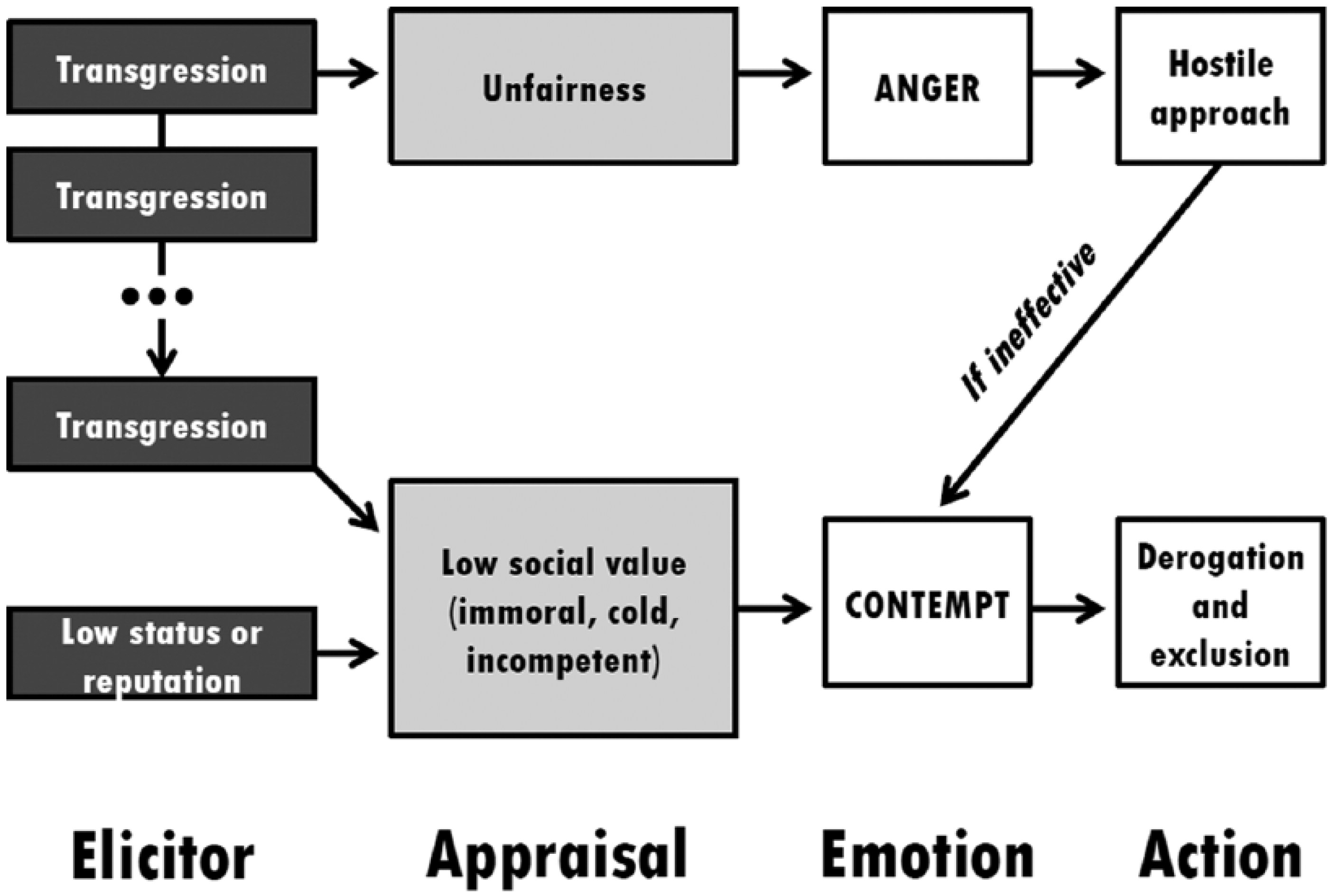
Dynamic social model of the different pathways leading to contempt and anger.
To start at the top left, a single transgression is likely to lead to the appraisal of unfairness in the action, which leads to anger and confrontational action tendencies. However, if the transgression is seen as characteristic or habitual (indicated by its repetition downwards), this will more likely produce an additional appraisal that the person or group has dispositionally low social value, which will lead to contempt. Another path to (the sentiment of) contempt goes more directly, through the transmission of beliefs about the target’s low social value by way of its status or reputation. Finally, on the right, if the confrontational actions arising from anger are experienced to be ineffective in changing the target’s ways, an angry feeling may be turned back into contempt.
The Functions of Contempt
Our next question involves the function(s) of contempt. We advocate a social functional approach to emotions (see also Fischer & Manstead, 2008; Giner-Sorolla, 2012; Hutcherson & Gross, 2011; Keltner & Haidt, 1999; Parkinson et al., 2005; van Kleef, 2010), and distinguish three functions relevant to contempt, each of which may operate on a number of social levels: (a) the associative function, which establishes strong associations between contempt and its target; (b) the self-regulation function, which uses emotions as a feedback mechanism to control behavior and to other emotions, and (c) the social distancing function, in which an appraisal of the situation leads to communication to achieve contempt’s social goals. We first describe these functions and then discuss their potential conflict in more detail, on the basis of Giner-Sorolla’s model of functional conflict (2012).
The Associative Function
This function assumes that we can respond quickly to emotional stimuli, because emotions help us to learn fast associations between stimuli and emotions. In addition, emotions become associated with important belief systems such as anger in response to unfair events, or disgust in response to violating hygiene norms. In the case of contempt, we assume that it can create enduring associations between certain low status groups and contempt, as we have seen. Indeed, Bell (2013) referred to contempt as a globalist emotion, in that it can take a whole person or group as its object without the actual occurrence of an event or act. As associations and sentiments become more accessible they help individuals to orient quickly to a potentially socially threatening environment, similar to the function of highly accessible attitudes (Fazio & Olson, 2014). An emotional reaction that becomes accessible without introspection or modification can also provide stability for a value system; like a terminal value, it is a truism beyond argument (Maio & Olson, 1998). On the group level, emotional sentiments that function as rigid associations may have a number of additional functions that strengthen the group and fulfill individual needs in a situation of conflict; for example, reinforcing moral certainty, or maintaining a sense of superiority (Bar-Tal & Halperin, 2011; see also Tajfel & Turner, 1979).
This function applies not only between but also within societies. Contempt works to preserve social hierarchies, as long as the group receiving contempt accepts its socially inferior position. Research we presented earlier on the stereotype content model suggests that some combination of distrust and perceived low competence is most likely to elicit contempt and related emotions from other groups. Many of the groups so perceived are people with a low perceived social value, such as the homeless or drug addicts. The associated actions of avoidance, and cognitions of dehumanization (e.g., Harris & Fiske, 2006), work to further keep them in a subordinate place. Feelings of contempt thus may assure individuals of their standing in a hierarchical social reality (Brandt & Reyna, 2011).
The Self-Regulation Function
A second function of contempt at the individual level may be self-regulation (Giner-Sorolla, 2012). As argued by self-regulatory theories (e.g., Baumeister, Vohs, DeWall, & Zhang, 2007; Carver & Scheier, 1990), emotions give evaluative feedback on actions, helping people learn from outcomes. Contempt triggers people’s efforts to distance themselves from a person they have been angry at and whom they start to devalue. The development of contempt may thus help to regulate anger or hate, and help the individual by “cooling down” those more effortful and dangerous emotions (see also Fischer & Manstead, 2008). This process has affinities with emotion regulation strategies that strive for calmness and composure (Erber, Wegner, & Therriault, 1996; Koole, 2009). If contempt often serves to regulate anger, this may also explain why the two emotions have been linked together in theory and data. 3
Research, including two comprehensive meta-analyses (Aldao, Nolen-Hoeksema, & Schweizer, 2010; Webb, Miles, & Sheeran, 2012), has identified a number of strategies that people might use to down-regulate unpleasant emotions including anger. “Choosing” contempt instead of anger matches the strategy of reappraisal. The key reappraisal transforming anger to contempt would be “This person is not capable or deserving of change; I do not need to get concerned.” However, an “emotional” perspective on emotion regulation (Mesquita & Frijda, 2011) would even better fit this idea that contempt replaces anger, because contempt and anger are both elicited as a response to the same event, but to multiple concerns. Anger is elicited because one’s goal is blocked by another person and one wants this person to stop it, but contempt is elicited because this person is not sensitive to one’s anger, and thus other action is required. Depending on the salience of one’s specific goals in a social situation, one may express one emotion at the expense of another.
We speculate that contempt might also be used to regulate unrequited love and other forms of social rejection. One somewhat arcane literary example comes from Ariosto’s chivalric epic Orlando Furioso (1532/1968). Here, the paladin Rinaldo is rid of his unrequited love, which appears allegorically as a monster, by the intervention of a mysterious knight called “Sdegno,” or in the archaic Italian of the poem, “Disdain.” More scientifically, Baumeister, Wotman, and Stillwell (1993) offered a content analysis of the experience of unrequited love in which 25% of the rejected reported harboring negative feelings for the object of their love. Contempt may very well be one of these.
Feelings and sentiments of contempt may have another effect that serves self-regulatory efforts, namely to boost feelings of self-worth and pride. If contempt usually involves devaluing another, then it should by comparison boost the self-image. Indeed, expressing contempt has been shown to increase the expresser’s externally perceived standing. In student settings, for example, those who displayed contempt were judged to be of higher status (Keltner, Young, Heerey, Oemig, & Monarch, 1998). It may be that this increased self-esteem is not only in the eye of the perceiver, but also in the eye of the contemptuous person. Direct proof of this idea, however, remains elusive.
The Social Distancing Function
Contempt can also be seen as motivating behavior in reaction to the appraisal that an undesirable inferior is too close. This in turn triggers efforts to reestablish the desired distance, whether by distancing oneself or making contemptuous expressions to drive the other away. The distancing function, in order to work, needs two parts: the person who creates the distance needs to communicate contempt; and the person receiving the signal needs to respond appropriately by withdrawing (if they agree that the relationship is not worth maintaining).
At the interpersonal relationship level, contempt creates social distance by defending the individual’s interests. It reinforces social boundaries when another person shows signs of a bad character, incompetence, or lower social status (see also Fischer & Manstead, 2008). Although these traits can also give rise to anger or pity, we think that contempt distinguishes itself from interpersonal anger by a focus on rejection rather than change, and from pity by absence of compassion. This function is clearly evident in the studies of marital couples by Gottman (Gottman, 1998; Gottman & Levenson, 2002), who reported that couples headed for divorce were high on four behaviors, labeled the “Four Horsemen of the Apocalypse,” namely criticism, defensiveness, contempt, and stonewalling (that is, listener withdrawal).
Social distancing has been studied in the development of interpersonal conflicts, especially in research on social exclusion (see also Williams, 2001). This body of research finds that frequent exposure to social exclusion leads to diminished self-esteem and impaired self-regulation (Baumeister, De Wall, Ciarocco, & Twenge, 2005). More indirect evidence can be found in Gerber and Wheelerʼs (2009) meta-analysis of 88 experimental studies on the effects of exclusion. They also show that social exclusion leads to greater negative mood, and to reciprocal signaling from the excluded person that they are inept and hopeless. This supports our point that the functionality of contemptuous distancing can work both ways. 4
On the intragroup level, however, research in the workplace shows that while contempt expressions indeed have a negative influence on interpersonal relations, they can also spur improvement of the quality of task performance (Melwani & Barsade, 2011). That is, recipients of contempt tend to feel the need to prove it wrong by improving their performance. However, the continued existence of hard feelings indicates that such efforts do not negate the essential distancing function of contempt; they merely try to restore the appearance of competence within the newly adversarial relationship. The circumstances under which contempt spurs self-improvement versus acquiescence, however, have not been much studied in other contexts.
Conflicts between different functions at different levels
These multiple functions on multiple social levels have the potential to conflict. An analysis by functional conflict theory (Giner-Sorolla, 2012) explains apparently dysfunctional outcomes of emotions as the intrusion of a functional feature of the emotion into a different functional context for which that feature is not appropriate.
In today’s world, people who express contempt often find themselves with an image problem. From the individual’s perspective, there may be functional reasons to express contempt, either to boost self-regard, avoid undesirable others, or cool down inappropriate anger. Contempt may also allow a person to inhabit an easily understood world where certain people or groups are simply contemptible, and not worthy of detailed consideration or distressing empathy (associative function). But other people may see things differently at a higher level of social organization. Because people tend to extrapolate enduring character traits from single expressive instances (Jones, 1979; Jost, Banaji, & Nosek, 2004), expressions of contempt risk projecting a negative image, lacking in warmth. Distancing, after all, cuts both ways. Contempt expressed in an attempt to “cool down” one’s personal anger may thus unintentionally signal a “cold” disposition to others. Likewise, a contemptuous associative sentiment, although formed in an attempt to understand a complex social world, may overgeneralize to people who do not deserve it, interfering with the function of emotion to appraise the present, individual case.
Conflicts between functions of contempt also have implications for its standing as a moral emotion. Generally speaking, an emotion acts to support morality if it is felt at the level of the self but represents the concerns of a larger level of social organization, beyond the individual (Giner-Sorolla, 2012; Haidt, 2003; Reed & Aquino, 2003). Thus, although contempt may aid the individual to maintain equanimity, feel good, and handle social situations, it can also impact negatively on others. This functional consideration leads directly to the question of whether contempt is a morally desirable and beneficial emotion.
The Controversies of Contempt
Scholars—mostly in the discipline of philosophy—have wrestled with the questions of whether, and how, we should evaluate contempt. Is it intrinsically reprehensible, or can it sometimes serve virtuous ends? Indeed, while it might be argued that such questions are beyond the scope of scientific research, we believe instead that psychological perspectives can inform beliefs about the value of specific emotions and actions, even if much of the key research remains to be done. In particular, our previous review of what thoughts typically and potentially arouse contempt should be brought to bear upon the question of whether contempt should be taken as a moral red flag or not.
We will discuss five recurring challenges to contempt in the literature: (a) violating the virtue of equality; (b) violating the virtue of humility; (c) violating the virtue of fairness; and (d) violating the virtue of taking action against a wrong.
Does Contempt Violate Equality?
Contempt has been deployed throughout history to support social orders that contemporary morality sees as unjust. For example, Herzog (1998) describes contempt, in 19th-century British political writings, as targeted at those who assert that an “inferior” race, sex, or social class has rights. Indeed, as we have seen, contempt involves an appraisal of low value, and a sense of looking down. Such a subjective lowering of the other seems incompatible with an egalitarian morality.
But looking down the social ladder is not required to feel contempt. Contempt can also be felt toward the powerful, for example in a protest (Tausch et al., 2011). Miller (1997) remarks on “upwards contempt,” directed at leaders. Similar phenomena have also received some attention from organizational scholars (Dean, Brandes, & Dharwadkar, 1998; Pelzer, 2005). In these cases, contempt depends on other schemes of ranking besides social status; high-status people seen as low in competence, for example. But contempt can also be felt on moral grounds; for example, when a failed bank’s managers receive an outrageous bonus, the wrongdoers can be seen as low regardless of social status. Indeed, research on social identity theory (Tajfel & Turner, 1979), and system justification theory (Jost et al., 2004) tells us that members of a low-ranking group might salvage their self-esteem by considering themselves superior to higher ranking groups on a moral or competence criterion.
Does Contempt Violate Humility?
If, as we have argued, contempt involves a feeling of superiority to another person, the worry is that people may express and feel contempt as much to boost their self-esteem as to reproach immorality. As far as we can tell, no empirical evidence in psychology confirms Hume’s (1739/2007) observation that contempt can raise self-esteem more so than other forms of condemnation. Nonetheless, it is plausible that contempt more so than anger or hate risks hypocrisy by enticing our less-than-perfect selves to feel socially or morally superior.
Bell (2005, 2013) defended the self-enhancing nature of contempt when a justly contemptible action has threatened someone’s self-worth; for example, a woman’s contempt at a sexist joke. Contempt, in other words, is justified when it reacts against a claim of superiority over one’s own self or group. In such a case, contempt’s self-affirmation is not a violation of humility, but an attempt to repair the threat to one’s collective social value. This also means that contempt is most acceptable when it comes from someone who was personally threatened by the offense. In the case of the sexist joke, a woman might be justified in defending her gender with a show of contempt, but a man treating the joke with contempt risks getting caught up in self-congratulation rather than the humility appropriate to such an intervention.
Does Contempt Violate Fairness?
Kant’s main objection to contempt was that it rejects the whole person, who deserves essential respect even if we disapprove of his or her misdeeds (Kant, 1797/1998). We might think likewise that contempt is less fair than anger because, as psychological research shows (Fischer & Roseman, 2007; Hutcherson & Gross, 2011), it focuses on the dispositional qualities of a person instead of on a specific act. However, Thomason (2013) argues that Kant, elsewhere in his writings, speaks of contempt as a justified reaction to immorality or arrogance. Likewise, Abramson (2009) and Bell (2013) argue that a character-centered emotion does not necessarily condemn the whole person but can instead reject an objectionable part of a person’s character. For example, even though someone admired John McCain for his commitment to campaign finance reform, he or she could feel contempt for other positions he expressed during his 2008 presidential campaign, which contradicted his apparent concern for equality and democracy in the USA.
A parallel might be drawn between the other-focused emotion of contempt and the self-focused emotion of shame, which shows itself as most functional when it condemns an important aspect of one’s own character, not when it condemns the whole self (Gausel, Leach, Vignoles, & Brown, 2012). Empirical research to date, however, does not clarify whether people who feel contempt typically do focus on only the bad parts of the target’s character, instead of making whole-person judgments. To conclude, it seems that contempt can be applied fairly, but only to specific aspects of a person’s being that it is within their power to change.
Does Contempt Violate Our Duty to Act?
Because of the link between contempt and withdrawal or social exclusion, some authors have seen contempt as less preferable than, for example, anger, because it encourages passive rather than active responses to moral wrongs (Haidt, 2003; Hill, 2000). Contempt’s defenders answer that the emotion’s expressive qualities constitute moral action, a protest communicated to the offending party and to others (Abramson, 2009; Bell, 2013; Mason, 2003). That said, the literature on emotion and collective action suggests another path for contempt. In three surveys examining protests in Germany, the UK, and India, Tausch et al. (2011) showed that anger is related to normative actions, such as participating in discussions or signing petitions, whereas contempt predicts nonnormative more radical actions, such as throwing stones, attacking the police, or arson attacks (Becker et al., 2011; Tausch et al., 2011). These actions, far from passive, can be understood as fundamental disagreement with the character of a society, not just with a specific action or policy.
In situations where further social relations with a wrongdoer are inconceivable, contempt may also be fully justifiable. It is hardly ethical to require a woman to argue angrily with her rapist in an attempt to make him change his mind, or require members of an oppressed group to spend their whole day contesting every slight from the majority. In this situation, contempt provides a rebuke whose distancing nature is appropriate to the moral goal.
The Future of Contempt Research
To sum up, we have presented three main arguments in this review. First, we believe that contempt has features and characteristics that lead us to classify it as a distinct emotion, although it is not a prototypical one and it often co-occurs with other states such as anger, disgust, or hate. Contempt’s core appraisal is the inferiority of the other person or group, leading to the tendency to take distance, ignore, or exclude. Second, whereas the emotion contempt is elicited by a specific event, contempt can also occur as a sentiment, when it attaches to a general representation of a group or individual. This is why we may feel contempt towards certain groups, without the presence of a specific moral or social transgression at a specific moment. Third, as a functional emotion or sentiment, contempt allows us to communicate an appraisal of low social worth to other people or groups, and to deal with social antagonists in a way that might be less effortful and risky than activating the related emotion of anger. This self-regulatory function of contempt may explain why contemptuous people do not seem agitated or emotional, but keep calm. The act of indifference is the response to a concern that confrontation and antagonism do not help. Finally, although contempt is often applied unfairly to people on the basis of prejudice, it does seem to have a place in justified moral condemnation if it targets an undesirable facet of a person’s moral character while holding open the possibility for transformative change.
The large number of open questions surrounding contempt, however, requires us to summarize the research speculatively. First, it is not clear whether contempt’s inferiority appraisal has the consequence of reinforcing one’s own feelings of superiority or self-esteem when compared to other emotions involved in social exclusion, such as anger, hate, or disgust.
A second issue is contempt’s self-regulation function. We suggested that contempt’s apparent coolness might work to suppress or preempt other more socially and personally costly emotions, such as hatred, anger, or frustration. Examining these ideas would not only improve our knowledge of contempt but would also shed new light on emotion regulation (see Mesquita & Frijda, 2011).
Third, research differentiating disgust and contempt conclusively has also been scarce, with the main efforts in the CAD hypothesis literature proving inconclusive on replication. Facial or vocal expressions may work better than verbal labels in studying the difference. One starting hypothesis might be that disgust is a more intense form of contempt implying a stronger metaphor of not just low, but actively negative and contaminating social value, requiring not just avoidance but cleansing.
Fourth, it is still not clear whether contempt necessarily involves a judgment of the whole person. Is it possible to have contempt for Picasso’s mistreatment of women, while maintaining respect for his artistic work? If we were able to differentiate the contemptible part of a person’s character from the core of humanity, this would help overcome the negative moral consequences of contempt.
A fifth and final issue relates to the expression of contempt. To date, one facial expression of contempt, the unilateral lip curve, has been studied. Contempt, however, clearly is expressed in other subtle ways. In the face, rolling one’s eyes is a dynamic expression that has hardly been studied; nor has inclining the head backwards, or “looking down one’s nose,” a common metaphor in English for contempt. In addition, contempt in natural settings is often expressed in vocal expressions or tone (Hawk et al., 2009). The problems in establishing a clear, reliable link between verbal terms for contempt and the classic facial expression should lead researchers to study these alternate expressions of contempt more extensively.
Contempt is a difficult emotion to study. We hope the reader is convinced that this difficulty has potential rewards. Contempt may not be the most typical emotion, but it has strong consequences for interpersonal and intergroup relations. The study of contempt as a marginal and problematic emotion also informs discussions in current emotion theorizing. Contempt underscores the problem of relying on language in emotion research, because its referent terms may be less useful in research than, say, facial or vocal expressions. Through contempt we see the importance of studying discrete emotions more precisely; a number of existing theories and studies have not distinguished between contempt and anger or disgust, leading to inconclusive results. Our speculation about contempt regulating anger also raises the possibility that emotions may be used to regulate other emotions. While some theories have raised this possibility before (Tomkins, 1963), prevailing taxonomies of emotion regulation do not to take it into account, leaving emotion regulation to cognitive or behavioral means. Finally, adding to analyses of other sociomoral emotions in terms of conflicting functions (Giner-Sorolla, 2012), we have argued here for the first time that contempt is also an emotion that serves to establish associations, signal social information, and regulate a person’s own behavior and feelings. These different functions, operating at different levels of social organization, can help us understand both when contempt is used correctly, and when it goes wrong.
Footnotes
Author note:
Both authors contributed equally to this article and the names appear in alphabetical order.
Declaration of Conflicting Interests
None declared.