




Abstract
The aim of this article is to give a general idea of how meanings of single emotion words, and configurations between words, change historically, reflecting changes in people’s understanding of emotions. The article provides a selective overview of linguistic research on the histories of a number of English words for emotions. It focuses on changes in the words emotion and mood as well as analyzing terms for the specific emotions of anger, fear, happiness, joy, love, pride, respect, and sorrow. This article also suggests that it is possible to use linguistic data in order to recover some “psychological” information about emotions, such as information on people’s responses to them.
Introduction
What can historical linguists tell us about emotions? Let us consider the history of the word emotion to give an example. According to the Oxford English Dictionary, the noun emotion was only introduced into the English language in the 16th century, and it first meant a “political agitation, civil unrest; a public commotion or uprising” or, more generally, a “movement; disturbance, perturbation; an instance of this” (“Emotion,” n.d.). In the 16th and 17th centuries, it could also mean “a movement from one place to another; a migration.”
Scholars have been interested in how the noun emotion received its current meaning. In particular, they have been interested in the role “motion” plays in it.
Soós (2009) and Diller (2014), although both dealing with the history of the English language, traced the history of the current meaning of the noun emotion back to a 16th-century French author, Michel de Montaigne, who, according to them, used it for the first time in his Essays. The first edition of Montaigne’s Essays was published in 1580, and their English translation by John Florio in 1603.
Both Soós (2009) and Diller (2014) suggested that there was something revolutionary about the way Montaigne used the noun emotion. The revolutionary thrust of Montaigne’s use of the noun emotion did not lie in the notion that such psychological phenomena relate to “motion” of some kind. Instead, what was crucial was the direction of the motion.
To put it simply, up to that point people had talked about passions rather than emotions, the noun passion meaning something that was “suffered” (Soós, 2009, p. 174). Passions then were understood as “(com)motion” in the human mind caused by actors and objects outside the mind, such as demons. Very fine distinctions were also made between the rational mind and lower parts of the soul such as the so-called “sensitive soul” whose movements would cause passions in the mind (Diller, 2014; Soós, 2009, p. 173).
However, the noun emotion no longer suggested an outside agent causing the “motion”—it could refer to a motion originating inside the mind where it was experienced (Diller, 2014; Soós, 2009). Diller (2014) indeed proposed that the transition from passion to emotion reflected a transition from a medieval, God-centered world view to an anthropocentric world view where the person experiencing the emotion was more central than the outside forces affecting him or her.
This example illustrates the wealth of insights language can provide into changing concepts of emotion. Further examples to illustrate this general point will be provided after I have discussed the kind of data and methods used for historical linguistic studies on emotion words and presented a general overview of what kind of research has been conducted in the field in approximately the past twenty years.
Data and Methods
The data in historical linguistic studies on emotion words came from dictionaries, electronic corpora, or digitized editions of texts, and often researchers combined dictionary analysis with corpus analysis, or used several corpora in the same study (the term corpus will be explained in what follows). The two most important dictionaries in this respect were the Oxford English Dictionary and the Historical Thesaurus of English (Kay, Roberts, Samuels, Wotherspoon, & Alexander, 2014), also published as the Historical Thesaurus of the Oxford English Dictionary (Kay, Roberts, Samuels, & Wotherspoon, 2009). These two dictionaries are tightly knit, because the latter was based on the second edition of the former (Simpson & Weiner, 1989). In addition, the historical thesaurus relied on the Thesaurus of Old English (Roberts, Kay, & Grundy, 1995). The thesaurus contributed to research on emotions in two ways. Linguists contributed to its compilation by collecting and classifying words for different emotions (Coleman, 1999; Sylvester, 1994), while the thesaurus itself was also utilized for the analysis of single emotions (Mikołajzuk, 2004; Tissari, 2003) as well as for the analysis of the entire vocabulary of emotion (Diller, 2014).
An electronic corpus is a carefully selected compilation of text samples, or in some rare cases, entire texts, representing, for example, a certain period or text type. Thus the Innsbruck Corpus of Middle English Prose represents Middle English prose, while the diachronic part of the Helsinki Corpus of English Texts comprises samples representing many different text types. The idea is that together these samples represent different varieties of the English language. These varieties comprise Old English (–1150), Middle English (1150–1500), and Early Modern English (1500–1710; Kytö, 1996). No precise date for the beginning of the Old English period is given, but only a few of the Old English texts predate 850 (Kytö, 1996). I will also use the term Late Modern English for the period 1700–1900. Twentieth and 21st-century English will be called Present-day English.
By analyzing the usage of a word in carefully selected data representing one of these periods one can make generalized claims about the usage of that word in the variety in question. That is why the Helsinki Corpus was used by several authors (e.g., Fabiszak & Hebda, 2006, 2010; Koivisto-Alanko & Tissari, 2006; Tissari, 2003). The Innsbruck Corpus of Middle English Prose was used by Diller (2014), among many other sources of data.
Diller (2014) in fact promoted the idea that linguists should use entire digitized texts rather than text samples in order to research word histories. This would allow them to state definitely whether a particular word occurs in a text or a collection of texts, such as the works by a certain author, and how it behaves there. Other authors who studied entire texts included Barcelona Sánchez (1995), Díaz Vera (2012), Gevaert (2007), and Ogura (2013).
Three main methodological approaches were employed in the analyses of emotion words presented in the following lines. One was to classify words into different groups revealing the conceptual structure of an emotion in the course of time (Coleman, 1999; Sylvester, 1994). The other was to collect occurrences of particular words and analyze them in their context, for example in terms of which senses they represented (e.g., different senses of sorg and sár in Molina, 2005), or which conceptual metaphors occurred together with them (e.g., metaphors of fear in Díaz Vera, 2013). The third method was to collect and analyze expressions denoting an emotion in terms of which conceptual metaphor they represented (e.g., Gevaert, 2001, on anger).
It is good to say something about conceptual metaphor. The idea of calling metaphors conceptual originates in a book by Lakoff and Johnson (1980) who recognized that metaphors such as
1. They gravitated to each other immediately.
2. I’m crazy about her.
The idea that emotions could be studied in terms of their metaphors was revolutionary and generated lots of research. One author in particular pursued extensive research on emotion in Present-day English, Kövecses (e.g., 1990, 2000). Diachronic work on emotions is very much indebted to him, not only as regards the idea of collecting metaphors but also as regards the idea that other characteristics of emotions such as their causes can be gleaned from linguistic data.
Overview of Recent Research
Recent linguistic research on English words for emotions is summarized in Table 1. It shows studies and their topics organized in terms of the periods covered.
A timeline of linguistic studies into words for emotions in English.
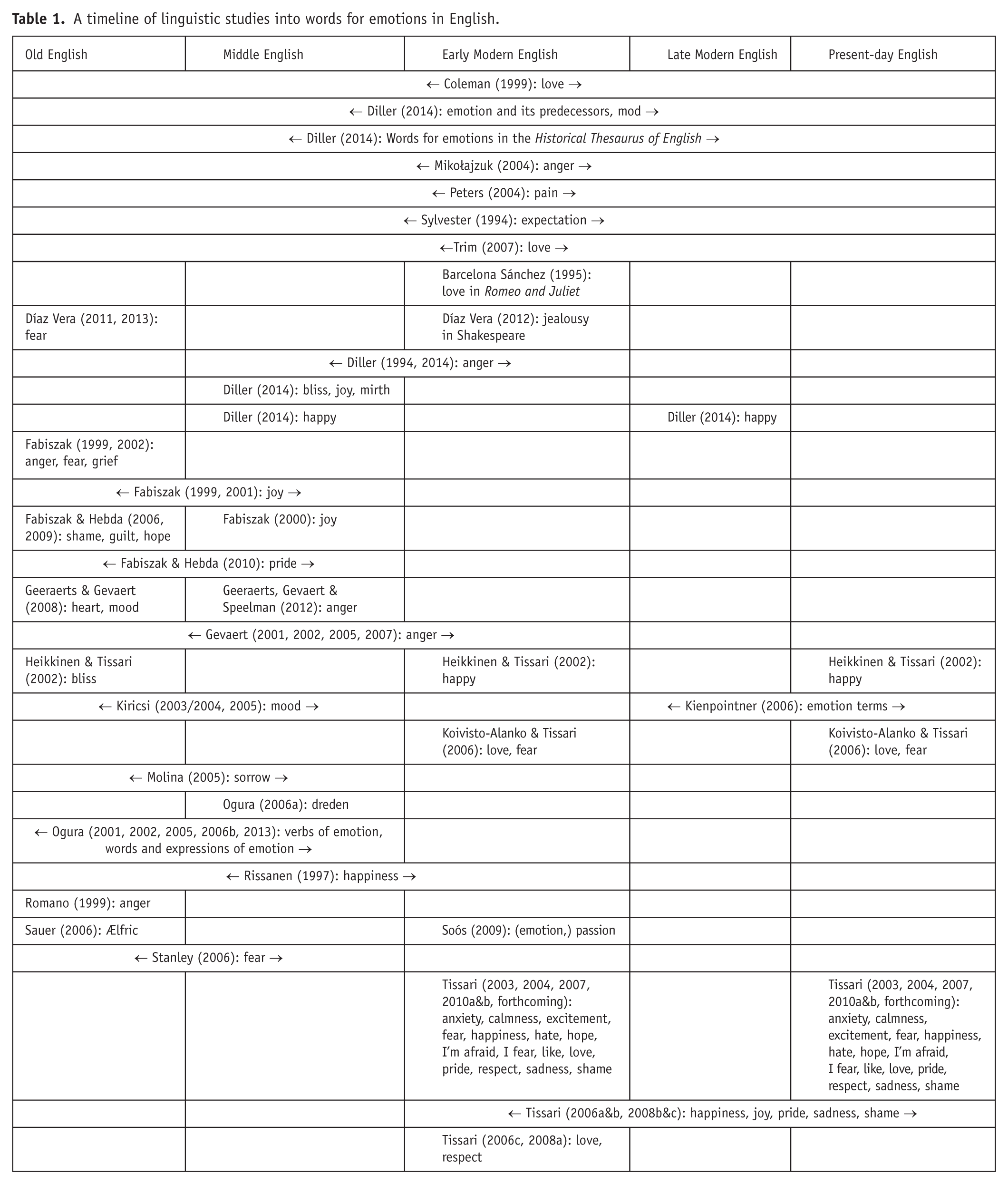
We can see from Table 1 that three authors considered words for emotions as a general category, Kienpointner (2006), Ogura (e.g., 2013), and Diller (2014). The rest of the work concerned particular emotions, or general words to do with the concept of emotion such as mood (Diller, 2014; Kiricsi, 2004, 2005). An exception was Sylvester (1994) who dealt with the concept of expectation, covering both emotions such as hope and fear, and less relevant categories such as prediction and caution. A borderline case was Soós (2009) which represented literary studies but was included because it dealt with dictionary entries and entered into a discussion with Tissari (2003) and Diller (2014) which consisted of previously published articles.
Table 1 also gives an idea of how much work I have selected to be presented in more detail in this article. I selected a set of emotions to focus on—anger, fear, happiness, joy, love, pride, respect, and sorrow—as well as two other words, emotion and mood, and restricted my scope to one or a few major findings per each of them. I also made a choice to focus on the meaning of the words rather than their grammar. Considering that I have had to exclude linguistic work which would have deserved a place in this article, it is not within my scope to extend the overview to recent work on English words for emotions by historians, such as Dixon (2003) and Frevert et al. (2014). I will also not dwell on linguistic research on words for emotions in Present-day English, unless it was conducted to compare Present-day English with an earlier variety of English.
Anger
Anger was the topic of Lakoff and Kövecses’s seminal study (1987) on how conceptual metaphors contribute to American English speakers’ understanding of emotion. They posited a central metaphor for anger,
3. I was fuming.
4. She flipped her lid.
Historical linguists became interested in Lakoff and Kövecses’s description of anger because Lakoff and Kövecses (1987, p. 219) suggested that the “folk” theory of anger which they described did not only apply to Present-day American English, but had “stood the test of time,” having “made sense to hundreds of millions of English speakers over a period of roughly a thousand years.” Some historical linguists, like Romano (1999) agreed that this was indeed so, while others, like Gevaert (2001, 2007) disagreed. Gevaert (2001) presented Old and Middle English data in support of an opposite claim. According to her, there may have been several Old and Middle English expressions suggesting the
Lakoff and Kövecses’s model (1987) was also criticized for ahistoricism on slightly different grounds. Geeraerts and Grondelaers (1995) suggested a historical reason for why anger would be conceptualized as the heat of a fluid in a container, the humoral theory. This theory was not just a “folk” theory, but an established medical theory in the Middle Ages, and it influenced medical thinking up to the 19th century. According to it, anger literally consisted of the heat of two fluids in the body. These were the yellow bile, a humor, and blood, which carried the yellow bile to all parts of the body.
While work inspired by Lakoff and Kövecses (1987) may be seen as a major strand in historical research on anger, there is also another strand which deserves a mention. This strand began with Diller’s (1994) analysis of a few words for anger in Chaucer’s works. On the basis of his analysis, Diller surmised that the word anger was introduced to the English language because due to changes in medieval society, people needed a word for reactions to private as against public offences. This would have been in contrast to cases of wrath where the offended person was of a considerably higher rank than the offender, even God, or a god.
Gevaert (2007) wanted to test Diller’s suggestion and studied the vocabulary for anger around 1300, 1400, and 1500. In her view, Diller was mistaken in his assumption that there was a period in Middle English when a word for private as against public offences was needed. According to her, the words ire and wrath could be used of private offences as early as 1300.
Geeraerts et al. (2012) also returned to Diller’s seminal analysis of anger (1994). Like Gevaert (2007), they studied the vocabulary for anger around 1300, 1400, and 1500. They analyzed uses of the words ire, wrath, and anger in terms of three issues in particular: whether the cause of anger was private or nonprivate, whether the rank of the experiencer of anger was high or not, and whether the intensity of reaction was violent or not. They came to the conclusion that anger was originally introduced to English as a word for private offences where the rank of the experiencer was low and the intensity of the reaction was nonviolent, but that its usage soon spread to all kinds of anger.
Fear
Historical linguists have approached the concept of fear from several different angles. Sylvester (1994) reported that she could identify more words for fear than for any other concept having to do with expectation. Her work on fear contributed to the Historical Thesaurus of the Oxford English Dictionary, which listed 1,917 words for fear. These included, for example, words for physical symptoms of fear such as the 19th-century word flittering which meant “shuddering with fear,” and words for fears of various things such as “fear of fire,” called baelegsa in Old English.
To continue with Old English, Díaz Vera (2013) studied responses to fear in Old English texts and in the Bayeux Tapestry. The Bayeux Tapestry is an embroidered cloth which, like a medieval cartoon strip, depicts the Norman invasion of England in 1066. The intriguing thing about Díaz Vera’s study (2013), which sets it apart from other studies of fear in the history of English, is the combination of linguistic and pictorial analysis.
Díaz Vera (2013) divided the responses of fear into four groups, which were: escaping and hiding, freezing and paralysis, fighting and body pressure responses. The escaping and hiding responses comprised movement back, movement down, shrinking, and change of color. The freezing and paralysis responses included lack of movement, rigidity, and freezing. The fighting response did not refer to fighting a human enemy. Rather, it meant that fear was seen as a metaphorical
According to Díaz Vera (2013), the most frequent response to fear in Old English texts was movement back. The second most frequent response was lack of movement, and the third most frequent response was freezing. As regards the Bayeux Tapestry, the most frequent responses to fear had to do with body pressure. These comprised bulging eyes, raised eyebrows, and mouth emphatically closed, which he took to convey an attempt not to let one’s fear come out of the body. The second most frequent response to fear in the Bayeux Tapestry was rigidity, which in practice meant that the arms of the characters were depicted as stuck to the body. The third most frequent response to fear in the Bayeux Tapestry was shrinking.
Happiness
Translations of Boethius’s De Consolatione Philosophiae, a treatise which deals with happiness, are a good source of English words for happiness because there are so many of them, beginning from King Alfred’s Old English translation. Boethius tended to use the Latin noun felicitas of “earthly happiness” and beatitudo of “heavenly happiness” (Rissanen, 1997). Any translator had the choice of translating these Latin words with either one and the same English word or with two different words. If a translator used the same English word for each Latin noun, s/he could modify that noun with an adjective denoting either “earthly” or “heavenly.” This is what Alfred did, although he also coined the compound word woruld(ge)sælða for “earthly (=wordly) happiness” (Rissanen, 1997). In most Boethius’s translations there was not an absolute separation between the words used to translate the two Latin nouns felicitas and beatitudo, but Walton, for example, used mainly felicite for felicitas and blissfulness for beatitudo in his translation in 1410 (Rissanen, 1997).
The interesting thing from a modern point of view is that the noun happiness only began to occur in these translations in the 17th century (Rissanen, 1997). It has been suggested that this reflects a change in the very concept of happiness which took place in the 16th century: before that, happiness either meant wordly wealth and prosperity or heavenly happiness, but around that time, people also began to speak about happiness as something that was neither purely material nor purely spiritual, but “a heightened feeling of contentment, harmony and balance” (Rissanen, 1997, p. 247). In brief, the noun happiness introduced a new kind of earthly happiness which was less tangible and more abstract than its medieval counterpart.
Joy
Fabiszak’s thesis on the concept of joy in Old and Middle English (2001) shed light on the everyday lives of speakers of Old and Middle English. She studied eight Old English and 11 Middle English words for joy, grouping them according to the causes of joy in each period, as people used different words for different kinds of joy.
Fabiszak (2001) identified three categories of joy in Old English. The first was religious, the second had to do with social relations, and the third comprised perceiving something pleasant, for example, a pleasant smell. Causes of joy which had to do with social relations included such things as finding a wife, the birth of a son, meeting somebody, receiving gifts, feasting, and talking with other people.
As regards Middle English, Fabiszak (2001) identified as many as nine categories of joy. These were caused by (a) religious experiences, (b) family life, (c) interaction with other members of the community, (d) good news or a letter, (e) ruling and power, (f) exchange of gifts, (g) entertainments, (h) romantic love, and (i) deeds of a definitely negative value. The last category included four subcategories: sexually charged bodily pleasure, somebody else’s misfortune, lying, and spilling blood.
Elsewhere, Fabiszak (2000) was able to distinguish between the meaning of the word joy in Middle English and Present-day English. While one definition of joy suffices for Present-day English, there were two kinds of joy in Middle English, nonreligious and religious. These differed with regard to their source and duration. The source of nonreligious joy was the person experiencing joy, while the source of religious joy was God. While nonreligious joy lasted only for a limited time, religious joy in Heaven was everlasting. Moreover, while Wierzbicka (1992) suggested that joy in Present-day English is about something that is happening now, Fabiszak (2000) noted that nonreligious joy in Middle English could also be about a past event.
Love
The Historical Thesaurus of the Oxford English Dictionary listed 2,950 words for love. These words were collected by Coleman (1999), who also categorized them. Her categorization suggested that the concept of love could be divided up in at least two different ways. Firstly, she distinguished between great love, mutual love, spiritual love, family love, self-love, and love-hate. These she called types of love. Secondly, she distinguished between words for types of love, aspects of love (e.g., love-tears), unloving (e.g., disaffectionate), loved one, affection, friend, and romantic love. From the second categorization we may derive at least three kinds of love: affection, friendship, and romantic love. Furthermore, she listed words for the expression of love, such as embracing and kissing, and for various kinds of amorous relationships and courting. Thus we might also divide the vocabulary of love into words for love as an emotion, words for the beloved, and words for loving behavior.
Tissari’s work (2003) suggested that the meaning of the verb and noun love and words derived from them (e.g., loving, lovingly) changed on its way from Early Modern English to Present-day English. Her categorization of love into family love, friendship, sexual love, religious love, and love of things was based on work by Lewis (1960/1968) and on dictionary data. The idea was to collect data on the love words in order to see which of these five types of love it would represent and what the proportions of each of the types of love would be with respect to each other. The data came from corpora representing Early Modern English in general, Shakespeare’s prose, and Present-day British and American English. A major change was observed even before the data was analyzed according to the different kinds of love. The love words were about twice as frequent in Early Modern English in general than in Present-day English, and about six times more frequent in Shakespeare’s prose than in Present-day English.
To continue, Tissari (2003) divided her data into two parts: the Early Modern English data, which included Shakespeare’s prose, and the Present-day English data, which included both British and American English. The most frequent category of love in both sets of data was sexual love, but it was more frequent in Present-day English (64%) than in Early Modern English (49%). The second most frequent category in Early Modern English was friendship (16%). Then came family love and love of things (14% each) and, lastly, religious love (7%). That religious love was not more frequent in the Early Modern English data was a surprise, because it was expected that secularization would show in the data. The Present-day English data behaved differently from the Early Modern English data with respect to the categories of friendship and family love which were much smaller (6% and 5%, respectively) and love of things which was larger (19%). This suggested that love was associated less with friends and family in Present-day English than in Early Modern English. In Early Modern English, lover could mean “friend.”
Mood
Nowadays mood usually means “a prevailing but temporary state of mind or feeling; a person’s humour, temper, or disposition at a particular time,” as suggested by the Oxford English Dictionary (“Mood,” n.d.). However, the same dictionary tells us that mood used to mean “mind, thought, will,” as well as “heart, feeling,” and “fierce courage; spirit, vigour,” as well as “pride, arrogance.”
Two researchers in particular have paid a lot of attention to mood. While Kiricsi (2005) studied medieval mood in relation to other words with related meanings, Diller (2014) was more interested in what kind of other words occurred with mood in medieval texts and what kind of further words were derived from mood (e.g., Old English mōdig “brave”).
Kiricsi (2005) was particularly interested in the meaning of Old and Middle English mood in relation to the word gemynd/mynde (hereafter: mind). The reason was that in medieval English, the relationship of these words could be described as “semantic rivalry,” as she termed it. There was a kind of competition between these two words as regards the issue which of them would be used to talk about the mind.
In Old English, mood could be used to refer both to the locus of thoughts and the locus of emotions (Diller, 2014). Kiricsi (2005) termed its two senses as “the rational mind/spiritual self” and “the emotional mind.” She showed that the sense “the rational mind/spiritual self” of mood was more frequent than the “emotional mind” sense throughout the Old English period. However, “the emotional mind” became the dominant sense of mood in the Middle English period.
To understand what caused the change in the meaning of mood between the Old English and the Middle English periods, Kiricsi (2005) also studied what happened to mind in these periods. She distinguished between three senses of mind: “mind,” “memory,” and “mention.” She noticed that in the beginning of the Old English period, “memory” was virtually the sole sense of mind, and it was the dominant sense throughout the Old English period. However, in the Middle English period “mind” and “memory” competed evenly to be the most frequent sense of mind. Moreover, the “memory” sense of mind began to mainly occur in fixed expressions such as beren in minde and comen to minde, which suggested that it had become fossilized. This explained why mood had begun to denote “the emotional mind” rather than “the rational mind/spiritual self” in the Middle English period. Its rival, mind, had taken over its sense “rational mind.”
Diller’s research (2014) also suggested changes in the meaning of mood between the Old English and Middle English periods. For example, he noticed that the noun mood was more productive in Old than Middle English. Many more words were derived from mood in the former than the latter period. Examples of Old English mood words included acolmod “affrighted, dismayed” and bliðemod “joyful; happiness,” which conveyed the idea that the emotion was located in the “mood.” Geeraerts and Gevaert (2008) noticed that several of such Old English mood compounds were identical to compounds with heart, such as bliðheort “happiness,” because the heart was also considered a location for the emotions.
Diller’s research (2014) on words occurring together with mood similarly implied a change between the Old English and Middle English periods. While in Old English, mood would occur together with words denoting activities of the rational mind such as knowing, thinking, and doubting, these words would only rarely occur together with mood in Middle English.
Furthermore, Diller (2014) suggested that a change had occurred in the uses and, consequently, in the meaning of mood between Middle English and Present-day English. This change went together with the prepositions with and in. In Middle English, mood was conceptualized as a bodily organ or an instrument with which emotions were experienced, whereas in Present-day English moods are conceptualized as “states” or metaphorical
Pride
The history of English words for pride is characterized by a dichotomy: throughout its history, pride has been seen both as a positive and a negative thing. The noun thing was used purposefully here, because pride has assumed many roles: valor in battle, sin, vice, virtue, self-esteem, and emotion.
Fabiszak and Hebda (2010) studied words for pride in Old and Middle English and suggested that their original Anglo-Saxon meaning was positive, having to do with valor in battle. The introduction of Christianity carried with it a negative evaluation of pride. Pride began to be seen as the original sin which Adam and Eve committed in Paradise when they rebelled against God. Pride was juxtaposed with the virtues of humility and meekness. Ogura (2013, pp. 16–17) suggested that pride in Middle English was a “troubled state of mind” as against a “blissful state of mind” such as lufu “love.” However, positive readings of words for pride persisted into Middle English. These concerned national and military pride (Fabiszak & Hebda, 2010).
Tissari (2006b) studied the noun and verb pride, the adjective proud, and the adverb proudly in data covering the years 1418–1991. In her Late Middle and Early Modern English data, pride was mainly associated with the original sin. However, she also paid attention to occurrences of military pride in Shakespeare’s plays, which suggested a continuation of the Old English “valor in battle” sense. In her Late Modern English data, pride was either a vice or a virtue. Another popular reading was related to self-esteem, which required a certain amount of pride, and could even be equated with pride. Again, there was also military pride. In her Present-day English data, pride was discussed like an emotion. For example, it was conceptualized through the metaphor
Respect
Kövecses’s (1990) definition of respect in Present-day English centered around two conceptual metaphors:
5. Young children look up to older ones.
6. He puts all his girlfriends on a pedestal, and then gets frustrated every time.
The metaphor
7. She values him highly.
8. She felt an appreciation for her parents.
Tissari’s work (2008a) on the verb and noun respect in Early Modern English suggested an even more fundamental metaphor of respect,
9. Lift up your minds to God, and care not too muche for the Worlde, looke not backe to the Fleshpots of Egypte, whiche will allure you from heauenly Respectes to wordlye Securitie, and can thereof neyther make you anye Suretie. (The Helsinki Corpus of English Texts: The Trial of Sir Nicholas Throckmorton I. 76.C2)
The idea that the verb and noun respect were based on a metaphor having to do with vision was theoretically important, because it challenged an earlier finding that metaphors of vision characterized the intellect, whereas metaphors of hearing characterized interpersonal communication (Sweetser, 1990). While respect may involve emotional intelligence, it can be seen to represent emotion rather than rationality. Moreover, even if we understand respect as rational rather than emotional behavior, showing respect to someone involves interpersonal communication.
Sorrow
In Present-day English, we distinguish between sorrow, “emotional suffering” and pain, “bodily suffering.” However, there was a point in the history of English when sorrow almost merged with sore to produce a noun denoting both mental and bodily suffering (Molina, 2005). The Old English form of sorrow, sorg, was very similar in meaning to Present-day English sorrow, denoting “emotional suffering,” but the noun sár, an ancestor of sore, had more senses than sore has now: it could mean “bodily suffering,” “emotional suffering,” “sickness,” and “wound” (Molina, 2005). There was thus some overlap between the meanings of sorg and sár. These two words began to appear in the same textual contexts, and they also sometimes adopted characteristics from each other: sorg would appear in forms with the letter a, such as sarowe, and sár would appear in forms with the letter o, such as sor (Molina, 2005). There existed a possibility that these two nouns could have combined to form one single noun. They were already on the way there.
In the long run, the pull towards distinguishing “emotional suffering” from “bodily suffering” was nevertheless stronger than the attraction between sorg and sár. One major factor contributing to this pull was the introduction of the French noun pein(e), pain into the English language in 1297 (Molina, 2005). Although it first mainly denoted “punishment” and “difficulty,” by the end of the 15th century, pain had ousted sore from the position of “bodily suffering,” and left sore with only two senses, “wound” and “painful spot” (Molina, 2005). After that, the main distinction was between sorrow “emotional suffering” and pain “bodily suffering” (Molina, 2005). To be precise, this is a generalization, because it is possible to talk about emotional pain. According to the Middle English Dictionary, pein(e) in Middle English could likewise mean “mental or emotional suffering, grief, distress, [and] anxiety” (“Pein[e],” n.d.).
Conclusion
To conclude, people’s words for emotions have been and will be alive throughout their histories, reflecting changing ideas of what emotions are, how they relate to each other, how they relate to other concepts, and how they affect us (the examples in brackets are by no means exhaustive). Sometimes people coin new words for concepts which have not existed before (emotion, happiness) or begin discussing familiar matters with new terms (pain ousting sore). Single words have various senses whose mutual relationships may change over time (anger, love). Words also share senses and these configurations may change over time (mood and mind, sore and sorrow), as well as, more generally, the relationships between different words (emotion and passion). The words which occur together with emotion words tell us a lot about emotions as well. These comprise conceptual metaphors which structure people’s thoughts about emotions (anger, fear, mood, pride, and respect) as well as causes of emotions (joy), typical experiencers of emotions (anger) and responses to emotions (fear), among other things. English historical linguistics has much to give to the discussion on the history of emotions.
Footnotes
Author note:
Corpora such as the Helsinki Corpus of English Texts can be accessed, for example, through the University of Oxford Text Archive (http://www.ota.ox.ac.uk//). For the Innsbruck Corpus of Middle English Prose, see 
Declaration of Conflicting Interests
The author declared no potential conflicts of interest with respect to the research, authorship, and/or publication of this article.