



Abstract
We explore the implications of a hierarchical structure, consisting of (a) the higher order dimensions of nonspecific Positive Activation and Negative Activation and (b) multiple specific negative affects (e.g., fear, sadness, and anger) and positive affects (e.g., joviality, self-assurance, and attentiveness) at the lower level. Emotional blends of the same valence (e.g., simultaneously experiencing both fear and sadness) are an essential part of this structure and form the basis of the higher order Negative and Positive Activation dimensions. Mixed cross-valence emotions (e.g., feeling both nervous and alert) are not central to this hierarchical scheme but are compatible with it. We examine the frequency of pure emotional states, same-valence emotional blends, and cross-valence mixed emotions in a large momentary mood sample.
For much of the 20th century, affect researchers focused primarily on specific emotions such as fear, sadness, anger, and joy (Watson & Vaidya, 2013). As evidence accumulated, however, it became increasingly clear that affect can be characterized by a much smaller number of general dimensions. Although some early models posited three dimensions, researchers gradually converged on a two-factor model consisting of Valence (sometimes labeled as pleasantness vs. unpleasantness) and Activation or Arousal (Barrett & Bliss-Moreau, 2009; Watson & Tellegen, 1985; Watson, Wiese, Vaidya, & Tellegen, 1999). Russell (1980) made a major contribution to this literature by proposing that these two dimensions define a circumplex, that is, a model in which mood descriptors can be systematically arranged around the perimeter of a circle.
Although Russell (1980) presented some evidence suggesting that this affect circumplex also characterized self-reported mood, the bulk of his support came from other types of data, such as analyses of facial and vocal emotional expressions. In fact, most of the data available in 1980 suggested that self-ratings actually were characterized by a much larger number of relatively small factors that essentially reflected classic discrete emotions (for a review of this early literature, see Watson & Tellegen, 1985). However, by reanalyzing the data from these studies, Watson and Tellegen (1985) demonstrated that the same basic two-dimensional structure also consistently emerged in self-ratings. Furthermore, they used these factor analytic data to create a circular structure that was explicitly designed to resemble Russell’s (1980) circumplex as closely as possible (although these two circular schemes differ in some ways; see Watson et al., 1999). Because the same basic two-dimensional model now had been established across multiple lines of evidence, Watson and Tellegen (1985) concluded that it represented the basic structure of affect at the general factor level.
The Hierarchical Structure of Affect
Although this two-factor model has received substantial support over the years, the data also revealed some significant problems. Watson et al. (1999) examined a wide range of affective responses, including findings from both between-subject and within-subject analyses, as well as results based on both short-term state and long-term trait ratings. These data consistently failed to conform to a strict circumplex. One consistent problem was that no affect terms fell close to the hypothesized activation/arousal axis. In other words, none of the terms was affectively neutral; rather, all of them were either positively or negatively valenced. Because of this, the data demonstrated the existence of two broad “superclusters,” with one consisting of positively valenced descriptors (e.g., enthusiastic, active, happy, content, relaxed) and the other composed of negatively valenced terms (e.g., nervous, hostile, sad, unhappy, dull). Other aspects of the structure—such as the magnitude of the negative correlations between indicators that were hypothesized to define opposite ends of the same dimension—were highly unstable across different types of ratings. 1
In light of these problems, Watson et al. (1999) argued for a hierarchical structure that retains essential elements of the original Watson and Tellegen (1985) model but abandons the rigid form of a circumplex. The lower level of this hierarchy consists of classic specific affects such as fear/anxiety, sadness/depression, anger/hostility, and cheerfulness/joy. It is important to note that these discrete affects represent specific content factors that repeatedly have emerged in structural analyses of mood terms. For instance, terms such as scared, frightened, nervous, and jittery form a coherent, replicable content factor that eventually led to the creation of the PANAS-X Fear scale that was included in the expanded form of the Positive and Negative Affect Schedule (PANAS-X; Watson & Clark, 1999); similarly, cheerful, happy, lively, and enthusiastic define a common dimension that is captured by the PANAS-X Joviality scale.
Scores on these specific affect scales are systematically interrelated with one another, thereby giving rise to two broader dimensions at the upper level of the affect hierarchy (Watson, 2000; Watson & Clark, 1992, 1997; Watson et al., 1999). To document this point, we present data from two intensive intraindividual studies in which participants rated their current mood on the PANAS-X; in both studies, respondents were asked to indicate “to what extent you feel this way right now, that is, at the present moment.” Participants in the first sample were 243 Southern Methodist University undergraduates who rated their current mood once per day for 45 days (M = 43.4 observations per respondent; overall N = 10,540 observations); results from this dataset have been reported previously (Watson, 2000; Watson et al., 1999). The second sample consisted of 118 University of Iowa undergraduates who rated their current mood three times per day for a week (M = 19.1 observations per respondent; overall N = 2,248 observations); these data are presented here for the first time.
We report results on seven specific PANAS-X scales. Four of these scales represent specific types of negative mood: fear (six items: e.g., afraid, frightened, nervous), sadness (five items: e.g., alone, blue, downhearted), guilt (six items: e.g., ashamed, blameworthy, dissatisfied with self), and hostility (six items: e.g., angry, disgusted, scornful). The three remaining scales assess specific forms of positive affect: joviality (eight items: e.g., cheerful, enthusiastic, happy), self-assurance (six items: e.g., bold, confident, daring), and attentiveness (four items: e.g., alert, attentive, determined).
To eliminate all between-subjects variance, we standardized these ratings on a within-subject basis and collapsed them across all of the participants in both samples. Table 1 presents the overall within-subject correlations between the PANAS-X scales in this combined sample (N = 12,788). Consistent with previous research (Watson, 2000; Watson & Clark, 1999), Table 1 demonstrates that same-valenced affects are substantially correlated with one another. The associations among the specific positive affects are particularly strong; correlations among the three PANAS-X positive mood scales ranged from .60 to .74 (mean r = .66). These substantial correlations, in turn, create a broader, nonspecific dimension of Positive Activation (or Positive Affect) at the upper level of the hierarchy.
Within-subject correlations between the Specific Negative and Positive Affect Scales of the PANAS-X in the combined momentary mood sample.

Note. N = 12,788. Correlations ⩾ |.30| are in bold. PANAS-X = expanded form of the Positive and Negative Affect Schedule. Assur = self-assurance. Jovial = joviality. Atten = attentiveness. Host = hostility. Sad = sadness.
In a related vein, scores on the four PANAS-X negative affect scales tend to be moderately related to one another, with correlations ranging from .36 to .52 (mean r = .45). These significant associations form the basis for the broader dimension of Negative Activation (or Negative Affect) at the higher order level of the structure.
One important feature of this hierarchical structure is that there are two higher order factors, not one. This is because within-valence correlations (e.g., between joviality and self-assurance) generally are substantially higher than cross-valence correlations (e.g., between joviality and fear). As shown in Table 1, the cross-valence correlations ranged from −.00 to −.48, with an average value of −.25.
Thus, the tighter clustering of similarly valenced affects leads to the emergence of two separable dimensions at the upper level of the hierarchy. We can document this point quantitatively by subjecting the Table 1 data to a formal structural analysis. We conducted a principal factor analysis, using squared multiple correlations as the initial communality estimates. We extracted two factors and rotated them to orthogonal simple structure using varimax. The resulting factor loadings are displayed in Table 2. The first factor is defined by self-assurance, joviality, and attentiveness—which all have loadings > .70—and clearly can be identified as Positive Activation. Conversely, the four negative affect scales have loadings ranging from .58 to .68 on the second factor, which obviously represents Negative Activation.
Varimax factor loadings of the PANAS-X Specific Affect Scales in the combined momentary mood sample.
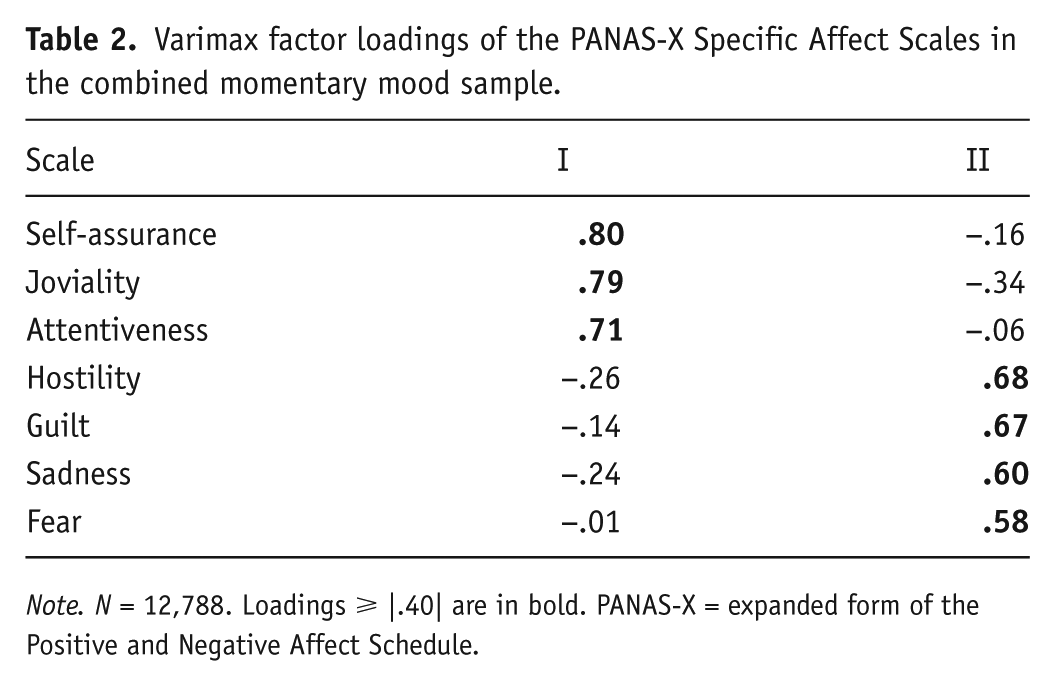
Note. N = 12,788. Loadings ⩾ |.40| are in bold. PANAS-X = expanded form of the Positive and Negative Affect Schedule.
Emotion Blends
Within-Valence Blends
Basic considerations
We now consider how different types of emotional blends fit within our structural scheme. We begin by discussing cases involving blended emotions of the same valence, that is, simultaneously experiencing two or more negative affects (e.g., a combined state of fear and sadness) or multiple positive affects (e.g., a mixture of joviality and self-assurance). These types of emotional blends are inherent in virtually any dimensional model (see Diener & Iran-Nejad, 1986; Watson, 2000), and they represent a crucial element in our structural scheme. For instance, Table 1 reports a strong within-subject correlation (r = .50) between the PANAS-X Sadness and Hostility scales. This substantial association indicates that these negative emotions tend to co-occur within individuals, such that someone who is feeling sad and lonely (i.e., high scores on the PANAS-X Sadness scale) also will frequently report the simultaneous experience of anger, disgust, and scorn (i.e., high scores on the PANAS-X Hostility scale). More generally, these types of negative emotional blends form the basis for the nonspecific Negative Activation dimension at the upper level of the hierarchy.
Similarly, the strong within-subject correlation between joviality and self-assurance (r = .74) indicates that feelings of happiness, enthusiasm, and energy (joviality) frequently are intermingled with the experience of feeling strong, confident, and daring (self-assurance). Blended emotions involving multiple positive affects should be particularly common in everyday experience for two reasons. First, as shown in Table 1, within-subject correlations between various positive affects (mean r = .66) tend to be stronger than those between different negative mood states (mean r = .45) in momentary mood data. Second, affective experience typically is pleasant (Watson, 2000), such that most people experience a mildly positive mood most of the time; Cacioppo and Berntson (1994) labeled this pervasive tendency the positivity offset.
Frequency of emotion blends in momentary experience
How common are these types of blended emotions? We can address this question using the data from our momentary mood sample. The PANAS-X descriptors are rated on a 5-point scale, where 1 = very slightly or not at all, 2 = a little, 3 = moderately, 4 = quite a bit, and 5 = extremely. Given this format, a midrange score of 3 represents a reasonable cutpoint for dividing momentary observations into significantly emotional (i.e., 3 or higher) versus nonemotional responses (for similar approaches, see Peterson & Janssen, 2007; Riediger, Schmiedek, Wagner, & Lindenberger, 2009). We therefore used this cut score to dichotomize responses on each PANAS-X scale. For instance, on the six-item PANAS-X Fear scale, scores in the 18–30 range—which represents an average item response of 3.0 to 5.0—were classified as emotional, whereas responses in the 6–17 range were scored as nonemotional. This scheme admittedly is arbitrary, but it allows us to quantify the existence of emotion blends in a relatively straightforward manner.
Table 3 summarizes the frequency of various affective combinations—reflecting instances of both pure and blended emotions—based on this dichotomous scoring scheme. Given that these data were collected naturalistically, without any attempt to manipulate mood, it is not surprising that respondents frequently failed to report any type of significant emotion. Overall, participants reported no significant emotional response in 5,397 instances, which represents 42.2% of the observations.
Frequency of different combinations of affect in the combined momentary mood sample.
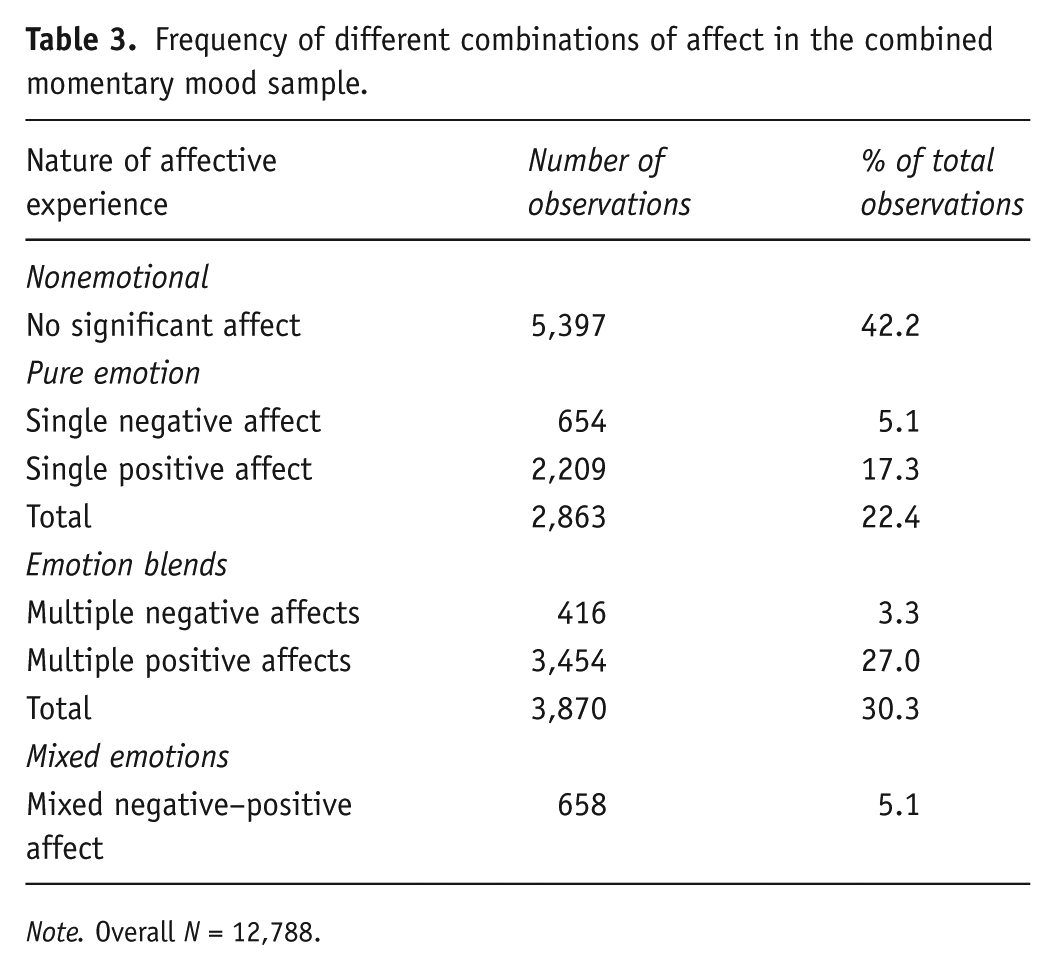
Note. Overall N = 12,788.
Table 3 indicates that pure instances involving a single negative affect—for instance, when a respondent reported moderate to strong levels of sadness, but produced lower scores on all other PANAS-X scales—were relatively infrequent in our data, occurring in only 654 cases (5.1% of the total). Consistent with previous research (e.g., Watson, 2000), pure cases of positive emotion (e.g., moderate to strong levels of self-assurance, combined with lower scores on all other scales) were much more common, characterizing 2,209 observations (17.3% of the total). Collapsing across both negative and positive moods, a single pure affect was reported in 2,863 instances (22.4% of the total).
Consistent with Table 1, our respondents frequently reported emotional blends of the same valence. Overall, in fact, they were reported more often than instances of pure affects. Collapsing across both negative and positive moods, our participants reported either multiple negative affects or multiple positive affects in 3,870 cases, which represents 30.3% of the total. Corroborating previous work (e.g., Cacioppo & Berntson, 1994; Watson, 2000), the bulk of these instances involved the simultaneous experience of two or more positive affects, which was reported in 3,454 observations (27.0% of the total). Reports of multiple negative affects were far less frequent but still represented 416 observations overall (3.3% of the total).
Cross-Valence Mixed Emotions
The ongoing controversy
We now consider mixed emotions of the opposite valence—for instance, the simultaneous experience of guilt (a negative affect) and joy (a positive affect). This topic is the subject of an ongoing controversy—which is the focus of this special section—regarding whether or not certain oppositely valenced affects are mutually exclusive and, therefore, cannot occur simultaneously. The controversy focuses in particular on the emotions of happiness and sadness. On the one hand, Russell, Barrett, and colleagues (e.g., Barrett & Bliss-Moreau, 2009; Barrett & Russell, 1999; Russell, 2017; Russell & Carroll, 1999) have argued that happiness and sadness represent opposite ends of a single bipolar dimension and, consequently, are incompatible with one another. As Russell and Carroll (1999) state, “Bipolarity says that when you are happy, you are not sad and that when you are sad, you are not happy” (p. 25).
On the other hand, Larsen and McGraw (2011) provide evidence of bittersweet situations that appear to produce mixed, simultaneous feelings of happiness and sadness. It should be noted, however, that these examples of bittersweet situations are subject to alternative explanations and do not necessarily prove that happiness and sadness can be experienced simultaneously (see Larsen, 2017; Larsen & McGraw, 2011; Russell, 2017).
Mixed emotions in the hierarchical structure of affect
Our hierarchical scheme emphasizes the distinctiveness of oppositely valenced affects, which form the basis of two higher order factors: Positive Activation and Negative Activation. This distinctiveness of these higher order dimensions, in turn, allows for positive and negative states to covary with each other in complex ways. These complex possibilities include the occurrence of mixed emotional states involving high levels of both positive and negative affect.
To be sure, the Table 1 data demonstrate that reports of positive and negative mood tend to be negatively correlated with one another, indicating that high levels of one type of affect tend to be associated with lower levels of the other. However, the cross-valence correlations displayed in Table 1 are only weak to moderate in magnitude (range = −.00 to −.48, mean r = −.25); associations of this relatively modest size certainly are not high enough to preclude the simultaneous experience of strong negative affect and elevated positive affect in at least some circumstances.
Having said that, however, we must acknowledge three additional considerations. First, as was noted earlier (see Endnote 1), opposite ends of a fully bipolar dimension will not necessarily be strongly negatively correlated with one another (Diener & Iran-Nejad, 1986; Larsen, McGraw, & Cacioppo, 2001; Russell & Carroll, 1999; Schimmack, 2001). Thus, even states that are only weakly correlated may be incompatible with one another and not be experienced simultaneously.
Second, the raw, manifest correlations shown in Table 1 are attenuated by both random and systematic measurement errors (Barrett & Russell, 1998; Diener, Smith, & Fujita, 1995; Green, Goldman, & Salovey, 1993; Tellegen, Watson, & Clark, 1999; Watson & Tellegen, 1999; Watson et al., 1999); latent correlations that eliminate the effects of these errors tend to be substantially higher (see Watson & Tellegen, 1999, Table 1).
Third, the magnitude of the association between negative and positive mood increases significantly during episodes of strong, intense emotion (Diener & Iran-Nejad, 1986; Watson, 1988). That is, extreme levels on one dimension generally are incompatible with strong activation on the other. In particular, Watson et al. (1999) argue that states of heightened negative affect represent “emergency reactions” to ongoing crises. These crisis responses trigger a number of important changes, such as shutting down nonessential functions; the systems regulating positive mood are among the affected functions. Consequently, states of intense negative mood generally should be associated with low levels of positive mood.
Putting these considerations together, momentary states involving elevated levels of both negative and positive affect should be relatively infrequent. Furthermore, states involving intense levels of both positive and negative mood should be quite rare, if they occur at all. Nevertheless, according to our model, there is no inherent reason why people cannot simultaneously report moderate levels of both negative and positive affect.
Frequency of mixed valence emotions in momentary experience
With these considerations in mind, the bottom portion of Table 3 reports the frequency of mixed valence states involving moderate to strong levels of both negative and positive mood. As would be expected, these mixed valence states are experienced relatively infrequently. At the same time, however, they hardly are rare. In fact, our participants reported 658 instances of mixed valence emotions, which represent 5.1% of the observations.
Frequency of specific combinations
What types of mixed emotions did our respondents report most frequently? As we have discussed, there is no simple, direct association between the magnitude of negative correlations and the frequency of co-occurrences. Nevertheless, it seems reasonable to predict that those affect pairs with the strongest negative correlations—namely, joviality and hostility (r = −.48) and joviality and sadness (r = −.41)—would co-occur relatively infrequently in our data.
To investigate this issue, Table 4 reports the frequency of specific pairs of mixed valence emotions (e.g., observations combining fear and joviality) in our sample (note that the total number of observations exceeds 658 due to co-occurring emotions of the same valence). In addition to presenting the absolute frequency of these mixed emotional states, Table 4 reports these numbers as a function of the total number of occurrences for that negative mood state (e.g., the percentage of fear episodes that involve co-occurring joviality) and for that positive mood state (e.g., the percentage of joviality states that involve the mixed experience of fear). Finally, the table displays these numbers as a function of the total number of observations.
Frequency of specific combinations of mixed emotions in the combined momentary mood sample.
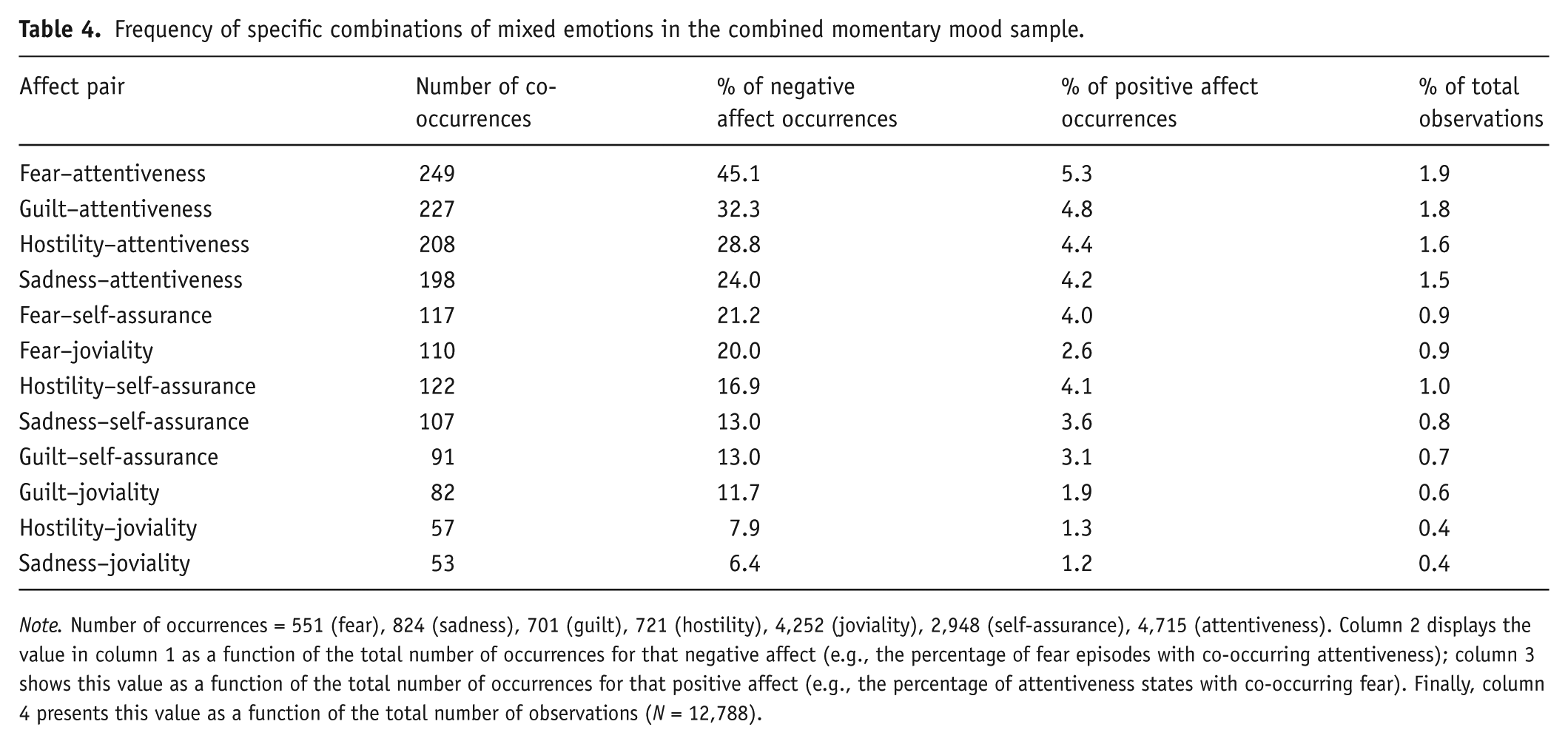
Note. Number of occurrences = 551 (fear), 824 (sadness), 701 (guilt), 721 (hostility), 4,252 (joviality), 2,948 (self-assurance), 4,715 (attentiveness). Column 2 displays the value in column 1 as a function of the total number of occurrences for that negative affect (e.g., the percentage of fear episodes with co-occurring attentiveness); column 3 shows this value as a function of the total number of occurrences for that positive affect (e.g., the percentage of attentiveness states with co-occurring fear). Finally, column 4 presents this value as a function of the total number of observations (N = 12,788).
Table 4 indicates that the four most common examples of mixed emotions all involved attentiveness. The co-occurrence of fear and attentiveness represented the single most common mixed emotion (N = 249) in our data. Indeed, it is striking that nearly half of all fear episodes (45.1%) were associated with high levels of attentiveness. This combination makes good sense conceptually, as fear is the prototypic emotion associated with the behavioral inhibition system (BIS; Fowles, 1994; Gray, 1987; Watson, 2000; Watson et al., 1999). The BIS inhibits behavior that might lead to pain, punishment, or some other undesirable consequence. Gray (1987) called it the “stop, look, and listen system” (p. 263) to emphasize how it redirects attention toward the environment. BIS activity promotes a state of vigilant apprehensiveness that focuses maximum attention on analyzing environmental stimuli, especially novel stimuli that potentially could signal danger. Consequently, it is not surprising that nervousness and fear frequently are associated with heightened levels of alertness and attention. Note, moreover, that the particular type of alertness experienced during these mixed states likely would be perceived by the individual as aversive, rather than pleasant, in nature.
At the other extreme—and consistent with prediction—the two rarest combinations involved (a) joviality and sadness and (b) joviality and hostility. Sadness and joviality co-occurred in only 53 instances; this represents 6.4% of the total number of sadness episodes and 1.2% of the joviality states (0.4% of the total observations). Hostility and joviality co-occurred in only 57 cases; this represents 7.9% of the episodes involving the former and 1.3% of the observations involving the latter (0.4% of the total observations). Guilt and joviality also co-occurred relatively infrequently (N = 82) in our data.
More generally, it is worth noting that the frequency of these mixed valence states is systematically linked to the correlational data presented in Table 1, such that those pairs with the strongest negative correlations (i.e., sadness and joviality; hostility and joviality) tend to co-occur least often. To document this point, we computed vector correlations (N = 12) between the negative correlations shown in Table 1 and the various columns of numbers presented in Table 4. These vector correlations were .77 (total number of co-occurrences), .87 (percentage of negative affect occurrences), and .83 (percentage of positive affect occurrences), respectively (all coefficients are significant at p < .01). At least in this particular case, it is possible to predict co-occurrence patterns quite well from correlational data.
Directions for Research: Explicating the Nature of Mixed Emotions
Mixed valence emotions—even those involving apparent opposites such as joy and sadness—can be identified in momentary mood ratings. It will be important for future research to explicate the nature of these mixed states further so that they can be integrated more fully into existing models of affective experience. One particularly interesting issue concerns the overall hedonic tone of these states. For example, pleasant feelings tend to predominate in nostalgia—a bittersweet emotion that combines elements of happiness and sadness (e.g., Baldwin, Biernat, & Landau, 2015; Wildschut, Bruder, Robertson, van Tilburg, & Sedikides, 2014)—such that it is experienced as a positive state overall. Thrilling experiences—which combine elements of fear and excitement—also tend to be primarily positive in nature (Kerr & Mackenzie, 2012; Spielberg, Olino, Forbes, & Dahl, 2014). In contrast, as we have noted, episodes combining fear and attention—which were the most common type of mixed emotion in our data—likely reflect a state of apprehensive vigilance that typically would be experienced as aversive in nature (Watson et al., 1999). These different types of mixed states merit greater attention in the future.
Footnotes
Declaration of Conflicting Interests
The author declared no potential conflicts of interest with respect to the research, authorship, and/or publication of this article.