



Abstract
How educators and students process and respond to emotions can either enhance or impede the development of the whole child. Social and emotional learning (SEL) refers to the processes of developing social and emotional competencies, which depend on individuals’ capacity to recognize, understand, and manage emotions (i.e., emotional intelligence or EI). Consensus across disciplines about the importance of EI highlights the need to advance the science of how to teach SEL. RULER, an evidence-based approach to teaching EI, provides an educational framework that encompasses a set of practices for comprehensive SEL integration across a school or district. In this article, we describe RULER, explain how it teaches EI, and summarize evidence of its effectiveness.
Keywords
How educators and students process and respond to emotions can either enhance or impede the development of the whole child. In one longitudinal study, kindergarten students who were rated by their teachers as having greater social and emotional competencies experienced better outcomes across multiple domains, including educational attainment and later employment (Jones, Greenberg, & Crowley, 2015). Moreover, the results of a meta-analysis showed that schools that integrate a systematic process for developing students’ social and emotional competencies have increases in academic success, improvements in student–teacher relationship quality, and decreases in problem behaviors (Durlak, Weissberg, Dymnicki, Taylor, & Schellinger, 2011).
The field of social and emotional learning (SEL) provides a framework for schools to systematically develop students’ critical social and emotional competencies, and show links to improved academic achievement and other important life outcomes. Specifically, SEL refers to the processes involved in developing self- and social awareness and regulation, responsible decision-making, and relationship management (Durlak, Domitrovich, Weissberg, & Gullotta, 2015). SEL is gaining traction, in part because of the mounting evidence that social and emotional competencies are critical not only for well-being and relationship quality, but also for academic success (Durlak et al., 2011; Heckman & Kautz, 2012; Levin, 2012). Nobel laureate and economist James Heckman has highlighted the return on investment in early intervention to improve children’s social and emotional competencies for both proximal (e.g., grade repetition) and distal (e.g., employment) outcomes (Heckman & Masterov, 2007). Economists Belfield et al. (2015) estimated that benefits of evidence-based SEL programs, such as academic performance and positive social behavior, outweigh the costs by a ratio of 11 to 1. Consensus across disciplines about the importance of SEL highlights the need to advance the science of how to teach SEL.
Emotional intelligence (EI) is a set of skills that helps individuals reason with and about emotion. These skills are key building blocks for other outcomes that SEL programs target (Brackett & Rivers, 2013), which include the ability to persist in the face of challenges (Ivcevic & Brackett, 2015), move between expansive thinking and deductive reasoning (Fredrickson, 2001), manage stress (Ciarrochi, Deane, & Anderson, 2002), get along with others (Lopes, Salovey, Côté, & Beers, 2005), and inspire trust and confidence (George, 2000).
RULER (Brackett & Rivers, 2013) is an evidence-based approach to SEL that encompasses a set of practices for comprehensive SEL integration across an entire school or district. RULER is an acronym that represents five skills: recognizing emotion in the self and others, understanding the causes and consequences of emotions, labeling emotions with a diverse and accurate vocabulary, expressing emotions constructively across contexts, and regulating emotions effectively. Grounded in EI theory (Mayer & Salovey, 1997; Salovey & Mayer, 1990) and employing an ecological systems approach to its implementation (Bronfenbrenner, 1979), RULER simultaneously focuses on developing EI skills in children and adults and enhancing the learning climate in schools. Accumulating evidence shows that RULER both enhances student outcomes (Brackett, Rivers, Reyes, & Salovey, 2012; Rimm-Kaufman & Hulleman, 2015) and improves the quality of learning environments (Hagelskamp, Brackett, Rivers, & Salovey, 2013; Rivers, Brackett, Reyes, Elbertson, & Salovey, 2013).
EI Theory in Context
EI theory proposes that skills for recognizing, understanding, and regulating emotions are critical for humans to act on emotions adaptively (Mayer & Salovey, 1997). EI encompasses the capacity of individuals to process emotions to guide thought and action, and to enhance reasoning and decision-making. Nearly two decades of research has shown that EI, when measured as a set of skills, is associated positively with important outcomes for children and adults, including cognitive and social functioning, psychological well-being, academic and workplace performance, and leader effectiveness (Mayer, Roberts, & Barsade, 2008). In efforts to design a robust approach to teach EI, the RULER framework encompasses Mayer and Salovey’s four-branch ability model, which specified four well-defined, interrelated emotion skills (i.e., perceiving, using, understanding, and regulating emotion). Each of the skills in the original ability model is incorporated into RULER, with aligned training components (see Brackett & Rivers, 2013).
At the highest level, RULER helps educators to: (a) understand how emotions enhance thinking and learning, relationships, decision-making, and well-being; and (b) integrate tools, activities, and specific lessons to develop both their own and their students’ EI. RULER’s design accounts for the connection between relationships, contexts, and developmental outcomes, informed by ecological systems theory (Bronfenbrenner, 1979). Accordingly, RULER’s theory of change (Figure 1) specifies that when adults and children use RULER components and practice the skills in daily interactions, all stakeholders develop their EI and improve the emotional climates in classrooms, schools, homes, and communities. Over time, the combination of enhanced individual skills and improved emotional climate leads to changes in more distal outcomes, such as health and well-being, responsible decision-making, and academic performance (Brackett & Rivers, 2013). This article summarizes the empirical evidence linking RULER with many of the proximal and distal outcomes shown in Figure 1. Links with other outcomes are supported by the broader literature on SEL.
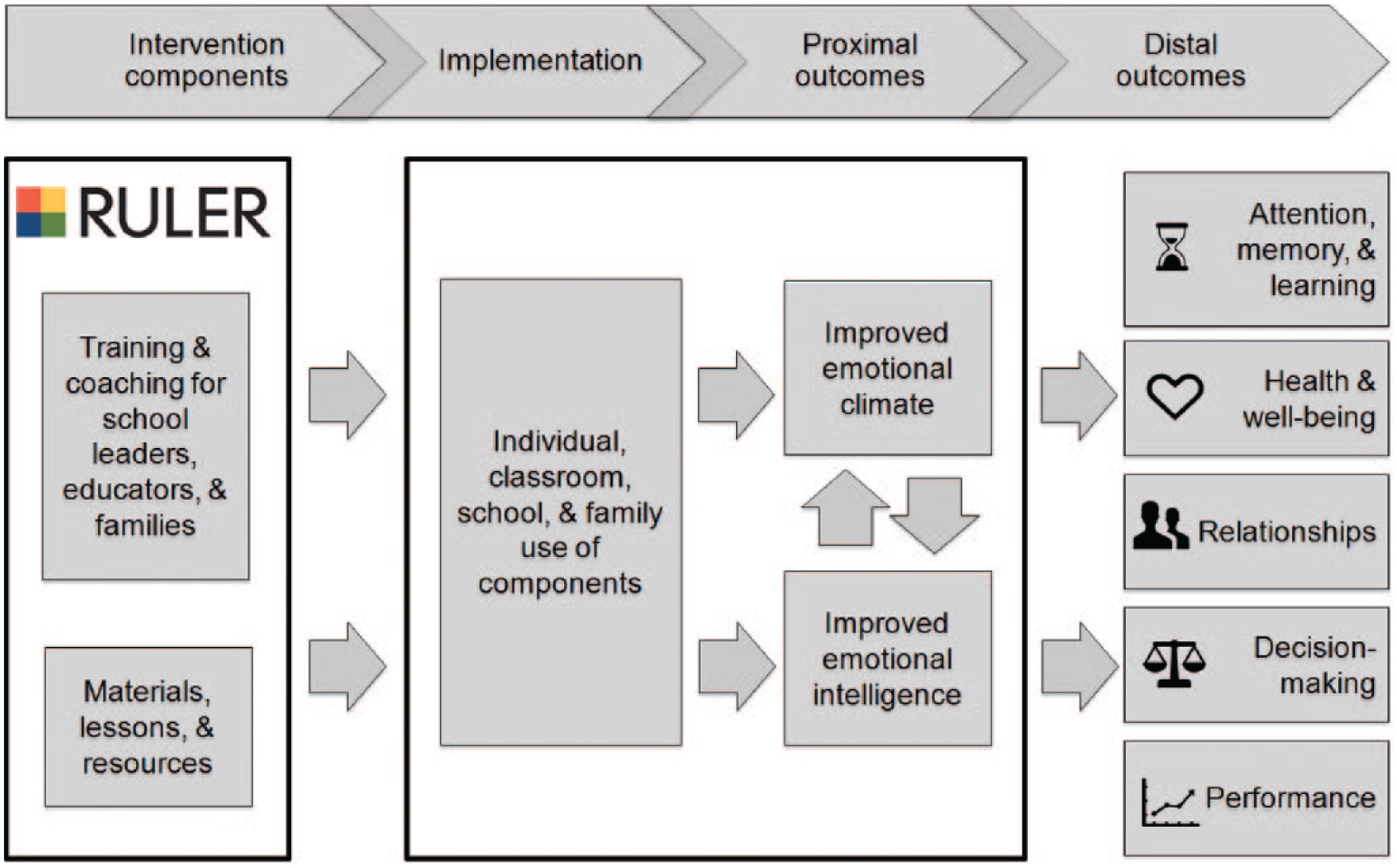
RULER theory of change.
How RULER Teaches EI
RULER is designed to help educators develop their own EI and teach EI to prekindergarten through high school students. The approach consists of a set of foundational anchor tools, which introduce EI skills into everyday classroom and school routines, an advanced Feeling Words Curriculum, a pedagogical approach that integrates emotions and EI skill-building into academic instruction for kindergarten to eighth grade classrooms (Brackett, Caruso, & Stern, 2006), and a series of advanced courses for high school students. RULER also includes resources for families to develop their own EI skills. Ultimately, RULER works by helping schools embed EI into norms, routines, policies, instruction, and school–home relationships.
The signature tool is the Mood Meter (Figure 2), a deceptively simple tool that supports EI skill building and enhances academic learning in myriad ways (Brackett et al., 2006). The four-quadrant grid represents two dimensions of core affect: valence (unpleasant to pleasant, represented by the X axis) and arousal (low to high energy, represented by the Y axis; Russell & Barrett, 1999). Older students and adults plot themselves using numbers and feeling words (“I feel +2, −2; peaceful”), whereas younger students initially use the four colors (yellow, red, blue, and green) and a feeling word (“I’m in the green; calm”). The simplicity of the Mood Meter’s color-coded quadrants makes it an easy starting place for educators to incorporate emotions into their daily routines.
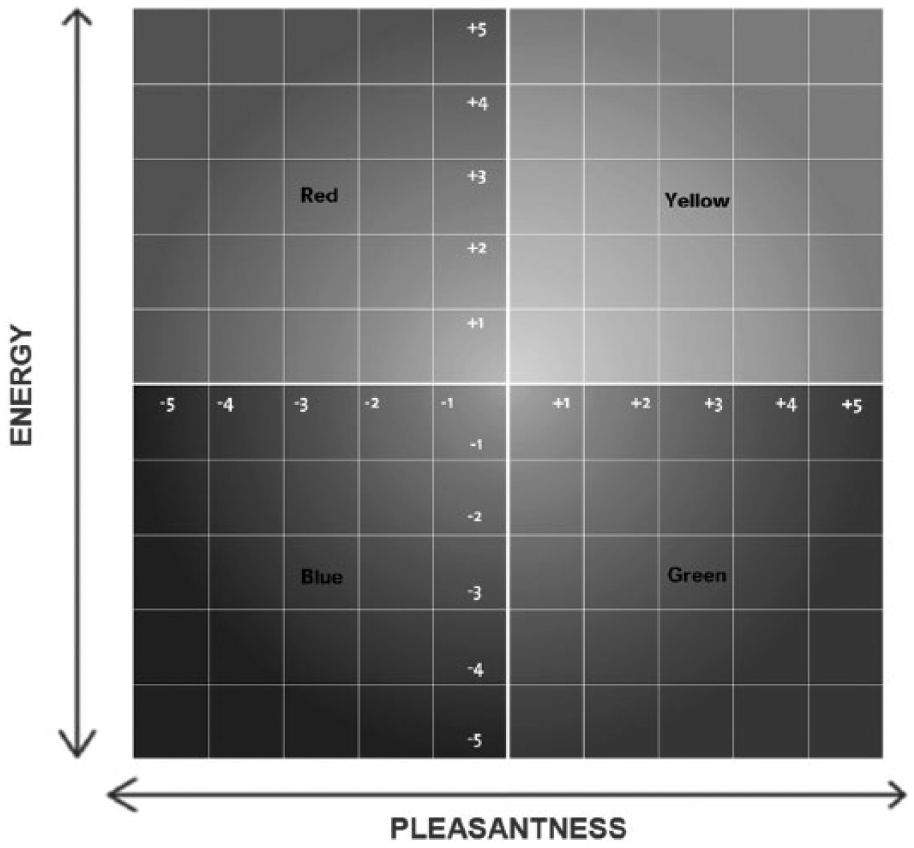
The Mood Meter.
Imagine a kindergartener whose teacher greets him by saying, “Good afternoon, Andrew. How are you feeling after recess?” With practice, Andrew will easily report being either in the yellow because he was the fastest in a sprint or in the red because someone claimed he cheated to win the race. He also would be able to convert his yellow or red feelings into words, such as proud or angry. This process of plotting himself on the Mood Meter helps Andrew build self-awareness (i.e., recognizing and labeling emotions) and reinforces the importance of monitoring feelings and thoughts (e.g., replaying the accusation) and physical sensations (e.g., racing heart, tense muscles). Over time, students like Andrew build a nuanced emotion vocabulary, filling each Mood Meter quadrant with dozens of words. Educators may also use the Mood Meter to teach students to evaluate whether their current feeling is ideal for what they are about to learn, and develop emotion regulation strategies to help them either maintain or shift their feelings to optimize learning. One of the other ways teachers embed the Mood Meter into the standard curriculum is through a character analysis in literature or history, connecting events that cause shifts from one emotion quadrant to another.
RULER includes three other anchor tools. The Charter is a collaborative agreement that helps to establish supportive and productive learning environments. Members of a classroom or school community identify how they want to feel (i.e., labeling), which behaviors foster those feelings (i.e., understanding), and how to handle times when they are living up to the Charter (i.e., regulating). Students and educators create classroom and staff charters. Norms of use include periodic check-ins to amend the Charter and activities to link it to instruction.
The Meta-Moment is a step-by-step process for extending the time between an emotional trigger and one’s response to it. The Meta-Moment is designed to help students and educators respond effectively to an emotional trigger by taking a deep breath, envisioning their best self, and selecting a response strategy based on this vision of self. This tool integrates all five skills and focuses most keenly on developing emotion regulation (Gross, 2015). For example, in response to a hurtful comment made by a close friend, a student taking a Meta-Moment would recognize he felt hurt, take a deep breath, think about what his best self would do in the situation, and ask the friend if they could have a conversation about the remark (instead of, for example, posting mean comments about the friend on social media).
Despite efforts to be their best selves, conflict inevitably arises. The final tool, the Blueprint, helps students and educators manage conflict more effectively through perspective-taking and analyzing the causes and consequences of emotions and behavior. Answering the Blueprint questions, including, “How did I (and the other person) feel?” and “What caused me (and the other person) to feel this way?” sparks both self-reflection and perspective-taking, sowing seeds of empathy. With practice, the Blueprint may contribute to a more emotionally supportive climate and better quality relationships.
The Feeling Words Curriculum comes after the anchor tools have been embedded with fidelity (typically in Year 2). This curriculum provides an extensive emotion vocabulary to embed into existing lessons. Teachers learn how to use EI skills to differentiate instruction, including methods to encourage both personalized learning (e.g., storytelling around feelings) and cooperative learning (e.g., discovering effective emotion regulation strategies in small groups).
In high school, a set of advanced courses helps students build greater self-awareness through assessments; build a vision for what they hope to achieve in high school; identify strength and challenge areas; engage in self-reflective practices; set goals for their wellbeing, relationships, and academics; and learn and practice strategies to achieve their goals.
RULER Evidence
Accumulating evidence supports RULER’s theory of change, including the positive effects of RULER on proximal and distal outcomes, such as EI skill development and academic performance. Three quasi-experimental pilot studies provide support for RULER’s proximal outcomes. A study of 47 teachers in Spain showed improvements in teacher outcomes (Castillo, Fernández-Berrocal, & Brackett, 2013). Teachers enrolled in either RULER or eLearning training. Both groups completed 30 hours of training along with pre- and postintervention surveys. After controlling for gender, age, trait affect, and personality, multivariate analyses of covariance showed that compared to the eLearning group, teachers in the RULER group had significantly higher ratings of work engagement such as vigor, dedication, and absorption, Wilk’s lambda (3, 31) = 5.68, p = .003; η2 = .35, and teacher–student interactions, including personalized interactions with students, response to emotions, and caring beyond classroom, Wilk’s lambda (3, 31) = 6.18, p = .002; η2 = .37.
A study (Rivers et al., 2016) of Preschool RULER, designed for children ages 3 to 5, examined child outcomes (n = 156) at three early childhood centers (two RULER, one comparison) serving families from low-income backgrounds. Children in RULER classrooms demonstrated greater knowledge of emotions and ability to use the Mood Meter, compared to classrooms not using RULER. Further, children’s ability to use the Mood Meter in RULER classrooms was associated with end-of-year performance on two emotion-related tasks, including significantly fewer errors in emotion recognition (z = −2.01, p < .05, modified Glass’ Δ = 0.52) and increased ability to label emotions accurately (z = 4.46, p < .001, modified Glass’ Δ = 1.39). Additionally, children exposed to RULER for 2 years had significantly fewer errors in emotion recognition (z = −2.04, p < .05, modified Glass’ Δ = 0.45) and improved emotion labeling (z = −2.35, p < .05, modified Glass’ Δ = 0.55), compared to children with no RULER training.
A quasi-experimental study tested the impact of RULER on 273 fifth- and sixth-grade students in 15 classrooms across three elementary schools (Brackett et al., 2012). Each school was assigned randomly to implement RULER in either fifth or sixth grade, and classrooms in the other grade served as the comparison group. The students were followed for 1 academic year with pre- and postintervention data collection comprised of end-of-year grades (i.e., academic performance) and teacher report of social and emotional competence. Students in RULER classrooms relative to those in comparison classrooms had significantly greater overall academic performance (i.e., distal outcome) for year-end grades, F(3, 219) = 5.83, p < .001, partial η2 = 0.07. Follow-up analysis showed students in RULER classrooms had higher grades in English language arts, F(1, 221) = 12.65, p < .002, partial η2 = 0.05, and work habits/social development, F(1, 221) = 10.04, p < .002, partial η2 = 0.04, than students in comparison classrooms. Additionally, multivariate analyses showed a significant Time x Condition interaction for teacher-reported social and emotional competence, F(4, 241) = 3.56, p < .01, partial η2 = 0.06. Follow-up analyses indicated that at posttest, students in the RULER condition had significantly higher subscale adaptability scores, F(1, 244) = 7.66, p = .006, partial η2 = 0.03, and significantly lower school problem scores, F(1, 244) = 9.34, p = .002, partial η2 = 0.04, than peers in comparison classrooms.
In a 2-year randomized controlled trial with 62 schools, including 155 classrooms, 105 teachers, and 3,824 students, schools were randomly assigned to either integrate RULER into their fifth- and sixth-grade English language arts (ELA) classrooms or to serve as a comparison school, using their standard ELA curriculum (i.e., “business-as-usual”; Rivers et al., 2013). Outcomes were measured using an observational coding rubric applied to video footage of ELA classrooms (Pianta, La Paro, & Hamre, 2008), and student and teacher reports. By the end of Year 1, observers rated classrooms in RULER schools as having greater warmth and connectedness between teachers and students (p = .048, g = .50), more positive climates (p = .007, g = .55), and higher regard for students’ perspectives (p = .030, g = .60), relative to comparison classrooms. Furthermore, teacher reports showed more emotion-focused interactions between teachers and students (p = .038, g = .52) and cooperative learning strategies (p = .021, g = .53) in RULER classrooms.
A follow-up study demonstrated that first-year shifts in classroom emotional climate (Rivers et al., 2013) continued and were followed by improvements in classroom organization and instruction (i.e., student learning) by the end of the second year (Hagelskamp et al., 2013). Relative to classrooms in the comparison schools, RULER classrooms maintained greater emotional support (b = .24, p = .043, g = .48), and had better classroom organization (b = .26, p = .026, g = .56) and more instructional support (b = .36, p = .005, g = .71).
Finally, how well RULER is implemented influences outcomes. In one study examining the fidelity of RULER’s implementation, students had more positive outcomes, including higher EI and better social problem-solving skills when their teachers had attended more trainings, taught more lessons, and were rated by impartial observers as high-quality implementers (Reyes, Brackett, Rivers, Elberston, & Salovey, 2012).
Summary and Future Directions
RULER has now been adopted by hundreds of public, charter, and independent schools throughout the US, and its implementation has been evaluated—informally and formally—in dozens of schools. While many aspects of RULER’s theory of change have been tested and positive effects have been found on both proximal (e.g., EI, classroom emotional climate) and distal outcomes (e.g., teacher instructional support, academic performance), further research is needed. First, the sequencing of proximal and distal outcomes (i.e., Year 1 impact on emotional climate and Year 2 impact on instructional quality and organization) needs further study to parse temporal versus dosage effects. More research on how RULER helps both children and adults develop specific EI skills, such as labeling and regulating emotions, will inform both program enhancements and the evidence base for SEL programs. One limitation to conducting this research, however, is the lack of developmentally sequenced, performance-based assessments of the full range of EI skills (Denham, 2015). The next generation of RULER research, therefore, needs to coincide with the development of high-quality EI assessments that are sensitive to change. The broader field currently relies on a small number of assessments that capture one or a few components of EI at one stage of development (e.g., adolescents’ emotion regulation). Multiple batteries of assessments are critically needed to both rigorously evaluate RULER and inform its practices (i.e., provide educators with both formative and summative assessment tools to understand their own and their students’ EI skill development).
Research is also needed to demonstrate RULER’s impacts on a wide range of distal outcomes, including additional indicators of performance (i.e., high school dropout rates, standardized test scores) and well-being of teachers (i.e., attrition and burnout). This research should include urban, suburban, and rural districts, as well as independent and charter schools. Of course, longitudinal studies demonstrating how RULER improves long-term personal, educational, and social outcomes for both students and adults will provide the most definitive evidence of RULER’s impact. Such research will increase adoption of evidence-based approaches to SEL like RULER. These types of evidence resonate with policy-makers who create policies and dedicate resources that will enable schools to embed quality SEL programming.
The outcomes associated with higher EI and the benefits of SEL training are now well documented (Durlak et al., 2011; Mayer et al., 2008). The argument, therefore, for teaching children and adults EI is backed by science. Why, then, is SEL programming not part of everyday practice in all schools? Progress in the field will likely happen when there is a convergence of policy-related efforts; more high-quality research that supports the benefits of SEL training across multiple contexts; and above all, educators, families, and policy-makers champion EI as a set of skills that help children reach their full potential—academically, socially, and emotionally.
Footnotes
Author note:
Authors Rivers and Brackett have a conflict of interest management plan in place with Yale University to ensure that their involvement in the development of RULER does not compromise research endeavors.
Declaration of Conflicting Interests
The author(s) declared no potential conflicts of interest with respect to the research, authorship, and/or publication of this article.