



Abstract
Emotional intelligence (EI) stands at the nexus between intelligence and emotion disciplines, and we outline how EI research might be better integrated within both theoretical frameworks. From the former discipline, empirical research focused upon whether EI is an intelligence and what type of intelligence it constitutes. It is clear that ability-based tests of EI form a group factor of cognitive abilities that may be integrated into the Cattell–Horn–Carroll framework; less clear is the lower order factor structure of EI. From the latter discipline, research linking EI with theoretical frameworks from emotion research remain relatively sparse. Emotion regulation and appraisal theory may be key to explain how EI may reflect different processes. We propose a research agenda to advance the EI study.
Keywords
Jerome Bruner (1986) warned about the common tendency to draw strong conceptual boundaries in thought, action, and emotion as independent “regions” of the mind, requiring scholars to build conceptual bridges to connect what should never have been separated. Since it was first proposed as a psychological entity, the concept of emotional intelligence (EI) has been seen as an attempt to build a theoretical bridge between human emotional experience and cognitive abilities. However, this particular bridge is still under construction. A cogent framework for theory development and empirical research around EI requires consideration of both assessment principles and the conceptual underpinnings of this construct. In this article, we provide some suggestions for crossing an arguably artificial, and perhaps unnecessarily cumbersome, chasm.
Early research on EI questioned whether an “intelligence” dealing primarily with emotional information could feasibly be an intelligence at all (Davies, Stankov, & Roberts, 1998). This early focus on the status of EI as an intelligence led to prolonged debate, including whether ability-based assessments of EI could meet these criteria (see e.g., MacCann, Joseph, Newman, & Roberts, 2014). However, the “emotion” element of EI received less attention. Few, if any, efforts were made to develop a comprehensive conceptual map that included theories of emotion (see, however, Matthews, Zeidner, & Roberts, 2003). Instead, much of the research focused on whether EI could predict a broad range of meaningful outcomes linked to both normal and abnormal functioning in the school, workplace, and home (e.g., Mayer, Roberts, & Barsade, 2008).
Concurrently, a large number of EI instruments were develo-ped, sometimes with careful consideration of psychometric principles (e.g., focusing on reliability and validity considerations as is required by the various versions of the Standards for Educational and Psychological Testing; see Matthews, Emo, Roberts, & Zeidner, 2006), and sometimes not. Perhaps because a subset of these instruments did not pass scientific muster, there was a nonnegligible amount of skepticism and criticism within academia around these measures (Gignac, 2009). We contend that this early backlash may now have abated, and it is worth reconsidering the extent that current developments support the assessment of emotional intelligence.
In this manuscript, we begin by describing how EI might be fully integrated into existing frameworks for cognitive ability research, before moving to consider something similar for emotion models; that is, how consistent with emotion theories are emotional intelligence models. Throughout, we review empirical evidence and emerging research testing such cross-links. The article concludes with a series of recommendations for moving the field forward.
Integrating Theory and Research From the Field of Intelligence
On the one hand, intelligence has encompassed various definitions: taxonomically, as a system of mental abilities; operationally, as performance in carrying out abstract reasoning with data; or theoretically, as a capacity to learn (e.g., Roberts & Lipnevich, 2011). On the other hand, a historical dichotomy between emotion as an irrational force and reason as its rational polar opposite made EI appear an oxymoron (Matthews et al., 2003). However, most modern theories of emotion treat cognitive processes as an essential element of emotion; cognition or reason is an integral part of how emotions are generated and the meaning that such emotions possess (see e.g., Moors, Ellsworth, Scherer, & Frijda, 2013). Accordingly, it appears entirely plausible that cognitive processes pertaining to emotions may differ meaningfully across people and in turn, constitute a particular type of intelligence.
Indeed, early in the debate over EI’s place with respect to other cognitive ability constructs, Mayer, Caruso, and Salovey (1999) proposed three criteria that EI must meet to be a legitimate form of intelligence. These criteria were:
Operational: EI should have an operational definition as an ability measure.
Correlational: EI should demonstrate positive correlations with other kinds of intelligence constructs.
Developmental: EI should demonstrate developmental progression (though, curiously, if other intelligence constructs are used as models for such progression, this could take the form of either improvement or decline over the lifespan).
Although other criteria might have been listed (especially biological concomitants and test criterion validity evidence), the field seems broadly to have accepted these criteria, with research frequently directed at resolving these issues. In what follows, we summarize current perspectives with respect to these three criteria. Note, however, in so doing, we simultaneously acknowledge that other logic arguments and criteria (e.g., consequential validity evidence; convergent and discriminant validity evidence) might be equally important elements for consideration within this domain (see Zeidner, Matthews, & Roberts, 2009).
Evaluating the Operational Criterion for an Intelligence
This criterion was arguably met upon inception when Mayer and Salovey (1997) developed a measurement model that broadly followed the assessment development rules of engagement outlined in the Standards for Educational and Psychological Testing (American Educational Research Association [AERA], American Psychological Association [APA], & National Council on Measurement in Education [NCME], 2014). However, it should be acknowledged that there are competing theoretical and measurement models of EI that likely do not meet the “operational criterion.” Theoretical models in the “mixed model” tradition of EI delineate a concept that is much broader than a set of abilities. This concept includes character traits, beliefs, social cognitions, attitudes, and other noncognitive attributes that contribute to emotional functioning (Matthews et al., 2003; Zeidner et al., 2009). Moreover, rating-scale measurement models do not assess actual abilities (generally aligned with maximum performance) but rather self-efficacy or self-perceptions of ability (usually aligned to typical performance; Roberts, Schulze, & MacCann, 2008).
With these caveats in mind, we refocus on the theoretical model suggested by Mayer and Salovey (1997), known as the four-branch model. This framework contains four related abilities:
Perception: Accurately perceiving/recognizing emotions from sensory stimuli from oneself and others (i.e., tone, facial expression, posture, or other environmental cues);
Facilitation: Using emotions and mood to facilitate, improve, or enhance task performance;
Understanding: Comprehending how emotions combine, progress, and change over time and situations; and
Management: Managing or regulating one’s own or others’ emotions to experience greater positive affect and enhance personal growth (both emotional and intellectual).
These abilities are operationalized by the Mayer, Salovey, and Caruso (2002) Emotional Intelligence Test (MSCEIT) measurement model, which consists of two tests for each branch. However, in evaluating the theoretical model, some scholars have suggested that the facilitation branch may be redundant with (or a subset of) the perception and management branches (Allen, MacCann, Matthews, & Roberts, 2013; Joseph & Newman, 2010; MacCann et al., 2014). Specifically, management is mainly the down-regulation of negative emotions (and occasionally the up-regulation of negative emotions such as anger; Tamir, Mitchell, & Gross, 2008). As such, the generation of emotions to assist with task performance (i.e., facilitation) necessarily entails such emotion production.
Structural analyses of the MSCEIT and its precursor (the Multi-Factor Emotional Intelligence Scale; Mayer, Caruso, & Salovey, 1998) generally do not support including a facilitation branch (e.g., Fan, Jackson, Yang, Tang, & Zhang, 2010). There are also measurement issues with the perception branch, which has low, negligible, and even negative relationships with other assessments of emotion recognition (e.g., Roberts et al., 2006). Also, the face (and ecological) validity of emotion understanding and management tests has been criticized (e.g., Matthews et al., 2003). However, such concerns about measurement are not theoretical issues negating the existence of EI as an intelligence. Instead, they can be addressed through ongoing research and development. For example, there are a significant and growing number of well-constructed tests of emotion recognition, many of which are theoretically grounded in emotion theory (e.g., the Geneva Emotion Recognition Test; Schlegel, Grandjean, & Scherer, 2014). Furthermore, there are promising recent efforts to assess emotion management by using multimedia stimuli (MacCann, Lievens, Libbrecht, & Roberts, 2015; Mortillaro & Schlegel, 2014).
In sum, meeting the operational criterion for an intelligence is an ongoing process of research and test refinement. There are currently ability-based tests of the four-branch model that meet this criterion, with ongoing research ensuring that this will continue. However, there remain doubts about the separate status of facilitation as a key component in the four-branch model. Whether the status of this construct in widely adopted EI frameworks is a measurement or substantive problem likely still requires empirical investigation (though we suspect it is a combination of both factors). Regardless of this point—anticipating a consistent theme throughout this manuscript—further measures beyond the MSCEIT are needed, minimally to supplement, and possibly to replace at least some branches of that assessment.
Evaluating the Correlational Criterion for an Intelligence
One of the earliest lawful rules of intelligence is the principle of positive manifold: All maximum performance tests of intelligence are positively correlated with all other tests (Spearman, 1927). Therefore, for EI to be an intelligence, EI test scores should correlate positively with scores on other intelligence tests. There is clear meta-analytic evidence that this is the case (e.g., Joseph & Newman, 2010; Roberts et al., 2008). Maximum performance measures of EI undoubtedly assess a type of intelligence. However, it is still unclear whether tests of EI capture a new and distinctive element of intelligence that is separate from other known abilities. This is a second and more nuanced aspect of the correlational criterion. It is necessary to consider some background in intelligence theory to describe what “other known abilities” may consist of and therefore ascertain whether EI is entirely independent of this set of constructs.
The Cattell–Horn–Carroll (CHC) model is “the most comprehensive and empirically supported psychometric theory of the structure of cognitive abilities to date” (Flanagan & Dixon, 2013, p. 368; see also Roberts & Lipnevich, 2011). In this model, intelligence consists of several broad abilities, such as fluid reasoning (Gf), acculturated knowledge (Gc), visual processing (Gv), auditory processing (Ga), and multiple factors representing memory and mental speed (McGrew, 2009). Each of these broad, second-order abilities encompasses several narrower primary mental abilities (PMAs). For example, reading comprehension, phonetic coding, and general information are some of the PMAs underlying Gc (see left half of Figure 1).
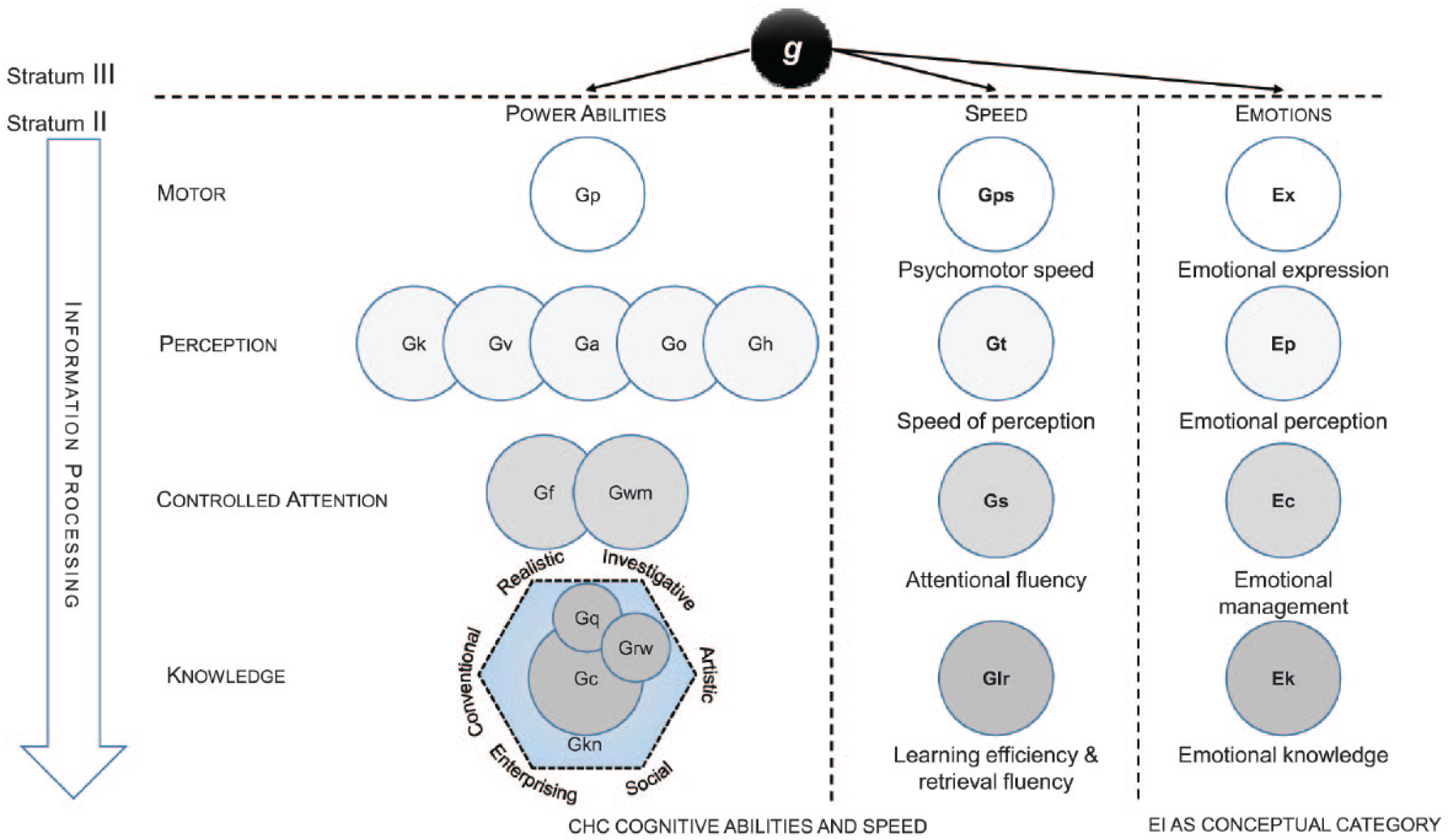
Cattell–Horn–Carroll (CHC) theory of cognitive abilities with emotional intelligence (EI) as a conceptual category.
It is possible to imagine a parallel structure for emotional intelligence (see right half of Figure 1) where perception/expression, understanding, and managing emotions are broad abilities, each consisting of underlying PMAs (with facilitation excluded or potentially a PMA of management, in line with our earlier evidence). In 1997, Mayer and Salovey depicted such a model, describing potential PMAs for each of the four branches of their EI model. For instance, emotional understanding (Branch 3) includes: (a) labeling emotions, (b) interpreting situational meaning from emotions (e.g., loss may precede sadness and unfairness may precede anger), (c) understanding complex blends of emotions, and (d) understanding transitions among emotions. This model is currently a theory to be tested rather than an empirically proven structure, as there are insufficient marker tests for each PMA to verify a factor structure. An alternative model integrating EI within CHC theory treats EI as a broad ability (with equivalent status to Gf, Gc, or Gv) where each of the branches constitutes a PMA of EI. MacCann et al. (2014) tested such a model using five broad abilities from CHC (Gf, Gc, Gq [quantitative knowledge], Gv, and Glr [learning efficiency and retrieval fluency]) and the perception, understanding, and management branches of the MSCEIT. This model showed better fit to a large data set than several competing models, supporting the idea of EI as a “group factor” of intelligence within the CHC model (see Figure 2, where EI abilities are modeled within the second stratum of the CHC model).
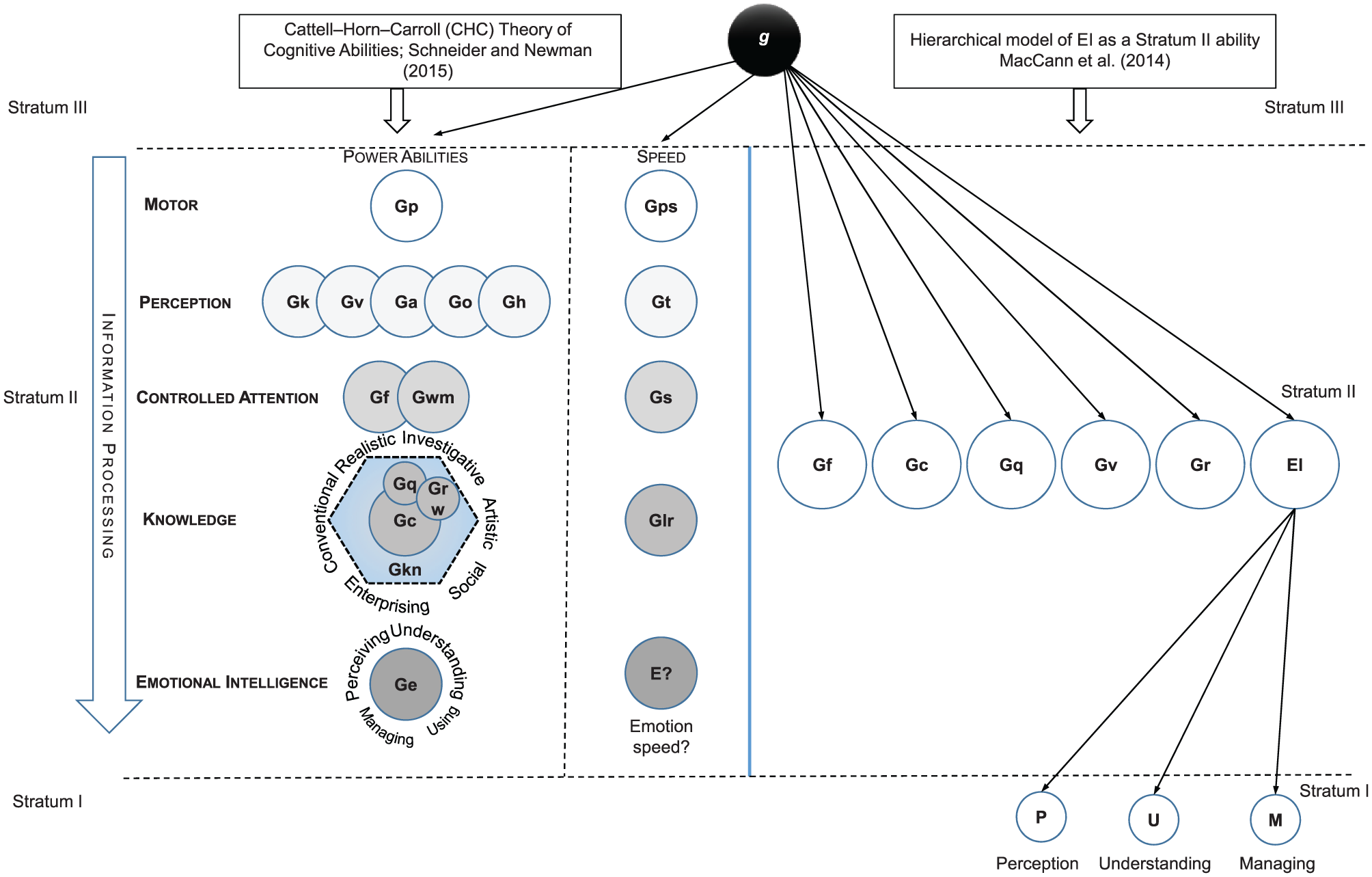
Cattell–Horn–Carroll (CHC) theory of cognitive abilities versus hierarchical model of EI as Stratum II ability.
Using a theoretical model of intelligence such as CHC theory allows a more nuanced answer as to whether EI is an intelligence and also what type of intelligence it is. Much of the existing research suggests that EI constitutes knowledge rather than reasoning or information processing. For instance, EI tends to show a stronger relationship with Gc than with Gf, and this relationship is particularly pronounced for emotional understanding (MacCann, 2010; Roberts et al., 2008). In fact, some scholars claim that EI needs to incorporate more fluid, perhaps even information processing, components (e.g., Ortony, Revelle, & Zinbarg, 2008).
In sum, if measured using maximum performance assessments, there is sufficient correlational evidence to consider EI a form of cognitive ability. Moreover, emerging data suggest that EI has similar status as Gf, Gc, Gv, and other constructs within the CHC model. An obvious next step in this line of research is to investigate primary PMAs of a broad EI factor. There is a clear need for more studies of this nature, with a range of assessments in addition to the MSCEIT. This is necessary both for empirical reasons (three marker tests are generally minimally necessary to factor each branch and the MSCEIT contains only two), and to address issues of mono-method biases that limit the generalizability of empirical findings.
Evaluating the Developmental Criterion for an Intelligence
While different broad cognitive ability factors show different developmental trajectories, the following general trends are apparent:
Fluid reasoning (Gf) ability and speed-related factors (like Gs) increase rapidly through childhood and adolescence before stabilizing and going into a slow decline.
Knowledge-related factors (like Gc) increase less rapidly (but still quickly) in childhood and adolescence but continue to increase across the lifespan. Specific, differentiated knowledge structures (expertise, vocational knowledge, domain-specific knowledge) show relatively greater growth in adulthood compared to more general acculturated knowledge.
Factors based on sensory modalities (Ga, Gv) show the greatest decline in older adults, with developmental trajectories otherwise similar to Gf (Horn & Cattell, 1967; Salthouse, 2005).
Thus, the developmental trends that characterize specific EI branches provide information about what types of abilities are involved in each branch. Two recent cross-sectional studies of the MSCEIT suggest that emotion management shows larger increases across the lifespan than do the other three abilities (Cabello, Bravo, Latorre, & Fernandez-Berrocal, 2014). Similarly, research on emotion regulation supports the idea that emotion management abilities increase across the lifespan. Older adults report greater use of anger regulation strategies and reappraisal but less use of ineffective regulation techniques such as suppression (John & Gross, 2004; Phillips, Henry, Hosie, & Milne, 2006). In contrast, older adults experience deficits in emotion recognition tasks but not in decoding emotions from verbal material (Phillips, MacLean, & Allen, 2002). Such a result suggests an age-related decline in emotion perception but not emotion understanding.
In sum, these results suggest that emotion perception follows a developmental trajectory similar to that of sensory-modality abilities (with decreases in adulthood), what CHC sometimes refers to as vulnerable abilities. By contrast, emotion understanding and management follow a developmental path similar to that of knowledge-like factors (continued increases across the lifespan well into old age; i.e., consistent with maintained abilities). As with other cognitive ability constructs, different aspects of EI have relative strengths and weaknesses at different stages of the lifespan. In sum, developmental trends indicate that different branches (or PMAs) of EI may represent distinct types of abilities. This evidence adds further weight to our belief that further research should focus on the PMA level of EI and separately consider both the theory and empirical evidence for the separate branches.
Integrating Theory and Research From the Field of Emotions
If EI is a concept that reflects how people process emotional information (Mayer et al., 2008), it is important to integrate theories of affect into the EI framework. This is the flip-side of the intelligence criteria outlined in the previous passages. This call to action first presented in Matthews et al. (2003) but has only recently started to gain momentum.
Among a range of possibilities, we discuss two broad emotion-related theories that might guide research on the “emotional” aspect of emotional intelligence: (a) the emotion regulation modal model (ERMM; Gross & Thompson, 2007) and (b) appraisal theories of emotion. While there are other possible emotion-related frameworks to consider, we believe that these two theories show promising theoretical links to known PMAs of EI (perception, understanding, and management). The reader should be aware of this caveat as we discuss these models.
Emotion Regulation Modal Model (ERMM) and Emotional Intelligence (EI)
Emotion regulation (ER) predates EI. ER focuses on the processes people use to influence which emotions they have, when they have them, and how they are expressed (Gross & Thompson, 2007). In contrast, EI has focused on individual differences in the ways people perceive, understand, and manage emotions. Recently, Peña-Sarrionandia, Mikolajczak, and Gross (2015) suggested integrating ER and EI to simultaneiously consider: (a) who manages emotions (i.e., the EI perspective of individual differences) and (b) how this is done (i.e., the ER process perspective).
Like the earlier transactional model of stress and coping (Lazarus & Folkman, 1987), ERMM describes emotion as a transaction involving a situation and a person’s attention to the goal-relevant elements of the situation, which activates both their interpretation of such elements and their behavioral, cognitive, or physiological response to the situation (Gross & Barrett, 2011). ER occurs when a person intervenes in this situation–attention–appraisal–response sequence to change the emotion that is experienced. In this model, there are five broad classes of ER, which primarily occur as specific points in any given emotional sequence. Table 1 shows some sample regulation strategies for each of these five general types of ER.
Links between emotion regulation strategies and EI*.
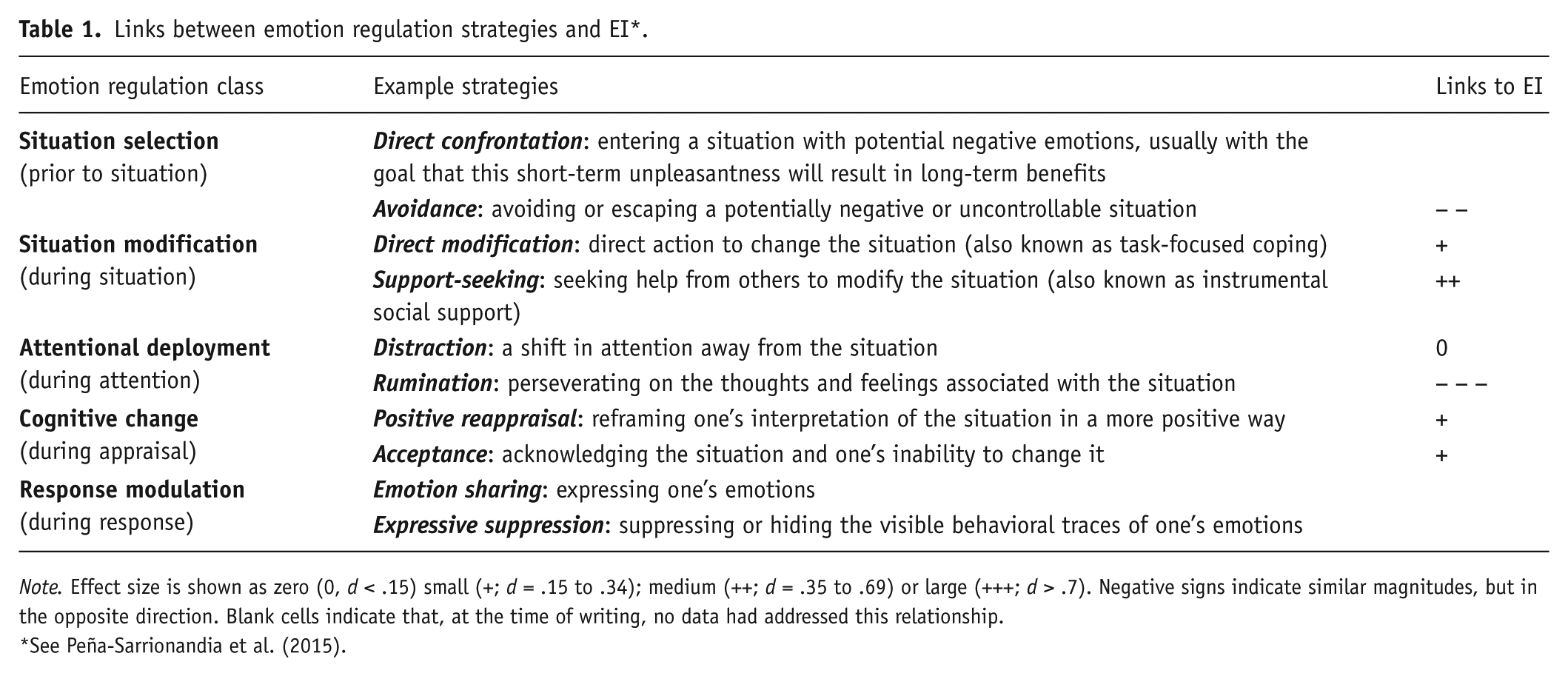
Note. Effect size is shown as zero (0, d < .15) small (+; d = .15 to .34); medium (++; d = .35 to .69) or large (+++; d > .7). Negative signs indicate similar magnitudes, but in the opposite direction. Blank cells indicate that, at the time of writing, no data had addressed this relationship.
A recent meta-analysis demonstrates that people’s level of EI predicts the types of ER strategies they invoke (Peña-Sarrionandia et al., 2015). We present a subset of this analysis in Table 1. We note that such links are both positive and negative, and vary in effect size. High-EI people use more of some strategies (like positive reappraisal and direct modification) but less of others (avoidance and rumination). It is not simply the case that high-EI people regulate more (i.e., use more of all available strategies). Some of these relationships are strong, and a few are near zero. These findings show that emotionally intelligent people systematically use particular ER strategies, suggesting a mechanism to translate the emotion knowledge of EI into ER behaviors. That is, emotion regulation may be the process by which EI produces positive outcomes.
There are several possible ways to merge ER and EI research. First, existing emotion regulation paradigms may be used in factor-analytic research on the nature of EI (as alluded to in the previous section), allowing more detailed modeling of the EI structure. Second, the EI management branch is usually assessed with situational judgment tests, where situation responses implicitly represent different regulation strategies. Making this categorization explicit would allow a direct link between ER and EI—it would be possible to tease apart whether high-EI people always use the same generally effective strategies, versus whether they adapt strategies to suit the situation (see e.g., Allen et al., 2015). Third, examining the strategy use of high-EI people in their actual behavior (rather than responses to test items) is possible through within-person paradigms such as experience sampling or the day reconstruction method (see e.g., Burrus et al., 2012). Such methods study ER as a process, and the effects of EI at each stage of this process may then be examined. In sum, studying EI through the theoretical framework of emotion regulation may produce greater understanding of the mechanisms by which EI capacities influence valued outcomes.
Appraisal Theories (AT) of Emotion and Emotional Intelligence
Appraisal theories are among the most influential theories of emotion and are based on the premise that emotions are elicited by appraisals of situations. AT assumes that: (a) emotions are elicited by specific patterns of appraisal; and (b) an emotion process starts when an appraisal is made, and this precedes physiological and motoric responses. Some appraisal theorists believe that this system evolved to help people cope and adapt to their environments (Roseman, 2001). They also propose that appraisal involves conscious processing and that nonadaptive emotions proceed from inappropriate appraisals (Roseman & Smith, 2001).
Appraisals are the cognitive basis for emotional experience, and thus individual differences in appraisals will result in systematic differences in the emotions experienced. For example, greater appraised unfairness, other-cause, and goal blockage results in greater anger (Kuppens, van Mechelen, & Rijmen, 2008). While there are systematic individual differences in appraisals (Kuppens et al., 2008), the basis of these differences is not yet known. One possibility is that one or more EI PMAs underlie such appraisal differences. Research on appraisal biases supports this idea—biases produce systematic errors in processing emotional information, and may therefore have a “causal role in emotional vulnerability” (Mathews, 2004, p. 1033). For instance, people with anxiety show more attentional bias than people with depression (Mogg & Bradley, 2005). However, more explicit memory biases are apparent in people with depression, panic disorder, obsessive-compulsive disorder, or posttraumatic stress (Coles & Heimberg, 2002; Mogg & Bradley, 2005). Thus, research examining whether EI may underlie differences in appraisals or appraisal biases seems warranted, and would unlock a wealth of theory on the mechanisms of EI by linking to the large literatures on emotion.
Scherer’s (e.g., 2005) componential model of emotion may help especially to understand the relationship between emotionally intelligent behavior and appraisals. In this model of emotions, emotions consist of five components: appraisals (e.g., threat); autonomic physiology (e.g., heart rate increases); action tendencies (e.g., fighting); motor expressions (e.g., shaking fists); and subjective feeling (e.g., anger). As such, this model of emotion encompasses how differences in appraisals may translate to differences in behavior. The experience of emotion unfolds in a process of sequential appraisals (where each appraisal is also associated with particular activations of the other four components; Scherer, 2001). An emotion is thus an unfolding sequence that differs in cognitive appraisal, conscious and automatic response, action, and feeling.
This theoretical model of emotion has implications for assessment developments. According to Scherer (2005), an emotional measure must: (a) focus on the feeling component rather than objective details (evaluate appraisal rather than a concrete response); (b) involve emotional complexity (arousal, valence, control, and conduciveness, as assessed using the Geneva Emotion Wheel); (c) rely on standard emotion labels in natural languages; (d) assess the intensity of the feeling (both qualitative and quantitative information on emotion should be sought); (e) avoid arbitrariness of different sets of emotion by including a full set of emotion labels; and (f) use graphical forms to aid understanding and shorten response times.
While these guidelines apply to the measurement of emotional experience itself, they appear equally relevant for the assessment of EI. In fact, developing assessments of emotion perception based on nuanced appraisal models has been undertaken (cf. Schlegel et al., 2014), and it may be possible to develop similar assessments of emotion understanding. Although tests of emotion understanding have been developed using appraisal theory frameworks (e.g., MacCann & Roberts, 2008), Scherer’s more detailed model and set of guidelines have not yet been used in such an endeavor, and might be particularly useful for developing a theory-driven assessment.
In sum, appraisal theories of emotion suggest two new lines of research for EI. First, they provide paradigms and guidelines for developing new measures of EI, which would allow researchers to focus on the PMA level of EI. Second, they provide a theoretical framework for examining emotion-related processes that involve EI.
Conclusions and Recommendations
In our view, EI research has benefitted from its integration with intelligence research and stands to benefit from a similar integration with emotion research. In the case of intelligence research, we know that EI is a distinct group factor. The higher branches of understanding and management are most closely aligned with knowledge and expertise conceptualizations of intelligence and likely increase across the length of the lifespan. In contrast, emotion perception may be most closely aligned with abilities based on sensory modalities, and may show steep declines in adulthood. In the case of emotion research, much less is known about how EI might fit within existing theoretical models and traditions, although we hypothesize that EI may relate to differences in appraisal processes as well as regulatory processes. In considering perspectives from intelligence and emotion research traditions, we make the following recommendations for the future of EI.
EI should be studied with multiple assessments rather than exclusively (or almost exclusively) with the MSCEIT, as is currently the case. A larger number of assessments would allow researchers to consider each branch in detail, potentially developing a structure for the PMAs of EI.
In developing new EI assessments, researchers might usefully integrate emotion perspectives, particularly those tied to emotion regulation. Particularly apposite would appear the recommendations outlined by Scherer (2007) for developing such assessments; this source should be better used in the future.
Research the subsidiary PMAs of EI, both as an empirical test for the underlying structure of EI, and potentially to increase predictive utility by matching specific, valued outcomes with the most appropriate branch. We expect here that emotion facilitation may not survive such an endeavor, but that other key abilities (e.g., empathy) may emerge.
Integrate EI theory with research on emotions, which may allow a focus on the processes that underlie EI. We have discussed appraisal processes and regulation processes, but there are other key literatures (e.g., those arising from neuroscience) that are also ripe for inclusion in this undertaking.
Footnotes
Author note:
We would like to thank Alicia Ogilvie for assistance in the preparation of this manuscript. All statements expressed in this article are the authors’ and do not reflect the official opinions or policies of any of the authors’ host affiliations.
Declaration of Conflicting Interests
The author(s) declared no potential conflicts of interest with respect to the research, authorship, and/or publication of this article.