



Abstract
Experience and expression are orthogonal emotion dimensions: we do not always show what we feel, nor do we always feel what we show. However, the experience and expression dimensions of emotion are rarely considered simultaneously. We propose a model outlining the intersection of goals for emotion experience and expression. We suggest that these goals may be aligned (e.g., feeling and showing) or misaligned (e.g., feeling but not showing). Our model posits these states can be separated into goals to (a) experience and express, (b) experience but not express, (c) express but not experience, or (d) neither experience nor express positive and negative emotion. We contend that considering intersections between experience and expression goals will advance understanding of emotion regulation choice and success.
Emotion regulation involves attempts to influence emotion in desired ways. In many instances of emotion regulation, people focus on a desired emotional end state and enact strategies with a view to achieving that state (Mauss & Tamir, 2014). This process has been the starting point of a new literature on emotion goals, which are cognitive representations of targeted emotional states (e.g., Mauss & Tamir, 2014; Tamir, 2009, 2016). In this article, we advance this burgeoning area of study by highlighting the need to distinguish goals for emotion experience (what one wants to feel) from goals for emotion expression (what one wants to show) in order to better understand how these goals interact to shape psychological outcomes. We propose that sometimes goals for these dimensions operate in concert (e.g., wanting to feel and show), but at other times goals for these dimensions may be in opposition (e.g., wanting to feel but not show). In this article, we offer a theoretical lens through which to understand the intersection of emotion expression and experience goals. Specifically, we consider the various ways that goals for emotion experience and goals for emotion expression may be aligned (e.g., when acting authentically; Mauss, Levenson, McCarter, Wilhelm, & Gross, 2005) or misaligned (e.g., when acting deceptively; Ekman, Friesen, O’Sullivan, & Scherer, 1980).
Emotion Goals
A goal is a cognitive representation of a desired end point (Fishbach & Ferguson, 2007), and usually arises when one notices a discrepancy between a current state and a desired state (e.g., Carver & Scheier, 2000). Once people are made aware of such a discrepancy, they become motivated to reduce the gap between current and desired states. Goals can be held about many targets, ranging from very concrete (e.g., “have a cup of coffee”) to comparatively abstract (e.g., “live by egalitarian principles”).
Recently, research has begun to focus on emotion as a target of goals (e.g., Mauss & Tamir, 2014). In this case, goals can arise when people become aware of a discrepancy between a current emotional state (e.g., “I feel anxious”) and a desired emotional state (e.g., “I want to feel less anxious”). Tamir (2016) refers to these desired emotional states as emotion goals and distinguishes them from emotion regulation strategies, which are the means by which emotion goals are enacted.
Emotions are multifaceted, comprising several dimensions, including subjective feelings (emotion experience), behaviour (emotion expression), cognitions (cognitive appraisals), motivation (action tendencies), and physiology (Frijda, 1987; Mauss et al., 2005; Mulligan & Scherer, 2012; Scherer, 1984, 2000). People can therefore hold goals for different dimensions of emotion. In this article, we focus on emotion experience and expression as two key dimensions that form the target of emotion goals.
Emotion experience and expression represent superordinate constructs under which other emotion dimensions may be subsumed. Although research shows people do indeed hold goals to change how they think about and appraise situations (e.g., implementation intentions; Gollwitzer, 1999), and for their physiological state (e.g., controlling hunger; Dohle, Diel, & Hofmann, 2017), we argue that it is unclear whether these kinds of goals are held with a specifically emotional end in mind. Indeed, the research thus far suggests that insofar as appraisal-based and physiology-based goals are emotional in nature, they are likely to be held with the goal of ultimately targeting emotion experience or expression (e.g., reappraising a racing heart to reduce felt anxiety; Jamieson, Mendes, Blackstock, & Schmader, 2010). In contrast, goals for emotion experience and expression are—by definition—obviously emotional, which allows for theoretical and empirical clarity in their assessment.
From the lay perspective, folk theories of emotion regulation center almost exclusively on emotion experience and expression (Parkinson & Totterdell, 1999). This suggests that these two dimensions are likely to be the most psychologically accessible for emotion goals. More practically speaking, emotion experience and expression are the two most easily observed consequences of emotion regulation processes (Webb, Miles, & Sheeran, 2012), and perhaps as a result, there is a larger body of research evidence regarding goals for expression and experience rather than goals for other dimensions of emotion. We therefore focus on the experience and expression dimensions of emotion because they are (a) theoretically clear constructs with which to assess emotion goals, (b) broadly understood by lay people, and (c) easily and commonly assessed by researchers.
In this article, we posit that there is value in differentiating emotion experience goals from emotion expression goals. Speaking to the distinguishability of these emotion dimensions, research has demonstrated only modest concordance between emotion expression and experience (e.g., Gross, John, & Richards, 2000; Hollenstein & Lanteigne, 2014). For example, Gross et al. (2000) found that self-reported emotion experience correlated between .24 and .42 with peer-rated expressivity. In addition, Butler, Gross, and Barnard (2014) found (in a control condition) that self-reported emotion experience correlated between .13 and .19 with computer-rated expressivity. Thus, experience and expression are correlated, yet, distinct, components of emotion.
Emotion regulation strategies appear to be a means by which emotion experience and expression are brought into or out of alignment: engaging in emotion regulation can reduce or increase concordance between these two dimensions (Butler et al., 2014; Dan-Glauser & Gross, 2013). Therefore, when investigating emotion regulation, it is informative to consider how people want to experience and express emotion because doing so will provide a more nuanced understanding of why people regulate their emotions, when, how, and with what effect.
Emotion Experience Goals
Previous research has considered goals people have for the experience of positive and negative emotion (e.g., Gruber, Mauss, & Tamir, 2011; Tamir & Ford, 2012). Much of the work in this space has focused on goals for hedonic emotional states, that is, goals to maximize positive emotion and minimize negative emotion (e.g., Diener, 2000; Fredrickson, 1998; Tsai, 2007; Tsai, Knutson, & Fung, 2006), because this is generally assumed to be people’s default desired emotional state (Tamir, 2009). Indeed, these goals are common in daily life: experience sampling research has demonstrated that people most often report wanting to decrease negative emotion and increase positive emotion (Gross, Richards, & John, 2006; Kämpfe & Mitte, 2009; Riediger, Schmiedek, Wagner, & Lindenberger, 2009), even though such goals may sometimes ironically impede people’s ability to achieve those emotion states (Bastian et al., 2012; Mauss, Tamir, Anderson, & Savino, 2011).
An emerging line of work has focused on goals for contra-hedonic emotional states—that is, those that maximize negative emotion and minimize positive emotion (e.g., Tamir & Ford, 2012). These goals are less common than hedonic goals in daily life, but are still experienced to a meaningful degree. For example, in an experience sampling study, Riediger et al. (2009) found that contra-hedonic goals were reported on approximately 15% of measurement occasions, thus representing a nonnegligible source of variance. Together, this work shows that people may sometimes have emotion goals to reduce the experience of positive emotion and increase the experience of negative emotion (i.e., generally unpleasant states), or they may have more prototypical emotion goals to increase the experience of positive emotion and reduce the experience of negative emotion (i.e., generally pleasant states).
Emotion Expression Goals
Other research has considered goals people have for the expression of positive and negative emotion, although this body of work is less unified than the work on goals for emotional experience. For example, research on display rules speaks to the importance of expressing the “right” emotion in the “right” situation (and the social costs of doing otherwise; Ekman & Friesen, 1969). In addition, the literature on emotional labor outlines how various professions require the expression of certain types of emotion (e.g., flight attendants and positive emotion; Hochschild, 1983), and speaks to the emotion regulation challenges posed by consistently meeting such goals (Grandey, 2000). While these research traditions do not assess the activation of expression goals directly, they do suggest the presence of desired emotion expression states varies as a function of particular social situations.
Reflecting the social utility of emotion expression, there is research suggesting that social and emotion expression goals go hand in hand, such that expression goals can be recruited to meet social goals. This often involves the strategic expression of emotion: for example, Clark, Pataki, and Carver (1996) found that people aim to express anger (and suppress happiness) when given an explicit goal to persuade another to do an unpopular task. It can also involve strategic reduction in emotion expression: for example, people sometimes strive to reduce positive or negative expression in social interactions in order to appear cool, calm, and collected (Lyman & Scott, 1968). Together, this work suggests that people can hold goals to increase or decrease emotion expression.
Intersecting Goals for Emotion Experience and Expression
As reviewed, research has begun to investigate goals for emotion experience and, separately, goals for emotion expression. We refer to these as one-dimensional goals, because they concern goals that are held with respect to only one dimension of emotion—experiential or expressive—with no discernable goal on the other dimension. We distinguish these one-dimensional goals from two-dimensional goals, which concern goals for both experience and expression of emotion.
This distinction between one-dimensional and two-dimensional goals is reminiscent of a differentiation in the goal literature between sequential and concurrent goal pursuit (e.g., Orehek & Vazeou-Nieuwenhuis, 2013). Sequential goal pursuit involves allocation of attention and resources to one goal at a time (e.g., increase emotion experience), and has been addressed by previous research and theory examining emotion experience goals and emotion expression goals separately. Concurrent goal pursuit involves allocation of attention and resources to more than one goal at a time (e.g., increase emotion experience and expression), and has not been addressed in previous emotion research. Thus, our model focuses on concurrent goals in which people have salient goals for the experiential and expressive dimensions of emotion active at the same time.
We contend that two-dimensional goal states are possible according to direct evidence in the goal literature outlined before, as well as indirect evidence in the emotion literature. In this article, we review empirical work that is suggestive of situations in which experience and expression goals might operate in tandem. We infer activation of two-dimensional goals based on observed regulation of emotion experience and expression and evidence that certain situations place particular constraints on appropriate experience and expression of emotion. We do note, however, that no research has directly investigated two-dimensional emotion goals of this sort. Therefore, to provide further evidence, we present pilot data suggesting that these goals are recognizable by lay people. In outlining a theoretical model of two-dimensional goals, this article calls for work to assess more directly whether these goals exist in everyday life, how often they are held compared to other types of emotion goals, and with what impact on emotion regulation efforts.
The Proposed Model
We propose a model that considers goals for the experience and expression of emotion simultaneously, rather than separately as in prior work. Put simply, this model proposes that an individual in a given situation may have a goal to (a) experience and express emotion, (b) experience but not express emotion, (c) express but not experience emotion, or (d) neither experience nor express emotion. We classify these four goal states into two broad categories in which (a) goals for emotion experience and expression are aligned (Goals 1 and 4) and (b) goals for emotion experience and expression are misaligned (Goals 2 and 3).
Figure 1 outlines the model. The y-axis represents an active goal regarding emotion experience, and the x-axis represents an active goal regarding emotion expression. These goals take the form of increasing, maintaining, or decreasing emotion experience and expression. For assessment purposes, this results in broad goals to experience/express or goals to not experience/not express. Panels A and B of Figure 1 represent the one-dimensional way in which emotion goals have been assessed in past work—separately and largely ignoring the other dimension. In these panels, the dimension that is not an active target of regulation is greyed out. Panel C represents our factorial model of two-dimensional goals in which both emotion dimensions are targeted for regulation.

Figures representing active experience goals (Panel A), active expression goals (Panel B), and active intersecting experience and expression goals (Panel C).
Early Evidence
Our model concerns situations in which people hold concurrent goals about more than one emotion dimension—that is, goals in which experience and expression are simultaneous targets of regulation. This means that in testing our model, it is important to assess whether or not people hold an active goal to target both emotion dimensions or only one dimension. We have done this in early work on this topic in which participants recall events in which they held certain types of goals. We asked 800 participants on Amazon’s Mechanical Turk (53% women; Mage = 36) to recall instances of holding two-dimensional goals (outlined in Figure 1, Panel C) or one-dimensional goals (outlined in Figure 1, Panels A and B). The exact wording of these goals is included in Table 1. After presenting a goal, we asked participants whether they had ever encountered a situation in which they held this goal (with response options coded “yes” = 1, “no” = 0).
Descriptions of goal conditions.
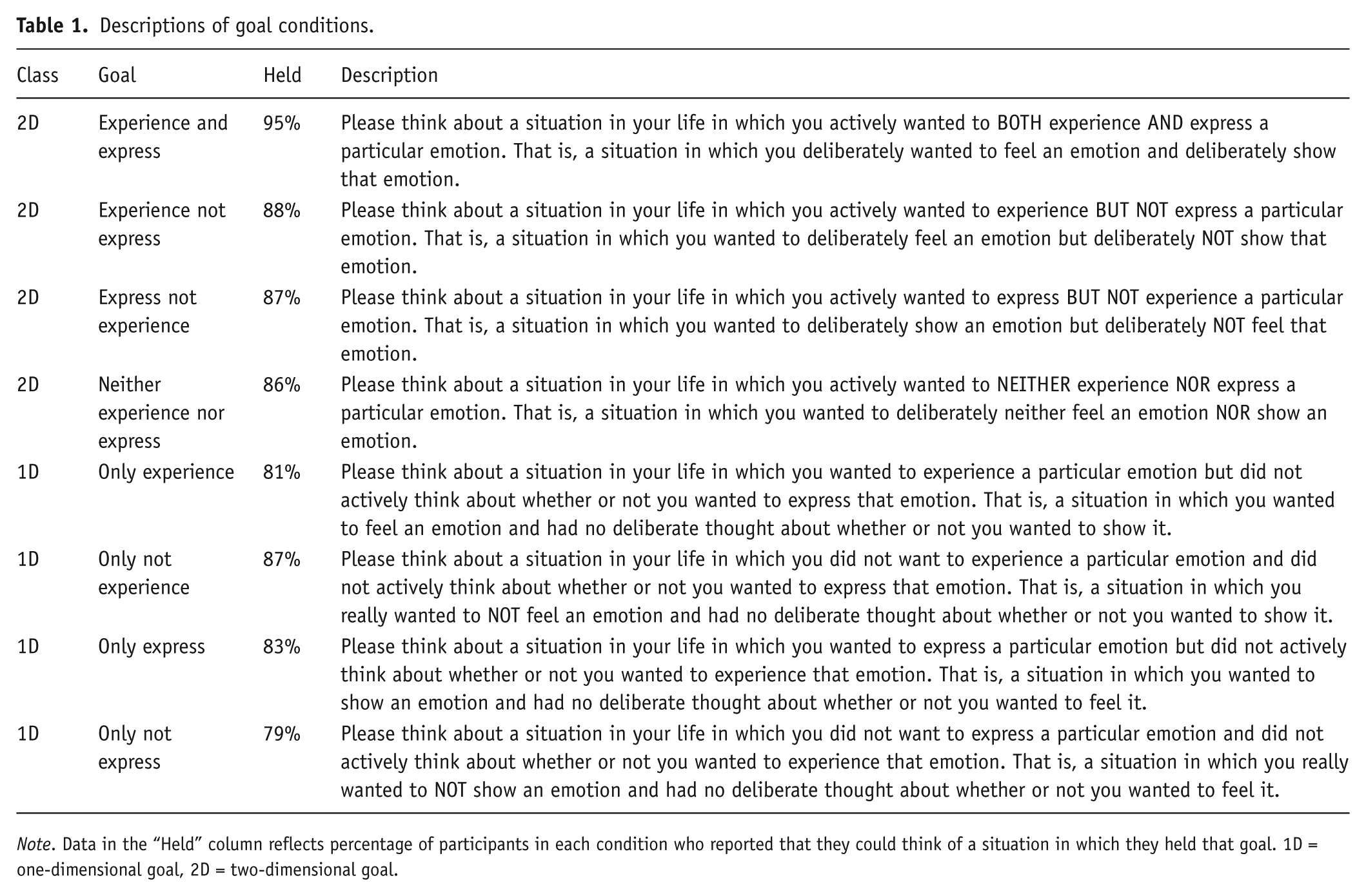
Note. Data in the “Held” column reflects percentage of participants in each condition who reported that they could think of a situation in which they held that goal. 1D = one-dimensional goal, 2D = two-dimensional goal.
We first investigated via logistic regression how often participants recalled having a two-dimensional goal (coded as 1) compared to a one-dimensional goal (coded as 0). This analysis revealed a significant effect of the class of goal such that participants reported holding two-dimensional goals more often than one-dimensional goals, b = .56, SE = .21, p = .007, odds ratio = 1.74. The odds of being able to think of a situation in which the goal was held were 74% higher when the goal was two-dimensional than when the goal was one-dimensional. Inspection of percentages in each condition revealed that 82% of participants reported holding a one-dimensional goal, while 89% of participants reported holding a two-dimensional goal. Inspection of individual goal type revealed that people were most likely to report holding Goal 1: to experience and express emotion (95%). The least commonly held goal was a one-dimensional goal to not express emotion (with no corresponding goal for emotion experience; 79%).
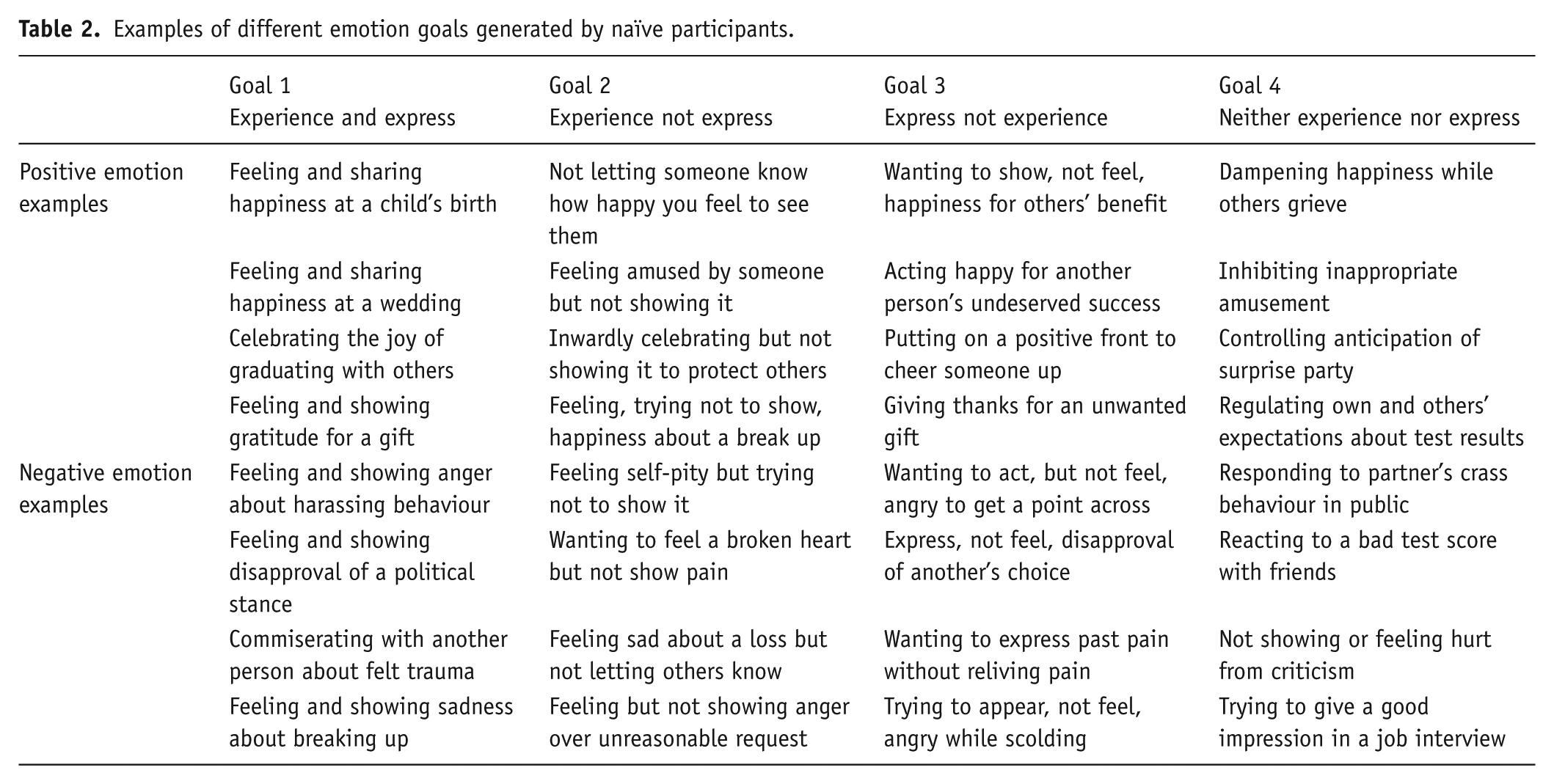
To generate real-life examples of the two-dimensional goals outlined in the model, we surveyed another 400 participants (49% women, Mage = 36) on MTurk, asking them to describe a situation in which they held one of the four goal states relating to either positive or negative emotion. Participants were able to do this, indicating that the concept of two-dimensional goals is accessible to people, and we summarize a number of these examples in Table 2.
Examples of different emotion goals generated by naïve participants.
Theoretical Contributions
We argue that people may hold one of these specific goals about emotion experience and expression, and that identifying these two-dimensional goals will help researchers better understand emotion regulation. The model allows for generation of new combinations of emotion goals hitherto overlooked in the literature; namely situations in which experience and expression goals are in conflict with one another and are regulated in opposite directions. This model therefore avoids an assumption that people’s goals for emotion expression will replicate their goals for emotion experience, or vice versa. Indeed, this model explicitly acknowledges situations in which what people want to feel is at odds with how they want to be seen to feel. This model therefore aids in the development of novel hypotheses about how these goals might shape emotion regulation processes.
In the following sections, we review evidence suggesting that people hold these two-dimensional goals in relation to positive and negative emotion. We focus on positive and negative examples equally because we believe the goals can be held in relation to either valence. In addition, an equal focus on both valences helps to address the fact that positive emotion regulation tends to be understudied relative to negative emotion regulation (Webb et al., 2012). After this review, we go on to discuss how to measure two-dimensional goals, the contexts in which they may become active, and the model’s theoretical implications for the study of emotion regulation.
Alignment in Emotion Goals
In Goal 1, people aim to experience and express emotion. In Goal 4, people aim to neither experience nor express emotion. Thus, these goals involve an alignment, albeit in different directions, of both emotion dimensions. It is worth noting that these goal states are often implicitly assumed to be operating in the extant literature—it is relatively uncommon for research to explicitly aim to investigate situations in which people may choose to express (or not) an emotion that is different from what they feel.
Goal 1: Experience and Express Emotion
Research has generally examined experience and expression separately, but in the case of both dimensions there is strong evidence that people prefer to express (vs. not express) and experience (vs. not experience) positive emotions. Turning first to experience, research has demonstrated that people generally prefer to experience pleasant emotions (Augustine, Hemenover, Larsen, & Shulman, 2010), report that they would prefer to be happy (Diener, 2000), and generally choose to savor, rather than dampen, positive emotional experiences (Quoidbach, Berry, Hansenne, & Mikolajczak, 2010). Indeed, a mild positive mood is the default state for most people (Diener, Kanazawa, Suh, & Oishi, 2015). Not only do people prefer to experience positive emotion, they also believe that this positive emotion should be expressed (Matsumoto, Yoo, Hirayama, & Petrova, 2005). This positive emotion expression is amplified in the presence of others, suggesting that it serves a social function (e.g., Jakobs, Manstead, & Fischer, 1999; Kraut & Johnston, 1979; Ruiz-Belda, Fernández-Dols, Carrera, & Barchard, 2003).
It may be socially advantageous for positive emotion expression and experience to be aligned with each other: such alignment reflects emotional authenticity, which is associated with perceptions of friendliness and customer satisfaction in service encounters (Grandey, Fisk, Mattila, Jansen, & Sideman, 2005). This suggests that aiming to experience and express positive emotion is often likely to have social benefits.
However, there may be some cultural variation in the degree to which people hold this goal for positive emotion: people from individualistic cultures endorse positive emotion expression more strongly than people from collectivistic cultures (Matsumoto et al., 2008). Moreover, individualistic American participants are more likely to savor positive emotion experiences than collectivistic Japanese participants (Miyamoto & Ma, 2011). This research does not offer direct evidence regarding the frequency with which people hold a two-dimensional goal to experience and express positive emotion cross-culturally. However, it does suggest the possibility that such a goal for positive emotion may be relatively common for people from individualistic cultures but perhaps less common for people from collectivist cultures. This may differ by arousal level: work on ideal affect suggests Americans value high-arousal positive affect compared with East Asians, who tend to value low-arousal positive affect (e.g., Tsai, 2007).
In the case of negative emotion, we posit that people are more likely to hold a goal to experience and express when they have instrumental motives in mind and aim to regulate their emotions to satisfy those motives (Tamir, 2016). For example, people appear to up-regulate the experience and expression of anger in order to confront another person if they believe anger will be useful in that situation (Tamir & Ford, 2012). In a workplace context, managers report strategically expressing the anger they feel to address problems with their team, stating explicitly that it is not enough to simply experience anger; this emotion must be conveyed to subordinates expressively to achieve desired outcomes (Lindebaum & Fielden, 2011).
Thus, it seems that the functional use of anger may sometimes require both expression and experience, necessitating the enactment of Goal 1 (experience and express), rather than Goal 3 (express but not experience). In line with this suggestion, in a negotiation study, participants were more likely to concede to the demands of a confederate who expressed and experienced anger, but made more demands of a confederate who expressed but did not experience anger (Côté, Hideg, & van Kleef, 2013). As with positive emotion, the perceptions of authenticity that are engendered by expressing a negative emotion one genuinely feels may be key to obtaining desired social outcomes. To the extent that people have insight into the social advantages of emotional authenticity, or wish to act authentically for some other purpose, they may hold a two-dimensional goal to simultaneously experience and express emotion.
Goal 4: Neither Experience nor Express Emotion
People may hold this goal in situations where social norms dictate that people should not feel, and should not be seen to feel, positive or negative emotion. For positive emotion, a quintessential example of such a case is attending a funeral. Indeed, in our own work, when we have asked participants to specify a situation in which feeling and showing positive emotion could have negative effects, we find that “laughing at a funeral” is a situation that comes to mind relatively frequently. While it is possible that people may aim to feel positive emotion while also aiming to not express it in this particular situation (i.e., hold Goal 2 to experience but not express emotion), this may be less common than Goal 1 (neither experience nor express emotion) because social norms generally hold that positive emotion experience is not appropriate at funerals (Graham, Gentry, & Green, 1981).
Direct evidence has been found for the notion that people aim to be “cool and collected” (i.e., reduce emotion experience and expression) in certain social situations. For example, Erber, Wegner, and Therriault (1996) found that people who were feeling positive were likely to seek out opportunities to down-regulate their own positive emotion experience when they believed they would interact with another person (hence making it necessary to regulate emotion expression in addition to emotion experience), but not when they were alone. Although this work did not directly assess expression goals in addition to experience goals, it was the explicit aim of the authors to assess constraints placed “on both emotional expression . . . and emotional experience” (Erber et al., 1996, p. 757). It therefore seems possible that people may hold a goal to neither experience nor express positive emotion in circumstances when it is important that they appear calm and composed to others (Lyman & Scott, 1968).
Other research points to competition as a situation in which people might sometimes hold a goal to neither experience nor express positive emotion. For example, Kraus and Chen (2013) found that professional fighters who smiled more (certainly reflecting positive expression but perhaps also reflecting positive experience) in prefight photos with their opponent were more likely to lose than those who did not smile. Moreover, Tamir and Ford (2012) found that people reported goals to down-regulate positive emotion experience when they imagined engaging in confrontation. Together, these findings suggest it may be functional to hold a goal to neither experience nor express positive emotion in competitive contexts.
It is not difficult to imagine why people may not want to experience negative emotion, but display rules also often dictate that one not express negative emotion—rules that people tend to learn at an early age (Zeman & Garber, 1996). Speaking to this point, research suggests that people may sometimes hold goals to neither experience nor express negative emotion. For example, in a study investigating how people control anxiety during public speaking, participants spontaneously used emotion regulation strategies that down-regulated negative emotion experience and expression to a similar degree (i.e., they reported using cognitive reappraisal as much as expressive suppression; Egloff, Schmukle, Burns, & Schwerdtfeger, 2006). This suggests that participants were focused on reducing experience and expression of anxiety during their speech.
In addition to particular circumstances, particular jobs may require people to neither express nor experience negative emotion. In a call center simulation study, Goldberg and Grandey (2007) had participants train to take customer service calls for a hypothetical office supply company. Commensurate with call center norms, participants were given an explicit instruction to control the expression of frustration and negativity toward difficult clients. Participants showed lower levels of work exhaustion when they spontaneously used regulation strategies to reduce negative emotion experience alongside negative emotion expression, compared to those who only reduced negative emotion expression. Thus, holding a two-dimensional goal to simultaneously reduce negative emotion experience and expression may sometimes be more psychologically beneficial than holding a one-dimensional goal to target expression alone. Together, these findings suggest that people may sometimes hold two-dimensional goals to neither experience nor express negative emotion, rather than holding a goal that targets only one of these emotion dimensions.
Misalignment in Emotion Goals
While there is only limited research pointing directly to the existence of two-dimensional goals in general, we note that there is even less research investigating the types of two-dimensional goals in which people’s goal for how they feel is different from their goal for how they are seen to feel. This makes these goals a rich area for future investigation.
Goal 2: Experience but Not Express Emotion
We propose that this goal state is likely to be active when people have a social objective that does not match their inner experience. The broader aim of this goal state is to preserve the effects of experiencing a particular emotion while shielding from others’ notice how one is feeling. For positive emotion, such a goal state may arise when one person experiences a positive outcome while an interaction partner experiences a negative outcome: here, the individual may wish to maintain their internal experience of joy or pride while protecting the other person’s feelings. Supporting this idea, research has demonstrated that in situations when one person outperforms another, winners spontaneously inhibit the expression of their emotional experience (Friedman & Miller-Herringer, 1991), and that this inhibition of expression is a successful social strategy (Kalokerinos, Greenaway, Pedder, & Margetts, 2014; Schall, Martiny, Goetz, & Hall, 2016). Yet, people also often wish to savor the positive emotion that goes along with winning (Bryant, Chadwick, & Kluwe, 2011), suggesting that people may in this context aim to feel good while not appearing to feel good (i.e., Goal 2).
Another context in which this two-dimensional goal might be active is when a person feels positive emotion in a negatively valenced situation: for example, feeling the urge to laugh during a serious business meeting. Research has demonstrated that the expression of positive emotion receives social censure in such situations (Kalokerinos, Greenaway, & Casey, 2017), and so again, it may prove socially beneficial to hide positive emotion expression but personally beneficial to maintain its experience (insofar as feeling amused has personal benefits; Fredrickson & Levenson, 1998). Research has shown that inhibition of emotion expression does not directly reduce emotion experience (Kalokerinos, Greenaway, & Denson, 2015), thus people seem able to successfully experience an emotion while not expressing it.
As with positive emotion, one might enact this goal to control negative emotion in a situation in which one is feeling negative (e.g., anger at a spouse) but wishes to control the expression of that emotion in the short term for social reasons (e.g., to avoid a scene in public or to maintain relationship harmony; e.g., Le & Impett, 2013). In these contexts, it would be beneficial to maintain negative emotion experience for future confrontation (Tamir & Ford, 2012), but hide the expression of that emotion for the sake of keeping up appearances (Tavris, 1984). Similarly, people may choose to preserve an experience of anxiety to increase motivation in a difficult exam or boost energy for a performance (e.g., Lane, Beedie, Devonport, & Stanley, 2011), while also aiming to project a calm exterior that hides this inner turmoil.
In addition, people may have less prosocial reasons for not expressing, and yet wanting to experience, an emotion. Given the damage schadenfreude may cause to social relations (Leach, Spears, & Manstead, 2014), we speculate that another example might involve inhibiting the expression of pleasure (i.e., schadenfreude) experienced when seeing the misfortune of an enemy, while enjoying the inner experience of this emotion (Knutson, 2004). Similarly, people may choose to hide pleasure at an opponent’s error in a negotiation because expressing happiness is costly in negotiations (van Kleef, De Dreu, & Manstead, 2004a), but still aim to enjoy the inner feeling of victory.
In sum, while no research has directly assessed whether people hold active goals to experience but not express emotion, research certainly shows people are under pressure to control the expression of particular emotions in particular situations. Additional evidence suggests people sometimes have active goals to preserve or increase emotion experience for strategic reasons. Taken together, these findings hint at the possibility that people may sometimes hold a goal to experience but not express emotion. This hypothesis, nevertheless, awaits targeted empirical testing.
Goal 3: Express but Not Experience Emotion
We hypothesize that this goal may also be active when people have a social objective that is at odds with their internal state. Research on emotional labor describes this as “surface acting” (e.g., Grandey, 2000), which is generally studied in relation to the amplification of nongenuine positive emotions (e.g., “service with a smile”). While this research does not directly speak to whether or not people have a simultaneous goal to not experience positive emotion while also expressing it, evidence does suggest that people in such situations do not always internalize feeling rules about experiencing what they express; instances of emotional labor that are sometimes referred to as “faking in bad faith” (Rafaeli & Sutton, 1987).
Other examples involving positive emotion may include thanking someone for an unwanted gift, or praising someone to his or her face while avoiding feeling gratitude or while even feeling inwardly disdainful. Yet, expressing positive emotion is often a beneficial social strategy, and so even when a person may not want to feel positive, it may be socially advantageous for them to appear positive (e.g., Hochschild, 1983). Indeed, according to people in the service industry, one of the top reasons for expressing positive emotion they do not feel is because it results in better tips (Adelmann, 1995). This type of emotion enactment is reminiscent of advice by Niccolo Machiavelli (2003), who advised projecting an appearance of sincerity, interest, and benevolence while inwardly pursuing a goal of ruthless self-interest. In a more generous interpretation, people may sometimes hold this emotion goal in an effort to engage in a form of social emotion management: influencing others’ emotions with prosocial intent while aiming actively to maintain or dampen their own emotion experience (Zaki & Williams, 2013).
Examples of the goal to express but not experience are comparatively thin for negative emotion.However, research in the emotion labor tradition suggests that such a technique may occur in certain professions. One example can be found in bill collectors, who often aim to express a high degree of negative emotion in order to negatively reinforce clients and so encourage payment, but who do not necessarily aim to experience that emotion (Sutton, 1991). This is also the logic behind the popular “good cop, bad cop” interrogation technique (Rafaeli & Sutton, 1991). Indeed, because people who use this technique in a professional capacity (e.g., bill collectors, interrogators) often must embody both roles—of “good cop” and “bad cop”—in the same interaction (Rafaeli & Sutton, 1991), it would seem logical to hold a goal of expressing a particular emotion while aiming actively to not experience that emotion, as emotion experience may prove more difficult to regulate quickly in order to switch roles.
We can imagine other instances in which people might hold a goal to express but not experience negative emotion, for example, attempting to maintain an imposing visage to discipline a child while feeling inwardly amused by their antics, or expressing sorrow at another person’s misfortune while enjoying a secret feeling of schadenfreude. However, these possibilities wait future testing, and it is our hope that upcoming work will begin to investigate when and why (or indeed, whether) people hold a goal to express but not experience emotion.
Testing the Model
We have presented a range of indirect evidence that people can hold concurrent goals for emotion experience and expression. We hope that this model sparks more direct research into when and how often people hold these types of emotion goals. In this section, we offer suggestions for how to measure and manipulate two-dimensional goals in the interests of forwarding this research agenda.
Measuring Emotion Goals
Meeting the assumptions of our model will involve assessing whether participants hold active goals for both experience and expression. The most direct method of assessment involves retrospective self-report. The pilot studies we outlined earlier used this methodology (see Table 1). In Table 3 we present example items to assess the self-reported presence (vs. absence) of these goals during an event. Because the items include separate questions targeting goals for emotion experience and expression, they will prove useful for distinguishing two-dimensional goal states from one-dimensional goal states. A two-dimensional goal requires participants to report holding active goals for both emotion experience and expression. A one-dimensional goal requires participants to report holding only one goal for either emotion experience or expression.
Example items assessing emotion goal activation.

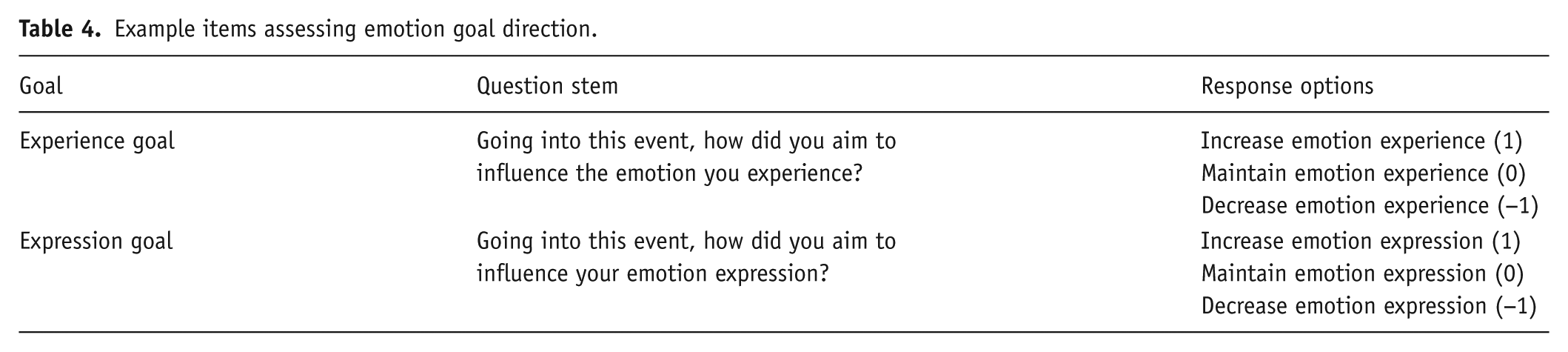
A further assumption of our model is that these goals for emotion experience and expression may be held to decrease, maintain, or increase emotion, resulting in goals that move in the same or opposite directions on the dimensions. For example, one might try to meet Goal 2 to experience but not express by actively maintaining emotion experience while decreasing emotion expression. Thus, if participants indicate that they hold a goal on a given dimension, this would necessitate follow-up questions to assess in which direction participants aim to regulate their emotion. Example items for assessing directionality are contained in Table 4.
Example items assessing emotion goal direction.
As well as using retrospective designs, our model could be assessed using ecological momentary assessment designs. These methods have been used to assess emotion experience goals in past work (Gross et al., 2006; Kämpfe & Mitte, 2009; Riediger et al., 2009), although to our knowledge, daily life research has not yet investigated emotion expression goals. Researchers could adapt the items outlined in Tables 3 and 4 for a momentary assessment context (e.g., “Right now, are you aiming to influence your emotional experience?”). In these momentary designs, it may be useful to assess current emotional expression and experience. This would allow researchers to assess the discrepancy between current and desired emotion, which may prove valuable given that larger discrepancies between current and desired states theoretically underlie instances of emotion regulation (Mauss & Tamir, 2014).
In addition, other methods may be used to complement the self-report approach. Here, observational methods in the lab, or background recording devices like the Electronically Activated Recorder in daily life (Mehl, Pennebaker, Crow, Dabbs, & Price, 2001), when used appropriately and ethically, may be prove useful for assessing how effective participants are in meeting emotion expression goals.
Manipulating Emotion Goals
Another way to move beyond self-report would involve manipulating, rather than measuring, two-dimensional goals. In unpublished work we have manipulated goals directly by asking participants to follow goal instructions mapping on to each of the four goal states. For example, for Goal 1, we instructed participants to “try to experience and express emotion . . . that is, try to feel and show positive emotion.” Previous work has manipulated goals more indirectly, for example, by putting people in a situation in which certain experience and expression goals appear to have more utility (e.g., Tamir & Ford, 2012). Experimental research will of course be critical in determining the causal impact of emotion goals on emotion regulation efforts.
Future Directions for the Model
One outstanding question of the model, beyond whether two-dimensional goals exist, is how often these types of goals are held—both in comparison to one-dimensional goals and in comparison to one another. Early pilot data reported in the previous lines suggest that two-dimensional goals are recognized more often than one-dimensional goals (although the effect may be small). This question of prevalence could be more directly assessed using experience sampling methodology, which is well placed to assess the activation of these goals in everyday life.
We suspect that an investigation of the relative prevalence of two-dimensional goals would reveal that goals for emotion experience and expression are more commonly in concert than they are in competition. Indeed, our own pilot data revealed that Goal 1—to experience and express emotion—was the most commonly recognized type of emotion goal. This is in line with the modest but positive correlation between emotion expression and experience (Hollenstein & Lanteigne, 2014), and research demonstrating that people have a general goal to be authentic (Gino, Kouchaki, & Galinsky, 2015). That said, uncovering situations in which experience and expression goals are misaligned is a novel direction for future research. Such situations pose important emotion regulation challenges that are likely to have consequential outcomes, and yet are not currently well understood by theorists. An understanding of social motives is likely to prove key to understanding misaligned goals, given that emotion expression is often used to communicate social intentions and consolidate social bonds (e.g., Ekman, 1972; Fischer & Manstead, 2008; Fridlund, 1994; van Kleef, De Dreu, & Manstead, 2010) in ways that do not necessarily require corresponding emotion experience. Yet, the question of how often experience and expression goals are aligned or misaligned remains open.
Beyond assessing prevalence, research is needed to better understand what predicts which emotion goals people hold. As with many questions in psychology, the answer is likely to depend heavily on context. This may involve identifying the contextual constraints placed on people in particular situations, and reflecting on how different emotion goals are likely to be elicited by different situational constraints (e.g., presence vs. absence of others, nature of the relationship between interacting partners; e.g., Fischer, Manstead, & Zaalberg, 2003; Fishbach & Ferguson, 2007). For example, Tamir and Ford (2012) found that cooperative versus competitive situations elicited different (one-dimensional) emotion experience goals in ways that depended on valence (i.e., up-regulate negative emotion and down-regulate positive emotion in competitive situations; up-regulate positive emotion and down-regulate negative emotion in cooperative situations). Similarly, van Kleef et al. (2010) have shown different impacts of expressing different emotions in cooperative versus competitive situations. Putting these findings together, we predict that people would be more likely to hold Goal 1—experience and express—in relation to negative emotion and Goal 4—neither experience nor express—in relation to positive emotion in competitive contexts. In contrast, we predict people would be more likely to hold Goal 1 in relation to positive emotion and Goal 4 in relation to negative emotion in cooperative contexts.
However, emotion goals are likely to depend on more than the given situation that people find themselves in. Indeed, the astute reader will note that the examples of two-dimensional goals provided in Table 2 often refer to the same situation across different goals (e.g., thanking someone for a gift in Goal 1 and 3; inhibiting amusement in Goal 2 and 4). While these goals may vary based on specific details of the situation (e.g., whether a gift is wanted or not), they may also vary in terms of more personal characteristics (e.g., how much a person values the experience of amusement). These personal characteristics may take the form of individual differences in personality traits (e.g., Lucas & Baird, 2004), motives (e.g., Tamir, 2016), or appraisals (e.g., Aldao, 2013). For instance, extraverts appear to value positive emotion experience (Lucas & Baird, 2004) and are thought to engage in more positive emotion expression (Tackman & Srivastava, 2016) than introverts. Thus, future research might investigate whether people with certain personality traits are more attracted to certain types of two-dimensional goals, such as those that bring emotion experience and expression into alignment (e.g., Goals 1 and 4 for extraverts). For example, tolerance for ambiguity (Budner, 1962) or need for cognitive closure (Webster & Kruglanski, 1994) might be associated with the tendency to hold different types of two-dimensional goals, but in opposite directions. That is, high (vs. low) tolerance for ambiguity may be associated with greater likelihood of holding misaligned goals (because these individuals are accepting of equivocality), while high (vs. low) need for cognitive closure may be associated with greater likelihood of holding aligned goals (because these individuals have a greater desire for predictability and structure).
Moreover, because there are cultural differences in the degree to which experience and expression of certain emotions is valued or endorsed across different situations (e.g., Bastian et al., 2012; Boiger, Mesquita, Uchida, & Feldman Barrett, 2013; Kitayama, Markus, & Kurokawa, 2000; Matsumoto et al., 2005; Tsai et al., 2006), different cultural orientations may give rise to different emotion goals. For example, as described in the section on Goal 1 (experience and express), people from individualistic cultures may be more likely to hold this goal compared to people from more collectivistic cultures. Thus, an important part of understanding where these emotion goals come from will involve understanding context, broadly construed: who is involved, and in which environment.
Theoretical Implications for Emotion Regulation
Throughout this article, we have referred to the role of emotion regulation in the effects of two-dimensional goals as outlined by the model. Given that emotion goals are often the impetus for emotion regulation to take place (Mauss & Tamir, 2014; Tamir, 2016), whether people hold the two-dimensional goals outlined in the model is likely to be an important predictor of when and how people regulate their emotions. The model therefore has the potential to shed new light on emotion regulation processes.
By considering goals for emotion experience and expression, the model may provide insight into why certain emotion regulation strategies are so effortful. Specifically, this may be in part because these strategies are used to meet a goal for discrepancy between different emotion dimensions. For instance, when holding Goal 2—experience but not express—people may choose to use expressive suppression; a strategy that preserves inner emotion experience while reducing emotion expression (Gross et al., 2006; Kalokerinos et al., 2015). This strategy has been shown to have cognitive costs (Richards & Gross, 2000), presumably because it targets experience and expression differently. In contrast, when holding Goal 4—neither experience nor express—people may choose to use cognitive reappraisal; a strategy that has been shown to reduce both emotion experience and expression (Gross & Thompson, 2007; Webb et al., 2012). This strategy is comparatively less cognitively costly than suppression (Richards & Gross, 2000), presumably because it aligns the experience and expression dimensions.
Thus, we suggest that emotion goals that involve a disconnect between emotion experience and expression (i.e., Goals 2 and 3) may be more cognitively demanding, and consequently require more effortful regulation strategies, than emotion goals involving alignment of these emotion dimensions (i.e., Goals 1 and 4). This hypothesis waits future empirical testing. In the meantime, we encourage researchers to consider which emotion goals (one-dimensional or two-dimensional) they are activating in participants when asking them to engage in particular emotion induction or regulation procedures. Certain procedures (e.g., those that include a partner or video recording) may encourage regulation of emotion expression as well as experience, and thus introduce expression goals—and associated cognitive load—into the study.
The model also highlights the possibility that people might use more than one strategy to achieve a particular two-dimensional emotion goal (e.g., suppression to down-regulate expression; rumination to up-regulate experience). Indeed, research in the lab (Aldao & Nolen-Hoeksema, 2013) and in daily life (Brans, Koval, Verduyn, Lim, & Kuppens, 2013; Kalokerinos, Résibois, Verduyn, & Kuppens, 2017) has demonstrated that people use multiple emotion regulation strategies in response to a single stimulus. Experimental research that has examined the use of multiple emotion regulation strategies has demonstrated that the first strategy used temporally (rather than subsequent strategies used) is key in predicting emotional outcomes (Yoon & Joormann, 2012). However, these studies focused on emotion experience, and it may be that coactive strategies would work together more effectively if targeted at separate emotional channels, in this case, expression and experience. A better understanding of how multiple emotion regulation strategies can work together to achieve specific two-dimensional goals will be important in moving the model forward.
Our goal-oriented model may also help to examine conditions under which traditionally maladaptive strategies (e.g., suppression, rumination) prove adaptive. Taking expressive suppression as an example, this strategy is typically investigated experimentally in conditions in which people may not usually have a goal to down-regulate the expression of emotion (e.g., discussing a negative film with a partner; Butler et al., 2003). Yet, suppression may be an effective strategy when people do explicitly aim to preserve inner emotion experience while inhibiting external emotion expression (Goal 2); the literature has simply been less concerned with investigating contexts in which this goal is likely to be active (Greenaway & Kalokerinos, 2017). Similarly, rumination is typically studied without considering that people might explicitly aim to up-regulate the experience and expression of negative emotion (Goal 1). In such circumstances, rumination is likely to be an effective strategy, but to our knowledge, little research has considered rumination from this perspective.
Concluding Thoughts
People regulate their emotions in a variety of ways and for a variety of reasons. They might try to downplay anger at a partner during a family gathering; increase anxiety to improve performance on an important exam; reduce hope in the face of a severe medical diagnosis; or show their appreciation for a favor performed by a friend. These emotion regulation efforts involve complex interplay between how people want to feel and how they want to be seen to feel—an interplay that has hitherto remained implicit in the broader literature. Here, we presented a model that balances the desire to regulate emotion experience and expression. We hope this model sparks research interest that will contribute to a more nuanced view of human emotion regulation.
Footnotes
Author note:
Katharine Greenaway is supported by an Australian Research Council Discovery Early Career Researcher Award (DE160100761). Elise Kalokerinos is supported by a Marie Skłodowska-Curie individual fellowship (704298) under the European Union’s Horizon 2020 research and innovation programme.
Declaration of Conflicting Interests
The author(s) declared no potential conflicts of interest with respect to the research, authorship, and/or publication of this article.
