



Abstract
Emotions signal flaws in the person’s anticipation systems, or in other words, in aspects of models of how the world works. As these models are essentially shared in society, emotional challenges experienced by any individual are of relevance to the community of others. Emotions emerge at the heart of the individual experience, the only place where collective knowledge can be tested against the world. Once felt, emotions generate a cascade of psychological facts: compelling concern, cognitive work, social sharing, and propagation of the social sharing. The larger the fault detected, the more intense the emotion, the more intensive the cognitive work it generates, and the broader the social sharing of the episodic information. Through the social sharing of emotions, common knowledge is updated and enriched.
Since emotions became the focus of scientific investigation, a considerable evolution occurred in the way we think about them. Emotions have been successively depicted as heritable expressive manifestations that were formerly purposeful in species evolution (Darwin, 1872/1965), as automatic bodily changes for mobilizing energy in emergency situations (Cannon, 1915/1929), as elevated motivation levels at which brain control is reduced and behavior temporarily disorganized (e.g., Young, 1943), as inherited response structures whose function is to amplify motivational states (Tomkins, 1962), or as changes in action readiness elicited by events that are appraised as touching upon the concerns of the subject (Frijda, 1986). Even when they included the notion of expressive displays, all these conceptions viewed emotional states as being essentially about the individual. It was only at the turn of the 21st century that a significant conceptual shift addressed the social functions fulfilled by emotions (e.g., Fischer & Manstead, 2008; Frijda & Mesquita, 1994; Keltner & Haidt, 1999; Manstead, 1991; Morris & Keltner, 2000; Oatley & Johnson-Laird, 1987; Parkinson, 1996; Parkinson, Fischer, & Manstead, 2005; Parrott, 2001; Rimé, Mesquita, Philippot, & Boca, 1991; Tiedens & Leach, 2004; for a review, see van Kleef, 2016).
In this article, we will take the social functions of emotion one step further. We want to point out that emotions play a social role well beyond their contribution to interpersonal processes and social interactions. According to the proposed view, emotions are states that signal flaws in the subject’s anticipation systems, or in other words, in aspects of the subject’s models of how the world works. As these models are essentially shared in society, emotional challenges experienced by any individual are of relevance to the community of others. Through the social sharing of emotions, common knowledge can be updated and enriched. From this perspective, emotions are tools that, while fulfilling functions towards individual adaptation, are more fundamentally at the service of cultural construction. We define cultural construction as the knowledge that society builds since time immemorial in order to ensure individuals the most viable possible living conditions.
We will start by briefly recapturing the issue of knowledge about the world, its origins, content, and transmission. We will then point out the role of emotional states as calling for updates of this knowledge, thus opening up emotion-driven cognitive work and emotional information processing. Next, we will examine the extension of this processing to the social sharing of emotions and the diffusion of this social sharing throughout social networks. We will conclude by stressing how closely this socially developed epistemic process is associated with the strengthening of social ties and enhancement of social cohesion of those involved.
Knowledge About the World: Origins, Content, Transmission
The most basic action can only be taken if individuals possess an information matrix on how the world works. Without such a background, they would be unable to undertake any kind of project and, in addition, their phenomenal experience would be one of chaos and paralyzing anxiety. Knowledge about the world thus conditions both action planning and the confidence needed to carry out the plans. But where does such knowledge come from? In psychological science, the source of this database has predominantly been located in the individual. Particularly concerned with escaping innate explanations of behavior, this discipline evolved around the idea that individuals constitute by themselves their adaptive knowledge in their interaction with the environment. This is how personal experience lies at the heart of psychology’s efforts to account for the rise of adaptive knowledge.
Psychological Science and Personal Experience
In the 19th century, the study of evolution revealed the existence in animal species of important adaptive knowledge transmitted to individuals by inheritance (Darwin, 1872/1965; Spencer, 1862). In their early work, psychologists in turn adopted the notion of “instinctive” knowledge in the adaptation of human individuals (James, 1890; McDougall, 1923). Very early on, however, the behaviorist current strongly opposed such an approach and emphasized instead the role of learning (Watson, 1919). From that time onwards, individuals were to be considered as producing by themselves the knowledge needed to adapt to the world. Initially, the acquisitions were conceived as resulting from simple connections between stimuli and responses (e.g., Hull, 1943). Tolman (1932) challenged this restrictive approach by stressing that when animals and humans collect information as they move through the environment, they elaborate on this information. In other words, they build representations of this environment. The “mental maps” of the world they thus develop incorporate the adaptive value, or meaning, of encountered elements. This perspective has paved the way to the cognitive psychology movement (e.g., Lindsay & Norman, 1972; Miller, Galanter, & Pribram, 1960) that still dominates psychological science nowadays, in alliance with the study of the brain. Cognitive psychology investigates processes by which sensory stimuli are found, memorized, elaborated on, transformed, and reused (Neisser, 1967), or how individuals produce the knowledge about the world upon which they rely for planning their action.
All along the 20th century, psychological science has thus fostered the view that the knowledge about the world used by individuals in their adaptation originates in their personal experiences of this world. According to this prevailing view, individuals develop this knowledge by themselves, as if each of them stood alone in the world. Social sources of knowledge emerged only in a tangential way (e.g., imitation; see Bandura, 1963). In sum, born out of the spirit of Descartes, Rousseau, and empiricist philosophies, fundamental psychology has historically ignored socially constructed and socially shared knowledge, and this despite countless observations from developmental psychology, as we will see in what follows.
Social Psychology and Socially Shared Knowledge
Paradoxically, however, psychologists have done a remarkable job highlighting the processes by which such knowledge can be produced. Social psychology distinguished itself richly in this field by revealing the propensity of individuals to concur on the way they perceive reality, and thus to create a shared representation of reality. Thus, Sheriff (1936) showed that in the presence of ambiguous perceptual data, observers agree on a consensual response and thus generate together a pseudoreality. Asch (1956) demonstrated that the same process can happen even in the presence of clear perceptual data. If a numerical majority displays a consensual position, the individual position fades out and aligns itself to this “social norm.” The role of social consensus in creating subjective reality was enriched with the concept of social comparison (Festinger, 1954). It states that people are concerned about evaluating and validating their subjective experience. They are looking for external guides. If an objective standard exists, they adopt it. But in the absence of such a standard, they compare themselves to others and define their own positions according to these social sources. The second case pervades everyday life.
Thus, as from the middle of the 20th century, psychology had fully at its disposal the concepts allowing to conceive the social construction of knowledge. In this discipline, the study of social representations initiated by Moscovici (1984) was for a long time among the rare to explore the process by which individuals collaborate in the construction of social objects. It showed that in their daily conversations, people are continually developing shared representations that then spread like rumors. Every new object that challenges them elicits endless deliberations in conversations that arise spontaneously in most encounters. People express opinions, give their votes, and thus produce representations in the manner of a collective decision-making committee. They thus attribute a common meaning to new elements in their social field. Since the turn of the 21st century, social psychology is developing a related trend with the study of shared reality (Echterhoff, Higgins, & Levine, 2009; Hardin & Higgins, 1996). It examines how people turn to others to make sense of the world around them, compare their experiences, and thus constitute an organized vision of the world that benefits from the validation of social consensus. Current research is now exploring the countless avenues of advancement opened up by this new perspective (for reviews, see Echterhoff & Higgins, 2018; Thompson & Fine, 1999). Another axis of psychological study of the social construction of reality is currently developing around the notion of common ground. It states that the sociocultural structure is produced in agents’ concrete, on-going activities and that social communication plays a social constructive role in this context in the construction, maintenance, and transformation of social reality (e.g., Kashima, 2008; Kashima, Klein, & Clark, 2007). Thus, although promising psychological research on socially shared reality is now clearly in the making, it is to be recognized that psychology was late in exploiting the concepts advanced by Sheriff (1936), Asch (1956), and Festinger (1954). By contrast, early on, sociologists of knowledge P. L. Berger and Luckmann (1966) made use of these psychological concepts to the extent that they deserved. 1
Sociology of Socially Shared Knowledge
P. L. Berger and Luckmann (1966) described in considerable detail how individuals produce “social reality” by continuously agreeing on visions, values, opinions, conceptions, or beliefs. According to their analysis, the strength of the social consensus gives this socially produced reality an objective value that makes it as robust as physical objects. The human world is populated with objects thus created that are passed on from generation to generation. Social sciences authors such as Garfinkel (1967), Goffman (1967), and Schütz (1967) have pointed out that such shared knowledge of common sense works well when it is confounded with reality. As a consequence, it remains unnoticed in such a way that people generally disregard the share of adaptive knowledge of social origin. Just ask people how they fared the first time they faced, for instance, a cow, and how they knew about it. They know that a cow is a mammal, domesticated, rather placid in character, ruminant, that produces milk, and so on. But they will be stunned when made to realize that the part of their sensory experience in the development of this knowledge is nil. After exposure to such a demonstration, they can better conceive that the individual existence is brief, that the knowledge needed to adapt to the world is immense, that this knowledge has developed in human societies since the beginning of time—and that it is thus the result of the accumulation of the shared experiences of individuals who have belonged to innumerable successive generations.
In sum, only a very tiny part of our knowledge is based on personal experience, the rest is made up of information that has been passed on to us by our parents, teachers, and relatives. P. L. Berger and Luckmann (1966), Garfinkel (1967), Goffman (1967), and Schütz (1967) have described and reviewed the countless components of this shared knowledge (see Table 1). All individuals who enter society acquire this shared knowledge, without which they could not participate in common life, nor even face the world. But how is the acquisition carried out?
Overview of major components of socially shared knowledge.
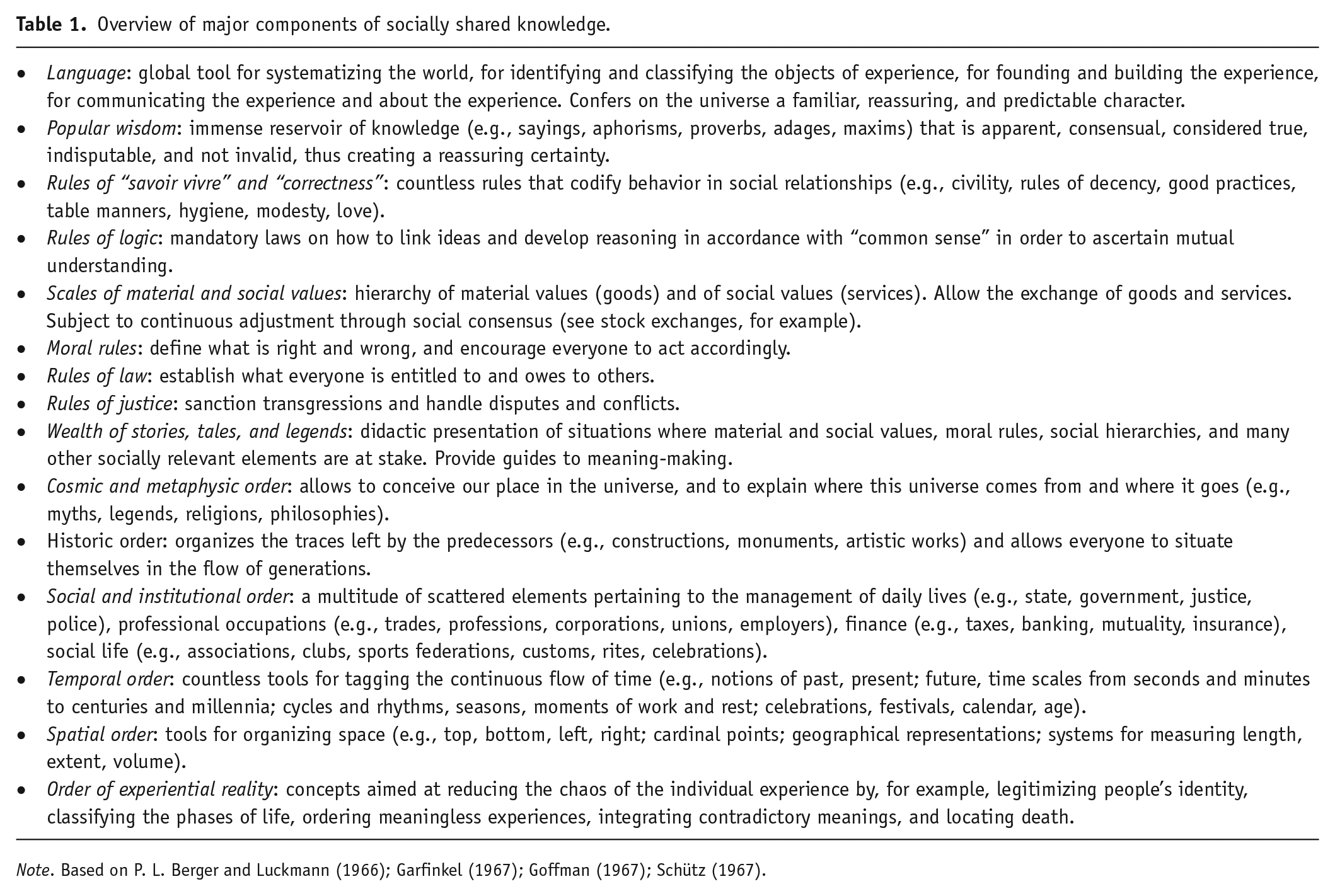
Note. Based on P. L. Berger and Luckmann (1966); Garfinkel (1967); Goffman (1967); Schütz (1967).
Social Transmission of Shared Knowledge
According to P. L. Berger and Luckmann (1966), the fundamentals of this shared social knowledge are transmitted in the primary socialization by parents, who provide children with an interface between themselves and the cultural community to which they belong. The authors pointed out that primary socialization involves more than purely cognitive learning. It takes place under circumstances that are highly charged emotionally. Without such emotional attachment to the significant others, the learning process would be difficult if not impossible. At school age, parents will be taken over by teachers and educators. Vygotsky (1978) has particularly emphasized the view that human beings cannot develop in isolation. The social world is at the origin of the concepts, ideas, facts, skills, and attitudes that children must acquire to become grounded in the world. It is therefore in their interactions with adults that children acquire the linguistic, technical, and technological tools enabling them to develop their own mental functions. These tools include written and spoken language, rituals, behavioral models in works of art, systems of scientific concepts, techniques that support memory or thought, tools that enhance mobility or human perception. Vygotsky (1978) paid particular attention to the scaffolding provided to the child by more knowledgeable persons. For each stage of learning, step by step, this social process allows children to increase their level of knowledge. Studies of developmental psychology have abundantly documented contributions of parents and adults to children’s knowledge about the world (Reis, Collins, & Berscheid, 2000). Here are a few illustrative examples:
Infant-directed speech. Long before children access language, parents immerse them into speech (Soderstrom, 2007). Children’s experiences are thus systematically read and commented on by parents, with children having increasingly more access to parent-generated verbal meanings.
Social referencing. Through the emotional and other nonverbal signals they spontaneously emit in situations encountered with the child, parents contribute to making the child’s environment meaningful (Campos & Stenberg, 1981).
Exposure to adults’ conversations. Through the narratives they share in the children’s presence, parents expose them to both the narrative model and the knowledge about what can happen (Bruner, 1990).
Exposure to narration. Parents develop a narrative universe with their children (J. M. Mandler, 1984). The stories they tell them, often in close intimacy before sleep, teach them schemes and scripts of events and emotional situations.
Training to recount experiences. As children master language, parents systematically train them in storytelling and social sharing of events (Fivush, 1994). They thus learn to give conventional shape and meaning to their experiences in order to make them communicable and accessible to the shared world.
Ritualized interactions. Ritualized infant–caregiver interactions and the family routines and rituals that emerge from them have been shown to constitute primary mechanisms for transmitting the offspring social norms vertically (Rossano, 2012).
Common sense knowledge. All through development, parents distill the shared knowledge base of their culture. In this way, children are gradually equipped with “what everyone knows” and thus become integral members of their community.
Thus, through these countless educational interactions, individuals are early on de facto rooted in a powerful intersubjective reality (Schütz, 1967) which progressively provides them with the knowledge needed to fit into the world. Yet, across life, change is rapid and continuous. The situations and events people face are endlessly renewed. The same applies to projects in which people engage. To stay effective, the shared knowledge must therefore be in constant flux as well. And indeed, everyone can observe that language, practices, values, and mores are evolving at a considerable speed. How is shared knowledge updated?
Updating Shared Knowledge: The Role of Emotion
At every moment of their engagement in the world, people project plans that are based on their knowledge of how the world functions (Miller et al., 1960). This knowledge is aimed at ensuring actions’ effectiveness. The smoother the action, the higher the validity of the knowledge that was implemented in this action. Therein lies the true role of the individual’s experience. As the place where the relation to the world resonates, people’s phenomenal universe is the point at which the validity of their shared knowledge of the world can be tested. Just as scientists verify the validity of their concepts through experiments, so do laypersons verify the validity of their worldviews in experience (e.g., Piaget, 1937; Polanyi, 1962; Tolman, 1932; Yates, 1985). People’s phenomenal experience echoes the fluctuations in the fluidity of their rapport with the outside world. If this experience points to critical gaps between the “mental map” and the “terrain,” knowledge is then in need of adjustment. This dynamic involving correction of errors is crucial to the quality of future action plans and is therefore a precondition of future adaptation (Miller et al., 1960).
The Role of Emotions in Error Detection
To be effective, the process of error detection demands a dedicated sensitivity to be implemented when critical deviations are encountered. It needs detectors that are fast, automatic, and powerful. In this regard, individuals are equipped with affect. Even in quiet moments, the interaction between individuals and their environment is continuously accompanied with affective fluctuations that document its evolution: “in every art, in every science, there is the keen perception of certain relations being right [emphasis added] or not, and there is the emotional flush and thrill consequent thereupon” (James, 1890, p. 427). Emotions properly said are automatically activated upon encountering a critical deviation, that is, when a projected plan is not carried out as expected (Carver & Scheier, 1990). Emotions thus signal shortcomings of the plan at work. 2 It is their disturbing character that makes them important for cognition, as they strike when we are cognitively challenged, when our knowledge seems false, inappropriate, or irrelevant. Emotions are mechanisms that make us learn something (Oatley, 1999, pp. 274–275). Frijda (1988) stated that all affective states exist “for the sake of signaling states of the world that have to be responded to” (p. 354). To this pragmatic perspective, let us add an epistemic one: emotional states exist to signal elements of knowledge that must be reexamined.
Emotion is thus depicted here as emerging from a conflict between data internal to the individual and data external to the latter. In empirical psychology, Hebb (1946) was probably the first author to adopt such a perspective in his analysis of the determinants of fear. Many others have subsequently considered that emotions occur when people confront events for which their assumptive world did not prepare them, thus compelling individuals to modify these constructions (e.g., Cantril, 1950; Johnson-Laird & Oatley, 1989, 1992; Kelly, 1955; G. Mandler, 1984; Reisenzein, 2009). An elaborated model of this kind was recently proposed by the theory of constructed emotion (Feldman Barrett, 2017). The model states that people run an internal model of the world for the purpose of regulating the body according to costs and benefits. The internal model is implemented with a collection of representations that allows us to anticipate what is about to happen in the environment as well as the best course of action to deal with it. Their consequences for the regulation process are made available in consciousness as affect.
Emotion Motivates Cognitive Work
We have pointed out that emotions are signals that highlight the flaws in knowledge systems. We will now argue that beyond the mere detection of errors, emotions also bring with them cognitive work aimed at their resolution.
3
In the framework of his evolutionary theory, Spencer (1855) insisted that human beings are continuously striving to enhance their fitness with the environment. Closer to us, Polanyi (1962) considered that human life is marked by a primordial striving for intellectual control, and that this struggle was prolonged in a need to understand one’s own experience: The shaping of our conceptions is impelled to move from obscurity to clarity and from incoherence to comprehension by an intellectual discomfort similar to that by which our eyes are impelled to make clear and coherent the things we see. (p. 106)
The concept of cognitive dissonance proposed by Festinger (1957) is particularly appropriate for addressing the quest for coherence and meaning. It states that when people face conditions contradicting prior knowledge, they experience a psychological tension which prompts cognitive work aimed at dissonance reduction. As long as the discomfort persists, cognitive work persists too. This rationale has clear implications for emotion. If emotion signals a discrepancy between cognitive expectations and the current situation, then it must also trigger cognitive work aimed at restoring coherence. Though generally supported by the available evidence, this reasoning linking emotion and cognitive work has received only limited attention from experimental research (for review, see Harmon-Jones, 2000). Yet, outside laboratories, a similar reasoning yielded major empirical developments with considerable clinical implications.
Cognitive Work After Traumas and Life Events
Epstein (1973) was probably the first to highlight the deleterious consequences that major emotional experiences have on the theories of reality held by the subject. Subsequently, Horowitz (1976, 1979) described posttraumatic stress disorder as resulting from a cognitive conflict in which what was experienced in an extreme situation contradicts preexisting knowledge. As long as new elements are not integrated, they are re-presented in the working memory. At the same period, a substantial number of studies observed that victims of major life events such as incest (Silver, Boon, & Stones, 1983), breast cancer (Taylor, 1983), and spinal cord injury (Bulman & Wortman, 1977) also evidenced cognitive conflicts. Such victims manifested a mental “working through” process aimed at either the restoration of their preexisting beliefs or the search for acceptable meaning of the event (for review, see Janoff-Bulman, 1992). In the hours and days following major collective stressful upheavals (i.e., Loma Prieta earthquake; first Gulf War declaration), Pennebaker and Harber (1993) recorded abundant event-related thoughts among exposed citizens. A persistent cognitive search for meaning was shown negatively correlated with psychological recovery and positively related to the occurrence of intrusive thoughts and distressing event-related rumination (Silver et al., 1983; see also Curci & Rimé, 2012). In a study of the long-term psychological impact of negative life events, Tait and Silver (1989) concluded that ongoing cognitive involvement in stressful events constitute a rich source of information about the psychological repercussions of negative life experiences. Together with many others, these observations thus confirmed that traumatic experiences and stressful life events abundantly stimulate cognitive work. Along similar lines, terror management theory (Pyszczynski, Greenberg, & Solomon, 1999) examined how people manage the terror resulting from the inevitability and unpredictability of their death by embracing cultural beliefs that act to counter biological reality with more durable forms of meaning and value. More recently, the meaning maintenance model (Heine, Proulx, & Vohs, 2006) investigated how disruptions to their meaning frameworks lead people to experience anxiety and, in response, to concentrate on meaning maintenance by reaffirming in a compensatory manner alternative meaning structures to reestablish their sense of symbolic unity.
Cognitive Work After Ordinary Emotion
In a limited number of studies, a similar demonstration was made in the context of daily life emotions. Horowitz (1976) insisted that the cognitive conflict at the root of posttraumatic disorders is actually also an integral part of any emotion. In his view, every emotion is initially followed by a repetitive re-presentation of experiential elements to be integrated. Laboratory studies conducted on healthy participants fully supported this view: movie inductions of positive as well as of negative emotion were systematically followed by intrusive thoughts (Horowitz & Becker, 1971, 1973). Martin and Tesser (1989) showed that when a conflict arises between a current and a desired situation, as is the case when a goal is blocked, conditions conducive to ruminative thoughts are met. Studies investigating the recall of autobiographic emotional episodes demonstrated that both positive and negative emotional episodes are followed by recurrent episode-related thoughts (Rimé et al., 1991; Rimé, Philippot, Boca, & Mesquita, 1992). More intense emotional experiences were found to elicit more abundant thoughts.
Several authors (Bless & Fiedler, 1995; Fiedler, 2001; Forgas, 2013) theorized that positive and negative affect differ in the type of cognitive processing they stimulate. Negative affect was said to signal a new challenging situation calling for accommodative processes (i.e., internal structures are modified in accordance with external constraints). Positive affect would signal that the environment is familiar or benign so that it would open upon top-down assimilative processing (i.e., internal structures are imposed on the external world). Thus, in this view, and in contradiction with the one presented in this article, negative emotions alone challenge preexisting knowledge. However, there are good reasons to disagree with this perspective. Each one of the positive emotions currently distinguished (Fredrickson, 2013; Shiota et al., 2017) leads to changes or reexamination of expectations and worldviews. Thus, joy and gratitude signal that the material world or the social world offers unexpected opportunities. Serenity provides a chance to specify, define, or clarify one’s expectations, needs, and aspirations. Interest opens one’s eyes to unexpected dimensions of reality and encourages to revise one’s views. Likewise, hope opens people’s eyes to new opportunities. Pride leads one to consider new dimensions of oneself, including new paths to success. Fun reveals new incongruities; it disconfirms people’s expectations about reality and incites relativizing them. Inspiration opens up new paths to realization, new opportunities, or new values. Awe also opens up new dimensions of the world and incites to an existential reflection. Love brings about a redefinition of one’s vision of the otherness, of one’s relationship with others, and of one’s own future. In short, there is much to be said about positive emotions as a source of cognitive work, of search and production of meaning, and of reexamination of knowledge. From their review of the relevant literature, Stein and Levine (1990, p. 58) concluded that both positive and negative emotions have been shown to facilitate thinking, depending on the nature of the thinking considered. It is not extraneous to this context that event-related thoughts were consistently observed to be as frequent after positive emotions as after negative emotions (Horowitz & Becker, 1973; Rimé et al., 1991; Rimé et al., 1992). In the same way, a recent set of studies showed that both extremely painful and extremely pleasant events were rated as more meaningful than milder ones by those who experienced them (Murphy & Bastian, 2019). Obviously thus, emotional intensity, and not emotional valence, is critical for the informative value of the experience.
The cognitive consequences of ordinary life emotions have been particularly well described in the study of organizations. In this context, Weick (1995, 2001) has focused on demonstrating that emotion opens up a process of meaning production. In his view, dissensions, surprises, unexpected events, incidents, accidents, and even catastrophes that can happen in organizations all mobilize their members’ attention to the production of meaning. Thus, when forecasts fail, when expectations are disconfirmed, when activities in progress are blocked, meaning production emerges at its best. The confrontation of obstacles awakens a cognitive dynamic that stimulates the production of mental maps and meanings. The violation of expectations causes emotional activation, which then acts as a tool for allocating attention to the service of the process of producing meaning. When emotion occurs, the situation is instantaneously identified as problematic, it is put on the list of current concerns, and it awaits efforts to resolve it. In this context, we find all the elements that have been mentioned previously in this article: anticipation systems, their flaws, emotions that follow, and the implementation of a meaning production process designed to improve the quality of anticipation tools. This latter element is converging with the issue of belief revision that philosophers deal with.
Emotions, Beliefs, and Revision
In philosophy, a research tradition is dedicated to the study of belief revision (e.g., Alchourrón, Gärdenfors, & Makinson, 1985). The object is the process in which our beliefs are changed rationally when they lead to conclusions conflicting with new reliable information. Livet (2002, 2016) developed an analysis of belief revision highlighting the critical role played by emotions in this regard. It offers a particularly clear look at the relationships linking emotion and worldviews. The author stressed that our beliefs are translated into implicit expectations for the immediate future. If an emotion occurs, it means that one of these expectations has either not been met or has been overwhelmed. Emotions can thus be defined as the resonance of a differential existing between characteristics of the situation and current thoughts, imaginations, perceptions, or actions. In sum, according to Livet (2002, 2016), emotions result from a discrepancy occurring between two dynamics, one originating from the outer world and another from our own motivations. The higher the discrepancy, the more intense the emotion is. By revealing the differential between reality and our desires, emotions also generate the motivation to reduce this differential. They make it imperative to revise our beliefs. As long as the necessary revision is not carried out, the associated emotion will resurface. Emotions are thus helping us adjust to the world. By indicating the extent to which reality may or may not satisfy our desires, they lead us to correct our expectations.
Conclusion
In this section, we have argued that emotions are not limited to detecting flaws in models used to produce action plans. Various lines of research have shown that emotion is followed by a cognitive work. It is noteworthy that this demonstration was initially carried out in the context of psychopathology, likely because psychopathology offered a magnifying glass in this regard. Yet, cognitive manifestations associated with emotions have been evidenced as well in everyday life emotional episodes.
Social Transmission of Emotional Experiences
The cognitive activity generated by emotions would be of little interest to our topic if it were to be restricted to the individual level. However, mental work is preparative for social communication.
Thoughts Pave the Way to Communication
Polanyi (1962) argued that, [E]ven while our thoughts are of things and not of language, we are aware of language in all thinking . . . and can neither have these thoughts without language, nor understand language without understanding the things to which we attend in such thoughts. (p. 101)
Baumeister and Masicampo (2010) stressed that the inner mental crosstalk of conscious thoughts enables information from distributed parallel processing in different brain and mind sites to be integrated. In their view, this is how people become able to tell their thoughts to other people (and learn theirs). They concluded that much of conscious thinking is for talking. In his intersubjective theory of meaning, Larsson (1997) went one step further by stressing that there is no other meaning than the one that is common and public, because it is impossible for the subject alone to validate their thoughts. Such validation cannot exist without a community and without an intersubjective consensus. Admittedly, people can talk to themselves and feel like they understand what they are saying. However, this so-called private meaning has no real existence, unless it has been publicly constituted in interaction with other speakers. Larsson (1997) argues that a relationship exists between intersubjective knowledge and the notion of communion. For meaning to emerge, individual cognition must be intersubjectively recognized and observed. So, where there is no intersubjective recognition, there is no sense: [W]ithout being adorned by words, or stripped by them, thoughts are no more than dreams: like ever-changing clouds in the sky, they float in the mind for a moment and then fade in the next one . . . without language not only humans would not have been able to communicate their thoughts to one another, but by comparison with what they possess, the quantity of their own ideas would have been in derisory numbers. (Larsson, 1997, p. 151)
To sum up, Baumeister and Masicampo’s (2010) arguments suggested that the cognitive work of meaning making generated by an emotional experience prepares people for social communication. Larsson’s (1997) arguments imply that people are highly motivated to undertake such a communication, for otherwise the meaning they are trying to produce would remain unsupported by others and thus, devoid of social validation. But do people actually talk about their emotions?
Emotions are Socially Shared
Emotions are commonly conceived as transient intrapersonal events affecting the course of the person’s life for a brief moment. As brief challenges to rationality and self-control, emotions are to be overcome rapidly and privately, a view that is illustrated by the large emotion regulation literature. Rimé et al. (1991) argued against such a short-lived vision of emotion. Based on theoretical arguments, they proposed that the social communication of an emotional experience forms an integral part of the emotional process. They predicted that, rather than ending with the event circumstances, emotion would be reactivated in subsequent conversations in which people openly communicate about their emotional experience and their own feelings and reactions. The predicted process was labeled “social sharing of emotion.” Studies addressing autobiographic episodes confirmed that an overwhelming majority of respondents had indeed shared their emotional experiences. No difference was found among emotions, and the extent of social sharing varied in direct function of the disruptiveness of the emotion. Later studies (for review, see Rimé, 2009) established that modally, people share an emotion several times with members of their closest social circle, in the hours and days (sometimes weeks, months, or even years; see Curci & Rimé, 2012) following the emotional episode. The social sharing of emotion was manifested in 80 to 100% of emotional episodes, and this proportion was found independent of gender, education, or culture. Experimental studies demonstrated the causal relation linking induced emotion and subsequent social sharing (J. Berger, 2011; Luminet, Bouts, Delie, Manstead, & Rimé, 2000). Findings consistently showed that positive and negative emotional material is shared with equal frequency (e.g., J. Berger, 2011; Skowronski & Walker, 2004). The social sharing of positive emotional experiences became a specific object of research known as capitalization (Gable, Reis, Impett, & Asher, 2004).
The empirical evidence thus largely supports the view that emotions are socially shared. When people are asked why they do so, two types of motives emerge (Duprez, Christophe, Rimé, Congard, & Antoine, 2015). A first one is epistemic. People want to (a) inform or warn people around, (b) achieve clarification and meaning, and (c) receive advice and solutions. Thus, not only do they want to spread the information about what happened to them, but they also expect the social-sharing process to provide them with enriched knowledge and understanding about their emotional experience. The other motive is affiliative. People want to obtain from others (a) empathy and attention, and (b) assistance, support, comfort, and/or consolation. This suggests that an emotional experience not only brings people new information and questions but also transforms them, making them somehow a different person. The affiliative motives indicate that they want to be reinserted into their social circle—to be accepted and absorbed after what has happened.
Social Diffusion of Emotion-Loaded Information
With regard to the topic of cultural construction addressed in these pages, a critical observation is that the social sharing of emotion develops far beyond person-to-person communications. Since long, studies documented that exposure to the narrative of an emotional episode elicits emotions among listeners (Archer & Berg, 1978; Lazarus, Opton, Monikos, & Rankin, 1965; Shortt & Pennebaker, 1992; Strack & Coyne, 1983). Christophe and Rimé (1997) reasoned that as emotion elicits social-sharing behaviors and as listeners experience emotion, the latter should in turn share the episode they heard with other persons in a “secondary social sharing.” Data from autobiographic recall confirmed that secondary social sharing occurred in an overwhelming proportion of shared episodes. As with primary social sharing, more intense emotional episodes were found secondarily shared more repetitively and with more partners. Diary studies conducted with broad samples and on both positive and negative episodes confirmed these observations (Curci & Bellelli, 2004). Thus, once an emotion is shared, there is an elevated probability that the target will share this emotion with other persons. Further, emotional episodes that were heard in a secondary sharing were found to be shared too, with one or several persons, in a large proportion of cases (Christophe, 1997; Harber & Cohen, 2005). These observations suggest that emotional episodes propagate very easily.
Emotional Information Flows Out Into Social Networks
Abundant data from various sources supported that emotionally loaded information flows in a particularly fluid manner through social networks. In an investigation of rumors or urban legends, Heath, Bell, and Sternberg (2001) demonstrated that the circulation of stories relies upon emotional rather than informational selection. When informational aspects of truth and usefulness were controlled for, people were found more willing to pass along stories that elicited stronger emotion, and more emotional legends were distributed more widely. Similar observations about emotionality were reported about gossip. Baumeister, Zhang, and Vohs (2004) had students report gossips they had heard and rate the emotions they had felt when hearing them. Gossips were indeed found associated with emotions of a broad spectrum, negative in the majority of cases, but also positive in a minority of instances. Peters, Kashima, and Clark (2009) investigated participants’ willingness to share social anecdotes that were previously rated for intensity of various emotions. Almost all of the emotions included, positively predicted their communicability ratings, indicating that participants were willing to share social anecdotes to the extent they aroused emotions. Overall, seven emotions accounted for 59% of the variance in communicability. J. Berger and Milkman (2012) investigated the function of emotions in the transmission of news information. Among some 7,000 articles published on The New York Times’s website, those characterized by emotional high arousal were more likely to be forwarded by readers via email. In a subsequent study, the authors asked participants how likely they would be to share a story, and they manipulated whether the story evoked more or less emotion. Again, people were more willing to share a story when it evoked more emotion. Stubbersfield, Tehrani, and Flynn (2017) examined the recall of urban legends high or low for evoking emotion using a transmission chain design in which legends are passed from one participant to another. Legends evoking higher levels of emotion were recalled with greater accuracy across the linear transmission. In the field of marketing, the transmission of good or bad consumer experiences was also found to be dependent upon the emotional content of the message (e.g., Dobele, Lindgreen, Beverland, Vanhamme, & van Wijk, 2007; Phelps, Lewis, Mobilio, Perry, & Raman, 2004).
Thus, abundant findings demonstrated that emotional information propagates and that the higher the intensity of its emotional content, the higher the likelihood that it will spread via verbal transmission. In a longitudinal social network analysis, Fowler and Christakis (2008) observed that the happiness of a given individual is associated with the happiness of people with up to three degrees of separation in the social network. The data did not allow to identify the actual mechanisms causing this spread of happiness and the authors were left to speculate on the causes (e.g., change in behavior of happy persons; “exuding” their emotion in a contagious manner). From the present perspective, the social sharing of emotion would be an obvious candidate in this regard.
Collective Emotion Fosters Collective Sharing
In some circumstances, the social sharing of emotions can become so widespread that it overloads social interactions. When an emotional event affects a community—accident, disaster, death of a key person, major success—a specific social dynamic develops (R. Collins, 2004; Rimé, 2007). Every member of the community experiences the emotions that the event arouses. Everyone consults the media to find out more, talks about it, and listens to others talk about it. At each evocation, attendees’ emotions are reactivated so that they then feel the need to talk about it again. In this way, each person feeds a communicative effervescence progressing at a high speed. For a few days, the only issue in the concerned community is the event and the emotions it generates. Pennebaker and Harber (1993) described such a collective emotion-sharing process first among residents of the Loma Prieta earthquake-affected area and then among U.S. citizens when the first Gulf War broke out in January 1991. Similar observations were made on Spanish residents following the March 2004 attacks in Madrid (Rimé, Páez, Basabe, & Martínez, 2010) and on Paris residents after the attacks on Charlie Hebdo in January 2015 (Pelletier & Drozda-Senkowska, 2016).
Collective Emotions and Digital Sharing
Exchanges triggered by a collective emotional event have taken a new turn since digital communications became commonplace. Twitter has become a tool of choice for such exchanges and its use is increasing. Thus, the attack on Charlie Hebdo in January 2015 generated 6.7 million tweets in 5 days for #JeSuisCharlie, and following the November 2015 attacks in Paris, 6.3 million tweets were recorded in 10 hours for #PrayForParis (Goldman & Pagliery, 2015). Smyrnaios and Ratinaud (2017) collected all Twitter messages for #charliehebdo between January 7 and 12, 2015, resulting in a total of 3.66 million tweets in different languages. A very remarkable observation of this study is that the vast majority of tweets collected were retweets. This was found for all languages in the data pool. Thus, 81.7% of the French tweets were retweets, and this was the case for 81.2% of the English tweets. In the other languages, the proportion of retweets ranged from 61% (Dutch) to 75.8% (Arabic). This demonstrates that in case of collective emotional circumstances, a significant part of emotion sharing represents in fact secondary or tertiary sharing in which the information and thoughts of some are repeated and propagated by others. Such findings support the concepts of effervescence and vicious circle evoked in the previous lines in cases of collective emotional events.
Conclusion
There is thus abundant evidence that the social sharing of emotion is far from being limited to person-to-person exchanges. Data revealed that listeners become in turn actors in the transmission of emotional episodes, and that a process of propagation of emotional information develops in this manner in the surrounding social network. Emotional episodes thus spark a process of diffusion allowing the transmission of an individual’s experience to members of the social network. The higher the emotional impact of an event, the broader its diffusion. Very high impact events can thus affect everyone in a community. Through this process, all group members are informed of what happened to one of them and how this one faced the situation. Presumably, they react to this information, spread it in turn, discuss it with others, and interpret it. Together, members of the social network can reflect upon the experience and they can derive lessons from it for the future of each of them. Through such a process, every significant experience of every single individual can enter the pool of shared knowledge, can impact on shared models of the world and on shared beliefs, and thus can engender changes into the systems of representations (concepts, beliefs, values, etc.) shared by the social milieu. In this sense, the social sharing of emotion is a tool for cultural transformation. The process thus offers a powerful social tool at the service of the continual updating of shared knowledge, theories, and representations. Smaller events will involve only a small number of people, and thus the resulting modification of knowledge will only be local; major events will involve a community, a nation, or even the whole world and will then be likely of a profound impact upon shared knowledge.
General Conclusion
In this article, we first emphasized the epistemic situation of human individuals. Through the transmission of the social knowledge they have benefited from since their birth, they live in a universe that is not populated by “raw reality” (P. L. Berger & Luckmann, 1966). The reading grids that culture has endowed them with, have situated them under the canopy of the shared world. Without elevation to this world, they would be left to anomia (DeNora, 2014; Durkheim, 1912; Hilbert, 1986), that is, to a world devoid of any order and organization, and dominated by the unknown, the unpredictable, and out of control—this is the world that was described by Becker (1973) and by terror management theorists (e.g., Pyszczynski et al., 1999). At the opposite side, in the context of shared knowledge, individuals are both immersed in a meaningful world and in tune with the cultural community that supports and validates the shared meanings. In this context, they can deploy their action, based on implicit beliefs that are nourished and sustained by the convergence of a multiplicity of people (P. L. Berger & Luckmann, 1966).
Shared knowledge is continually subject to negotiation and renegotiation (DeNora, 2014). The central argument of this article is precisely that emotions play a critical role in this negotiation and renegotiation of shared knowledge. We pointed out that emotions emerge at times when individuals experience a break in the sense of fit that links them to both shared knowledge and their community. In emotion, a gap is detected between some environmental conditions and some individual aspiration. Whatever the aspiration (or intent, or purpose, or goal) at stake, its implementation toward action requires the framework of socially shared knowledge. By detecting a gap, emotions signal at the same time the need to renegotiate aspects of this framework. The motivation to conduct such a renegotiation is powerful, as emotion and the rupture it signals are reminiscent of the threats inherent in shared knowledge shortages. Indeed, at the borders of culture, raw reality looms on the horizon—together with the spectra of anomia and loneliness. Emotion thus urges people to make sense of reality again.
This article would miss an essential point if it failed to stress that the social sharing of emotions is systematically linked to a specific sociorelational context. Indeed, sharing emotions seems to be associated in all cases with the strengthening of the social ties and social cohesion of those involved. This was observed in interpersonal situations of social sharing of an emotional experience (Christophe & Rimé, 1997; Rimé, 2009), in the process of capitalization upon a positive emotional episode (Gable & Reis, 2010), in emotional self-disclosure situations (N. L. Collins & Miller, 1994; Laurenceau, Feldman Barrett, & Pietromonaco, 1998), in the social sharing following collective stressful events (Garcia & Rimé, 2019; Páez, Basabe, Ubillos, & Gonzáles-Castro, 2007; Rimé et al., 2010), in social talk in which people express the same emotional feelings towards the target of the conversation (Peters & Kashima, 2007), after participation in a positively or a negatively toned collective emotional gathering (Páez, Rimé, Basabe, Wlodarczyk, & Zumeta, 2015), after commemorations of a past collective trauma (Marín Beristain, Páez, & González, 2000), and after participation in a truth and reconciliation process (Kanyangara, Rimé, Philippot, & Yzerbyt, 2007; Rimé, Kanyangara, Yzerbyt, & Páez, 2011). Why this systematic association between emotion sharing and interpersonal and social cohesion? Referring to the study of aesthetic transactions, DeNora (2014) stressed that “making sense of reality involves something akin to religious communion, [emphasis added] as something that people make (craft) together” (p. 131). This view is reminiscent of the “mutual attunement” that was described by Alfred Schütz (1951). Earlier in the present article, we met the very same idea of “communion” in the context of Larsson’s (1997) intersubjective theory of knowledge. This author developed a view that came close to the previous one: And where, precisely, can we find this “fullness of meaning” that human beings . . . dream of, if not in communion with other human beings, in perfect intersubjectivity, that is, in love and friendship? And what is the most tragic loss of meaning, if not in loneliness and isolation? . . . It is because meaning is constituted and emerges as such in an act of common recognition—or in an act of communion—that it can have an objectively cognizable existence for two human beings. From this point of view, the very essence of meaning is to be common. (p. 80, own translation)
Yet, the close association between emotion sharing, meaning construction, and affilitative process remains puzzling for all those interested in the issue of knowledge acquisition and transformation. As was mentionned earlier in this article, P. L. Berger and Luckmann (1966) had stressed that without the highly charged emotional attachment to the significant others involved in primary socialization, the learning process would be difficult if not impossible. The exact causal process and mediating variables involved in the observed association between shared emotions, meaning construction, and social ties are still largely opened to theoretical analysis and empirical scrutiny.
In closing this article, we need to turn to empirical questions. Admittedly, the proposed reasoning is purely theoretical, and we offered no empirical evidence in support of it. What type of data do we need? We need empirical data on the contents exchanged in the context of emotional experiences, on how these contents evolve during their diffusion, on the impact that these contents and their diffusion have on individuals’ knowledge as well as on social representations and shared knowledge, and, of course, on the cultural contexts in which emotions take place. Actually, in recent literature, there is evidence that relevant research is already ongoing. The difficult task of investigation of social sharing content is now undertaken (e.g., Habermas & Berger, 2011; Habermas, Meier, & Mukhtar, 2009; Pasupathi et al., 2015). Oatley and Johnson-Laird (2014) recently reviewed some studies showing that, contrary to the common belief that emotions impair reasoning, after experiencing an emotion, people were more likely to consider possibilities that they would otherwise have neglected (Hertel, Schütz, & Lammers, 2009), and reasoned more accurately about issues at stake in the emotional episode (Blanchette & Campbell, 2012; Blanchette, Richards, Melnyk, & Lavda, 2007). Peters, Jetten, Radova, and Austin (2017) observed that when people witness behaviors that deviate from social norms, they manifest the need to share the emotion they felt in response and to gossip about it. These authors conducted experimental studies demonstrating that conversations of this kind created a clearer understanding of social norms and that this effect was fully mediated by the length of time that participants spent gossiping about the deviant act. In addition, exposure to deviance indirectly improved cohesion through norm clarification when (and to the extent that) participants were able to share deviance gossip. Such findings clearly illustrate the process of shared knowledge transformation resulting from felt emotions and their social sharing, as well as its impact on social relationships. In a recent study, Pasupathi, Wainryb, Oldroyd, and Bourne (2019) obtained data showing not only that emotions and their social sharing generate learning, but also that such learning has consequences for the regulation of emotions. Young people first recalled an anger-provoking experience and were randomly assigned to either narrating the event or fulfilling one out of three control tasks. They then recalled the event a second time and rated the extent to which they had learned from that event. Participants reported more learning when they had narrated their experience. They also reported more learning when they had narrated the event more frequently prior to participation. Stronger reductions in anger following narration were associated with greater self-reported learning. These findings not only show that sharing an emotional experience allows for acquisition of new knowledge, they also confirm that modification of one’s knowledge reference frames constitutes an effective way through which emotional disclosure can reduce the emotional impact (Rimé, 2009). These few studies are illustrative of research avenues that the reasoning in these pages seeks to promote.
We began this article by objecting to the idea that individuals’ experiences are at the root of the adaptive knowledge they have. From our point of view, the individual’s experience is, relative to socially shared knowledge, no more than a drop in the ocean. But the reasoning we have proposed reminds us that the ocean is composed of drops of water. In sum, according to this perspective, any individual experience whose relevance is signaled by emotion is likely to contribute to the transformation of cultural knowledge. Any individual existence is therefore likely to make numerous contributions to the common construction of shared meaning. By experiencing and sharing experiences with others, every human life plays a role and finds its utility in contributing to the process of cultural construction.
