



Abstract
Do people really fare better if they can rely on many social ties? Research suggests that benefits of interpersonal emotion regulation (ER) can be derived from both large and small social networks. Building on the intrapersonal regulatory flexibility model, we propose the emotion regulation repertoire of social support (ERROSS) model that views effective socioemotional support as the combination of network size and ER strategies, resulting in a repertoire of ER resources one can draw on. Best outcomes in mental health should follow from both a large network and a diverse repertoire of strategies. ERROSS is applied as an example in the context of bereavement, and specific contributions of the model are highlighted.
Humans don’t live in isolation, but as part of social networks. Attachment theory (Bowlby, 1969) suggests that individuals strive to form and maintain relationships with others throughout their lives. From the moment we are born, we depend on others to help us regulate our emotional states. Even when humans gain the ability to self-regulate, they continue to seek out others for emotional or instrumental support (e.g., Rimé, 2009). Social ties play an important role in the psychological and physical well-being of individuals (Hansen et al., 2017; Kawachi & Berkman, 2001; Uchino, 2004). However, the extent to which social networks confer benefits varies from person to person and seems to depend not only on network characteristics but also on the types of support a network affords. Whereas individuals can derive benefits from both small and big networks (Hether et al., 2016), qualitative dimensions of social networks such as type and quality of support received seem just as or even more important (Berkman et al., 1992; Cohen & Wills, 1985; Hansen et al., 2017; Kawachi & Berkman, 2001). A meta-analysis suggests that individuals who lack social integration, both quantitatively and qualitatively, are at risk of premature mortality, an effect comparable to established negative health behaviors such as smoking and alcohol consumption (Holt-Lunstad et al., 2015; Holt-Lunstad et al., 2010). In this article, we build on the findings showing that both network size and type of support provided are crucial for individuals’ well-being, and propose a theoretical model for understanding how well-being may be shaped through an interaction of network size and interpersonal emotion regulation.
Social Support
Social support is widely recognized as important for individuals’ well-being, and several aspects can be distinguished within the multidimensional construct of social support (Cutrona & Russell, 1990; House & Kahn, 1985; Seeman, 2008). The structural (or quantitative) component of social relationships involves the extent to which individuals are integrated in social networks (e.g., number of close others identified by a participant). The functional component comprises the qualitative aspect of relationships, such as actual support received or perceived support availability. Within the functional dimension of social networks, instrumental support refers to tangible help or concrete instrumental assistance to cope with a stressful situation (e.g., giving someone a ride to the doctor’s office). Emotional support, on the other hand, aims to make the recipient feel loved, cared for, and capable of coping with a situation. It can take various forms, from providing empathy, encouragement, and companionship to engaging in perspective-taking, distraction, or reappraising the situation together.
Structural Social Support
Considerable evidence suggests positive associations between structural social support (e.g., network size) and psychological and physical well-being (Cohen & Wills, 1985; Hansen et al., 2017; Holt-Lunstad et al., 2015; Lund et al., 2000). Individuals with more social ties report less distress and greater positive affect regardless of underlying stress levels (main effect hypothesis; Cohen & Wills, 1985). However, social support benefits can also be derived from small networks. Research on attachment figures and dyadic coping shows that even one or two close ties can be associated with improved affect regulation and health (e.g., Debrot et al., 2013; Horn et al., 2018). An analysis of online health-related social networking sites found more activity and support in smaller compared to larger networks (Hether et al., 2016). Thus, smaller networks seem to facilitate interaction among members, whereas larger networks may diffuse support responsibilities (Hether et al., 2016). Furthermore, larger networks are not always related to positive outcomes, as indicated by small or nonsignificant effects (Chu et al., 2010; Huxhold et al., 2013; Pressman et al., 2005). These findings suggest that larger networks are not necessarily associated with better outcomes than smaller networks. Instead, both large and small networks can be predictive of good outcomes, and additional variables may be needed to explain the relationship between social support and outcomes.
One possible explanation for the oftentimes overlooked positive effects of small networks on individuals’ health is that structural aspects of social networks don’t automatically reflect the array of support (e.g., quality, type) offered by network members. For example, a small network, although seemingly inadequate, could promote individuals’ well-being as long as individuals are satisfied with the support they receive. A large network, in contrast, may at first seem superior but can fall short of the expected benefits if network members are not reliable sources of support, offer the wrong support, or are not perceived as helpful. This notion is also evidenced by only moderate correlations between structural and functional aspects of social relationships (Coyle & Dugan, 2012). Thus, assessing only the structure of social networks provides little information about the type, quality, amount, and perceived adequacy of support and its implications for well-being.
Emotional Social Support
Emotional social support, or “the ability to turn to others for comfort and security during times of stress, leading the person to feel that he or she is cared for” (Cutrona & Russell, 1990, p. 99), appears to constitute a crucial facet of functional support. It is at the heart of many current theories of social support and relationships. For instance, simply the perception that a relationship partner is responsive to one’s goals, needs, and values is presumed to contribute to the couple’s intimacy and closeness (Reis et al., 2004). The key role of emotional support is also depicted in the relationship enhancement model of social support (Cutrona et al., 2005), in which interpersonal trust (i.e., the perception of one’s partner as kind, loving, and caring) represents a main mechanism in the link between social support and health. Indeed, emotional support predicts both personal and relational well-being (Gable et al., 2006; Gleason et al., 2008), and is linked to a number of positive outcomes including fewer sleep disturbances, better cognitive functioning, and reduced mortality risk (Bolger & Amarel, 2007; Lyyra & Heikkinen, 2006; Martire et al., 1998; Nordin et al., 2012; Seeman et al., 2001). This functional component of social relationships is suggested to operate through a stress-buffering mechanism (Cohen & Wills, 1985), with emotionally supportive relationships buffering the effects of stress by enhancing individuals’ coping abilities. Emotional social support frequently emerges as a better predictor of individuals’ health beyond structural and other functional aspects of networks (Berkman et al., 1992; Gleason et al., 2008).
Most often, emotional support is offered by few close network members rather than loose ties (Dunbar & Spoors, 1995; Hill & Dunbar, 2003; Stiller & Dunbar, 2007). The belongingness–bonding–binding continuum and other clusters of relationships suggest that social networks are comprised of different layers, including the most intimate connections (e.g., marital ties), close support connections (e.g., best friends, close relatives), and weaker relations (e.g., community members), with layers increasing in size but decreasing in relationship intensity (Dunbar & Spoors, 1995; Hill & Dunbar, 2003; Lin et al., 1999). Closer ties are relationships from whom one would seek advice, support, or help in times of emotional distress, whereas the distal layer characterizes loose social ties which provide a sense of belonginess but less emotional support (Dunbar & Spoors, 1995; Hill & Dunbar, 2003). The number of close ties that provide emotional support is frequently small and restricted to approximately two to 10 network members (Hill & Dunbar, 2003; Stiller & Dunbar, 2007). Even though many individuals seem to derive emotional support from a small circle of people, social networks are characterized by substantial interindividual variation, with some individuals relying on more and others relying on few social ties for emotional support (Dunbar & Spoors, 1995; Hill & Dunbar, 2003). Armstrong and Kammrath (2015), for instance, reported distinct associations between individuals’ enacted support-seeking strategies and their measured outcomes. Whereas participants perceived higher levels of support availability when seeking support from different network members (rather than more support from few people), higher self-esteem was reported when seeking support broadly and deeply (a lot of support sought from different network members).
To summarize, there is no clear evidence of the superiority of having many social ties versus a smaller number of relationships that nevertheless offer high levels of support. Structural aspects of networks are not necessarily a good indicator of the types of support offered by network members. The weak correlations between different social support components highlight the importance of distinguishing between structural and functional aspects of support, and the need to assess both in order to derive implications for mental health. Emotional support, perhaps the most important domain of social support, seems to be of particular value for individuals’ personal and relational well-being (Gleason et al., 2008), with great interindividual variability in how people utilize others for emotional support (Armstrong & Kammrath, 2015; Dunbar & Spoors, 1995).
Intra- and Interpersonal Emotion Regulation
A related construct, although distinct from emotional support, involves interpersonal emotion regulation (IER), or individuals’ goal-directed and controlled attempts to influence their own or others’ emotion-related experiences through social interactions (Niven, 2017; Zaki & Williams, 2013). Whereas intrapersonal emotion regulation refers to attempts that are enacted within the individual, IER describes emotion regulation efforts that occur in a social context and involve more than one person (Niven, 2017; Zaki & Williams, 2013).
Intrapersonal Emotion Regulation
Gross’s process model of emotion regulation has been highly influential in intrapersonal regulation-focused research (Gross, 1998). A recent extension of the original process model highlights how individuals identify opportunities to regulate emotions, initiate regulation, and how particular strategies are selected and implemented (Gross, 2015b). Bonanno and Burton (2013) proposed a regulatory flexibility model, emphasizing that the use of any one strategy is less important than the ability to vary one’s responding across different stressors that call for different strategies. The range of emotion regulation strategies that a person is able to use is called the emotion regulation repertoire. High repertoire flexibility is associated with better psychological functioning, such as decreased levels of distress or symptoms of posttraumatic stress disorder (Bonanno et al., 2004; Burton et al., 2012; Levy-Gigi et al., 2016). Due to the importance of repertoire in our model, we will come back to this concept in a later section.
Interpersonal Emotion Regulation
The present article defines IER as individuals’ goal-directed attempts to manage their own emotions through social partners and the emotion regulation strategies those partners afford. We propose that emotion regulation strategies afforded by relationship partners serve as IER (e.g., encouragement from a partner may reduce one’s own anger). This notion is supported by findings that people seek out others to share their emotions (Gable et al., 2004; Rimé, 2009), and selectively turn to different relationship partners for different emotions (Cheung et al., 2015).
Other definitions of IER distinguish between efforts to modify one’s own (intrinsic), another person’s (extrinsic; Zaki & Williams, 2013), or each other’s emotional states (dyadic; (Butler, 2015; Butler & Randall, 2013), or consider the extent to which IER requires feedback from others (i.e., response-dependent vs. independent; Zaki & Williams, 2013) and is intentional or deliberate in nature (Koole, 2009; Niven, 2017). Since the emotion regulation repertoire of social support (ERROSS) model introduced in this article focuses on the target of regulation (i.e., the person receiving emotion regulation strategies) rather than the regulator’s perspective (i.e., the network member offering strategies) or a dyad perspective, our definition of IER does not include these additional considerations and we direct the interested reader to Dixon-Gordon et al. (2015); Niven (2017); and Zaki and Williams (2013).
IER can take on various forms from humor (Horn et al., 2018), to encouragement (Niven et al., 2015), to drawing on a friend’s reappraisal skills (Horn & Maercker, 2016). It can be distinguished from related concepts such as emotional support and dyadic coping, as well as from intrapersonal emotion regulation (Williams et al., 2018; see previous description). Unlike emotional support, IER is goal-directed and targeted towards modifying emotional experiences, even outside the context of stress. Emotional support, in contrast, is a more general concept than time-limited, emotional-event-focused IER, and is offered in response to stress (e.g., during the time period following a diagnosis of chronic illness or unemployment). Emotional support can be employed in response to both emotional and nonemotional goals (Cutrona & Russell, 1990). For example, emotional support may have the goal of having a person persist in chemotherapeutic treatment, but not necessarily to make them less afraid. In addition, emotional support is one form through which people use others to regulate their emotions (e.g., providing comfort). Dyadic coping describes how two individuals in a close relationship respond to stressors jointly (Bodenmann, 1997), whereas IER can be viewed from various perspectives (e.g., see intrinsic vs. extrinsic IER; Zaki & Williams, 2013), not necessarily involving both partners and their oscillating patterns of regulation.
IER is common and can help individuals effectively manage both positive and negative emotions. Successful IER is associated with adaptive adjustment, such as increased momentary affect, psychological well-being, and heightened relationship quality (Horn & Maercker, 2016; Horn et al., 2018; Niven et al., 2015; Niven, Holman, & Totterdell, 2012). For example, participants’ neural response to threatening electric shocks was attenuated when they held the hand of either a stranger or their spouse, though this hand-holding had a greater effect for couples with higher marital quality (Coan et al., 2006).
Which and when strategies promote successful IER is still unclear (Niven et al., 2015; Niven et al., 2009). When it comes to regulating one’s own feelings, certain strategies (e.g., reappraisal) are indeed considered more effective than others (Gross & John, 2003), but only to the extent that these strategies meet contextual demands across time (Bonanno & Burton, 2013; Webb et al., 2012). For example, a meta-analysis by Webb et al. (2012) found unique associations in the effectiveness of intrapersonal emotion regulation both within and between strategies. While cognitive change processes were more effective than attentional deployment and response modulation processes in regulating emotional experiences, different subtypes within these emotion regulation processes were associated with distinct outcomes. If this finding extends beyond the intrapersonal context, one could expect that specific IER strategies are less important than the availability of a pool of different IER strategies. If your friends and family members cover a variety of different strategies (e.g., reappraisal, distraction, problem-solving, and encouragement), there is a greater likelihood that one of these strategies will cover your regulatory need at a given moment. In times of need (e.g., when arguing with your partner), one could then choose from the array of IER strategies offered by network members and flexibly draw on the strategies that seem most effective based on contextual demands, rather than relying exclusively on one strategy across different situations. Conversely, if an IER attempt fails, a pool of diverse IER strategies can provide additional opportunities for IER. For instance, if your friend’s attempt to put your ex-partner in a bad light is not effectively helping you manage your emotions, you could make use of other IER strategies from the repertoire (e.g., distraction, reassurance, reappraisal). Building on advancements in the field of emotion self-regulation suggesting that flexible use of diverse intrapersonal strategies is associated with benefits (see regulatory flexibility; Bonanno & Burton, 2013; Levy-Gigi et al., 2016), the availability of different IER strategies should promote context-sensitive IER responding and, in turn, increase adaptation.
Benefits of a repertoire of diverse emotion regulation relationships have been recently studied. Evidence suggests that people indeed selectively turn to specific individuals who they consider effective at regulating a particular emotion—termed emotionships (Cheung et al., 2015). In a study by Cheung et al. (2015), individuals were able to name discrete relationship partners for specific emotions (e.g., relationship partner effective at cheering up sadness vs. soothing anxiety) and drew closer to these nominated individuals when the specific emotion was activated. Interestingly, greater well-being was reported when IER efforts were diversified across specialized social ties. Similarly, among college students, empathic individuals were sought out for trust, serving as stress buffers, and had central roles in smaller networks, whereas students high in well-being attracted fun and excitement, fostering positive experiences, and occupied central roles in broader networks (Morelli et al., 2015). The evidence outlined before suggests that individuals have a sense of whom to turn to for IER, and that benefits may be maximized when IER is diversified (Cheung et al., 2015) and when individuals can draw on different regulation strategies (Bonanno & Burton, 2013). In the study by Cheung et al. (2015), participants identified people they would approach for particular emotional experiences (e.g., when experiencing sadness vs. anger). Distinct, however, is the question whether emotional experiences correspond to regulation strategies afforded by network members. It seems unlikely that an individual would always turn to the same friend when experiencing anger. For instance, when the anger results from a rejected manuscript, a person might be more inclined to turn to an academic colleague to discuss the rejection, but to another network member when anger is caused by relationship problems and distraction is sought. Who the regulator is, how he or she responds (i.e., IER strategy), and to what extent these IER strategies are concentrated on few versus many relationship partners may have stronger implications with regard to network usage and well-being.
In sum, existing frameworks and empirical findings highlight the importance of others in helping people regulate their emotions. Whereas some individuals draw on a large network, others rely on the same few people. Research on intrapersonal emotion regulation processes suggests that a pool of different strategies promotes context-sensitive responding and health benefits. To what extent emotion regulation repertoire can be extended to encompass interpersonal aspects and why both small and large networks are sometimes associated with well-being are the core questions that drove the development of our emotion regulation repertoire of social support (ERROSS) model. ERROSS proposes that effective social support operates through various emotion regulation strategies provided by network member(s), which are then available to the support seeker. We posit that a diverse network of IER strategies offered by others can provide people with a broader pool of resources to draw from, thereby allowing them to capitalize on others’ strengths in providing regulation. Further, we hypothesize that people will have greater well-being if an individual’s network offers a variety of loved ones, or a variety of different IER strategies. Of course, the best outcomes would follow for people who have both. This conceptualization of effective social support as a combination of structural support and emotion regulation strategies constitutes a unique approach to assessing network utilization in IER. Of course, we do recognize that human interactions are complex for a number of reasons. For instance, individuals need to be aware of their need for IER and able to communicate it for relationship partners to be able to respond. Even if someone seeks help, regulators may not be able to decode the help-seeking attempt, they may misread the intent, or the supposedly helpful emotion regulation strategies may not be in tune with the expresser’s goals (e.g., if they simply want to vent and the regulator provides advice rather than just listening). There are costs of mismatches between needs and IER attempts, contextual constraints, individual differences in delivery of IER, and iterative mutual influences within the dyad. However, for this article, we present a simplified model. As we describe ERROSS, we will first introduce a basic, computational model before depicting the model in a more nuanced, complex version. This computational model is an intentional oversimplification which introduces its core components and main assumptions. Although the model is simplified, we believe that researchers can still benefit from this model, as it allows for an easy generation of research hypotheses. In a similar vein, we introduce the basic model in terms of global perceptions first and consider the role of actual social exchanges in a later section.
The Model: Emotion Regulation Repertoire of Social Support (ERROSS)
Building Blocks: Network Size, Emotion Regulation Strategies, and Repertoire
Within ERROSS, three main variables are operationalized: network size, emotion regulation strategies, and emotion regulation repertoire.
Network size
Network size is defined as the number of close others with whom individuals are in regular contact (see Social Network Index; Cohen et al., 1997). Building on research findings which suggest that emotional support is typically provided by close social ties (Dunbar & Spoors, 1995; Hill & Dunbar, 2003; Stiller & Dunbar, 2007), our definition of network members does not include loose ties. In Figure 1, network size is graphically depicted as the number of columns with at least one black and white checkered cell. In this example, Figures 1a and 1c have a network size of two, 1b a size of 10, and 1d a network size of eight. Table 1 provides an overview of arithmetic operationalization and graphic depiction of the various model components as well as the resulting model component estimates for the four hypothetical individuals presented in Figure 1.
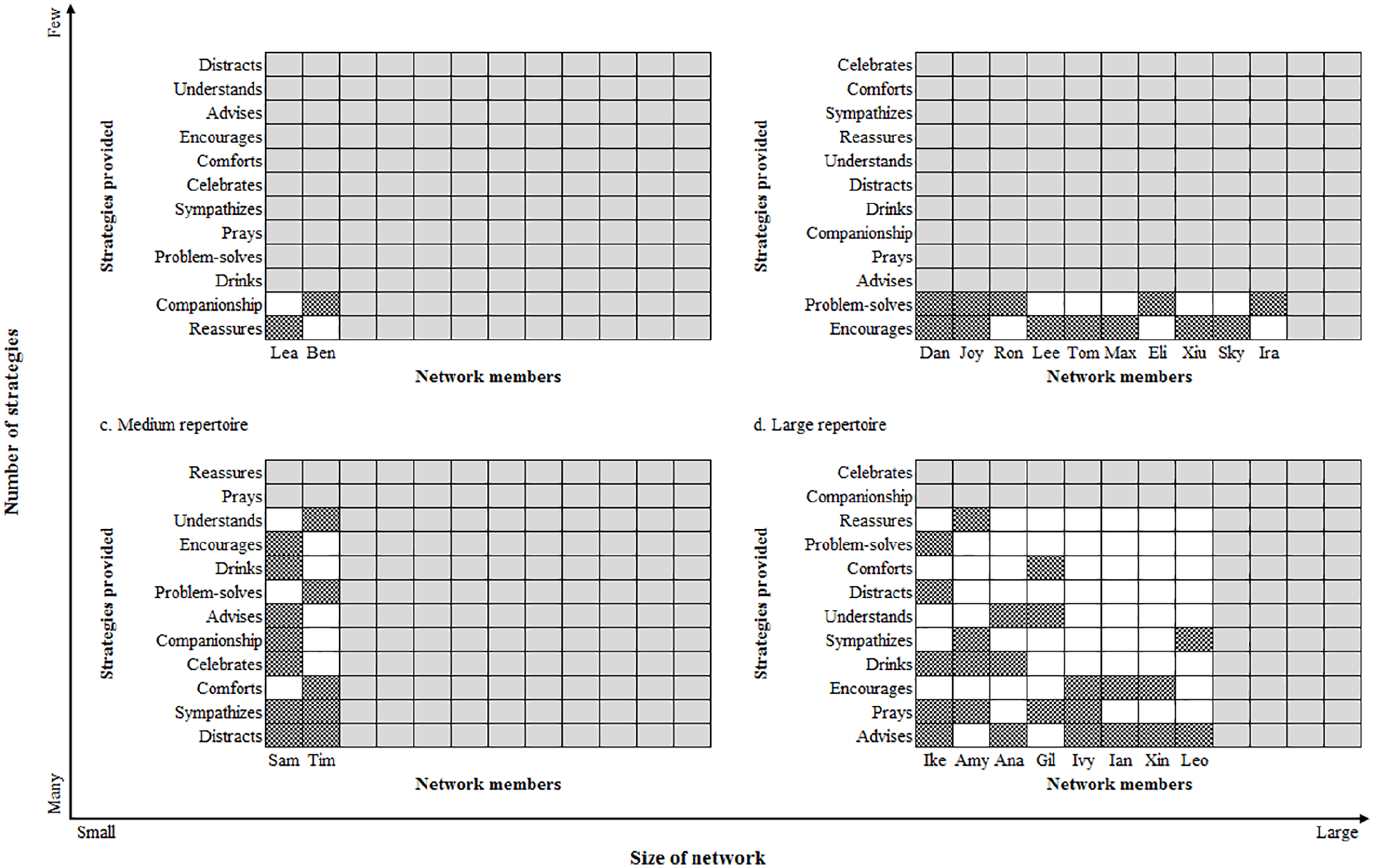
Exemplars of interpersonal emotion regulation repertoires from four hypothetical individuals, including network size and emotion regulation strategies provided.
Components of ERROSS, including their arithmetic operationalization, graphic depiction, and their estimates for four hypothetical individuals from Figure 1.
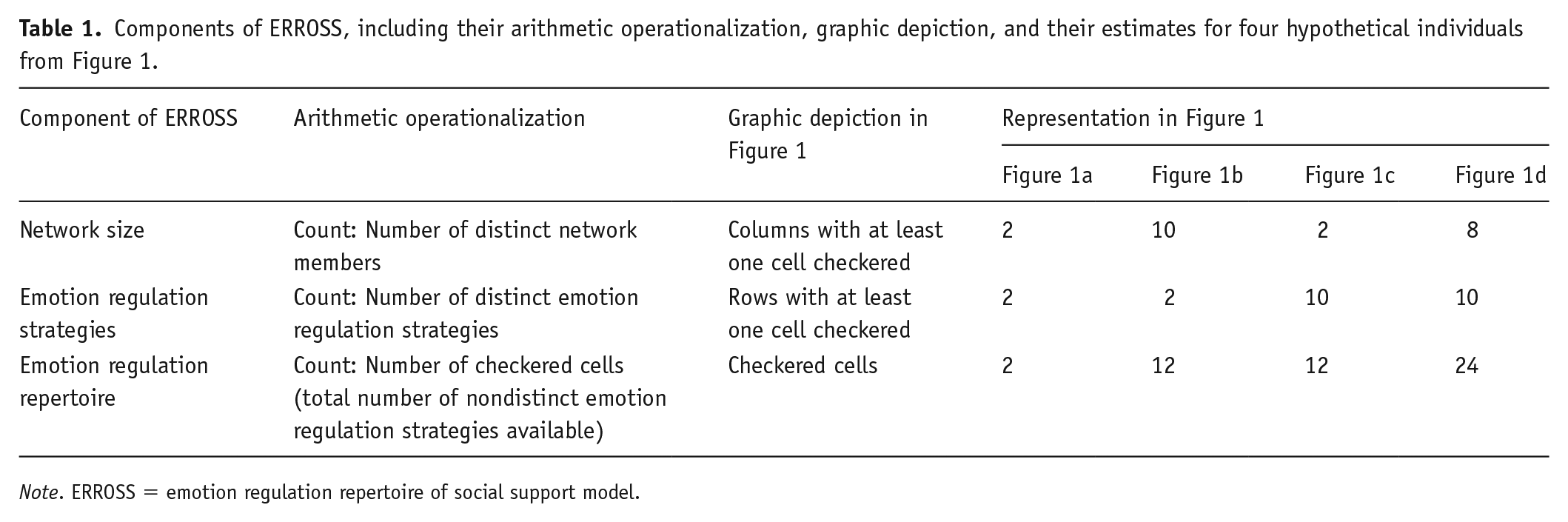
Note. ERROSS = emotion regulation repertoire of social support model.
Emotion regulation strategies
Within ERROSS, emotion regulation strategies are defined as the number of unique strategies or behavioral acts/efforts provided by at least one network member aimed at modulating an individual’s frequency, experience, and expression of emotion. ERROSS posits that different friends and family members provide a range of particular strategies that help to manage one’s feelings. The strategies afforded by others are quite diverse, and include strategies such as providing encouragement, making the other person laugh, or problem-solving. Of note, the strategies depicted in Figure 1 are meant to serve as examples of the potential universe of behaviors that can be employed in the service of emotion regulation (Koole, 2009). Even though we list different strategies in Figure 1, please keep in mind that emotion regulation strategies refer to the number of distinct strategies, not the type of strategies. In Figure 1, emotion regulation strategies are graphically depicted as the number of rows with at least one checkered cell (i.e., the number of strategies provided by at least one person). In our example, individuals depicted in Figures 1a and 1b have access to two emotion regulation strategies. Individuals depicted in Figures 1c and 1d have access to 10 different emotion regulation strategies.
Emotion regulation repertoire
The third variable, emotion regulation repertoire, represents the total number of strategies available to a person from all members of their social network. Compared to emotion regulation strategies, repertoire comprises nondistinct strategies offered by more than one network member (some strategies may be offered by more than one member; for example, two different friends may use advice as a strategy). In Figure 1, repertoire is graphically depicted as the number of checkered cells. Therefore, the person in 1a shows a small repertoire (n checkered cells = 2), 1b and 1c are medium and exactly the same size (n checkered cells = 12), and 1d is large (n checkered cells = 24). The ERROSS model’s conceptualization of repertoire extends existing definitions of emotion regulation repertoire in psychological adjustment (Aldao et al., 2014; Aldao & Nolen-Hoeksema, 2013; Bonanno & Burton, 2013; Gross, 2015a) to encompass interpersonal processes. Other frameworks have generally used the term repertoire to indicate the number of strategies that one individual has and is able to use in service of regulating emotions. For the present approach, we use the term repertoire to refer to the extent to which individuals have a broad range of IER strategies and network members available that can readily be adapted to different contextual demands and opportunities. In this sense, our relationships with others provide us with a regulatory toolkit or pool we can choose from in times of need. Despite intraindividual variability in emotion regulation provided by others, ERROSS assumes that individuals have a set of relationship partners they interact with on a regular basis (their main support clique), and who tend to provide a set of emotion regulation strategies to help a person manage their feelings. Thus, ERROSS assumes interindividual differences in network size, emotion regulation strategies, and repertoire, and suggests typological repertoire constellations: as illustrated in Figure 1, a person may have only few others they feel close to, and these network members may only provide a few strategies (a small repertoire; see Figure 1a). Alternatively, someone with many social contacts may receive a lower level of regulatory support if the majority of their network provides few or overlapping strategies (a medium repertoire; see Figure 1b). However, a medium repertoire could also be the consequence of having relatively fewer social contacts, but each of those contacts offering a wide variety of different strategies (see Figure 1c). The largest repertoire would come from individuals who are part of a large social network in which friends and family provide many different strategies (a large repertoire; see Figure 1d).
This integration of network structure and IER is different from existing frameworks that typically view psychological adjustment as a function of either structural support or IER. ERROSS, in contrast, takes the combined effect of network size and emotion regulation strategies into account by conceptualizing repertoire.
Main Assumptions
Building on existing research from the social support and emotion regulation literature cited before, ERROSS postulates specific hypotheses regarding the mental health associations of network size, emotion regulation strategies, and repertoire. Whereas assumptions regarding network size and emotion regulation strategies will only be discussed briefly, we will focus on repertoire due to its novelty and since this variable is at the heart of our model.
At its core, ERROSS suggests that effective socioemotional support operates through the availability of various emotion regulation strategies provided by network member(s), resulting in a repertoire of strategies the support seeker can draw on. Repertoire, the conglomerate of total network size and total number of emotion regulation strategies afforded, is assumed to predict good mental health, such that individuals with a larger repertoire should report higher well-being compared to individuals with a smaller repertoire (main effect). This assumption follows from Bonanno and Burton’s (2013) regulatory flexibility model which suggests that the use of any one strategy is less important than the ability to vary one’s response across different stressors that call for different strategies (Burton et al., 2012; Levy-Gigi et al., 2016). In the interpersonal context, access to various emotion regulation strategies across different network members should promote context-sensitive responding by allowing individuals to have choices for the best-fitting strategies through multiple relationship members.
Furthermore, we hypothesize that people will have greater well-being if an individual’s network offers a variety of loved ones, or a variety of different IER strategies (main effects). Building on the general positive relationship between network size and health (Hansen et al., 2017; Holt-Lunstad et al., 2015), larger networks are not only positively associated with perceptions of support, but they also increase the likelihood of actual support. Similarly, different strategies provide an array of emotion regulation strategies to draw from, and enhance the likelihood that at least one of the strategies will meet the regulatory need, which is adaptive for individuals’ adjustment to life stressors (Orcutt et al., 2014). Even though this relationship has only been shown for intrapersonal emotion regulation, it is plausible that the same is true in an interpersonal context. To summarize, ERROSS proposes that network size, emotion regulation strategies, and repertoire function as predictors of individuals’ well-being via main effects, with greater benefits posited for those with access to larger networks, different strategies, and greater repertoire.
So far, ERROSS has been described primarily as the global perception of social networks and the IER provided by their network members. The model, however, can also be applied to individuals’ actual social exchanges. We posit that the ERROSS model’s main assumptions would hold for both perceptions and actual social exchanges, but that pathways may differ for the proposed relationships. As such, perceptions of a large network, different emotion regulation strategies, and a large repertoire may exert their effect through increasing overall levels of perceived support. On the other hand, actual access to emotionally supportive others may impact well-being through increasing an individual’s coping resources, such as promoting intrapersonal emotion regulation and context-sensitive responding, or decreasing efforts associated with intrapersonal emotion regulation. In addition, larger effects are expected for individuals’ perceptions versus actual social exchanges, given past research that has consistently documented positive associations between perceived support and well-being (Kawachi & Berkman, 2001; McDowell & Serovich, 2007; Reinhardt et al., 2006), whereas actual support interactions frequently fail to yield positive outcomes (Bolger et al., 2000; McDowell & Serovich, 2007; Shrout et al., 2006).
Functional equivalence
The added benefit of conceptualizing repertoire as the combination of network size and emotion regulation strategies becomes most apparent when considering the low ends of the spectrums (i.e., few network members or low number of strategies). Person 1b and Person 1c represent special cases insofar as their repertoire is equally sized but made up of different constellations of network size and emotion regulation strategies (i.e., large network with few strategies; small network with many strategies). We propose, in this theory, functional equivalence between network members and regulation strategies. In other words, we propose that both variables are equally influential in predicting well-being, which is an empirical question that remains to be tested. Thus, in Figure 1, Individuals 1b and 1c should do equally well based on their equal repertoire size, given that network size and strategies are weighted equally in the model. This conceptualization, therefore, may explain why a small network could lead to reasonably good well-being. Conceptualizing network size and emotion regulation strategies as interchangeable is a unique component of the model, and it is useful in explaining why both a large network with few strategies and many strategies from a small network might obtain the same psychological benefits. Measuring the two components separately (and not assuming functional equivalence) would not clearly demonstrate that a small network may still provide many strategies (Figure 1c). Repertoire is a unique measure of social support in that it captures both social support aspects; thus, in linear modeling, a one-unit increase in repertoire (as a predictor variable) comprises either an increase in the size of one’s network or an additional emotion regulation strategy—not distinguishing between the two. The ERROSS model’s variables enable a comparison of different support constellations. The conceptualization of ERROSS is empirically testable; nevertheless, we acknowledge that differential weighting of network size and strategies is also plausible.
For simplicity in explaining the model, we further assume that all network members and emotion regulation strategies are created equal. Nevertheless, we acknowledge that individuals often rely more heavily on certain relationship partners and strategies compared to others, which implies a differential weighting of network members and emotion regulation strategies. For instance, romantic partners commonly constitute a main source of emotional support for individuals (Gurung et al., 2003), and close social ties (e.g., family or friends) are more likely to provide affect-improving strategies compared to loose ties (Niven, Macdonald, & Holman, 2012). In terms of emotion regulation strategies, Nils and Rimé (2012) documented differential consequences of cognitive versus behavioral strategies targeted towards improving the affect of a friend or intimate following an emotional video sequence. In their study, cognitive improving strategies promoted targets’ emotional recovery, whereas behavioral/socioaffective improving strategies were associated with more positive social consequences such as greater feelings of emotional proximity and reduced loneliness. A similar finding was reported by Levy-Gigi and Shamay-Tsoory (2017), who showed that cognitive empathy from a partner reduced distress more effectively than emotional empathy or intrapersonal emotion regulation. In addition, some strategies (e.g., cobrooding; Horn & Maercker, 2016) or social exchanges are associated with adverse health outcomes, even if intended to be supportive (Rook, 2001; Zee & Bolger, 2019), implying that the effects should be inversed. Despite this preliminary evidence, we do not yet know enough to hypothesize how relational contexts affect IER, whether some network members or IER strategies are more important or effective than others, and whether network members and strategies contribute less to overall adjustment as they increase in number (i.e., diminishing returns; decreased importance of strategies and network members with each additional row or column in Figure 1). While we encourage future empirical tests and refinements of the model to take the type of network member and type of strategy into account (e.g., attachment figures may be weighted more heavily in the model), the assumed equivalence of network members and strategies results in a model with falsifiable hypotheses for its foundation.
ERROSS: Individual Differences and Contextual Factors
The extent to which emotion regulation afforded by others is associated with mental health benefits likely depends on complex situational and individual features. Although our model is an attempt to focus on the predictive power of emotion regulation repertoire, in the following, we highlight selected situational factors and individual differences that may moderate or mediate the mental health associations of the ERROSS model’s variables.
For example, provision of emotion regulation may come at a relational cost, varying by situation and the person providing the regulation strategies. Network members may not always be willing to provide IER. Drawing on the same few people for IER (i.e., few columns and many rows in Figure 1) may exhaust the few network members, which we refer to as overburdening. Network members may also not want to provide IER because of unmet expectations of reciprocity, whereby they feel that they have provided more than they have received in return. In this sense, some level of redundancy of network members or IER strategies in one’s repertoire may prevent overburdening and buffer against temporal unavailability of network members. For example, Individual 1b has perfect redundancy of IER strategies (i.e., each strategy is offered by more than one network member), whereas 1a and 1c have less redundancy built in their repertoire and thus a higher chance of overburdening their relationship partners. Preliminary evidence by Cheung et al. (2015) suggests that individuals’ well-being is maximized if they diversify their emotion regulation needs across different relationship partners rather than concentrating all needs on the same few network members.
On the other hand, someone who has a wider network may accumulate more costs, suffering from what we call overhead. Relying on many different social network members requires more time, possibly more shame from imposing on multiple people, and more obligations for reciprocal support, among other costs. How individuals optimally arrange and utilize their social networks for IER, and whether overhead and overburdening play a role is currently unknown, but testable in the ERROSS model. Empirical tests of the ERROSS model may be able to mathematically assess tipping points for overburdening and overhead, and include these as predictors of mental health outcomes as well.
Thus, similar to feedback processes described in existing models of emotion regulation (Bonanno & Burton, 2013; Gross, 2015b), the effectiveness of network members and strategies in regulating affect will vary. The person in need of emotion regulation must monitor whether additional efforts are necessary. These feedback processes, in turn, will inform future selection and application of network members and strategies. Failures, or costs, of IER could appear at any stage of the process. For example, people could make suboptimal choices of interaction partners, miscommunicate their emotional needs, or overburden network members. We must also consider the possibility that greater use of IER might indicate ineffectiveness. Seeking out more IER from a larger number of relationship partners might suggest that the initial IER attempt was not successful. By the same logic, low usage could reflect a highly effective support (or other interpersonal) process, whereby the person’s emotion regulation needs are met and they are able to adjust or feel better without needing to seek out more IER strategies and/or network members.
In an example of moderation, attachment style and use of IER resources may also impact perceptions of the supportiveness of one’s network as well as actual exchanges. Securely (vs. insecurely) attached individuals may not only report access to a larger repertoire, but these differences in perception may also translate into their actual support-seeking behavior and, in turn, affect their mental health.
Although access to a large repertoire should promote context-sensitive responding by allowing individuals to flexibly choose among the best-fitting strategies and relationship members, this requires not only the ability to identify and discriminate which network members are effective (vs. ineffective) at providing certain emotion regulation strategies, but also to selectively seek out network members. Research suggests that individuals differ on their tendency to rely on and their perceived efficacy of IER (Williams et al., 2018). Preliminary evidence suggests that individuals have an awareness of whom to turn to when experiencing specific emotions, and that people turn to these relationship partners when such an emotion is elicited (Cheung et al., 2015). If individuals lack such an awareness, a large repertoire should not be more beneficial than a small or medium-sized repertoire. Fortunately, perceived efficacy can be measured, and could be used as a moderating variable with empirical data.
Beyond individual differences, situational and contextual factors may also affect the ERROSS model. For instance, different sociodemographic and cultural groups may use and benefit from network size, emotion regulation strategies, and repertoire differently. According to the transactional model of stress and coping (Lazarus & Folkman, 1984), when the need for emotion regulation is high, it may be especially beneficial to rely on others for regulatory benefits. Thus, we present the example of bereavement to further explore the ERROSS model.
ERROSS Applied: The Example of Bereavement
Emotion Regulation and Social Support During Bereavement
Stressful situations such as a romantic break up, job loss, or the death of a loved one commonly provoke a range of intense emotions. One unique aspect of the death of a loved one is its irreversibility, reducing options for changing the stressor situation. Therefore, bereaved individuals need to regulate their heightened emotional intensity and reactivity (Horowitz et al., 1997; Shear et al., 2011). During this time, emotion regulation facilitates the critical task of adaptation: integrating the loss and adjusting to life without the deceased. However, not all bereaved individuals have the self-regulatory resources to manage this emotional turmoil. For example, research suggests greater adjustment problems for survivors who experience more difficulties regulating their emotions (Diminich & Bonanno, 2014; Gupta & Bonanno, 2011).
Bereavement is an example of a situation in which the ERROSS model is particularly useful. When emotional intensity is high and sources of self-regulation are diminished, social ties are particularly important. Research suggests that the lack of social support constitutes a risk factor in the development of clinical conditions such as prolonged grief disorder or complicated grief, and adjustment problems in general (Burke et al., 2010; van der Houwen et al., 2010).
Cognitive stress theory and other theories of social support (Cohen, 1988; Cohen & Wills, 1985; Lazarus & Folkman, 1984) suggest that living loved ones can provide compensatory coping resources, even given the difficulties that may result from losing someone close like a spouse (i.e., an attachment figure). In fact, treatment for complicated grief targets interpersonal functioning by holding a conjoint session with a close, supportive person from the viewpoint that responsive, empathic, and trustworthy relationships can promote emotion regulation and adaptation to the loss (Shear, 2010, 2012).
The Role of Network Size, Emotion Regulation Strategies, and Repertoire During Bereavement
The ERROSS model expands on these existing perspectives by proposing that close relationships can help survivors manage the heightened emotional reactivity and potential regulatory challenges associated with grief if they provide access to different regulatory strategies. In turn, a lack of social ties may contribute to the development and maintenance of disordered grief because of the absence of others who could help regulate the emotions of the bereaved. In terms of the ERROSS model’s components, we expect the following associations for individuals’ adjustment to loss.
Network size during bereavement
Building on the general positive association between network size and health (e.g., Holt-Lunstad et al., 2015), and network size and resilient adaptation from the bereavement literature (Baarsen & Broese van Groenou, 2001; Burke et al., 2010), large networks may be particularly beneficial as they increase perceptions and likelihood of support during a time characterized by emotion dysregulation and altered interpersonal functioning (Shear et al., 2011).
Emotion regulation strategies during bereavement
In addition, ERROSS postulates that survivors should benefit from a diverse set of emotion regulation strategies because different strategies enhance the likelihood that at least one of them will meet their regulatory need at a given moment. Research with bereaved and traumatized individuals shows that people with greater access to intrapersonal emotion regulation strategies experience resilient trajectories of stable, low traumatic stress following a mass shooting (Orcutt et al., 2014). A survivor of loss with access to many different strategies can choose from a pool of strategies the one(s) that seems most effective at regulating his various grief-related emotions (see Figures 1c and 1d).
Repertoire during bereavement
The opportunity to call up a friend to complain about an acquaintance’s maddeningly insensitive comment, but also to reach out to different people for distraction from one’s feelings of grief, should promote mental health according to ERROSS. A diverse repertoire that allows mourners to flexibly engage with their grief by choosing the best-fitting strategies and network members for a given situation should be particularly beneficial during bereavement when survivors experience a wide range of emotions and altered interpersonal functioning. In contrast, a repertoire derived from a network that focuses exclusively on confronting, or exclusively on avoiding grief-related emotions, may be less adaptive. This is congruent with the dual process model of grief, which proposes that successful adjustment to loss involves an oscillation between loss- and restoration-oriented stressors (M. Stroebe & Schut, 2010). Loss orientation refers to a person’s focus on aspects of the loss experience (e.g., creating a picture album of the deceased). Restoration orientation describes a person’s focus on secondary stressors (e.g., engaging in new hobbies without the deceased). According to the dual process model, survivors sometimes confront their loss and restoration stressors, and other times avoid them, thus resulting in an oscillating, regulatory process. Diverse strategies provided by different network members should support survivors in this oscillation, which is associated with beneficial bereavement outcomes (Caserta & Lund, 2007). Indeed, research suggests that emotional/grief disclosure alone is not always associated with beneficial outcomes (W. Stroebe et al., 2005). In addition, a large repertoire can buffer against unavailability of network members. It can limit emotional reliance on few network members, thereby preventing overburdening and decreasing the risk of burnout, since grief is not only distressing for the bereaved, but also for their family and friends (Shapiro, 2001).
ERROSS in spousal loss
Romantic partners commonly regulate each other’s emotional states, resulting in oscillating emotional patterns between partners that maintain emotional stability (Butler & Randall, 2013). The death of one’s romantic partner then constitutes a special case, as regulatory support previously provided by one’s main attachment is suddenly withdrawn, leaving the surviving spouse to adjust how to manage emotion regulation. This reorganization of emotion regulation needs is likely even more challenging for those with previous emotionally dependent relationships. For instance, men tend to rely on their romantic partners as the primary source of IER, whereas women generally distribute their needs across a greater number of network members (Armstrong & Kammrath, 2015; Gurung et al., 2003). This gender difference seems to be maintained during bereavement, with widows receiving more support from network members compared to widowers (Stelle & Uchida, 2004). Thus, due to greater emotional dependence and fewer opportunities for social support, the loss of a spouse may pose a particular challenge for bereaved men’s emotion regulation options. In our model, married men may have a repertoire constituted by few or many network members, with most strategies provided by one person, namely, their spouse. With the death of their spouse, their network becomes smaller and the available emotion regulation strategies diminish to a minimum, resulting in the scenarios of a small network with few strategies (Figure 1a) or a medium-sized but emotionally sparse network (Figure 1b). One testable hypothesis posits that widow(er)s who used to rely predominantly on their spouse for IER will experience greater adjustment problems when current network members cannot fill the regulatory void (i.e., current network members cannot replace IER strategies from the deceased).
We believe that a situation where the number of network members or IER strategies is zero is a special case that would predict particularly poor outcomes. Having zero network members and no access to IER is qualitatively different from having just one network member even if that one only provides a few strategies. An example of this scenario is a widower who used to rely solely on his spouse for IER, and is now left without any access to IER. Berkman et al. (1992) compared the effects of having zero, one, and two or more sources of emotional support on patients’ mortality risk following myocardial infarction. Patients who had no source of emotional support had twice the risk of dying within 6 months after their first infarction compared to individuals who relied on two or more relationship partners for emotional support provision.
To summarize, we believe that bereavement represents a unique context in which increased emotional intensity and frequency as well as diminished self-regulation capacity challenge survivors’ ability to self-regulate. The transition to widowhood highlights the importance of combining network size and emotion regulation provided by network members, and accounting for interindividual differences in IER previously provided by romantic partners. Bereavement exemplifies the role of situational and individual aspects that impact individuals’ social emotion regulation. According to ERROSS, a diverse repertoire of emotion regulation strategies provided by different network members will promote regulatory flexibility and thus adjustment, but various mediators and moderators will also influence that association.
Testing ERROSS
In its simplest version, the ERROSS model can be tested cross-sectionally with individuals identifying network members, emotion regulation strategies provided by each network member, and psychosocial outcomes. To allow for the computation of ERROSS model parameters (i.e., network size, strategies, and repertoire), it is important to use “personalized” measures such as the Social Network Index (SNI; Cohen et al., 1997), where respondents indicate the name of network members across different relationship categories (e.g., romantic partner, family, coworkers, etc.), and then choose from a checklist of emotion regulation strategies which ones are associated with each network partner (e.g., Emily – comforts, reassures). Which network members and emotion regulation strategies to include in such a checklist is both a theoretical and an empirical question, and should be informed by the research question and study context at hand. For instance, based on researchers’ definition of network members, the SNI may be adapted to include the specific relationship categories of interest. Due to the lack of consensus or taxonomy on (interpersonal) emotion regulation strategies (Koole, 2009), we suggest starting with a broad range of potential strategies covering real-life examples of affect regulation strategies drawing on existing measures, frameworks, and qualitative pilot data (e.g., strategies used by Hofmann et al., 2016; Niven et al., 2011; Williams et al., 2018). An empirically informed checklist can then be derived from subsequent statistical analyses such as factor analysis. Providing network members with a checklist and relationship categories rather than open-text responses can reduce measurement error associated with poor recall, and thus improve reliability. To increase face validity, participants should further have the option to indicate additional strategies not listed. Various psychosocial outcomes are possible and not limited to mental or physical well-being, such as symptoms of depression and anxiety, self-esteem, quality of life, relationship quality, or grief symptoms.
Cross-sectional designs can also be extended to (intensive) longitudinal or intervention designs. The ERROSS model lends itself to an experience sampling approach allowing the researcher to track the individuals’ daily social exchanges. While cross-sectional tests of ERROSS restrict researchers to assess respondents’ mental representations or perceived global support, momentary reports of social interactions allow to capture individuals’ actual daily network size and emotion regulation obtained. Daily (dyadic) life approaches can also be used to test the directionality of effects by assessing whether social exchanges truly enhance individuals’ well-being, or whether well-being contributes to an individual’s ability to develop and utilize a more diverse repertoire of IER (e.g., analysis of lagged-day and longitudinal associations). These approaches can further be used to investigate the effectiveness of IER attempts, to examine different patterns of network usage, and to help identify contextual or intraindividual factors associated with social exchanges (e.g., individual differences in self-esteem; Armstrong & Kammrath, 2015). Cross-sectional and experience sampling approaches would nicely complement each other and offer interesting insights such as whether individuals’ perceptions differ from their day-to-day support, or whether perceptions are a better predictor of individuals’ well-being compared to actual social exchanges. For instance, individuals may not interact with network members listed in the cross-sectional survey, or the listed network members may not be the ones who provide emotion regulation. Furthermore, research consistently documents that people have higher well-being when they perceive that support is available to them (Kawachi & Berkman, 2001; McDowell & Serovich, 2007; Reinhardt et al., 2006), whereas actual support interactions are not always associated with benefits (Bolger et al., 2000; McDowell & Serovich, 2007; Shrout et al., 2006).
Day-level data can also inform whether high usage of IER might actually indicate ineffectiveness. Having to seek out more IER, and possibly from a larger number of relationship partners, might suggest that the initial attempt at IER was not successful. This can be assessed by whether IER is in spurts across days, with many contacts in a short time. By the same logic, low use of IER could reflect a highly effective support (or other interpersonal) process, whereby the person’s emotion regulation needs are met and they are able to adjust or feel better without needing to seek out more IER strategies and/or network members. An additional question asking whether the participant felt that the experience of IER was effective at modulating their emotional experience would help to shed light on effectiveness of the contacts.
Intensive longitudinal data from dyads and experimental designs pose yet another possibility to test aspects of the model. For example, such designs would enable researchers to assess whether individuals’ current utilization patterns run the risk of overburdening network members, or whether there is more overhead associated with the number of network members, with limited benefits in the diversity of strategies available. Laboratory tasks of reaction time could help clarify whether individuals automatically associate network members with emotion regulation strategies, or whether these associations are conscious. Overall, we believe that the main hypotheses proposed by ERROSS can be used to test various research questions, in particular if different study designs are being employed.
Contributions of ERROSS
The proposed ERROSS model extends existing literature in two main ways. First, ERROSS expands the concept of repertoire and thereby offers a novel theoretical way to conceptualize this so far predominantly intrapersonal construct. Second, ERROSS offers an operational way to assess repertoire by proposing a computational model with empirically testable concepts and hypotheses.
Over the last decade, research on emotion regulation has seen remarkable developments. Challenging the view that some regulation strategies are inherently superior compared to others, emotion theorists have shown that individuals’ well-being and adaptation to stressors depend less on the use of one regulatory process and more on the ability to flexibly regulate emotions based on current situational demands (Bonanno et al., 2004; Gupta & Bonanno, 2011; Westphal et al., 2010). In their regulatory flexibility framework, Bonanno and Burton (2013) distinguish three sequential components of flexibility. One of them is described as repertoire, an individual’s availability of a diverse pool of regulatory strategies. The ERROSS model expands on this repertoire component. Rather than defining repertoire as only individuals’ ability to utilize a wide range of intrapersonal regulatory strategies, ERROSS posits the existence of an interpersonal repertoire to describe individuals’ access to various emotion regulation strategies afforded by others. In this sense, others are serving as a repertoire that might accommodate divergent contextual demands and opportunities.
Beyond its theoretical novelty, ERROSS offers a computational way to empirically test whether mental health is a function of network size, emotion regulation strategies, or their combination (emotion regulation repertoire). Distinct from existing frameworks, repertoire captures both an individual’s network size and their available emotion regulation strategies; thus, in linear modeling, a one-unit increase in repertoire comprises either an increase in network size or an additional emotion regulation strategy—not distinguishing between the two. This unique conceptualization as a conglomerate rather than separate entities is theoretically convincing based on individuals’ experience of the real world. The ERROSS model sheds new light on the current inconsistencies in the literature that suggest that large and therefore seemingly beneficial network structures are not always related to benefits, whereas small and therefore ostensibly inadequate network compositions sometimes turn out to be effective. Furthermore, our arithmetic approach has advantage in its simplicity. The computational framework also sets the stage for experimental studies testing the possibility that interventions which alter key aspects of social networks (e.g., network size, pool of IER strategies) lead to better health. Beyond its core assumption, ERROSS considers interindividual differences and contextual factors which can add predictive power and advance its testing. By acknowledging plausible functional aspects of support that may impact support utilization and its health associations, we lay the foundation for future refinements of the ERROSS model.
Conclusion
Individuals have different ways of modulating their emotions, including intrapersonal and interpersonal approaches, or a combination of both. When others are used to regain self-regulatory control, large networks are often considered superior, while little attention has been paid to the actual emotion regulation strategies provided by others. In the present article, we present a computational model to test whether well-being is a function of network size, emotion regulation strategies, or their combination (i.e., repertoire). The model extends existing frameworks by suggesting that friends and family can promote well-being when they offer a repertoire of diverse emotion regulation strategies that the individual can choose from. In addition, the unique conceptualization of repertoire as a conglomerate of network size and emotion regulation strategies enables a test of different network constellations and their associations with health outcomes. The present article focused primarily on bereavement as an example of how ERROSS might be applied. Beyond the bereavement context, ERROSS can inform our understanding of IER processes for individuals’ general health as well as in other domains that feature emotion dysregulation and disrupted interpersonal functioning (e.g., divorce, life transitions, psychological disorders).
