



Abstract
Empathy is a construct that is notoriously difficult to define. Murphy and colleagues (2022) argue for leaning into the construct's inherent fuzziness and reverting to what they term a classical definition informed by the observations of philosophers and clinicians: as a dynamic, “unfolding process of imaginatively experiencing the subjective consciousness of another person, sensing, understanding, and structuring the world as if one were that person.” Although consistent with some historical conceptualizations, this definition risks incorporating so many processes it would make empathy difficult to operationalize or distinguish from any generally socially sensitive interaction. Defining empathy instead as the attempted representation, or simulation, of another's subjective internal experiences (whether sensory, affective, or cognitive) would increase its clarity and empirical utility.
If scholars who study empathy agree on one thing, it is that what “empathy” means is hard to pin down (Hall & Schwartz, 2019).
The constructs most commonly described as empathy usually include some form of self-other matching (often termed emotional empathy), perspective-taking (often called cognitive empathy), and care (often called empathic concern or compassion) (Hall & Schwartz, 2019; Lamm, Rütgen, & Wagner, 2019; Zaki, 2017).
The difficulty with referring to any of these three phenomena as “empathy” is that they are not identical. They do not reliably co-occur (Oliver, Neufeld, Dziobek, & Mitchell, 2016; Shamay-Tsoory, Aharon-Peretz, & Perry, 2009). They can be dissociated using self-report measures or physiological correlates, and by their relative impairment in clinical populations (see Marsh, 2018). For example, strokes that affect temporal lobe structures like the anterior insula impair emotional empathy but not empathic concern, whereas the reverse is true when strokes affect the striatum (Shdo, et al., 2018). And whereas people with psychopathy are defined by their limited empathic concern, they often show typical cognitive empathy as well as typical emotional empathy for some emotions, like disgust (Jones, Happé, Gilbert, Burnett, & Viding, 2010).
This may explain what Murphy and colleagues (2022) describe as the recent shift away from referring to any of these phenomena as simply “empathy” and toward the use of more specific terms. Many may view this as progress. Scientific advancement entails, among other things, the ongoing development of new frameworks that allow causal explanations to be more reliably tested (National Research Council, 2007). Because more precise constructs can be more precisely measured, they are more useful for making testable predictions. Thus, for example, the psychological term “neurosis”, which broadly refers to symptoms related to depression, anxiety, obsessiveness, and hypochondria has fallen into disuse in favor of more specific terms for mood, anxiety, and stress-related phenomena.
In light of widespread agreement that the term “empathy” is not currently well-defined, there are several ways usage of the term could evolve. In their review, Murphy and colleagues argue for leaning into the inherent fuzziness of the construct of empathy, and reverting to what they term the classical definition, one informed by decades of observations by philosophers and clinicians: as a dynamic, “unfolding process of imaginatively experiencing the subjective consciousness of another person, sensing, understanding, and structuring the world as if one were that person.”
This approach benefits from consistency with some historical conceptualizations, a major advantage if it could facilitate further progress in understanding empathy. But it is not clear it would do so. The main reason is that, as Murphy and colleagues acknowledge, emphasizing the dynamic, unfolding nature of empathy makes it “extremely difficult to operationalize” (p. 34) or measure. And a concept that cannot be measured cannot be empirically studied.
Focusing on dynamic, unfolding qualities does highlight the inherent complexity of socially sensitive interactions marked by affect sharing, perspective-taking, and interpersonal care. There is no doubt that such interactions are dynamic and complex, and that capturing these complexities is important for fully understanding socially sensitive interactions. Indeed, among the most exciting recent advances in contemporary social and affective psychology and neuroscience are technological and statistical approaches that increasingly permit highly complex interpersonal processes to be measured and predictions about them tested (Kelsen, Sumich, Kasabov, Liang, & Wang, 2020; Wohltjen & Wheatley, 2021; Xie et al., 2020).
But it is debatable whether defining empathy so as to leave it all but indistinguishable from any generally socially sensitive interaction will further contribute to progress. Murphy and colleagues incorporate such varied phenomena as observation, imagination, inferential reasoning, and emotional sensing/experiencing into their dynamic, unfolding definition of empathy. This approach risks muddying distinctions among these phenomena, leaving us no better off in terms of understanding either the dynamics of empathy or the dynamics that drive sensitive interactions.
However, the remainder of Murphy and colleagues’ definition of empathy as “imaginatively experiencing the subjective consciousness of another person, sensing, understanding, and structuring the world as if one were that person,” beautifully captures a definable, measurable event in human psychology: the attempted representation, or simulation, of another's subjective internal experiences, whether sensory (e.g., pain), affective (e.g., fear), or cognitive (e.g., belief).
This definition captures the isomorphic nature of empathy, but not in a restricted way. Arguably, it is exactly how “empathy” should be defined.
The reasons are several. First, defining empathy as the attempted representation or simulation of another's subjective internal experiences is conceptually clear and can be reliably measured using multiple methods, thanks to the increasingly interdisciplinary nature of empathy research—itself a marker of progress (National Research Council, 2007). It is probably not a coincidence that empathy is increasingly defined in terms of shared representations now that functional neuroimaging research has demonstrated that experiencing, observing, and imagining states like pain and fear recruit similar patterns of activation in overlapping networks of brain areas (Lamm, Rütgen, & Wagner, 2019; Marsh, 2018). Converging sources of evidence support that these activation patterns reflect attempted simulation (Rütgen et al., 2021; Chen, 2018)—which, as a bonus, can be measured using common approaches across the lifespan, across clinical populations, across cultures, and even across species. As a result, empathy researchers are no longer confined to relying on self-report measures, a limitation that long hampered empirical empathy research (Cottrell, 1950). These developments also underscore that the construct of empathy should not be equated with the self-awareness of empathy that is measured by self-report scales. This is especially true when neural indices of empathic simulation show greater predictive validity than self-report measures (Brethel-Haurwitz et al., 2018).
Second, and relatedly, defining empathy as attempted simulation distinguishes it from other phenomena that are distinct from but causally related to it. Empathic simulation of another's internal state has many potential downstream consequences, including accurately interpreting the other's state, engaging in behavioral synchrony, and experiencing interpersonal care (Figure 1). Although sometimes referred to as “empathy”, interpersonal care is distinct from empathic simulation, and better understanding their reciprocal relationship requires distinguishing between them (Marsh, 2018). Simulation and full-blown emotional contagion should also be distinguished. Murphy and colleagues’ concern about “restricted isomorphic matching” definitions of empathy may reflect the (very common) conflation of simulation with full-blown contagion (Hall & Schwartz, 2019)—for example, that isomorphic matching entails that empathy occurs only if an observer panics in response to another's panic, or becomes angry in response to their anger. But simulation and contagion are not identical (Lamm, 2019). One of many lines of evidence is that highly altruistic populations who experience very low levels of empathic distress (contagion) nonetheless show heightened empathic simulation of others’ pain and fear (Brethel-Haurwitz et al., 2018; Marsh, Stoycos, Brethel-Haurwitz, Robinson, & Cardinale, 2014; O’Connell et al., 2019). Full-blown emotional contagion—up to and including feeling murderous rage in response to another's murderous rage—is one potential downstream consequence of empathy, particularly when the self-other boundary is porous, and so can signify that empathy has occurred. But I concur with Murphy and colleagues, Hall and Schwartz (2019), and others, that it does not in itself constitute empathy. The frequent conflation of empathy with full-blown contagion may reflect a historical reliance on self-report measures (e.g., asking someone how fearful they feel in response to another's fear), answers to which should be interpreted as measuring the contagion that may result from empathy, not empathy itself.
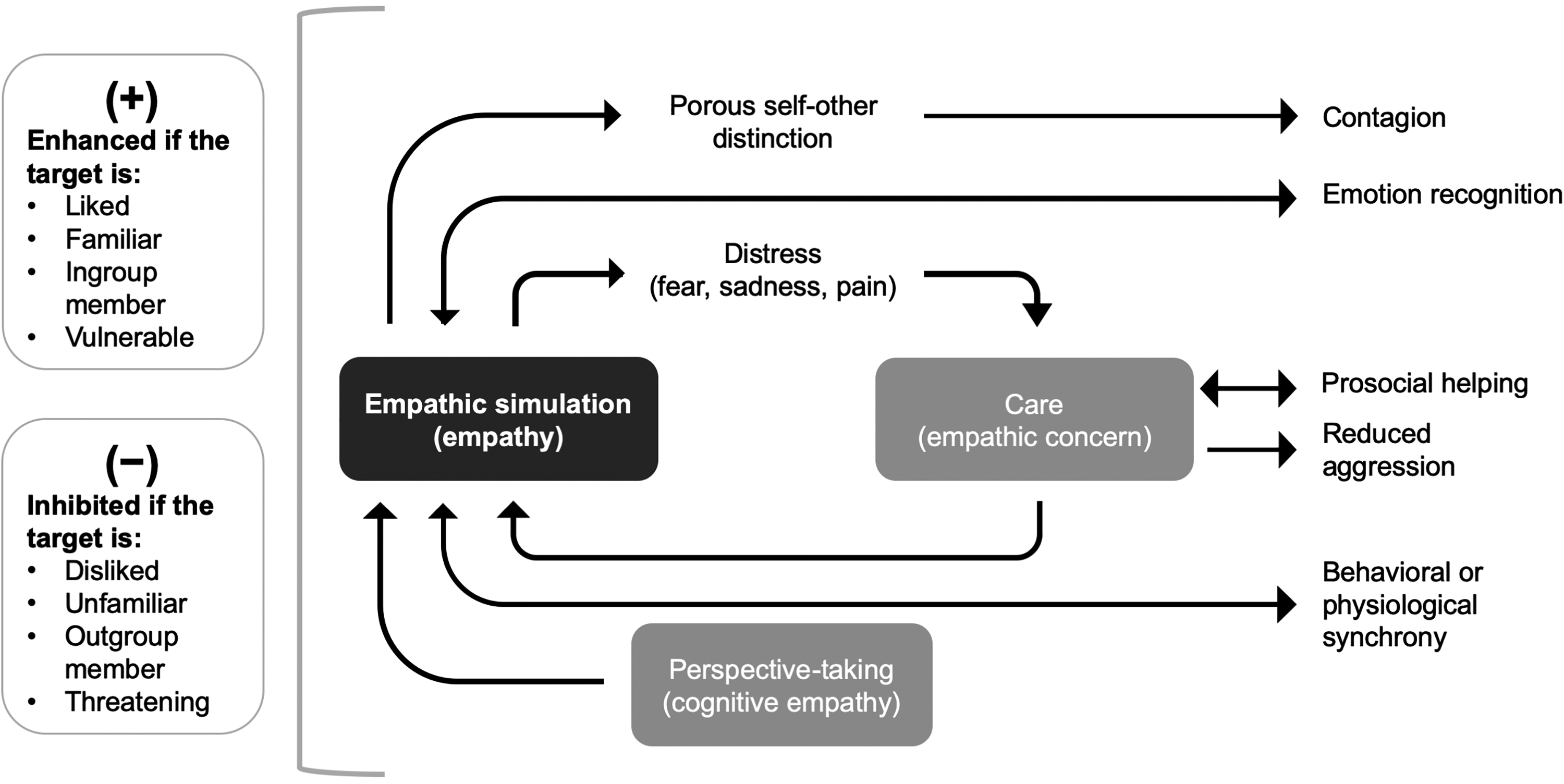
Distinguishing empathy (defined as empathic simulation) from its promoters, inhibitors, and causally related outcomes. Note: Evidence suggestions empathic simulation is distinct from but reciprocally related to emotion recognition, empathic concern (which occurs in response to empathic simulation of distress-related states like fear, sadness, or pain), and behavioral and physiological synchrony. It can result in emotional contagion when the self-other distinction is porous. It can be enhanced by effortful perspective-taking. The relationship between empathy and prosocial helping and inhibition of aggression is mediated by empathy's effects on empathic concern. Finally, empathy can be enhanced when a target is liked, familiar, an in-group member, and/or vulnerable (e.g., a child); it can be inhibited when a target is disliked, unfamiliar, an outgroup member, and/or threatening.
Third, defining empathy as attempted simulation clarifies many core features of empathy, including how it can occur in the absence of directly perceived nonverbal cues (which simulation does not require); that it can occur either automatically or effortfully (to the degree mentalizing or “perspective-taking” is defined as a conscious effort to simulate another's state, it should be seen as means to attaining empathy (Lamm, 2019)); that it occurs more readily in response to socially familiar or similar others (whose internal states are easier to simulate); and that is frequently inaccurate (since simulation need not reflect directly “catching” another's state, but only the effort to internally represent it) (Eyal, Steffel, & Epley, 2018).
Finally, this definition comes closest to how most people already define empathy (Hall, Schwartz, & Duong, 2021). Why fight it, given there isn’t another obvious word for this important phenomenon?
Contemporary empathy researchers owe a tremendous debt of gratitude to scholars from the twentieth century and earlier for their foundational wisdom and insights. But we enjoy empirical tools and evidence that our forebears did not, and our theories and terminologies have naturally shifted to reflect them. There remains, however, enormous inconsistency and imprecision in how empathy and related constructs are defined and measured across disciplines and research groups—a state of affairs that we all agree must be rectified.
Arguably, there has never been a more important time to do so than the present era, when social polarization is rising and interpersonal trust is falling. Muddy definitions of empathy too often cause it to be used to mean, “whatever it is I don’t like about someone.” Someone was tactless? Said something you didn’t want to hear? Made you upset? They must lack empathy. If empathy is whatever occurs during socially sensitive interactions, this claim becomes hard to dispute. And if empathy is also whatever callous people lack (which, when imprecise definitions are used, could also be true) it becomes easy to conclude every interaction marked by insensitivity or a failure of understanding reflects the other person's callousness or poor character.
But defining empathy more narrowly as an attempted simulation of another's mental state reframes many of the insensitive interactions that are unavoidable parts of daily life. Accurately representing others’ subjectively experienced states is hard, and even well-meaning people often get it wrong, despite our best efforts (Eyal, Steffel, & Epley, 2018). One reason is that simulation requires leveraging our own experiences to understand others. The more different or unfamiliar the other, the harder it is to do this successfully. Thus, failures of empathy often simply mean more information, time, and/or effort is needed to bridge the gap between minds, rather than that the observer is fundamentally uncaring, insensitive, unimaginative, or unobservant. Researchers seeking to define, measure, and understand empathy should not imply otherwise.
Footnotes
Declaration of Conflicting Interests
The author(s) declared no potential conflicts of interest with respect to the research, authorship, and/or publication of this article.
Funding
The author(s) received no financial support for the research, authorship, and/or publication of this article.
