



Abstract
Disgust seems to play an important role in moral judgment. However, it is unclear whether the role of disgust in moral judgment is limited to certain kinds of moral domains (versus many) and/or certain types of disgust (versus many). To clarify these questions, we conducted a multilevel meta-analysis (k = 512; N = 72,443) on relations between trait disgust sensitivity and moral judgment (disgust-immorality association). Main analyses revealed a significant overall mean disgust-immorality association (r = .23). Additionally, moderator analyses revealed significant specificity in disgust type and moral domain (grounded in Moral Foundations Theory): effects were stronger for (a) sexual disgust compared to pathogen disgust, (b) sanctity moral judgments compared to other domains of moral judgments, and (c) sexual-sanctity associations compared to other disgust type-moral domain pairings.
Building on a long philosophical tradition, the dominant view in the cognitive sciences is that emotions play an important role in moral judgment (Cushman et al., 2010; Haidt, 2001; Horberg et al., 2011; Nichols, 2002; Prinz, 2007). The body of evidence that has been marshalled in support of this general claim has predominantly focused on disgust, a withdrawal emotion evolved to defend against sources of disease (Landy & Goodwin, 2015; Oaten et al., 2009). Most notably, inductions of state disgust and individual differences in trait disgust have been shown to influence moral judgments (Eskine et al., 2011; Schnall et al., 2008; Wagemans et al., 2018). While these lines of research have helped us better understand the nature of the relationship between disgust and moral judgment, questions about the scope of this relationship remain unanswered. Specifically, there are conflicting accounts about whether the role of disgust in moral judgment is limited to certain kinds of moral transgressions (e.g., sanctity transgressions) (Horberg et al., 2009; Wagemans et al., 2018), or whether disgust is involved in many kinds of moral transgressions (e.g., harm transgressions) (Chapman & Anderson, 2014; Wheatley & Haidt, 2005). Moreover, it is unclear whether multiple or all types of disgust (e.g., pathogen disgust, sexual disgust) are implicated in moral judgments (e.g., van Leeuwen et al., 2017) or if only some are (e.g., Karinen & Chapman, 2019). Answers to these questions are consequential to adjudicating between accounts of the role of disgust, and indeed emotion more broadly, in moral cognition.
In the current meta-analysis, we investigate the relationship between trait disgust sensitivity and moral judgment (hereinafter the disgust-immorality association). This line of work has, to date, shown that greater disgust sensitivity is generally associated with harsher judgments of (at least some) moral violations (for review, see Chapman & Anderson, 2013). Further, this line of work has, relative to other approaches (e.g., incidental disgust; Pizarro et al., 2011), also paid close attention to delineating specific disgust type and moral domain effects and is therefore a suitable candidate for meta-analytically answering questions of specificity versus generality. To shed light on these questions, our meta-analysis specifically focuses on disgust type and moral domain (per the framework provided by Moral Foundations Theory; Graham et al., 2013) as moderators of the disgust-immorality association. Moreover, given much of the interest on the emotional roots of moral judgment has centered around disgust, the current synthesis will also shed light on questions about the broader role of intuition and emotion in moral judgment (Haidt, 2001).
Disgust and Disgust Sensitivity
There is broad agreement among theorists that disgust functions to facilitate disease avoidance (Curtis et al., 2011; Oaten et al., 2009; Rozin et al., 2008; Tybur et al., 2013). According to this perspective, the emotion disgust is elicited by disease-related cues (e.g., rotting flesh, vomit, blood, feces, urine, decaying foods, sores, etc.) and is accompanied by withdrawal and rejection behaviors from such stimuli. These behaviors include expulsion (e.g., spitting and vomiting), facial movements that guard the face, mouth, and eyes (e.g., wrinkled nose, lip retraction, and squinted eyes), and physical removal or distance from the situation (e.g., walking away) (for a comprehensive review see, Oaten et al., 2009). Phenomenologically, disgust is associated with feelings of nausea and retching (Levenson, 1992), as well as appraisals of weakness and dependence (Lee & Ellsworth, 2013). We use the term ‘canonical disgust’ to capture this suite of elicitors, appraisals, responses, and functions (others have used varied terms: core; Rozin et al., 2008, pathogen; Tybur et al., 2013, physical; Chapman & Anderson, 2013). Scholars view canonical disgust as the key component of a broader “behavioral immune system”, a suite of behavioral strategies geared towards avoiding infectious entities (Murray & Schaller, 2016; Schaller & Park, 2011).
Significant effort has been devoted to measuring disgust. Whilst some research has assessed disgust by focusing on, for example, facial movements, physiological reactivity, behavioral tasks, and digestive activity (for a review, see Armstrong et al., 2021), the vast majority of disgust research comes from examining responses to various self-report measures of disgust sensitivity, a trait-level construct that reflects stable between person variation in the propensity to experience disgust (Olatunji et al., 2007; Tybur et al., 2009). Disgust sensitivity can refer both to reaction intensity and reaction range: someone who is highly disgust sensitive may (a) given a fixed set of elicitors, experience disgust more intensely than someone who is less disgust sensitive, and/or (b) experience disgust (of a given intensity) to a wider range of elicitors than less disgust sensitive individuals. In practice, these two meanings of disgust sensitivity are often conflated in measurement, a point we will return to later. Importantly, however, research on disgust sensitivity has closely tracked theoretical developments in disgust that have begun to implicate disgust in domains other than disease avoidance.
Beyond Canonical Disgust
In recent decades, it has been proposed that cues other than obvious pathogen vectors can elicit disgust (e.g., moral violations, sexual deviance; Rozin et al., 2008; Tybur et al., 2013). Delineation of these categories of disgust elicitors has also led some to consider the possibility that disgust may serve a range of functions beyond disease avoidance, including (sexual) partner selection and the regulation of social and moral deviance (for a review, see Tybur et al., 2013). There are two major models for analyzing the domain structure and function of disgust and disgust sensitivity which are of relevance to the current meta-analysis: that grounded in the work of Rozin colleagues (2008) and extended by Olatunji and colleagues (2007) (hereinafter the Rozin, Haidt, and McCauley [RHM] account and the updated-RHM account, respectively); and that grounded in the work of Tybur and colleagues (hereinafter Tybur account) 1 .
RHM Account
For RHM and colleagues (Haidt et al., 1994; Rozin & Fallon, 1987; Rozin et al., 1994, 2008), disgust is elicited in response to four broad classes of stimuli: core elicitors (such as food, body products, animals), animal nature (or reminder) elicitors (such as sex, death, hygiene, body envelope violations), interpersonal elicitors (such as contact with strangers or ‘undesirables’), and moral elicitors (such as certain moral offences) (Rozin et al., 2008). RHM propose that core disgust originated as an elaboration of distaste, which was later co-opted to a range of elicitor classes beyond those directly associated with disease avoidance. When considering the emotions that these different elicitor classes generate, RHM seem to suggest that the experiential, physiological, and behavioral responses are consistent across classes and all serve broadly ‘protective’ functions, ranging from protecting the body from disease or infection (core disgust) to more abstract meanings: protecting the body, soul, and social order (for animal nature, interpersonal and moral disgust).
In an attempt to validate these classes of elicitors, Haidt et al. (1994) developed the Disgust Scale (D-Scale), a 32-item measure of individual differences in sensitivity to each disgust class. The D-Scale contains 16 items that specifically ask respondents to rate on a 3-point scale how disgusting they perceive certain stimuli to be, as well as 16 aversive true-false statements that do not specifically probe disgust per se (e.g., “it would bother me tremendously to touch a dead body”). Although the D-Scale recognizes numerous classes of elicitors theorized to cover the four-domain structure of disgust noted above, the empirically extracted subscales yield inadequate reliabilities, leaving it a rather poor measure of the domain specificity of disgust sensitivity (Haidt et al., 1994). Resultingly, the authors recommended that the D-Scale should be interpreted as a measure of general disgust sensitivity because it yielded good internal reliability when the classes were aggregated.
Updated RHM Account
Olatunji and colleagues (2007) developed a revised version of RHM's scheme (D-Scale-R) to address some of the above measurement issues. After item and factor analyses, the D-Scale-R retained 25 items (of the original 32) loading on to three factors: core, contamination, and animal reminder. Core disgust sensitivity includes items relating to rotting foods, waste products and small animals, and is claimed to assess offense taken at pathogen threats; contamination disgust sensitivity, captures aversion to potential sources of contact contamination, such as touching toilet seats and drinking from another person's cup; and lastly, the animal reminder disgust sensitivity domain taps into body envelope violations and references to death, and is thought to capture aversion to reminders of humans’ animal nature.
Numerous studies have replicated the factor structure of the D-Scale-R (e.g., Olatunji et al., 2009; van Overveld et al., 2011) and other work has attested to the unique predictive utility of the distinct disgust types. For example, the subscales have seen extensive use in the clinical domain: contamination disgust sensitivity is specifically related to obsessive compulsive concerns about sexual orientation (Ching et al., 2018), and animal reminder disgust sensitivity is specifically related to a variety of anxiety concerns (Olatunji et al., 2014), as well as blood-injury fears (Olatunji et al., 2008). There is also evidence of subscale specificity outside of the clinical domain. For instance, core disgust sensitivity has a special relation with prejudice towards homosexuals (Olatunji, 2008), whereas contamination disgust sensitivity has a special relation with prejudice towards immigrants (Aarøe et al., 2017).
Taken together, these various lines of research point to the utility in distinguishing between at least three types of disgust sensitivity: core, contamination, and animal reminder.
Despite the sound psychometric properties and unique predictive utility of these subscales, the RHM and updated RHM accounts and measures have been criticized on a number of fronts. First, there are considerable theoretical issues with animal reminder disgust. As Tybur et al. (2009) point out, it is not clear why disgust is suited to perform the function of avoiding existential thoughts, such as fear of death and recognition of our phylogenetic connection with non-human animals. Confirming these validity issues is recent research showing that (a) reminders of death and mutilation elicit an emotional experience that is more akin to empathic concern than disgust (Kupfer, 2018) and (b) human-animal similarities fail to even elicit disgust (Kollareth & Russell, 2017). Second, neither the D-Scale (aggregates items across different elicitor classes) nor the revised version (excludes the sexual and moral elicitor classes) adequately captures the sexual and moral elicitors of disgust, and therefore do not allow for exploration of these two types of disgust. Third, the D-Scale-R potentially introduces some redundancy since both the core and contamination subscales might be interpreted as an index of pathogen avoidance (Tybur et al., 2018). Fourth, that both instruments ask for responses to a variety of negative states (e.g., “bothered”, “upset”) and not exclusively reports of “disgust”, has led some scholars to suggest the D-Scale and D-Scale-R might better be characterized as measures of general negative affect rather than disgust (Cusimano et al., 2018). In sum, these limitations raise important concerns about the construct validity of the D-Scale and D-Scale-R and potentially undermine the interpretability of their associations with other psychological constructs.
Tybur Account
To address some of the conceptual and methodological issues in RHM's accounts and measures, Tybur and colleagues (2009, 2013) developed an alternative account which posits three domains of disgust: pathogen, sexual, and moral. On this view, domains are distinguished not only by elicitors and ultimate functions but also by (somewhat) different sets of psychological, physiological, and behavioral responses (Tybur et al., 2009, 2013). Accordingly, different domains may indeed reflect different emotions (at least to some degree) rather than different manifestations of the same emotion.
Pathogen disgust evolved to foster avoidance of contact with infectious disease-causing agents. It is triggered by cues such as bodily products, animals, poor hygiene, decomposing organic matter, and in this way, pathogen disgust overlaps with at least two of the three updated RHM domains (core and contamination). The pathogen disgust response is akin to the canonical disgust response discussed above.
Sexual disgust evolved to foster avoidance of contact with people who jeopardize reproductive fitness. It is triggered by cues indicative of low mate value (e.g., promiscuous partners) and is somewhat characterized by the canonical disgust response, although the information processing architecture subserving this adaptation is attuned to cues of sexual value and motivates avoidance of sexual contact (rather than contact per se).
Moral disgust evolved to communicate and coordinate condemnation of rule violators and is triggered by rule violations (especially those violations that are likely to be condemned by others, such as lying, cheating, and stealing). The moral disgust response is not theorized to resemble canonical disgust, but rather consists of signaling behaviors designed to regulate and coordinate condemnation (e.g., facial and vocal expressions of disgust).
The Three Domain Disgust Scale (TDDS; Tybur et al., 2009) was developed to assess individual differences in sensitivity to these types of disgust. Factor analyses from the original and subsequent replication studies demonstrate support for a three-factor model (DeBruine et al., 2010; Tybur et al., 2009, 2011). Moreover, there is evidence of the unique predictive validity of the subscales, and thereby differences between disgust types. For instance, research examining contamination fears in obsessive-compulsive disorder patients has found that pathogen disgust sensitivity specifically predicts fear of contact contamination, whereas sexual disgust sensitivity specifically predicts fear of mental contamination (Poli et al., 2019). More evidence of subscale specificity comes from outside of the clinical domain: on the one hand sexual disgust sensitivity is uniquely related to moral condemnation of recreational drugs (Kurzban et al., 2010), and on the other hand pathogen disgust sensitivity is uniquely related to women's preferences for masculine men (DeBruine et al., 2010; Jones et al., 2013).
Tybur's account and measurement are also not without limitations. Primary among them is that ‘moral disgust’ may be better thought of as rhetorical concept that actually resembles the characteristic signatures of anger instead of disgust (for more elaboration, see Nabi, 2002), a criticism that has garnered a fair amount of empirical support in recent years (Gutierrez et al., 2012; Kollareth & Russell, 2019; Royzman et al., 2014). This has implications for interpreting correlations between moral disgust and other variables: if moral disgust is a (closer) proxy for anger, then it may be anger that is doing the explanatory work rather than disgust per se.
The criticisms of both approaches notwithstanding, updated RHM and Tybur models (and measurements) suggest that it may be worth distinguishing between kinds of disgust (at least in terms of elicitor classes). One of the key foci of this meta-analysis is to assess the extent to which the specific measures of disgust sensitivity discussed above (and the subscales thereof) are related to moral judgment (see Method for more detail), and hence whether the role of disgust (in particular disgust sensitivity) in moral judgment is best characterized as a general effect (manifest across disgust types) or one that is more specific (particular to one or few disgust types).
Disgust in Moral Psychology
Over recent decades, moral judgment has come to be seen as being based in or caused by emotions (e.g., Greene et al., 2004; Haidt, 2001, 2007; Nichols, 2002; Prinz, 2007). Much work on the emotional causes of moral judgment has relied on disgust to empirically test its claims (for a review, see Landy & Goodwin, 2015). Some of the strongest evidence for the notion that disgust drives moral judgments comes from studies that experimentally manipulate disgust using inductions that are unrelated – i.e., incidental – to a moral judgment task. These studies show that incidental disgust inductions – such as noxious odors, bitter tastes, or canonically disgusting video clips – makes wrongness ratings of subsequent moral transgressions harsher than they otherwise would be (e.g., Eskine et al., 2011; Schnall et al., 2008; Ugazio et al., 2012). These effects are explained by people misattributing disgust from incidental sources for their feelings towards the behaviors they are being asked to judge (Haidt, 2001; Schnall et al., 2008). However, the more recent research on this topic has not corroborated these earlier findings. Large-scale replications of original studies (Ghelfi et al., 2019; Johnson et al., 2016), highly powered new studies (Białek et al., 2021; Jylkkä et al., 2021; Sanyal et al., 2021), and even a meta-analysis (Landy & Goodwin, 2015) all point to there being either a null or trivially small effect of incidental disgust manipulations on moral judgment.
This tenuous connection between incidental disgust and moral judgment, however, does not mean that disgust and moral judgment are unrelated. Research examining individual differences in disgust sensitivity has established that disgust sensitivity is positively associated with increased condemnation of (at least some) moral violations (e.g., Wagemans et al., 2018). Although correlational, this work is consistent with the possibility that (a) disgust is integrally involved in moral judgment (rather than or in addition to incidentally) and (b) multiple types of disgust might be involved in moral judgment (rather than or in addition to canonical disgust). For these reasons, exploring the boundary conditions of disgust sensitivity and moral judgment effects is likely to provide insights into the relationship between disgust and morality regardless of whether incidental disgust manifests effects on moral judgments. We will review each of these points, (a) and (b), in turn.
First, research on disgust sensitivity is agnostic about whether any causal role of disgust in moral judgment is played by disgust that is incidental or integral (elaborated below) to moral judgment. One possibility is that those high on disgust sensitivity are more prone to experience incidental disgust or to misattribute it (or both). An alternative possibility is that disgust sensitivity reflects greater tendencies to experience integral disgust. Integral emotions are those that are related or intrinsic to a stimulus under processing (Damasio, 1994; Lerner & Keltner, 2000; Schwarz & Clore, 2007). On an integral disgust account of moral judgment effects, for disgust to impact moral judgment, the emotion needs to be directly related to the moral stimulus under processing (Horberg et al., 2009, 2011; Wisneski & Skitka, 2017). Such accounts posit that integral emotions carry judgment relevant information (that incidental emotions do not). For example, feelings of canonical disgust triggered by seeing an individual defecate in public may signal that there is infection risk present and, in turn, generate moral condemnation of public defecation. Thus, disgust sensitivity may reflect greater tendencies to experience more intense integral disgust and/or integral disgust to a wider range of disgust elicitors.
Building on this idea, others have even argued that integral disgust can influence moral judgments without the accompanying arousal of disgust. As pointed out by Schaller (2014), disgust (and the behavioral immune system more broadly) produces proactive responses, which he defines as attitudinal and behavioral strategies that manage the latent threats of disease or suboptimal mate selection even when there is no evidence of such stimuli in the immediate environment. According to this view, felt disgust that is integral to an immoral action (e.g., public defection) at one point in time can facilitate moral judgments of that action at any future point in time in the absence of the concurrent arousal of disgust, a proactive response made possible by the potent effects of disgust on learning and memory (for a review, see Schaller, 2014). On such an account, trait disgust sensitivity may reflect chronic proactive responses to typically disgust-eliciting stimuli, rather than tendencies to experience incidental or integral disgust.
The results of the current meta-analysis cannot directly speak to which of the above accounts best reflects the proclivities captured by disgust sensitivity, but they will provide boundary conditions that any account of disgust sensitivity (be it grounded in incidental disgust, integral disgust and/or proactive tendencies) will have to accommodate.
Second, research on disgust sensitivity has paid closer attention to delineating the dimensionality of disgust (e.g., canonical disgust, sexual disgust) than has research on incidental disgust and can therefore help illuminate the different disgust-based motives underlying moral judgments (e.g., avoidance of pathogens, avoidance of promiscuity). For instance, a recent study found that sexual disgust sensitivity is a stronger correlate of some moral judgments than is canonical disgust sensitivity, suggesting that sexual disgust motives (e.g., promiscuity avoidance, incest avoidance, etc.) might be more proximately relevant to moral judgment than canonical disgust motives (i.e., pathogen avoidance) (e.g., van Leeuwen et al., 2017). By contrast the vast majority of incidental disgust studies and the handful of integral disgust studies have, to date, relied on canonical disgust elicitors as induction stimuli, thus limiting what can be said about the causal role of non-canonical disgust-based motives in moral judgment. The possibility remains that certain types of disgust (e.g., sexual disgust) unexamined in the experimental approaches to disgust (to date) may play a causal role in moral judgment.
In sum, recent work has cast doubt on the causal role of incidental disgust in moral judgment (e.g., Landy & Goodwin, 2015). However, limitations with this approach raises the possibility that (a) disgust might be integral to moral judgments (rather than merely incidental) and (b) certain non-canonical disgust types (e.g., sexual disgust) might influence moral judgment. These limitations are less evident in the correlational research on disgust sensitivity and moral judgment. This line of work not only offers the potential for studying the integral role of disgust in moral judgment, but it can also address questions of the specificity of disgust-immorality associations both as a function of disgust type and moral domain, and as a result potentially uncover relations between specific types of disgust and specific domains of moral concerns that might have been overlooked by the experimental approaches.
Disgust and Moral Domain Specificity Versus Generality
Accounts of disgust in the moral domain vary in their claims about the specificity of effects of disgust on moral judgment. They vary in at least two ways. First, they vary in whether they posit effects of disgust (of one type or another) to be limited to certain domains of morality (i.e., moral domain specificity versus generality). Second, they vary in whether they posit one or more kinds of disgust to influence moral judgment (i.e., disgust type specificity versus generality). Considering these sources of variation together, on the one hand, there are accounts of disgust-immorality associations which are general both in their claims about disgust type and moral domain. Most prominently, constructionist accounts of emotion and morality argue against specific emotions (and sub-classes of emotions) being tied to specific domains of moral judgment (e.g., Cameron et al., 2015), suggesting instead that emotions and morality are connected through more fundamental processes of affect and conceptual knowledge. This strict generality view predicts that all types of disgust should have (roughly) equally strong relationships with each domain of moral judgment, thus neither disgust type nor moral domain should moderate the disgust-immorality association. On the other hand, there are accounts that claim greater degrees of specificity. Modular theories of moral judgment, like Moral Foundations Theory (and the associated CAD triad hypothesis; Rozin et al., 1999), claim that canonical disgust should be uniquely or at least most strongly associated with the sanctity foundation, a moral domain based upon the adaptive challenge of avoiding communicable diseases. This strict specificity view predicts that disgust-immorality associations should be moderated by both disgust type (canonical) and moral domain (sanctity) (Graham et al., 2011, 2013). If one considers the empirical record, one also finds that while some studies are suggestive of more general accounts of disgust-immorality associations (e.g., van Leeuwen et al., 2017), others imply more specific associations (e.g., Horberg et al., 2009).
Moral Domain Specificity Versus Generality
Evidence of moral domain specificity is mixed. Some work suggests that disgust sensitivity (of one kind or another) is associated exclusively with violations of the moral foundation of sanctity or purity. In moral judgment research, measures of moral violations are commonly derived from Moral Foundations Theory (Graham et al., 2011, 2013), a theory which suggests the moral universe consists of a variety of moral foundations or domains which are aligned with fitness challenges across our evolutionary history and to which our moral intuitions are attuned. These domains are Care/Harm, Fairness/Cheating, Loyalty/Betrayal, Authority/Subversion, Sanctity/Degradation (aka Purity) (and Liberty/Oppression 2 ). Each foundation is characterized by specific adaptive challenges, triggers, characteristic virtues, and emotions. It is worth noting that there are other theoretical accounts of morality within the psychological literature that carve-up the moral universe quite differently. The theory of Morality as Cooperation, for instance, suggests that our sense of morality is grounded in a collection of biological and cultural solutions to the problems of cooperation and proposes seven distinct domains of cooperation which are considered morally relevant across cultural contexts (Curry et al., 2019). However, because the majority of disgust-immorality effects in the literature are derived from studies that use the Moral Foundations Theory taxonomy, the present analysis also follows the Moral Foundations Theory taxonomy (and unless otherwise specified, we take moral domains to reflect the domains of Moral Foundations Theory). As mentioned, because of shared evolutionary pressures, one's sensitivity to condemning sanctity moral violations should be closely linked to one's sensitivity to disgust; and there is empirical work consistent with this. Indeed, some studies have demonstrated a unique disgust-sanctity association (e.g., Horberg et al., 2009), whereas other highly powered studies (e.g., Wagemans et al., 2018) are suggestive of a less strict ‘primarily purity’ effect, in which disgust sensitivity is associated with condemnation of a variety of moral violations, but is most pronounced for the condemnation of sanctity moral violations (for similar findings see, Garvey & Ford, 2014; Olatunji et al., 2016; van Dijke et al., 2018; van Leeuwen et al., 2017).
By contrast, other work indicates disgust-immorality effects are more general, such that disgust sensitivity is associated with condemnation of violations in domains other than sanctity. Landy and Piazza (2019), for example, found that disgust sensitivity was associated with harsher moral judgments of harm and fairness transgressions. Similarly, Chapman and Anderson (2014) found that disgust sensitivity was associated with condemnation of harm transgressions even after controlling for potential confounds such as trait anger and social conservatism. The studies by the aforementioned authors, however, do not include sanctity violations to directly compare their disgust-immorality associations with, rendering their results inconclusive as to whether there any meaningful differences in the size of associations between moral domains. Further evidence in favor of moral domain generality can be found in a recent cross-cultural study in which van Leeuwen and colleagues (2017) showed that pathogen disgust is more strongly related to authority transgressions than sanctity transgressions.
Disgust Specificity Versus Generality
Extant work is also ambiguous about disgust-specificity. This ambiguity derives in part from a variety of methodological and measurement issues. First, some studies looking at disgust sensitivity and moral judgment ignore questions of disgust specificity altogether and use either ad hoc or truncated measures that pay no heed to disgust type (e.g., Horberg et al., 2009; Inbar et al., 2009; Schein et al., 2016). Second, some studies that do use validated measures with the potential to explore disgust-specificity do not report disgust type effects, and instead aggregate across elicitor classes (e.g., Garvey & Ford, 2014; Landy & Piazza, 2019; Wagemans et al., 2018).
The limited work that has explicitly considered different dimensions of disgust sensitivity yield results suggestive of some degree of disgust type specificity. For example, across several studies, Karinen and Chapman (2019) found that core disgust sensitivity (subscale of D-Scale-R) was more strongly associated with moral condemnation of harm transgressions than the other subscales in the D-Scale-R. Furthermore, using the TDDS, van Leeuwen and colleagues (2017) found that sexual disgust sensitivity was more strongly associated with moral condemnation of sanctity transgressions than was the pathogen disgust sensitivity subscale (for an analogous finding, see Kurzban et al., 2010).
In sum, extant work on disgust sensitivity and moral judgment is ambiguous about the role of moral domain as a moderator of the disgust-immorality effect and is at least indicative of the possibility that multiple types of disgust sensitivity are associated with moral judgments. In the current meta-analysis, we use the moderators disgust type and moral domain to clarify questions of specificity and generality in the disgust-immorality association, and to also articulate the pattern of disgust-immorality associations that future theorizing must consider.
Method
Literature Search
Articles were obtained by searching in PsycINFO, Google Scholar and Web of Science during March 2018 using the following search string: combination: (“disgust sensitivity” OR “trait disgust” OR “disgust scale*” OR “disgust propensity”) AND (“moral judgement*” OR “moral judgment*” [USA spelling] OR “moral violation*” OR “moral transgression*” OR “moral foundation*”). Theses and dissertations were retrieved via ProQuest using the same combinations of keywords.
Descendant (or forward) searches were conducted on key empirical articles (Chapman & Anderson, 2014; Horberg et al., 2009) using the PsycINFO “cited by” function. Ancestor (or backward) searches were performed by searching the reference lists of all the studies that met the inclusion criteria. In addition, we also searched the reference lists of several major narrative reviews on disgust and moral judgment (Cameron et al., 2015; Chapman & Anderson, 2013; Piazza et al., 2018; Russell & Giner-Sorolla, 2013). As depicted in Figure 1, these searches generated 1,072 unduplicated citations. Requests for unpublished literature were also sent to the electronic mailing lists of the Society of Social and Personality Psychology, and via direct email to authors of key published studies in the area.

Meta-analysis literature search flow diagram.
Study Eligibility
After initial article-level screening was conducted by scanning titles and abstracts, the following eligibility criteria were applied to the remaining studies within articles. A study was included if:
The study reported zero-order correlation(s) between measures of trait disgust sensitivity (and/or subscales thereof) and moral judgments (more detail below). Studies that reported partial associations (e.g., effects in multiple regressions or mediation contexts) were included if bi-variate correlations were also reported. In cases in which zero-order correlations were unreported, we contacted the authors by email to request them. The study used a self-report measure of trait disgust sensitivity. Typical measures of trait disgust sensitivity include the Disgust Scale (D-Scale; Haidt et al., 1994), Disgust Scale-Revised (D-Scale-R; Olatunji et al., 2007), and the Three Domain Disgust Scale (TDDS; Tybur et al., 2009). We also included studies that contained shortened versions of these instruments (e.g., Schein et al., 2016, study 1). Studies that used other, less common measures of trait disgust sensitivity were also eligible for inclusion (e.g., Izard's trait disgust scale [Izard et al., 1993] was used in, Steiger & Reyna, 2017). Studies that did not use self-report to assess disgust sensitivity were excluded (e.g., fMRI indices; Moll et al., 2005; Parkinson et al., 2011; or facial muscle activity; Cannon et al., 2011; Chapman et al., 2009). If a study included a trait disgust sensitivity measure and a manipulation of state disgust, it was included if the zero-order correlation between disgust sensitivity and moral judgments could be obtained (e.g., Olatunji et al., 2016). The study contained an explicit measure of moral judgment that involved the normative evaluation (on dimensions such as good, bad, right, wrong, permissible, impermissible, morally justifiable, morally unjustifiable) or punishment judgment (on dimension punishability) of at least one norm-violating third-party action. This criterion permitted inclusion of judgments of norm violations under the Moral Foundations Theory framework (norms pertaining to care, fairness, loyalty, authority, and sanctity). The emphasis on third-party actions led to the exclusion of studies assessing attitudes towards groups (e.g., Hodson & Costello, 2007) and social and political issues (e.g., Feinberg et al., 2014). Studies asking participants to rate the guiltiness and culpability of moral norm violators were excluded because they were deemed not to be a moral judgment per the above criteria (e.g., Jones & Fitness, 2008). Studies that incorporated implicit measures of evaluation were also excluded (e.g., Inbar et al., 2009, study 2), as were studies that used the same instrument to assess disgust sensitivity and moral judgments (e.g., Schein et al., 2016, study 3). Finally, many relevant studies operationalize moral judgments using Moral Foundations Questionnaire (Graham et al., 2011). Moral Foundations Questionnaire is comprised of relevance and judgment items for each domain. Although not an explicit measure of moral judgment (according to our criteria), given that relevance items are (a) strongly correlated with judgment items (Graham et al., 2011), and (b) typically combined with judgment items in research, we decided to treat the subscale totals as a measure of moral judgment. Thus, studies employing Moral Foundations Questionnaire were included in our analysis.
After applying these criteria, a final set of 512 effects, from 74 studies were retained for the meta-analysis (for the complete list of effects and studies, see the coding sheet [B1] and the reference list [C1] in the Online Supplemental Materials).
Coding of Study Characteristics and Substantive Moderators
Primary coding for study characteristics and moderators was performed by the lead author. Double coding was not performed on the grey literature sent to us (approximately 30% of the total effects) because codes were completed by other researchers in the coding template provided to them (moderator codes closely resembled those found in Table 1). Out of the remaining eligible effects to be coded, 78% were independently double coded by Warren and Azaad. Interrater reliabilities were calculated using Cohen's kappa for categorical moderators and Pearson's r for continuous moderators. All reliabilities were in an acceptable range (0.83–1; M = .96). Disagreements were resolved through discussion. A summary of how these variables were coded is presented in Table 1. The coding details for the key substantive moderators, relating to disgust sensitivity type and moral domain, are discussed in detail below.
Coding scheme for moderators

Note. *General community refers to non-Mturk, non-student, and non-YourMorals based samples (see endnote iii for treatment of YourMorals data); **USA = United states of America, EU = European Union, UK = United Kingdom; ***other refers to non-validated measures of disgust sensitivity (e.g., ad hoc measures); coded moderators were determined by the studies available to us. Only moderator codes with four or more effects (stemming from different samples) were retained for analyses.
Disgust Sensitivity Measure
To test specificity versus generality of disgust type effects on moral judgment, we used disgust sensitivity measure as an imperfect proxy for disgust type. Subscale codes for the TDDS (TDDS-pathogen, TDDS-sexual, and TDDS-moral) and D-Scale-R (Core, Animal reminder, Contamination) are face valid and can be read as proxies for the related constructs (notwithstanding the critiques outlined in the Introduction and returned to in the Discussion). As noted, it is rather common in research on disgust sensitivity and moral judgment to use aggregated D-Scale and D-Scale-R, despite both containing subscales. Although this is warranted in the case of the D-Scale (given poor subscale reliabilities), it is less so for D-Scale-R (given good subscale reliabilities). Regardless, mapping these aggregate scales onto clear constructs is problematic. Considering the validity issues discussed earlier with respect to the animal reminder and moral elicitor classes, it's not clear how to interpret the aggregated D-Scale (combines elicitors from core, animal reminder, interpersonal and moral classes) and the aggregated D-Scale-R (combines elicitors from core, animal reminder and contagion classes). These ambiguities notwithstanding, we code the aggregate scales as imperfect proxies and elaborate on ambiguities of interpretation in the Discussion.
Moral Domain
To test between hypotheses about the specificity versus generality of the domain of moral judgment on the disgust-immorality association, we coded moral domain. As mentioned earlier, our coding scheme for moral domain followed Moral Foundations Theory which offers a comprehensive taxonomy for classifying moral violations based on content and also is the central theory in accounting for disgust-immorality effects (Graham et al., 2013). Most studies explicitly referred to the domain of moral judgment: Care, Fairness, Authority, Loyalty, Sanctity. For studies that did not provide labels, we placed them into one of the five categories. There was no ambiguity about which moral domain the violations fell into (inter-rater agreement = 1.00).
Effect Size Estimation, Transformation, and Combination
Pearson's correlation coefficient (r) was the focal statistic for meta-analytic procedures; all effects in the meta-analysis were scored such that positive correlations indicated that higher disgust sensitivity corresponded to higher ratings of moral wrongness. The majority of effects were reported in this way, except for two studies that reported the effect in terms of group mean differences in moral wrongness as a function of a categorical disgust sensitivity variable (Chapman & Anderson, 2014; Nichols, 2002). For these studies, the mean difference was converted into a Pearson correlation by first transforming effect sizes into d's (standardized mean differences) from t statistics, and then from d to r using the appropriate formulas outlined in Lipsey and Wilson (2001). For unpublished reports, authors either sent (a) raw data necessary to compute the correlations or (b) information and correlations in a coding template provided to them.
Following the formulas outlined in Lipsey and Wilson (2001), all coded effects were transformed into a Fisher's z coefficient and weighted by N–3 (inverse variance). This procedure addresses problems with standard error formulation for r (Lipsey & Wilson, 2001). All meta-analytic computations were performed on the transformed z values, and then converted back to r for presentation.
Meta-Analytic Procedure
Sample-level dependency in our dataset was substantial; we obtained 512 effects from 74 samples. This is because it is common for different types of disgust and different domains of moral judgment to be measured in the same samples. Given that our dataset contained substantial sample-based dependence among effects, we conducted a multilevel meta-analysis (with three-levels) to model this dependency, so that we could minimize data loss typical of the more common methods of ensuring independence among effects (e.g., aggregation, selection, shifting units).
In our meta-analytic dataset, each sample (indexed by subscript j) may yield multiple effects (indexed by subscript i) (we use notation from, Cheung, 2014). To deal with this dependency, we adopted a multilevel analysis strategy that takes into account (a) sampling variance at Level 1, (b) within-sample variance at Level 2, and (c) between-sample variance at Level 3. More specifically, the model, without moderators is:
Each error term,
Using this approach, we began by estimating the overall effect size, in the context of the above-specified model, and also the within and between sample variances as indicators of heterogeneity. We tested the significance of these heterogeneity components and the proportion of the total variance between observed effects accounted for by variance at each level (I2). Given that variability in observed effects was not due merely to sampling variance (see below), we followed these initial analyses with moderator analyses in which categorical or continuous moderators were added to the above model. We also considered publication bias using three strategies: inspection of funnel plots, Egger's test (Egger et al., 1997), and moderation by publication status. All analyses used Restricted Maximum Likelihood estimation and were implemented using the metafor package for R (Viechtbauer, 2010).
Results
Overall Effect and Heterogeneity
The first goal of the current meta-analysis was to obtain an overall weighted-mean correlation for the disgust-immorality association. Two effects were more than three standard deviations from the unweighted mean effect size. However, neither of these were influential cases (Cook's d's = .08, .11). As such, all 512 effects (from a total of 72,443 participants
3
) were used in the analyses. To estimate the overall mean effect, we first fit a three-level model to our data, which yielded a mean effect size of r = .23, SE = .01, t = 19.1, p < .001, 95% CI = [.20, .25]
4
. We conducted likelihood ratio tests comparing models with and without respective variance components and found significant variance between effects within samples, Var (
For comparison purposes, we fitted a two-level model (a traditional random effects model) based on sample-level aggregated effects, which yielded highly similar results, r = .22, SE = .01, z = 18.77, p < .001, 95% CI = [.20, .24]. Further, the two-level model indicated that there was significant heterogeneity in the set of aggregated effects, Q(74) = 204.12, p < .001, I2 = 71.55%.
Publication Bias
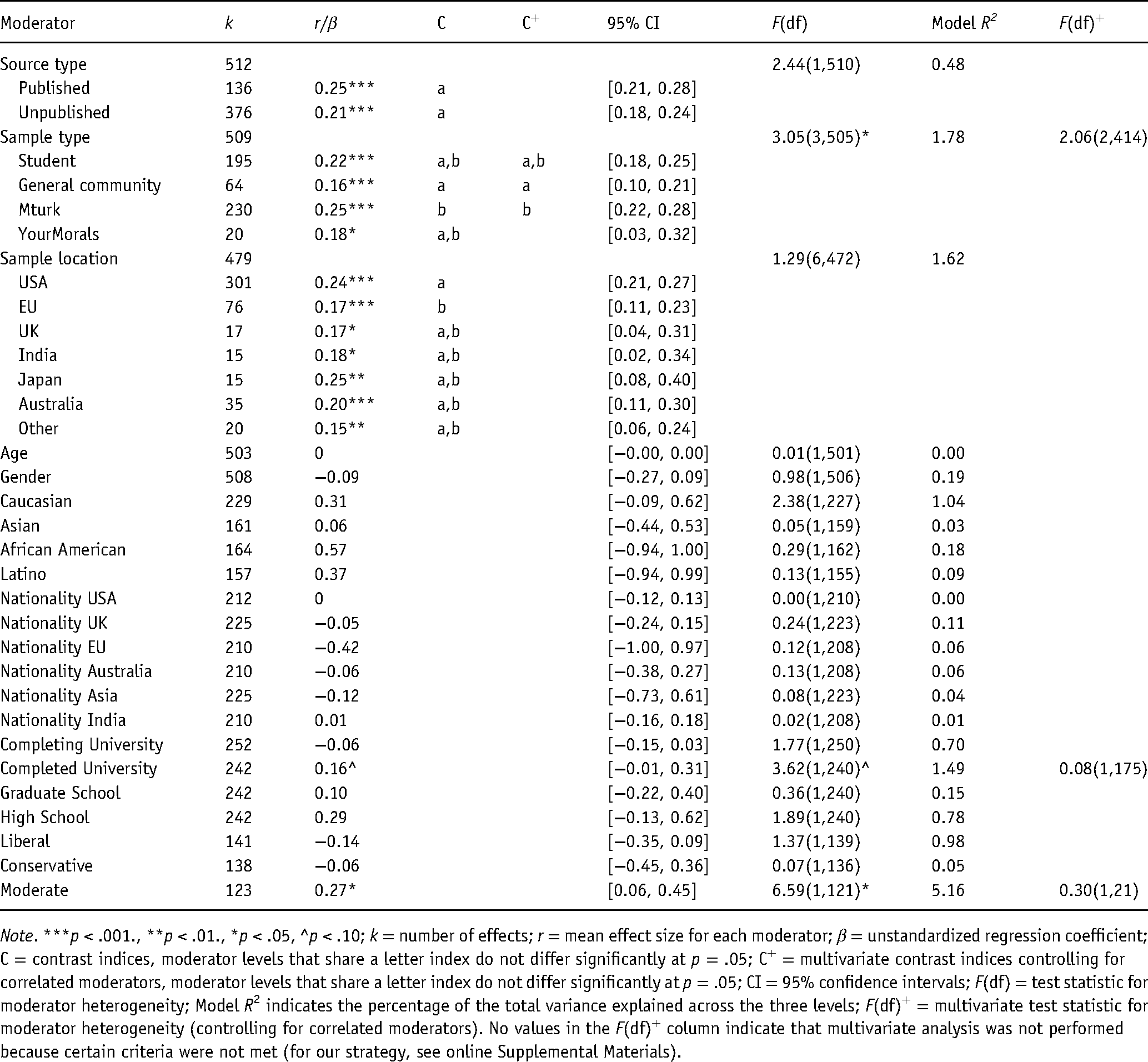
We used multiple methods to assess publication bias. Visual inspection of a funnel plot did not reveal the obvious asymmetry indicative of publication bias (Figure 2). Consistent with this, the Egger regression method (Egger et al., 1997), did not indicate publication bias, F(1, 134) = .07, p = .79. Additionally, source type did not moderate disgust-immorality associations; that is, effect sizes did not differ between published and unpublished effects, F(1, 510) = 2.44, p = .12 (see Table 2 for further detail). Thus, the results detailed here are unlikely to be affected by publication bias.

Funnel plot of standard error and effect size (Fisher's Z) of published effects.
Source and sample moderators
Note. ***p < .001., **p < .01., *p < .05, ^p < .10; k = number of effects; r = mean effect size for each moderator; β = unstandardized regression coefficient; C = contrast indices, moderator levels that share a letter index do not differ significantly at p = .05; C+ = multivariate contrast indices controlling for correlated moderators, moderator levels that share a letter index do not differ significantly at p = .05; CI = 95% confidence intervals; F(df) = test statistic for moderator heterogeneity; Model R2 indicates the percentage of the total variance explained across the three levels; F(df)+ = multivariate test statistic for moderator heterogeneity (controlling for correlated moderators). No values in the F(df)+ column indicate that multivariate analysis was not performed because certain criteria were not met (for our strategy, see online Supplemental Materials).
Moderator Analyses
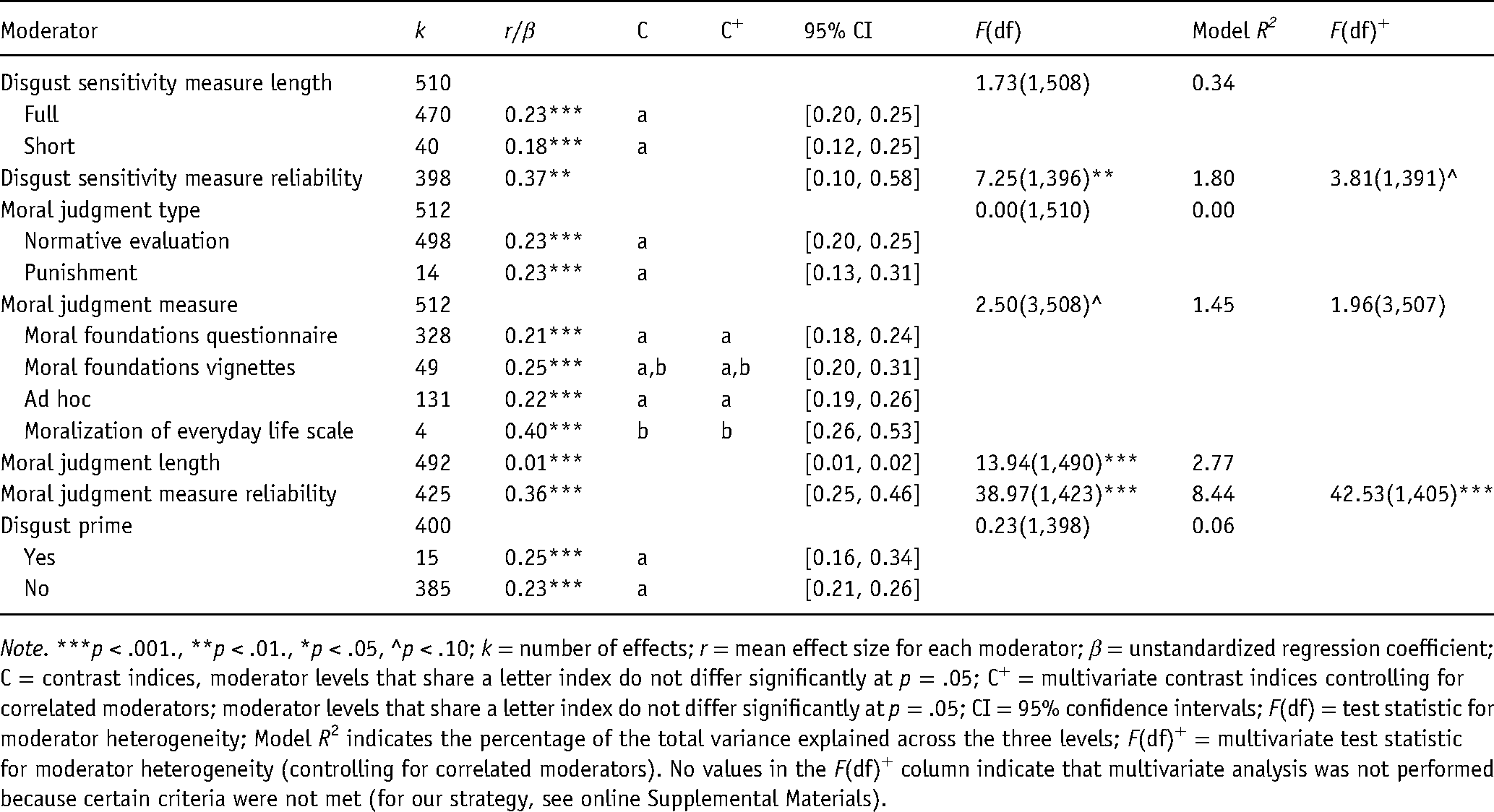
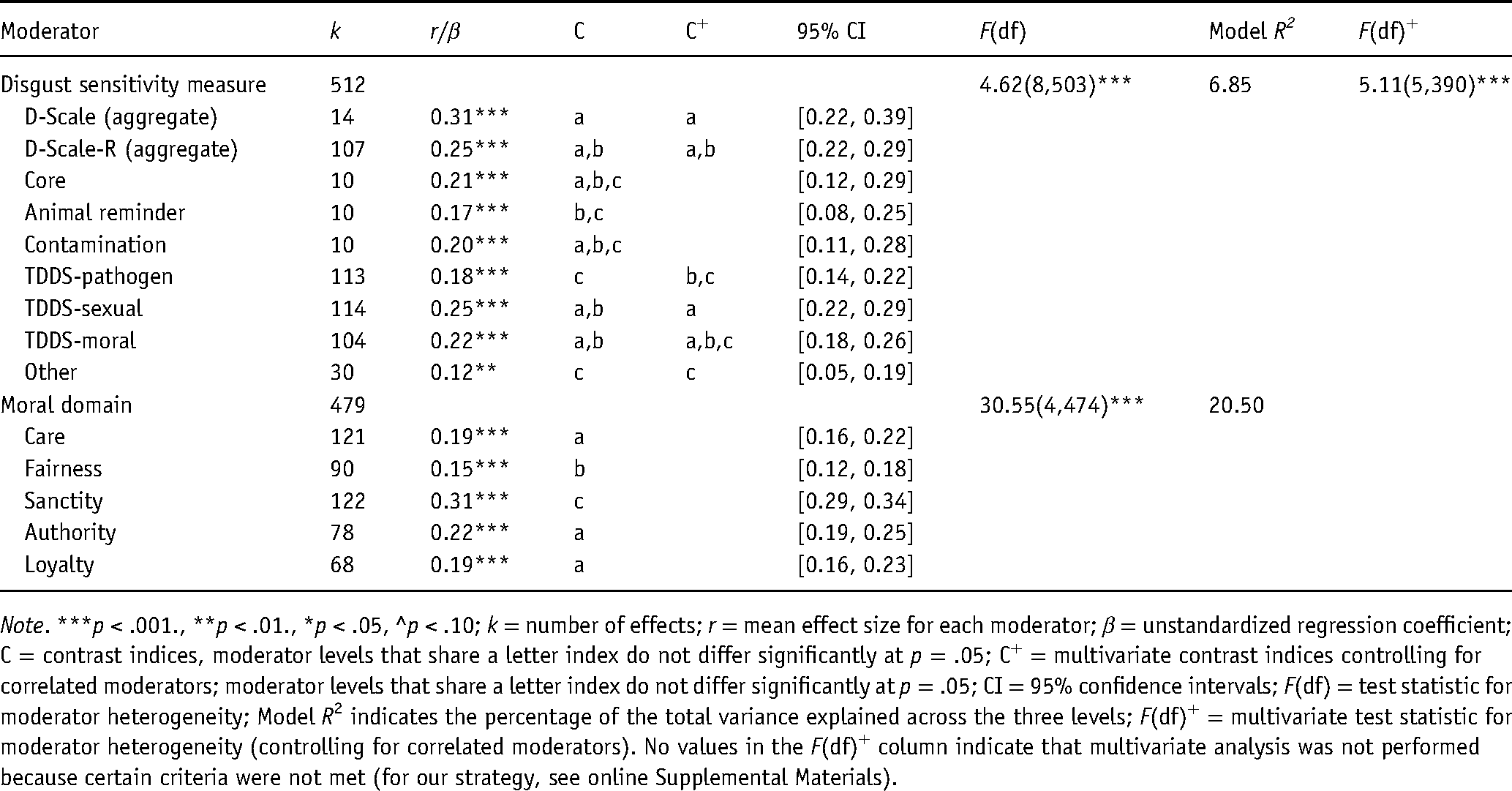
Moderators for this meta-analysis can be considered to belong to three broad categories: (a) source and sample (Table 2), (b) method and design (Table 3), and (c) those of more substantive theoretical interest (Table 4). To ensure moderator analyses were sufficiently powered to support meaningful inferences, any moderator categories comprised of fewer than four (between-sample) effects were not included in the analyses. For continuous moderators, standardized univariate coefficients are reported; for categorical moderators, correlation estimates for each level of the moderator are reported, as are pairwise comparisons between moderator levels.
Method and design moderators
Note. ***p < .001., **p < .01., *p < .05, ^p < .10; k = number of effects; r = mean effect size for each moderator; β = unstandardized regression coefficient; C = contrast indices, moderator levels that share a letter index do not differ significantly at p = .05; C+ = multivariate contrast indices controlling for correlated moderators; moderator levels that share a letter index do not differ significantly at p = .05; CI = 95% confidence intervals; F(df) = test statistic for moderator heterogeneity; Model R2 indicates the percentage of the total variance explained across the three levels; F(df)+ = multivariate test statistic for moderator heterogeneity (controlling for correlated moderators). No values in the F(df)+ column indicate that multivariate analysis was not performed because certain criteria were not met (for our strategy, see online Supplemental Materials).
Substantive moderators
Note. ***p < .001., **p < .01., *p < .05, ^p < .10; k = number of effects; r = mean effect size for each moderator; β = unstandardized regression coefficient; C = contrast indices, moderator levels that share a letter index do not differ significantly at p = .05; C+ = multivariate contrast indices controlling for correlated moderators; moderator levels that share a letter index do not differ significantly at p = .05; CI = 95% confidence intervals; F(df) = test statistic for moderator heterogeneity; Model R2 indicates the percentage of the total variance explained across the three levels; F(df)+ = multivariate test statistic for moderator heterogeneity (controlling for correlated moderators). No values in the F(df)+ column indicate that multivariate analysis was not performed because certain criteria were not met (for our strategy, see online Supplemental Materials).
We also ran additional analyses to address potential confounds among moderators. This was achieved by first investigating the associations between moderators, using Pearson's r for continuous variables, Cramer's V for categorical variables, and multiple R (unsquared) for continuous-categorical variable associations (see Tables A1–A3 in the Online Supplemental Materials), and then running a series multivariate analyses on significant moderators to control for substantially correlated moderators (see Online Supplemental Materials for multivariate models [A4-A10] and details about our strategy for conducting these multivariate analyses). We report the multivariate moderator results along with the univariate results in Tables 2–4. Specifically, column F(df)+ and C+ refers to moderator heterogeneity and contrast indices, respectively, after controlling for correlated moderators. Where possible, we interpret moderation effects and pairwise differences from multivariate models rather than univariate models. We note that the direction of the effects for different levels of categorical moderators are the same in both univariate and multivariate analyses (for more details, see Tables A4–A10 in the Online Supplemental Materials).
Source and Sample Moderators
As can be seen in Table 2, all sample types yielded significant effects. Despite this, pairwise comparisons showed that Mturk samples (from which the majority of effects came) produced larger effects than did general community samples. However, after accounting for correlated moderators, multivariate analyses indicated that sample type was not a significant moderator of the disgust-immorality association.
The proportion of conservatives, moderates, and liberals in a sample did not significantly moderate the effect, although the effect of the latter trended towards attenuation (as evidenced by an asymmetric confidence interval).
None of gender, age, education level or ethnicity significantly moderated disgust-immorality associations. Neither, as noted earlier, did source type. Although nationality did not significantly moderate the effect (and disgust-immorality associations were significant in all locations), pairwise comparisons did suggest larger effects from US than European samples.
Method and Design Moderators
As highlighted in Table 3, more reliable measures of both disgust sensitivity and moral judgment increased the magnitude of disgust-immorality associations. Moderating effects of disgust sensitivity measure reliability and moral judgment measure reliability remained marginally significant and significant, respectively, after controlling for correlated moderators. And although disgust sensitivity measure length (full versus short) did not moderate effects, moral judgment measure length did, with moral judgment measures containing a higher number of items producing significantly larger disgust-immorality associations. We also note that the scale used to measure moral judgment marginally moderated the effect in univariate (effects were larger for Moralization of Everyday Life Scale 5 than Moral Foundations Questionnaire and ad hoc) but not in multivariate analyses. Furthermore, effects were unmoderated by disgust prime and moral judgment type (normative evaluation versus punishment).
Substantive Moderators
Disgust Sensitivity Measure
Univariate analyses indicated that disgust sensitivity measure (our proxy for disgust type) was a significant moderator (see Table 4). We obtained comparable results in our multivariate analyses. That is, disgust sensitivity measure was a significant moderator even when controlling for associated moderators: publication type, disgust sensitivity reliability, and disgust sensitivity length (see Table A10 in the Online Supplemental Materials). In considering questions of specificity versus generality of disgust sensitivity measure effects there are several things to note. First, as is apparent in Table 4, all nine disgust sensitivity measures produced significant zero-order effects (although of different strengths). Second, the two aggregate measures (D-Scale and D-Scale-R) produced effects as large or larger than the more specific measures of disgust sensitivity. Third, each of the D-Scale-R subscales yielded significant effects (which did not differ from each other); as did each of the TDDS subscales although pathogen disgust sensitivity was a significantly weaker predictor of moral judgment than was sexual disgust.
Taken together we can reasonably infer the following: (a) multiple types of disgust sensitivity are associated with moral judgment and (b) pathogen disgust sensitivity is not the strongest predictor of moral judgment (based on TDDS effects, which provide the clearest delineation of pathogen from other disgust types).
Moral Domain
Univariate analyses revealed significant moderation by moral domain, explaining most of the coded heterogeneity in effect sizes (see Table 4). No multivariate analysis was performed because no moderators were substantially correlated with moral domain. Although all five domains of moral judgment produced significant disgust-immorality associations, these effects were significantly strongest for the sanctity domain (compared to all other domains) and significantly weakest for the fairness domain (compared to all other domains). The effects of care, authority and loyalty did not differ from each other, but were each significantly weaker than the effects of sanctity and stronger than effects of fairness. Figure 3 summarizes the results of the moderator analyses for the moral domain.

Caterpillar plot of effect sizes (Fisher's Z) by moral domain.
Disgust Sensitivity Measure and Moral Domain
To further test specificity in disgust-immorality associations, we investigated whether the effects of disgust sensitivity measure varied as a function of moral domain (disgust type × moral domain). These analyses were run to (a) test the specific a priori predictions of Moral Foundations Theory that canonical disgust is uniquely (or primarily) associated with moral judgments of sanctity transgressions (Graham et al., 2013) and (b) explore other patterns of associations between types of disgust and domains of moral judgment.
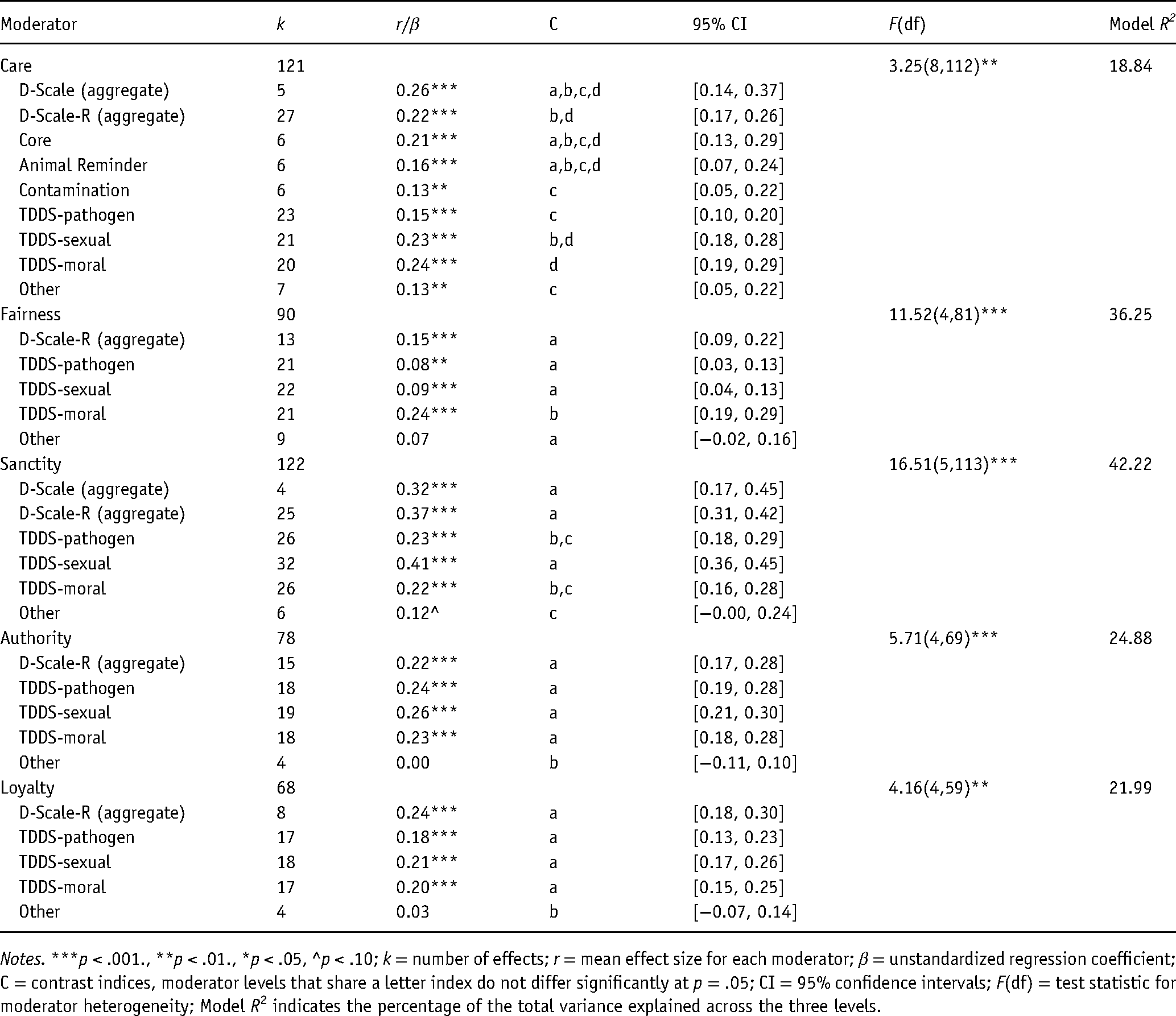
To this end, we tested whether or not there was an interaction between moderator's disgust sensitivity measure and moral domain. Results revealed that the interaction between disgust sensitivity measure and moral domain was statistically significant, F(32, 434) = 4.23, p < .001, indicating that disgust sensitivity measure-moral domain combinations explain significant heterogeneity in disgust-immorality associations. The results from meta-analytic multilevel regression testing moderation by disgust sensitivity measure within each of the moral domains are documented in Table 5. Specifically, within each moral domain, we (a) estimated the average correlation for each disgust sensitivity measure and (b) tested whether correlations significantly differed across disgust sensitivity measures. To ensure sufficient data was available in each moderator analysis, we required at least four effects (derived from independent samples) to be coded for the disgust sensitivity measure – moral domain combinations in Table 5. This meant that particular moderator level combinations were excluded from our analyses (e.g., D-Scale × fairness).
Disgust sensitivity measure effects as a function of moral domain
Notes. ***p < .001., **p < .01., *p < .05, ^p < .10; k = number of effects; r = mean effect size for each moderator; β = unstandardized regression coefficient; C = contrast indices, moderator levels that share a letter index do not differ significantly at p = .05; CI = 95% confidence intervals; F(df) = test statistic for moderator heterogeneity; Model R2 indicates the percentage of the total variance explained across the three levels.
For authority and loyalty, although disgust sensitivity measure was a significant moderator, pairwise comparisons revealed that this was driven by ‘other’ disgust sensitivity measures (of which there were very few, k = 4) producing significantly weaker effects than the TDDS subscales and D-Scale-R (aggregate), all of which produced significant effects that did not differ from each other (Table 5).
For fairness, the effect for moral disgust was significantly stronger than for each of the other disgust sensitivity measure types available for that analysis (i.e., TDDS subscales and D-Scale-R [aggregate]).
For care, significant moderation appears to be accounted for primarily by the TDDS-pathogen, D-Scale-R contamination and ‘other’ measures yielding smaller effects than the rest of the coded measures (although the ‘other’ and contamination effects were based on rather small k's). Among the TDDS subscales, the pathogen effect is significantly smaller than both moral and sexual disgust sensitivity, indicating that to the extent disgust sensitivity plays a role in the condemnation of care violations, it is disgust sensitivity types other than pathogen that have stronger effects. D-Scale-R (aggregate) also has significantly stronger effects than both its contamination subscale (although not its core and animal reminder subscales) and TDDS-pathogen. Although the D-Scale also produced effects for care comparable to the D-Scale-R, the small set of effects upon which its results are based is reason for pause in over-interpretation.
Finally, for the sanctity domain, significant moderation by disgust sensitivity measure indicated that among the TDDS subscales, it is sexual disgust sensitivity (rather than the pathogen or moral disgust sensitivity) that produces the strongest effects (Table 5). Counter to claims of Moral Foundations Theory, which would predict pathogen disgust to be the strongest predictor here, sexual disgust appears to account for significantly more variation in judgments of sanctity violations. The aggregate D-Scale and D-Scale-R effects are of comparable size to that of sexual disgust, although again, the former effect is based on too few effects to warrant strong inference.
Unfortunately, as with most of the other moral domains except for care, too few effects were estimated from the D-Scale-R subscales to assess their roles in predicting judgments of sanctity violations.
Discussion
It is well established that disgust sensitivity is associated with increased condemnation of moral transgressions. However, the scope of the association continues to be a topic of ongoing theoretical and empirical debates (Chapman & Anderson, 2013; Russell & Giner-Sorolla, 2013; Wagemans et al., 2018). More specifically, questions of both moral domain specificity versus generality and disgust type specificity versus generality remain open. To address this, the present study conducted a theoretically informed meta-analysis of the disgust-immorality association. Based on 512 effects drawn from over 70,000 participants, we found that the overall mean r was .23, an r which is typical of meta-analytically derived correlations in social and personality psychology (Gignac & Szodorai, 2016; Richard et al., 2003). Of central theoretical interest, we found systematic variation in disgust-immorality associations that was partly explained by disgust type and moral domain. We also identified several methodological variables that moderated the disgust-immorality association; and we found no indication of publication bias in this literature. This comprehensive examination suggests that, on balance, neither strict specificity nor strict generality, either of disgust type or moral domain, neatly characterize the disgust-immorality association. Below, we elaborate on how these findings contribute to our understanding of disgust and its role in moral judgment.
Theoretical Implications
Moral Domain
The finding that disgust sensitivity (averaged across measures) was related to all moral domains (care, fairness, sanctity, authority, and loyalty), but was most strongly related to the sanctity domain, is inconsistent with hypotheses that propose either strict moral domain specificity (e.g., sanctity domain; Moral Foundations Theory; Graham et al., 2013) or strict moral domain generality (e.g., constructivism; Cameron et al., 2015). On balance, our moral domain moderator results are consistent with the ‘primarily purity’ (or primarily sanctity) account of disgust-immorality effects, recently supported in Wagemans et al.'s (2018) large-scale, systematic exploration of disgust sensitivity effects across moral foundations.
It comes as no surprise that disgust sensitivity is closely linked to sanctity moral concerns, as disgust-based motives (e.g., disease avoidance) are theorized to ground sanctity moral concerns (Graham et al., 2013); however, it is less clear why disgust sensitivity is also linked to non-sanctity sanctity moral concerns. One possibility is that the association between disgust and non-sanctity moral judgments is artefactual. For instance, some of the effects might be overestimated because of the shared variance between disgust and other specific emotions, such as anger, that also correspond to socio-moral violations. Recent work, though, has largely put to rest this concern by showing that disgust sensitivity predicts judgments of non-sanctity violations when controlling for trait anger (Chapman & Anderson, 2014; Karinen & Chapman, 2019; c.f. Horberg et al., 2009). Alternatively, some of the effects might be overestimated because of the shared variance between disgust and a general tendency to respond with negativity (Landy & Piazza, 2019). Some comfort over this concern can be found in recent regression results indicating that the relationship between disgust sensitivity and non-sanctity moral judgments survive covariation of negative affect (an imperfect proxy for negativity in judgments) (Karinen & Chapman, 2019).
Assuming that there is a robust relationship between disgust and non-sanctity moral judgments, there might be several psychological mechanisms that explain this relation. First, one potential mechanism is interpersonal value. In line with the notion that disgust involves trade-offs between pathogen avoidance (or sexual avoidance) and the benefits of social contact (or sexual contact), recent work has shown that people are less comfortable with engaging in acts that involve infection risk with those who have lower interpersonal value (e.g., disked individual, dishonest stranger) (Tybur et al., 2020). Following this logic, more disgust sensitive people might be more likely to interpret certain individuals, such as norm violators, as non-valued conspecifics and thus avoid them. Moreover, moral condemnation might be used as a way to justify inclinations to avoid norm violators, or anyone else perceived to be of low interpersonal value. Thus, interpersonal value may help explain the relationship between disgust and non-sanctity judgments in the current meta-analysis.
Second, another potential mechanism is self-other similarity. Recently, Mentser and Nussinson (2020) found that more disgust sensitivity people are more likely to perceive unfamiliar others as less similar to oneself, presumably as a form of protection against the infection (or sexual) risks involved in social (or sexual) contact. Low similarity perceptions are also implicated in a range of social phenomena including basic first impressions, prejudice towards outgroups, and moral character judgments (e.g., Bocian et al., 2021; Lydon et al., 1988; McDonald et al., 2017). In a similar manner, people might perceive the actions of norm violators to be maximally distinct from the self and recruit moral condemnation as a way to express this. Thus, disgust sensitivity might be associated with moral judgments because more disgust sensitive people may perceive a greater discrepancy between themselves and the norm violators than lower disgust sensitivity individuals.
Third, a further possibility is that disgust-based mechanisms (e.g., disease voidance, promiscuity avoidance) might (partly) explain the moralization of non-sanctity domains. On the one hand, the non-sanctity effects might be due to disease avoidance mechanisms (i.e., canonical disgust). For instance, the authority domain might be linked to disgust because adhering to tradition and established societal practices might provide some protection against the risk of disease transmission (Murray et al., 2011). Similarly, the loyalty domain might be linked to disgust because moralizing in-group/out-group boundaries may have decreased the risk of contact with people from foreign ecologies who may carry novel diseases (Fincher & Thornhill, 2008). On the other hand, the non-sanctity effects might be due to sexual avoidance mechanisms (i.e., sexual disgust), such as promiscuity avoidance. For instance, moralizing authority (e.g., religion, family) and loyalty (e.g., partner trustworthiness, faithfulness) might reduce the risk of mate poaching and other related promiscuous behaviors. The notion that sexual restrictiveness is driving disgust-immorality effects is explored in more detail below.
Disgust Type
Interpretations of the moderator disgust sensitivity measure (our proxy for disgust type) is less straightforward than that of the moral domain because many of the effects come from composite scales, D-Scale (k = 14) and D-Scale-R (k = 107). One issue with the D-Scale and D-Scale-R composites involves their inclusion of animal reminder elicitors. Theoretically, the existence of an anti-animal reminder mechanism is doubtful (Tybur et al., 2009, 2013); and empirically, aversive reactions to animal reminders (including injuries, gore, mutilation, body-envelope violations) are based on empathy rather than disgust (Kupfer, 2018). This latter point raises the possibility that empathy might partly explain disgust-immorality effects derived from D-Scale and D-Scale-R composite scales. One can circumvent the issues with the animal reminder construct by considering the core and contamination subscale effects of the D-Scale-R (the poor subscale reliabilities of the D-Scale do not allow for this). However, we urge caution in interpreting these subscale results because they were estimated on a very small number of effects (k = 10) and were predominantly based on only care transgressions. Another issue is the fact that the D-Scale composite conflates different elicitor classes (e.g., canonical, sexual). The implication of this is that there is no way of knowing which elicitor class (or classes) accounts for the effects of the D-Scale on moral judgment. By contrast, the D-Scale-R omits the sexual elicitors and hence inhibits inquiry of sexual disgust motives in moral judgment altogether.
Unlike the D-Scale and D-Scale-R, the TDDS permits for more straightforward interpretations of the results of disgust type on moral judgment because (a) animal reminder elicitors are not present in the TDDS (thus the effects of the TDDS on moral judgments are not confounded by empathy) and (b) the measure is consistently used by researchers at the subscale level (thus facilitating investigations of disgust type specificity [e.g., canonical disgust, sexual disgust] on moral judgment). However, in the same way animal reminder disgust raises validity problems for D-Scale and D-Scale-R, the moral disgust construct raises validity concerns for the TDDS. Specifically, relations between TDDS-moral and moral judgments might be obscured due to the moral disgust construct representing an emotion that is closer to anger than disgust (Nabi, 2002). Given the ambiguities just described in interpreting certain measures of disgust (i.e., D-Scale composite, D-Scale-R composite, TDDS-moral), we focus our discussion specifically on how TDDS-pathogen disgust and TDDS-sexual disgust are related to moral judgment and the implications of these patterns for current and future theorizing.
Our results revealed that despite both pathogen and sexual disgust yielding significant effects, TDDS-pathogen was a significantly weaker predictor of moral judgment (aggregated across moral domains) than TDDS-sexual. Interactions between different disgust types and different moral domains indicated that this difference is driven by stronger effects of sexual disgust within the care and sanctity domains. Thus, neither strict disgust type generality (e.g., constructivism; Cameron et al., 2015) nor specificity (e.g., canonical disgust; Moral Foundations Theory; Graham et al., 2013) adequately describe these patterns of associations.
The finding that sexual disgust is more strongly predictive of condemnation of sanctity transgressions than is canonical disgust 6 is consistent with recent evolutionary accounts that view reproductive strategies as a determinant of individual political and moral values (Petersen, 2018; Tybur et al., 2015; van Leeuwen et al., 2017). A growing body of research suggests that various measures of sexual restrictiveness (including sexual disgust sensitivity) are related to values and attitudes broadly supportive of restricting promiscuity and promoting monogamy, including conservative political ideology (Billingsley et al., 2018; Kubinski et al., 2018; Tybur et al., 2010, 2015), religiosity (Weeden & Kurzban, 2013), opposition to gay marriage (Pinsof & Haselton, 2016), and recreational drug use (Kurzban et al., 2010; Quintelier et al., 2013). Functionally, sexual disgust is claimed to be part of an adaptation designed to process the costs and benefits of risky sexual encounters (Tybur et al., 2013). Endorsing a suite of traditional normative practices and attitudes may be one way of minimizing general exposure to fitness compromising sexual encounters. The results of the current meta-analysis complement the above findings by extending the scope to moral values and judgments, emphasizing the importance of sexual disgust (i.e., sexual strategies account; Tybur et al., 2015) – as opposed to canonical disgust (i.e., disease avoidance account; Graham et al., 2013) – in explaining variance in moral values and judgments (especially in the sanctity domain). Future work should heed this pattern of results and at the very least simultaneously examine both pathogen and sexual disgust to distinguish the respective roles of each disgust type (and thereby distinguish between the disease avoidance account and sexual strategies account) in the moral domain. Additionally, a logical next step is to examine which sexual disgust motives underlie these sexual disgust-immortality effects. Indeed, it has recently been suggested that there are multiple domains of sexual disgust (Taboo, Oral sex, Promiscuity, Hygiene, BDSM, and Same-sex attraction), each of which represents a different kind of mating problem that sexual disgust supposedly evolved to solve (Crosby et al., 2020). Future work should make use of the Sexual Disgust Inventory to elucidate the different sexual disgust motives involved in moral judgment, as TDDS-sexual disgust measure doesn't allow for these domain-level distinctions to be made.
Revisiting the Sanctity (Purity) Foundation
A sensible question to consider next is whether the conceptualization of sanctity (purity) as a moral domain that responds to violations that involve disease is accurate (Graham et al., 2013). Our finding that sexual disgust is more strongly related to the sanctity domain than is canonical disgust is inconsistent with this conceptualization. Rather than performing a disease mitigating function, our results suggest that the sanctity domain might function to regulate sexual behavior, by facilitating moral condemnation of actions that undermine monogamy and conventional sexuality (e.g., promiscuity, infidelity, casual sex). Future theorizing on the topic should consider that the moralization of sanctity norms might not result from just disease avoidance mechanisms but also sexual avoidance mechanisms. Recognizing this complexity might involve dividing the sanctity domain into two sub-domains, distinguishing norms enforcing disease mitigation from norms enforcing conventional sexuality.
Even if one grants that the conceptualization of the sanctity construct is accurate (i.e., rooted in disease avoidance; Graham et al., 2013; Haidt & Graham, 2007), various measures of sanctity have questionable construct validity, thus posing a problem for interpretating the sanctity domain (Gray et al., 2021). For instance, the most widely used measure of sanctity concerns – the Moral Foundations Questionnaire sanctity subscale - contains an item that has nothing to do with disease avoidance (“Whether or not someone acted in a way that God would approve of”; Graham et al., 2011). Hence, using the Moral Foundations Questionnaire sanctity subscale (65% of the effect in this meta-analysis were based on the Moral Foundations Questionnaire) might underestimate (canonical) disgust-sanctity effects because some of the sanctity items do not represent the sanctity construct. However, we suspect that this concern is unlikely to dramatically alter our results, since the other five items that form part of the sanctity subscale are nominally about disease (or could at least be interpreted in this way). Nonetheless, future research should develop more construct valid measures of the sanctity domain.
Implications for Causal Theories of Disgust in Moral Judgment
Our results are also consistent with the idea that disgust has a causal effect on moral judgment (although not sufficient to justify the claim). There are two key points to be made here. First, as discussed earlier, research on disgust sensitivity is agnostic as to whether the causal role of disgust in moral judgment is incidental or integral. Taken with Landy and Goodwin (2015) (which suggests that incidental canonical disgust does not play a clear causal role in moral judgment) our finding that disgust sensitivity is robustly associated moral judgment suggests that integral disgust (of various kinds) might be a better candidate for studying the causal role of disgust in moral judgment. Surprisingly, there is a dearth of moral judgment research incorporating the manipulation of integral disgust (for an exception, see Wisneski & Skitka, 2017). We encourage future work studying the causal role of disgust in moral judgment to explore this possibility.
Second, our finding that sexual disgust explained more of the variance in some moral judgments than canonical disgust raises the possibility of sexual disgust as a candidate for playing a causal role in moral judgment (especially of the sanctity domain). To date, experimental approaches to disgust – incidental and integral – have only examined inductions of canonical disgust on moral judgment, and thus it is an open question as to whether sexual disgust causally influences moral judgment. Future work should attempt to manipulate the different sexual disgust motives and study the effects on the different domains of moral judgment (while controlling for pathogen disgust).
Limitations
Although the current meta-analysis reveals important patterns of associations between disgust sensitivity and moral judgments, it is not without limitations. First, many studies use multi-factorial disgust scales (especially the Disgust Scale-Revised) as aggregate scales. As noted earlier, this approach inhibits our ability to de-confound animal nature disgust from core and contamination disgust, thus limiting the claims we could make about the specificity of core and contamination disgust in the moral domain. Whilst simply reporting the subscale effects can ameliorate this specific problem, the Disgust Scale-Revised leaves sexual items (i.e., sexual disgust) unmeasured and thus introduces a new problem: apparent associations between the Disgust Scale-Revised and other variables might be confounded by sexual disgust (a construct known to be strongly correlated with various measures of canonical disgust; Al-Shawaf et al., 2015; Tybur et al., 2009). We did not consider the partial effects of canonical and sexual disgust on moral judgment in the current meta-analysis (because regression contexts were too varied across included studies), but our findings nevertheless suggest that sexual disgust should be measured and controlled for in future studies on this topic.
Second, and following on from the previous point, we cannot make claims about the causal role of disgust in moral judgment because we cannot rule (non-disgust based) third variable effects. Earlier in the discussion, we cited evidence suggesting that candidate third variables, anger and generalized negativity, are unlikely to account for the disgust-immorality effects (e.g., Karinen & Chapman, 2019). In spite of that, other third variables that have not been discussed here could potentially explain the disgust-immorality associations. Thus, the inferences we make about the specificity and generality of the disgust-immorality effect should be interpreted with caution.
Third, the precise mechanisms that connect disgust to moral judgments remains unclear. Although we have argued that disgust-based motives (e.g., disease voidance, promiscuity avoidance) are likely to be the proximate mechanisms involved in sanctity judgments, it is less obvious that the same motives are involved in non-sanctity judgments. We proposed two additional mechanisms, interpersonal value and self-other similarity, that might explain the connection between disgust and non-sanctity concerns. We encourage future research to explore these possibilities.
Conclusion
In a comprehensive meta-analysis of 512 effects, we found that disgust sensitivity was reliably related to moral judgment. Evidence of moderation by disgust type and moral domain indicate that patterns of disgust-immorality associations are not adequately characterized by strict notions of specificity or generality. The effect of disgust sensitivity on moral judgment generalized across types of disgust and domains of moral judgment, but effect sizes were, on average, larger for (a) sexual disgust (than canonical disgust), (b) the sanctity domain (than other domains), (c) sexual-sanctity associations (than other disgust type-moral domain pairings). We hope that the pattern of effects described in the current study will encourage more nuanced theorizing on disgust's role in morality. In addition, our work, together with a recent meta-analysis (demonstrating that incidental disgust is unrelated to moral judgment; Landy & Goodwin, 2015), indicates that integral disgust and/or sexual disgust might be better candidates for studying the causal role disgust in moral judgment. Exploring such avenues can help us get better purchase on how disgust – as well as emotions more broadly – relates to our moral cognition.
Supplemental Material
sj-docx-1-emr-10.1177_17540739221114643 - Supplemental material for Specificity Versus Generality: A Meta-Analytic Review Of The Association Between Trait Disgust Sensitivity And Moral Judgment
Supplemental material, sj-docx-1-emr-10.1177_17540739221114643 for Specificity Versus Generality: A Meta-Analytic Review Of The Association Between Trait Disgust Sensitivity And Moral Judgment by Michael R. Donner, Shaheed Azaad, Garth A. Warren and Simon M. Laham in Emotion Review
Supplemental Material
sj-xlsx-2-emr-10.1177_17540739221114643 - Supplemental material for Specificity Versus Generality: A Meta-Analytic Review Of The Association Between Trait Disgust Sensitivity And Moral Judgment
Supplemental material, sj-xlsx-2-emr-10.1177_17540739221114643 for Specificity Versus Generality: A Meta-Analytic Review Of The Association Between Trait Disgust Sensitivity And Moral Judgment by Michael R. Donner, Shaheed Azaad, Garth A. Warren and Simon M. Laham in Emotion Review
Supplemental Material
sj-docx-3-emr-10.1177_17540739221114643 - Supplemental material for Specificity Versus Generality: A Meta-Analytic Review Of The Association Between Trait Disgust Sensitivity And Moral Judgment
Supplemental material, sj-docx-3-emr-10.1177_17540739221114643 for Specificity Versus Generality: A Meta-Analytic Review Of The Association Between Trait Disgust Sensitivity And Moral Judgment by Michael R. Donner, Shaheed Azaad, Garth A. Warren and Simon M. Laham in Emotion Review
Footnotes
Declaration of Conflicting Interests
The author(s) declared no potential conflicts of interest with respect to the research, authorship, and/or publication of this article.
Funding
The author(s) received no financial support for the research, authorship, and/or publication of this article.

Supplemental Material
Supplemental material for this article is available online.
Notes
References
Supplementary Material
Please find the following supplemental material available below.
For Open Access articles published under a Creative Commons License, all supplemental material carries the same license as the article it is associated with.
For non-Open Access articles published, all supplemental material carries a non-exclusive license, and permission requests for re-use of supplemental material or any part of supplemental material shall be sent directly to the copyright owner as specified in the copyright notice associated with the article.
