



Abstract
Although there is evidence parent–child attachment security is associated with trait-like emotion indices, trait perspectives do not fully capture children's responses to context, an important emotion regulation component. This paper evaluates whether attachment is associated with two dynamic emotion indicators: emotion reactivity and emotion recovery. We review conceptual and empirical connections, describe the dynamic emotion perspective, discuss hypotheses, and review evidence. Our review (15 studies) shows that secure attachment was more consistently related to recovery than reactivity, avoidant attachment was related to low emotion reactivity and recovery, ambivalent attachment was associated with greater emotion reactivity, and disorganized attachment was related to high reactivity and recovery difficulties. We close by comparing trait-like and dynamic emotion conclusions then propose future research directions.
The ability to regulate emotion is a foundational aspect of children's social and emotional competence. Emotion regulation (ER) refers to the ability to monitor, evaluate, and modulate emotions in the service of reaching one's goals (Thompson, 1994). Children who can effectively regulate their emotions are less likely to experience mental health difficulties such as anxiety (Mathews et al., 2016), depression, (Houben et al., 2015), or bipolar disorder (Chapman, 2019). Therefore, an important direction for research on ER is to identify factors that promote children's adaptive ER. A number of theoretical perspectives on the development of ER point to parent–child relationships as an important context for ER development (Cassidy, 1994; Eisenberg et al., 1998). One influential perspective is attachment theory, which proposes that the quality of children's relationships with their primary caregivers provides a foundation for children's subsequent social, emotional, and personality development (Bowlby, 1969, 1979).
Attachment and emotion are conceptually and empirically linked in that the attachment system has an emotion-regulatory function (Brumariu, 2015; Zimmermann et al., 2001). Interactions with attachment figures are a critical context within which children develop expectations and schemas for what happens in emotionally laden situations, develop interpretive biases that may influence reactions to emotional events, and learn patterns of how and when to express and regulate emotion, all of which may affect the organization of a child's emotional responses (Brumariu, 2015; Cassidy, 1994; Parrigon et al., 2015; Zimmer-Gembeck et al., 2017). There is indeed evidence that secure attachment is associated with some trait-like indices of emotion such as temperament, positive and negative emotion, and the ability to regulate emotion (Brumariu, 2015; Cassidy, 1994; Cooke et al., 2019; Groh et al., 2017; Parrigon et al., 2015; Zimmer-Gembeck et al., 2017). Yet a trait perspective that focuses on typical patterns of emotion responding manifested across time and context—typically assessed with measures of the experience, expression, or tendencies to regulate emotion—does not fully capture children's emotional experiences. Additionally, trait-like measures do not allow for examining whether the reactions of securely and insecurely attached children might occur only in some contexts; for example, the suggestion that attachment might be most strongly related to responses to interpersonal stressors for young children (Groh & Narayan, 2019). A trait-like approach is also not consistent with theoretical perspectives that argue that adaptive ER reflects the ability to modulate emotion in response to environmental demands (Calkins & Hill, 2007; Cole et al., 1994; Cole et al., 2004; Saarni, 1999; Thompson, 1994). A dynamic perspective on emotion, with a focus on the importance of adaptation to the current context, suggests the need to understand not only general tendencies in children's experience and in regulation of emotion, but also how children flexibly adapt emotion to context (Calkins & Hill, 2007; Gross & Thompson, 2007; Thompson, 1994). This type of responsiveness is in contrast to the emotional rigidity and instability theorized to be at the core of affective disorders (Coifman & Bonanno, 2009; Kashdan & Rottenberg, 2010).
The goal of this paper is to review the conceptual and empirical links between dynamic ER (emotion reactivity and recovery) and parent–child attachment in children and adolescents up to 18 years old. We first begin by briefly reviewing conceptual perspectives on attachment and emotion and methodological approaches to assessing attachment across childhood. Then, we review empirical linkages between attachment and trait measures of emotion as a reference for how researchers have commonly studied emotion and attachment. We rely primarily on prior literature reviews when summarizing this large body of research. We next introduce the dynamic emotion perspective, with a specific focus on the concepts of emotion reactivity and emotion recovery in a particular real-time situation. Then, we discuss hypotheses and evidence regarding how attachment might be related to emotion reactivity and recovery, followed by a review of the literature. Finally, we will evaluate what is currently known regarding how attachment is related to dynamic emotion indices in children. We consider interpretations of the findings, discuss measurement issues in assessing emotion dynamics, and propose directions for future research.
Conceptual Relations Between Attachment and Trait Measures of Emotion
Attachment theory proposes that the parent–child relationship provides a vital foundation for subsequent development (Bowlby, 1969, 1979). Indeed, the interplay between children's signals to their caregivers for support and caregiver's provision of care in response to those signals is crucial as it impacts children's organization of attachment behavior and internal working models or mental representations about self and others. In a secure parent–child attachment relationship, the child feels comfortable seeking parental assistance and comfort and openly expressing emotions while the parent is consistently available and sensitively responds and encourages developmentally appropriate exploration (Ainsworth, 1989; Bowlby, 1988; Cassidy, 1994). Thus, the child is able to use the parent as a safe haven and source of comfort as well as a secure base from which to safely explore the environment. The child also develops expectations and scripts of the parent–child relationship in which caregivers are viewed as responsive, caring, and available and the self is viewed as worthy of love (Bowlby, 1988; Waters & Waters, 2006). In comparison, caregivers in an insecure parent–child attachment relationship may be inconsistently available and responsive or consistently unavailable and ineffective in response to children's needs or emotional expressions, and children may in turn learn that they may not adequately have needs met in a sensitive and appropriate manner.
Emotions are central for attachment. The formation of secure attachments gives rise to joy (Ainsworth, 1989), and shared positive emotion between child and parent can build and sustain the attachment bond (Abraham & Kerns, 2013; Ramsey & Gentzler, 2015; Shiota et al., 2004; Sroufe & Waters, 1977). The experience of negative emotion can also serve as an instigator of attachment behavior as children seek proximity and contact with attachment figures for soothing and help regulating negative emotions (Ainsworth, 1989; Bowlby, 1969). Moreover, bidirectional coregulation of emotional or affective states within the parent–child relationship plays a pivotal role in children's development of emotion self-regulation (Butler & Randall, 2013; Calkins & Leerkes, 2011). These skills are particularly relevant during middle childhood when the attachment system evolves into a collaborative alliance in which children assume greater responsibility for coregulation of secure base contact (Kerns & Brumariu, 2016) and during adolescence when children are gradually developing greater autonomy from parents. In adolescence, the capacity for self-regulation of emotion during times of challenge is an integral marker of secure attachment (Allen & Manning, 2007; Allen & Miga, 2010).
In addition, attachment relationships are a critical context within which emotions are socialized as parental patterns of care and responses to children's displays of emotion shape children's learning of ER strategies (Cassidy, 1994; Morris et al., 2007; Thompson & Meyer, 2007). Attachments also affect emotion as attachments impact processing of social information (Dykas & Cassidy, 2011), including emotional encounters. For example, children's cognitive scripts or mental representations of attachment include information relevant to emotion such as the emotional openness of caregiver or others, emotion expression rules, and ways of resolving distress (Cassidy et al., 2013; Main et al., 1985; Waters & Waters, 2006). Taken together, parent–child attachment and emotion are inextricably linked.
Individual differences in the organization of attachment patterns thus reflect, in part, differences in the experience and expression of emotion. In more secure parent–child relationships, parents are likely to engage with their children in ways that promote open and emotionally flexible dialogues (Cassidy, 1994), acceptance of emotion during conflict discussions (Kerns et al., 2011), and strategy utilization (e.g., emotion coaching; Chen et al., 2012) when discussing potentially threatening topics (e.g., misbehavior; Laible & Thompson, 2000) or negative events (Laible, 2011). Importantly, there are likely to be more references to emotion in secure dyad conversations, helping children develop a greater understanding of emotion (Raikes & Thompson, 2005). Parents may intervene directly in managing children's emotion or model ways of managing emotion (Thompson & Meyer, 2007). Patterns of emotional responding that are developed within the parent–child dyad are thought to generalize to other social partners (Kerns et al., 2007; Sroufe & Fleeson, 1986).
Unlike those in secure attachment relationships, children in insecure attachment relationships are likely to be in emotional environments where caregivers are dismissive, inconsistent, or psychologically unavailable. In insecure avoidant relationships, children are likely to have experienced an emotional environment characterized by parental rejection or minimization of emotion, which has reinforced to children the importance of reducing outward signs of emotional needs to caregivers (Cassidy, 1994). Consequently, avoidant children may minimize emotional expressions to social partners (Cassidy, 1994). Avoidant children may also sometimes show signs of anger and aggression toward other social partners such as peers, resulting from their failure to learn adaptive ways of regulating emotions (Sroufe, 1983).
In insecure ambivalent relationships, children are thought to engage in emotion-heightening strategies stemming from inconsistent parental availability or responsiveness (Cassidy, 1994; Cassidy & Berlin, 1994). Children who are more ambivalently attached may exaggerate their emotional responses, perhaps displaying excess distress, in an effort to receive attention from their attachment figure. Uncertainty about caregiver availability is also hypothesized to foster chronic feelings of anxiety or fear (Bowlby, 1973). Additionally, caregivers of ambivalent children may themselves be prone to displays of dysregulated emotion in response to their own children's emotions (Hans et al., 2000; Kerns et al., 2011), which may further amplify ambivalent children's negative emotions. At older ages, ambivalent children may also provoke conflicts with caregivers as a way to attract their attention and involvement (Hans et al., 2000), which leads to cycles of negative affect. Thus, ambivalently attached children are likely to experience distress more often than other children, which may be reflected both in their perceptions of distress and objective measures (e.g., facial affect).
Disorganized attachment is hypothesized to result when caregiver helplessness, harshness, psychological unavailability, or frightening behavior leaves a child unable to rely on the attachment system and prone to be “overwhelmed by negative emotions” (DeOliveira et al., 2004, p. 473). Due to their misattuned parenting, caregivers in these relationships may also fail to provide children with scaffolding during emotional situations (Brumariu, 2015). For example, in disorganized relationships, caregivers have been found to be unpredictable, threatening, or detached in response to their children's displays of emotions, even though their children show high levels of distress (Beebe & Steele, 2013). The chronic stress of interactions with a disengaged or frightening attachment figure could also affect the organization of disorganized children's stress response systems, such that disorganized children show a pattern of heightened adrenocortical responses (Spangler & Zimmermann, 2014). In response to this caregiving environment, disorganized children may engage in rigid or inconsistent patterns of coping with emotions and overall may be the least capable of managing their emotions (Brumariu, 2015; DeOliveira et al., 2004).
It is important to note that studies of attachment and ER have included children across a broad age span, and given the many changes in children's social, emotional, and cognitive abilities across childhood, different measurement approaches to assessing attachment have been used at different ages. Approaches include behavioral, self-report, and representational measures (Kerns & Seibert, 2021; Solomon & George, 2008). Behavioral measures of attachment specifically examine children's attachment-related behaviors when interacting with caregivers, and this approach is often utilized when examining attachment in young children. The most well-known example of a behavioral measures of attachment is the Strange Situation Procedure, which focuses on support-seeking and exploration behaviors in young children during a series of parental separation and reunion episodes (Ainsworth et al., 1978, 2015), although there are alternative behavioral measures that are used with older children (e.g., the Iowa Attachment Behavioral Coding System; Boldt et al., 2016). As children age and mature cognitively, additional methods of measuring attachment can be utilized. For instance, self-report questionnaires such as the Kerns Security Scale (Brumariu et al., 2018; Kerns et al., 2001) and the Experiences in Close Relationships Scale (Brenning et al., 2012) can be administered to obtain children's direct perspectives on their attachment relationship quality. In comparison, representational measures of attachment evaluate children's reflections on attachment relationship experiences and secure base script mental representations. Representational measures of attachment include word prompts, story stem completion tasks, and autobiographical interviews or narrative measures (Gastelle & Kerns, 2022). For instance, the Friends and Family Interview (Steele & Steele, 2005) and Child Attachment Interview (Target et al., 2003) are autobiographical interview measures for children, and the Adult Attachment Interview (Main et al., 1985) is an autobiographical interview measure for adolescents and emerging adults. Cross-method correlations in the attachment literature are often modest (Brumariu et al., 2018; Pinquart et al., 2013), suggesting that they likely capture different aspects of parent–child attachment. The use of different methods across studies can complicate the evaluation of the attachment literature but also provides opportunities for examining whether findings for attachment generalize across measurement method.
Furthermore, measures can capture attachment as assessed in a categorical or continuous manner. Classification systems vary (e.g., whether disorganized subtypes are captured) as do the types of comparisons made during data analysis (e.g., secure versus insecure; secure versus specific insecure patterns). In comparison, continuous assessments of attachment provide a range of scores for an attachment pattern (e.g., more secure versus less secure; more avoidant versus less avoidant, etc.). There has been a debate within the attachment literature on whether individual differences in attachment are better represented as being organized in a categorical or a continuous way, with some arguments for the utility of categories (Steele & Steele, 2021), although tests of the structure of attachment tend to suggest that that attachment is distributed in a continuous manner (Raby et al., 2021). Collectively, these considerations are important to keep in mind as they impact how we measure attachment and subsequently interpret empirical findings.
Empirical Relations Between Attachment and Trait Measures of Emotion
There is evidence that the prototypical patterns of attachment are associated with distinct trait-like patterns of how emotions are experienced and expressed. In a meta-analysis of studies of attachment and temperament in young children based on 109 independent samples, Groh et al. (2017) reported that secure attachment was not related to measures of positive emotionality but was weakly associated with less negative temperament. None of the insecure patterns were related to positive emotionality, but ambivalent attachment was moderately related to negative temperament. Associations of avoidant and disorganized attachments were not related to negative temperament, except that avoidant attachment was weakly related to higher fearful distress. Cooke et al. (2019) conducted a series of meta-analyses, based on 25 studies, that examined attachment and global experiences of positive and negative emotions (i.e., how children typically report feeling, observed emotion expression) across a broad age range (children up to age 18 years). They reported that secure attachment was related to higher global positive emotion and lower global negative emotion, avoidant attachment was related to experiencing significantly less global positive emotion, ambivalent attachment was related to experiencing more global negative emotion, and disorganization was related to experiencing both less global positive emotion and more global negative emotion. Although these meta-analyses differed in the types of emotion measures included, they both suggested that attachment patterns predict children's typical displays of negative emotions, with securely attached children experiencing less negative emotion and insecurely attached children (most strongly ambivalent children) experiencing more negative emotion. The findings for experiences of positive emotion are less consistent.
The other emotion concept studied extensively in the attachment-emotion literature is ER, which includes both the capacity to stay emotionally regulated under conditions of stress as well as the use of specific coping strategies (Brumariu, 2015; Parrigon et al., 2015). Cooke et al. (2019) concluded in their meta-analytic review that more securely attached children are rated as better able to regulate their emotions and more likely to use adaptive strategies such as social support coping or cognitively oriented coping strategies (e.g., problem solving) to regulate their emotions. In comparison to more securely attached children, avoidantly attached children were rated as significantly poorer at regulating emotions and less likely to use both cognitively oriented and social support seeking coping strategies, whereas more ambivalently attached children were rated as poorer regulators of emotion in comparison to securely attached children but were not different in their utilization of specific regulatory strategies (Cooke et al., 2019). Although some studies suggest disorganized children have ER difficulties, the evidence is surprisingly sparse (Brumariu, 2015; Cooke et al., 2019).
In summary, the research conducted to date provides robust evidence that securely attached children generally experience more positive and less negative emotion and are better able to regulate their emotions as assessed with context-free, trait-like measures of emotion. The main limitation to the literature, which reflects a concern more broadly in the literature on child emotion (Cole et al., 2004), is that most studies have only examined trait-like (typical) measures of emotion and thus do not elucidate how attachment is related to patterns of change in emotion responding in response to context changes (Parrigon et al., 2015).
Dynamic Emotion Processes and Conceptual Links to Attachment
Emotions have been referred to as a set of “neurocomputational adaptations” which serve to promote survival and provide information to the brain regarding appropriate behavior (Ekman, 1992; Tooby & Cosmides, 2008, p. 117). Environmental demands are constantly in flux, thus sensitivity to changes in context (termed context sensitivity; Coifman & Bonanno, 2009) is key to understanding whether an emotional response or reaction is adaptive. Similarly, elements of time (e.g., emotion duration and frequency), are also necessary in gathering a more comprehensive, nuanced picture of emotion responses and regulation. For example, in the context of a loss, sadness is extremely adaptive as it will signal to others that comfort is needed, which could lead to lessened feelings of sadness, yet sadness may become maladaptive when it persists far past the duration of the loss context (especially at higher intensities). Indeed, shifts in emotion in response to changing circumstances is associated with psychological health and adjustment (Coifman et al., 2016). Similarly, positively valenced emotions are not inherently adaptive. Although happiness is considered to be generally adaptive, in certain contexts extreme levels of happiness may lead to negative outcomes (e.g., too much positive emotion may lead to neglecting threats; Baumeister et al., 2001; Gruber, Mauss, & Tamir, 2011), and displays of happiness by preschool-aged children engaging in aggressive behavior have been associated with lower peer acceptance (Arsenio et al., 2000).
A key construct that captures the dynamic nature of emotion, and also acknowledges that emotions serve a social function, is emotion flexibility. Emotion flexibility is a two-prong process that includes the generation and regulation of emotion (Coifman & Almahmoud, 2016). Emotion generation refers to the amount or intensity of emotional response produced, while regulation refers to the amount of change that occurs within or between contexts. Importantly, there is ample evidence to suggest that these processes typically occur in an automatic, implicit manner (Coifman & Almahmoud, 2016; Koole & Rothermund, 2011; Mauss et al., 2007) and work together to produce various outcomes that may be more or less adaptive (Coifman & Almahmoud, 2016). For example, expressing high levels of fear in a low-threat context (i.e., poor context sensitivity) and difficulty regulating emotion is likely to put children at risk for developing anxiety disorders (Buss, 2011). Emotion flexibility is particularly important to consider throughout development as children shift from emotional coregulation with parents in infancy to independent emotion self-regulation in adolescence (Allen & Manning, 2007; Allen & Miga, 2010; Butler & Randall, 2013; Calkins & Leerkes, 2011).
It is important to note that some conceptualizations of ER refer to the ability to generate and upregulate emotions (e.g., Cole et al., 1994) or the ability to alter or downregulate emotions (e.g., Gross, 2015). Some point out that ER includes both reactivity and control dimensions (i.e., efforts to manage the emotions) that are linked with responses to everyday situations (Calkins & Johnson, 1998) and the dynamic, ongoing nature of ER (Calkins & Johnson, 1998; Gross & Thompson, 2007; Thompson, 1994). Unique to studies of emotion flexibility, versus other related constructs, is the emphasis on the functional utility of discrete emotional responses in particular contexts and the repeated assessments of real-time emotion responding across multiple circumstances to assess the flexibility of responses to contextual change (Coifman & Almahmoud, 2016). A wide variety of terms have been used to capture aspects of emotion flexibility (or its inverse, emotional rigidity). Our review focuses on two closely related yet distinct constructs: emotion reactivity and emotion recovery.
Emotion reactivity is defined as the amount of change in emotion (reported, observed, or physiology) an individual experiences from baseline following the introduction of an emotion inducing stimulus (Gross et al., 1998). Reactivity is important when new stimuli, particularly aversive ones, are presented, as an emotion flexibility perspective implies that contextually sensitive reactivity is adaptive (e.g., feelings of anger in response to provocation). Thus, from an emotion flexibility perspective, reactivity in and of itself is not inherently good or bad but dependent on context.
In the literature, there are different proposals regarding how attachment security would be related to emotion reactivity (Movahed Abtahi & Kerns, 2017). On the one hand, it has been argued that more securely attached children may show lower reactivity across situations due to an ability to regulate their emotions effectively (Cooke et al., 2019; Groh & Narayan, 2019), an idea that is consistent with a trait perspective on emotion. Alternatively, and consistent with an emotion flexibility perspective (e.g., Coifman & Almahmoud, 2016), because securely attached children have likely had opportunities to engage in open, flexible emotion dilogs (Cassidy, 1994) and show greater understanding of emotion (Cooke et al., 2016), they might respond to emotional experiences in a context-sensitive manner (i.e., demonstrate emotion flexibility). Thus, more securely attached children might show changes in emotion in response to context, even when that emotion might not be viewed as inherently “good.” For example, in a situation designed to elicit anger, 12-year-old children who had been securely attached to mothers in infancy showed more anger than did insecurely attached children (Spangler & Zimmermann, 2014). The finding was attributed to securely attached children having greater awareness of their emotional state and a willingness to report their emotions. Note that our prediction is contrary to most evidence, based on context-free measures of negative emotion, showing that securely attached children are less likely to experience negative emotion (Cooke et al., 2019).
Regarding insecurely attached children, more avoidantly attached children may respond to a stimulus with low reactivity having learned that emotional responses are discouraged. More ambivalently attached children may respond to a stimulus with prolonged response to get the attention of caregivers (e.g., when distressed). Theory is less clear regarding disorganized attachment, but it is possible disorganized children may show low reactivity if they freeze or disengage during emotional experiences. Alternatively, they may become overwhelmed during fearful or stressful events and experience uncontrolled negative emotion. It is important to emphasize again that these responses are not necessarily consciously made and that they may occur automatically as a result of experiences in the attachment relationship (as well as innate temperamental tendencies).
Emotion recovery is defined as the change in emotion responding needed in order to return to baseline following the removal of the emotional stimulus (Gruber, Harvey, & Purcell, 2011). Recovery can also be indicated by decreases in negative emotion or increases in positive emotion following the removal of a negative emotion inducing stimulus, even if there is not a return to baseline.
Regarding hypotheses for attachment and emotion recovery and consistent with the concept of emotion flexibility (Coifman & Almahmoud, 2016) and previous ER findings (Cooke et al., 2019), we predict that more securely attached children will be responsive to contextual cues and able to down-regulate or upregulate emotions as adaptive for the context. For example, following a stressful experience, once the stressor is removed, we expect that securely attached children would recover more quickly. By contrast, we expect that avoidant children might show little response to changes in condition that allow for recovery (e.g., withdrawal of a stressor) as part of their strategy to minimize emotion experiences (Cassidy, 1994). It is less clear what to predict for ambivalent children. They might be slow to down-regulate emotion as doing so could decrease the caregiver's availability. Alternatively, they may be temperamentally prone to emotional extremes (Cassidy, 1994), which could actually facilitate emotional recovery after conditions become less threatening. Disorganized children, who might show a collapse of coping in response to threatening or other emotionally challenging events (DeOliveira et al., 2004), might be slow to develop an organized response and thus show delayed recovery from a distressing experience.
Attachment and Dynamic Measures of Emotion: Literature Review
In this section, we review evidence for the relations between attachment and emotion flexibility in the child literature. Cooke et al. (2019) provided a meta-analytic summary of studies that looked at one way of assessing emotion reactivity. Specifically, they examined how attachment was related to measures of positive and negative “elicited affect.” That review included studies that examined changes in affect in response to a specific event (e.g., fear stimulus introduction), which is similar to how we define emotion reactivity, as well as studies that examined affective responses during a stimulus event without controlling for prior affect (e.g., joy when watching a puppet). Cooke et al. (2019) reported that attachment security was not related to elicited positive affect in response to positive events but was significantly but weakly related to less negative affect when children were exposed to distressing events (r = –.12). Avoidant attachment was not related to elicited negative affect, although ambivalent attachment was related to elicited negative affect. More ambivalent children responded with more negative affect in situations intended to elicit negative emotion. A limitation of this meta-analysis is that they included studies that did not obtain a baseline measure of emotion, and consequently it is unclear whether children's emotional reactions reflect responses to context or a priori trait-like differences in emotion responding. To our knowledge, there are no published reviews of studies that examined how childhood attachment is related to emotional recovery of positive or negative emotion.
A second meta-analysis (Groh & Narayan, 2019) examined differences between securely and insecurely attached children in their physiological regulation when experiencing an interpersonal stressor, specifically, the Strange Situation procedure. Although measures of physiological activity are not measures of emotion per se, some physiological measures such as heart rate (HR), HR variability/respiratory sinus arrythmia (RSA), and cortisol are thought to reflect stress responses and to be affected by changes in emotion. Groh and Narayan (2019) specifically looked at studies that included a behavioral measure of attachment, and about two thirds of their samples included children under two years of age. They examined children's HR and RSA during episode six (second caregiver separation) and episode eight (second caregiver reunion) of the Strange Situation. Based on our definitions, we interpret responses during separation as reflecting physiological reactivity and responses during reunion as reflecting physiological recovery as presumably the return of the caregiver allows for down-regulation of emotion, although it is important to note that it is not clear whether all studies in the meta-analysis controlled for baseline. Groh and Narayan found that secure attachment and insecure attachment were not related to HR or RSA during separation. They found that during reunion episodes, RSA but not HR was related to attachment: insecure children showed lower RSA during reunion, which was interpreted as showing that insecure children are showing increased regulatory effort (whereas secure children are showing more effective coping). Additionally, Groh and Narayan analyzed studies that examined cortisol levels after children completed the Strange Situation, and they found that secure children showed lower cortisol levels. It is not clear whether this difference reflects a reactivity or recovery effect given that cortisol was only assessed once several minutes after the Strange Situation was completed. They concluded that attachment is related to responses to an interpersonal stressor involving caregivers and that over time insecure children may develop less adaptive coping responses, which could affect their ability to cope in other interpersonal contexts.
We sought to build on prior reviews that examined how parent–child attachment is related to emotional reactivity and emotional recovery by using stricter criteria to define these constructs to ensure studies were analyzing dynamic indicators of emotion rather than capturing trait-like measures of emotion. We therefore included studies that examined emotional responses in a specific context. An important distinction, and a difference from prior reviews, is that we excluded studies that assessed emotion in a specific task (e.g., frustration paradigm, puppet show) but did not include a baseline measure of emotion or a procedure to ensure children were in a similar calm state prior to the context change (e.g., Braungart-Rieker et al., 2001; Kochanska, 2001; Nachmias et al., 1996) because in these studies it is not clear whether post-task emotion measures are capturing pre-existing individual differences, responses to context, or both. We also excluded studies that scored attachment and emotion within the same paradigm, such as the Strange Situation (e.g., Bernard & Dozier, 2010; Hertsgaard et al., 1995), as that would confound assessment of attachment and emotion (i.e., ability to recover emotionally during reunion is a criterion in scoring attachment in the Strange Situation). Consequently, our review does not overlap with studies included in the Groh and Narayan (2019) meta-analysis of attachment and physiological regulation in the Strange Situation.
Studies were identified from a PsychInfo search, and a narrative review was conducted rather than a meta-analysis given the small number of studies that met our inclusion criteria. We included 15 papers (Table 1) meeting the following conditions: (1) examined relations between attachment and at least one indicator of emotion flexibility (e.g., reactivity, recovery), which meant that the study had to assess emotion at more than one-time point to include a baseline assessment; (2) considered context in the assessment of emotion; and (3) were conducted with children ages 0–18 years. Studies included in this review are starred in the reference list, and two of the 15 reviewed studies included samples from the same dataset as indicated in Table 1. Given the broad age range, reviewed studies included different types of attachment assessments (e.g., behavioral, representational) that include both categorical and continuous measures of attachment to be as comprehensive as possible. Studies of infants and toddlers used behavioral attachment measures, and studies of older children used representational attachment measures or experimental manipulation of attachment. The only study in this review that included a questionnaire attachment measure (Dujardin et al., 2019) also included experimental manipulations of attachment representations. Thus, no studies identified in this review assessed attachment only with child questionnaire reports of attachment.
Reviewed articles.
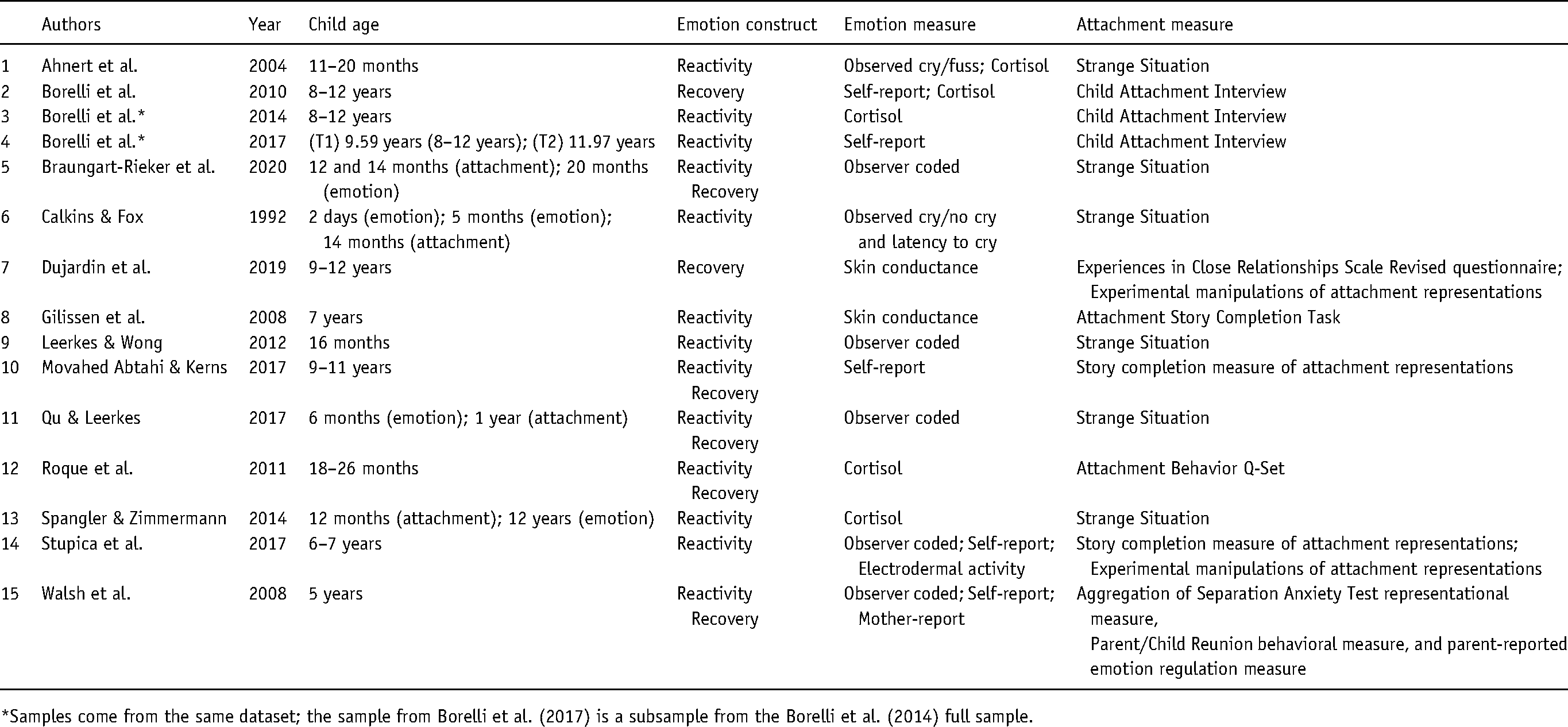
*Samples come from the same dataset; the sample from Borelli et al. (2017) is a subsample from the Borelli et al. (2014) full sample.
Note that testing our hypotheses regarding attachment and emotion dynamics requires in the moment, across time emotion assessments. Studies have included a diverse set of measures, such as self-reports of affect, observer coding of facial expressions, and several physiological indicators that were interpreted as capturing emotion processes. It should be noted that the physiological indices utilized in prior studies are varied and cannot be directly compared as they capture different biological systems (e.g., parasympathetic versus sympathetic systems; HPA activation). Our review includes self-reports of affect and observer coding of facial expressions. We limit our review of biomarkers of emotion to studies that measured changes in cortisol or skin conductance of electrodermal activity in response to the presentation or withdrawal of a stimulus as these measures have been conceptualized as indicators of stress reactivity, which are presumably linked to changes in emotion states. They are thus more indirect measures of emotional reactivity and recovery, but we included them to see if these biomarkers showed results similar to more direct measures of emotions.
Parent–Child Attachment and Emotion Reactivity
None of the studies designed to elicit positive emotion included a baseline assessment, so the review focuses on emotional reactivity of negative emotions. Several studies assessed distress reactivity or other indicators of negative affect, and so we roughly organized findings by emotion reactivity measure (e.g., observational and self-report before physiological indicators) and age. We begin by first reviewing evidence for emotion reactivity and attachment security before reviewing evidence specific to insecure attachment patterns.
Several studies examined changes in affect from before to after an event to index emotion reactivity. Securely attached 16-month-old infants were less distress reactive than resistant infants but were more distress-reactive than avoidantly attached infants in a laboratory study designed to elicit frustration and fear (Leerkes & Wong, 2012). In a laboratory study of newborns (Calkins & Fox, 1992), secure babies were less distress reactive than insecure babies; however, when individual attachment classifications (secure, avoidant, resistant) and distress reactivity (i.e., pacifier withdrawal and arm restraint) at 2 days and 5 months in the same sample were compared, no significant relations were found. In a laboratory study using the Still Face Paradigm (Braungart-Rieker et al., 2020), secure 20-month-old toddlers did not differ from avoidant or ambivalent toddlers in expressed positive or negative affect after parents became unresponsive. In another study of 11- to 20-month-old toddlers transitioning from home to childcare with and without parents, secure children showed more crying at childcare than insecure toddlers, although they did not react more strongly to parent separation (Ahnert et al., 2004). In a laboratory study of 6- and 7-year-old children, children with dispositional attachment security (compared to dispositional insecure attachment) or those who underwent security priming (compared to happy and neutral priming conditions) demonstrated the fewest fearful faces (as coded by Ekman's Facial Action Coding System) in response to threatening stimuli (Stupica et al., 2017), although there were no significant effects for self-reported fear. In a laboratory study of 5-year-old children (Walsh et al., 2008), no link was found between secure attachment and distress or pain reactivity to a shot. In a home-based study of children 9 to 11 years old who participated in the Trier Social Stress Task for Children, attachment security was not related to positive and negative emotion reactivity as assessed with child self-reports (Movahed Abtahi & Kerns, 2017).
A few studies examined reactivity via changes in skin conductance or electrodermal activity. One laboratory study of 7-year-old children found that more securely attached children experienced lower electrodermal reactivity than insecure children during a public speaking task, the Trier Social Stress Trask for Children (Gilissen et al., 2008). Another laboratory study reported that school-aged children with dispositional secure attachment (compared to children with dispositional insecure attachment), as well as children primed with secure attachment (compared to happy and neutral priming conditions), demonstrated a significant decrease in electrodermal activity in response to fearful stimuli (Stupica et al., 2017).
Cortisol was another measure utilized in several studies to assess reactivity. Ahnert et al. (2004) found that both secure and insecure 11- to 20-month-old toddlers demonstrated significant increases in cortisol when making the stressful transition from home to childcare, though secure toddlers showed lower cortisol reactivity to this stressor than did insecurely attached toddlers. Similarly, secure 8- to 12-year-old children demonstrated a lack of stress reactivity as indicated by a decrease in cortisol levels from prestressor to poststressor in a laboratory paradigm where children were presented with vignettes depicting different states of vulnerability (e.g., sickness, physical pain, fear, and sadness; Borelli et al., 2014). When comparing cortisol levels, prestressor cortisol was comparable while poststressor cortisol was lower for secure children compared to avoidant children (Borelli et al., 2014). By contrast, securely attached toddlers (18–26 months) had greater pre-to-post cortisol reactivity to a laboratory fear-eliciting toy paradigm than insecurely attached toddlers (Roque et al., 2011), though not in a frustration-eliciting toy paradigm. These results suggest a quicker response to a fearful stimulus in securely attached children compared to insecurely attached children. No link was found between cortisol (stress) levels and secure attachment following a fear task in one laboratory study (Spangler & Zimmermann, 2014).
Taken together, the findings of studies investigating associations between secure attachment and emotional reactivity are quite mixed. There are studies showing that securely attached children are more reactive, less reactive, or no different in their emotional or physiological responses to distressing events. When differences are found, they tend to show that secure children differ from a specific insecure group (i.e., more reactive than avoidant children, but less reactive than ambivalent children).
With regards to the insecure patterns, more avoidantly attached children are predicted to show dampened emotion responses rather than reactivity (Cassidy, 1994), although Sroufe (1983) suggested avoidant children might show anger-driven reactivity. Leerkes and Wong (2012) found that 16-month-old infants classified as avoidant were less distressed than infants classified as resistant but comparatively more distressed than infants classified as secure in a laboratory-based study designed to elicit frustration and fear. In a laboratory study that assessed patterns of emotional responding, avoidant infants showed little change in emotion during the Still Face Paradigm (Qu & Leerkes, 2017). Calkins and Fox (1992) reported no significant relation between distress reactivity and individual attachment classification (avoidant, secure, and resistant) for both 2-day-olds and 5-month-olds in a laboratory study. Avoidant 20-month-old toddlers were not different from secure or ambivalent toddlers in their responses to decreased parental responsiveness in a laboratory-based Still Face Paradigm (Braungart-Rieker et al., 2020). Furthermore, there was no relation between attachment avoidance and pain reactivity or anger level in a laboratory study of 5-year-old children (Walsh et al., 2008). More avoidantly attached children in middle childhood also self-reported experiencing little negative emotion during the Trier Social Stress Task for Children compared to less avoidantly attached children in a home-based study (Movahed Abtahi & Kerns, 2017). Similarly, Borelli et al. (2017) found that high dismissing (avoidant) children did not differ from low dismissing children in self-reported change in state anxiety from baseline to postparticipation in a laboratory Trier Social Stress Task for Children in a sample of 8- to 12-year-olds. Based on an overlapping dataset, Borelli et al. (2014) also reported that avoidantly attached children show a lack of reactivity evidence by no change in cortisol response from prestressor to poststressor when presented with vignettes of different states of vulnerability (i.e., sickness, pain, fear, and sadness) in the laboratory. There are no studies, to our knowledge, examining emotion reactivity in avoidantly attached children using skin conductance. Most studies suggest that avoidant children are less prone to show emotional reactivity in response to distressing events.
More ambivalently attached children are expected to react strongly to stress by using emotion-heightening strategies (Cassidy, 1994). Infants classified as resistant showed significantly greater distress than infants classified as secure and avoidant in frustration-eliciting and fear-eliciting laboratory tasks (Leerkes & Wong, 2012; Qu & Leerkes, 2017). Furthermore, more ambivalently attached children demonstrated greater pain reactivity as measured by both facial coding of pain during needle injection and mother-reported reactivity to everyday pain experiences compared to less ambivalently attached children in a laboratory study of 5-year-old children (Walsh et al., 2008). In another home-based study, more ambivalently attached children showed increased self-reports of negative emotion during the Trier Social Stress Task for Children compared to less ambivalently attached children (Movahed Abtahi & Kerns, 2017). By contrast, ambivalent 20-month-old toddlers were not different from secure or avoidant toddlers in their responses to decreased parental responsiveness in the Still Face Paradigm (Braungart-Rieker et al., 2020), and Calkins and Fox (1992) also found no significant relation between individual attachment classification (resistant, secure, and avoidant) and distress reactivity in newborns and young infants. We found no studies investigating emotion reactivity in ambivalently attached children via skin conductance or cortisol levels. Thus, most but not all studies showed that ambivalent children show greater emotional reactivity in response to experiencing distressing events.
More disorganized children also are hypothesized to react strongly to situations that induce stress or negative emotions due to the inability to rely on the attachment figure and difficulties in regulating emotion (e.g., freezing or disengaging; DeOliveira et al., 2004). A laboratory study of 5-year-old children (Walsh et al., 2008) found that children with greater disorganized attachment demonstrated higher pain reactivity (per coded facial activity and mother report) during immunization and in the context of everyday pain experiences (mother report) compared to children with less disorganized attachment. To the best of our knowledge, no studies to date examined emotion reactivity in more disorganized children using skin conductance. More disorganized children did experience significant increases in cortisol following a fear task compared to more securely attached children (Spangler & Zimmermann, 2014), indicating they may be poor at regulating stress responses. There is therefore some evidence that disorganized children show heightened emotional reactivity in response to distressing events, although the evidence is extremely limited.
To summarize, these studies provide some evidence that emotion reactivity patterns are related to insecure child attachment patterns. These results should be interpreted with great caution due to a limited number of studies and some potential limitations in study methods. For example, some of the contexts utilized (e.g., vulnerability vignette paradigm; Borelli et al., 2014) may not be ideal for examining reactivity as they may not elicit strong emotion. Additionally, many studies relied on physiological indicators of reactivity. Cortisol and skin conductance cannot be directly compared given that they reflect different biological systems which themselves may be loosely correlated with changes in emotion. More studies that measure emotion directly (e.g., reported affect, observations of facial affect), as well as studies measuring all of the insecure attachment patterns, are needed.
Parent–Child Attachment and Emotion Recovery
Despite the interest in attachment and emotion, and despite the fact that emotion recovery is considered an indicator of the ability to regulate emotion, there are surprisingly few studies that have investigated secure attachment and emotion recovery. In a study of 20-month-old toddlers in a laboratory administration of the Still Face Paradigm (Braungart-Rieker et al., 2020), secure children showed increases in positive affect from the ignore to reunion interaction episodes. In another study of toddlers (18–26 months), securely attached children demonstrated a significant decrease in pre-to-post cortisol levels in response to a laboratory toy paradigm designed to elicit positive affect (following a negative affect inducing episode) compared to insecurely attached toddlers (Roque et al., 2011). In a study of children 9–11 years, following the completion of the Trier Social Stress Task, more securely attached children showed a greater increase in self-reported positive emotion compared to less securely attached children (Movahed Abtahi & Kerns, 2017). There were, however, no effects for negative emotion recovery in the same sample (Movahed Abtahi & Kerns, 2017), nor for pain recovery in another study (Walsh et al., 2008). In another laboratory study of 8- to 12-year-old children, securely attached children displayed greater recovery as evidenced by decreased cortisol levels and decreased self-reported state negative affect pre-to-post startle (Borelli et al., 2010). Although there are only a small number of studies, secure attachment has been shown to be related to emotional recovery, especially to indicators of positive emotion.
If more avoidantly attached children have a learned pattern of down-playing emotional experiences (Cassidy, 1994), they may show little reactivity thus decreasing the need for recovery (usually conceptualized as a decrease in negative emotion or increase in positive emotion following the removal of a negative-emotion stimulus). Studies of reported or observed emotion generally show little evidence for an association between avoidance and emotional recovery. For instance, avoidant toddlers did not show changes in emotion after the removal of a social stressor in a laboratory study (Braungart-Rieker et al., 2020). More avoidantly attached children compared to less avoidantly attached children did not show significant positive or negative emotion changes when a stressor was removed in a home-based study (Movahed Abtahi & Kerns, 2017). There was also no relation between attachment avoidance in young children and pain recovery (Walsh et al., 2008). Furthermore, avoidantly attached children (compared to securely attached children) showed a slower recovery from a laboratory threat paradigm as measured by cortisol levels prestartle to poststartle paradigm (Borelli et al., 2010). Dujardin et al. (2019) found in a laboratory study that avoidant children's emotion recovery depended on subsequent conditions: those who approached mothers showed greater emotional recovery as reflected in greater declines of self-reported negative affect and declines in skin conductance compared to children who avoided mothers in a computer task. Overall, the evidence suggests that avoidance is related to dampened emotional recovery responses.
More ambivalently attached children, due to learned difficulties in modulating emotion resulting from inconsistent responding by their attachment figures (Cassidy, 1994) and patterns of conflict and dysregulated affect with caregivers (Hans et al., 2000), may show poor emotion recovery. Ambivalent toddlers did not show greater or lesser emotional recovery in two studies (Braungart-Rieker et al., 2020; Qu & Leerkes, 2017), and another study found no relation between attachment ambivalence and pain recovery in young children (Walsh et al., 2008). In comparison, more ambivalently attached preadolescents did show recovery in terms of decreased self-reported negative emotion following the removal of a stressor compared to less ambivalently attached preadolescents in a home-based study (Movahed Abtahi & Kerns, 2017). In another laboratory study of children in middle childhood (9–12 years of age), more ambivalent children showed greater recovery of self-reported negative affect under some conditions compared to less ambivalent children, but ambivalent attachment was not related to changes in skin conductance (Dujardin et al., 2019). Thus, studies of young children do not find evidence of an association between ambivalence and emotional recovery, although studies with older children suggested that at least in some circumstances more ambivalent children might show greater emotional recovery.
Theoretically, it may be the case that more disorganized children will show little recovery after experiencing stress due to a lack of learned ability to regulate emotions (DeOliveira et al., 2004). In the one study of disorganization and emotion recovery, Walsh et al. (2008) found that greater attachment disorganization in young children was related to more time needed to calm following an acute pain experience (i.e., showed slower recovery) compared to children with less attachment disorganization.
In summary, despite strong arguments that securely attached children will be advanced in their ability to regulate emotions (e.g., Brumariu, 2015; Zimmer-Gembeck et al., 2017), there are currently very few studies that examine attachment and emotion recovery as assessed in real time. Although the small data base makes it difficult to draw conclusions, there is some evidence that securely attached children recover more readily after an emotional event, avoidant children show little change in emotion, the relation between ambivalence and emotion recovery may differ depending on child age, and disorganized children have difficulty with emotion recovery. Although a few studies measured both reactivity and recovery (e.g., Movahed Abtahi & Kerns, 2017; Qu & Leerkes, 2017; Walsh et al., 2008), it will be important in future studies to examine both within a single study, as these processes are closely linked. Finally, as was the case with emotional reactivity, it is also difficult to draw conclusions because studies have used diverse measures to index emotion processes that tap different underlying processes.
Conclusions and Future Directions
Prior reviews have established that attachment is related to trait-like, context-free measures of children's experiences with emotion and ER (Brumariu, 2015; Cassidy, 1994; Cooke et al., 2019; Groh et al., 2017; Parrigon et al., 2015; Zimmer-Gembeck et al., 2017). In contrast, few studies have incorporated an emotion flexibility perspective to examine how attachment is related to dynamic emotion indicators such as emotion reactivity and emotion recovery. Thus, we sought to evaluate these sparse yet informative articles in a comprehensive manner. Our systematic literature review of dynamic studies of emotion showed that secure attachment is more consistently related to emotion recovery than emotion reactivity. For insecure attachment patterns, the avoidant attachment was related to low emotion reactivity and recovery suggesting a pattern of dampened emotional responding, ambivalent attachment was associated with greater emotion reactivity but not consistently related to emotion recovery, and disorganized attachment was related to high reactivity and difficulties with emotion recovery. The findings suggest there may be meaningful differences in dynamic emotion responses for different insecure attachment patterns, although these conclusions are tentative as in most cases they are based on a small number of studies and samples.
It is interesting to compare these conclusions to those reached from meta-analytic reviews that focus on attachment and its association with trait-like emotion measures. Focusing first on attachment security, reviews of those literature works suggest that securely attached children are, generally, less likely to display negative temperament characteristics (Groh et al., 2017) or negative affect (Cooke et al., 2019) and are advantaged in ER as they are better able to manage emotions and use more adaptive coping strategies (Cooke et al., 2019). Our examination of studies that used dynamic emotion measures revealed that secure attachment is not consistently related to emotion reactivity, but it is related to emotion recovery. In addition to the latter finding being consistent with the conclusion from prior reviews that securely attached children show more adaptive ER (Cooke et al., 2019), our review also clarifies that enhanced ER for securely attached children is most likely due to the ability to recover emotionally following the removal of a negative experience rather than due to initial reactions to emotional events. Given that emotional recovery is central to everyday interactions, our findings further underscore the importance of building secure relationships. Long term, repeated experiences of emotional recovery may also help securely attached children build resilience to enhance their recovery from more serious stressors.
Meta-analytic reviews of avoidant attachment and trait-like measures of emotion have found that avoidant children show less positive emotion, have greater difficulty regulating emotion, and are less likely to rely on others for support (Cooke et al., 2019). Our review suggests that more avoidant children tend to show dampened emotional responses (low emotional flexibility) in response to immediate environmental condition changes. Taken together, findings based on both trait-like and dynamic indicators of emotion may suggest that avoidant children can successfully suppress emotions in the short term, which over time interferes with opportunities to learn more adaptive ER strategies, and thus they may at times be prone to dysregulated displays of emotions. It may also be that avoidant children have some deficiencies in identifying their emotions and respond by suppressing these undifferentiated feelings in the moment rather than engaging in adaptive ER.
The findings from trait-like meta-analyses of ambivalent attachment and emotion tend to show that more ambivalent children experience and express more negative emotion generally as well as when placed in distressing situations (Cooke et al., 2019; Groh et al., 2017). Our review of studies of ambivalent attachment and emotional reactivity and recovery suggest that ambivalent attachment is associated primarily with stronger emotion reactivity (heightened negative emotions) to negative events, and this is not limited to just interactions with caregivers. Interestingly, ambivalent attachment was not consistently related to emotion recovery. There was some evidence with older children that ambivalent children showed stronger emotion recovery, which in combination with the reactivity findings suggest that ambivalent children might be emotionally labile. Emotion lability is relevant to the construct of emotion instability, which encompasses rapid time-dependent changes in reported experiences of emotion (Ebner-Priemer et al., 2009; Houben et al., 2015). While it can be adaptive for emotions to change in response to context shifts, emotion instability reflects large shifts in emotion from one occasion to the next and is thought to reflect poor ER. Future research is needed to determine whether indeed children with ambivalent attachment experience emotion instability.
Finally, disorganized children have been shown generally to display less positive emotion (Cooke et al., 2019) and more negative emotion (Cooke et al., 2019; Groh et al., 2017). Our review extends those conclusions by suggesting that disorganized children may be both more emotionally reactive and less able to emotionally recover once a negative experience ends. The difficulty with both emotional reactivity and recovery might explain why children with disorganized attachment are at the highest risk (among the insecure patterns) for psychopathology (Lyons-Ruth & Jacobvitz, 2016). These conclusions are speculative given the small number of studies, but they point to the need for future studies to examine dynamic emotional responses of disorganized children to better understand whether their emotional difficulties are due more to how they generate or try to modulate emotional responses.
A dynamic emotion perspective necessarily has methodology implications. Measuring emotion concepts across time and context is difficult, which may be why so many studies assess children's emotions in a single context and/or at a single timepoint. Nevertheless, a focus on capturing the dynamics of emotion, including the ability to flexibly change in response to contextual changes, requires assessment of emotion across time and situations. We should note that there are additional studies not included in this review that evaluated how attachment is related to emotion in specific contexts, such as an anger elicitation task (Spangler & Zimmermann, 2014). These studies were not included in this review because they assessed emotion in a specific situation rather than capturing how emotion changes in response to context (e.g., did not assess changes from a measured baseline). We encourage researchers who have these types of data sets to consider doing additional coding and analysis to examine dynamic emotion constructs. Relatedly, we recommend that investigators design future studies of attachment and emotion so that they allow for studying changes in emotion across context. These contexts need not be lengthy (e.g., Movahed Abtahi & Kerns, 2017 examined changes in emotion during 5-minute-long tasks), but the key is to provide different contexts that allow for examination of affective and physiological changes in response to changing conditions. We also encourage researchers to include multiple indicators of emotion within the same study to understand emotion flexibility in a comprehensive manner.
In addition to considering context, a multimethod approach is also necessary to fully capture emotion as emotion is experienced across multiple channels, including subjective experience, facial emotion, and physiological responses (Rosenberg, 1998). Some studies (e.g., Borelli et al., 2014; Movahed Abtahi & Kerns, 2017; Stupica et al., 2017) included multimethod assessments of emotion, but others only included one type of measure. Additionally, some studies relied on self-reported emotion data, reported either in the present or retrospectively. This leads to concerns which are inherent to self-reported data in general but is also at odds with the idea that most emotion processes (e.g., ER) occur at least to some extent outside of our awareness in an automatic, implicit manner (Mauss et al., 2007). Self-report data can still be useful, especially when collected during multiple timepoints, but should be supplemented by other measurements of emotion rather than the only method. Facial emotion is one indicator of emotion that can capture changes in an individual's emotion in real-time when assessed multiple times throughout a task (Coifman & Almahmoud, 2016). Similarly, physiological methods allow for examining changes in the central nervous system that may correlate with and indirectly reflect changes in emotion (see Zisner & Beauchaine, 2016 for a comprehensive review). Overall, multimethod measurement is critical as it provides greater depth and breadth of information about emotion.
Another suggestion for future research is greater attention to the situations in which emotion is assessed. Many studies examined children's emotions with parents, and future research could examine attachment and emotion flexibility in the context of social interactions with other partners. This is particularly relevant for older children given the expansion of social connections and interactions during middle childhood (Bosmans & Kerns, 2015), and the ability to self-regulate emotion is likely to have implications for children's peer relationships. Varying contexts also allows for testing whether attachment is more highly related to emotional responding in interpersonal contexts, as proposed by Groh and Narayan (2019). It will also be important to give more attention to the nature of emotional stimuli. Fear has been the primary discrete emotion studied to date. A discrete emotions perspective would suggest that there are likely to be differences in patterns of response for different emotions, such as anger, sadness, or joy. In designing studies and constructing hypotheses, it will be important to consider that the context sensitivity rather than the valence of an emotion determines its adaptiveness.
Our review also revealed that there is scant research in the child attachment literature on positive emotions from a dynamic emotion perspective. Positive emotions are hypothesized to be agents that “broaden and build” one's abilities to grow, gain knowledge, and lead to greater health and odds for survival (Fredrickson, 2001, 2013), and thus they may be one mechanism by which more securely attached children develop greater social and emotional competencies. Experiences of positive emotion in relationships can also produce upward spirals of positive emotion (Ramsey & Gentzler, 2015), and some complex positive emotions such as gratitude might be fostered within attachment relationships (Obeldobel & Kerns, 2021). Attachment might also play a role in how positive emotions change with context. For example, in a study of college students, securely attached individuals were more likely to engage in behaviors such as marking events that serve to amplify or sustain experiences of positive emotions (Gentzler et al., 2010), and in a study of early adolescents, greater attachment security to fathers was marginally related to greater savoring of personal positive events (Gentzler et al., 2013). Thus, children with secure attachments may show slower recovery after experiencing events that induce positive emotions if they make active efforts to savor those experiences or if they are more prone to remembering experiences of positive emotion (e.g., Belsky et al., 1996). There is a need for more research to investigate how attachment is related to dynamic changes in emotion and what processes might explain any changes in emotion.
An additional consideration for future work is demographic diversity. Some of the reviewed studies in the present paper were from Canadian and European samples (e.g., Ahnert et al., 2004; Gilissen et al., 2008; Roque et al., 2011; Spangler & Zimmermann, 2014), although the majority included samples from the United States. Within United States samples, some were ethnically diverse (Borelli et al., 2017; Qu & Leerkes, 2017; Stupica et al., 2017), though the majority of reviewed studies included primarily White/European American samples. Given that Western, Education, Industrialized, Rich, Democratic (WEIRD) child samples are not ideal for generalizing results to other groups (Henrich et al., 2010), and that parental emotion socialization strategies can differ across racial-ethnic identities (e.g., Perry et al., 2017), we suggest that future research continues to examine emotion reactivity and recovery in diverse child samples. It is also possible that effects for attachment and emotion reactivity and recovery could vary depending on cultural norms regarding emotion (e.g., emotion reactivity effects might be smaller in cultural contexts where children are generally expected to dampen expressions of negative affect).
Finally, it is important to consider the associations between attachment and emotion dynamics in the context of other factors such as child temperament. It is possible that child temperament, rather than secure attachment, is more strongly related to children's emotional reactivity (see Brumariu & Kerns, 2013), whereas secure attachment may be more likely to have implications for children's ability to recover from emotions than for how intensely they respond to emotionally laden events. In addition, attachment and temperament might interact to impact children's emotion flexibility. For example, difficult temperament might be less highly related to emotion reactivity for children who are securely attached. Furthermore, previous studies have found a moderation effect of temperament and attachment on ER in infants (Horton et al., 2015; Kim et al., 2014). Additional studies that assess attachment, temperament, and emotion dynamics across childhood are needed to test these hypotheses.
In summary, research investigating links between attachment and emotion has grown a great deal in recent years, and both attachment and emotion have important implications for child development, particularly in the area of psychological health. Incorporating an emotion dynamics perspective will allow researchers to explore how attachment is related to the flexible display of emotion across time and contexts. Our review indicates a need to study emotion recovery as well as reactivity. A dynamic perspective also requires multiple assessments and can be studied using multiple methods. We hope that by incorporating the recommendations of this paper, this promising field will grow our understanding of the interconnections between attachment and emotion and the implications of these factors for critical developmental outcomes in children.
Footnotes
Acknowledgement
The authors wish to thank Kaela Stuart-Parrigon for her valuable insights that made this publication possible.
Declaration of Conflicting Interests
The author(s) declared no potential conflicts of interest with respect to the research, authorship, and/or publication of this article.
Funding
The author(s) received no financial support for the research, authorship, and/or publication of this article.
