



Abstract
Personal and social norms are well-established predictors of proenvironmental behavior, and past research often discusses the motivational properties of different norms. However, less research has examined how individuals feel after conforming to, or deviating from, a norm. We suggest that emotions may function as norm enforcement tools that reward conformity and punish deviance. As a starting point, we outline the emotions that individuals may experience when conforming to, or deviating from, different norms (i.e., personal norms, descriptive social norms, injunctive social norms), and how these emotions can influence proenvironmental behavior. More research is needed to clarify how emotions facilitate, and possibly mediate, the influence of norms on proenvironmental behavior.
Psychological research has clearly established the important role of normative beliefs in proenvironmental behaviors (PEB) (Bamberg & Möser, 2007; Cialdini & Jacobson, 2021; Schultz, 2022; Thøgersen, 2006). Broadly speaking, individuals judge their behavior on whether it is consistent with their personal values and morals, and how it compares to what others do and what others would approve of doing. While research on normative influence often discusses the motivational properties of different norms, fewer studies articulate the emotions that coincide with, and underlie, those norm-based motivations (Cialdini et al., 1991; Schwartz & Howard, 1981; te Velde & Louis, 2022). This overlooks what may be an important function of emotions: to reinforce conformity and punish deviance.
Intuitively, it seems clear that we experience emotions when we conform to, or deviate from, a norm. Imagine receiving your monthly energy bill and discovering that your carbon footprint was 33% smaller than the neighborhood average—that probably feels good. Alternatively, imagine dumping a month's worth of household recycling into the trash—that probably feels bad. According to socio-functionalist theories of emotion (Frijda & Mesquita, 1994; Smith & Ellsworth, 1985), these good and bad feelings likely influence what we do next: do we stop trying to reduce our carbon footprint because we have done enough? Or do we try harder? In this way, emotions are critical for understanding the influence of norms on behavior.
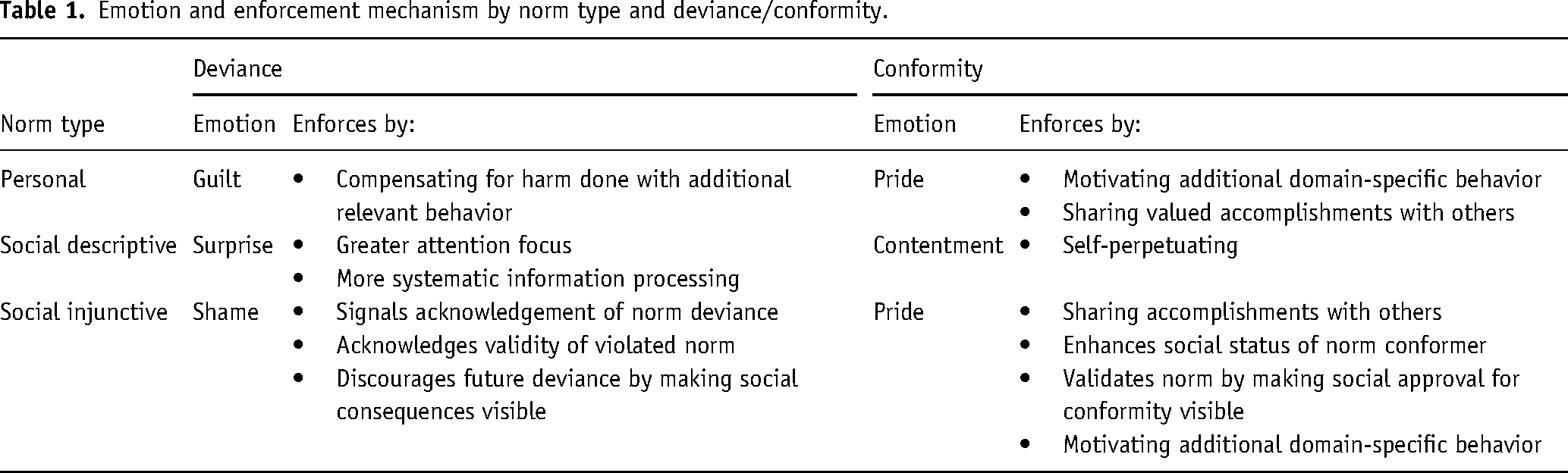
As a starting point for exploring how emotions reinforce norms, we offer a 2 (norm conformity, norm deviance) × 3 (norm type: personal, social descriptive, social injunctive) conceptual framework that identifies potential emotions that individuals may experience when they compare their own behavior to normative referents, and how these emotions can motivate subsequent PEB (see Table 1).
Emotion and enforcement mechanism by norm type and deviance/conformity.
Guilt and Personal Norm Deviance
Personal norms motivate behavior because they are imbued with a moral obligation to act (Schwartz & Howard, 1981; Skitka et al., 2005). Deviating from these personal standards elicits guilt. In fact, a defining characteristic of guilt is an appraisal of personal responsibility for violating a personal norm (Tangney et al., 2006). Furthermore, guilt is associated with reparative action tendencies, whereby it motivates individuals to compensate for the harm they may have caused (Haidt, 2003). By predisposing individuals to correct their norm-deviant behavior, guilt reaffirms the personal importance of a personal norm, and it returns individuals to a state of greater norm compliance.
Pride and Personal Norm Conformity
Individuals feel pride when they appraise themselves as achieving a socially valued outcome (Mascolo & Fischer, 1995), or “when they have lived up to some ideal self-representation” (Carver et al., 2010, p. 698). Relative to other positive emotions, pride is unique because it motivates additional domain-specific behavior, particularly when that behavior requires some personal costs (Tracy & Robins, 2007; Williams & DeSteno, 2008). This is especially relevant to sustainability efforts. Proenvironmental action often requires individuals to make personal sacrifices—for example, eating less meat, taking shorter showers, or reducing personal vehicle use. These sacrifices are made for uncertain, diffuse benefits in the future, even when others engage in environmentally unfriendly behavior (see Sparkman et al., 2021). Thus, pride helps us feel good despite, or possibly because of, the immediate sacrifices it requires. Feeling good about achieving norm-congruent outcomes also heightens the salience and personal relevance of that norm, encouraging future norm conformity (Aquino et al., 2009; Hofmann & Fisher, 2012; Williams & DeSteno, 2008).
Shame and Injunctive Social Norm Deviance
Injunctive social norms reflect beliefs about behaviors that are approved or disapproved by others. Conforming to injunctive norms grants social rewards (e.g., improved social status) and deviating from injunctive norms prompts social punishments (e.g., rejection, loss of status; Cialdini et al., 1991). Deviating from injunctive norms often elicits shame (Fessler, 2007; Suhay, 2015). Individuals who feel ashamed have a heightened focus on how others will evaluate their norm deviance, and how that will negatively impact their social image (Tangney et al., 2006). This also highlights the norm-enforcing functions of expressing shame: (a) it exposes others to the social consequences of norm deviance, and (b) it acts as an appeasement to other group members—by acknowledging responsibility for injunctive norm deviance, individuals hope to reduce the severity of the social punishments they incur (Fessler, 2007; Schaumberg & Skowronek, 2022). While shame often coincides with attempts to withdrawal or hide (to save face), it can motivate reparative behavior if individuals are aware of tangible methods of improving their social image (de Hooge et al., 2010). Committing to future norm conformity may be one way to repair damage to a person's social image, while also reinforcing that injunctive norm.
Pride and Injunctive Social Norm Conformity
Similar to personal norms, individuals are likely to feel proud when they conform to injunctive social norms (Suhay, 2015). Pride also serves important social functions. Feeling proud motivates individuals to share their norm-conforming achievements with others (Mascolo & Fischer, 1995; Tracy & Robins, 2007). This increases the likelihood that an individual is “rewarded” for their behavior. Furthermore, and similar to the functions of shame, the tendency to publicize socially valuable behavior heightens the salience of the norm in question, and it broadcasts the benefits of conformity to others (Tracy & Robins, 2007).
Surprise and Violated Descriptive Norms
Surprise corresponds to appraisals of violated expectations and uncertainty, and it motivates greater attentional focus and information processing of a surprising event (Reisenzein et al., 2019; Stavraki et al., 2021). We expect something similar to occur when individuals violate a descriptive norm. Because descriptive norms are beliefs about the extent to which an attitude or behavior occurs within a group, deviating from a descriptive norm does not elicit immediate social approval or disapproval (Cialdini et al., 1991). Instead, it warrants additional investigation to determine the context of a person's deviance (e.g., did they engage in a behavior more or less than the group), and the potential consequences for doing so. For example, after learning that you use less water than your neighbors, you may infer that such water conservation is consistent with a proenvironmental personal norm—in which case, you may continue conserving water, despite it being contrary to the descriptive norm. Alternatively, you may infer that such water conservation explains why your grass is always more yellow than other neighbors’—now, you might increase your water use to conform to the descriptive norm. In other words, greater scrutiny of norm deviance may reinforce a descriptive norm, or it may make other norms more salient.
Contentment and Conforming to Descriptive Norms
Individuals are motivated to conform to descriptive norms because this “wisdom of the masses” usually offers a reasonable, effective choice (Cialdini et al., 1991). To our knowledge, no research has investigated the emotional consequences of descriptive norm conformity. However, we suspect it would elicit something like contentment—a low-arousal, positive emotion associated with appraisals of goal attainment and feeling safe and satisfied (Gilbert et al., 2008; Tong, 2015). Importantly, contentment is distinct from other emotions discussed here in terms of its action tendencies: contentment elicits inaction or behavioral deactivation (Lazarus, 1991). This is particularly relevant for strengthening descriptive norms. If conforming to a descriptive norm makes individuals feel content, no additional information processing or attention is necessary. In turn, descriptive norms become self-perpetuating. Individuals are motivated to do what others are doing because others are doing it, while feeling content signals that conformity is sufficient and satisfactory, increasing the likelihood of future conformity (te Velde & Louis, 2022).
Future Directions
Knowing how emotions facilitate and reinforce norms is critical for designing effective proenvironmental interventions, and for sustaining PEB. Guilt is well-known for its positive impact on PEB (see Shipley & van Riper, 2022), and it typically mediates the effects of norms on behavior (Adams et al., 2020; Bamberg & Möser, 2007; Mallett, 2012). However, in the absence of proenvironmental personal norms, guilt appeals are ineffective (Wonneberger, 2018), and they may instead trigger reactance or defensiveness rather than increased environmental engagement (Bessarabova et al., 2015; Graton et al., 2016). Future emotions research can elucidate the recursive relationship between guilt and personal norms, as well as the contexts in which inducing guilt is more likely to elicit greater PEB.
Pride is associated with greater PEB, and it often mediates the effects of personal norms on PEB (e.g., Antonetti & Maklan, 2014; Onwezen et al., 2014; Schneider et al., 2017). However, precisely because pride is associated with adhering to personal (often moral) standards, individuals may perceive their moral self-concept as more secure when they feel proud. That is, engaging in sufficient PEB may “license” individuals to behave in a less environmentally friendly way without harming their self-concept (see Merritt et al., 2010). For example, Meijers and colleagues (2015) found that after donating to a local charity, participants reported significantly less proenvironmental intent, compared to those who did not donate to charity. Future research can help specify the boundary conditions of pride's positive influence on PEB, and in what contexts pride is more likely to increase or decrease subsequent behavior.
Despite the strong, consistent impact that descriptive norms have on PEB, we know relatively little about how descriptive norms make us feel. Future research can test whether our conjectures about surprise and contentment are correct, and whether low-arousal emotions like contentment, or neutral-valenced emotions like surprise, influence descriptive norm conformity similar to how guilt and pride influence conformity to personal and injunctive norms.
Finally, while it is beyond the scope of the present paper, our conceptual framework could be extended to the behaviors of others. For example, reading about others who engage in environmentally destructive behavior may elicit outrage among individuals with proenvironmental personal norms (Landmann & Rohmann, 2020). Similarly, ingroup perpetration of environmental harm may elicit collective guilt or shame (e.g., Ferguson & Branscombe, 2010; Iyer et al., 2007). Furthermore, ingroup PEB may elicit feelings of collective pride (Harth et al., 2013), but feeling proud about ingroup PEB also risks reducing proenvironmental intent among individual members (see Meijers et al., 2019). More research is needed to clarify how the behavior of others can influence the emotions of individuals, and how collective emotions differ from personal emotions in predicting proenvironmental action.
Footnotes
Declaration of Conflicting Interests
The authors declared no potential conflicts of interest with respect to the research, authorship, and/or publication of this article.
Funding
The authors received no financial support for the research, authorship, and/or publication of this article.
