



Abstract
While the economic and environmental impacts of Radio Frequency Identification (RFID) deployments have been extensively studied, their effects on employee working conditions, remain largely unexplored in the literature. This paper addresses this gap by proposing a methodology to quantify the social sustainability of RFID deployments. The methodology employs two key indicators derived from a questionnaire administered to employees utilizing RFID technology in their daily tasks. The first indicator, adapted from the Net Promoter Score (NPS), measures employees’ propensity to recommend RFID implementation. The second is an analytic index, based on a modified Technique for Order Preference by Similarity to Ideal Solution (TOPSIS), which assesses the impact of RFID systems on four pillars: empowerment, enrichment, engagement, and manage & control. A case study of a fashion retail company that implemented RFID technology across its retail stores and headquarters validates the methodology. Results demonstrate that RFID deployment led to significant improvements in all four dimensions, notably increasing employee satisfaction, collaboration, support, commitment and productivity. Indeed, results show that employees who are using RFID in their daily work would recommend the adoption to friends and colleagues who do not. This general-purpose framework can be applied to any organization implementing RFID technology, providing a valuable and extensible tool for assessing the ‘People Return on Investment’ (PROI).
Introduction
Radio Frequency Identification (RFID) technology has gained considerable attention over the years due to its transformative impacts across various supply chains areas (procurement, operations, distribution and logistics, retail) in diverse industries.
RFID uses radio waves to automatically identify and track objects. This is achieved through the interaction of three main components. (1) The tag, which contains a chip and an antenna to store and transmit information. The tag, integrated into labels, hard tags or other formats, has enabled various applications. (2) The RFID reader, which emits radio waves to energize tags, capturing the stored data. (3) Backend middleware software manages analyses and shares the collected data.
The global RFID market is experiencing significant growth, driven by increasing demand for automation, inventory management, and supply chain visibility.
UHF RFID accounts for a major portion of this growth, due to its longer read range, faster data transfer rates, and lower costs, especially for tags, compared to other RFID frequencies.
UHF RFID enables the most relevant use cases, such as follows: • Process automation (Shekhawat, 2024), streamlining workflows, reducing labour, and preventing errors (Ma et al., 2022). • Inventory management (Kim et al., 2015), improving accuracy (Mezzogori et al., 2024), reducing stockouts, and optimizing inventory levels across the supply chain (Shahid & Naveed, 2020). • Shrinkage reduction and loss prevention, deterring theft, reducing losses (Aliakbarian et al., 2024), and improving security in retail and other environments (Purandare & Aliakbarian, 2023). • Supply chain visibility, tracking goods in real-time, improving traceability (Qiao et al., 2023), and enhancing efficiency across the supply chain (Othman et al., 2025). • Grey and black-market fighting, combating counterfeiting (Mengfan et al., 2019), ensuring product authenticity, and protecting distribution channels (Dobrykh et al., 2022). • Customer experience, enabling personalized experiences, enhancing customer engagement, and improving satisfaction in retail and other settings (Chin & Chiu, 2023).
In 2024, an estimated 53 billion UHF RFID tags were shipped globally (RAIN Alliance, 2025). This highlights the widespread adoption of this technology across various sectors, fashion and apparel leading the way. Notably, three-quarters of all RFID tags are utilized within this industry (Chang & Das, 2024), which, according to Rogers’ technology adoption curve (Rogers, 1995), has reached the early majority phase and is approaching the tipping point of 50% adoption.
However, other industries are recognizing the RFID potential and are at different stages of adoption.
RFID is gaining traction for tracking tyres throughout their lifecycle, from manufacturing to recycling, improving inventory management, tracking and tracing, reducing labour and preventing errors. Michelin, for instance, has been a prominent advocate and early adopter of RFID in the tyre industry, showcasing its potential benefits (Michelin, 2024). With an estimated 2.3 billion tyres produced globally each year in 2025, the potential for RFID adoption in this sector is vast.
Driven by IATA Resolution 753, which mandates airlines to track baggage at key points in the journey (IATA, 2024), RFID is becoming increasingly prevalent in airports for baggage handling, reducing mishandling rates, and improving efficiency. Major airlines like Delta Air Lines, have implemented RFID baggage tracking systems (Lentsch, 2017), while airports such as Hong Kong International Airport have invested in RFID infrastructure to improve baggage handling and passenger experience (Peng, 2023).
In the Pharma and Medical Device industries, RFID plays a crucial role in ensuring drug authenticity, tracking (Saritha et al., 2024) and tracing medical devices (Lardon et al., 2023), linking them to patients and surgeries, improving patient safety (Mora et al., 2017). This sector is steadily adopting RFID, driven by regulatory requirements and the need for enhanced traceability (Claucherty et al., 2024). Systems like Johnson & Johnson Medical’s ‘Resolution’ demonstrate the technology’s impact in linking medical devices, patients, surgeons and surgeries, improving patient safety, inventory management and operational efficiency (Bianco & Rizzi, 2025).
Driven by mandates from major retailers like Walmart, requiring for RFID tagging on many product categories, and the surge of ecommerce in many retail industries, RFID is being increasingly used in retail for inventory management, to enhance product availability, reduce cancelled orders and improve order fulfilment by many major retailers (Swedberg, 2022).
These are just a few examples, and RFID adoption is expanding across various sectors, driven by the need for improved efficiency, accuracy, visibility, traceability, security and, last but not least, sustainability.
RFID and the Three Dimensions of the Sustainability
Sustainability has gained increasing global importance. Derived from the Latin word sustinere (to sustain), this word refers to meeting present needs without compromising the ability of future generations to meet their own (United Nations, 2024). This concept is central for addressing global challenges like climate change, resources depletion, and socio-economic inequalities. Sustainability is built upon three strongly intertwined pillars: environmental, economic and social.
Economic Sustainability
Economic sustainability focuses on creating a self-sustaining economic system in the long term, through efficient, inclusive practices, that generate prosperity without harming the environment or exacerbating social inequalities.
The main indicators for assessing the economic sustainability, commonly used by companies, are the Discounted Cash Flow (DCF), the Pay back Period (PBP), the Internal Rate of Return (IRR) and the Return on Investment (ROI). These financial indicators can be used independently or in conjunction, to derive complementary insights.
As far as RFID technology is concerned, the economic sustainability of RFID deployments has been widely addressed in scientific literature.
Several works are focused on it, demonstrating that the initial investment and the maintenance costs are repaid in the long term by the benefits of the technology.
In the fast-moving consumer goods (FMCG) sector, Bottani and Rizzi assessed the ROI in a three-echelon supply chain, consisting of manufacturers, distributors, and retailers (Bottani & Rizzi, 2008). The economic return on investment for each player and for the FMCG supply chain was evaluated. The authors demonstrated the economic sustainability of RFID deployment at the pallet level for each player, as well as for the supply chain as a whole, while case-level applications generate returns on investment for the entire supply chain, with the primary benefits accruing to the retailer.
In the retail industry, the pioneering research at the University of Arkansas has highlighted the significant economic benefits of RFID implementation in retail environments, primarily through the reduction of out-of-stock situations (Sandeep Goyal et al., 2016) and improved inventory accuracy (Hardgrave et al., 2009).
According to Brown and Russell, who conducted an exploratory investigation into RFID adoption in South African retail organizations, the return on the investment is realized in two years through increased operational efficiency, reduced losses and improved customer satisfaction (Brown & Russell, 2007). In fact, one of the main economic benefits of RFID is the improvement in inventory management through accurate and products’ real-time tracking: this translates into decreased product losses, as misplaced or stolen goods, and more efficient inventory management, resulting in lower operating costs (Gladysz et al., 2020). Moreover, the automation of data collection processes saves companies time and resources, increasing productivity and reducing the labour costs (Tajima, 2011).
Those results were confirmed also in Italy, where a sample of companies from different sectors were interviewed on the RFID implementation: they declared not only a favourable ROI but also a competitive advantage over competitors through the logistics processes automation and avoided stock out (Bottani et al., 2024). Moreover, the authors noted that corporate image also benefits the implementation: companies that use RFID are often perceived as more technologically advanced and competitive in the market.
Rizzi et al. presented a framework for classifying RFID economic use cases in fashion and apparel retail (Rizzi et al., 2016). Examining more than 160 RFID deployments, the authors identified 18 specific use cases across 6 categories. Their paper offers a comprehensive overview of RFID’s potential to impact both costs and revenues in the fashion and apparel industry.
A case study on route optimization for a logistics company demonstrates that the model can suggest improved routes, cutting total transportation costs by more than 25% in comparison to relying solely on RFID (Jing et al., 2024).
Therefore, besides these few but effective examples, it can be stated that, with proper planning and strategic implementation, RFID is positively linked to the economic sustainability of processes and companies can exploit the economic benefits improving also their market competitiveness.
Environmental Sustainability
Environmental sustainability concerns the protection and responsible management of natural resources. It focuses on conserving and utilizing natural ecosystems in a way that does not compromise their ability to regenerate. To this end, one of the goals is to reduce human environmental impact. This includes reducing greenhouse gas emissions, waste, and inefficient use of natural resources.
In this context, research has shown how RFID technology can actively contribute to enhancing environmental sustainability, for example, by reducing food and commercial waste through improved inventory tracking (Alfian et al., 2020), reducing unnecessary transport such as error-ridden routes or error repair, and decreasing greenhouse gas emissions (Aliakbarian et al., 2024). Furthermore, RFID adoption has been found to be an incentive for circularity, as the traceability and visibility offered can facilitate reuse, recycling and material recovery (Dahake & Pawar, 2025).
Of course, like all products, RFID itself generates an environmental impact, which is mainly related to tag manufacturing and transportation, involving energy consumption and the use of materials often of fossil origin (Chen & Hwang, 1992). The RFID tag impact may vary depending on its material and size (Ghirlandi et al., 2024). However, scientific literature proved that the RFID tag environmental impact is negligible compared to the environmental benefits induced by the RFID system. For example, the application of RFID in a food chain has been shown to reduce food waste, and these benefits are more than 5 times the impact originated by product tagging (Bottani et al., 2014). This study evaluates the environmental impact by means of a recognized methodology, namely, the Life Cycle Assessment.
In addition to the above-mentioned study, Ghirlandi et al. compared the environmental impact of plastic and paper-based RFID tags, demonstrating that paper tags are an eco-friendlier option, reducing greenhouse gas emissions by up to 23% (Ghirlandi et al., 2024).
In a previous publication, the authors developed a versatile framework to calculate the environmental impact of an RFID project deployment. This tool, called ‘return on the environment’ (EROI), is based on Life Cycle Assessment (LCA) methodology and balances the positive and negative environmental contributions of RFID adoption, measured in tons of CO2 equivalent per year. The EROI tool was validated through two applications in the pharmaceutical and medical device sectors (Aliakbarian et al., 2024). These case studies demonstrated that the environmental savings related to product shrinkage reduction (achieved by reducing inventory discrepancies, theft, and expired products due to incorrect shelf-life management) and reduced transport (due to fewer errors) significantly offset the environmental impact associated with RFID tag manufacturing and transportation and RFID data management.
This literature review demonstrates that methodologies and tools are available for calculating the environmental sustainability of RFID deployments. Companies can leverage these tools to assess the environmental impact of RFID technology applied to their products.
Social Sustainability
Social sustainability is about promoting social equity and the well-being of communities. It is based on the idea that a sustainable society must ensure that all its members have access to basic resources such as education, health, housing, and decent work. It also involves creating resilient and inclusive communities where people can live in harmony and prosper. This requires policies that promote social justice, gender equality and respect for human rights. Social enterprises and social innovation are important tools to achieve social sustainability. These initiatives aim to solve social problems through sustainable business models, creating a positive impact on the community.
ICT advancements have the potential to significantly impact job roles, leading to an enlargement of skills as employees adapt to new advanced tools and processes. By introducing new tools and technologies into the workplace, organizations can empower employees to take on more complex and engaging responsibilities This shift can facilitate a transition from low value-added tasks to higher-value activities, fostering a sense of personal growth, and therefore greater job fulfilment and satisfaction.
As far as RFID technology is concerned, unlike the economic and environmental dimensions of sustainability, the social impact of this technology does not appear to be researched in scientific literature. A quick analysis on a scientific database such as Scopus, using the keywords ‘RFID’ and ‘social sustainability’, yields only 5 results to date. In general, it shows how process automation made possible by RFID systems can reduce the workload of operators, improving working conditions (Ujjwal et al., 2024). Or how RFID systems can improve the transparency of supply chains, allowing consumers to have more information about the origin and history of the products they buy. However, no research provides a tool to calculate the social impact of an RFID system.
An interesting, but more general, article on the Information Technologies (IT) is that of Torkzadeh and Doll, who developed and validated a questionnaire to assess the impact of IT on workers through a systematic process.
The first step of their methodology was to identify four main dimensions of how IT: (1) improves task quality, efficiency and productivity, and objective accountability of responsibility (empowerment), (2) increases customer satisfaction through improved services (engagement), (3) facilitates innovation and creativity in work tasks (enrichment), (4) helps management in monitor and control operations (manage & control).
Subsequently, they developed an initial set of 39 items (questions/statements) covering these four dimensions, based on previous research and existing literature concerning IT and the work. The questionnaire was conducted on a large scale involving 409 participants.
Statistical techniques were used to analyse the collected data, such as factor analysis to verify the four-factor structure of the questionnaire and confirm that the items measured the intended dimensions, and the calculation of Cronbach’s Alpha to assess the internal consistency of each scale/dimension of the questionnaire. After statistical analysis, the number of items was reduced to 12, retaining those that had the highest scores in terms of validity and reliability. This reduction made the questionnaire more practical and easier to use without losing its ability to accurately measure accurately the dimensions of IT impact (Torkzadeh & Doll, 1999).
However, this article is generic and very outdated and, apart from that, there are no other systems available to date for assessing the social sustainability of a RFID system applied to any product in any sector.
To address the existing literature gap and facilitate a comprehensive sustainability assessment of RFID technology, this study develops a practical and up-to-date tool for evaluating its social dimension. The paper proceeds as follows: Section 2 details the adapted NPS and TOPSIS methodologies employed. Section 3 presents a real-world case study to demonstrate the tool’s applicability and outcomes. Finally, Section 4 concludes with key implications and future research directions for both academics and practitioners.
Materials and Methods
The proposed methodology calculates a synthetic index, the People Return on the Investment (PROI), to assess the social sustainability of RFID systems. While developed and tested in the apparel industry, the framework is generally applicable and easily adoptable to other sectors.
We propose two methodologies to evaluate the PROI, as described in Section 2.1. The first is a synthetic methodology, based on the well-known Net Promoter Score (NPS) (Reichheld, 2004), while the second is an analytical, multi-attribute methodology based on the modified Technique for Order Preference by Similarity to Ideal Solution (TOPSIS).
Both methodologies rely on the responses to a questionnaire regarding RFID implementation and its effects on working conditions. A retail sector case study, presented in Section 2.2, validates the general methodology.
Synthetic and Analytical Index for PROI Evaluation
Net Promoter Score
As mentioned above, the synthetic methodology employs the Net Promoter Score (NPS), introduced by Reichheld. The NPS measures customer loyalty and their likelihood of recommending a product or service (Reichheld, 2004), based on the question: ‘On a scale of 0 to 10, how likely are you to recommend this brand/product/service to a friend/colleague?’
Reichheld argued that it is the single most important indicator of a company’s growth. The way the NPS question is phrased elicits a personal endorsement, implying that the respondent is willing to put his/her own reputation on the line by recommending the product or service, thus contributing to valuable word-of-mouth marketing that attracts new customers and fuels business growth. Administered to a statistically significant sample, this question reveals the supply chain’s ability to deliver a combination of product/service that not only meets customer expectations, fostering loyalty, but also attracts new customers.
Respondents are categorized as detractors (0–6), passives (7–8), or promoters (9–10). Detractors are dissatisfied customers who may spread negative opinions and are likely to discontinue using the product/service. In the age of social media, detractors pose an even greater risk, as their negative opinions can rapidly spread and damage a brand’s reputation. Passives are satisfied but not enthusiastic enough to recommend, thus neutral; while they may not express negative opinions, they lack the loyalty to actively recommend the brand/product/service. Promoters are delighted customers who, not only continue to purchase, but also recommend the brand/product/service, acting as brand ambassadors.
The NPS ranges from −100% to +100%. A positive NPS suggests that a company has more promoters than detractors, indicating potential for sustainable growth. As demonstrated by Reicheld, there is a strong positive correlation between NPS scores and company growth rates across various industries.
In our application of the NPS to assess the social sustainability of RFID, the question is adapted to focus on the respondent’s work environment: ‘Based on the impact of your working conditions, On a scale of 0 to 10, how likely would you be to recommend to a friend/colleague in a similar position at a company without RFID, the introduction or suggestion of its deployment?’ This recommendation is based on the perceived impact of RFID technology on their work experience.
Respondents are categorized as P – promoters (9–10), N – neutral (7–8), and D – detractors (0–6), and the NPS is calculated (1).

A high positive NPSRFID indicates strong social sustainability of the RFID system within the company, while a low or negative NPSRFID suggests poor social sustainability impact.
TOPSIS
The second, more analytical, methodology uses a multi-attribute approach based on an original modification of the Technique for Order Preference by Similarity to Ideal Solution (TOPSIS).
This involves measuring the distance between positive and negative ideal solutions. TOPSIS, a linear weighting method, identifies the alternative closest to the positive ideal solution (the best) and furthest from the negative ideal solution (the worst) based on multiple criteria (Hwang & Yoon, 1981).
As a multi-attribute comparative technique, TOPSIS has been used in a wide range of fields, for example to select the most suitable supplier on the basis of cost and reliability (Opricovic & Tzeng, 2004), or service quality, flexibility, reputation using, for example, a fuzzy variant that allows handling the uncertainty typical of human judgement in supplier evaluation (Bottani & Rizzi, 2006). Again, it has been used to compare the most profitable investment opportunities based on criteria of risk and liquidity (Chen & Hwang, 1992), to select the most promising projects considering technical, environmental and social factors (Nesticò et al., 2022).
In this study, TOPSIS is employed to derive a synthetic numerical index for assessing the social sustainability of the RFID deployment, using data from the questionnaire described below.
This study draws inspiration from previous research on the social sustainability of Information Technology systems, which identified four key impact areas: (a) productivity, (b) customer satisfaction, (c) innovation, and (d) management control (Torkzadeh & Doll, 1999).
To develop a concise questionnaire, applicable in real business environment, the 39 questions from this earlier work were analysed, summarized, and adapted to the context of RFID technology deployments. Questions were selected to assess RFID’s influence on: • • • •
However, a key modification in this framework is that TOPSIS is not used for comparing alternatives, its typical application. Instead, it serves as a synthetic index to measure the distance from the positive ideal solution – representing the maximum positive impact of RFID implementation on the four attributes (empowerment, engagement, enrichment, and manage & control) – and the negative ideal solution, which represents the diametrically opposite scenario.
The resulting questionnaire comprises ten questions, each with a scale from 0 to 10 (where 0 represents ‘not at all’ and 10 represents ‘very much’), to be analysed using the TOPSIS methodology.
Additionally, to provide context for the results, respondents are asked to specify their job role (Figure 1). Structure of the questionnaire for the PROI evaluation.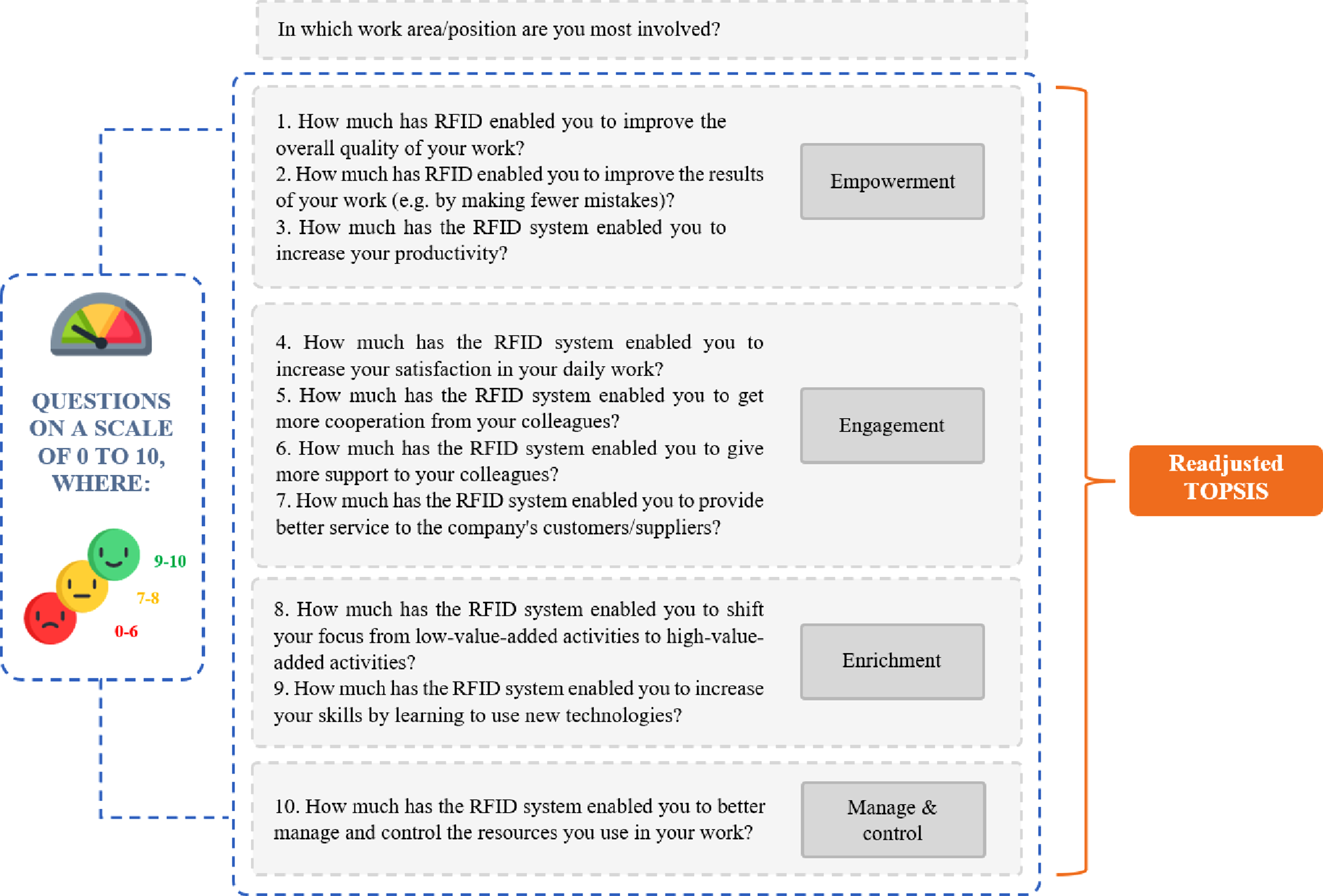
The modified TOPSIS procedure for calculating the social sustainability index of the RFID system was as follows: 1. 2. 3. 4. 5. 6. 7. 8. 9. 10.








Relationship Matrix With the General Methodology for the PROI Calculation

TOPSIS – Weights Calculation
Questions Weights
Weights for the ten questions from 1 to 10 must be established through a separate short questionnaire.
It is crucial to note that this questionnaire should be administered to a specific audience: C-level decision-makers, who are responsible for strategic choices regarding social sustainability within the company.
Respondents are asked to rate the importance of the ten items in Figure 1 for increasing social sustainability.
The question is phrased as follows: ‘Thinking about your work/company, with a view to increasing social sustainability, how important would you consider certain items?’ Express your opinion on a scale from 1 to 5, where 1 = ‘not at all important’, 2 = ‘not very important’, 3 = ‘neutral’, 4 = ‘important’, and 5 = ‘very important’.
Respondents then rate the ten items (corresponding to the criteria in Figure 1) using the Likert scale above.
The average score given by the respondents for each investigated criteria is calculated and then normalized.
The formula for calculating the average score for each item (AS
j
) can be written as:
Then, the formula for calculating the normalized score for each item j (NS
j
), which represents the item’s weight, can be written as:
Each normalized score NS j serves as the criterion weight for each question in the modified TOPSIS analysis.
Job Positions Weights
We assume that each employee’s perspective on social sustainability has to be considered equally important. Therefore, the job position weights are determined in two steps.
First, the proportion of responses from a given job position j relative to the total number of respondents should be calculated:
Second, P
j
should be divided by the total number of respondents in that area to obtain the Job Position Weight (JPW
i
) for each answer:
Validation of the Methodology: A Retail Case Study
To validate the proposed methodology for assessing the social sustainability of RFID, presented as a general framework, a retail case study was conducted.
To this extent, we selected Intrend, an apparel retailer that has utilized RFID technology for managing its retail outlet store operations since 2015.
The data collection utilized a questionnaire developed on Google Forms, which was distributed via email to employees across diverse operational areas, including commercial headquarters, retail stores (comprising store managers and assistant store managers), and logistics headquarters.
Concurrently, the supplementary questionnaire for determining criterion weights, as described in Section 2.1.2.1, was administered to a selected group of company C-Level managers.
Results and Discussion
A total of 80 responses were collected. The sample of respondents consisted of 31% shop personnel, 28% shop manager, 23% assistant store manager, 14% commercial headquarter and 5% logistics headquarter.
PROI Evaluation through the Net Promoter Score
Analysis of the responses to the first question (Figure 2): ‘Based on the impact of your working conditions, on a scale of 0 to 10, how likely would you be to recommend to a friend/colleague in a similar position at a company without RFID, the introduction or suggestion of its deployment?’ revealed 60 promoters (40 rating 10 and 20 rating 9) who would recommend the adoption of RFID technology. Fifteen respondents were classified as passives (3 rating 7 and 12 rating 8), while five were detractors (1 rating 0, 2 rating 5, and 2 rating 6). Analysis of the results for the NPS (0–10 scale).
Figure 3 summarizes the distribution of opinions based on respondent roles. It illustrates that all respondents in the commercial headquarters are promoters of RFID, 91% of store managers, 68% of store employees, 61% of assistant store managers, and 25% of logistics headquarters respondents. Detailed answers to the question ‘From 0 to 10, how much would you advise a friend/colleague, who holds a position similar to yours in a company that has not yet adopted RFID technology, to introduce or suggest its introduction?’
Neutral accounted for 28% of assistant store managers and store employees, 25% of logistics headquarters respondents, and 9% of store managers. Finally, detractors comprised 50% of logistics headquarters respondents (2 individuals), 11% of assistant store managers (2 individuals), and 4% of store employees (1 individual).
It is crucial to acknowledge that the sample size from the logistics headquarters, consisting of only four respondents, is notably small and, therefore, statistically limited. Consequently, any conclusions drawn from this group should be interpreted with caution. Nevertheless, the fact that a significant portion of these respondents did not perceive RFID as recommendable warrants further investigation, given the potential benefits of the technology within logistics operations. Post analysis revealed that before RFID, warehouse staff responsible for processing store returns performed only a cursory check based on transportation documents. With RFID, a detailed inspection of all returned items is now required, potentially contributing to an increased workload, which might explain the negative perception among some logistics personnel. Another plausible explanation is that some respondents classified as logistics headquarters may, belong to the IT department. If so, they might have been less directly impacted by the operational benefits of the project, further contributing to their less favourable perception of RFID’s social sustainability.
With 75% promoters and 6% detractors, the PROI calculated through the Net Promoter Score (NPS) was 69%, a positive result indicating strong social recommendation for the RFID system adoption within this case study.
This outcome also highlights the easy and practical applicability and consistent performance of the developed framework.
PROI Evaluation Through the TOPSIS
The answers to the ten questions about impact criteria are firstly analysed and described with graphs showing main statistics.
While the questions were scored on a 0 to 10 scale, applying the standard Net Promoter Score (NPS) categorization of 9–10 as promoters, 7–8 as passives, and 0–6 as detractors is inappropriate. This is due to the question’s phrasing, which did not ask ‘how likely would you recommend’, thus lacking the direct, personal endorsement inherent in NPS evaluations. However, to provide a positive, neutral, or negative connotation to the scale, as it was present in the questionnaire, we retained a green, yellow, and red colour coding for the respective score ranges.
Empowerment
The results show that the adoption of the RFID system within the analysed company was satisfactory for most of the respondents. In particular, 97% of them perceived an increase in the quality of the work performed, of which 68% gave it a 9–10 rating (Figure 4). Respondents’ opinion about RFID impacts on empowerment.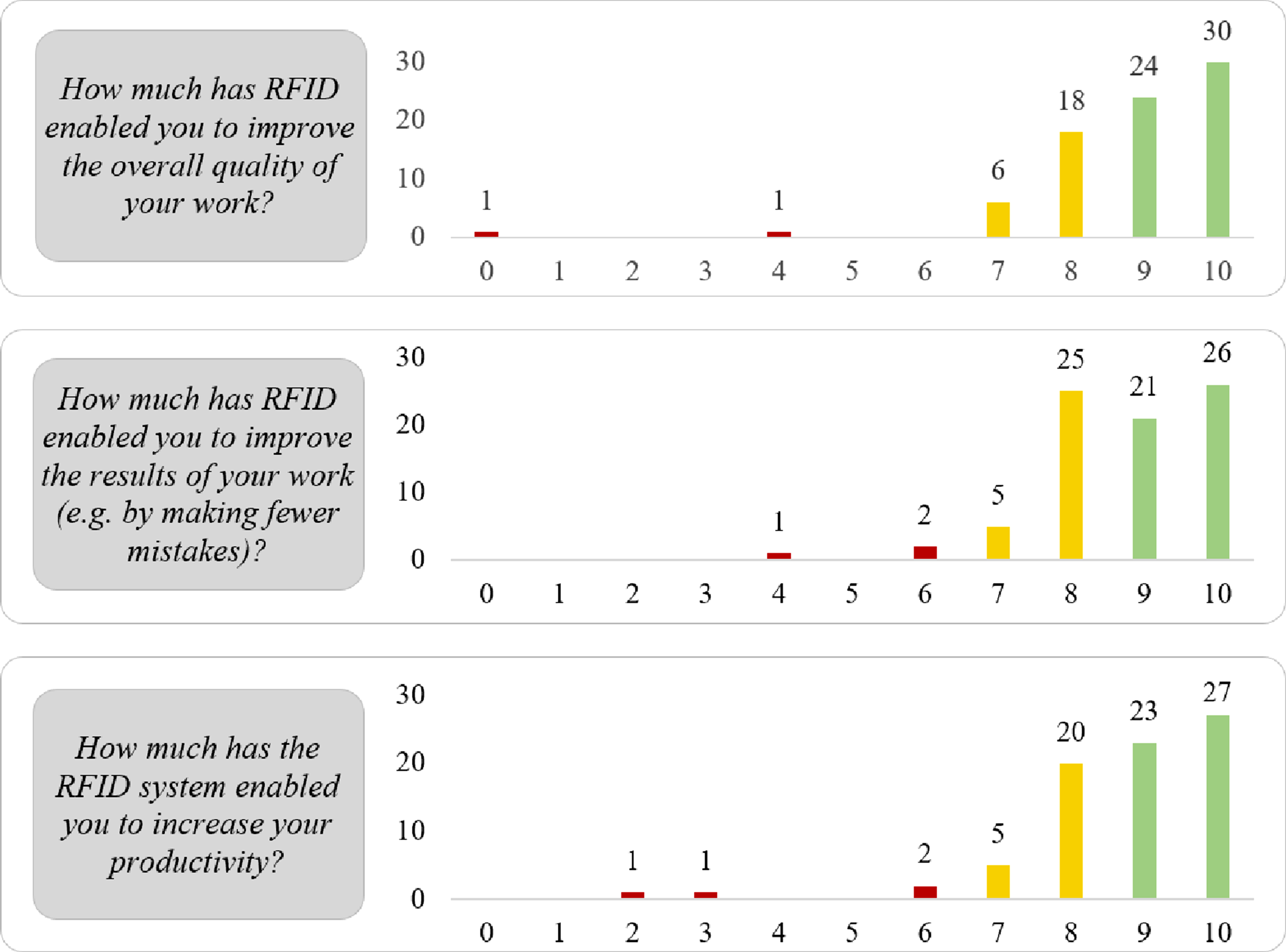
RFID system was also able to improve the results achieved by the workers, for example, by decreasing the errors made, according to 96% of the respondents. As a result, an increase in productivity was also recorded in 95% of the respondents.
Engagement
As a result, as Figure 5 shows, RFID has increased operators’ satisfaction in doing their job, becoming more collaborative with colleagues and being able to give them more support. Customer service has also improved and has no response below a rating of 6. Respondents’ opinion about RFID impacts on engagement.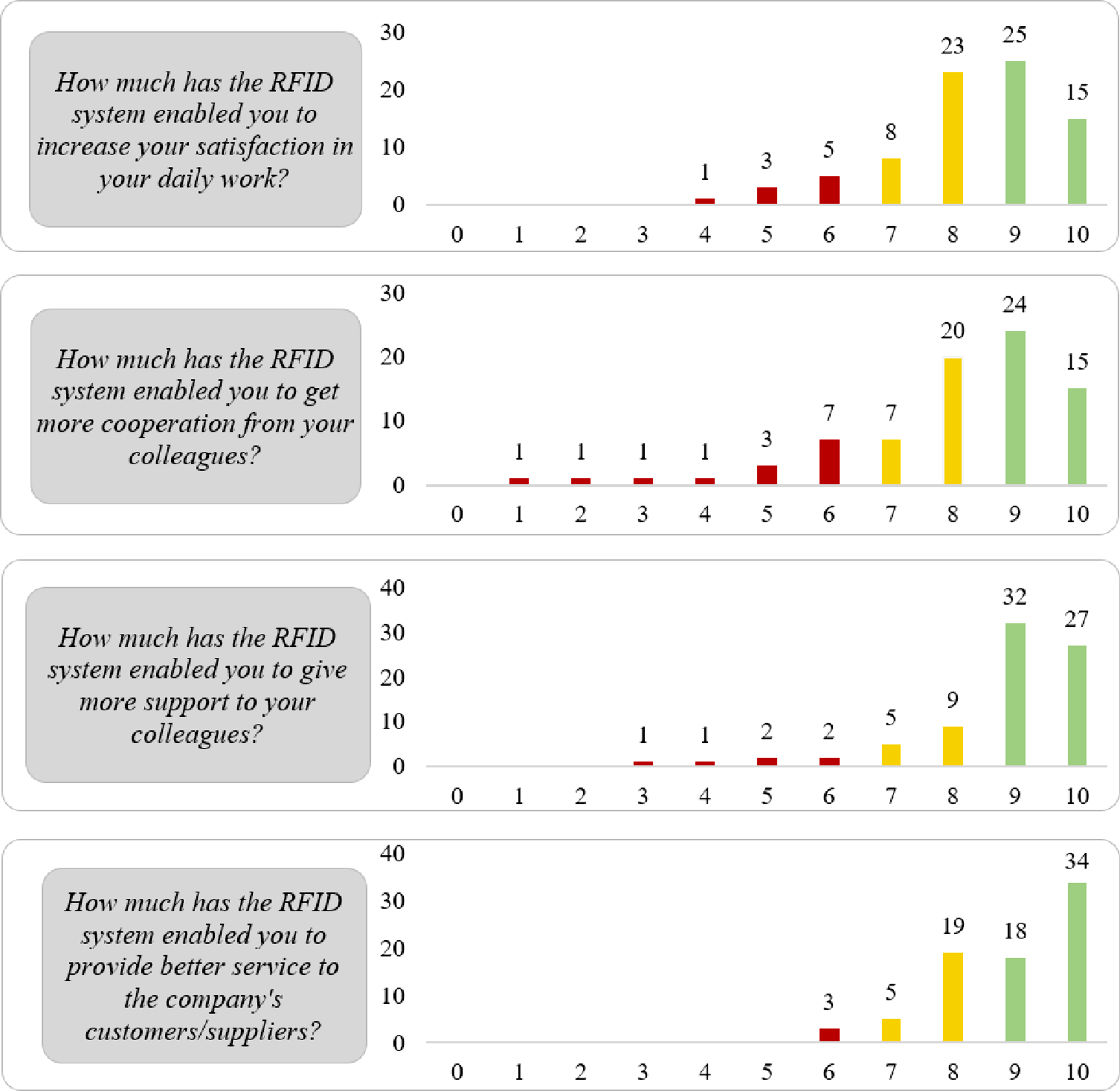
Enrichment
The overwhelming majority of respondents agreed that RFID enabled them to increase their professional competences by learning new skills and technologies (Figure 6). In this case, the highest number of scores 9 and 10 (76%) is registered. Furthermore, RFID has also facilitated the shift from low value-added activities (LVA) to high value-added activities (HVA) according to 92% of the respondents (considering answers 7–10), of which 61% were 9 and 10. Respondents’ opinion about RFID impacts on enrichment.
Manage & Control
Finally, 61% of the respondents stated that RFID enabled better resource management and gave a boost to control activities (Figure 7). Respondents’ opinion about RFID impacts on manage & control.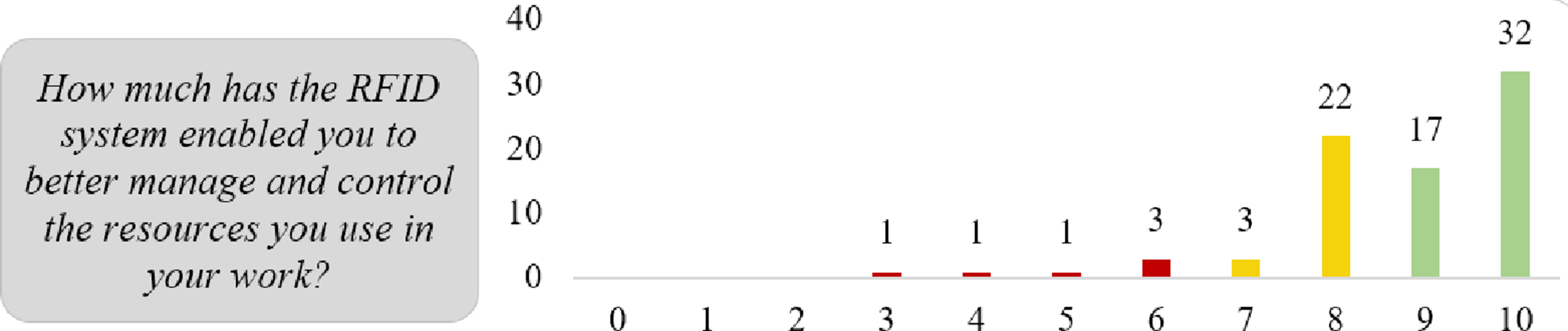
Having completed a general description of the main statistics of the collected responses, we leveraged them to calculate the analytical index to assess the environmental sustainability of the RFID deployment. The objective is twofold. On the one hand, we want to validate the developed framework and, on the other one, to evaluate the PROI, that is the social impact of RFID implementation through the assessment of its distance from both the positive and negative ideal solution.
Firstly, we calculated the weights of the job positions. Considering the 80 respondents and their mentioned job positions, following the calculation procedure illustrated in the methodological part, we obtained the weight of each job position equal to 0.013.
Calculation of Criteria Weights in the Retail Application Case

Results of the Questionnaire and Analysis of the Results

Calculation of the PROI Trough the Readjusted TOPSIS

The synthetic index PROI presented in (9) allows the analytical evaluation of the PROI, resulting 0.85. This result indicates that the implementation of the RFID system within the Intrend case study had positive social feedback according to the employees who experienced it.
Conclusions
In today’s global context, where sustainability is not merely an important objective but an essential necessity, this study introduces an innovative methodology for evaluating the social sustainability of RFID implementations, namely, the PROI – the People Return on Investment.
The PROI is calculated by means of both synthetic and analytical novel indicators.
By addressing a gap in the literature, which is poor of social sustainability assessment, this research complements the well-established analyses of economic and environmental sustainability, providing a more comprehensive perspective on the sustainability of RFID systems.
The findings from the retail case study strongly supported the validity of the proposed framework.
The consistent results obtained, with a PROI based on the NPS of 69% while the PROI based on TOPSIS score of 0.85, demonstrate the robustness of both methodologies in providing a synthetic index for assessing the impact of RFID technology on employee well-being.
However, the two indices differ significantly in their approach: while NPS synthetically reflects the employees’ willingness to advocate for the technology, indicating overall satisfaction, TOPSIS offers a more granular, multi-criteria evaluation, enabling the assessment of the individual impact of each criterion on employee well-being (empowerment, engagement, enrichment and manage & control). This analytical depth allows for a nuanced understanding of how specific aspects of RFID implementation influence the overall social benefit, providing valuable insights beyond a simple satisfaction metric.
It is important to acknowledge the potential for increased complexity with the TOPSIS methodology. Hypothetically, this complexity could lead to a more demanding survey for respondents, potentially resulting in lower response rates and posing challenges in gathering statistically significant data. Similarly, while the NPS question is well understood due to its diffusion in many customer satisfaction questionnaires, the manifold nature of the questions in the TOPSIS methodology could theoretically introduce variability in respondent interpretation, affecting the consistency and reliability of the collected data. In our practical application, however, we did not observe any of these limitations. We successfully collected over 80 questionnaires, and the responses showed no significant inconsistencies or reported difficulties. Nonetheless, when considering future applications, it is essential to be mindful of these potential challenges.
It is noteworthy that the criteria weights in the TOPSIS analysis were assigned by managers, who hold responsibility for fostering employee social well-being. A valuable extension for future research would be to incorporate employee-assigned weights for these criteria and subsequently compare any discrepancies in perceived importance between managers and employees.
Furthermore, the analysis could be broadened to include other companies within the industry that have implemented RFID, facilitating comparative analysis and statistical inference. This would allow for the exploration of independent variables such as industry sub-sector (e.g. luxury vs. fast fashion in apparel), business model, deployment strategy, employee training and involvement, specific RFID use cases tackled for the implementation, company size, and other potential factors that may influence the perceived social value from employees and the social impact of RFID deployments.
This research is particularly relevant in the context of increasing Environmental, Social, and Governance (ESG) considerations, where the ‘G' pillar underscores the importance of ethical business practices enabled by RFID, which may be tackled in future works.
RFID technology has indeed demonstrated significant potential in supporting ethical use cases, such as combating counterfeited products, mitigating the parallel market, reducing theft, and ensuring accurate inventory data for financial reporting. As highlighted by Rizzi regarding asset tracking, RFID enhances transparency and accountability, crucial elements in ethical governance (Rizzi, 2025).
In conclusion, this research further suggests a remarkable and nearly unique attribute of RFID technology. Unlike many technologies that require trade-offs between economic, environmental, social, and ethical factors, RFID can positively impact all four dimensions simultaneously. It generates economic returns, reduces carbon emissions, improves employee well-being, and aids companies in adhering to ethical standards.
To conclude, whether a company’s core ‘why’ revolves around generating economic returns, reducing carbon emissions, enhancing employee well-being, or upholding ethical standards, RFID offers a versatile tool to support and amplify these objectives. This multi-faceted impact presents a significant opportunity for businesses to align their technological investments with their foundational values, showcasing that with RFID, profit, planet, people, and principles can indeed coexist and reinforce each other.
Footnotes
Acknowledgements
The authors would like to thank Intrend and Mr Alessandro Montanini (CEO) and Mrs. Sara Denti (CRO) for the collaboration in the research. Thanks also to Mr Antonio Farini, Max Mara Fashion Group CIO and board Member, for supporting this initiative.

Funding
The authors received no financial support for the research, authorship, and/or publication of this article.
Declaration of conflicting interests
The authors declared no potential conflicts of interest with respect to the research, authorship, and/or publication of this article.