




Abstract
Case study
Suppose your next patient this afternoon is Mr A, a 75-year-old gentleman who wants to discuss his lower urinary tract symptoms. He had a prostate specific antigen (PSA) test done last month and, when he phoned up, was told by a receptionist that it was ‘normal’. He’s now wondering how sure he can be that he doesn’t have prostate cancer? How do you respond and why?
What Mr A is really asking about is the validity of the PSA test: How reliable is a negative PSA test at ruling out prostate cancer? To be able to answer him properly we need to understand:
How accurate the test is What a positive/negative test means
These basic statistical properties of tests are the positive predictive value (PPV), negative predictive value (NPV), sensitivity and specificity. These are fundamental properties of all tests; understanding them helps us know which tests are best to use, and how to counsel patients both before and after them. They are also on the AKT curriculum (just in case you needed extra motivation …).
How to construct a 2 × 2 ‘test table’.

Meanings and formulae.
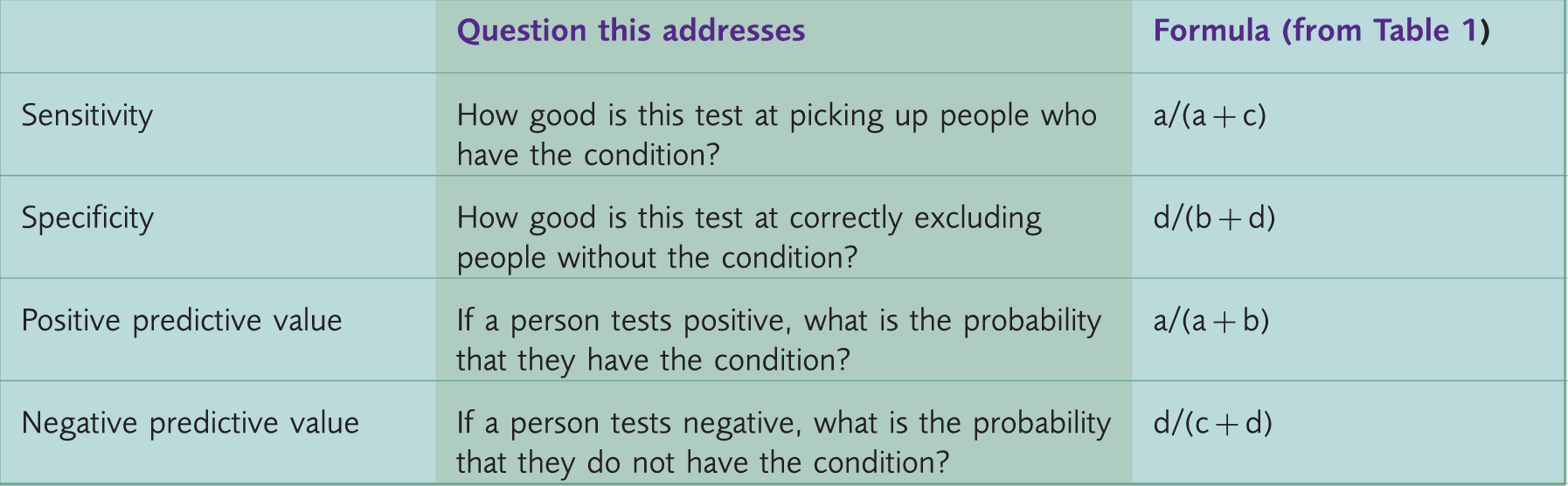
So you will see that sensitivity and specificity tell us about the test ‘in general’, whereas PPV and NPV are really helpful in telling you what a particular test result means for the patient in front of you (the NPV might be particularly helpful in your chat with Mr A in the example above). It is worth remembering that a sensitive test is good at ruling a condition out, and a specific test is good at ruling it in (some people find this easier to remember as ‘SPIN’ and ‘SNOUT’). So, for example a d-dimer test (something I am sure we have all been caught out by before) is very sensitive but not specific, so it’s great for ruling out but not for ruling in. If the test comes back negative then it is highly unlikely that you have a clot, but a raised d-dimer doesn’t necessarily mean you do have a clot (there are lots of other reasons for it being high).
All too often patients and doctors alike assume that a positive test means a 100% chance of having the disease, or that a negative test totally rules it out. This certainly is not the case; understanding PPV’s and NPVs tells you why.