



Abstract
Autism spectrum disorder (ASD) is a complex life-long neurodevelopmental disorder that affects just over 1% of the UK population. This means that the average practice of 7000 patients will have about 70 patients with ASD. It can be very challenging for general practice to meet the health care needs of this population, but with some adjustments and increased awareness among staff, it is possible to improve access to health care.
The GP curriculum and making your practice autism friendly
Effective primary care requires the coordination and commitment of a multi-professional team working in partnership with patients
Working in partnership with your patients and understanding their needs is vital to improving clinical care and reducing health inequalities Patients, their families and carers have an important role in the assessment of health care: their views are therefore essential for the development of high-quality health care. Patients should be encouraged to be actively involved in planning their care and in the development of services at practice level and beyond
Recognise the importance of the principle of fairness and equality, irrespective of the innate abilities of each patient Appreciate the role of your own patients in the evolution of services for patients with intellectual disability (and autism). All mainstream services should offer patients with intellectual disability (and autism) professional resources and facilities that are appropriate and tailored to their needs.
Background
Autism spectrum disorder (ASD) is a social communication disorder that affects how a person communicates with and relates to other people. To confirm a diagnosis, rigid and repetitive routines or behaviours must be present (World Health Organization (WHO), 2016). ASD is also associated with difficulties in cognition, behavioural flexibility, sensory processing, emotional regulation and altered sensory sensitivity.
There are a number of co-occurring conditions that are common in ASD. Epilepsy is 20 times more common than in the general population (Viscidi et al., 2013). Mental health problems affect up to 70% of those on the spectrum (Simonoff et al., 2008). Learning difficulties co-exist in about one third of individuals (MacKay, Boyle, & Connolly, 2016) and bowel disorders, including inflammatory bowel disease, coeliac disease, diarrhoea and chronic constipation of unknown aetiology, are estimated to occur in 61% of patients with ASD (McElhanon, McCracken, & Karpen, 2014).
A spectrum of abilities
One person with ASD will have very different abilities and needs to another person with ASD. This makes it a challenge for health services to meet the needs of such a diverse group of patients who often experience barriers when accessing services.
Those with ASD are at risk of dying many years younger than the general population. The Confidential Inquiry into Premature Deaths of People with Learning Difficulties published by the University of Bristol in 2013 demonstrated that those with a learning difficulty die, on average, 16 years sooner than those without. It also showed that the mortality from preventable causes of death is three times more common in patients with learning difficulties compared with the general population. In Scandinavia patients with ASD and no intellectual disability die, on average, 16 years younger than the general population and those with ASD and an intellectual disability die 30 years younger than the general population (Hirvikoski et al., 2016). We do not have data on premature mortality for those with ASD in the UK, but the mortality statistics are probably similar.
The causes of the premature mortality are not always clear and will undoubtedly be multi-factorial. However, failure to access health care in a timely manner is likely to be a significant feature. The Westminster Commission on Autism survey reported 74% of respondents as having experienced difficulties accessing health care in England (Westminster Commission on Autism, 2016).
Barriers to health care access
There are many reasons why patients with ASD struggle to access general practice. Some of these are intrinsic problems to the individual, and some are a result of the failure to take into account the patient’s specific needs and make reasonable adjustments for them.
In the first instance, the person with ASD will need to recognise that they are ill and convey the nature of their problem. They will often struggle to make sense of the questions a health professional may ask and what information they need to provide to allow the clinician to give them help. It is difficult for the person with ASD to recognise that the health professional in front of them does not necessarily think in the same way as they do. The Theory of Mind (Baron-Cohen, Leslie, & Frith, 1985) suggests that those with ASD do not have the same ability to understand the beliefs, desires, intentions, imagination and emotions of others, unlike the neuro-typical population.
ASD is a complex condition, and is under-recognised in older adults. It presents a challenge to busy GPs to make the diagnosis and then have a satisfactory consultation with the patient with ASD. For more information on consulting with a patient with ASD, please see ‘Top tips: Consulting with a patient with autism’ (Buckley, 2016).
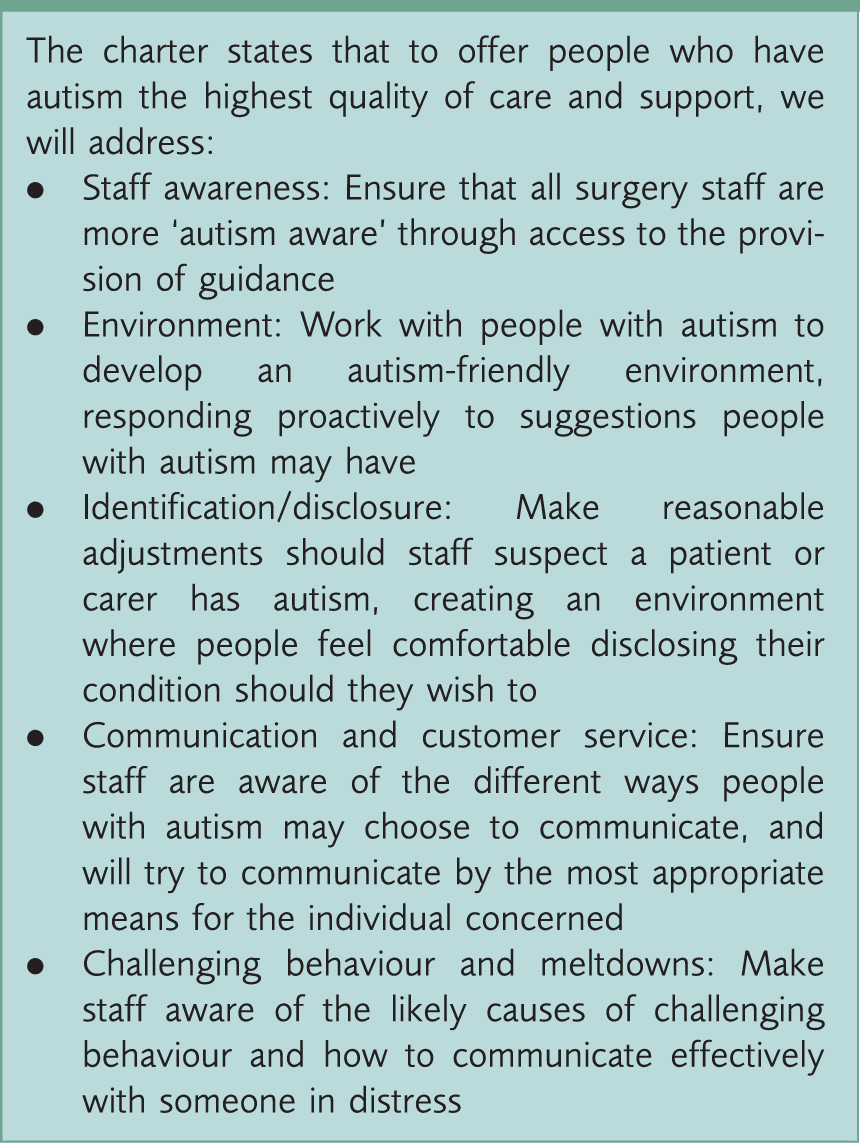
The RCGP Autism Patient Charter.
Staff awareness
In a recent survey of UK GPs, 40% reported having had no training about ASD in either undergraduate or post-graduate education (Unigwe et al., 2016). Despite this, they scored well in their knowledge of ASD, but felt under-confident in their ability to support their patients, and were critical of the lack of specialist support services. In general practice, receptionists and administrative staff are very important in ensuring timely access to services. A report from Bristol University’s Norah Fry Research Centre demonstrated significant barriers faced by patients with ASD accessing primary care when compared with the general population (Heslop, 2014). The lack of awareness of ASD within health service organisations is a significant problem; it was identified as such by 76% of those surveyed for the Westminster Commission on Autism report (Westminster Commission on Autism, 2016).
There is statutory guidance (Department of Health, 2015) that requires health and social care staff to have access to autism-awareness training. This should be provided by the local statutory bodies, such as Clinical Commissioning Groups in England. In some areas this is not being provided by these bodies but is widely available from other sources. There are many voluntary organisations that will provide face-to-face training, and there are a variety of e-learning modules signposted on the RCGP Autism Spectrum Disorders toolkit (www.rcgp.org.uk/asd).
Environment
Patients with ASD struggle with uncertainty and may not have the basic communication skills needed to ask for help. Clear signage at the practice detailing where to queue, how to find the consulting rooms, where to leave specimens or request repeat prescriptions, and how to locate the toilets, benefits all patients, but is particularly important for patients with ASD. A practice in South London introduced large green footprints on the floor indicating where to queue for Reception. This was done for everyone’s benefit, but a visiting ASD specialist applauded this particularly ‘autism-friendly’ signage.
Staff photographs, particularly of clinical staff, on the website and at the entrance to the practice may be helpful for patients with ASD. Staff name badges that are clearly visible and show the designated role of the staff member make communication easier. It is important to make sure the name on the consulting room door matches the person inside the room, as some patients with ASD have significant difficulties with facial recognition (Weigelt, Koldewyn, & Kanwisher, 2013).
Some practices offer a specially trained health navigator to aid vulnerable patients who may struggle to access services. Such help is offered not only for patients with ASD, but also to assist patients with mental health problems or learning difficulties. A direct line telephone number bypassing the main switchboard allows patients and carers to access an administrator who can arrange appointments or visits. The navigator can also direct the patient to other sources of help and support, outside or within the practice.
Identification/disclosure
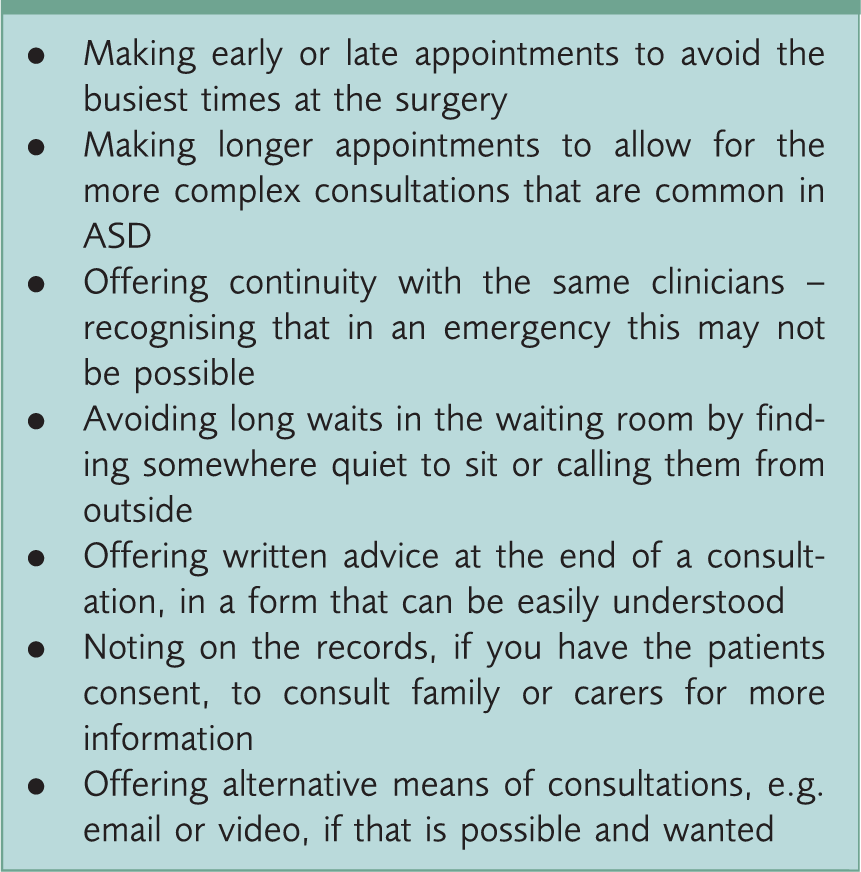
It is also vital to highlight the diagnosis of ASD on the practice computer system. New patients registering with a practice will often be asked to complete a registration form asking for details about smoking status and alcohol consumption. At registration suggested adjustments to allow equitable access to care and support can be identified and highlighted. The required adjustments can then appear as a prompt on the computer system when a patient’s records are accessed.
Some patients with ASD will be very anxious when visiting a new practice and it may help to offer ‘training’ visits when the surgery is quiet. This allows the individual and their carers to find their way around without the additional anxiety of a consultation.
Communication and customer service
ASD is a social communication disorder, so it is not surprising that failures in communication can be a barrier to accessing health care. Individuals with ASD are often very literal in their interpretation, so being told to phone for an appointment at 8.30 am, only to discover the phone is constantly engaged, can cause anxiety and confusion.
Having clear and simple information in an accessible format on the practice website and in the practice booklet about how to make an appointment, the person with whom they can make the appointment, how to get test results, and what services are available, is very supportive. Also, making it clear that appointments can be booked in different ways, e.g. online, in person or by email will help, as the telephone is not always an ideal means of communication for someone with ASD.
There are other ways of improving communication that can be employed. This may include encouraging patients to ask if they do not understand any part of the consultation or what the future plans are and offering a written summary of planned treatment or investigations. It can help to suggest the use of patient passports detailing the individual’s needs when seeing other unfamiliar health care professionals. An example of a patient passport can be found on the National Autistic Society website at www.autism.org.uk/about/health/hospital-passport.aspx.
Individual reasonable adjustments.
Challenging behaviour and meltdowns
The waiting room can be a noisy, chaotic and difficult place for patients with sensory issues and many patients with ASD will have hyper- or hypo- sensitivities. This is sometimes termed a sensory processing disorder and further information on how this may affect a person with autism is described on the National Autistic Society website (www.autism.org.uk/sensory). The members of the reception staff need to be aware of the difficulty this may cause, and have alternative options available. Noise, lighting and smells may affect patients with sensory issues, and these environmental factors are all difficult to control within practice waiting rooms.
Unfortunately, sensory overload is a common cause of an autistic meltdown. A meltdown can occur when the individual becomes so overwhelmed that they resort to repetitive behaviours, increased stimming (the term used to describe repetitive movements – often finger-flicking or hand-flapping) or even aggressive behaviour. Preventing this avoids distress for the patient, relatives and carers, and avoids wasting appointments and diverting staff resources. If the staff and clinicians are autism-aware and reasonable adjustments are in place, it is often possible to avoid sensory overload and subsequent behavioural problems. Supporting a patient experiencing an autistic meltdown is challenging. The normal human response to hold or touch the affected person and offer comfort may exacerbate the sensory overload. If a staff member becomes anxious or agitated, this may also exacerbate the problem. Keeping calm and offering an escape to a quiet place, without pressure, may help defuse the situation.
Key points
There are significant barriers for those patients with ASD in accessing health care Practices can make a difference and improve care for potentially vulnerable patients Offer autism-awareness training to all staff, including reception and administrative staff Ask about individual reasonable adjustments and record them on the patient record Ensure that your practice provides clear information about the process of making an appointment, getting results or getting a prescription to benefit all patients including those with ASD Display and promote the RCGP Autism Patient Charter