




Abstract

Welcome to this month’s Crammer’s Corner. The aim of our few pages in InnovAiT is to cover elements around GP training and the MRCGP in an informative way. In the upcoming months we will move through individual articles about training, considering elements around tutorials, educational meetings, the ePortfolio and generally maximising the opportunities trainees get during their vocational training. This month, to set the scene, we begin the journey by considering an overview of elements of the GP training scheme, the MRCGP assessments and some hints and tips for each training year.
The GP speciality training scheme and MRCGP
In order to become a GP via a standard route, trainees must undertake at least three years (four years on an academic programme) whole time equivalent clinical training on a GP speciality training scheme, complete MRCGP assessments and maintain an appropriate ePortfolio. This leads to the certificate of completion of training (CCT) and subsequent entry onto the GP register. We thought it might be helpful to summarise important aspects of GP training and tips for each year.
Supervision through training
Trainees are allocated an educational supervisor (ES) who supervises them over the course of training and provides advice and support as well as having a more formal role in producing reports on progress at 6-monthly intervals. Usually the ES will be the GP trainer in the ST3 host practice. The ES should be the first point of call for queries about training and a trainee should aim to build up a good working relationship by contacting and visiting the ES shortly after starting training. On a post-by-post basis, trainees are also allocated a clinical supervisor (CS). The CS should be the point of contact about that post.
Formal local training is usually provided by the locality training scheme. Each training scheme has training programme directors (TPDs) who provide help and support, but also organise the day release course that provides formal teaching, usually on a weekly basis.
ePortfolio
The ePortfolio is the unifying record of GP training and is designed not only to document learning and development, but also to record assessments and show progress towards qualification. It is also a portal for communication between trainee and ES. The ePortfolio is reviewed annually by deaneries as part of the Annual Review of Competence Progression (ARCP), and if satisfactory, allows progression and ultimately qualification.
The main bulk of the ePortfolio is the learning log, where trainees record reflective entries on a week-by-week basis linking these to the GP curriculum. ESs then read these entries, provide comments where appropriate and validate entries that demonstrate application of specific competencies. We ran a series of useful articles in Crammer’s Corner over 2015/2016 covering curriculum areas and how each of these could be covered in the ePortfolio. I would highly recommend reading these articles.
MRCGP assessments
WPBA requirements.
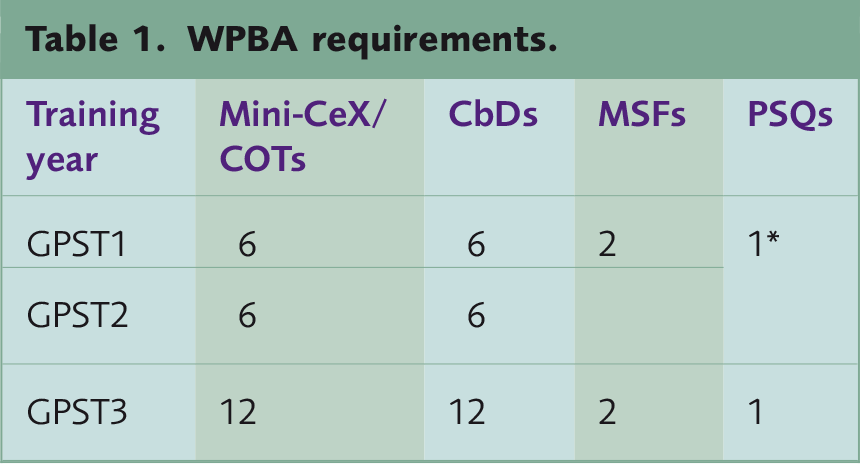
*During a GP post. CEPS – as appropriate depending on job – all intimate examinations need to be assessed by the end of ST3. CSR – one per hospital post.
Hints and tips for trainees in each ST year
Most training schemes include 18 months in hospital-based posts and 18 months in GP posts. GP posts usually consist of a 6-month placement in either training year 1 (ST1) or year 2 (ST2) and then a full year in ST3 (usually in a different practice). There are different priorities for each ST year and a few hints and tips for trainees follow.
GPST1
Arrange to meet your ES at an early date and discuss any aims and needs. Register for the ePortfolio and start familiarising and working on this as soon as possible. Many training schemes offer induction sessions on the ePortfolio, but there is no need to wait to get going! Consider your personal development plan (PDP) aims and record these in the ePortfolio. Think about each job, what you might gain (with GP focus) and how you might achieve this. Don’t waste opportunities as they appear and be proactive in less busy times. Attend day release sessions with the GP training scheme when offered. These should be protected in hospital post rotas so if there are any conflicts or difficulties attending, flag these at an early stage. Consider the requirements for WPBA and ensure you start working on these as soon as possible. Finding people to carry out CbDs or mini-CEXs can sometimes be challenging in hospital posts, so aim not to leave these to the last minute. Two MSFs are required in ST1, so plan properly to maximize their benefit. Get to know your CS. They will have to write your CSR, so in order for this to be helpful it is in your best interests to meet them often. Also, plan regular meetings or contact with your ES. Some training schemes offer days in practice during hospital posts to attend your ES’ practice – use these wisely. Think well in advance about the 6-monthly Educational Supervisors Review (ESR) meetings. Preparation for these takes time. Remember that ESRs in the second half of the year need to be done early so check the dates well in advance.
GPST2
The aim of training is to show progression and movement towards competence. This applies to reflective entries in the ePortfolio too. Ask your ES for their honest advice. Don’t forget the PDP! The AKT can be sat during ST2. Consider the rotations you have and when this might be best (e.g. during a rotation with less on call or following a GP placement). Know application dates and plan revision. Don’t neglect gaining knowledge of the business side of general practice during your ST1 or ST2 GP post. Questions on GP administration and management come up in AKT and practical experience can help develop understanding.
GPST3
All GP placements (ST2 or 3) include an initial induction period. Plan this wisely with your supervisor so that you are spending the time appropriately. Carry out an initial learning needs assessment and aim to repeat this part way through the year. Plan an outline view of the year at an early stage – when will you aim to reduce consultation times, when will you start doing duty doctor sessions? Consider the CSA. Many trainees plan to sit this in the spring to allow enough time to develop consultation skills, yet still allow for re-sit, if needed. Start your quality improvement project early in the year to allow time for several improvement cycles. Try to be involved in all aspects of the practice. Attend and participate in partnership, business and ideally accountant meetings. Remember more WPBAs are required during ST3 – there should be more than enough time to do these with weekly tutorials, but the final ARCP is earlier than ST2/3 and you need to avoid any final rush! Be aware of the recommended working week and ensure you are getting enough protected learning – TPDs should be able to give advice if needed. Plan out-of-hours sessions wisely; try to gain a mixture of experiences (e.g. base shifts and home visiting). Don’t forget the extra requirements needed by the end of training. Ensure safeguarding training and basic life support are carried out early in the year. Make the most of the time following CSA and ARCP. There are usually a couple of months following ARCP; maximise preparation for independent practice. Above all make use of the advantages that individual supervision brings, enjoy yourself and be proactive – there are numerous learning opportunities within GP training. Don’t miss out on these opportunities!
If you would like to contribute to Crammer’s Corner or have any suggestions for future topics or articles, please contact us at