




Abstract
‘Doctor’, derived from Latin, means ‘teacher’. As doctors, we teach our patients, students and colleagues. The General Medical Council makes reference to this in ‘Good Medical Practice’, stating that as a doctor ‘you should be prepared to contribute to teaching and training doctors and students’. The importance of teaching is echoed in the RCGP curriculum. Despite its importance, not every doctor has the opportunity of formal training on how to become an effective teacher. This article presents a simple guide that doctors can use to plan teaching sessions.
The GP curriculum and teaching
Recognise it is the duty of every doctor to contribute to the education and development of colleagues and team-members, for the benefit of the health service When teaching individuals or groups, identify learning objectives and preferences, adopting teaching methods appropriate to these Construct educational plans and evaluate the outcomes of your teaching activities, seeking feedback on your performance
Why be SMART?
There are opportunities to be involved in teaching throughout GP training, whether teaching peers at GP Vocational Training Scheme study days, teaching foundation doctors and medical students on the wards, or colleagues at a practice meeting. As described in the RCGP curriculum, whether teaching individuals or groups, it is important to identify learning objectives and preferences, and to adopt appropriate teaching methods for these objectives and preferences. It is also important to evaluate the outcomes of teaching sessions by seeking feedback.
As part of constructing an educational plan, setting clear teaching objectives may be required. Well-designed objectives can help provide focus to a teaching session. A tool known as ‘SMART objectives’ designed by George Doran in 1981 for setting work objectives within business (Doran, 1981) has subsequently been modified and applied to medical education (Oxford Medical, 2017). SMART objectives describe the setting of Specific, Measurable, Achievable, Relevant, and Timely outcomes that can help engage students, providing clear direction in what is to be achieved by the teaching session. SMART objectives are illustrated in Fig. 1.
Diagram illustrating SMART objectives.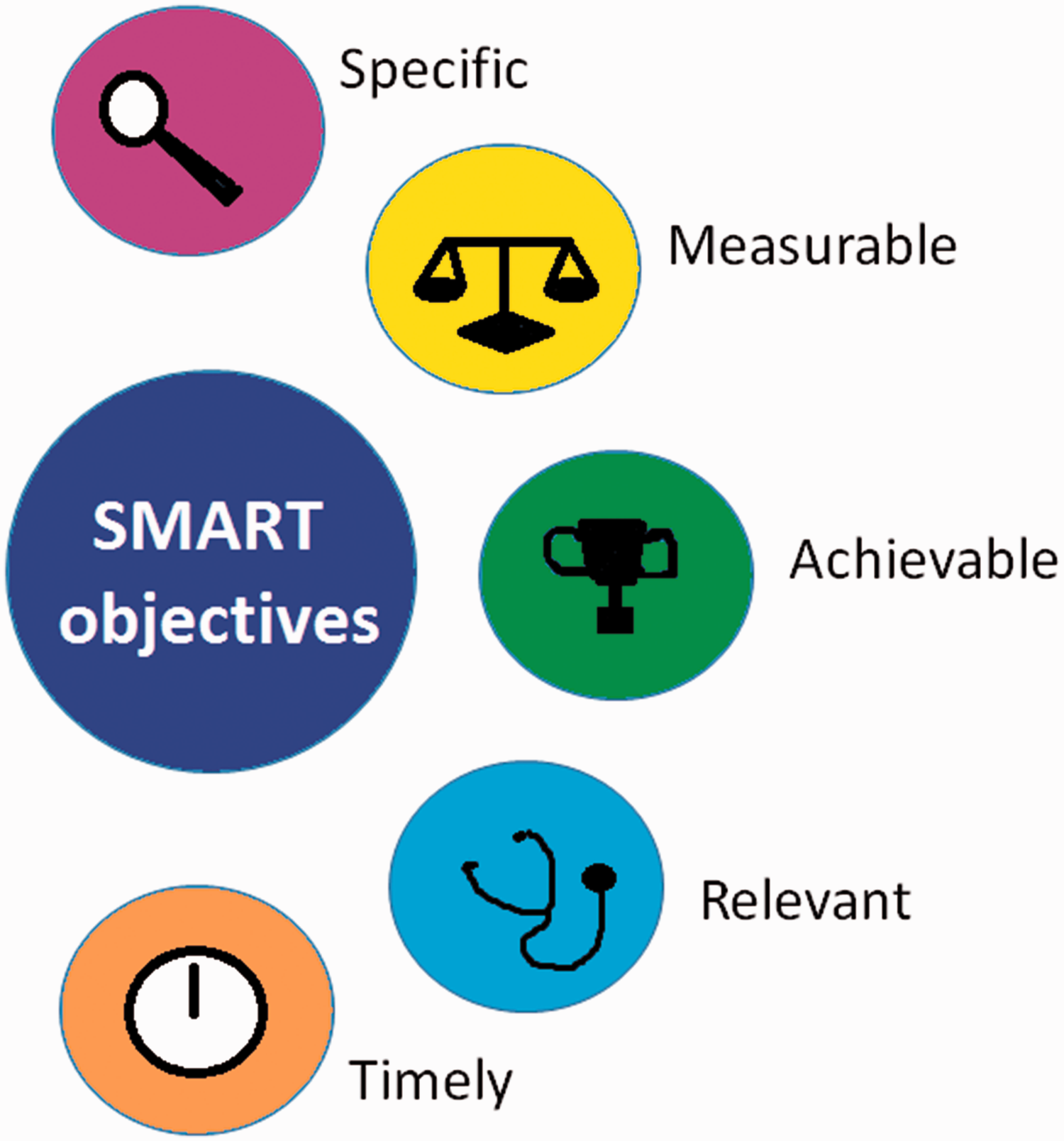
How do I apply SMART objectives to my teaching?
Be specific
When designing your teaching session, try to specify exactly what you want to teach. For example, if delivering teaching to GP trainees, refer to the RCGP curriculum in choosing your topic. If, for example, you choose to teach on heart failure, consider which aspects you wish to focus on; it would be relevant to GP trainees to know a best practice approach to the diagnosis of heart failure, when referral to secondary care is warranted, and how heart failure is managed in primary care. In this instance, you may wish to define one of your learning objectives as ‘To be able to list the indications for requesting an echocardiogram in primary care to investigate heart failure as per the National Institute for Health and Care Excellence (NICE) 2010 Diagnosis of Heart failure guidelines’.
In addition to specifying the subject material, specify to what depth you intend to cover the topic. This will involve considering the learning needs of your audience, as delivering a teaching session, even on the same topic, will need to be adapted based on the learners prior level of knowledge or skill.
In order to write specific learning objectives, we need to word them carefully. Good objectives have specific verbs and avoid vague terms such as ‘understand the meaning of’. Bloom described three domains of educational activity or learning: cognitive (knowledge), psychomotor (skills), and affective (attitude) (Bloom, Engelhart, Furst, Hill, & Krathwohl, 1956). Bloom collaborated with a group of educational psychologists to categorise six levels within the cognitive domain: knowledge, comprehension, application, analysis, synthesis, and evaluation (Bloom et al., 1956). They ordered these domains from simple to complex, as illustrated in Fig. 2. For instance, the process of evaluation requires more critical-thinking skill than a much simpler task, such as recalling information. They went on to create a compilation of useful verbs that address each category. This is widely known as Bloom’s Taxonomy and can serve as a useful tool when writing learning objectives and also when designing assessments.
Diagram illustrating the six cognitive domains of Bloom’s Taxonomy and useful verbs to describe each category. Note how the complexity of the cognitive processes increase as a learner evolves from acquiring knowledge to evaluation. Based on work from
Bloom et al. (1956)
. Adapted by Dr Yasmin Hughes (2017) from Multiprofessional faculty development, writing learning outcomes or learning objectives. Retrieved from
http://faculty.londondeanery.ac.uk/e-learning/setting-learning-objectives/writing-learning-outcomes-or-learning-objectives

To illustrate the levels of the cognitive domain described by Bloom, consider a familiar example; GPST consultation skills teaching. If you were designing a teaching session on consultation skills to GPST1s, just entering their first GP placement, you may want to teach the Calgary–Cambridge consulting model. It is likely that, by the end of the session, you would like them to not only be able to recall the model but also comprehend how it could be used in the consultation. When designing a teaching session for the same GPST1s towards the end of their GP placement, you may want them to be able to apply the model in practice. Role play, for example, could be a useful means to teach and practise this. By the time GPSTs reach ST3, it may seem reasonable to design a teaching session asking GPST3s to evaluate the use of the Calgary–Cambridge model in their consulting. Critiquing videos of consultations is a common learning activity that could be used for this purpose.
Although all three teaching sessions described are centred on the Calgary–Cambridge consultation model, the cognitive level at which GPSTs are being asked to engage is progressively improving. Blooms Taxonomy can be used to describe the cognitive level that has been established.
Try to measure your teaching performance
A popular model for the evaluation of an educational event or course is Donald Kirkpatrick’s four levels of evaluation (Kirkpatrick, 2007), which are depicted in Fig. 3.
Diagram illustrating Donald Kirkpatrick’s four levels of evaluation; they may be used as a framework when assessing the effectiveness of a learning activity.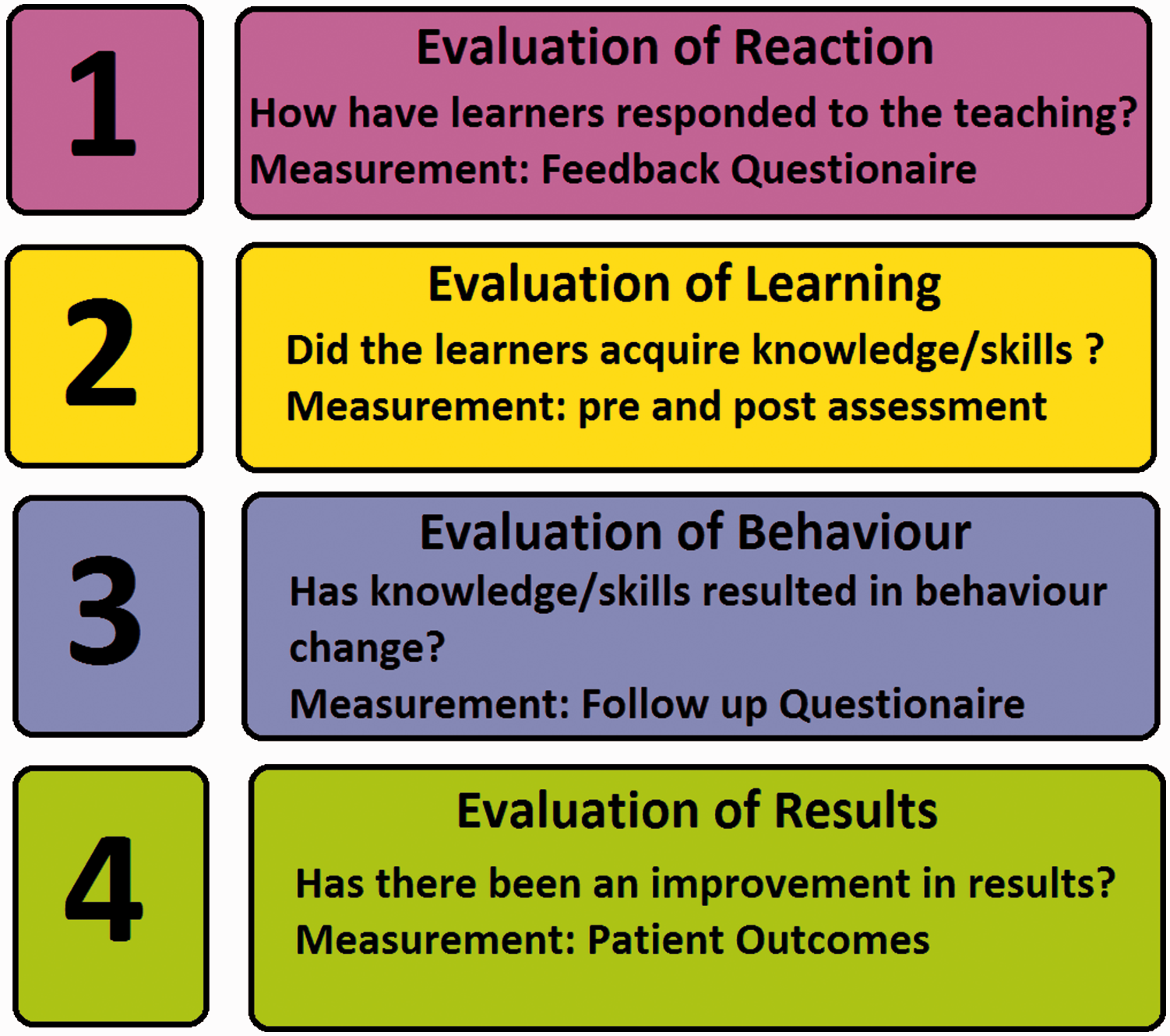
Consider an example: you are asked to deliver a teaching session on the National Review of Asthma Deaths at your practice meeting. In this context, evaluation of reaction may be sought by asking colleagues to complete a feedback questionnaire or provide verbal feedback. There are a number of ways that questionnaire’s may be designed, including with quantitative outcome measures such as Likert scales where students are asked to rank how much they agree or disagree with a statement, often ranked numerically as 1–5. Probably more useful would be to ask open questions such as ‘What did you like about this teaching session?’, ‘What was done well?’, and ‘How could it be improved?’ If requesting feedback from a small group of students, a reflective discussion at the end of the session may be helpful. If being supervised while giving a teaching session, your trainer may provide one-to-one feedback on your performance. Evaluation from learning may be accomplished from a post-teaching session multiple choice question (MCQ) on the key recommendations presented.
Evaluating at stages 1 and 2 of Kirkpatrick’s model is relatively straightforward, however, evaluating at the higher levels of levels 3 and 4 is often far more challenging. Evaluation of behaviour aims to assess whether the acquisition of knowledge or skills has resulted in behaviour change. In this example, one may try to evaluate this by engaging staff in reflective practice. Evaluation from results usually seeks to assess the transfer or impact of learning to the workplace. This is often the hardest measure, as many other variables are in play. In this example, you may wish to evaluate results by comparing rates of adverse outcomes (acute asthma exacerbations requiring hospital admission or asthma deaths) before and after the educational meeting.
Some studies suggest that the most effective educational interventions seek to investigate behavioural change at the individual level and link this with performance at the organisational level (Oxford Medical, 2017). In healthcare, the overall aim, of course is to improve patient care, and so our educational interventions should always have this overall goal in mind. Donald Kirkpatrick’s four levels of evaluation form a useful and important framework for evaluating the effectiveness of an educational activity; however, in practice, it may be difficult to accurately evaluate behaviour change and results at an organisational level from a teaching session or course. None the less, this is something for which we should all be striving when we set our learning objectives.
Design teaching aims that are achievable
Medical information is expanding exponentially. It is easy to get bogged down when designing a teaching session. Do not try to cover too much material, focus on important points and ‘take home messages’. For example, if you are presenting on NICE guidelines on cancer diagnosis and have a 1-hour teaching slot, then perhaps, just focus on the five most common cancers and design three take home messages for each. Making learning outcomes achievable to both students and teachers will sustain motivation and level of engagement. It is unlikely that you will be able to cover all of a large topic in one session, and so by wetting their appetite for the subject, you can motivate learners to undertake further reading in their spare time. To this end, you may wish to signpost students to where they can find further information on the topic.
Make your teaching sessions relevant to the learners
To gain learners attention and sustain their level of engagement, make the teaching session relevant to them. First, find out the learning preferences of your audience, not only with regard to the material to be covered, but also the preferred learning style. It may be that they feel that they are lacking teaching in a particular area, for instance ear nose and throat (ENT). If you are delivering a teaching session on ENT to GP trainees, consult the RCGP curriculum content on ENT. If students are aware that they need to know this information for their membership of the RCGP, they are more likely to engage in the session. Again, if teaching on ENT to GP trainees, try and reflect on what are the most common presentations to a GP or what are the diagnoses that as a GP you would not want to miss, for example, mastoiditis. When deciding on the level of detail required in teaching topics, make this relevant to the learner. For example, it is unlikely that a GP would need to know the detail involved in performing a tonsillectomy; however, they would be required to know when to refer a patient for a tonsillectomy. Prior to designing the session, if possible, find out if students wish to practice ENT examinations, see pictures of ENT pathology or learn about management guidelines. Making teaching relevant to learners is likely to result in a successful teaching session.
Set a time limit for completion of your teaching goal
If you have been asked to deliver a teaching session at a specific time then the time limit for completion of your teaching objectives will be quite obvious. However, if you have a group of students with you for several weeks on a rotation, it may be worth thinking about the time limit for completion of a number of teaching objectives that you are likely to want to cover during this period. Having a time limit in mind can help keep your teaching objectives on track.
SMART objectives, initially founded in the business world, have been applied to both undergraduate and postgraduate medical education settings and in designing continued professional development plans. They form a simple way to structure educational goals and can help in the design of effective teaching and training sessions.
Key points
Teach the Be Make Keep your teaching Design teaching goals which can be delivered on