



Abstract
Subfertility affects 1 in 6 couples in the UK. In the initial GP consultation it is helpful to see both partners together, although this may be difficult in a single 10 minute consultation. In 39% of couples, both male and female factors are responsible for subfertility, with male factors accounting for 30% of subfertility problems. Although this article will focus on female factors, male assessment is important, and a semen sample is one of the first steps in an assessment. If an abnormality is detected in the semen analysis, the test is normally repeated and if confirmed a secondary care referral is required. In 70% of cases a female factor will be the primary cause, and this article will focus on female factors in the more detailed management of subfertility.
The GP curriculum and female infertility
General practice has an important role in the management of sexual health problems A holistic and integrated approach should be taken Sensitive, non-judgemental communication skills are essential
Background and definition
Subfertility is defined as the inability of a couple to conceive after 12 months of regular vaginal sexual intercourse (two to three times per week). It may be primary subfertility, where the female partner has never conceived, or secondary subfertility, when the female partner has conceived in the past regardless of the outcome of the pregnancy. Recurrent miscarriage is not discussed in this article, but advice can be found in the Royal College of Obstetricians and Gynaecologists (RCOG) Green top guideline no. 17 (RCOG, 2011).
Fertility can be assessed in terms of fecundity, which is the conception rate per menstrual cycle. Female age is an important factor in fertility. Fecundity declines with advancing maternal age: in 19 to 26-year-old females the probability of fecundity is 92%, whereas in 35 to 39-year-old females it is 80% after a year of regular intercourse (Dunson, Baird, & Colombo, 2004). Couples should be counselled that 84% of women with a regular menstrual cycle having regular vaginal sexual intercourse will conceive within 12 months, 92% within 2 years and 93% within 3 years (Te Velde, Eikemans, & Habbema, 2000). On this basis, simple reassurance and support may be all that is needed for a young woman with a normal menstrual cycle presenting less than a year after starting to try to conceive. Conversely, a 36-year-old woman or young woman with known risk factors for subfertility will need more prompt investigation and secondary referral (Cutting, Morroll, Roberts, Pickering, & Rutherford, 2008).
Female subfertility is broadly divided into anovulation problems (inability to release an egg), tubal factors, and uterine and peritoneal factors (endometriosis, adenomyosis and fibroids). Anovulation contributes to 25% of cases and the most common cause is polycystic ovarian syndrome (PCOS) (National Institute for Health and Care Excellence (NICE), 2016; Thonneau et al., 1991). Tubal factors are responsible for 20% of cases (pelvic inflammatory disease), severe endometriosis and previous pelvic surgery), (NICE, 2013; Thonneau et al., 1991). Uterine factors are responsible for 10% of subfertility cases. In 25% of cases, no cause is found, and this is labelled as unexplained subfertility. Unexplained subfertility for more than 2 years requires referral to a fertility clinic for possible treatment.
Pre-conceptual advice
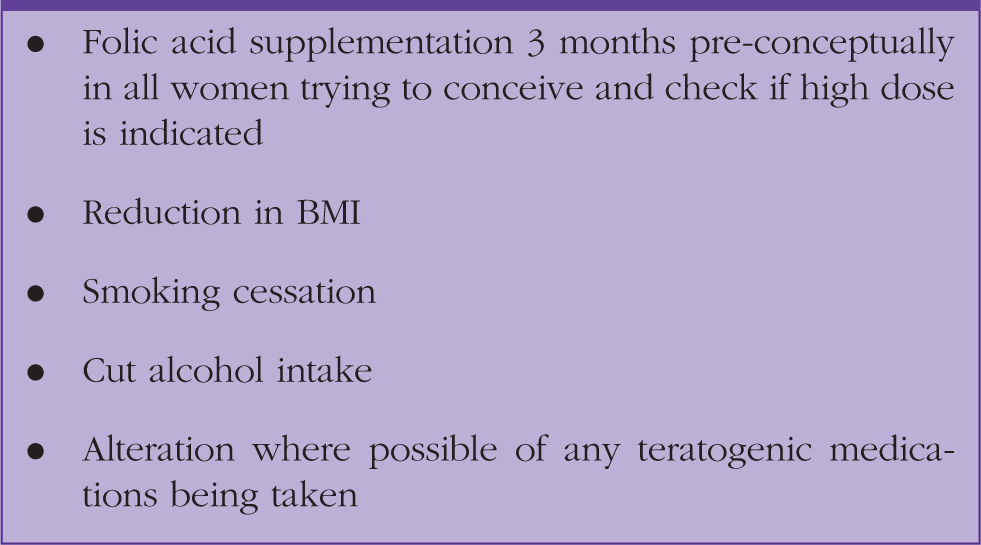
When a woman presents with subfertility, there is an opportunity to review her medical history and promote a healthy lifestyle. It is a time when a woman will usually be highly motivated to address these changes. This chance should not be missed. Encourage regular vaginal sexual intercourse, two to three times per week. Smoking is a well-documented cause of subfertility and is strongly linked to poor pregnancy outcomes in addition to sudden infant death syndrome. The couple should be advised that even passive smoking can affect fertility (Hull, North, Taylor, Farrow, & Ford, 2000). In addition, it should be made clear to patients at the outset that smoking in either partner may not only impact on the success of any assisted reproductive techniques, but also that in areas where NHS funding is still available for in vitro fertilization (IVF) it is likely to make them ineligible for treatment. Patients who wish to stop smoking should be offered referral to an intensive support programme as per NICE guidance.
Folic acid supplementation of 400 micrograms daily should always be advised in all women known to be actively seeking a pregnancy, ideally for 3 months pre-conceptually and until at least 12 weeks of pregnancy to reduce the risk of neural tube defects. The higher dose of 5 milligrams daily is required for patients with diabetes, epilepsy, a body mass index (BMI) of more than 30 kg/m2, a history of cardiac defects and women with malabsorption syndromes such as Crohn’s disease.
A BMI of 30 kg/m2 or more for a female is associated with a longer time to conceive even with regular menstrual cycles (Bolumar, Olsen, Rebagliato, Saez-Lloret, & Bisanti, 2000). In areas where IVF is funded, a BMI of 30 kg/m2 or below in female partners is often mandatory. As a result, women who need IVF should be encouraged to lose weight if necessary (Wales fertility referral criteria, www.wales.nhs.uk/863/page/75679). Similarly, for secondary care services where clomiphene is needed to stimulate ovulation, a female BMI of 35 kg/m2 or less is required to improve the chance of fecundity. Weight loss should be emphasized, not only in terms of improved fertility, but also to give better outcomes for a successful pregnancy. Being overweight increases the risk for pre-eclampsia, gestational diabetes and venous thrombo-embolism. Venous thrombo-embolism is still the leading cause of direct maternal deaths in the UK (MBRRACE-UK 2015). A BMI of more than 30 kg/m2 for a male is also associated with reduced fertility; therefore, weight loss should be encouraged in both partners to improve the chances of conception.
Excessive alcohol intake is detrimental to the fetus (RCOG, 2006). For women, the recommendation is to consume less than 1 to 2 units of alcohol once or twice per week. For male partners, alcohol consumption of less than 3 to 4 units per day is unlikely to affect semen quality; however, intake beyond this level is likely to be detrimental. All couples should be counselled that excessive alcohol intake can affect semen quality and fecundity.
Pre-conceptual key points.
Ovulatory dysfunction
Anovulation accounts for 25% of cases in sub-fertile couples. A normal menstrual cycle varies between 26 and 36 days, with ovulation usually taking place 12 to 16 days before the start of the next menstrual period. Anovulatory cycles become more common later in life. PCOS is the most common cause of anovulation followed by hyperprolactinaemia.
The World Health Organization subdivides anovulation into three groups:
Class 1: Hypogonadotrophic hypogonadism in 10% (normal prolactin, low basal gonadotrophins, low oestrogen) Class 2: Normogonadotrophic normo-oestrogenic (gonadotrophins and oestrogen normal range) hypothalamic pituitary dysfunction in 85%, for example PCOS Class 3: Hypergonadotrophic anovulation or ovarian failure in 1–5% (high gonadotrophins, low oestrogen).
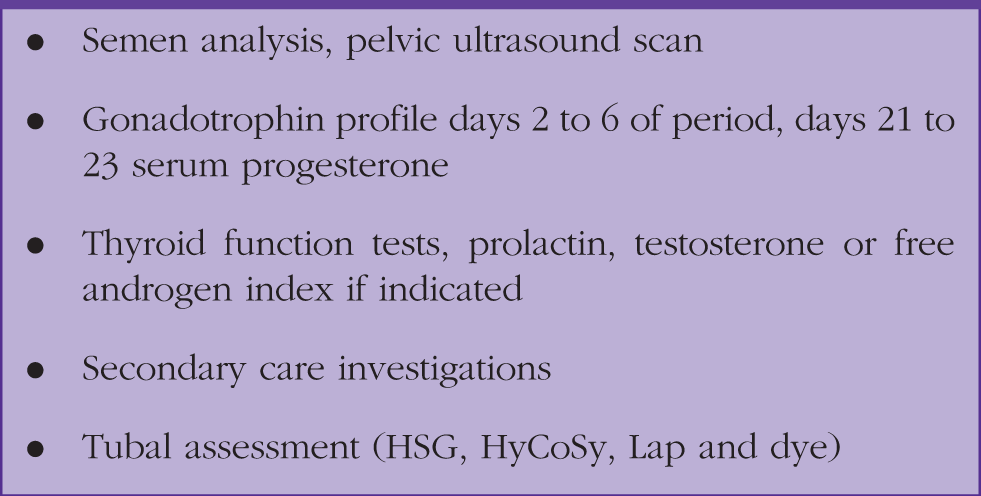
PCOS is the most common cause of anovulatory cycles. The diagnosis of PCOS is usually established using the Rotterdam criteria, where at least two of the following three features should be present: oligomenorrhoea or amenorrhoea; hyperandrogenism, either clinical or biochemical; and appearance on an ultrasound scan of equal to or more than 12 antral follicles in one ovary or an ovarian volume more than 10 cm3. The biochemical markers of hyperandrogenism include an elevated free androgen index or free serum testosterone, or a high level of luteinising hormone. Gonadotrophins should be checked on days 2 to 6 of a woman’s cycle for ease of interpretation.
Menstrual disturbance and anovulation may also be caused by thyroid dysfunction. Therefore, thyroid function tests should be checked if oligomenorrhoea or menorrhagia is present.
Anovulation secondary to PCOS may be rectified with weight reduction if a woman’s BMI is greater than 30 kg/m2. If anovulation still persists despite the weight reduction, or the woman is struggling to lose weight, clomiphene citrate treatment can be commenced to induce ovulation, this is normally co-ordinated and monitored in secondary care. The addition of metformin with clomiphene improves the chances of pregnancy and reduces the risk of ovarian hyperstimulation. Risks of treatment with clomiphine include multiple pregnancy and ovarian hyperstimulation, and patients should be appropriately counselled.
The symptoms of hyperprolactinaemia include galactorrhoea, amenorrhoea and headaches. Several medications including phenothiazines (e.g. prochlorperazine, chlorpromazine), haloperidol, pimozide, bezamides (metoclopramide and clebopride), cimetidine, risperidone and methyldopa can cause hyperprolactinaemia, this should be considered in the history (Shaw, Luesley, & Monga, 2011). An endocrine specialist opinion may be needed depending on the suspected underlying cause of hyperprolactinamia.
Type 3 anovulation is most commonly due to premature ovarian failure (with chromosomal, genetic, infectious, enzymatic, iatrogenic and autoimmune causes), and therefore a full medical and family history of conditions such as previous malignancy necessitating chemotherapy or radiation, or auto-immune conditions such as Addison’s Disease should be taken. A referral to secondary care to assess ovarian reserve should be made.
Tubal disease
Tubal factors account for 20% of subfertility cases. The most common causes of tubal damage are sexually transmitted infections (STIs) such as Chlamydia trachomatis or Eisseria gonorrhoea. The incidence of tubal damage following one infection is 14%, with a second episode the incidence rises to 36%, and a third episode can lead to 56% of cases experiencing damage (Khalaf, 2003). It can be a sensitive subject, but any previous infections need to be considered, remembering that enito-urinary medicine clinic notes are held separately. Any current symptoms or risk factors for STIs should prompt testing and treatment if necessary. Further history should include any previous pelvic surgery (such as appendectomy, salpingectomy or bowel surgery) as adhesions secondary to surgery can affect tubal function (Luttjeboer et al., 2009). Any history of previous ectopic pregnancies, whether treated conservatively with methotrexate or surgically is relevant, as this often indicates tubal disease. In cases of distal tubal damage, surgery may improve chances of conception, whereas in cases of hydrosalpinx, removal of the badly damaged tube is recommended to improve IVF success (Zhang, Sun, Guo, Li, & Duan, 2015).
Endometriosis and Mullerian abnormalities are other possible causes of tubal disease. Investigations into tubal function are arranged through secondary care and may include hysterosalpingogram (HSG), laparoscopy and dye test, and hysterosalpingo contrast sonography (HyCoSy). NICE recommends laparoscopy and dye test as gold standard in the presence of co-morbidities, where as HyCoSy or HSG is recommended in low-risk cases (NICE, 2016).
Endometriosis
Endometriosis can affect between 6 and 8% of women presenting with subfertility. The most common presentations of endometriosis are dysmenorrhoea and deep dyspareunia. It affects fertility in several ways: release of chemokines and natural killer cells can affect the egg, adhesion formation can affect pelvic anatomy, tubal disease can be caused by deposits on the fallopian tubes, and endometriosis can affect implantation. The gold standard for diagnosis of endometriosis is laparoscopy; however, ultrasound can often pick up endometriomas. The treatment of mild-to-moderate endometriosis improves the chances of natural conception (Younas, Majoko, Sheard, Edwards, & Bunkheila, 2014). In the patient trying to conceive, excision of endometriosis deposits is associated with better fertility outcomes, less pain and less re-occurrence, however, excision of endometriomas is debatable as it may affect ovarian reserve (Healey, Ang, & Cheng, 2010). As such, early diagnosis and specialist referral is recommended (Donnez, Lousse, Jadoul, Donnez, & Squifflet, 2010).
The role of the GP
The World Health Organization and the Human Fertilisation and Embryology Authority (HEFA) recommend seeing both male and female partners together in the first consultation (HEFA, 2004; Rowe, Comhaire, Hargreave, & Mellows, 1997). The majority of patients present to their GP first and this consultation plays an important role especially regarding pre-conceptual advice. Obtaining the following information is essential in this consultation: ages of both partners; time trying to conceive; menstrual history; previous obstetric history; and contraception use. When seeing a couple together, it might be beneficial to have a 20-minute appointment to complete a first consultation.
Maternal age is the single biggest factor for subfertility services, and patients should be counselled correctly from the outset. NICE recommends three IVF cycles where the female age is less than 40 years, whereas for women less than 42 years in age and with normal ovarian reserve, only one cycle is recommended.
Previous obstetric history is important in helping to establish any underlying reasons for subfertility. In particular any previous ectopic pregnancy is important, as this can indicate tubal disease.
Information on contraceptive use is important to ascertain a time frame for fertility to restore after stopping the contraceptives. Prolonged use of depo-provera injections takes longer to restore fertility compared with other methods. It is appropriate, for example, to simply reassure a 28-year-old woman who has not conceived 6–9 months following depo-provera cessation, provide pre-conceptual advice and suggest a planned review if the couple have still not conceived 6 months in the future.
Time trying to conceive must be quantified, as secondary referral is only indicated after 12 months of regular unprotected sexual intercourse. A couple may be referred earlier if the woman is aged 36 years or over, there is a known clinical cause of infertility or a history of pre-disposing factors for infertility. Where treatment is planned that may result in infertility (such as treatment for cancer), early fertility specialist referral should be offered.
Investigations in primary care for couple.
KEY POINTS
If a woman under the age of 35 years presents with a history of failure to conceive of less than a year, simple reassurance is often all that is needed Semen analysis is always needed as part of overall assessment Three main subgroups exist in female infertility: ovulation disorders, tubal factors, and endometriosis Focused history and examination will lead to appropriate referral and investigation All women presenting with infertility will need a pelvic ultrasound scan