Abstract

The growth in medical science, knowledge and understanding brings new technologies, medicines, devices, techniques and procedures. Some of these advances in medicine are readily incorporated into NHS treatment protocols, formularies and services and are available for widespread use within the NHS. At this stage, interventions will have been evaluated and found to be clinically beneficial and cost effective. Such evaluation works well for common conditions, such as hypertension or diabetes. However, if the disease or condition is very rare, or the treatment novel, high-quality trials and research evidence may be lacking and will not support inclusion within treatment protocols. Treatments may not have been appraised by the National Institute for Health and Care Excellence (NICE) in England and Wales, or by the Scottish Medicines Consortium (SMC) in Scotland, and clinicians are left to identify whether funding and resources can or should be provided for such treatments.
Individual funding requests (IFRs) provide a route to support individual patients when their condition or treatment does not have enough supporting evidence for inclusion in treatment protocols. IFR is the term used in England and Northern Ireland, individual patient treatment request in Scotland and individual patient funding request in Wales. Although the terminology may differ within the UK, the principle of funding exceptional treatments remains the same. IFR originated in the 2000s, with the number of IFRs increasing. Just over half of the IFRs made in 2016–17 were approved (Iacobucci, 2017).
Individual funding requests process
The IFR process varies within individual Clinical Commissioning Groups in England or Health Board in Scotland, Wales and Northern Ireland. Each locality will have their own local processes for making decisions on whether to support an IFR. IFRs can be raised by any clinician on behalf of a patient, but not by patients directly. IFRs can be requested by GPs or hospital consultants when they feel the clinical circumstances are exceptional, but the treatment is not routinely provided by the NHS. Clinicians need to believe that a patient's clinical circumstances differ significantly from other patients with the same condition in order that a particular treatment should be provided, and that the patient would respond differently to other patients and gain greater clinical benefit from a treatment (NHS England, 2017a). It is also expected that the requested treatment would be considered a good use of NHS resources (NHS England, 2017b). In Wales, the circumstances require demonstration of ‘significant clinical benefit' and ‘reasonable value for money', rather than ‘exceptional clinical circumstances' (NHS Wales, 2017) as used elsewhere in the UK.
IFR considerations
Because patients all have the same rights to treatment from the NHS, irrespective of personal, social, financial or other circumstances, IFRs should only look at clinical factors when considering clinical exceptionality. The IFR process does not consider patients’ employment status, patients’ dependents or any financial obligations (e.g. mortgage) and aims to ensure that decisions are based only on clinical factors. This is intended to make the IFR process non-discriminatory and fair to all.
IFRs screening panel
When an IFR is submitted, a screening process ensures relevant information has been provided and that the application meets IFR criteria. If there is insufficient information, the IFR is returned to the referrer for additional information. The application is considered by an independent panel made up of healthcare professionals, including doctors, pharmacists, nurses and public health practitioners. The panel is chaired by a lay person and considers the evidence before making a decision. The process can take weeks, but is usually completed within 30 working days (NHS England, 2017a). All cases brought before an IFR panel are seeking to access funds from the same budget. Therefore, cases need careful consideration before a decision is made.
If a funding request is declined, disappointed applicants can request a review of the decision within 28 days if both patient and supporting clinician consider the decision-making process has not been followed correctly, new clinical evidence has emerged or the patient's clinical situation has changed. If there is evidence that other patients with the same condition might also benefit from the same treatment, clinicians can consider proposing the development of a new clinical policy for the treatment to avoid raising further IFRs for a number of different patients (NHS England, 2017b).
An IFR panel needs to be satisfied that a patient has not responded to usual treatment for genuinely exceptional reasons beyond the natural course and history of a condition. If a treatment is known to work only for a certain proportion of patients, then treatment failure is not considered exceptional. Having co-morbid conditions, such as asthma, hypertension or diabetes, do not make an individual exceptional when the comorbidities are already common within the general population (NHS England, 2017b). The severity of the condition, patient genotype or genetic profile or a multiplicity of factors attempting to afford exceptionality may be considered, but do not necessarily make a patient ‘exceptional' within the IFR process. It is important to remember that non-clinical and social factors are disregarded in the IFR process and clinicians should not refer to these factors when submitting IFRs.
Evidence-based decisions
The IFR panel will seek to review the literature and scientific evidence when making a decision. Treatments may be unique and unprecedented so that the literature is very sparse or of poor quality. An IFR panel must consider how closely a patient matches study populations and whether there is evidence of benefit for the patient from treatment outcomes. Complications, impact on quality of life (outside of social circumstances) and the impact of co-morbidities is considered (NHS England, 2017b). Literature based on case studies, expert opinion and other low-strength evidence may not be considered by some IFR panels and given little weight if considered. As usual, better evidence comes from randomised controlled trials, meta-analyses and systematic reviews in line with the accepted hierarchy of clinical evidence. Treatments that are still under investigation in clinical trials, or otherwise experimental are not automatically excluded from IFR consideration, but clinicians should bear in mind that data supporting use is likely to be inadequate, and insufficient to gain the required level of confidence needed for an IFR panel to approve a treatment. Experimental treatments may be funded, but the individual patient will need to show ongoing clinical benefit for funding to continue.
Prior approval
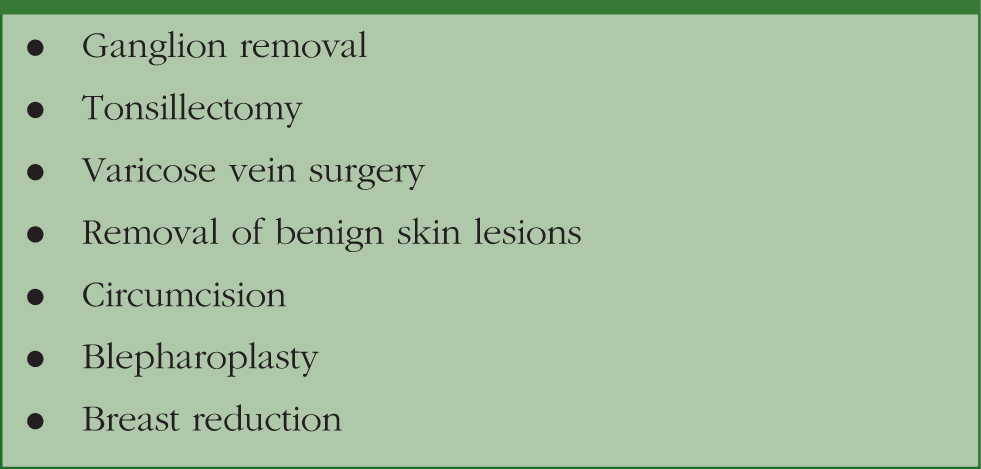
Examples of low priority procedures.