




Abstract

I was once told by a partner that ‘sitting is the new smoking’. Having spent all morning sat down he did his admin standing up. Another partner told me that since starting as a GP he had put on two stone in weight. Traditionally, and perhaps strangely, work as a GP involves sitting down all day.
Indeed, a large proportion of the population’s working lives will be spent sat at a desk, often for up to 7 hours a day. The population is increasingly sedentary at home as well and we know that long periods of sitting are linked with cardiovascular disease, diabetes and cancer. Why then, I thought, if ‘sitting is the new smoking’ do we as GPs sit down all the time? Would it make a difference to our practice if we stood up more? So began my investigation.
How I started standing throughout my consultations happened organically. Each of the rooms I worked in had an adjustable computer stand, which meant I could stand and still read the screen. As I gained confidence, after examining patients, I would then, still standing type up notes. Eventually I got rid of the sitting all together and was standing when the patients came through the door.
Often patients would be a little surprised, head straight to a chair and proceed to take out a list of complaints. Others hovered around me awkwardly and needed prompting to sit. I would do the consultation and type while standing.
‘Do you always do your consultations standing up?’ one patient asked me. ‘I’ve never had a doctor stand before’ said another. ‘Have you hurt your back?’ was one interesting observation. After a brief explanation, most patients agreed it was a good idea.
Reaction from my colleagues was mixed. Some showed fierce resistance, arguing patients wouldn’t like it, but couldn’t give a reason why. I thought I would find out what patients thought about it. I put together a survey asking how they felt about their doctor standing and emailed it to all the patients I had seen over a 3-week period. I also printed off a survey and started handing it out to all my patients for the following 2 weeks and asked them to hand them in at the front desk, along with pens I never saw again.
I asked them the following questions:
Have you recently had a GP appointment where the doctor was standing throughout? Yes/No Did you need to be prompted to sit down? Yes/No Would you have been happy to stand as well? Yes/No/No preference (if no why?) Were you comfortable with the GP standing throughout? Yes/No/No preference Did you feel it had a positive effect on the consultation? Yes/No/No preference Is this the first time you have had a consultation standing up? Yes/No Are you aware of the negative effects of sitting for long periods of time? Yes/No Would you like to see more doctors having the option to stand during the consultation? Yes/No/No preference Any other comments
The overall result can be seen in Figure 1.
Percentage responses of questions 2–7.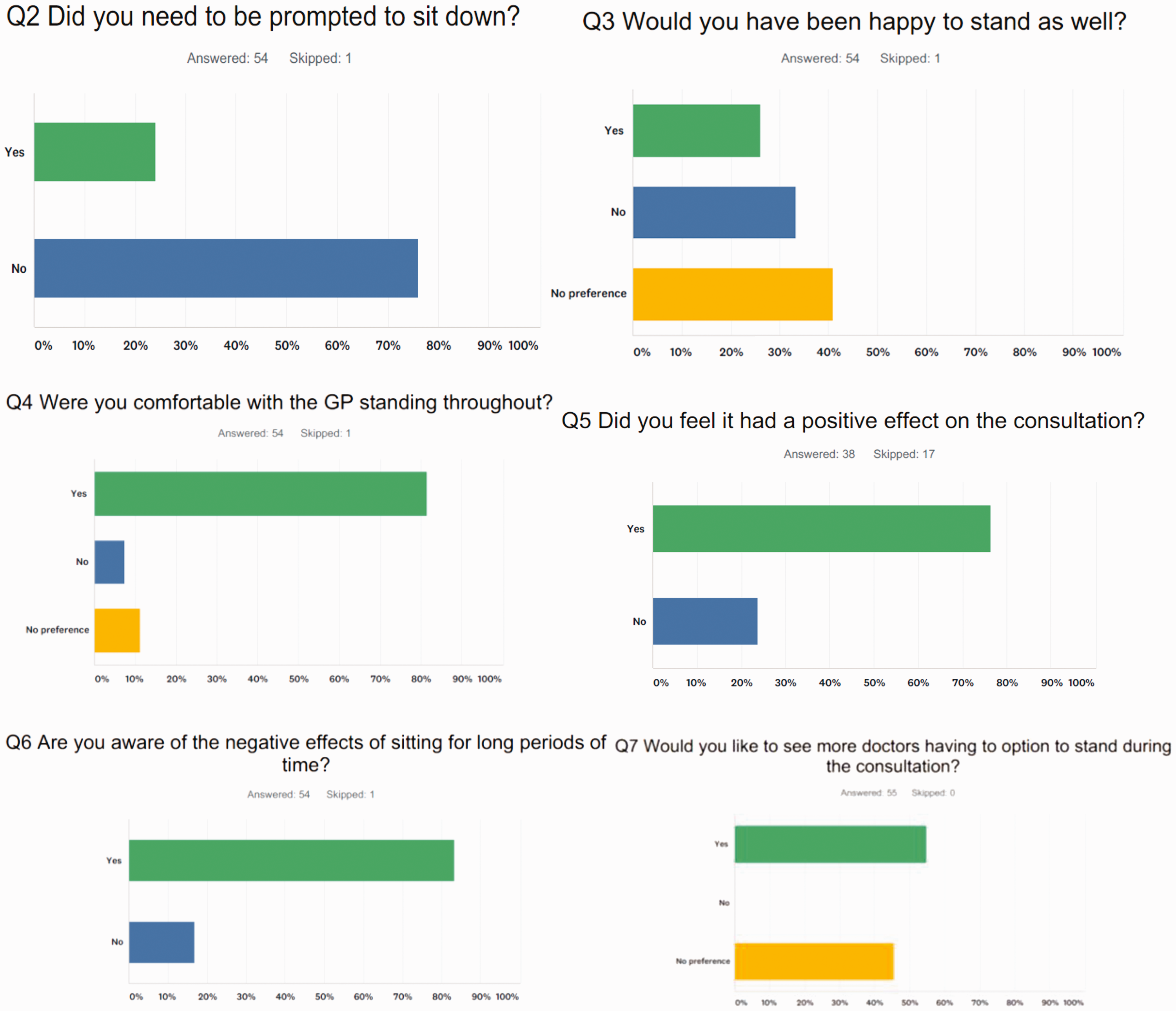
Did you need to be prompted to sit?
Yes 24.07%; No 75.93%
I included this question as I noticed some patients were completely thrown by the whole situation and simply stood in the middle of the room. A large majority (75.93%) took the chair; 24% of people surveyed needed to be prompted to sit down. A quarter of patients required me to ask them to sit, so I began offering them a seat straight away to kill the elephant in the room.
Would you have been happy to stand as well?
Yes 25.93%; No 33.33%; No preference 40.74%
Out of interest, I asked this question. One might assume that patients would prefer to sit, however, the question received a mixture of responses. Perhaps GPs should give patients the option of standing if they wish?
Were you comfortable with the GP standing throughout?
Yes 81.48%; No 7.41%; No preference 11.11%
I was told by many doctors I spoke to that they thought patients would be uncomfortable with a GP standing, however, the results showed the opposite. The clear majority of patients were comfortable with me standing. Quotes from patients included:
‘It was strange at first, as you expect a doctor to be sat down, you soon got used to it’. ‘Only if [the GPs] are comfortable with standing’. ‘I was extremely comfortable with him standing throughout’.
Other patients were more interested in my performance:
‘Did not make a difference to my consultation’. ‘I am only interested in his ability as a doctor’.
However, there were patients who weren’t comfortable who commented thus:
‘The balance of communication felt wrong for me as a patient’. ‘Dr Sherrington was fine but standing is intimidating and makes you feel less important’. ‘Having a doctor stand throughout the consultation, makes you feel as if they don’t have the time to give to patients. It’s very impersonal and they came come across as in a rush and disinterested’. ‘Wondered whether the practice might save time for each consultation, since subconsciously having the GP standing suggests he/she is in a hurry and wants to ‘get on’’.
I didn’t consider at first another possible outcome. Did it make patients focus on only one problem?
Did it have a positive effect on the consultation?
Yes 76%; No 23%
Patients generally seemed to be happy with me standing throughout. Many patients were pleased that I was practising what I preach:
‘Provided a good example to everyone’. ‘It gave me something else to think about’. ‘I thought it was an excellent idea and told the doctor’. ‘It sets a good example, everyone sits down too much and should be encouraged to carry out tasks standing’.
One of the surprising responses was that patients felt that it helped me to focus on them. Maintaining eye contact was better than looking at the computer screen.
‘It compelled the Dr to look at the patient more and establish eye contact. Sometimes I have dealt with some medical professionals who cannot take their eyes off the screen’. ‘I felt that with the doctor standing he was able to concentrate better’.
Many patients were happy for me to do whatever I felt I needed to do provided I was comfortable:
‘Only if they are comfortable with standing’.
Were they aware of the negative effects of sitting?
Yes 83.33%; No 16.67%
Public education on the effects of a sedentary lifestyle is clearly having a large effect, but there is room for improvement.
Would they like more doctors to have the option of standing?
Yes 54.55%; No 0%; No preference 45.5%
No patient felt we shouldn’t have the option to stand, but it seems just under half don’t really mind what we do.
I felt proud of people who responded on message: ‘If I could afford a standing workstation I would have one’.
There were a few other questions to consider with this study
What were these patients coming in for?
If it was for mental health issues or if this was for breaking bad news, sitting might be better for the patient.
Does the patient’s age change the opinion?
I found that some older patients weren’t as happy with me standing as younger patients.
Could how and where I stood affect how the patients feel?
I am not that tall, so standing may have been less intimidating than with a taller doctor.
Seventy-six per cent of patients felt that standing had a positive effect on the consultation and 81% were comfortable with me standing. No patient was against the idea of doctors being given the option of standing. In addition, I felt healthier standing and it possibly helped me focus.
I think that standing consultations should be examined more closely before adopting the practice more widely. A recent study in the BMJ has already shown that standing improves work-related health (Edwardson et al., 2018). One of the best ways to educate about health is by setting a good example. If sitting is the new smoking, then perhaps we should be the first to stub it out.